🏬Supersize Online Funeral Retailer🪦1000's of Headstones⚱️Over 10,000 Cremation Urns⚰️Caskets Overnight Delivery🛒Funeral & Memorial Superstore🚚FREE Shipping on ALL Orders👨👩👧👦Helping Families for over 20 Years💰Lowest Price Guarantee🏬Supersize Online Funeral Retailer🪦1000's of Headstones⚱️Over 10,000 Cremation Urns⚰️Caskets Overnight Delivery🛒Funeral & Memorial Superstore🚚FREE Shipping on ALL Orders👨👩👧👦Helping Families for over 20 Years💰Lowest Price Guarantee
🏬Supersize Online Funeral Retailer🪦1000's of Headstones⚱️Over 10,000 Cremation Urns⚰️Caskets Overnight Delivery🛒Funeral & Memorial Superstore🚚FREE Shipping on ALL Orders👨👩👧👦Helping Families for over 20 Years💰Lowest Price Guarantee🏬Supersize Online Funeral Retailer🪦1000's of Headstones⚱️Over 10,000 Cremation Urns⚰️Caskets Overnight Delivery🛒Funeral & Memorial Superstore🚚FREE Shipping on ALL Orders👨👩👧👦Helping Families for over 20 Years💰Lowest Price Guarantee
A funeral card message is not a sympathy card, and writing one as though it were is the commonest mistake people make.
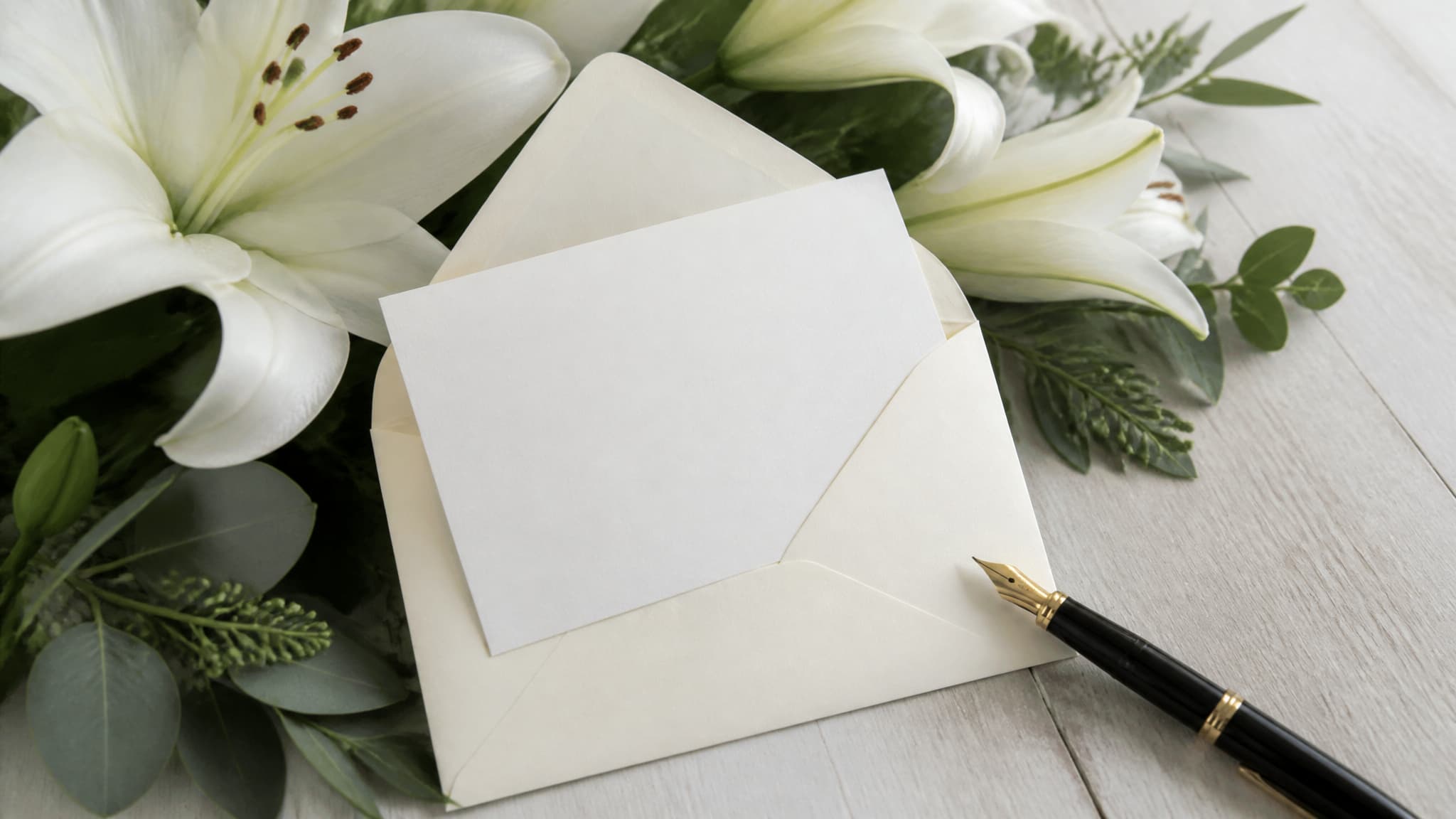
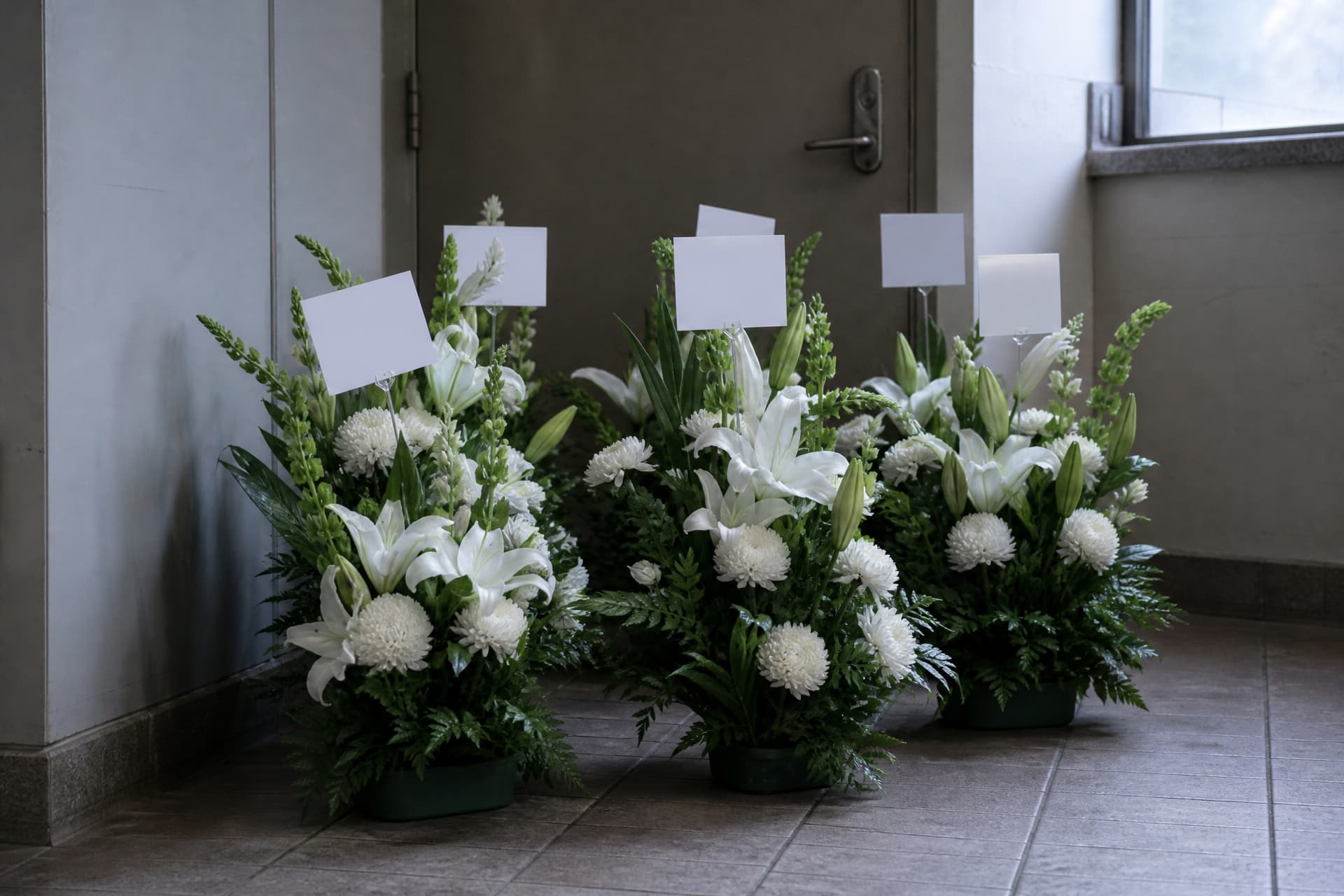
The card attached to funeral flowers is two or three lines on a piece of paper the size of a business card. It will be detached at the funeral home, read aloud or logged by a staff member, and given to the family in a bundle of forty others — often weeks later, when the flowers are long gone and the cards are all that is left.
That changes what it needs to do. It has to be short enough to fit, clear enough that a stranger reading it aloud makes sense, and specific enough that the family knows who you are.
The Rule That Solves Most of It
Say who you are.
The family is receiving cards from their parent's former colleagues, their neighbor's children, people from a church they left in 1994. "With deepest sympathy, Jim and Carol" tells them nothing. "With deepest sympathy — Jim and Carol Petersen, from the Tuesday bridge group" tells them everything, and it is the line they will be glad of in a year.
"He taught me how to do this job, and I have never forgotten it. — Dan Alvarez, Riverside Plant"
"Thinking of you all. She was the kindest manager I ever had. — Priya Shah"
"Forty years of Thursday nights. I'll miss him. — Ron Kestrel, from the darts team"
"With love and so many good memories. — The Hollisters, next door on Maple"
If you know the family but not the deceased
"Thinking of you and your family. — Marie Dubois, Anna's colleague at Fairview"
"With sympathy, from all of us at Greenline. We are thinking of you, Tom."
"So sorry for your loss. Here if you need anything at all. — Sam and Dee Whitlock"
From a company or group
"With deepest sympathy from everyone at Harrow & Sons."
"In loving memory of our colleague and friend. — The Night Shift, Building 4"
"With sympathy from the congregation of St Anne's."
If words are not coming
Short is fine. Nobody has ever received a funeral card and wished it had been longer.
"With deepest sympathy. — Full Name"
"Thinking of you. — Full Name"
"With love. — Full Name"
"In loving memory. — Full Name"
This is where your card arrives and where it is detached. A staff member logs which arrangement came from whom, which is why a first name on its own cannot be traced back to you.
How Long Should It Be?
Fifteen to twenty-five words, including your name. Florist cards are small, and handwriting that shrinks to fit reads as a struggle rather than as care.
If you have more to say, say it in a proper card sent to the house a week or two later — and that is genuinely the better place for it. Our guide to what to write in a sympathy card covers the longer message, which is a different piece of writing entirely.
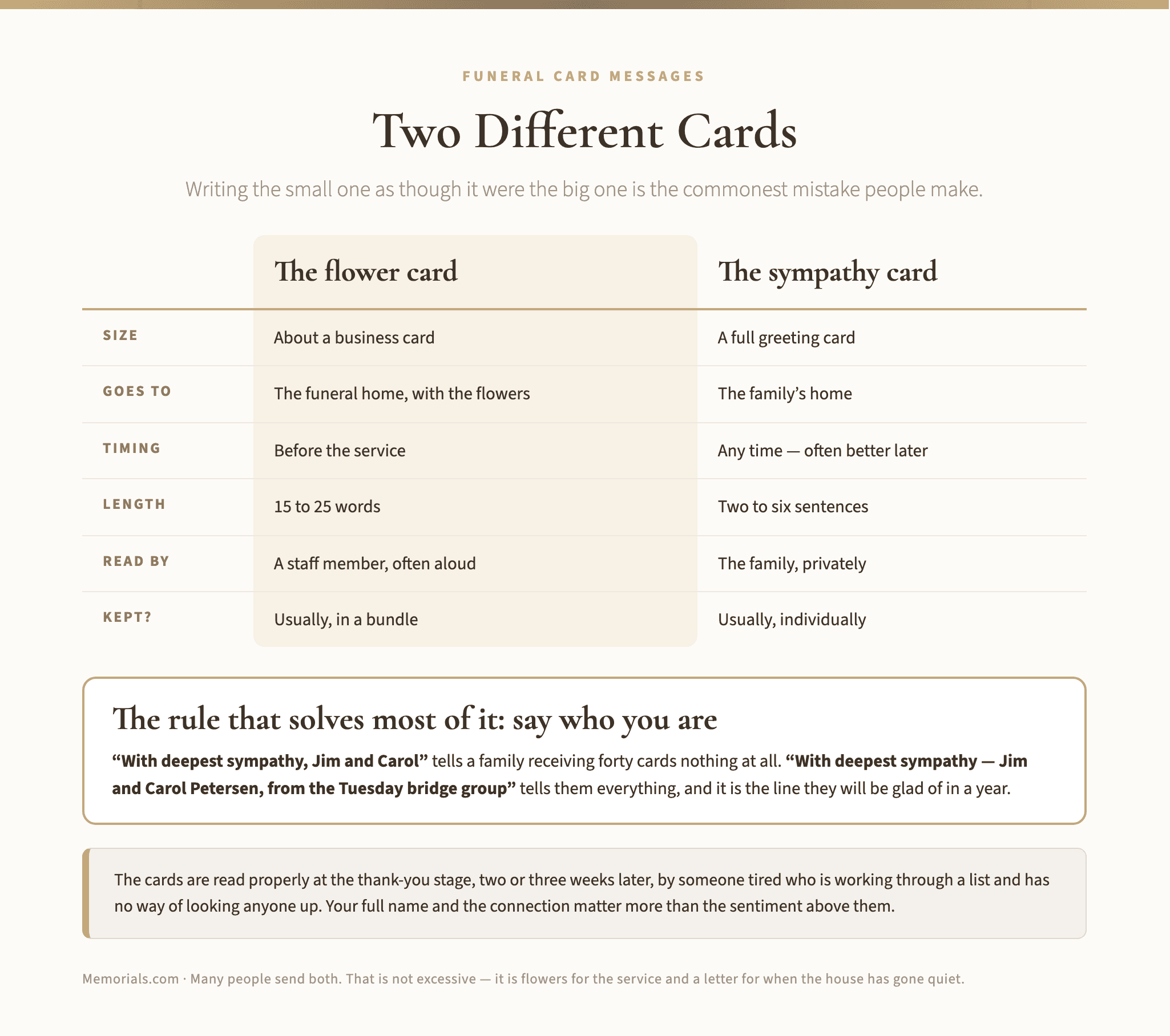
Condolence Card Message vs Funeral Flower Card
These get confused constantly, and the distinction is worth holding.
Flower card
Sympathy card
Size
Business card
Full greeting card
Goes to
Funeral home, with flowers
The family's home
Timing
Before the service
Any time, often better later
Length
15 to 25 words
Two to six sentences
Read by
A staff member, often aloud
The family, privately
Kept?
Usually, in a bundle
Usually, individually
A condolence card message sent to the house can be personal, specific and long. A flower card cannot, because of where it is read and who reads it.
Many people send both. That is not excessive — it is the flowers arriving for the service and the letter arriving when the house has gone quiet, which is when it helps most.
The two get confused constantly. Where a card is read, and by whom, is what decides how it should be written.
What to Avoid
Inside jokes. A stranger will read this aloud in a room of mourners.
Anything about the death itself. "Such a shock", "at least it was quick", "after everything he went through" — none of it belongs on a card that will be read publicly.
Religious language, unless you know. "She's in a better place" is a comfort to some families and an irritation to others. Neutral warmth is safer when you are unsure.
First names only, unless you are certain they will know. This is the single commonest problem with funeral cards.
"Sorry for your loss" alone. It is not wrong, and it is what most people write. Our article on what to say instead has alternatives if you want one, but a signed name matters more than the phrase above it.
Who Signs It
A couple: both first names and a shared surname. "Jim and Carol Petersen."
A family: "The Petersen family" is fine, or list the children if they knew the deceased.
An office: the company name, or the team. If the deceased worked there, a department name is warmer than a company name.
A group of friends: name the group rather than listing everyone. "Your Tuesday walking group" is better than eleven signatures on a card that size.
Memorial Card Message Ideas: The Other Kind of Card
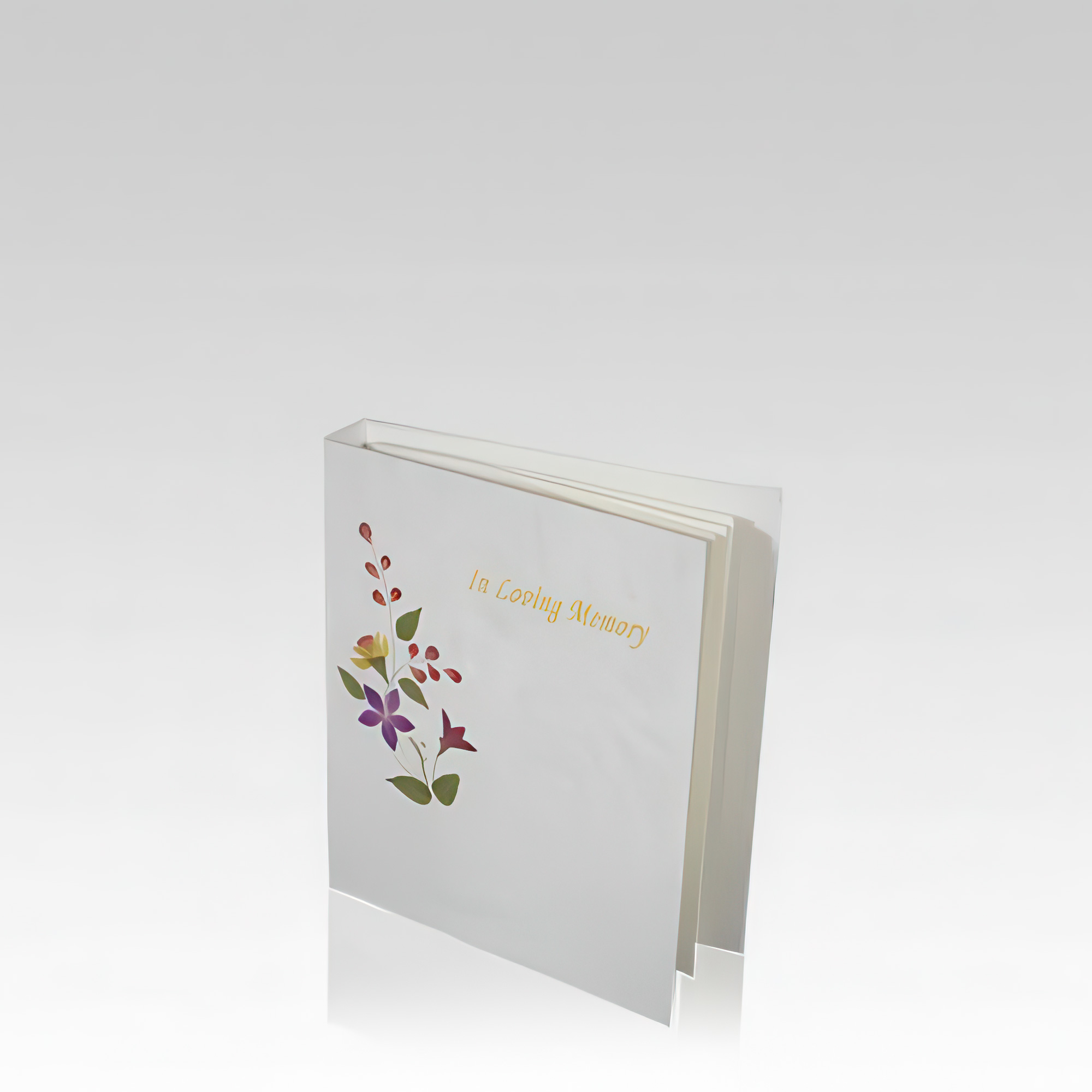
A separate thing, often searched with the same words. Memorial card message ideas usually mean the printed card handed out at the service — a folded card or bookmark with the person's name, dates, a photograph and often a verse or a short poem.
That card is produced by the family rather than sent to them, and the wording follows different conventions entirely. Our guide to celebration of life cards covers what goes on one, and memorial cards covers the printed formats.
If you arrived here looking for that, it is the article you want.
Practical Notes
Order the flowers early enough. Florists need the card message when you order, and staff will write it for you over the phone. Spell your surname out; they will get it wrong otherwise, and a misspelled name on a card kept for years is a small sad thing.
Ask the florist what the card size is. Some are genuinely tiny. If your message will not fit, they will tell you.
If flowers were declined, respect that. "In lieu of flowers" in an obituary usually names a charity, and a donation with a note to the family does the same job. Our guide to in lieu of flowers explains what is expected.
Sending to the funeral home, not the house. Flowers for the service go to the funeral home, addressed with the deceased's name and the service date so staff can match them. Flowers for the family go to the house afterward.
Worth knowing, because it explains why the advice on this page is what it is.
The florist cards are detached at the funeral home, usually by a staff member who logs which arrangement came from whom. The family receives them in a bundle — sometimes on the day, more often a week or two later, occasionally in an envelope nobody opens for a month.
They are read properly at the thank-you stage. Somewhere in the second or third week, someone sits down with the bundle and a list and works out who to write to. That is the moment your card is actually read, by a person who is tired, who is trying to be fair to forty people, and who has no way of looking anyone up.
If your card says "Jim and Carol", they cannot thank you. If it says "Jim and Carol Petersen, from the Tuesday bridge group", they can — and more than that, they learn something about the person they lost.
Families keep these. Not filed and revisited often, but kept — in a box with the order of service and the obituary clipping. Years later they are one of the few surviving records of who that person's life touched.
The family receives them like this — often a week or two later, sometimes in an envelope nobody opens for a month.
If You Have Missed the Funeral
A card that arrives late is not a failed card. It is frequently a better one.
The flowers and cards all arrive in the same three days, and then they stop, abruptly, at exactly the point the family is coming out of the practical phase and into the quiet one. A note arriving in week three or week six lands in an empty space and is remembered disproportionately.
Say nothing about being late. "I have been thinking about you and about David" needs no apology attached, and an apology only makes the recipient reassure you, which is work they do not need.
Funeral Card Messages by Relationship
The connection changes what is appropriate more than the circumstances do.
For a parent of a friend. You are writing to your friend, not about their parent. "Thinking of you this week, and of your mom. — Full Name" is complete. Naming the parent matters; you do not have to have known them.
For a spouse. The surviving spouse will read these repeatedly. Something specific about the couple lands better than sympathy alone: "Forty-one years and they still held hands in the parking lot. Thinking of you, Ellen. — Full Name."
For a child. The hardest card anyone writes. Shorter is better, the child's name should appear, and no attempt at meaning should be made. "We are thinking of you and of Rosie, and we are so very sorry. — Full Name." Avoid anything that sounds like an explanation.
For a colleague. Name the workplace and how long you worked together. The family often does not know what the person's working life looked like, and cards from colleagues are frequently how they find out.
For someone you had lost touch with. Say so plainly. "We had not spoken in years and I regret that. He was a good friend to me when it counted. — Full Name." Families find these genuinely moving rather than awkward.
For a difficult relationship. Honesty without detail. "Thinking of you all at a complicated time. — Full Name" acknowledges what the family already knows without putting it on a card a stranger will read aloud.
Sending to Someone You Work With
The commonest card anybody writes, and the one people agonize over longest.
Write it as a colleague, not as a company. "The team has been thinking about you all week" is warmer than anything on letterhead, and it is more accurate.
Name what they do and how long you have worked together. It gives the family a piece of the person's life they may genuinely not have — people are frequently surprised by who their parent was at work.
Do not mention their return, cover arrangements, or workload. Not one word. Even kindly meant, it reads as pressure.
One card from the team beats eleven separate ones, unless people knew the deceased personally, in which case separate cards are better and the family will read every one.
The moment your card is actually read. Someone tired is working through a list, trying to be fair to forty people, with no way of looking anyone up.
A Note on Handwriting
If you are writing the card yourself rather than dictating it to a florist, write it before you buy the flowers rather than standing at the counter.
Funeral cards are small and unforgiving. There is no room to cross anything out, the pen is usually not yours, and people routinely start too large and end with a cramped signature. Draft the sentence on paper first, count the words, and then copy it.
It sounds fussy. But the card is kept, and the family looks at it again months later when they are writing thank-you notes — which is exactly when they need to be able to read the name.
Frequently Asked Questions
What do you write on a funeral card?
Fifteen to twenty-five words: a brief expression of sympathy, and your full name with how you knew the person or the family. The name and connection matter more than the sentiment.
Do you sign a funeral flower card with your full name?
Yes. The family may be receiving forty cards from people they have never met. First names alone are the commonest reason a card cannot be acknowledged later.
What is appropriate funeral card wording for a colleague?
Name the workplace and the relationship: "With sympathy — the accounts team at Fenwick, where Maria worked for eleven years." It tells the family something they may not know and will value.
Is a funeral card the same as a sympathy card?
No. A funeral card is the small card on flowers, sent to the funeral home, read by staff. A sympathy card is a full card sent to the family's home, and it can be much longer and more personal.
Should I write the card myself or have the florist do it?
Either. Florists transcribe messages routinely and it is entirely normal. Handwriting is warmer where practical, and a message dictated over the phone is not less sincere.
What if I did not know the person who died?
Say so simply and address the family instead: "I did not know your father, but I know how much you loved him. Thinking of you. — Full Name." That is a good card.
In Short
A funeral card message has one job the sender usually overlooks: telling the family who sent the flowers. Get that right and the rest can be four words.
If you want to say more, send a letter to the house two weeks later, when the visitors have stopped coming. That is the one that gets read twice. Our funeral planning guide covers what a family is dealing with in the meantime.