🏬Supersize Online Funeral Retailer🪦1000's of Headstones⚱️Over 10,000 Cremation Urns⚰️Caskets Overnight Delivery🛒Funeral & Memorial Superstore🚚FREE Shipping on ALL Orders👨👩👧👦Helping Families for over 20 Years💰Lowest Price Guarantee🏬Supersize Online Funeral Retailer🪦1000's of Headstones⚱️Over 10,000 Cremation Urns⚰️Caskets Overnight Delivery🛒Funeral & Memorial Superstore🚚FREE Shipping on ALL Orders👨👩👧👦Helping Families for over 20 Years💰Lowest Price Guarantee
🏬Supersize Online Funeral Retailer🪦1000's of Headstones⚱️Over 10,000 Cremation Urns⚰️Caskets Overnight Delivery🛒Funeral & Memorial Superstore🚚FREE Shipping on ALL Orders👨👩👧👦Helping Families for over 20 Years💰Lowest Price Guarantee🏬Supersize Online Funeral Retailer🪦1000's of Headstones⚱️Over 10,000 Cremation Urns⚰️Caskets Overnight Delivery🛒Funeral & Memorial Superstore🚚FREE Shipping on ALL Orders👨👩👧👦Helping Families for over 20 Years💰Lowest Price Guarantee
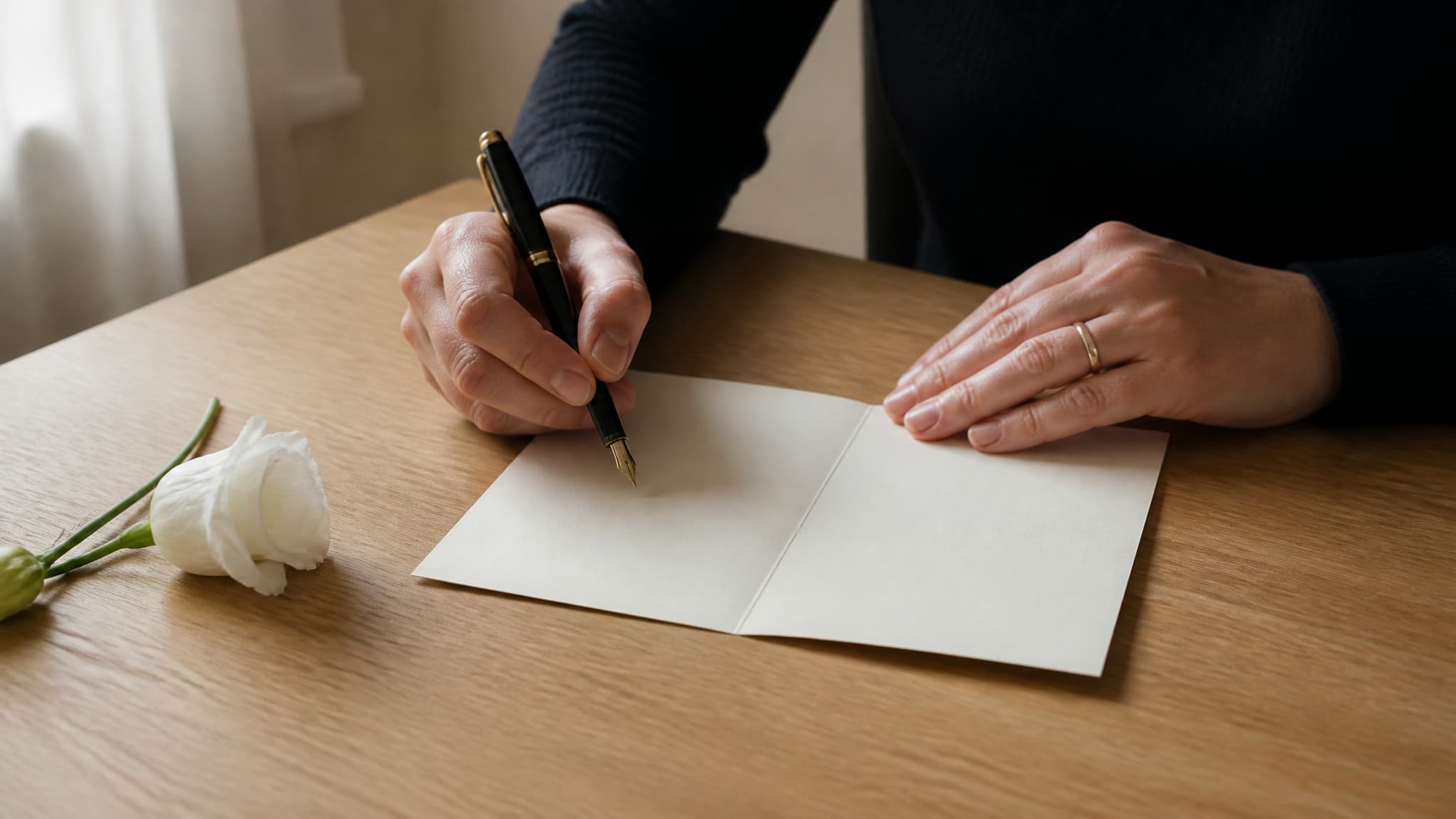
The card is open on the table and you have been staring at it for ten minutes. That is not a failure of caring. It is usually the opposite — sympathy messages feel impossible to write precisely because you want to get it right, and because you are afraid the wrong sentence will make a hard day harder.
Here is the part that helps most: there is no perfect sentence. There are only sincere ones. The people who receive these cards almost never remember the exact wording. They remember that you wrote at all, and that you said their person's name.
Condolences for a loss are easier to write when you stop looking for one universal sentence, so this guide gives you sympathy messages grouped by who you are writing to — a mother, a father, a spouse, a coworker, a friend who lost a pet — because what you can honestly say depends entirely on that relationship. Before those, there is a simple four-part structure that makes almost any message work. After them, the phrases that tend to land badly, and what to write instead.
If you are also sending something alongside the card, the broader questions of timing, tone, and what is appropriate are covered in our guidance on sympathy gift etiquette, and our sympathy gift guide walks through the choices in more depth.
What to Write in a Sympathy Card: The Four-Part Structure
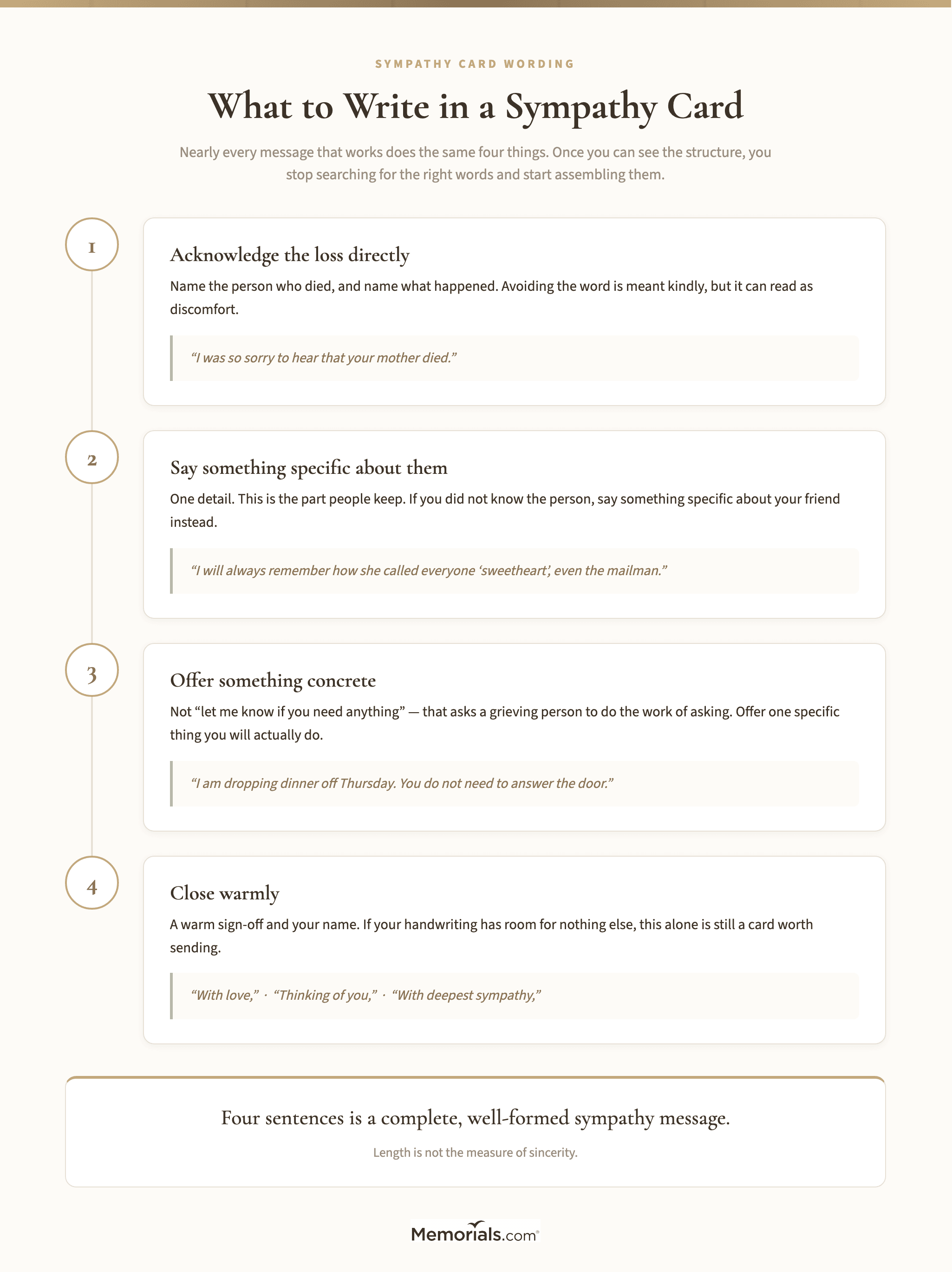
There is no single answer to what to write in a sympathy card, but nearly every message that works does the same four things. Most sympathy card wording problems disappear once you can see the structure — you stop searching for the right words and start assembling them.
1. Acknowledge the loss directly. Name the person who died, and name what happened. Avoiding the word is meant kindly, but it can read as discomfort. "I was so sorry to hear that your mother died."
2. Say something specific about them. One detail. This is the part people keep. "I will always remember how she called everyone 'sweetheart', even the mailman." If you did not know the person, say something specific about your friend instead: "I know how much you looked after her these last two years."
3. Offer something concrete. Not "let me know if you need anything" — that asks a grieving person to do the work of asking. Offer one specific thing you will actually do. "I am dropping dinner off Thursday. You do not need to answer the door."
4. Close warmly."With love," "Thinking of you," "With deepest sympathy," and then your name. If your handwriting has room for nothing else, this alone is still a card worth sending.
That is it. Four sentences is a complete, well-formed sympathy message. Length is not the measure of sincerity — a short card sent this week is worth more than a long one you are still not ready to write next month.
Sympathy Messages by Relationship
The right words change depending on who died and who you are to the person reading. The sympathy card messages below are written to be adapted, not copied — swap in the name and the detail that is true for you.
Most of the relationships below now have a page of their own carrying fifty or more messages, linked from each section, and our guide to condolences is where they all start.
Loss of a Mother
A mother's death is often the first loss that reorders someone's whole sense of home. Acknowledge that scale without dramatizing it.
"I was so sorry to hear about your mom. She had a way of making everyone feel like they belonged in her kitchen. I am thinking of you this week and the next."
"There is no replacing a mother. I hope you are letting people look after you the way she would have."
"Your mom talked about you constantly, and always with such pride. I wanted you to know that."
"I do not have the right words for losing your mother. I just did not want to say nothing."
Fifty more, sorted by how well you knew her and by what you are able to say, are on our page of condolences for loss of mother.
Loss of a Father
Fathers are frequently mourned in practical language — what he built, fixed, taught, showed up for.
"Your dad taught half this street how to change a tire. I thought of him the moment mine went flat last week, and I will keep thinking of him."
"I am so sorry about your father. He was the steadiest person in any room he walked into."
"Losing a dad is its own kind of quiet. Take whatever time you need — the rest of it will keep."
"He was proud of you. He said so, to me, more than once."
If you knew him, one concrete thing he did is worth more than any of the lines above. A sympathy message for loss of father has sixty more, including the one sentence people say to sons that lands as a weight rather than a comfort.
Loss of a Spouse or Partner
This is the loss where "I understand" is most likely to be wrong, and where practical help matters most.
"I cannot imagine what this week has been. I am not going to pretend to. I am here, and I will keep being here after everyone else goes home."
"Forty-one years. What a thing to have had. I am so sorry it ended."
"I will call on Sunday. You do not have to pick up — I will just keep calling."
"You two were the reason I believed in it. I am so sorry, and I love you both."
The hardest part of this one is not the card, it is March — when the casseroles have stopped and the house is quiet. Condolences for loss of husband or wife covers the two dates nobody else marks, and the sentence that stings most.
Loss of a Child
Write briefly, name the child, and do not reach for meaning. There is no consolation to offer here, and attempting one is the most common way these cards go wrong.
"There are no words for this. I am so deeply sorry. We loved Aiden too."
"I am holding you both. I will say her name whenever you want to hear it."
"I am not going to try to make sense of this. I am just going to be here."
There is more to say about what not to write here than what to write. A sympathy message loss of child covers the phrases that wound, miscarriage and stillbirth, and the surviving siblings nobody writes to.
Loss of a Brother or Sister
The most overlooked mourner in the house. A brother or sister is asked how their parents are holding up, often at the funeral and often repeatedly, and almost nobody asks how they are. Ask them.
"I keep thinking about your brother, and I keep thinking about you. Not your mom and dad — you."
"You two had a whole world nobody else was in. I am so sorry it is only yours now."
"I know everyone is asking about your parents. How are you?"
They have also lost the only other person who remembers the house, the grandparents, and the version of their parents nobody else saw. Each side has a page of its own: a condolence message for loss of brother, and for the sister who was holding the family together, loss of a sister.
Loss of a Grandparent
Two people are grieving here and the messages nearly all go to one of them. Your friend has lost a grandmother; their parent has lost their mother, and is being treated as the organizer of the funeral rather than as somebody bereaved.
"So sorry about your grandma. I still think about her shortbread. Thinking of all of you."
"I know you have lost your mom as well as Sam's grandmother. Thinking of you."
"Three generations are missing her today. I am so sorry."
Send two — one to your friend and one to their parent, even if you barely know them. A condolence message for loss of grandmother covers both, and why leaving her age out of it matters.
Loss of a Friend
You may be grieving alongside the reader rather than consoling them, and it is fine to say so.
"We lost a good one. I keep reaching for my phone to tell her something. I am so sorry, for both of us."
"Thirty years of friendship does not just stop. I would love to hear your stories about him when you are ready."
A friend also has latitude the family does not — you can say the honest thing rather than the correct one. What to say to a friend who lost a loved one covers the jobs only a friend can take, and month six, when everyone else has stopped asking.
Loss of a Coworker or Colleague
Keep it warm but appropriately bounded — sincere, not familiar beyond what the relationship holds.
"I was very sorry to hear about Dan. He made the early shift genuinely enjoyable, which is no small thing. The team is thinking of you all."
"On behalf of everyone here — we are so sorry. Please do not think about work for a single minute."
The constraint at work is the workplace, not the loss. A condolence message for coworker covers writing on behalf of a team, what to say when they come back, and how much warmth suits your level.
Loss of a Pet
Never qualify it. "Only a dog" has no place on a sympathy card, and the grief is frequently as sharp as any other.
"I am so sorry about Rosie. Fourteen years is a whole era of your life, and she was in every part of it."
"He was a very good boy and he was very well loved. I am so sorry."
Grief for an animal runs on the same timeline as any other and is routinely given a fraction of the room. Grieving the loss of a pet is the page to pass on to someone apologizing for how hard they are taking it.
Who you are writing to shapes what you write.
Short Sympathy Messages When You Do Not Know What to Say
Sometimes the relationship is distant, or the card is going around an office, or you simply cannot find more than a line. A short sympathy note is not a lesser message. A one-line note on a sympathy card that names the person outlasts a paragraph that does not.
"Thinking of you and your family."
"So very sorry for your loss."
"Holding you in my thoughts this week."
"With deepest sympathy from all of us."
"She will be missed here."
"No words — just love."
If a single line is all you have, sign your full name. In a stack of cards, "Kate" is a guess; "Kate from the Tuesday choir" is a memory. If none of these fit, short sympathy messages of your own are always better than a borrowed one that does not sound like you.
A short message, sincerely meant, is enough.
Phrases to Avoid — and What to Say Instead
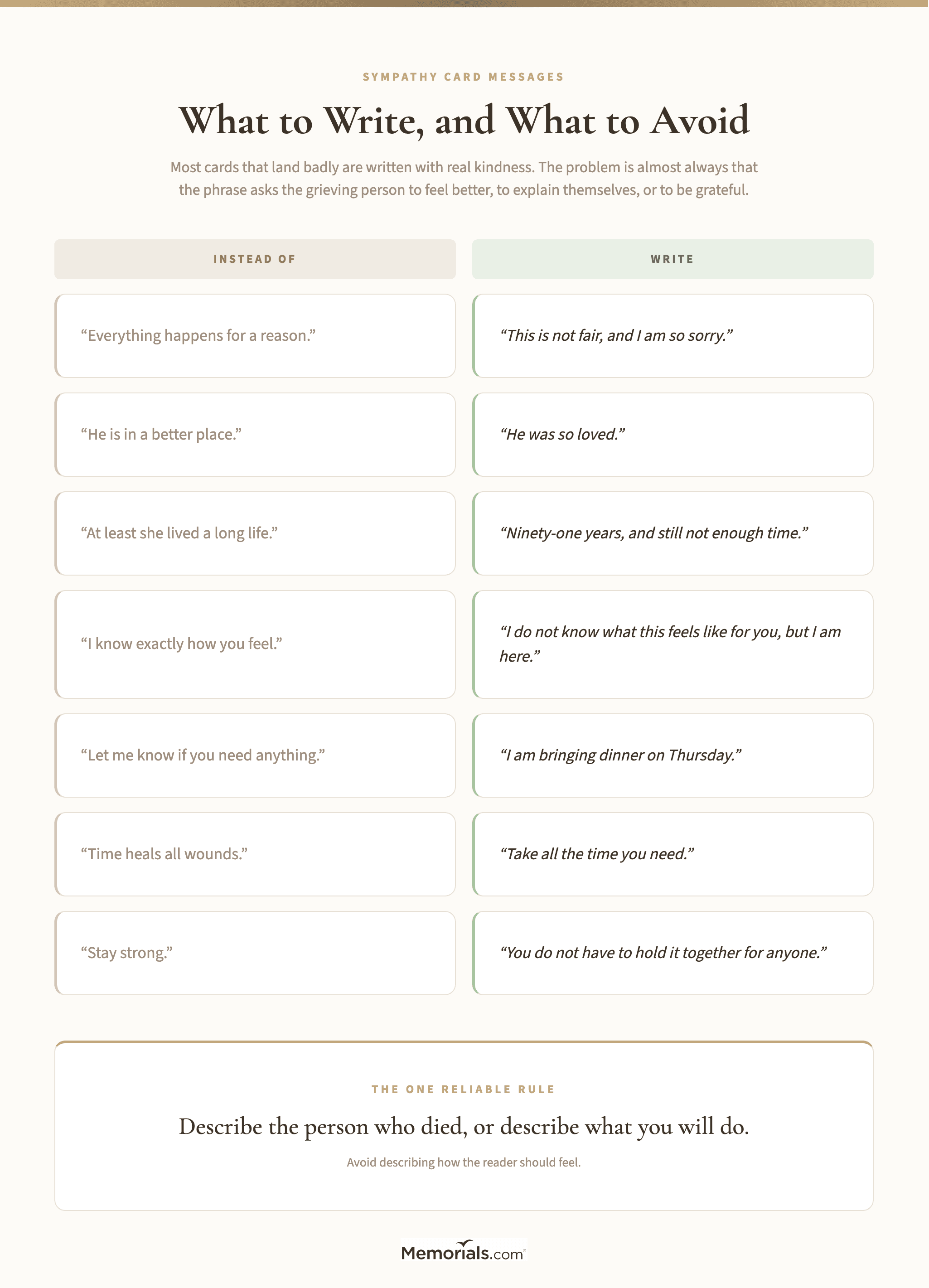
Most cards that land badly are written with real kindness. The problem is almost always that the phrase asks the grieving person to feel better, or to explain themselves, or to be grateful. The things to say in condolence cards are nearly always smaller and more specific than the ones people reach for; there is no single best phrase for sympathy, only a true sentence about this person. Here is what to reach for instead.
"Everything happens for a reason." This asks someone to accept that their loss was necessary. Write instead: "This is not fair, and I am so sorry."
"He is in a better place." Fine when you know the family shares that belief; painful when you do not. Write instead: "He was so loved."
"At least she lived a long life." Any sentence starting with "at least" is a comparison, and grief does not respond to comparisons. Write instead: "Ninety-one years, and still not enough time."
"I know exactly how you feel." You may be close, but you are not inside it. Write instead: "I do not know what this feels like for you, but I am here."
"Let me know if you need anything." Well meant, and almost never taken up. Write instead: "I am bringing dinner on Thursday."
"Time heals all wounds." It does not, quite, and it is not comforting on day four. Write instead: "Take all the time you need."
"Stay strong." This asks the bereaved to perform composure for other people's comfort. Write instead: "You do not have to hold it together for anyone."
The single most reliable rule: describe the person who died, or describe what you will do. Avoid describing how the reader should feel. If you want alternatives, knowing what to say instead of sorry for your loss usually comes down to naming something specific rather than reaching for a better formula.
Choosing the Card Itself
The card is part of the message, and a small amount of care here is noticed.
Handwrite it. Always, even if your handwriting is poor and the message is three lines. A printed card with a signature reads as an obligation met; a handwritten one reads as time spent.
Choose restraint over sentiment. Cards with long printed verses leave you writing in the margins of someone else's words. Plainer memorial cards give you room to say your own thing, which is the part that matters.
Send it when you remember. Within two weeks is customary. Later than that is still worth sending, and often lands better — the cards stop arriving around week three, and that is frequently when the house goes quiet and the loss gets heavier.
Sign for yourself, not for the household, unless everyone actually contributed a line. "The Harpers" from a family who all knew the person is warm. "The Harpers" when only one of you wrote it is a card from nobody in particular.
Choosing the card: paper, weight and color all set a tone.
Pairing a Card With a Gift
A card alone is complete and always appropriate. But if you want to send something with it — particularly for a close friend, or when you live too far away to help in person — the card becomes the part that explains the gift.
Keep the note simple when something accompanies it. "A small thing to keep her close. Thinking of you." is enough; the object does not need justifying.
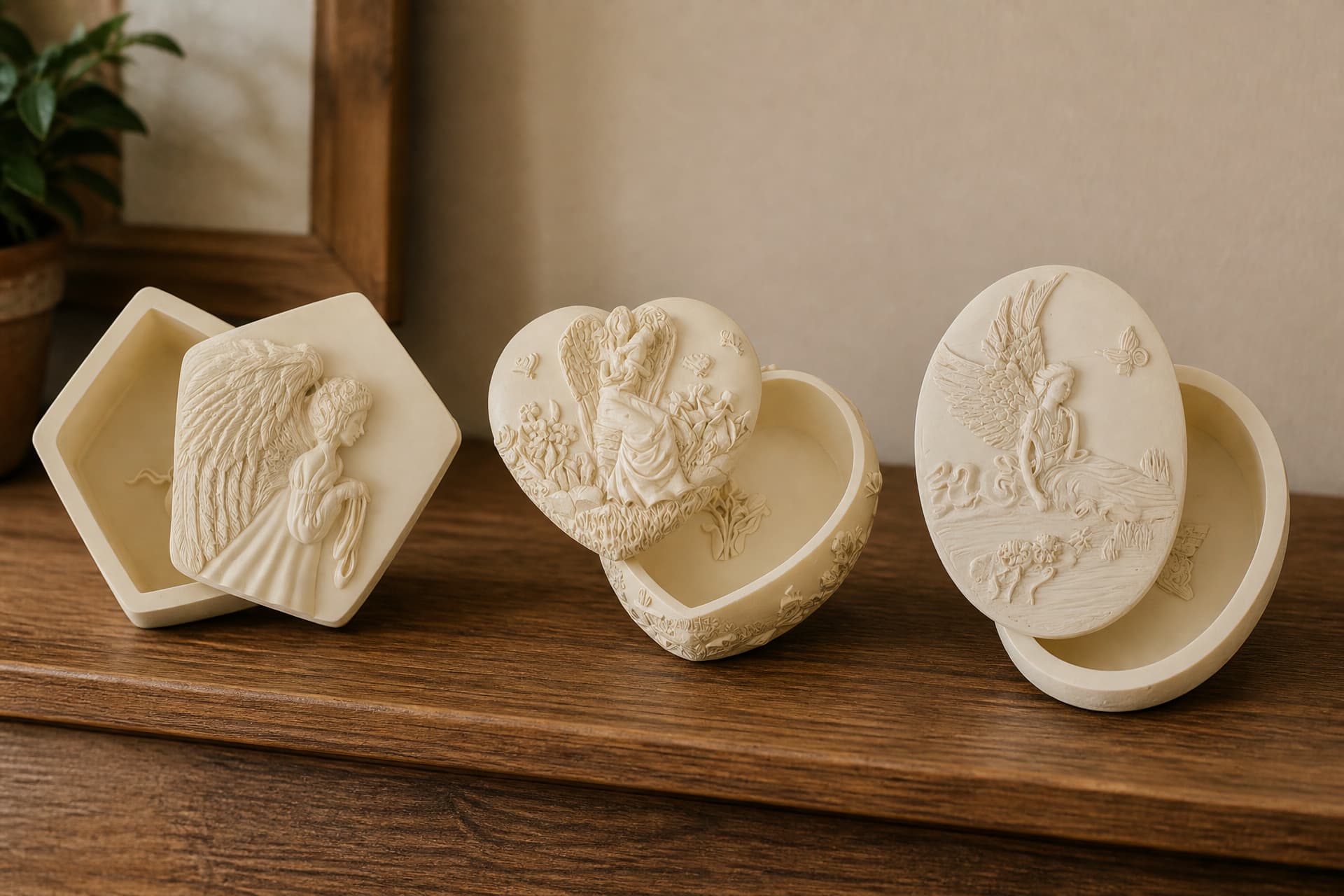
Practical support tends to be received better than decorative gestures in the first two weeks: meals, a cleaning service, someone to handle the phone. Later, when the casseroles have stopped, a lasting keepsake often means more than it would have at the funeral. Our range of sympathy gifts is organized with that timing in mind.
It is also worth knowing which gestures tend to misfire — some very common choices create work or discomfort for a grieving family, and we have covered them in what not to send as a sympathy gift.
Frequently Asked Questions
What do you write in a sympathy card if you did not know the person well? Write about the person you do know — the one reading it. "I never had the chance to meet your father, but I have heard you talk about him for years, and I am so sorry." Honesty about the distance is better than inventing a closeness you did not have.
Is it okay to send a sympathy card weeks later? Yes, and it is often the more useful card. Acknowledge the delay in one line without apologizing at length: "I have been thinking of you since I heard, and I am sorry it has taken me this long to write." Cards arriving in week five reach someone at a much lonelier point than cards arriving in week one.
Should you sign a sympathy card from the whole family? Only if the whole family had a relationship with the person or with the bereaved. Otherwise sign individually — a specific name gives the reader someone to picture, and someone to reply to if they ever want to.
What is the difference between a sympathy card and a condolence card? In practice, nothing — and the same goes for a bereavement card. The label on the packet changes; the writing does not. What to write on a condolence card, what to write in a bereavement card and what to write in a sympathy card are one question with one answer: name the person, say one specific thing, offer one concrete thing. "Condolence" is slightly more formal and more common outside the United States, and "sympathy" is what you will see on most cards in a US shop. Either word is correct on the card and in the message.
How long should a sympathy message be? Two to four sentences is the sweet spot. Long enough to say the person's name and one specific thing about them; short enough that you actually finish and post it.
In Closing
Write the card badly rather than not at all. That is the whole of it.
The people who receive these are not grading your prose. They are counting who showed up, and a card is a way of showing up from wherever you are. Say the name, say one true thing, offer one concrete thing, and sign it. If you manage nothing more than "So sorry. Thinking of you," and your name — that card still gets kept in a drawer, and read again in six months, and it still helps.