🏬Supersize Online Funeral Retailer🪦1000's of Headstones⚱️Over 10,000 Cremation Urns⚰️Caskets Overnight Delivery🛒Funeral & Memorial Superstore🚚FREE Shipping on ALL Orders👨👩👧👦Helping Families for over 20 Years💰Lowest Price Guarantee🏬Supersize Online Funeral Retailer🪦1000's of Headstones⚱️Over 10,000 Cremation Urns⚰️Caskets Overnight Delivery🛒Funeral & Memorial Superstore🚚FREE Shipping on ALL Orders👨👩👧👦Helping Families for over 20 Years💰Lowest Price Guarantee
🏬Supersize Online Funeral Retailer🪦1000's of Headstones⚱️Over 10,000 Cremation Urns⚰️Caskets Overnight Delivery🛒Funeral & Memorial Superstore🚚FREE Shipping on ALL Orders👨👩👧👦Helping Families for over 20 Years💰Lowest Price Guarantee🏬Supersize Online Funeral Retailer🪦1000's of Headstones⚱️Over 10,000 Cremation Urns⚰️Caskets Overnight Delivery🛒Funeral & Memorial Superstore🚚FREE Shipping on ALL Orders👨👩👧👦Helping Families for over 20 Years💰Lowest Price Guarantee
When a coworker loses someone they love, the professional relationship you share doesn't erase the very real impulse to help. You see this person every day — at meetings, in the break room, across a shared calendar — and the loss they're carrying into the office deserves acknowledgment. The challenge is finding a sympathy gift that feels genuine without overstepping the boundaries of a professional relationship. If you need broader guidance on choosing a meaningful sympathy gift for any situation, our complete guide covers every relationship and occasion. This article focuses specifically on the workplace — where the rules are a little different, and getting the tone right matters.
The good news: you don't need an expensive or elaborate gift to make a real difference. A well-chosen condolence gift for a colleague communicates something simple and powerful — That message lands whether it comes from you alone or from a group of coworkers pooling together.
Choosing a bereavement gift for a colleague isn't the same as selecting one for a close friend or family member. Professional relationships carry their own boundaries, and a gift that would be perfect for a sister-in-law might feel too personal — or too impersonal — for someone you sit three cubicles away from. Understanding sympathy gift etiquette guidance specific to workplace settings helps you avoid missteps.
Three factors should guide every workplace sympathy gift decision:
The depth of your relationship. Are you close enough to know their favorite coffee order, or do you mainly interact in group meetings? A deeper personal bond opens the door to more personalized gifts, while a cordial professional relationship calls for something universally appropriate — a sympathy card with a heartfelt note, a comfort food basket, or a potted plant.
The type of loss. A coworker who lost a parent faces a different kind of grief than one navigating a miscarriage, a divorce, or the death of a pet. The gift should acknowledge the magnitude of the loss without making assumptions about how they're processing it.
Company culture and norms. Some offices pass an envelope and collect for a group gift. Others rely on individuals to express condolences privately. Understanding your workplace's existing customs — and working within them — ensures your gesture feels supportive rather than awkward.
Individual Gift Ideas That Strike the Right Tone
When you're choosing a sympathy gift on your own, aim for something that communicates warmth without requiring an intimate knowledge of the recipient's personal life. The best individual gifts for a grieving coworker tend to fall into a few categories.
Comfort and Self-Care Gifts
Grief is physically exhausting. A coworker returning from bereavement leave may be running on little sleep, skipping meals, and carrying tension they can't set down at the office door. Self-care gifts offer a small invitation to pause.
A care package with herbal tea, a scented candle, a soft throw blanket, or bath products can be assembled for under $40. You can also purchase a pre-made comfort box — many online retailers curate these specifically for bereavement. A set of worry stones offers a quieter, more personal form of comfort: something your coworker can hold during a hard moment at their desk without drawing attention.
If you know the coworker well enough, a gift card for a massage, spa treatment, or yoga class gives them permission to do something restorative for themselves.
Food and Meal Gifts
Food has a long history as a condolence offering, and for good reason — cooking is often the last thing a grieving person has energy for. A gourmet gift basket with artisanal snacks, dried fruit, chocolate, and crackers provides nourishment that doesn't require preparation. If you prefer something more substantial, a meal delivery gift card (DoorDash, Uber Eats, or a local restaurant the coworker enjoys) removes the burden of planning dinner during the hardest weeks.
One practical consideration: if you're sending food to the office, choose items that are easy to eat at a desk or take home — individually packaged snacks, baked goods, or a fruit arrangement. Avoid anything that requires refrigeration or elaborate assembly.
Memorial Keepsakes
A lasting keepsake can mean a great deal, though this category works best when you have some knowledge of the coworker's taste. Wind chimes with a memorial inscription, a small memorial keepsakes piece like a remembrance ornament or figurine, or a memory box where they can store photos and small mementos are all appropriate. These gifts work well for a coworker you've built a genuine friendship with over the years.
For a slightly more personal touch, memorial cards or prayer cards offer a traditional way to honor the person who passed. These are especially fitting when you plan to attend the funeral or memorial service.
Books and Journals
A grief journal with guided prompts can help a coworker process emotions they may not feel comfortable expressing at the office. A carefully selected book on loss and healing — chosen based on the coworker's personality rather than a generic bestseller list — shows that you put thought into the gesture. If you're unsure what to pick, a blank journal with a quality cover and a brief note saying "for whenever you need it" keeps the gift open-ended and pressure-free.
Group Gifts: Pooling Resources from the Team
In many offices, coworkers collect contributions for a shared gift. Group gifts carry a few advantages — they allow you to offer something more substantial than any individual might afford, they show collective support, and they take the pressure off any one person to choose the "right" thing.
How to Organize an Office Collection
Assign one person (often someone in HR, an office manager, or a close colleague of the bereaved) to coordinate. A simple email or Slack message — "We're collecting for [name]. If you'd like to contribute, you can Venmo/give cash to me by Friday" — keeps it low-key and avoids pressuring anyone. Contributions should always be voluntary, and no one should feel their amount is being judged.
Once collected, the fund can go toward a single meaningful gift, a combination of items, or a donation to a charity the bereaved cares about. A charitable donation in the name of the deceased is especially appropriate when you don't know the coworker well enough to choose a personal gift — and it sidesteps the risk of selecting something that doesn't fit their taste.
Scaling Gifts to the Budget
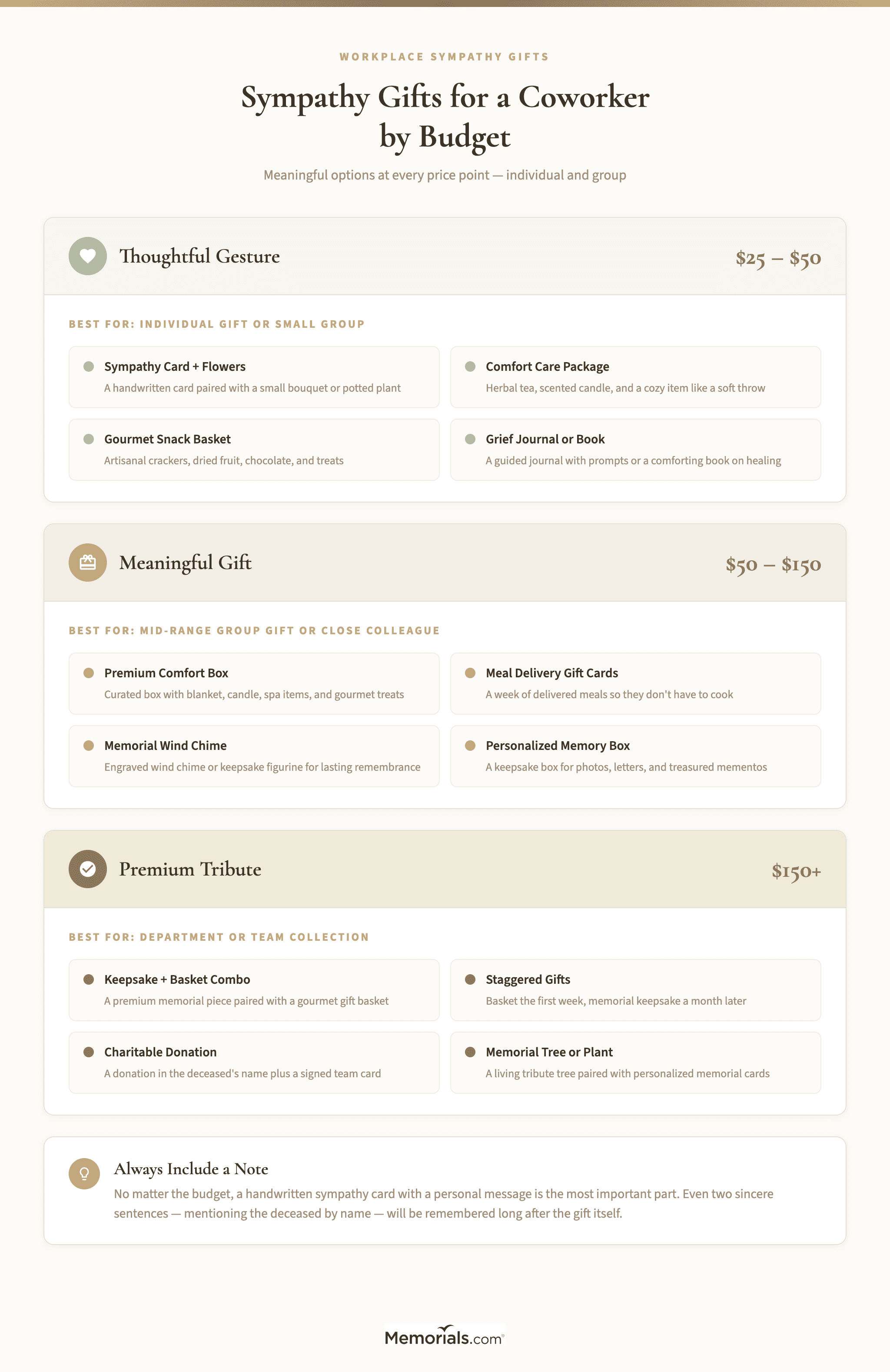
For smaller office collections ($25–$50), a tasteful sympathy card signed by the team paired with flowers or a small plant is perfectly appropriate. For mid-range budgets ($50–$150), consider a comfort care package, a delivered meal service for a week, or a curated gift basket. Larger collections ($150+) open the door to premium keepsakes, a personalized memorial piece, or a combination gift — for example, a gourmet basket delivered the first week and a memorial keepsake delivered a month later as a reminder that the team hasn't forgotten. For a more detailed breakdown of options at each price tier, see our guide to budget-friendly sympathy gifts.
What to Avoid: Workplace Gift Pitfalls
The professional context that makes workplace sympathy gifts unique also creates a few traps worth sidestepping. Even well-intentioned gifts can miss the mark if they cross a line the recipient didn't expect — and in a work setting, gifts that miss the mark can create lasting awkwardness.
Overly personal gifts. A piece of jewelry, clothing, or anything that implies an intimate knowledge of the coworker's body or personal habits can feel invasive. Save these for close friends or family.
Religious items (unless you're sure). A devotional book, rosary, or religious figurine may be deeply meaningful — but only if you know the recipient shares that faith. When in doubt, choose something secular. If you're aware of the coworker's religious background, a sympathy gift that honors their tradition shows genuine respect.
Alcohol. A bottle of wine might be a standard corporate gift for celebrations, but it's a risky choice for bereavement. You may not know the recipient's relationship with alcohol, and the connotation can feel off.
Generic "thinking of you" gifts without a note. A gift without any personal message — even a brief one — can feel transactional. Always include a handwritten sympathy note, even if it's just a few sentences. "I'm so sorry for your loss. Thinking of you during this time" is enough.
Nothing at all. Silence is the biggest pitfall. Many coworkers avoid saying or doing anything because they're afraid of saying the wrong thing. A simple sympathy card with a sincere sentence or two is better than avoidance.
The Sympathy Card: Often the Most Important Part
Whether you send a card on its own or attach one to a gift, the condolence message inside matters more than most people realize. In a professional relationship, your note should be genuine but measured — you're not writing a eulogy, and you don't need to share a personal grief story of your own.
A few guidelines for sympathy notes to a coworker:
Keep it brief and sincere. Two to four sentences is sufficient. "I was so sorry to hear about your mother's passing. She was clearly someone special, and I know this is an incredibly difficult time. Please know that we're here for you whenever you're ready" covers the essentials without overreaching.
Mention the deceased by name if you know it. This small detail shows that you see the loss as specific, not generic.
Avoid platitudes like "everything happens for a reason" or "they're in a better place." These rarely land well, even when meant kindly.
Offer something concrete if you can. "I'd be happy to cover your Wednesday client calls while you're out" means more than "let me know if there's anything I can do."
Supporting a Coworker Beyond the Gift
A sympathy gift is a starting point, not a finish line. Grief doesn't follow a schedule, and many coworkers report that the hardest days come weeks or months after the funeral — when the office has moved on but they haven't. Dealing with grief at work is one of the less-discussed challenges of bereavement, and your ongoing awareness can matter more than any single gesture.
Check in gently after they return. A brief "How are you holding up?" in a private setting (not in the middle of a team meeting) gives them space to answer honestly without performing for an audience.
Remember significant dates. If you know the anniversary of the loss or the deceased's birthday, a simple text or note around that time — "Thinking of you today" — can mean the world. Holidays are particularly tough; many grieving people dread the first Thanksgiving, Christmas, or Mother's Day without their loved one.
Respect their pace. Some coworkers want to talk about their loss. Others want the office to feel like a grief-free zone where they can focus on something other than sadness. Follow their cues rather than pushing conversation.
Be patient with performance changes. Grief affects concentration, memory, and energy. A colleague who was previously sharp and reliable may struggle for weeks or months. Offering quiet support — picking up a task, covering a meeting, not commenting on missed deadlines — is a gift no store sells.
Cultural and Religious Considerations
Not all grief looks the same, and not all cultures mark loss in the same way. If your coworker comes from a cultural or religious background different from your own, a little research goes a long way.
In some traditions, white flowers are associated with mourning, while in others, specific colors carry symbolic weight. Certain faiths observe mourning periods with particular customs — Jewish shiva, for example, traditionally involves bringing food to the mourning family rather than flowers. Hindu traditions may emphasize charitable giving over material gifts. Muslim customs often focus on practical support and prayers rather than physical gifts.
When you're unsure, ask a mutual colleague who shares the bereaved person's background, or simply ask the coworker themselves: "I want to be respectful of your traditions — is there a way I can best show my support?" Most people appreciate the question far more than a well-meaning but misguided gesture.
Frequently Asked Questions
How much should I spend on a sympathy gift for a coworker?
There's no fixed amount, and the price of a gift has little correlation with its impact. An individual gift in the $15–$50 range is appropriate for most professional relationships. Group gifts from a team or department may total $50–$200 depending on the number of contributors. A heartfelt sympathy card with no accompanying gift is perfectly acceptable and often preferred over an expensive but impersonal item.
Is it appropriate to send a sympathy gift to a coworker's home?
Yes, especially if the coworker is on bereavement leave and won't be in the office to receive it. Sending a gift or card to their home shows that your concern extends beyond the workplace. If you don't have their home address, a colleague or HR contact may be able to help — or you can send the gift to the office for them to receive when they return.
Should I send a sympathy gift if I barely know the coworker?
A sympathy card signed by the team is always appropriate, regardless of how well you know the person. If your office is collecting for a group gift, contributing a few dollars and signing the card is a thoughtful way to participate without feeling like you're overstepping. Even a brief email expressing your condolences can make a difference.
When is the right time to give a sympathy gift?
The best time is within the first week after you learn of the loss. Prompt gestures feel more genuine than delayed ones. That said, a gift or card that arrives a few weeks later isn't too late — it actually serves a valuable purpose, reminding the coworker that they haven't been forgotten after the initial wave of condolences subsides.
Can I send sympathy gifts as a group if our coworker lost a pet?
Absolutely. Pet loss is a significant form of grief, and many people feel it deeply even when others minimize it. A sympathy card acknowledging the loss, a small memorial keepsake, or even a framed paw print are all appropriate. The key is to validate the loss rather than dismiss it.