🏬Supersize Online Funeral Retailer🪦1000's of Headstones⚱️Over 10,000 Cremation Urns⚰️Caskets Overnight Delivery🛒Funeral & Memorial Superstore🚚FREE Shipping on ALL Orders👨👩👧👦Helping Families for over 20 Years💰Lowest Price Guarantee🏬Supersize Online Funeral Retailer🪦1000's of Headstones⚱️Over 10,000 Cremation Urns⚰️Caskets Overnight Delivery🛒Funeral & Memorial Superstore🚚FREE Shipping on ALL Orders👨👩👧👦Helping Families for over 20 Years💰Lowest Price Guarantee
🏬Supersize Online Funeral Retailer🪦1000's of Headstones⚱️Over 10,000 Cremation Urns⚰️Caskets Overnight Delivery🛒Funeral & Memorial Superstore🚚FREE Shipping on ALL Orders👨👩👧👦Helping Families for over 20 Years💰Lowest Price Guarantee🏬Supersize Online Funeral Retailer🪦1000's of Headstones⚱️Over 10,000 Cremation Urns⚰️Caskets Overnight Delivery🛒Funeral & Memorial Superstore🚚FREE Shipping on ALL Orders👨👩👧👦Helping Families for over 20 Years💰Lowest Price Guarantee
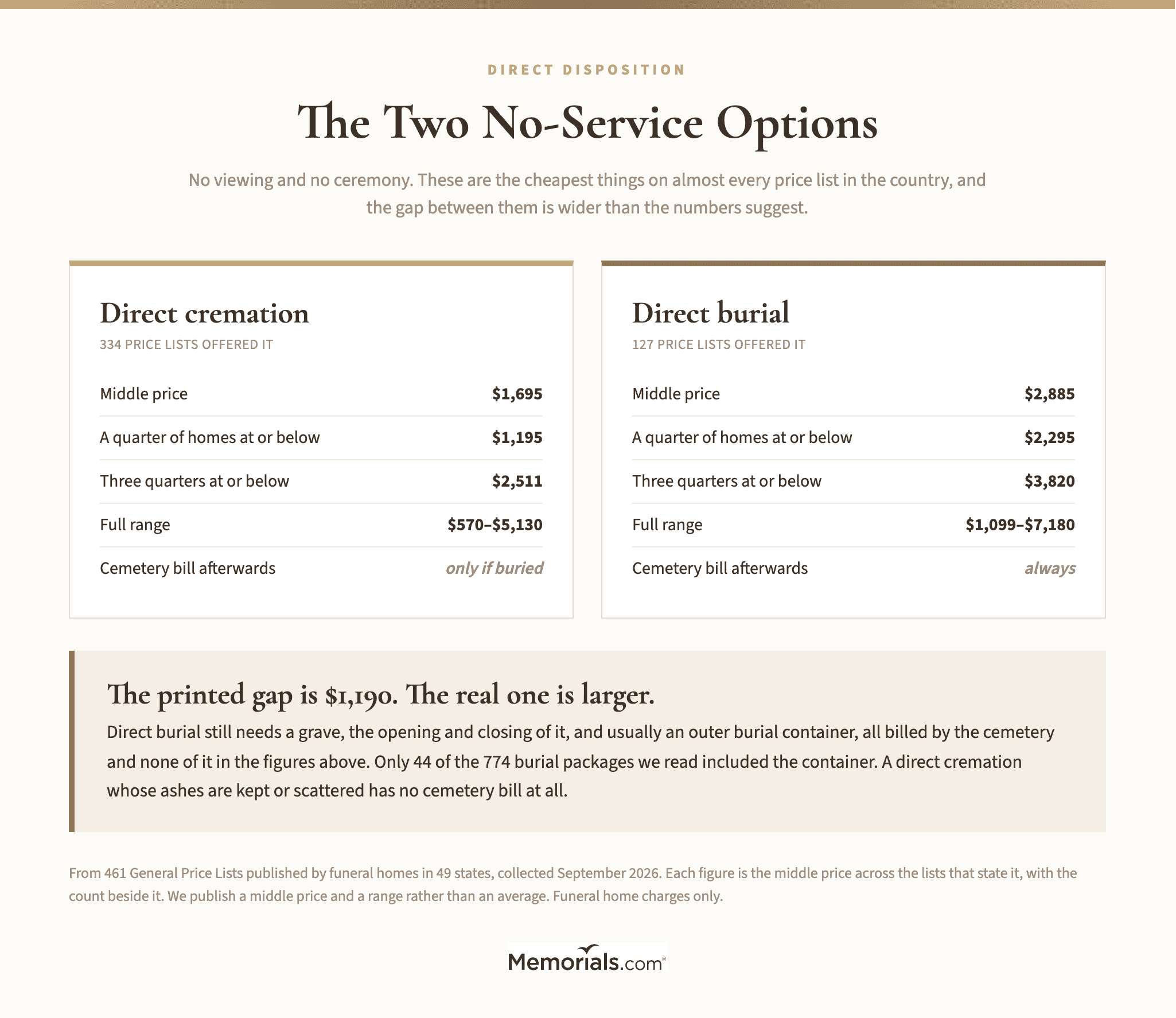
Two lines on almost every funeral home price list have no viewing, no ceremony and no procession attached to them: direct cremation and direct burial. They are the least expensive things a funeral home sells. Across the 127 price lists we read that offered it, the middle direct burial cost was $2,885, with half of those homes falling between $2,295 and $3,820. Direct cremation sat lower, at a middle price of $1,695 across 334 price lists. The distance between those two figures is real, and it is also the most misleading comparison on this page, because one of them arrives with a second bill attached and the other may not.
This article is about what each option actually is, what each price actually covers, and what is still owed afterward. It is part of our wider research into what a funeral costs, drawn from 461 General Price Lists published by funeral homes in 49 states and collected in September 2026.
One thing to settle at the start, because it decides everything that follows. Choosing no service from the funeral home does not mean there is no funeral. It means the gathering happens somewhere else, on a day you choose, arranged by the people who knew the person. That is a different decision from the one being priced here, and families make it constantly.
What Direct Cremation Is
Direct cremation is cremation with nothing around it. The funeral home collects the person who died, completes the paperwork and the permits, holds the body in refrigeration until the authorization and the cremation permit are in order, cremates, and returns the ashes to the family. There is no viewing, no embalming, no ceremony at the funeral home and no hearse, because none of those things are happening.
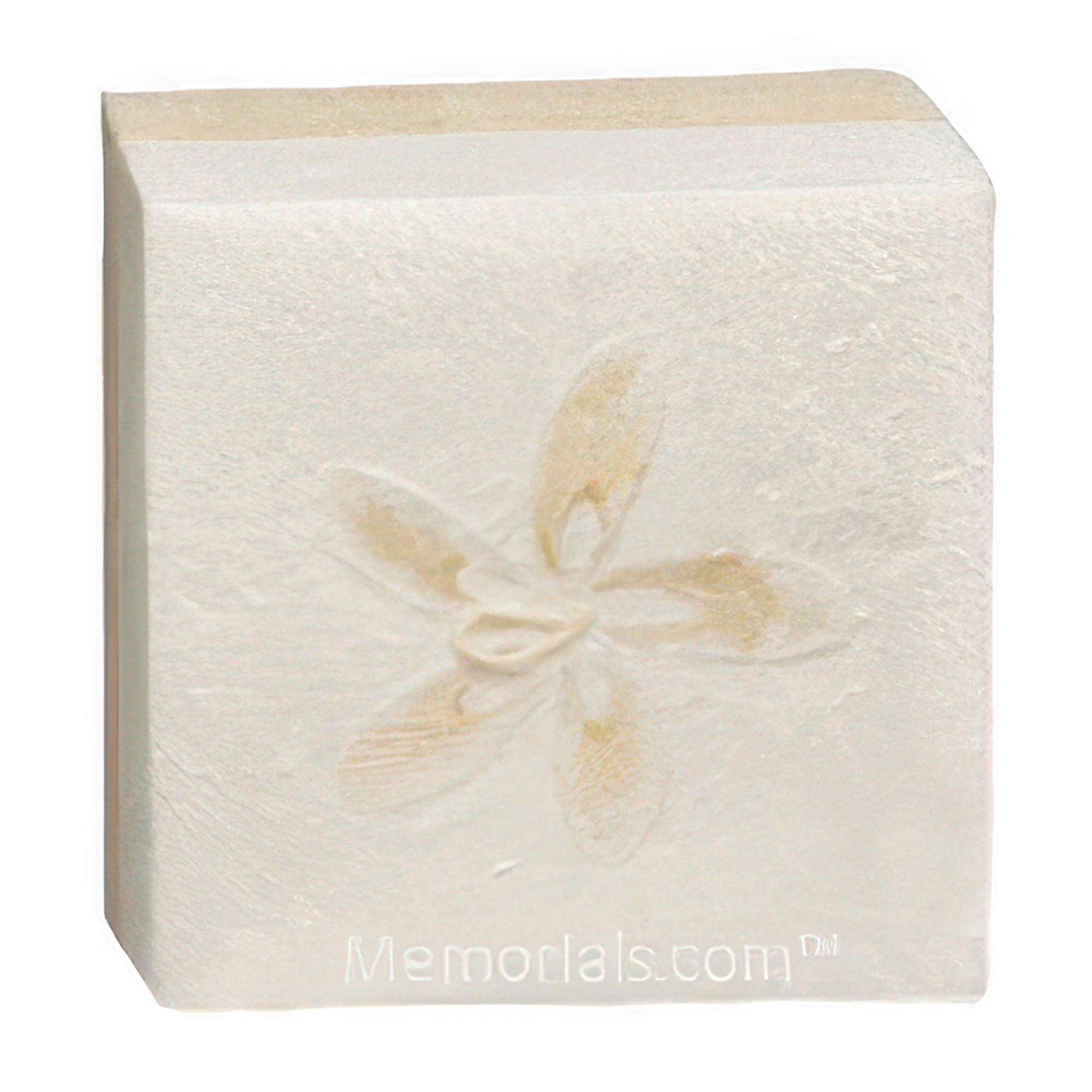
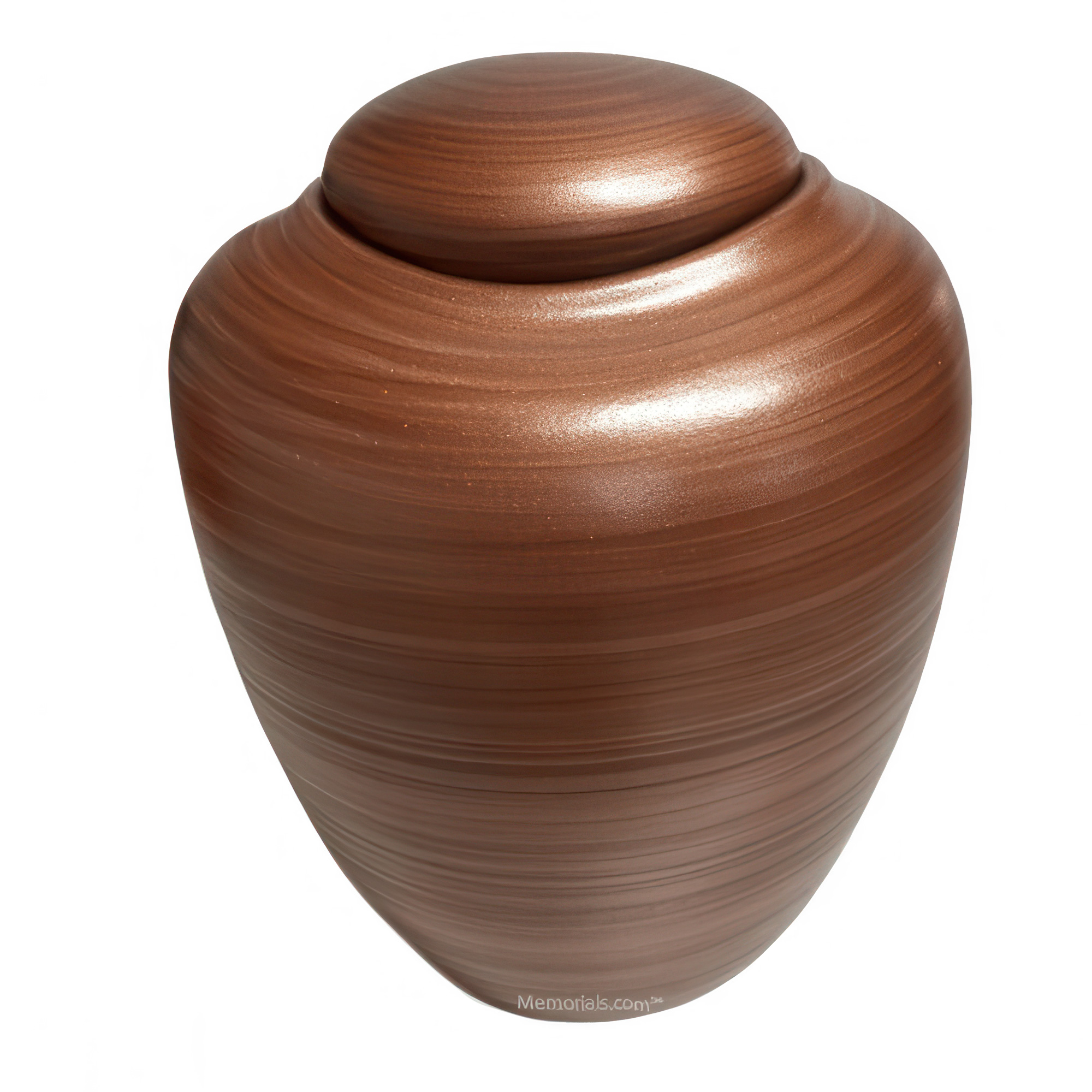
What the price normally covers is the transfer of the body into the home's care, the basic services of the director and staff, refrigeration or holding, the crematory fee, a rigid combustible container for the cremation itself, the filing of the death certificate, and a simple temporary container for the ashes. That last item matters more than it sounds. The ashes come back in a plastic or cardboard box unless you supply something else, and most families do supply something else, either straight away or later. Our range of cremation urns shows what the container itself costs, and a funeral home is required to accept one you bought elsewhere without charging a handling fee for it.
The spread on direct cremation cost is wide. The full range across those 334 price lists ran from $570 to $5,130, and a quarter of homes quoted $1,195 or less. A $5,130 direct cremation and a $570 one are the same service. That is the strongest argument in this article for calling three homes rather than one. Our guide to direct cremation goes through the process step by step.
Direct burial, which many price lists call immediate burial, is burial without a viewing or a ceremony at the funeral home. The body is collected, prepared minimally and not embalmed, placed in a casket or a rigid container, and taken to the cemetery for burial. Some families attend at the graveside and say something brief. Some do not attend at all. Either way, the funeral home is not running an event.
The middle immediate burial cost across the 127 price lists that offered it was $2,885, and the full range ran from $1,099 to $7,180. Half of homes sat between $2,295 and $3,820. What that price covers is the transfer, the basic services fee, the minimal preparation, the paperwork, and transport to the cemetery. Two things it usually does not cover are the casket and everything the cemetery is about to charge.
The casket question
A direct burial package is normally quoted with the home's least expensive container, or with no container at all and a note to select one. You are free to buy the casket anywhere, and the funeral home must accept it and use it without a fee. Across our own caskets range we currently list 63 adult caskets from $284 to $13,200, with a middle price of $1,880. For a burial with nobody looking at it, an unlined, plain, inexpensive casket does the job the law and the cemetery require.
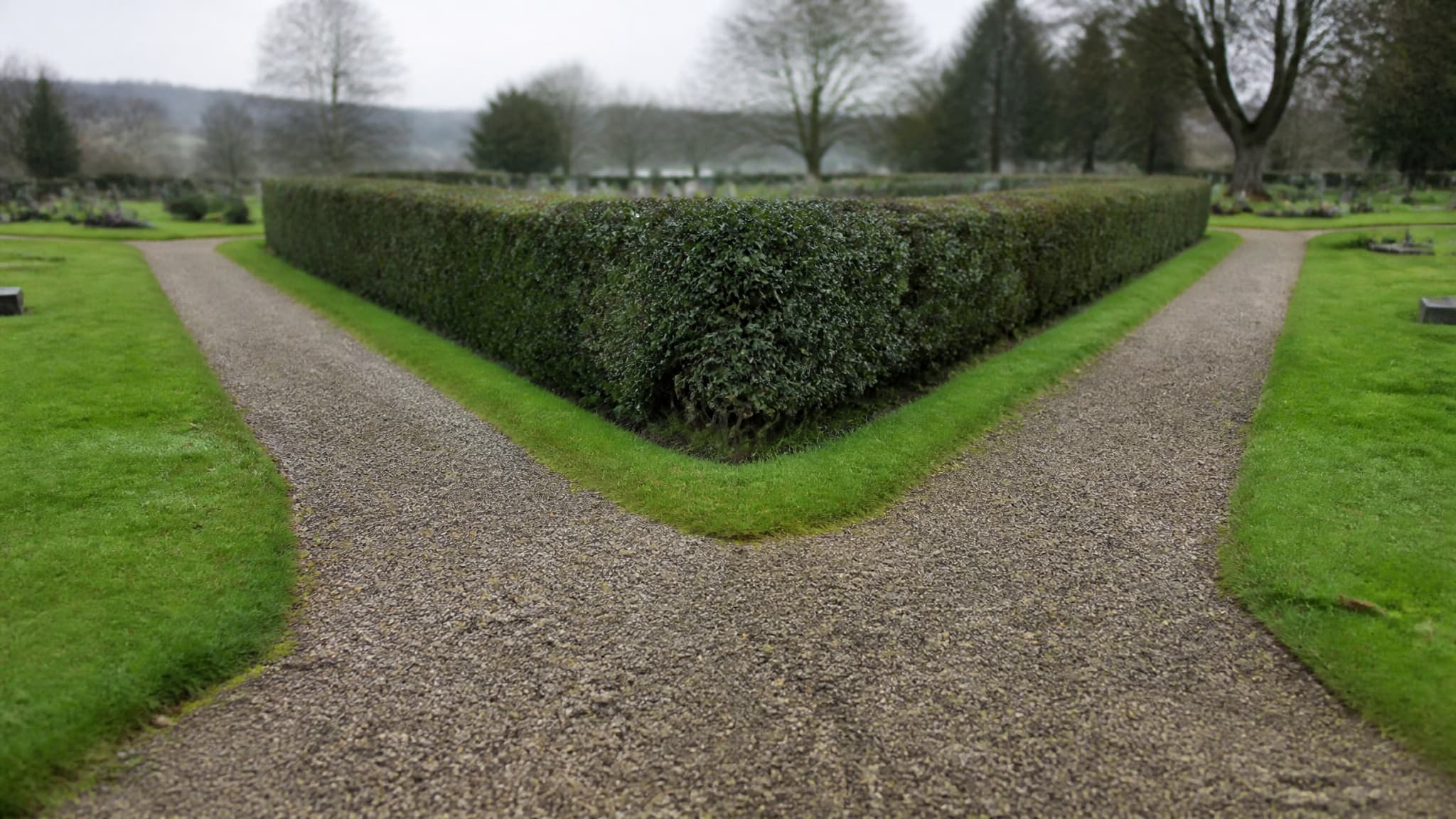
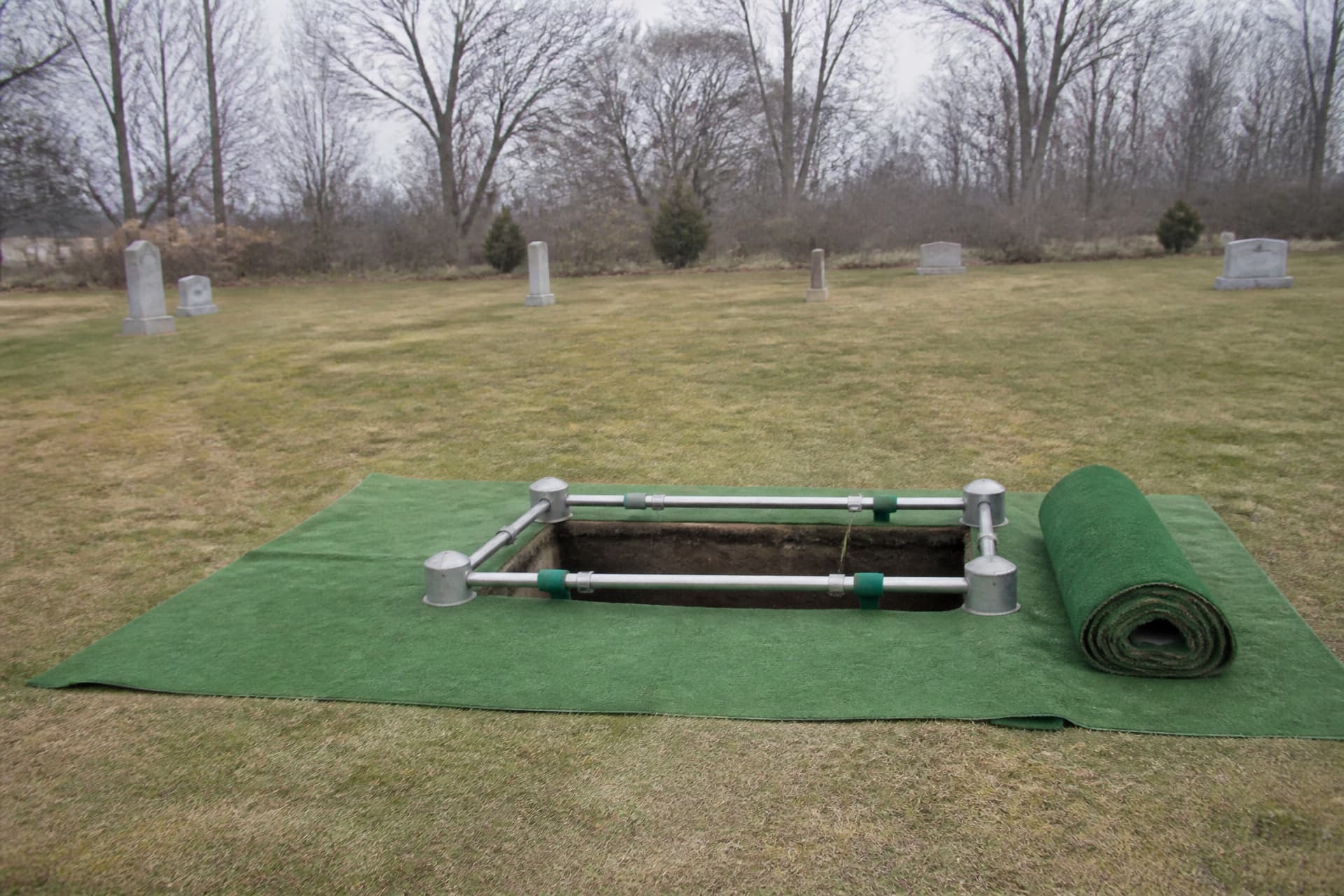
An immediate burial looks like this: the grave, the frame, and nobody present. The service, if there is one, happens somewhere else and on your own terms.
Why the Gap Is Larger Than the Two Numbers Suggest
Here is the part that changes the decision. $1,695 and $2,885 are both funeral home charges, and only one of the two options ends there.
Direct cremation can finish with no further bill at all. If the ashes are kept at home, divided among family, or scattered somewhere that permits it, nothing else is owed to anybody. You have paid the funeral home and you are done.
Direct burial cannot finish there, because a body has to go into ground that somebody owns. Every direct burial needs at least three more things, and the funeral home's price list does not include any of them.
A grave. A plot has to be bought from a cemetery, and plot prices vary by geography more than almost any other figure in funeral planning. Our guide to cemetery plot cost covers what drives it.
Opening and closing the grave. This is a cemetery labor charge for excavating the grave and filling it in afterward, billed by the cemetery, not the funeral home, and charged on top of the plot.
An outer burial container, usually. Most cemeteries require a vault or a grave liner so the ground does not settle over time. Only 44 of the 774 burial packages we read included one. Our guide to what a burial vault is explains why cemeteries want them.
One price list we read put the whole problem in a single sentence, and it is worth quoting exactly as written:
"This package does not include outer burial container (vault), grave space or open close fees." — one of the price lists we read, stating it plainly.
That is a direct burial priced honestly and disclosed honestly, and it is still a price with three significant items missing from it. A family comparing $2,885 against $1,695 and concluding that burial is a little over a thousand dollars more has compared one complete price against one partial one.
There is a fourth item most families want eventually: a marker or a headstone for the grave. It is usually chosen weeks or months later and bought separately, so it rarely features in the first conversation, but it is coming.
What Both Options Still Include
Neither option is bare. Both carry charges that exist whatever you decline.
The basic services fee is non-declinable. This is the one charge on a General Price List you cannot refuse, and it is inside both prices. It covers the director's time, the permits, the death certificates, the coordination with the crematory or the cemetery, and the overhead of a business that has to be reachable at three in the morning. Across the 398 price lists that stated it separately, the middle basic services fee was $2,140, with half of homes between $1,346 and $2,895 and a full range from $125 to $7,500. That single charge varies more between funeral homes than any other, and it is the largest reason one home's direct cremation is $570 and another's is $5,130.
Transfer of the body is in both, and some homes add mileage beyond a set radius. Ask what the radius is if the death happened away from home.
A container is in both. Cremation requires a rigid combustible container, not a casket. Burial requires something the cemetery will accept.
Paperwork is in both. Death certificates are usually billed per certified copy, and families routinely need more copies than they expect, for banks, insurers, pensions and the title to a car.
What falls away with a no service funeral is everything built around an event: embalming, dressing and cosmetology, the viewing room, the ceremony, the staff who run it, the hearse, the limousine, the printed programs. That list is most of the cost of a conventional funeral. A burial with a viewing and ceremony had a middle price of $5,475 across 137 price lists, and a graveside-only burial $4,108 across 84. The gap between those and $2,885 is the price of the event, not the price of the burial.
Direct cremation is the cheapest thing on almost every price list in the country, with a middle price of $1,695 across the 334 lists that offered it.
Choosing No Service Does Not Mean No Funeral
This is the point families most often miss, and it is the one worth saying plainly. A direct cremation or a direct burial settles what happens to the body. It says nothing at all about how the person is remembered.
A memorial gathering held two weeks later in a home, a church hall, a park, a restaurant back room or a community center is a real funeral. It can have a eulogy, readings, music, photographs and food. It can happen on a weekend, when the people who live far away can actually get there, rather than on the Tuesday four days after the death that a funeral home's schedule dictates. It costs whatever the room and the food cost, which is frequently very little and sometimes nothing.
Ashes make this easier still, because there is no deadline. Families hold the gathering when the family can travel, and scatter or bury the ashes then, or keep them and do it a year later. With a direct burial the burial itself has already happened, so the gathering afterward is unhurried in the same way.
What you give up is the thing a funeral director provides: someone else running the day. That is a genuine service and some families want it badly in the week after a death. The trade is real, and it is worth naming rather than pretending the cheaper route costs nothing.
Which One to Choose
Cost is one input. It is not the only one, and for most families it is not the deciding one.
Direct cremation makes sense when there is no strong preference for burial, when the family is scattered and a gathering will take time to organize, when the ashes are going somewhere that costs nothing, or when the budget genuinely will not stretch. It is the lowest price on nearly every list in the country and it leaves every remaining decision open.
Direct burial makes sense when burial matters, for religious, cultural or personal reasons, and the ceremony does not. Some traditions call for prompt burial without embalming, and a direct burial fits that exactly. It is also the right answer when a grave already exists: a family plot bought decades ago removes the largest of the added costs, and then direct burial is a far closer comparison than it first appears.
People searching for the cheapest way to bury someone are usually asking one of two different questions. If the question is truly about burial, direct burial with a plain casket in a plot the family already owns is the answer. If the question is really about the lowest total cost of any disposition, it is direct cremation, and it is not close.
Two things are worth checking before either decision. A veteran is generally entitled to a grave, a marker and a committal service in a national cemetery at no cost, which removes the entire cemetery bill described above and changes this comparison completely. Our guide to VA burial benefits covers eligibility. The Social Security Administration also pays a small lump-sum death benefit to a surviving spouse or child, which is worth claiming whatever you choose.
Choosing no service does not mean no funeral. This costs very little, it happens when the family can travel, and nobody is watching the clock.
Questions to Ask Before You Agree
Ask these of the funeral home, in this order, and ask for the answers on the itemized price list they are required to hand you.
Is this your lowest-priced direct cremation, or a package with extras in it?
What is the basic services fee inside this price?
Does the price include the crematory fee, or is that billed separately?
For direct burial, does the price include a casket, and may I see the container price list?
Is transport to the cemetery included, and is there a mileage limit?
How many certified death certificates are included, and what does each extra one cost?
What is the earliest date this can happen, and what is holding it up?
For burial, ask the cemetery its own set at the same time: the plot price, the opening and closing charge, whether a vault or liner is required, and what it costs to install a marker later.
Every funeral home in the country has to give you an itemized list on paper before discussing arrangements, has to quote prices over the telephone, and has to let you buy only what you want rather than a package. Our guide to the General Price List goes through the document section by section. Take it away and read it somewhere quieter. Nothing has to be decided at the table.
One cost sits outside both options and surprises people either way. How much does an obituary cost is a newspaper's price rather than a funeral home's, billed by the line, the column inch or the word, and it arrives whichever disposition you choose.
Prices in this article come from 461 General Price Lists published by funeral homes in 49 states, collected in September 2026. We publish the middle price and the middle half of the range rather than an average, and name the number of price lists behind every figure. Funeral homes that publish their prices online may not be typical of every home in the country.