🏬Supersize Online Funeral Retailer🪦1000's of Headstones⚱️Over 10,000 Cremation Urns⚰️Caskets Overnight Delivery🛒Funeral & Memorial Superstore🚚FREE Shipping on ALL Orders👨👩👧👦Helping Families for over 20 Years💰Lowest Price Guarantee🏬Supersize Online Funeral Retailer🪦1000's of Headstones⚱️Over 10,000 Cremation Urns⚰️Caskets Overnight Delivery🛒Funeral & Memorial Superstore🚚FREE Shipping on ALL Orders👨👩👧👦Helping Families for over 20 Years💰Lowest Price Guarantee
🏬Supersize Online Funeral Retailer🪦1000's of Headstones⚱️Over 10,000 Cremation Urns⚰️Caskets Overnight Delivery🛒Funeral & Memorial Superstore🚚FREE Shipping on ALL Orders👨👩👧👦Helping Families for over 20 Years💰Lowest Price Guarantee🏬Supersize Online Funeral Retailer🪦1000's of Headstones⚱️Over 10,000 Cremation Urns⚰️Caskets Overnight Delivery🛒Funeral & Memorial Superstore🚚FREE Shipping on ALL Orders👨👩👧👦Helping Families for over 20 Years💰Lowest Price Guarantee
Prepaid funeral plans are sold on a simple promise: pay today's price now, and your family pays nothing later. The promise is real, but it is narrower than the sales conversation makes it sound. A plan bought from a funeral home typically guarantees that home's own services at today's price. It rarely guarantees the casket you will actually want. It almost never guarantees what the cemetery charges, and the cemetery is where the fastest increases sit. Before you sign anything, the only question worth asking is which line items are price-guaranteed and which are not, in writing, as a list.
That question has an answer. Every plan has one. It is just not usually the first thing you are shown.
A plan has two halves, and only one of them is locked
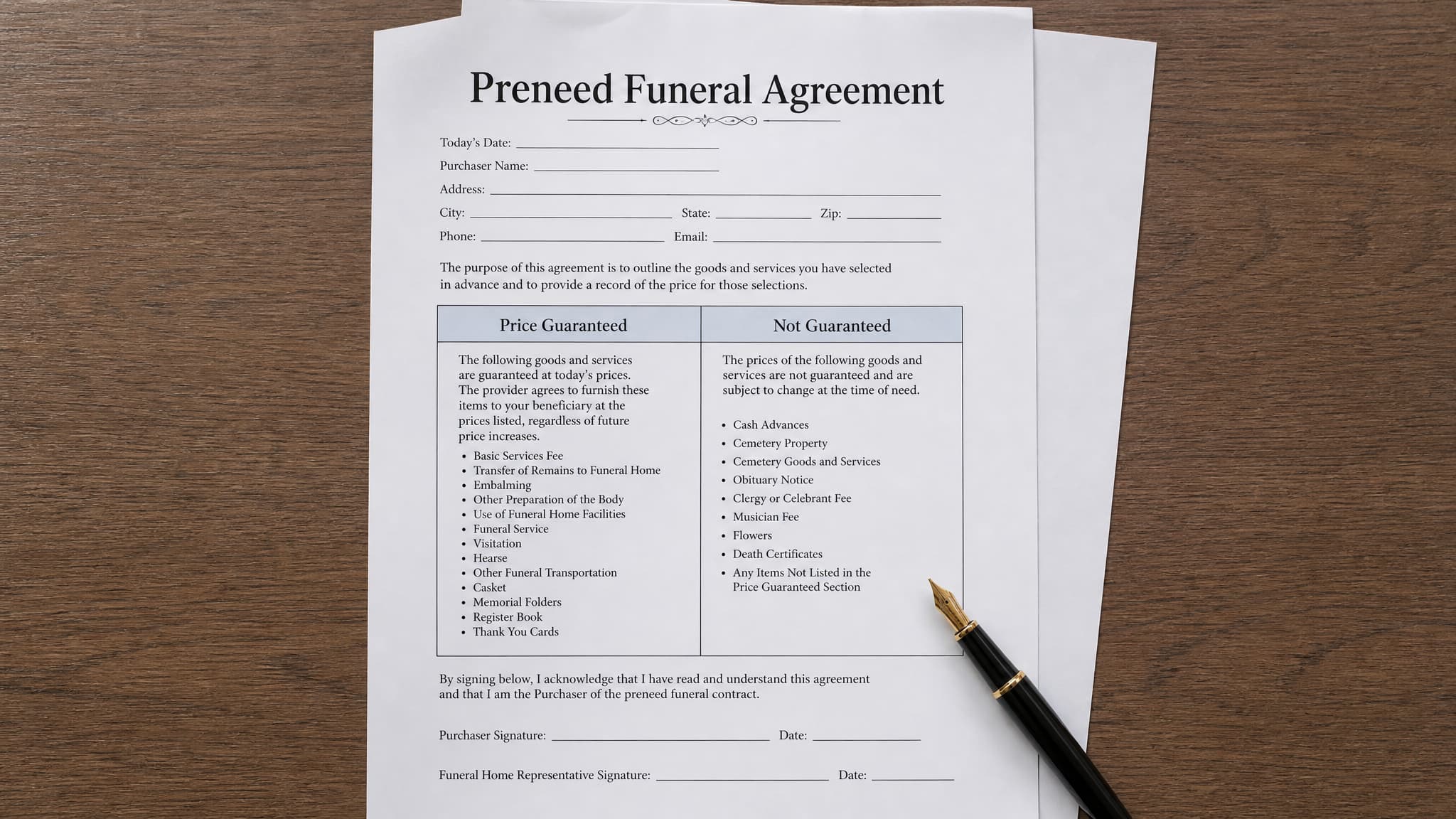
A preneed funeral contract almost always divides into guaranteed items and non-guaranteed items. The division is not a trick. It exists because a funeral home can promise the price of something it controls and cannot promise the price of something it buys from somebody else years from now.
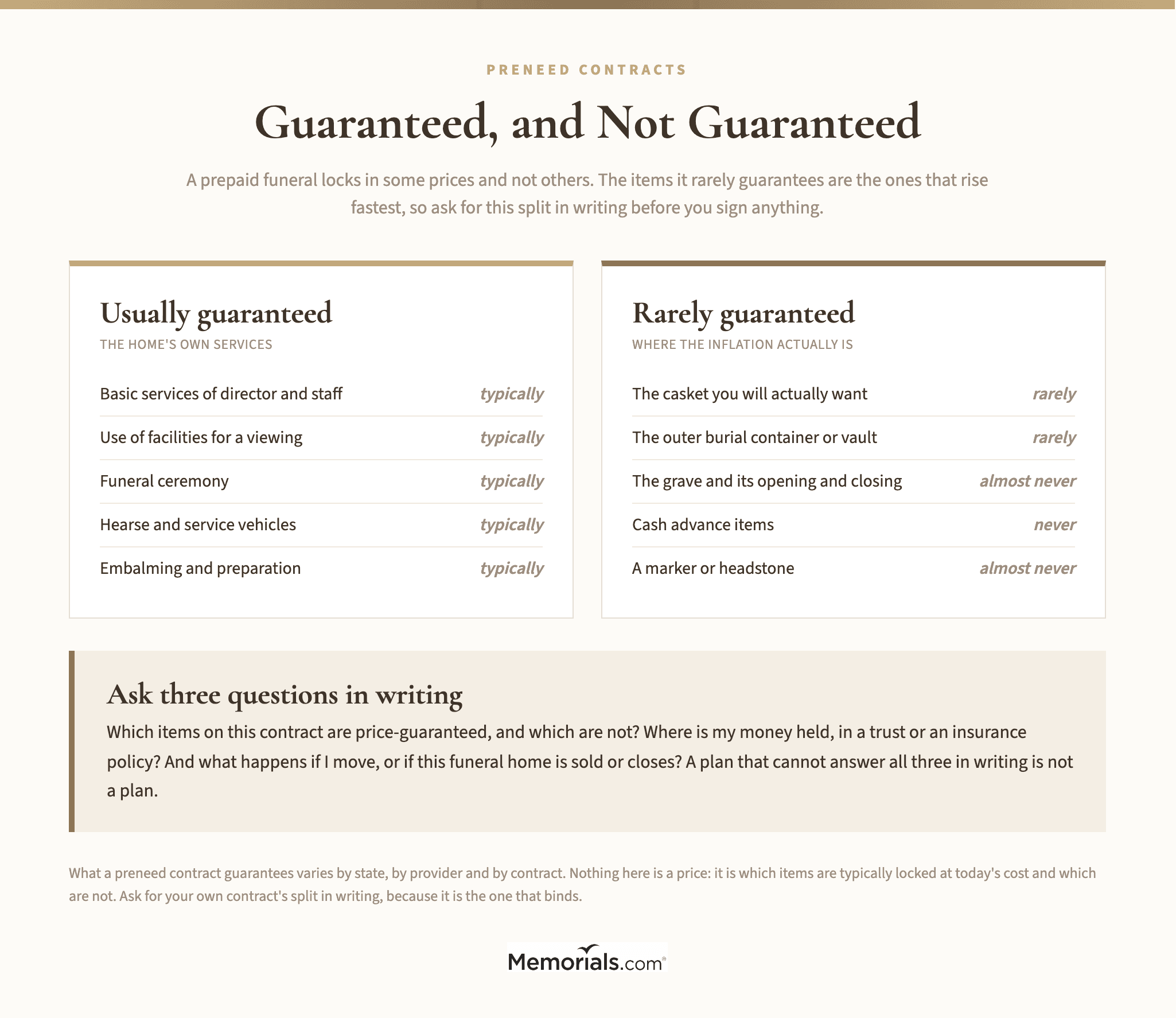
Guaranteed items are the funeral home's own work and facilities. The basic services of the director and staff, the use of a room for a viewing, the ceremony, the hearse, the paperwork and the permits. These are the charges the home sets itself, and a guaranteed plan holds them at the price on the day you sign. Across the 398 price lists that stated it, the basic services fee had a middle price of $2,140, and it ranged from $125 to $7,500. It is also non-declinable, meaning it is the one charge nobody can remove. Locking it is worth something.
Non-guaranteed items are everything the funeral home passes through or buys in. Cash advance items are the clearest case: clergy honoraria, death certificates, the obituary notice, flowers, musicians, sometimes the opening of the grave. The home is not setting those prices and does not pretend to. On the contract they usually appear with an estimate beside them and a note that the estimate is not binding.
When we read 461 General Price Lists published by funeral homes in 49 states, the single most useful thing we found was this: two out of three full-service burial packages did not include the casket at all. The package covered the director, the staff, the facilities and the ceremony, and the casket was quoted from a separate sheet.
That pattern carries straight into preneed. A plan often guarantees the service and then guarantees a casket only by model. If that exact model is no longer made when the plan is used, which over a span of years is likely, the contract says you get a comparable one. Comparable is a judgment made by the party selling it, at a moment when nobody in your family is going to argue.
It is also the largest single number on most bills. Across our own caskets range we list 63 adult caskets from $284 to $13,200, with a middle price of $1,880. The funeral home's own list is usually a different animal.
There is a right here that survives a preneed contract intact. Under the Federal Trade Commission's Funeral Rule, a funeral home must accept a casket or urn bought somewhere else, must use it, and cannot charge a handling fee for doing so. Prepaying does not sign that away. If your plan's casket allowance turns out to buy less than you hoped, your family can still supply one and apply the allowance to the rest of the bill. A home that tells your family otherwise is telling you something useful about the rest of the contract.
What a preneed contract usually locks in, and what it leaves exposed — which is where the fastest inflation sits.
The cemetery is a different business and a different bill
This is the part that undoes the arithmetic most often. Everything above is the funeral home's charge. If anything is being buried, a body or an urn, the cemetery bills separately for the grave, the opening and closing of it, and usually an outer burial container. Of the 774 burial packages we read, only 44 included the container. One price list said it in as many words:
"This package does not include outer burial container (vault), grave space or open close fees." — one of the price lists we read, stating it plainly.
A funeral home's preneed contract has no authority over any of that: it cannot guarantee a price set by a cemetery it does not own. So a plan can be fully funded, fully guaranteed on its own terms, and still leave a family facing the bill with the fastest growth in it. If you want the cemetery side locked too, that is a second purchase from the cemetery itself, with its own contract and its own terms. Our guide to cemetery plot cost covers what drives that price and what the opening and closing charge actually is.
Buy the two together if you are going to buy either. A prepaid funeral and an unbought grave is half a plan.
The useful version of this conversation happens years early, unhurried, with both people in the room and nothing being decided that day.
How the money is held, and why it decides everything else
Two structures dominate, and they behave differently in every situation that matters. The contract says which one you have, though rarely on the first page.
Trust-funded plans
Your money goes into a trust account, held separately from the funeral home's own funds, and is released to the home when the services are performed. State law governs how much of your payment has to go into the trust: in many states a percentage can be retained by the seller up front, so not every dollar you pay is sitting in the account. Ask what percentage is deposited.
Who keeps the interest the trust earns is a contract term, not a law of nature. In a guaranteed plan that growth is the home's hedge against inflation, which is what makes the guarantee possible at all.
Insurance-funded plans
You buy a small whole life policy, name the funeral home or a trust as the beneficiary, and assign the benefit to pay for the services. The policy is an asset that exists independently of the funeral home, which is its main advantage. Some policies grow at a stated rate, some grow with an index, and some have a fixed face value that does not move at all. A fixed face value on a plan sold as a hedge against rising prices is worth noticing, because it is not one.
Related but not the same thing: assigning an existing life insurance policy at the time of death, so the insurer pays the funeral home directly instead of your family bridging the gap. That is a settlement mechanism, not a prepaid plan, and we cover it in our guide to assigning a life insurance policy to a funeral home.
What happens if a funeral home closes, or is sold, or you move
Ask what happens if a funeral home closes before you ask anything else. Sellers do not enjoy the question, and it is the only failure mode that costs a family everything.
Funeral homes change hands often. A family business is bought by a group, the group is bought by a larger one, and the people who sold you the plan are gone. A contract you signed fifteen years ago may be honored by a business with no memory of the conversation. What binds them is the paperwork, which is why the guaranteed-items list matters more than any assurance given across a desk.
If the business closes outright, where your money sits decides what you recover. Trust-held funds are supposed to remain in the trust and follow the contract. Insurance-funded plans rest on a policy from an insurer that is a separate company entirely, and the insurer's failure and the funeral home's failure are two different events. Money that was neither trusted nor insured, which some states allow in some circumstances, is the exposed case.
State guaranty funds exist for exactly this. Many states operate a preneed guaranty or recovery fund, supported by fees the sellers pay, that reimburses consumers when a preneed seller fails to deliver. Coverage is not universal, the caps and eligibility rules vary, and some states have no fund at all. Find out whether your state has one and whether the plan you are being offered is covered by it before you sign, not after. Your state's insurance department or funeral board regulates preneed sales and will tell you.
If you move, portability is a contract term. Insurance-funded plans generally travel, because the policy pays whoever ends up doing the work, though the price guarantee usually does not travel with it: the new funeral home charges its own prices and the policy pays toward them. Trust-funded plans vary more, and some carry a transfer fee or are tied to a named provider. Ask directly what happens if the plan is used 800 miles away, and get the answer in the contract rather than in conversation.
Whoever will arrange the funeral needs to know this folder exists and where it is. A contract nobody can find has guaranteed nothing at all.
Surplus, shortfall, and who keeps the difference
A plan funded today will not match the bill exactly when it is used. Both directions are covered somewhere in the paperwork.
On a guaranteed plan, the funeral home has taken the price risk. If costs rose faster than the trust or policy grew, that is its problem, and it performs the guaranteed services anyway. If the funding grew faster than prices, the surplus usually belongs to the funeral home, which is the other side of the same bargain. Some contracts return a portion to the estate. Read which.
On a non-guaranteed plan, sometimes called a deposit plan, you have simply set money aside. The family pays whatever the prices are on the day, using the fund as a credit. Any shortfall is theirs. Any surplus is returned. Plans of this kind are sold alongside guaranteed ones and the paperwork can look nearly identical, so confirm which one is in front of you.
Either way, non-guaranteed items behave the same on both: estimated, not locked, and settled at the prices of the day.
Revocable or irrevocable
A revocable plan can be canceled. What you get back is a contract term and a state law question combined, and cancellation charges are common, so the refund is not automatically everything you paid.
An irrevocable plan cannot be canceled, and that is sometimes the point. Making a plan irrevocable is how it is excluded from countable assets under some state Medicaid rules, which is a legitimate reason many families choose it deliberately. If that is why you are signing, the restriction is the feature. If nobody explained that and the plan is irrevocable anyway, ask why.
Irrevocable does not necessarily mean immovable. Several states let an irrevocable plan be transferred to a different provider even though it cannot be cashed in.
Ask what happens if this business is sold, or closes, or if you move. A preneed contract is a promise from a company, and companies change hands.
The alternative that keeps you in control
Prepaying is not the only way to have the money ready. The plainest alternative is a dedicated account at your own bank with a payable-on-death beneficiary named on it. You keep control of the money for as long as you live, you can add to it or spend it, and on death it passes directly to the person you named without waiting for probate. They pay the funeral home and keep whatever is left.
What you give up is the price guarantee, and that is a real thing to give up. What you get is flexibility, full portability, and the surplus. You also keep the ability to change your mind about the funeral itself, which people do.
There is a way to get most of the benefit of both. Write down the funeral you want with the same specificity a preneed funeral contract would use, take a General Price List from two or three homes so your family knows what the arrangements you described actually cost, and fund it with a payable-on-death account. Our guide to the General Price List every funeral home must show you goes through that document section by section, and the funeral planning guide covers the decisions in the order they come up.
Check first what is already covered. A veteran is generally entitled to a grave, a marker and a committal service in a national cemetery at no charge, which removes the cemetery bill entirely and changes what a plan needs to fund. The VA burial benefits guide sets out who qualifies. The Social Security Administration pays a small lump-sum death benefit to a surviving spouse or child. Neither is large enough to build a plan around, and both are large enough to be worth knowing before you fund one.
Are prepaid funerals worth it?
The honest answer to "are prepaid funerals worth it" is that it depends on which half of the contract is doing the work.
They are worth it when the guarantee is broad and written down, when the funding is held somewhere you can verify, when you have bought the cemetery side as well, and when you are confident the arrangements will be used where you signed them. And they are worth something that does not appear on any balance sheet: your family arriving at a funeral home with the decisions already made, rather than making them in an afternoon.
They are worth less when the guarantee covers only the services, the casket is a model number, the cemetery is unbought, and the whole thing rests on a business continuing to exist and continuing to be reasonable for twenty years.
The prepaid funeral plan cost you are quoted is today's price for a specific list of items. A widely repeated national average funeral figure of $7,000 to $12,000 gets used to make a plan look like a bargain, and we do not publish an average precisely because the spread is driven by what is bundled in. In the price lists we read, a burial with a viewing and ceremony had a middle price of $5,475 across 137 homes, and a direct cremation with no service had a middle price of $1,695 across 334. Those are different products, not different markets, and a plan quoted against the wrong one is not a saving.
What to ask for, in writing, before you sign
Ask for all of this on paper. A seller who will provide it is probably worth buying from.
The guaranteed list and the non-guaranteed list, as two separate lists. Not a paragraph describing them. Two lists, with every item on one or the other.
How the money is held, trust or insurance, which institution, and what percentage of your payment is deposited.
Who keeps the interest or growth, and who keeps a surplus if there is one.
What happens if you move, including whether the price guarantee travels or only the funding does.
What happens if the business is sold or closes, and whether your state's preneed guaranty fund covers this contract.
Whether it is revocable, and if not, why, and what the cancellation terms are if it is.
A current General Price List for the same home. You are entitled to it, and it lets you check the plan against the home's own posted prices rather than against a number in a brochure.
Take all of it home. Nothing here has to be decided at the table, and a plan that will not survive a week of reading at your own kitchen table is not a plan you want.
For the underlying numbers, what a funeral costs, how the casket changes it, and what the cemetery adds, our research on what a funeral costs covers all 461 price lists in full.