🏬Supersize Online Funeral Retailer🪦1000's of Headstones⚱️Over 10,000 Cremation Urns⚰️Caskets Overnight Delivery🛒Funeral & Memorial Superstore🚚FREE Shipping on ALL Orders👨👩👧👦Helping Families for over 20 Years💰Lowest Price Guarantee🏬Supersize Online Funeral Retailer🪦1000's of Headstones⚱️Over 10,000 Cremation Urns⚰️Caskets Overnight Delivery🛒Funeral & Memorial Superstore🚚FREE Shipping on ALL Orders👨👩👧👦Helping Families for over 20 Years💰Lowest Price Guarantee
🏬Supersize Online Funeral Retailer🪦1000's of Headstones⚱️Over 10,000 Cremation Urns⚰️Caskets Overnight Delivery🛒Funeral & Memorial Superstore🚚FREE Shipping on ALL Orders👨👩👧👦Helping Families for over 20 Years💰Lowest Price Guarantee🏬Supersize Online Funeral Retailer🪦1000's of Headstones⚱️Over 10,000 Cremation Urns⚰️Caskets Overnight Delivery🛒Funeral & Memorial Superstore🚚FREE Shipping on ALL Orders👨👩👧👦Helping Families for over 20 Years💰Lowest Price Guarantee
An epitaph is one of the most enduring forms of tribute a family can give — a handful of words carved into stone that outlast generations. The practice stretches back thousands of years, from ancient Greek tombs to modern granite memorials in cemeteries around the world. Some inscriptions are solemn and reverent; others are sharp with wit or heavy with historical weight. Together, they form a rich tradition that continues to shape how we honor the people we love. For a broader look at all forms of memorial engraving options explained, from headstone lettering to urn personalization, our complete guide covers every step.
This article traces the most famous epitaphs in history — the inscriptions that have inspired visitors, scholars, and families across centuries. Whether you are choosing an inscription for a loved one's or simply drawn to the stories behind these well known epitaphs, the words below offer a window into how people have always searched for the right way to say goodbye.
Most gravestone inscriptions are private tributes read only by visiting family. A famous epitaph breaks beyond that circle. It becomes part of cultural memory because it captures something universal — humor in the face of mortality, defiance of convention, or a phrase so perfectly chosen that it defines the person buried beneath it.
Several qualities tend to separate a well-known epitaph from the millions of forgotten ones. Brevity matters: the most quoted tombstone inscriptions tend to be a single sentence or less. Authenticity matters even more. Many of the most celebrated historical epitaphs were composed by the deceased themselves, long before death arrived. And sometimes an epitaph becomes famous simply because the person it memorializes already was — their final words on stone become the last chapter of a public life.
Understanding what an epitaph is in both a historical and practical sense helps families approach the tradition with confidence rather than uncertainty.
Ancient and Classical Epitaphs
The history of memorial inscriptions reaches back to ancient Egypt, where sarcophagi carried prayers and biographical details of the deceased. The ancient Greeks transformed the epitaph into something more personal, writing in elegiac verse that expressed grief, love, and the shortness of life.
The Seikilos Epitaph
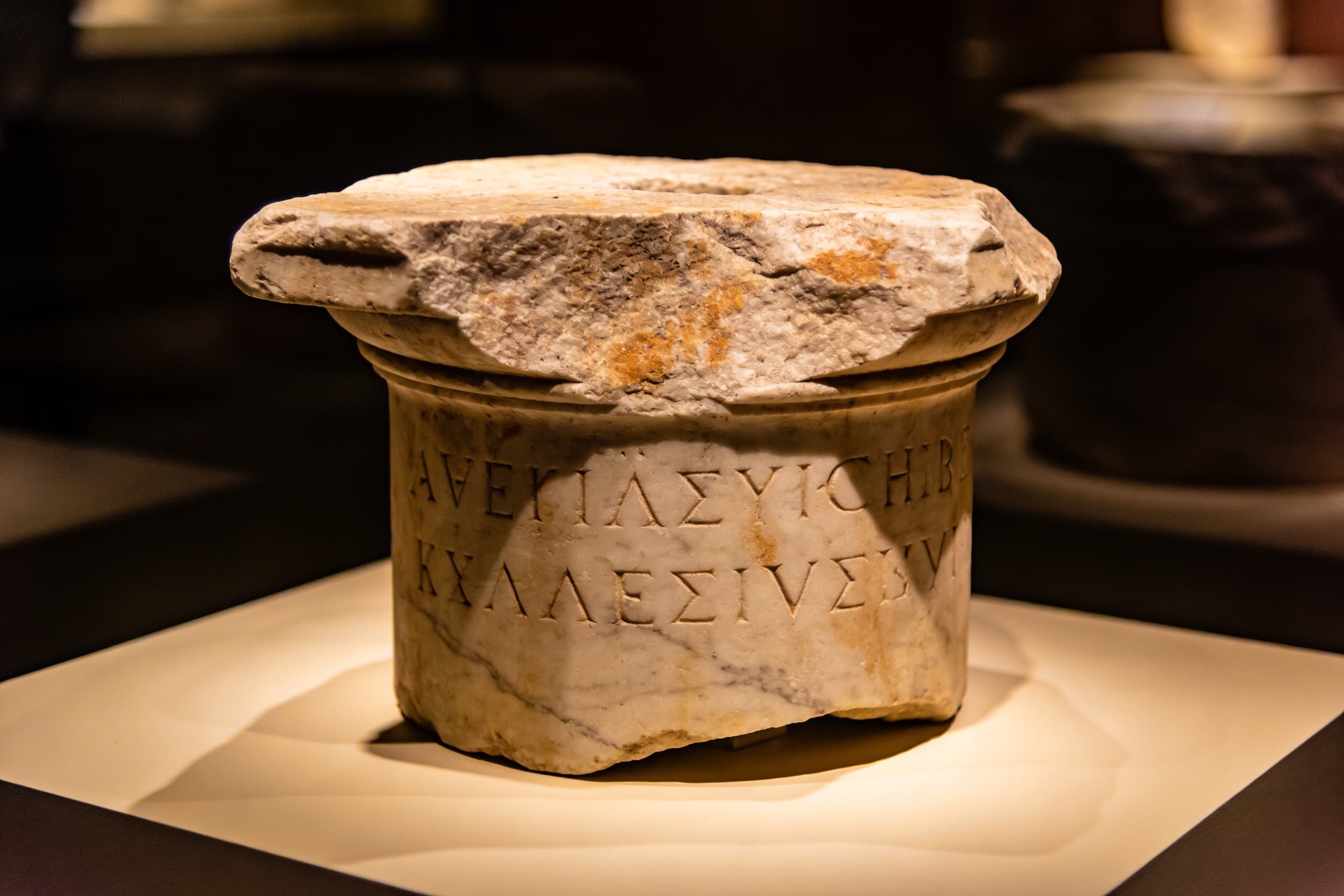
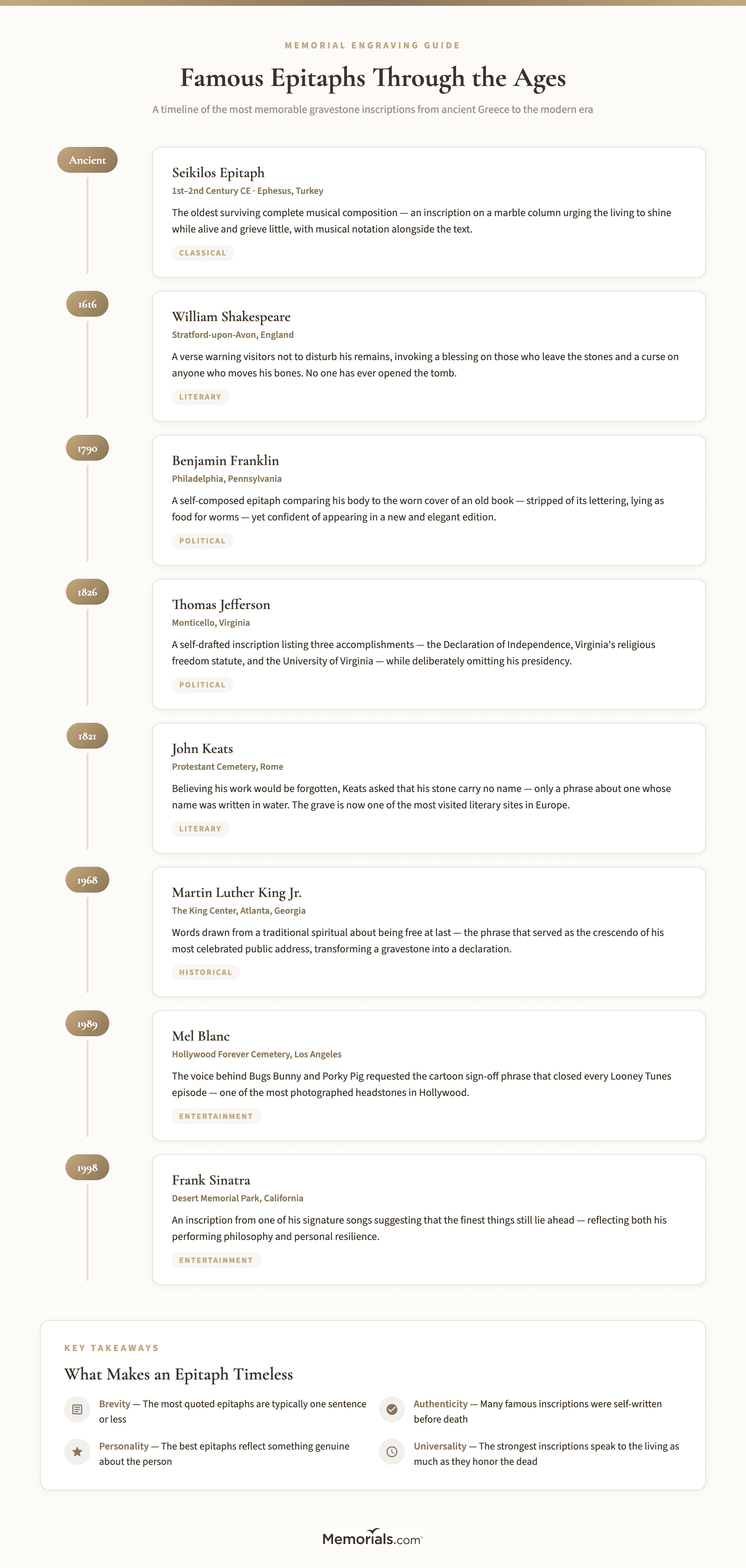
The oldest surviving complete musical composition in the world is actually an epitaph. The Seikilos epitaph, discovered on a marble column near Ephesus in modern-day Turkey, dates to roughly the first or second century CE. The inscription urges the living to shine while they are alive, to grieve little, and to remember that life lasts only a short while. Alongside the text, the column includes musical notation — an ancient melody written for a departed wife named Euterpe.
Greek and Roman Traditions
Ancient Greek epitaphs favored emotional expression and poetic form. The Spartans were famously terse: the memorial at Thermopylae for the 300 soldiers who died there carried an inscription telling passersby to report that the fallen lay there in obedience to Spartan law. It remains one of the most recognized military epitaphs in Western history.
Roman epitaphs were more uniform and factual, often listing a person's career, family connections, and years of service. A common Roman tombstone inscription translated loosely as a wish for the earth to rest lightly upon the deceased. This formulaic approach influenced early English church monuments, where Latin inscriptions dominated for centuries.
Literary and Poetic Epitaphs
Writers, by nature, tend to leave behind words worth remembering. Many of the most famous gravestone inscriptions in history belong to poets, playwrights, and novelists whose final messages matched the power of their published work.
William Shakespeare
One of the most well known epitaphs in the English language belongs to William Shakespeare, inscribed on his tomb at Holy Trinity Church in Stratford-upon-Avon. The verse warns visitors not to disturb his remains, invoking a blessing on those who leave the stones undisturbed and a curse on anyone who moves his bones. Whether Shakespeare wrote the lines himself remains debated, but the inscription has protected his grave for over four centuries — no one has ever opened the tomb.
John Keats
The Romantic poet John Keats died in Rome in 1821 at the age of twenty-five. Believing his work would be forgotten, Keats asked that his gravestone carry no name — only the phrase describing one whose name was written in water. The memorial in the Protestant Cemetery in Rome has become one of the most visited literary graves in Europe, proving his fear of obscurity spectacularly wrong.
Emily Dickinson
Emily Dickinson's gravestone in Amherst, Massachusetts carries just two words suggesting she had been summoned back — a reference to a brief note she sent to her cousins shortly before her death in 1886. Given that Dickinson composed nearly 2,000 poems exploring mortality and the afterlife, the simplicity of her memorial inscription feels both fitting and deeply poignant.
Robert Frost
The New England poet Robert Frost rests beneath a gravestone in Old Bennington, Vermont. His epitaph, drawn from his own poem, describes his relationship with the world as that of a quarreling lover. The line captures both the tenderness and the tension that defined his writing life.
Edgar Allan Poe
Poe's original burial site in Baltimore went unmarked and neglected for over twenty-five years after his death in 1849. When a proper monument was finally erected, it included a passage from his most recognized poem about a raven that visits a grieving narrator. The epitaph transformed a forgotten grave into a literary pilgrimage site.
Political and Historical Epitaphs
Leaders and public figures often carry the weight of their legacy right to the gravestone. Some of the most memorable historical epitaphs were written by presidents, activists, and military heroes who understood that their final inscriptions would be read by history itself.
Thomas Jefferson
Thomas Jefferson drafted his own epitaph, specifying not only the words but the plain stone design he wanted. His inscription names three achievements: authoring the Declaration of Independence, writing the Virginia statute for religious freedom, and founding the University of Virginia. He deliberately omitted his presidency — a choice that tells us as much about Jefferson as any biography.
Benjamin Franklin
Benjamin Franklin composed his epitaph decades before his death, comparing his aging body to the worn cover of an old book — its contents torn out and stripped of gilding, lying as food for worms. He then expressed confidence that the work would appear again in a new and more elegant edition. The metaphor of a printer reimagined by his Creator became one of the most frequently quoted memorial inscriptions in American history. Franklin's actual gravestone, however, carries only his name and his wife's — a simpler tribute than the literary version he envisioned.
Winston Churchill
Sir Winston Churchill's inscriptions at his burial site in Bladon, Oxfordshire are relatively understated for a man of his stature. But a quote widely attributed to him — about being ready to meet his Maker while questioning whether his Maker was prepared for the ordeal — captures the defiant wit that defined his public life. Churchill understood that a sharp phrase could outlast a marble monument.
Martin Luther King Jr.
The memorial tomb of Dr. Martin Luther King Jr. at the King Center in Atlanta carries words drawn from a traditional spiritual about being free at last. The phrase, which served as the crescendo of his most celebrated public address, transforms a gravestone into a declaration that continues to resonate with visitors from around the world.
Celebrity and Entertainment Epitaphs
Hollywood actors, musicians, and comedians have given us some of the most distinctive tombstone inscriptions of the modern era. Many chose their own final words, ensuring that their public persona followed them into eternity.
Mel Blanc
The legendary voice actor behind Bugs Bunny, Daffy Duck, and Porky Pig requested that his headstone carry the cartoon sign-off phrase that closed every Looney Tunes episode. The inscription has become one of the most photographed granite headstones in the Hollywood Forever Cemetery.
Frank Sinatra
Frank Sinatra's grave at Desert Memorial Park in Cathedral City, California carries a line from one of his signature songs, suggesting that the finest things still lie ahead. The optimistic sentiment reflects both his performing philosophy and his personal resilience across a career that spanned six decades.
Dorothy Parker
The American writer and satirist Dorothy Parker, known for her biting wit, once suggested that her headstone should ask visitors to excuse her dust. The line appeared on a memorial plaque at the Algonquin Hotel in New York, where she hosted her famous literary roundtable. For those drawn to sharp, concise wording for memorial markers, Parker's approach offers memorial plaque wording ideas that prove brevity and personality can coexist beautifully on bronze or stone.
Rodney Dangerfield
The comedian famous for his self-deprecating catchphrase about never getting respect chose a headstone inscription joking that his arrival would lower the quality of the neighborhood. The epitaph extends his comedic persona beyond the stage, giving cemetery visitors one last punchline.
Dean Martin
Dean Martin's simple gravestone carries a line from his beloved song, suggesting that everyone finds love eventually. The inscription at Westwood Village Memorial Park captures the warmth and romance that defined the Rat Pack entertainer's public image.
Humorous Epitaphs That Became Legends
Not every famous epitaph belongs to a celebrity. Some of the most well known gravestone inscriptions were carved for ordinary people whose wit or circumstances created an inscription too good to forget.
A tombstone in a Thurmont, Maryland cemetery carries what may be the most frequently cited humorous epitaph in America: a note about a well-dressed atheist with nowhere to go. The name of the deceased has been lost to time, but the joke endures.
In Tombstone, Arizona — a town whose very name invites the genre — a grave marker for a man named Lester Moore notes that he received four slugs from a .44 caliber weapon. The inscription then plays on his name to declare there is no less and no more. The wordplay has made it one of the most photographed grave markers in the American West.
These humorous epitaph examples demonstrate that laughter and remembrance have always shared space in the cemetery. From ancient Roman tombs to modern headstones, humor has served as a way to soften grief and celebrate a life lived with personality.
How Famous Epitaphs Can Inspire Your Own Memorial Inscription
Reading through historical epitaphs reveals patterns that families can draw on when choosing words for a loved one's memorial. The strongest inscriptions tend to share a few qualities: they are concise, they reflect something genuine about the person, and they speak to the living as much as they honor the dead.
Consider the approach that resonates most with the person you are memorializing. A literary family might choose a line from a favorite poem. A veteran might draw from military tradition. A person known for their humor might prefer something that makes visitors smile.
Whatever direction you choose, the tradition of the epitaph reminds us that a few well-chosen words — carved into granite, etched onto bronze, or engraved on a memorial plaque — can carry meaning across generations. For practical guidance on engraving methods, lettering styles, and design options, our guide to tombstone design inspiration walks through everything from font selection to symbol placement.
Some families choose companion headstones that carry a shared inscription for a married couple — a tradition with deep roots. George Burns and Gracie Allen, buried together at Forest Lawn Memorial Park, share a headstone that simply reads their names with the phrase acknowledging they are together again. The inscription waited more than three decades for Burns to join his wife — a quiet testament to enduring love.
Frequently Asked Questions
What is the most famous epitaph in history?
Shakespeare's tombstone verse at Holy Trinity Church in Stratford-upon-Avon is widely considered the most famous epitaph in the English-speaking world. The inscription's warning against disturbing his bones has protected his grave since 1616 and remains one of the most quoted gravestone inscriptions globally. Benjamin Franklin's self-composed epitaph comparing himself to a worn book is another strong contender for the title.
What is the difference between an epitaph and an epithet?
An epitaph is an inscription written in memory of a deceased person, usually carved on a tombstone or memorial marker. An epithet is a descriptive word or phrase used to characterize someone — like "the Great" in Alexander the Great. The two terms are sometimes confused because they sound similar, but they serve entirely different purposes.
What is the oldest known epitaph?
The Seikilos epitaph, dating to the first or second century CE, is the oldest surviving complete musical composition and one of the oldest known personal epitaphs. However, Egyptian funerary inscriptions on sarcophagi date back thousands of years earlier. The oldest known epitaphs in the broader sense are ancient Egyptian tomb inscriptions from approximately 2600 BCE.
Can you write your own epitaph?
Absolutely. Many of the most famous epitaphs in history were self-written, including those of Thomas Jefferson, Benjamin Franklin, and Johannes Kepler. Writing your own epitaph gives you control over how your life is summarized and can spare your family the difficulty of choosing words during a time of grief. Some families include epitaph preferences in their advance funeral planning documents.
How many words should an epitaph be?
Most memorial inscriptions range from three to thirty words, though there is no strict rule. The most memorable epitaphs tend to be brief — often a single sentence. Practical considerations matter too: headstone engraving is typically priced per character, and the physical space on a grave marker limits how much text can be displayed legibly. Shorter inscriptions also tend to be easier for cemetery visitors to read and remember.
Honoring a Legacy with the Right Words
The famous epitaphs explored here span thousands of years, dozens of countries, and every imaginable tone — from Shakespeare's solemn warning to a comedian's final punchline. What unites them is the universal human desire to leave behind words that matter.
If you are choosing an inscription for a loved one's memorial, take your time. Read widely. Consider what made the person irreplaceable, and look for language that captures that quality in as few words as possible. The best epitaphs are never rushed.
Memorials.com offers a wide selection of headstones and engraved memorials that can carry the inscription your family chooses. Browse our collection to find a memorial worthy of the words you have in mind.