🏬Supersize Online Funeral Retailer🪦1000's of Headstones⚱️Over 10,000 Cremation Urns⚰️Caskets Overnight Delivery🛒Funeral & Memorial Superstore🚚FREE Shipping on ALL Orders👨👩👧👦Helping Families for over 20 Years💰Lowest Price Guarantee🏬Supersize Online Funeral Retailer🪦1000's of Headstones⚱️Over 10,000 Cremation Urns⚰️Caskets Overnight Delivery🛒Funeral & Memorial Superstore🚚FREE Shipping on ALL Orders👨👩👧👦Helping Families for over 20 Years💰Lowest Price Guarantee
🏬Supersize Online Funeral Retailer🪦1000's of Headstones⚱️Over 10,000 Cremation Urns⚰️Caskets Overnight Delivery🛒Funeral & Memorial Superstore🚚FREE Shipping on ALL Orders👨👩👧👦Helping Families for over 20 Years💰Lowest Price Guarantee🏬Supersize Online Funeral Retailer🪦1000's of Headstones⚱️Over 10,000 Cremation Urns⚰️Caskets Overnight Delivery🛒Funeral & Memorial Superstore🚚FREE Shipping on ALL Orders👨👩👧👦Helping Families for over 20 Years💰Lowest Price Guarantee
Most people who go looking for a taxidermy dog or cat are not curious. They are in the first days after a death, they have been handed a decision they did not want, and the idea of a body being taken away and returned as ashes feels unbearable. Keeping the animal — actually keeping them, the shape and the fur and the particular set of the ears — sounds like the one option that does not involve losing anything else.
That impulse is not strange, and it is not something to be talked out of. It is worth understanding properly, though, because pet taxidermy is expensive, slow, and harder to get right than almost any other kind of preservation work. Some people are glad they did it for the rest of their lives. Others spend several thousand dollars and many months waiting, only to find that the thing they get back is not the thing they were grieving for.
This article is part of our . It covers what the work involves, what it costs, how freeze-drying differs from traditional taxidermy, and — the part most guides skip — what the finished result honestly tends to look like.
Traditional taxidermy does not preserve your pet's body. This is the single most common misunderstanding, and it changes how a lot of people feel about the decision.
In conventional taxidermy, the skin is removed, treated, and mounted over a sculpted form. The form is a manufactured or hand-carved mannequin shaped to the animal's measurements. Everything inside — muscle, bone, organs — is not part of the finished piece. What comes back is your pet's fur, and their fur only, stretched over a sculpture of them.
Freeze-drying works differently, and for pets it is now the more common choice. The body itself is preserved. The animal is posed, then placed in a vacuum chamber at very low temperature for a period of months, during which the moisture in the tissue sublimates away without the tissue collapsing. The result is the actual animal, dehydrated and stable, rather than a reconstruction.
Neither one is embalming, and neither one is reversible. Once a body has been skinned or freeze-dried, cremation is no longer an option for what remains.
How Much Does Pet Taxidermy Cost?
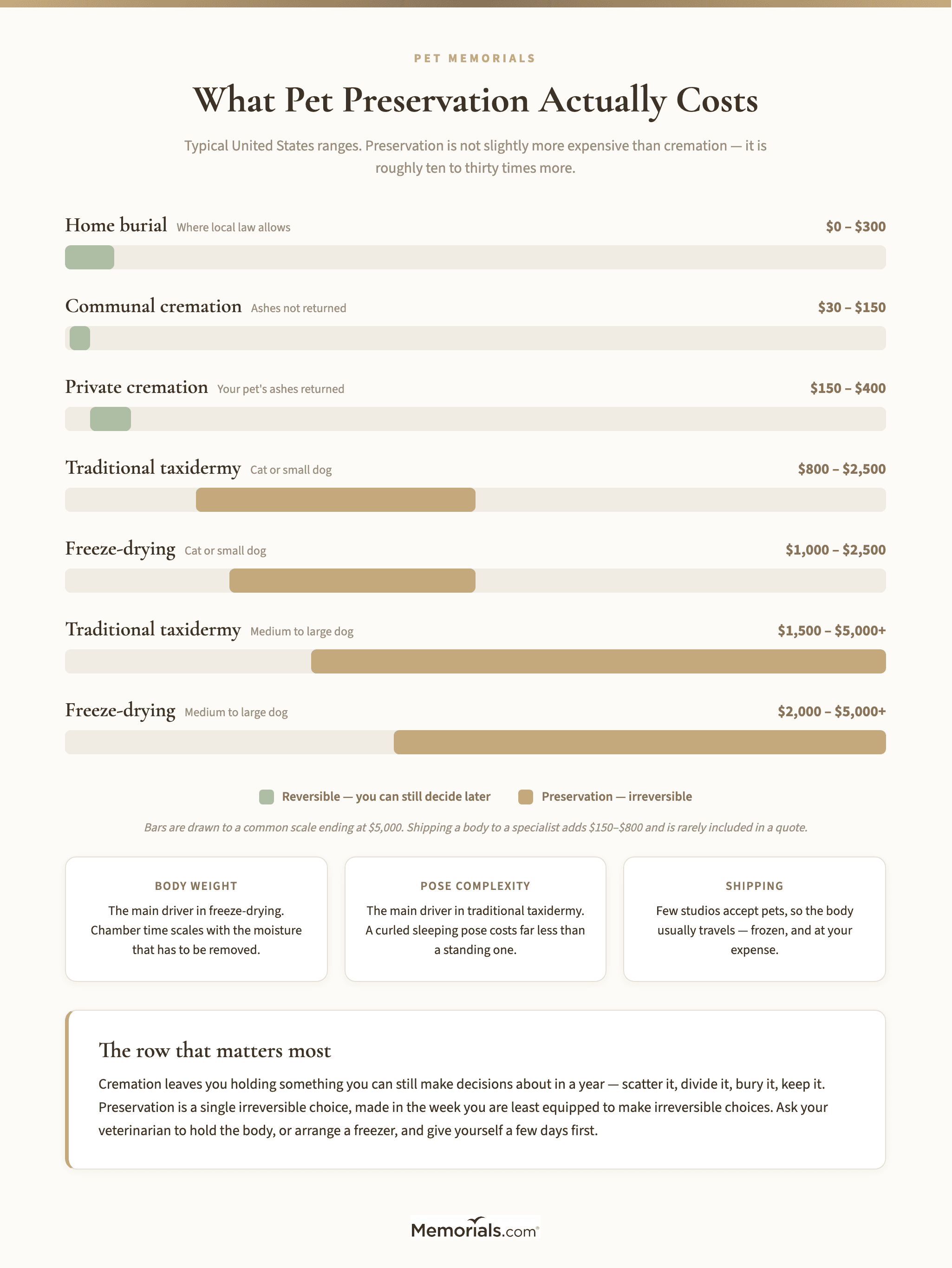
Cost is where most people's decision actually gets made, and the numbers surprise them. Pet taxidermy cost is driven by body weight and by how much hand-work the pose demands, so a quote is specific to your animal rather than to a menu.
As a general guide for work in the United States:
Service
Typical range
Priced by
Traditional taxidermy, cat or small dog
$800 – $2,500
Size and pose complexity
Traditional taxidermy, medium to large dog
$1,500 – $5,000+
Size and pose complexity
Freeze-drying, cat or small dog
$1,000 – $2,500
Body weight
Freeze-drying, medium to large dog
$2,000 – $5,000+
Body weight
Add-ons (custom base, case, shipping)
$150 – $800
Varies
A few things move these numbers more than people expect. Weight is the main driver in freeze-drying, because chamber time scales with the moisture that has to be removed — which is why dog taxidermy generally costs more than the same work on a cat, and why a heavy-coated 90-pound retriever can take a year and be priced accordingly. Pose complexity matters most in traditional taxidermy; a curled sleeping position is far cheaper than a standing pose with the head turned. And shipping a body to a specialist, which most people end up doing because few studios take pets, runs to several hundred dollars on its own and has to happen frozen.
It is worth setting that against the alternatives before going further. Private pet cremation cost generally runs $150 to $400 for a dog, and cat cremation cost is usually lower still. Preservation is not a little more expensive than cremation. It is roughly ten to thirty times more expensive, and that gap is the reason many families who start out set on taxidermy do not finish there.
Traditional Taxidermy vs. Freeze-Drying
Both methods produce a pet you can keep in the room. They fail in different ways, and the difference matters more for pets than it does for anything else.
Traditional taxidermy is the older craft and the more flexible one. A skilled taxidermist can pose an animal in almost any position, repair damage, and produce something durable for decades. But it depends entirely on sculpture. The taxidermist has to rebuild your pet's face from photographs and measurements, and faces are where recognition lives.
Freeze-drying keeps the real body, so the proportions, the paws, and the set of the face are genuinely your pet's rather than an interpretation. That is why most pet specialists now work this way. The trade-offs are real, though: it takes far longer, it is sensitive to humidity and pests afterward, and the pose is essentially locked at the start because the animal is positioned before the chamber and cannot be changed after.
Traditional taxidermy
Freeze-drying
What is preserved
The skin and fur only
The whole body
Facial accuracy
Sculpted; depends on the artist
The animal's own features
Typical timeline
6 – 12 months
6 – 12 months, sometimes longer
Pose flexibility
High
Fixed at the outset
Long-term care
Durable, dust it
Keep dry; watch for insects
Availability for pets
Fewer studios accept pets
More specialists available
Not all pet preservation options involve the whole animal, and the narrower ones are worth knowing about. Some families keep only a part — a paw, or the skeleton — which costs far less and asks less of the room it sits in. Pet skeleton preservation in particular is its own specialty, with its own cleaning methods and its own practical considerations.
How Long It Takes
Expect somewhere between six months and a year, and be prepared for longer.
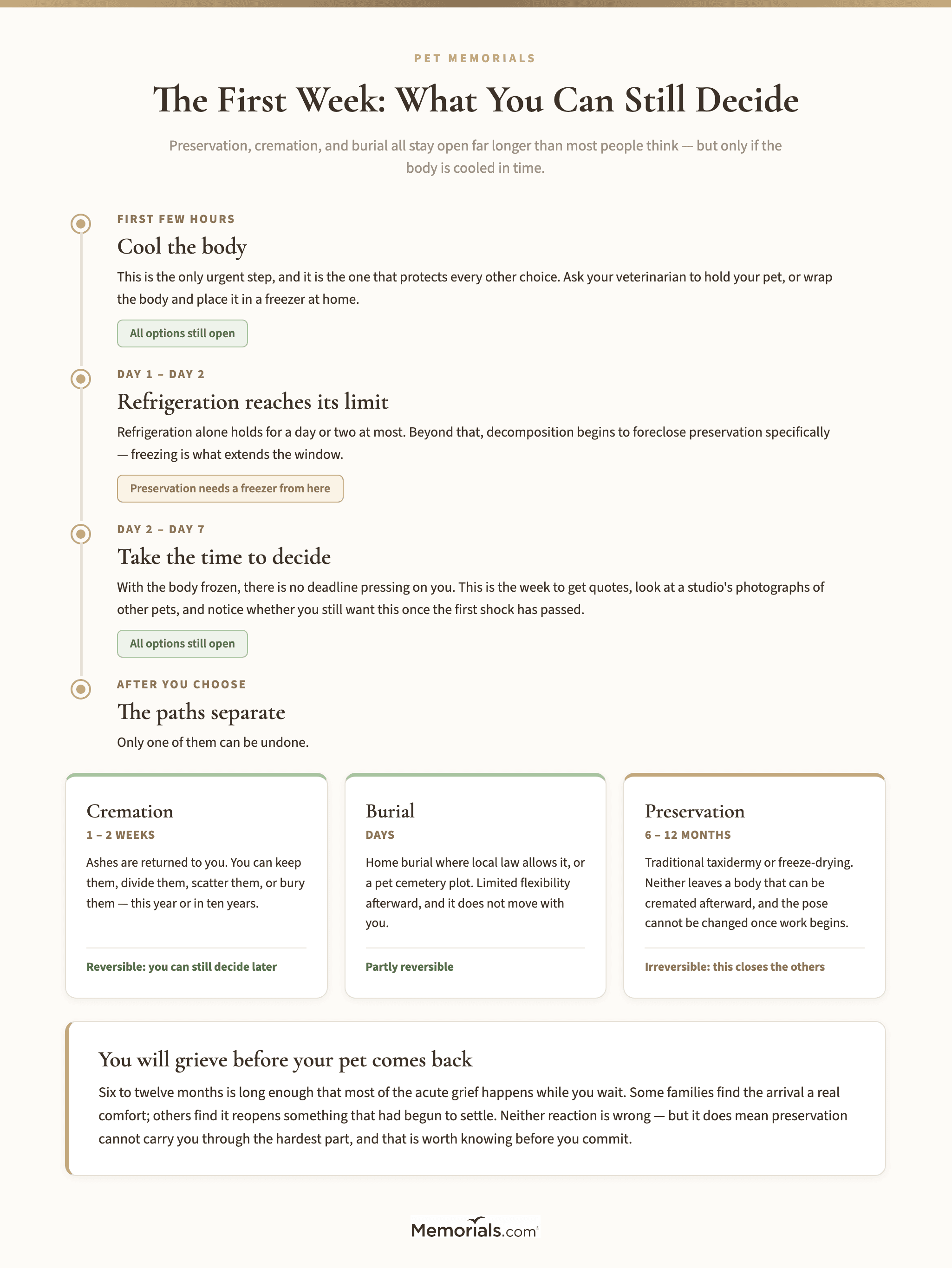
That timeline surprises people who are making the decision in the first 48 hours, and it deserves saying plainly: you will do most of your grieving before your pet comes back. Several months in, many people find that the arrival of the finished mount reopens something they had begun to settle. Others find it a genuine comfort. Neither reaction is wrong, but the delay means you cannot count on preservation to carry you through the acute part of the loss.
Until the work begins, the body has to stay frozen. If you are considering this at all, the immediate step is to get the animal into a freezer or ask your veterinarian to hold them — the same first move covered in what to do when your dog dies. Refrigeration is not enough for more than a day or two, and decomposition forecloses the option entirely.
The decision usually arrives in the first day or two, long before anyone feels ready to make it.
What the Result Actually Looks Like
This is the part worth reading twice, because it is where the disappointment lives.
Taxidermists themselves widely regard pets as the hardest work in the field, and many decline it outright. The reason is not technical difficulty. It is that you know this animal. You know the exact asymmetry of their face, how their eyebrows moved, what their expression did when you came through the door. A wildlife mount only has to look like a fox. A pet mount has to look like your dog, to the one person on earth who would notice a two-millimeter difference in the set of an eye.
Even excellent work tends to read as asleep rather than alive. Glass eyes do not focus. Fur that was constantly in motion is now still. Freeze-drying is more faithful to the real proportions, but it can also produce a slight shrinkage in the face and around the eyes as moisture leaves the tissue, which some owners find they cannot stop noticing.
None of this means the result is bad. It means the honest description of a good outcome is "a very close likeness of my pet, resting" — not "my pet." People who go in expecting the first are usually glad. People expecting the second are usually not.
The honest description of a good outcome is a very close likeness of your pet, resting.
Is Pet Taxidermy Legal?
For your own domestic pet, yes. Dogs, cats, rabbits, birds kept as pets, reptiles, and horses can all be legally preserved in the United States, and no permit is required to have your own animal mounted or freeze-dried.
The restrictions apply to wildlife, not pets. Native migratory birds are protected under the Migratory Bird Treaty Act, which makes possessing them illegal without specific authorization even if the bird died naturally in your yard. Endangered and threatened species are covered separately. Some states add their own rules for native game species. If your animal was anything other than a domestic pet, check before you commit to anything.
A practical note rather than a legal one: airlines and international borders treat preserved animals inconsistently, so if you expect to move abroad, ask before rather than after.
How It Compares to Cremation and Burial
Preservation is one of several ways to answer the same question, and it helps to see them next to each other. Our full comparison of whether it is better to cremate or bury a pet covers the two most common paths in more depth.
Preservation
Cremation
Burial
Typical cost
$1,000 – $5,000+
$150 – $400
$0 – $1,500
Time to completion
6 – 12 months
1 – 2 weeks
Days
Can you change your mind later
No
Yes, ashes remain
Limited
Portable if you move
Yes
Yes
No
Ongoing care
Dusting, humidity control
None
Site upkeep
Widely available
Few specialists
Nearly everywhere
Depends on local law
The row that matters most is the third one. Pet cremation leaves you holding something you can still make decisions about in a year — scatter it, divide it, bury it, keep it. Preservation is a single irreversible choice made in the week you are least equipped to make irreversible choices. That is not an argument against it. It is an argument for taking a few extra days, with the body frozen, before you commit.
Questions to Ask Before You Commit
If you are seriously considering it, these are the questions that separate a good outcome from an expensive regret:
How many pets have you done, and can I see photographs of them? Not wildlife. Pets, and ideally the same breed or a similar coat.
What is the full quote, including shipping both ways and any base or case? The headline price rarely includes freight, and freight is significant.
What is your realistic turnaround right now? Ask for a current figure, not a general one.
What happens if I am not satisfied? Most studios cannot redo the work — the material is finite. Understand that before, not after.
How should I care for it, and what will it look like in ten years? Ask specifically about humidity, sunlight, and insects.
What do you need from me now? Usually: freeze the body promptly, and supply clear photographs of the face from several angles, taken while your pet was alive.
Ask for references, and be wary of anyone who will not discuss the limits of the result honestly. A studio that only tells you it will look perfect is telling you something useful about itself.
If You Decide Against It
A great many people research this thoroughly and then choose something else — usually after the cost or the timeline lands. That is not a failure of nerve, and it does not mean settling for less.
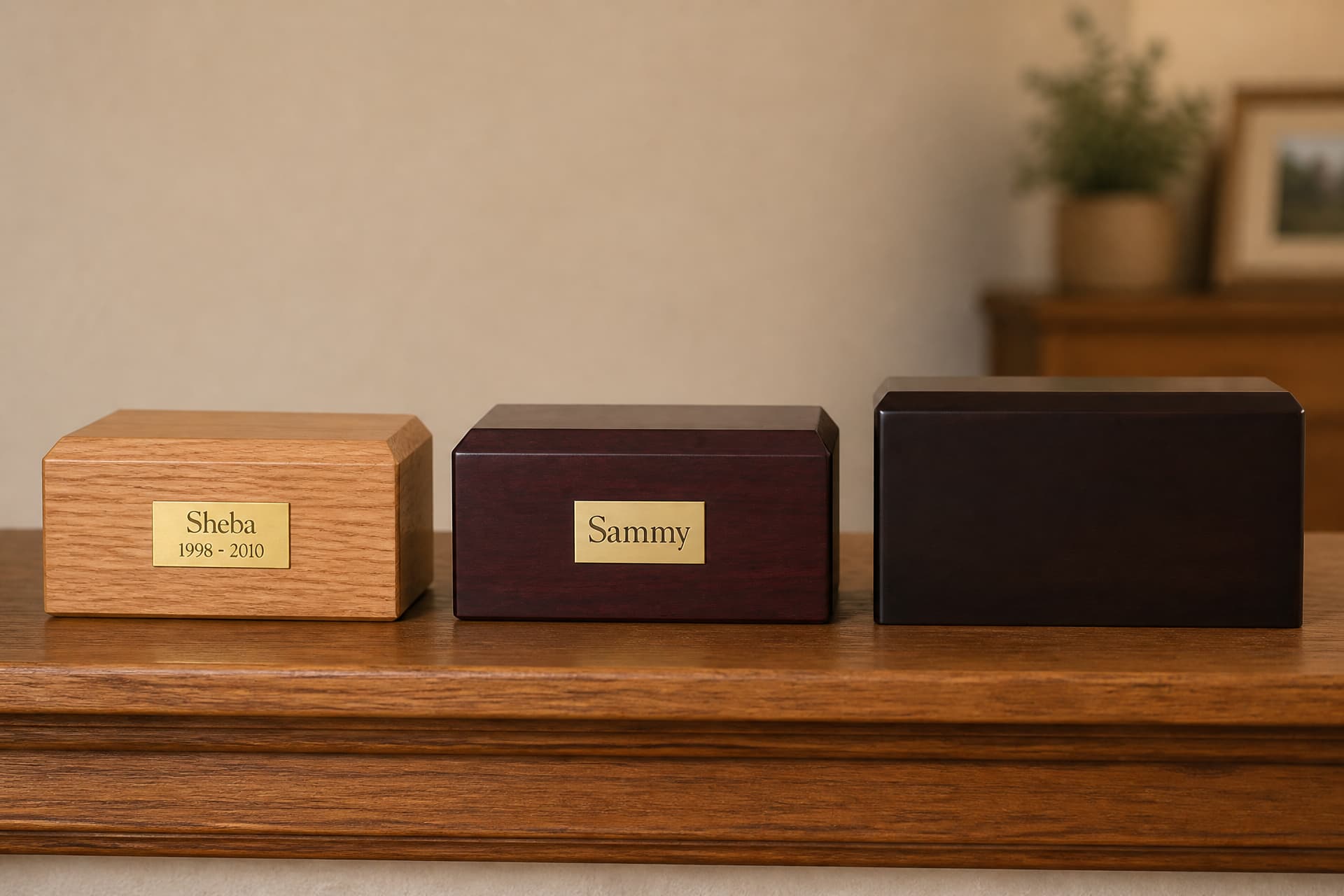
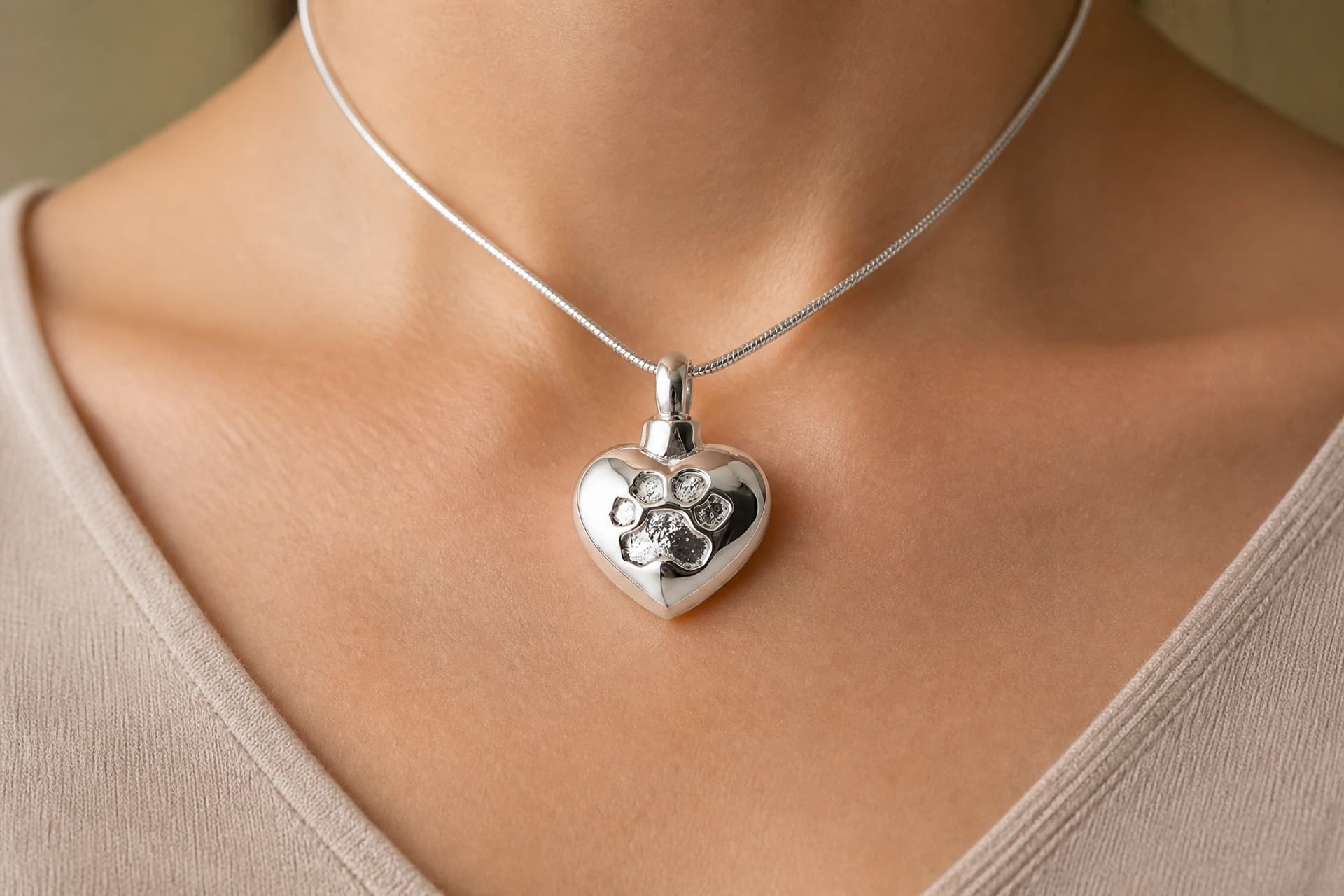
What most of those families want is something physical to keep, and there are gentler ways to get it. Cremation preserves the option to keep your pet with you in a form that suits the house you actually live in — pet urns range from plain wood to figurines that resemble the animal, and how to choose a pet urn walks through sizing and material. If you want something you can carry rather than display, pet cremation jewelry holds a small portion of ashes in a pendant or bracelet, and our guide to how it works covers sealing, capacity, and what to ask before ordering.
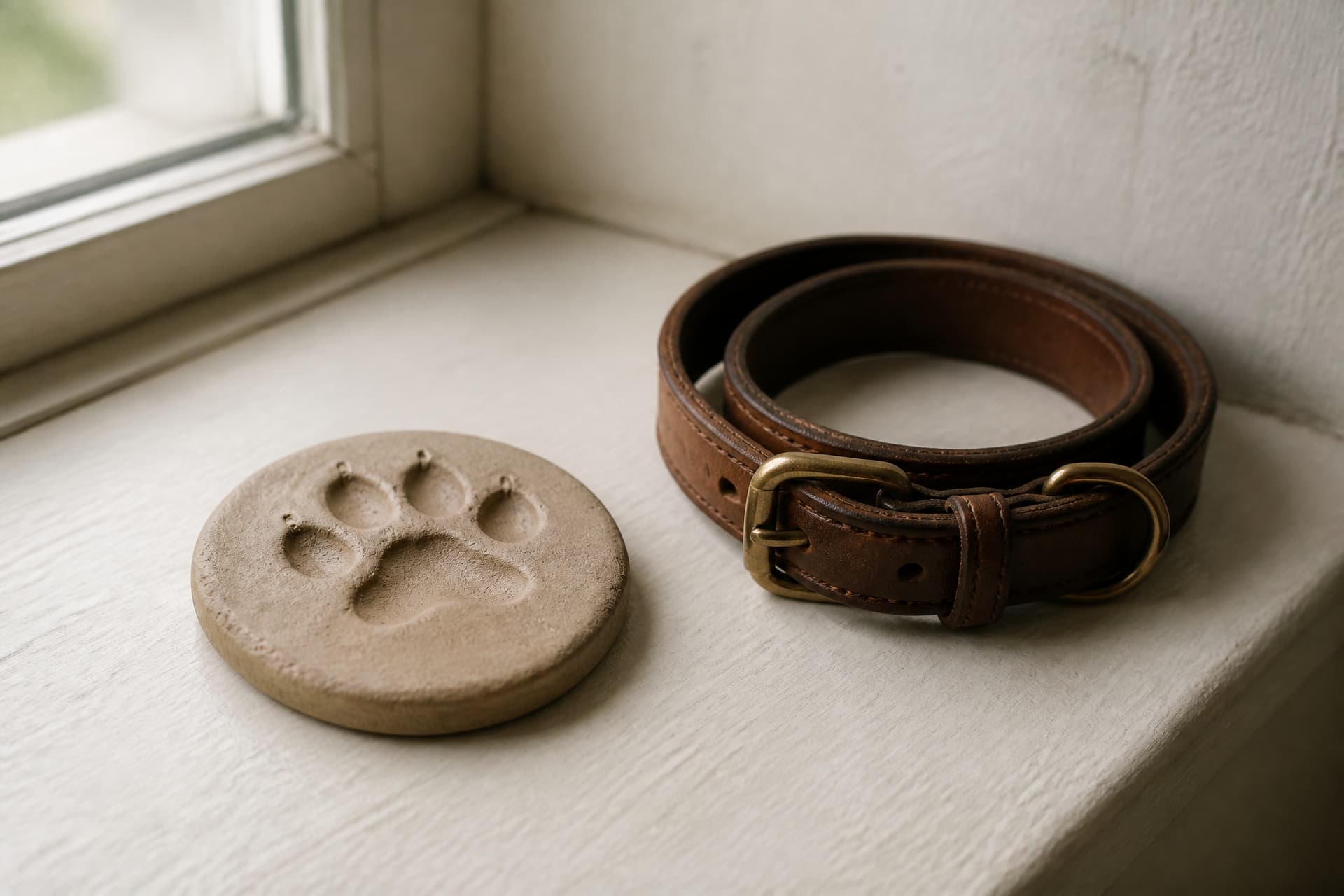
There are also the things that cost almost nothing and that people say they treasure most: a paw print taken at the veterinarian's office, a clipping of fur in a locket, a nose print, the collar kept on a hook. Our collection of pet memorial ideas has more of these, and several are still possible after cremation.
Ask for a paw print before you leave the veterinarian's office. It costs almost nothing and cannot be taken later.
A Word About the Decision Itself
If you are reading this within a day or two of a death, the most useful thing anyone can tell you is that you do not have to decide today. Ask your veterinarian to hold the body, or arrange a freezer. That buys you a week, and a week is often the difference between a decision you made and a decision that happened to you.
Whatever you choose, wanting to keep your pet in a form you can see and touch is not morbid or excessive. It is the same thing people have always wanted from a photograph or a headstone, expressed a little more literally. If you are struggling with the loss itself rather than the logistics, grieving the loss of a pet may be the more useful place to start.
Frequently Asked Questions
How much does it cost to taxidermy a dog?
Most dogs fall between $1,500 and $5,000, with small dogs at the lower end and large or heavy-coated breeds above it. Freeze-drying is generally priced by body weight, while traditional taxidermy is priced by size and pose complexity. Shipping the body to a specialist typically adds several hundred dollars and is rarely included in a quoted price.
How much does it cost to taxidermy a cat?
Cats usually run $800 to $2,500. Because cats are smaller and lighter, freeze-drying chamber time is shorter and the work costs less than it does for most dogs. As with dogs, the quote depends on the pose and on whether a base or display case is included.
How long does pet taxidermy take?
Six to twelve months is typical, and longer is common for large animals. Freeze-drying takes months in the chamber alone, with heavier animals needing proportionally more time. The body must stay frozen until the work begins.
Is freeze-drying better than traditional taxidermy for pets?
For pets specifically, most specialists now prefer freeze-drying, because it preserves the animal's real body and therefore their actual facial proportions rather than a sculpted approximation. Traditional taxidermy offers more flexibility in posing and is more durable long-term, but it depends heavily on the individual artist's skill at rebuilding a face you know intimately.
Can I still cremate my pet after taxidermy?
No. Both traditional taxidermy and freeze-drying are irreversible, and neither leaves a body that can be cremated afterward. This is the main practical reason to take a few days — with the body frozen — before deciding.
Is it legal to taxidermy my dog or cat?
Yes. Domestic pets are not subject to the wildlife protections that govern taxidermy of native birds, game animals, and endangered species. No permit is required to preserve your own pet in the United States.
What does a preserved pet actually look like?
At its best, a very close likeness of your pet at rest. Even excellent work reads as sleeping rather than alive, because the eyes are glass and the fur no longer moves. Freeze-drying is more faithful to real proportions but can shrink slightly around the face as it dries. Owners who expect a close likeness are usually satisfied; owners who expect the animal back are usually not.