🏬Supersize Online Funeral Retailer🪦1000's of Headstones⚱️Over 10,000 Cremation Urns⚰️Caskets Overnight Delivery🛒Funeral & Memorial Superstore🚚FREE Shipping on ALL Orders👨👩👧👦Helping Families for over 20 Years💰Lowest Price Guarantee🏬Supersize Online Funeral Retailer🪦1000's of Headstones⚱️Over 10,000 Cremation Urns⚰️Caskets Overnight Delivery🛒Funeral & Memorial Superstore🚚FREE Shipping on ALL Orders👨👩👧👦Helping Families for over 20 Years💰Lowest Price Guarantee
🏬Supersize Online Funeral Retailer🪦1000's of Headstones⚱️Over 10,000 Cremation Urns⚰️Caskets Overnight Delivery🛒Funeral & Memorial Superstore🚚FREE Shipping on ALL Orders👨👩👧👦Helping Families for over 20 Years💰Lowest Price Guarantee🏬Supersize Online Funeral Retailer🪦1000's of Headstones⚱️Over 10,000 Cremation Urns⚰️Caskets Overnight Delivery🛒Funeral & Memorial Superstore🚚FREE Shipping on ALL Orders👨👩👧👦Helping Families for over 20 Years💰Lowest Price Guarantee
Anyone looking for the best plants for cemetery plots is usually answering the wrong question first. Before the plant matters, one thing decides everything: whether the cemetery permits planting at all. A great many do not, a great many permit it only in containers, and the families who find this out after planting are the ones who arrive one spring to find everything gone.
So this guide starts with permission, then covers what survives on rain and neglect if the answer is yes, and what to do instead if the answer is no.
Can You Plant Flowers at a Grave?
The honest answer is: sometimes, and less often than people assume.
Most modern cemeteries restrict planting in the ground, and lawn-park and memorial-park cemeteries usually prohibit it outright. The reasons are practical rather than unkind.
Grounds are cut in long mechanical passes. Anything growing outside the marker's footprint is an obstacle that has to be trimmed around by hand, and on a cemetery with thousands of graves that is not a small ask.
Roots. Woody roots lift and crack markers and foundations, and they interfere with future interments in the same plot.
Spread. A plant that behaves in a garden bed will colonize a lawn. Ivy and periwinkle are the classic offenders, and a cemetery that allows either once spends years removing it.
The plot is not yours in the way you think. Buying a plot buys interment rights, not the land. The cemetery retains control of the surface, which is why it can and does remove plantings.
Ask these three questions of the cemetery office before buying a single plant: is planting in the ground permitted in this section; are potted or container plants permitted, and on what dates; and when does the cemetery clear the grounds? That third one matters most, because almost every cemetery has scheduled clearances and anything left out is collected. Our notes on cemetery etiquette cover the conventions around all of this.
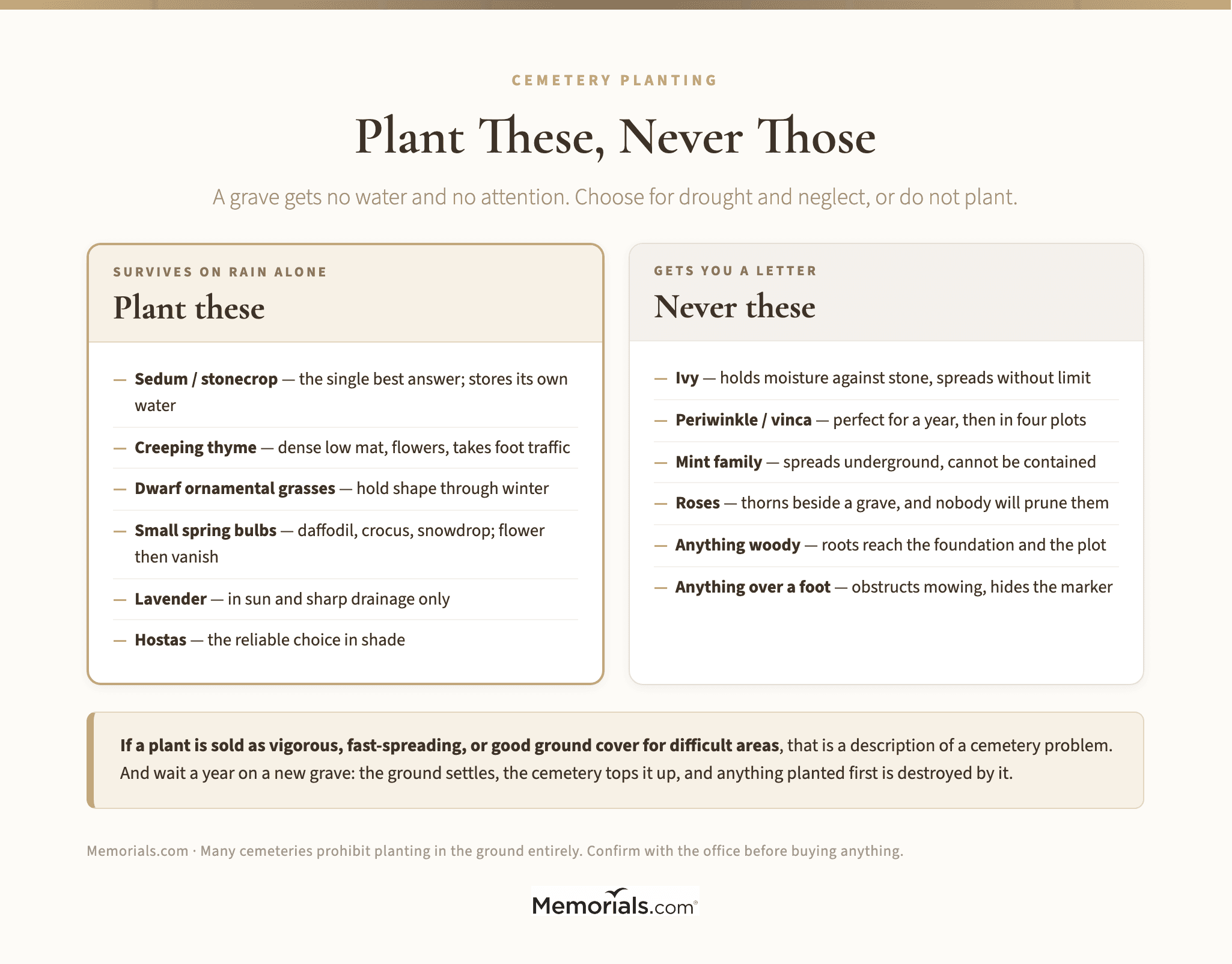
Six that survive on rain and neglect, and six that get a family a letter from the cemetery office.
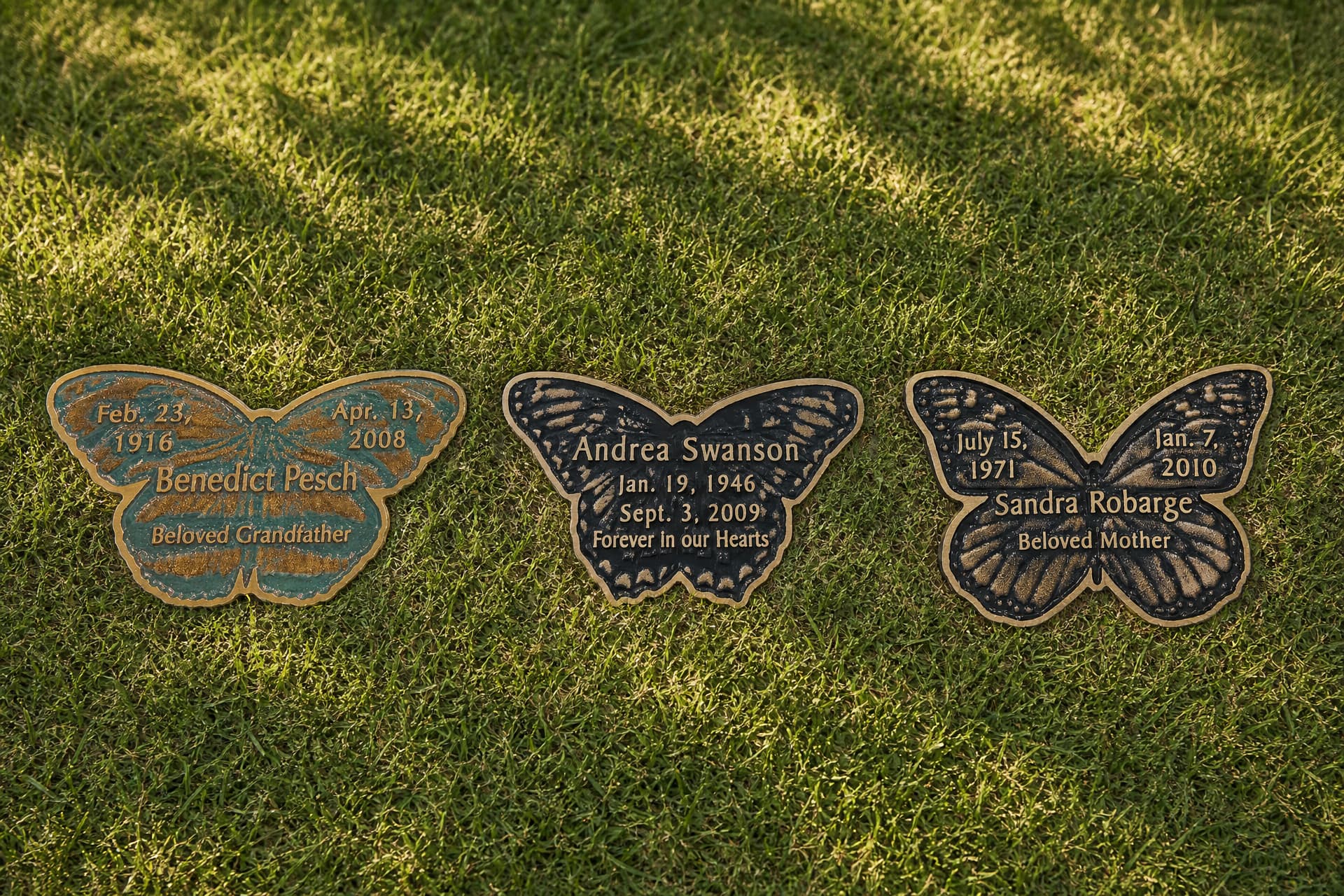
Shop Grave and Garden Markers
Flush bronze markers and engraved garden stones for planted memorials
A grave is a hostile site. Nobody waters it, the soil is usually compacted and poor, it is fully exposed, and it gets visited a few times a year. The plants that work are the ones that would survive in a neglected rock garden.
Four qualities to look for, in order of importance: drought tolerance, shallow roots, a low mature height that stays inside the marker's footprint, and no spreading habit. Anything that needs all four is, by definition, one of the low maintenance plants for a grave rather than a garden plant being asked to cope.
The best flowers for graves, as opposed to foliage, are almost all bulbs for the same reason: they do their flowering and then remove themselves.
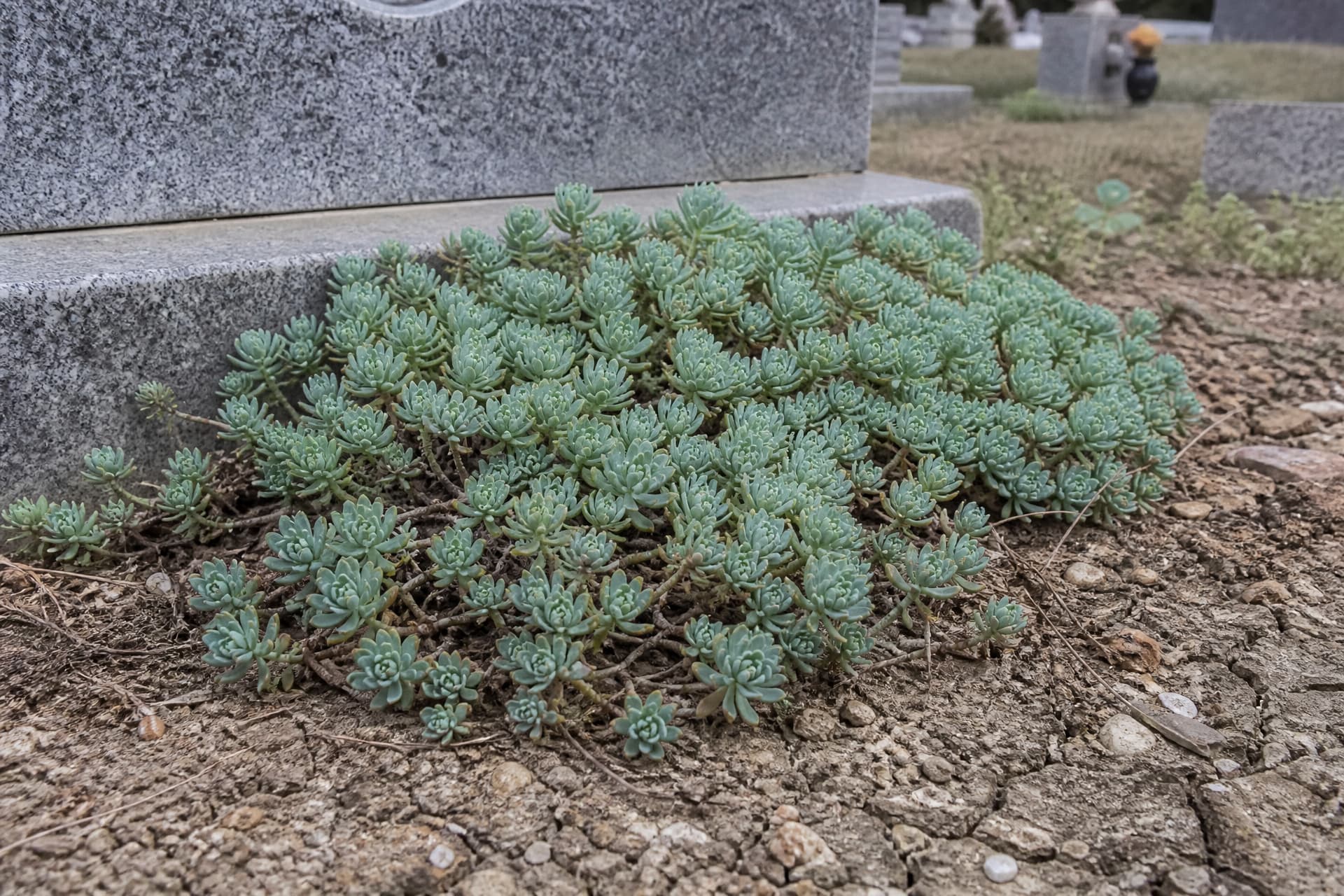
Sedum, also called stonecrop. The single best answer for most graves. It stores water in its leaves, it thrives in poor soil, its roots are shallow, and the low mat-forming varieties stay under a few inches. It survives being ignored for a year.
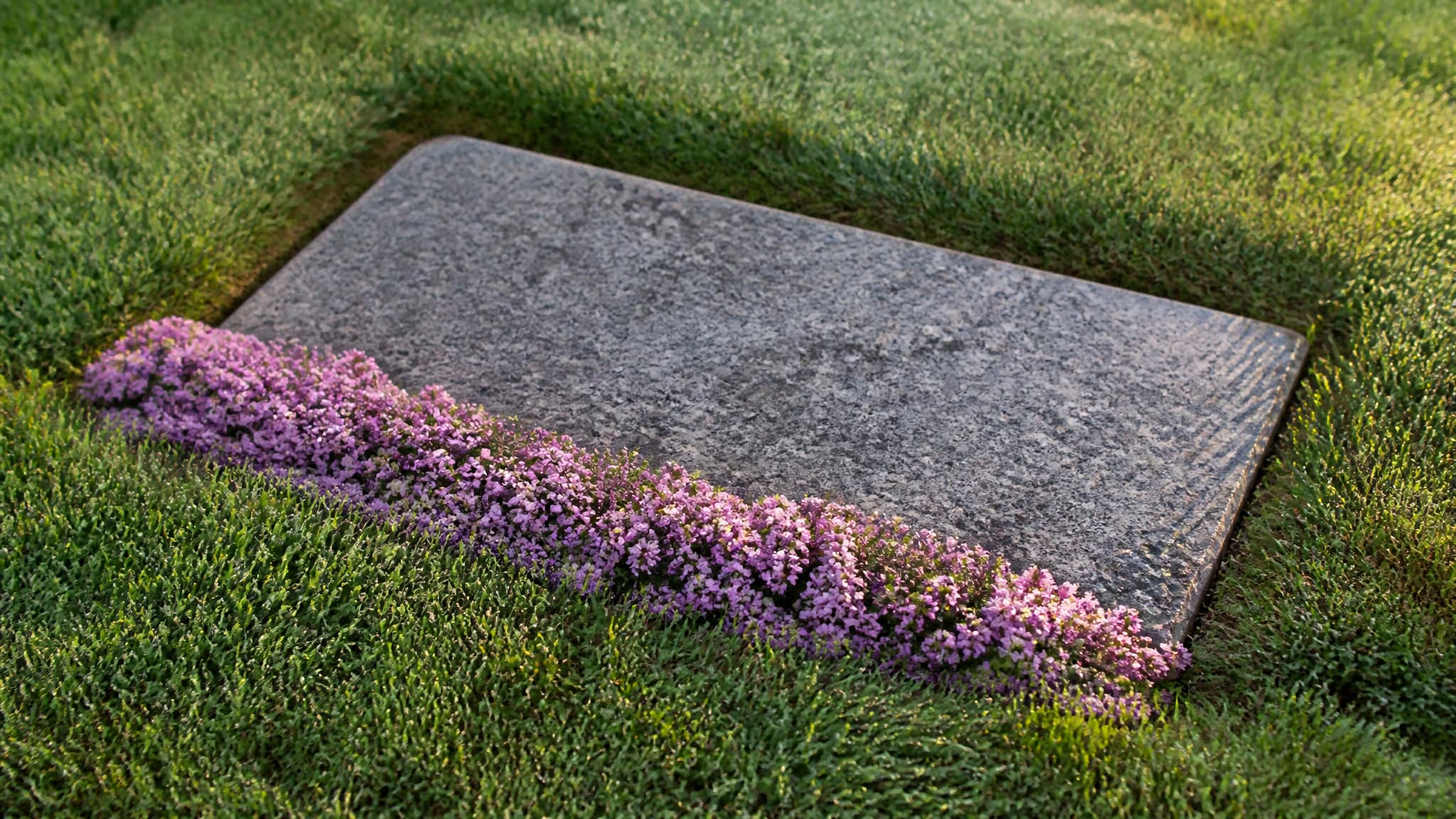
Sedum in exactly the conditions a grave offers: compacted soil, full sun, no water, nobody coming. This is what drought tolerance actually looks like.
Creeping thyme. Forms a dense low mat, tolerates drought and foot traffic, flowers in early summer, and smells good when brushed. Wants sun and sharp drainage.
Dwarf ornamental grasses. Blue fescue and similar clump-formers hold their shape, need nothing, and look intentional in winter when everything else has gone.
Lavender, in a dry sunny spot. Long-lived, deeply associated with remembrance, and genuinely unbothered by neglect. It dislikes wet feet, so it fails in heavy soil.
Small spring bulbs. Daffodils, crocus, snowdrops and grape hyacinth are the traditional grave planting for a reason: they appear, flower, die back, and ask nothing for the rest of the year. They also naturalize, so they increase. Plant them in autumn.
Hostas, if the grave is shaded. Under a tree, where most of the above will sulk, hostas are the most reliable of the low maintenance plants for graves. They disappear entirely in winter.
Rosemary, where winters are mild. The remembrance symbolism is ancient and the plant is tough, but it will not survive a hard winter in the ground.
What Not to Plant
This list matters more than the one above, because these are the plants that get a family a letter from the cemetery.
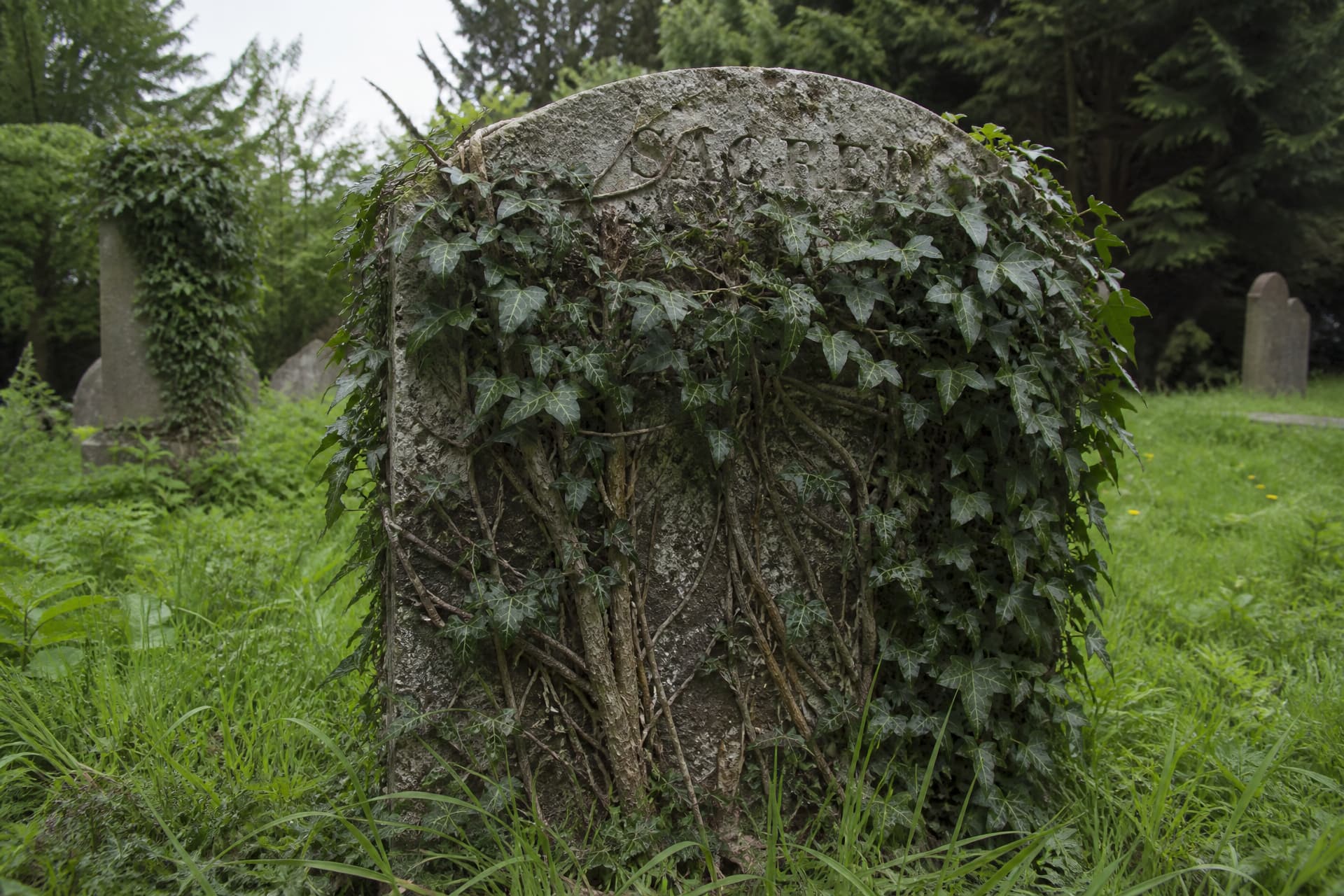
Ivy. Traditional, and a genuine menace. It spreads without limit, climbs and holds moisture against stone, and is very difficult to remove once established.
Twenty years of one plant. The ivy is holding moisture against the stone and has taken the inscription; removing it now will take some of the surface with it.
Periwinkle, or vinca minor. Same problem. It looks perfect for a year and then it is in the next four plots.
Mint and anything in its family. Spreads underground and cannot be contained in open soil.
Roses. Thorns beside a grave are a hazard for groundskeepers, and roses need pruning, feeding and spraying that nobody will give them.
Anything woody. Shrubs and trees are prohibited almost everywhere. The roots reach the foundation and the plot.
Bamboo. For the obvious reason.
Tall perennials. Anything over about a foot obstructs mowing and obscures the marker.
If a plant is described as vigorous, fast-spreading or good ground cover for difficult areas, that is the description of a cemetery problem.
Potted Plants: Usually the Permitted Option
Where in-ground planting is refused, containers are often allowed, and they solve most of the objections at once — nothing roots into the plot, nothing spreads, and the whole thing lifts out for mowing.
The best potted plants for graves are the ones that tolerate a container drying out completely: sedum again, small succulents, dwarf conifers, ornamental grasses, and seasonal bedding if somebody will visit often enough to replace it.
Two practical points. Use a heavy container, because light pots blow over and end up in the next section. And check whether the cemetery specifies a container type — many require a particular style, and many require that pots sit on the marker or foundation rather than on the turf.
A permanent vase is the tidier version of the same idea and is permitted far more widely than pots are, because it is fixed and does not move. Our guide to choosing cemetery vases covers mounting and materials, and our cemetery vases range covers the formats.
Planting Around a Marker Without Damaging It
Three things cause almost all the damage we see.
Digging too close to the foundation. Keep planting outside the concrete. Roots and repeated digging at the edge undermine it, and a leaning marker is an expensive repair.
Soil piled against the stone. It traps moisture against the surface and accelerates staining and, on softer stone, spalling. Keep the soil level below the base.
Fertilizer and plant food on the stone. These stain granite and corrode bronze. If you feed a planting, keep it off the marker and rinse anything that lands.
Planting works when it matches how often the grave is actually visited.
Visiting a few times a year: spring bulbs and one drought-proof mat plant. Nothing else will survive.
Visiting monthly: add a potted seasonal plant and swap it three or four times a year.
Visiting weekly: anything the cemetery permits is viable, including bedding plants that need water.
Be honest about the first of these. A planting that needs care it will not get looks worse after two years than bare turf, and that is the outcome most families are trying to avoid.
If Planting Is Not Allowed at All
Plenty of graves fall here, and it is not the end of the idea.
Cut flowers in a fixed vase are permitted almost everywhere, and which blooms actually last at a graveside is a separate question — our guide to the best flowers for a gravesite covers which ones survive the week. Seasonal decoration is permitted in most grounds within limits, covered in seasonal cemetery decorations and in our wider cemetery grave decoration ideas. And a permanent gravestone decorations piece asks nothing of anybody between visits.
For a living memorial where a cemetery will not take one, the answer is usually to move it. A tree, a shrub, or a corner of a garden at home carries the same intent and none of the restrictions, and it can be visited without driving anywhere.
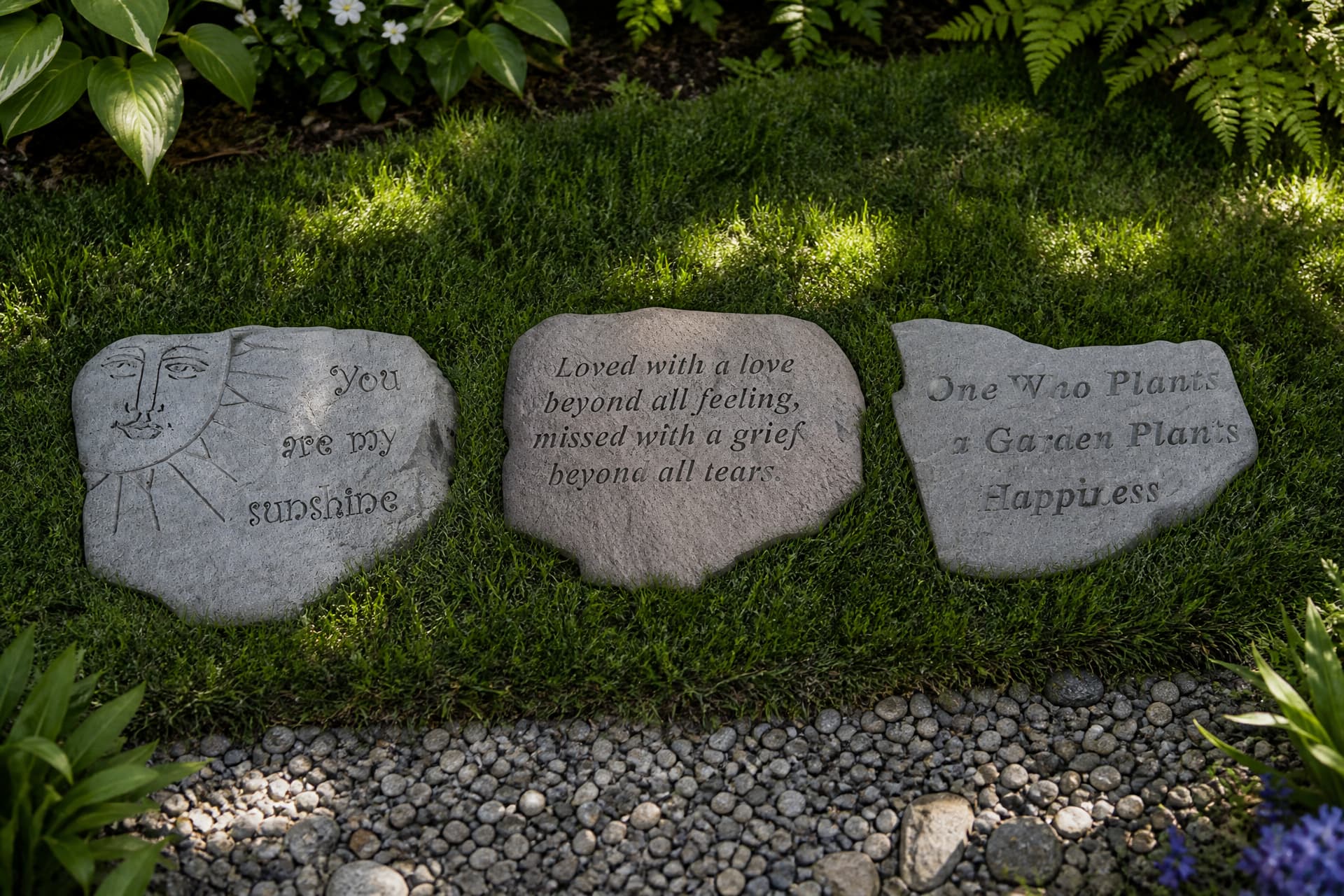
That is also where a marker becomes worth having, because an unmarked planting stops meaning anything once the person who planted it is gone. A memorial rock garden stone set into the planting gives it a name and a date, which is the whole difference between a memorial and a shrub. Families who cannot plant at the grave frequently end up preferring this arrangement anyway: it is theirs, nobody clears it on a schedule, and it can be as elaborate as they want.
Grave soil is usually terrible, and it explains most of the failures that get blamed on the plant.
A grave is backfilled with whatever came out of it, dropped back in, and then driven over by equipment. What you are planting into is compacted subsoil with very little organic matter and often a lot of clay. Water sits on it in winter and it sets like brick in summer. That combination kills lavender and rosemary faster than cold does, because both die from wet roots rather than from frost.
Two things help and neither needs the cemetery's permission in any grounds that allow planting at all. Break up the top few inches where you are planting rather than pushing a plant into an unopened hole. And plant slightly proud, with the crown a little above the surrounding level, so water drains away from it instead of pooling around the stem.
If the ground is genuinely waterlogged, stop fighting it and use a container. A pot with drainage holes gives you complete control over the one variable the site will not give you.
When a Grave Is New
Hold off for the first year.
Fresh graves settle, sometimes by several inches, and the cemetery will usually top up and reseed the surface once settling finishes. Anything planted before that is either buried or lifted, and the topping-up will destroy it either way. The marker itself is often not set for months for the same reason.
Wait for the ground to be level and the marker to be in place. Then plant.
Frequently Asked Questions
Can you plant flowers at a grave without asking? You can, and they will probably be removed. Cemeteries clear the grounds on a schedule and unauthorized plantings go with everything else. The permission is free; ask for it.
What is the best cemetery plant for full sun and no water? Sedum. Nothing else on the list tolerates that combination as reliably, and it spreads slowly enough to stay where it was put.
Are artificial flowers a good alternative? They are permitted in some cemeteries and banned in others, often seasonally. They also fade badly and shed plastic. Check the rules before buying.
What are the best flowers for cemetery planting in shade? Snowdrops and crocus in early spring, hostas through summer. Both die back completely, which cemeteries prefer.
Will a plant damage the headstone? A shallow-rooted plant kept off the foundation will not. Ivy, woody shrubs and anything piling soil against the stone will.
Who is responsible for a planting once it is there? The family, in every cemetery we know of. Grounds staff mow and maintain the turf; they do not weed, water or replace anything a family put in. If a planting dies it stays dead until somebody removes it, which is the practical argument for choosing something that cannot die.
Can I plant on a grave that already has a flush marker? Usually only outside the marker's footprint and only if the section permits planting at all — and flush-marker sections are the most likely to refuse, because that rule exists to keep the mowing line clear.
Ask, Then Plant Something Tough
Two steps, in that order. Get the section's rules from the cemetery office, and then choose for drought and neglect rather than for the picture in your head. Sedum and a handful of spring bulbs will still be there in five years; almost nothing else will.
For the wider set of decisions about the plot and what may go on it, start with our cemetery planning guide.