🏬Supersize Online Funeral Retailer🪦1000's of Headstones⚱️Over 10,000 Cremation Urns⚰️Caskets Overnight Delivery🛒Funeral & Memorial Superstore🚚FREE Shipping on ALL Orders👨👩👧👦Helping Families for over 20 Years💰Lowest Price Guarantee🏬Supersize Online Funeral Retailer🪦1000's of Headstones⚱️Over 10,000 Cremation Urns⚰️Caskets Overnight Delivery🛒Funeral & Memorial Superstore🚚FREE Shipping on ALL Orders👨👩👧👦Helping Families for over 20 Years💰Lowest Price Guarantee
🏬Supersize Online Funeral Retailer🪦1000's of Headstones⚱️Over 10,000 Cremation Urns⚰️Caskets Overnight Delivery🛒Funeral & Memorial Superstore🚚FREE Shipping on ALL Orders👨👩👧👦Helping Families for over 20 Years💰Lowest Price Guarantee🏬Supersize Online Funeral Retailer🪦1000's of Headstones⚱️Over 10,000 Cremation Urns⚰️Caskets Overnight Delivery🛒Funeral & Memorial Superstore🚚FREE Shipping on ALL Orders👨👩👧👦Helping Families for over 20 Years💰Lowest Price Guarantee
Ask how much is cremation in California and you will be quoted a package price. Across 34 published California price lists we read in 2026, direct cremation starts between $875 and $3,195, median $1,642.50 — each figure the lowest direct-cremation price on that provider's own document.
Which number you get depends on the kind of company you dialed, not on where you stand. Cremation-only providers, who sell nothing else, hold the bottom of the range; full funeral homes with chapels and staffed hours sell the same cremation as one line on a long price list, and hold the top. The California cremation cost spread is not geography, and it is not the price of the cremation itself — it is what else the firm is set up to do.
What Cremation Costs in California
A floor of $875, a median of and a top of put California and . The national median of the fifty state medians is $1,925, so California sits below the middle.
The floor is not an ordinary retail price: it is a member rate at a nonprofit consumer memorial society, reached through a $65 membership that can be bought even after a death has occurred.
Federal law makes every California funeral establishment hand you an itemized general price list and quote prices by phone, but nothing requires publishing one online. If a firm has no document on its website, ask for the itemized list — it has to give you one.
Urns for After a Direct Cremation
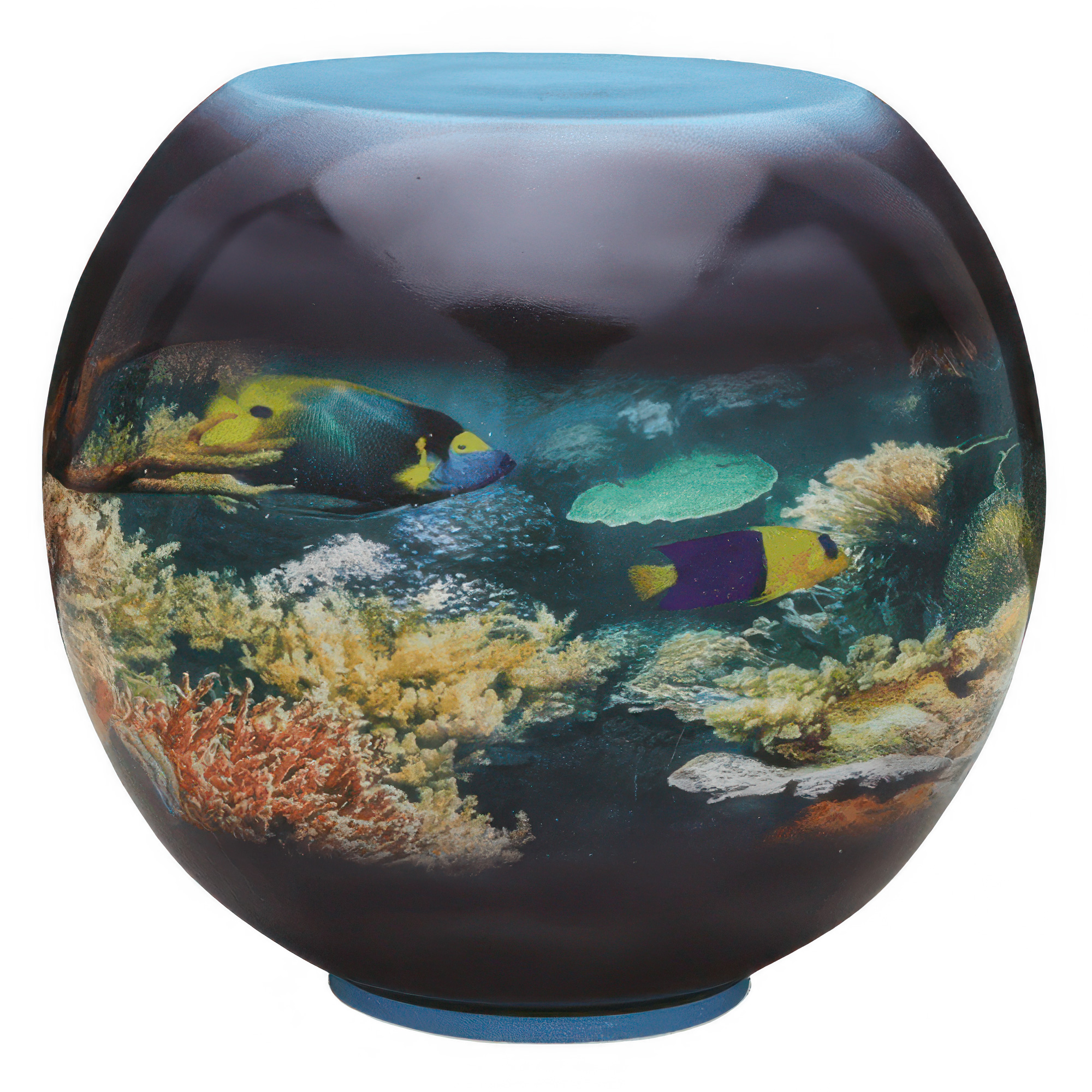
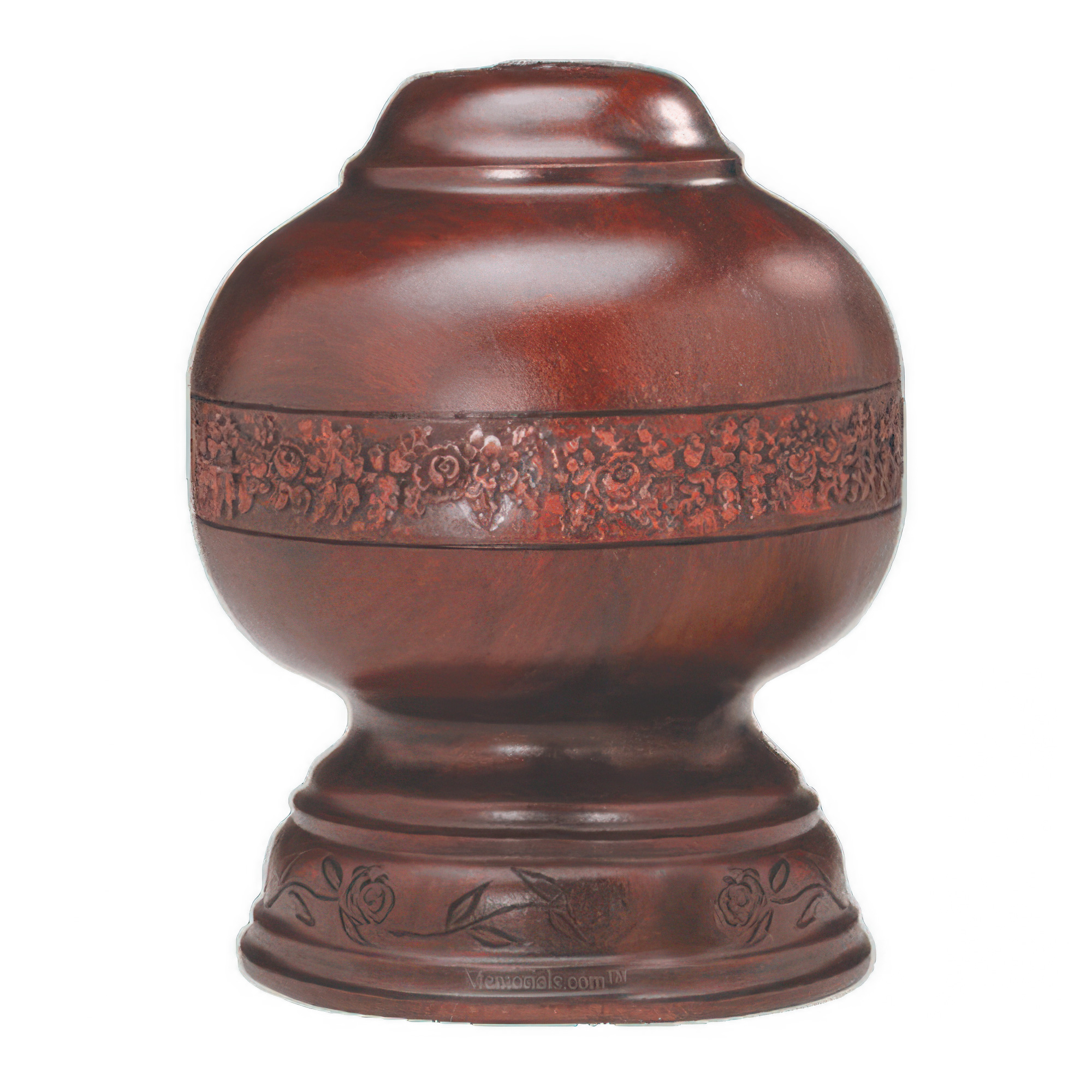
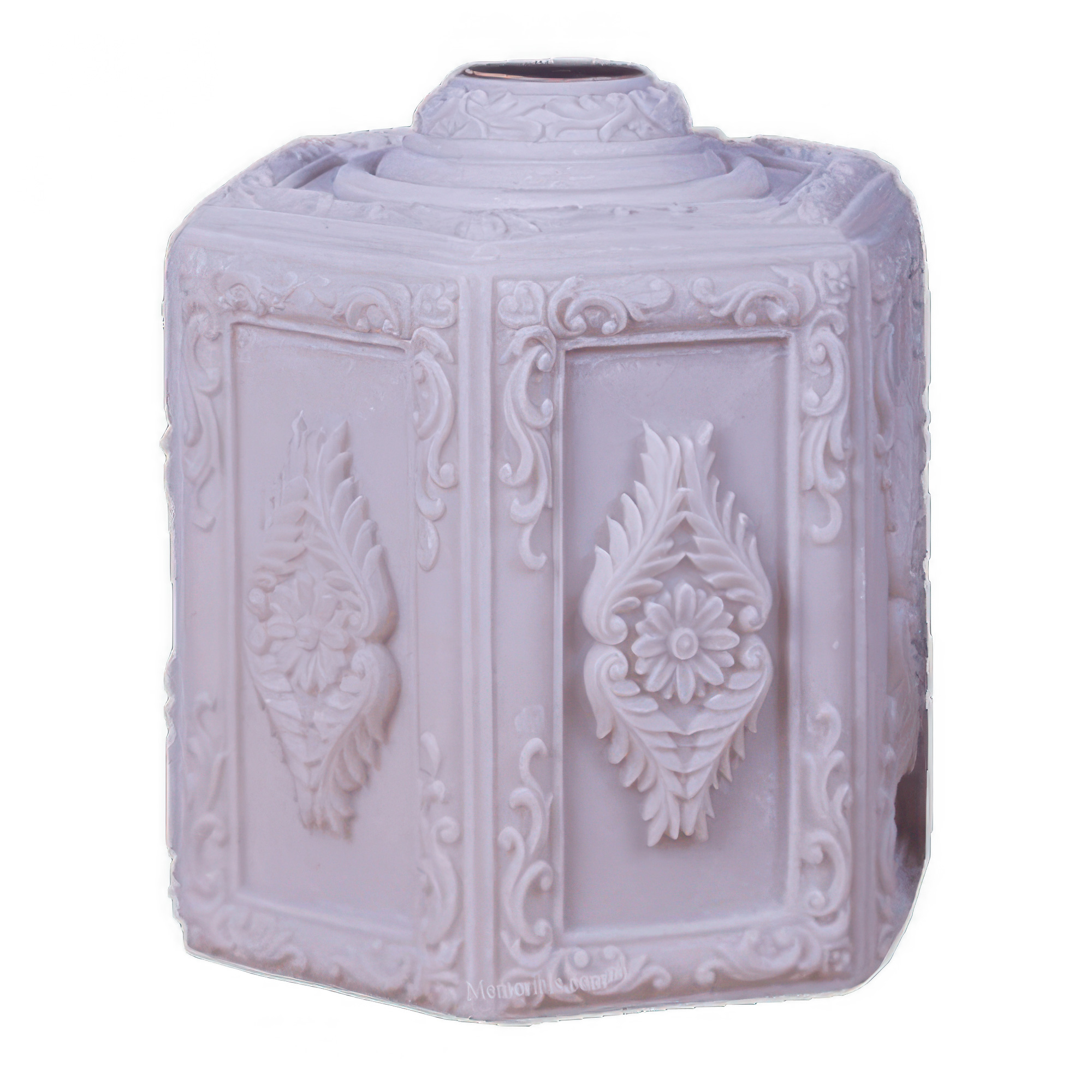
Almost no California price list includes a permanent urn
Most of the gap is one fact: the firms at the bottom of California's published range and the firms at the top are not the same kind of business. They are selling different amounts of business, and the cremation is the part they have in common.
The cremation-only provider sets the floor
A cremation-only provider sells one thing. It either owns a retort or contracts with a crematory that does, it arranges by phone or online, and several have no premises a family would ever visit — no chapel, no viewing rooms, no staffed hours to keep lit. The whole company is built around a single transaction, so the price sits close to what that transaction costs to perform. Firms of that shape hold the bottom third of the state's range.
The full funeral home occupies the middle and the top
A full funeral home is a building before it is anything else: arrangement offices, a chapel or viewing rooms, refrigeration, grounds, and staff who answer the phone at three in the morning. It sells direct cremation as one line on a price list that also carries embalming, visitations, services with your loved one present, graveside committals and caskets, and it publishes almost everything in the upper half of California's range.
Why one is cheaper
The cheaper firm is not undercutting the expensive one. It is selling less. The chapel, the viewing rooms and the staffed hours are real costs, and a funeral home's direct-cremation line has to carry a share of a building the cremation-only operator never built. The retort itself does not know which company it works for: both perform the same direct cremation, and neither does it better. What separates the bottom of California's range from the top is standing capacity — and if a direct cremation is all you want, the top of that range is capacity you will pay for and never use.
What the cheaper option cannot do
It cannot hold a viewing, or a service with your loved one present, and it generally cannot turn into a burial if the family changes its mind after the arrangements are made. Those are not upsells a cremation-only firm has chosen not to offer — they need a room, refrigeration and staff on site, and a company with none of the three cannot produce them at any price.
We found no separate California license category for a cremation-only seller — a statement about our lookup, not about the world. Some states draw that line with a license: Florida licenses a "direct disposal establishment" and limits what it may sell, so there the cheap option is barred from holding a viewing rather than merely unequipped for one. California is not built that way, and the cheapest providers in our file publish the same kind of FD number a full-service mortuary does.
So the line between the two kinds of firm is business model rather than license, as far as we could establish, and no credential on the document will draw it for you. Decide first whether the family will want time with your loved one beforehand, then ask each provider whether it has a chapel and can arrange a viewing. Settle that before you compare numbers: the cheapest quote in this state and the most expensive one are not two prices for the same purchase.
One template, many names
A second thing widens the range, and it is worth knowing before you treat two quotes as two opinions. Seventeen of the California lists we read share a template word for word, served from one file host, and several once-independent brands now point their own domains at it — so two firms you would take for competitors can be quoting you from the same document. One template is not one price, either: those firms publish floors spanning nearly the whole width of the state's range, and two of them sit in the same town, on the same template and the same effective date, hundreds of dollars apart. Ask each firm what its price covers rather than assuming the gap means something.
Read the bottom of a printed range rather than the top, too. The FTC Funeral Rule makes a price list cover every container up to a hardwood casket, so the ceiling of a published direct-cremation range is usually a cremation with a purchased cremation casket rather than anything a family shopping on price would buy — our cremation cost by state guide explains that at length. Some California lists go further and print natural organic reduction, a different disposition method, as the top line of the same block.
What Is Included, and What to Ask
California lists describe what they cover inconsistently — some itemize, some price by container variant, some name only what they exclude — so no rule of thumb will tell you what a given firm's floor buys. The itemized list will, if you make it name the items rather than quote you a package.
Six things to establish, and what each looks like when it goes wrong in this state.
Where the cremation itself is priced. On some California lists the cremation charge is not inside the package at all. It sits further down the same document among the cash advance items — disclosed and priced, but billed alongside rather than within, and enough to move a headline floor by a few hundred dollars.
Refrigeration. Some California firms carry it inside the price and some bill it separately, which can run into the hundreds. The lists that charge for it cite the rule that makes it hard to avoid: a funeral director holding someone unembalmed longer than 24 hours must arrange refrigeration, which they attribute to Business and Professions Code 1223c. We report that as what the lists say, not as a section we verified.
Which container the quoted line assumes — and do not assume the frugal answer is the cheap one. Several California lists price a direct cremation higher when the family supplies its own container than when the provider supplies its alternative.
The transfer, and how far it reaches. Ask whether bringing your loved one into the provider's care is inside the price, then ask for the radius in miles and the per-mile rate past it. A transfer from a hospital across town and one from a home two counties away are the same line item with very different bills.
Weight. Overweight surcharges are the largest single add-ons on these documents, and they are written inconsistently: one flat charge above a stated weight on some lists, two charges for the same condition on others with nothing saying whether both apply. Ask for the threshold in pounds and the charge at each band.
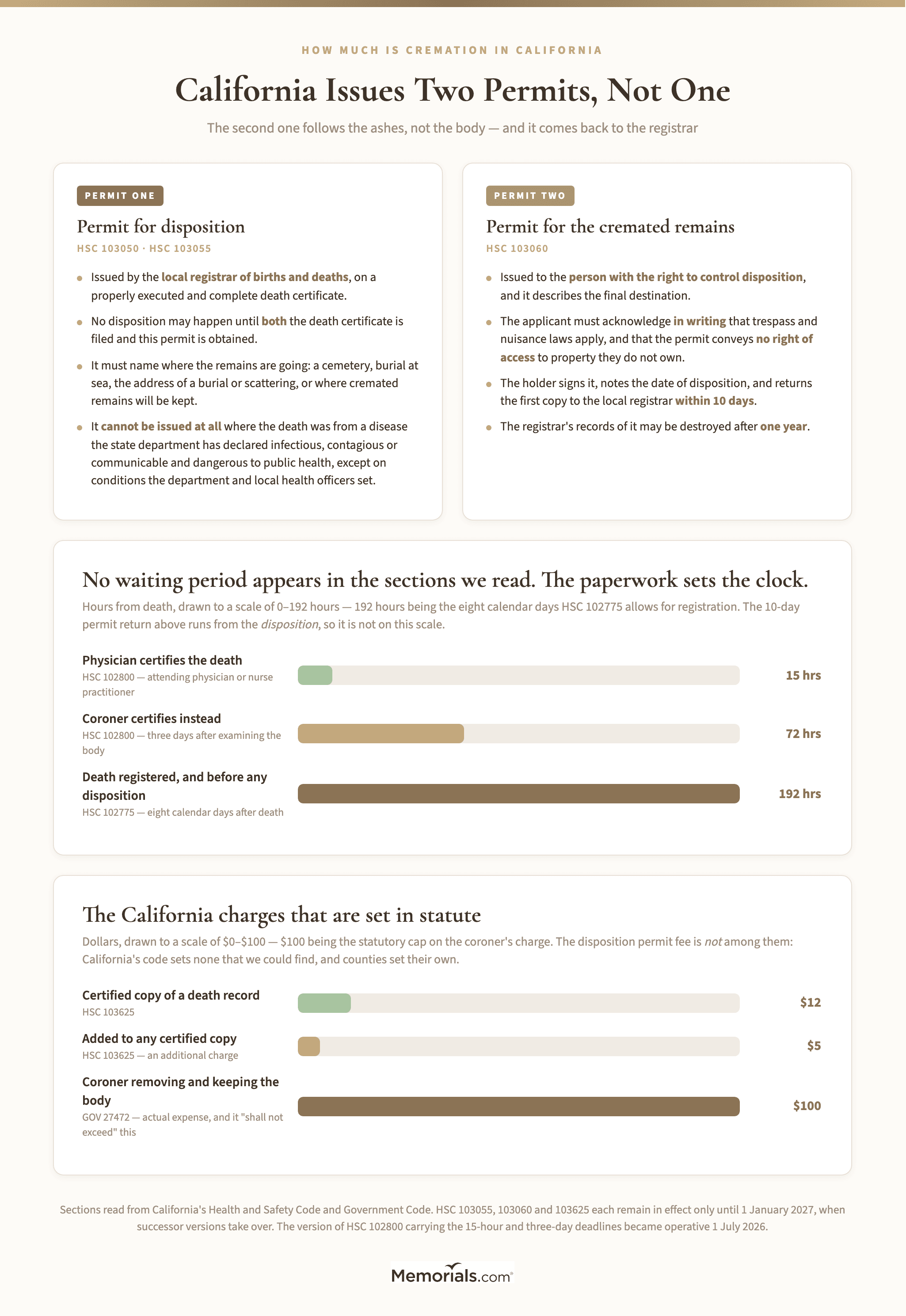
Certificates and state paper. Certified copies of the death certificate are their own line item, $12 to $26 each depending on the county; our guide to how many death certificates you need is worth reading before you order them.
What the state charges on top
Nearly every California price list carries two small lines outside the package: a disposition permit at $12 and a Department of Consumer Affairs fee at $11.50. The figure printed on a list is therefore not quite the figure a family pays, and some lists say so outright, noting state fees of around $35 on top.
We will not call the $12 a statutory fee, because we could not find it in statute — permit fees appear to be set county by county. The code does fix the other piece of paper: HSC 103625 puts a certified copy of a death record at $12, plus $5 on any certified copy.
One charge is capped statewide. Government Code 27472 lets a coroner bill the actual expense of removal from the place of death and care until release, but "not exceed one hundred dollars ($100)" — and it may not be charged at all to a person who proves indigency, or for a child aged 14 or younger. A coroner's cremation clearance, where a price list shows one, is county practice rather than California law as we could establish it.
Most states issue one permit. California issues two, and the second one follows the ashes rather than your loved one. The cremated-remains permit under HSC 103060 names where the remains will end up, carries a signed acknowledgment that the permit grants no right of access to land you do not own, and has to be returned to the local registrar within 10 days of the disposition.
California Cremation Laws That Affect Cost
No statewide waiting period appears in California's cremation statutes. We read the cremation, disposition and vital-records sections of the Health and Safety Code and none imposes a 24- or 48-hour hold — a bounded reading of a very large code, and a county ordinance we could not rule out.
The paperwork sets the timeline instead. A death must be registered with the local registrar within eight calendar days and before any disposition (HSC 102775), and nothing may be disposed of until the death certificate is filed and a disposition permit is issued (HSC 103050). HSC 102800 gives the certifying physician 15 hours to complete the medical certification, and a coroner three days.
Who may authorize, and the order is not the usual one. HSC 7100(a) ranks the right to control disposition: an agent under a power of attorney for health care first, then the surviving spouse, the adult children, the parents, the adult siblings, more distant kin, and finally the public administrator. The health-care agent comes ahead of the spouse — worth settling before a family assumes otherwise. Your loved one's own written directions control outright (HSC 7100.1), but only where they are clear enough to avoid ambiguity and the payment has already been arranged.
Two permits, not one. The disposition permit (HSC 103055) names where the remains are going. HSC 103060 then adds a second permit for the cremated remains themselves, issued to the person with disposition rights and returned to the registrar within 10 days of the scattering or interment. Both sections run only until 1 January 2027, when successor versions take over.
When the coroner is involved. Government Code 27491 sends violent, sudden or unusual deaths, unattended deaths and deaths in custody to the coroner; where the circumstances turn out to be natural, the coroner may let the physician of record sign instead.
No casket is required. HSC 7006.5 defines a cremation container as "a combustible, closed container resistant to leakage of bodily fluids" — a fiberboard box satisfies that, and no section we read requires a casket. Federal law removes the remaining doubt: 16 CFR 453.2(b)(4)(ii)(B) makes every price list showing a direct-cremation range print beside it, "If you want to arrange a direct cremation, you can use an alternative container." If that sentence is missing, the list is not compliant.
One at a time. HSC 7054.7 forbids cremating more than one person at a time in the same chamber, or commingling remains, and requires a signed acknowledgment — kept five years — that bone fragments remain and that chamber residue is periodically removed.
Scattering, and the numbers no competitor page carries
On land, HSC 7116(a) allows scattering "in an area where no local prohibition exists," provided the remains are not distinguishable to the public, are not in a container, and you have the written permission of the property owner or governing agency.
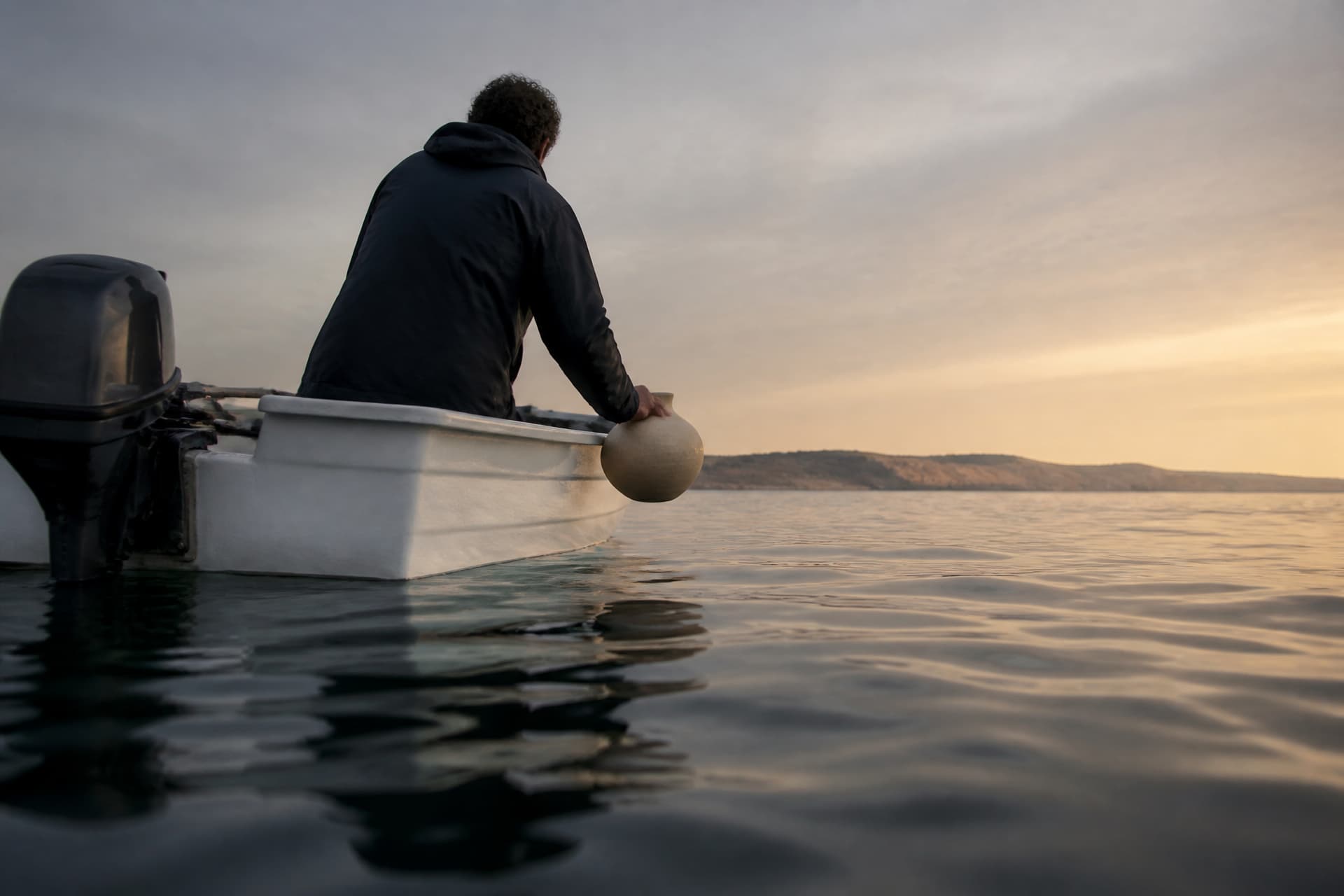
At sea, HSC 7117 is unusually specific: "at sea" includes inland navigable waters but excludes lakes and streams, the boat must be 500 yards from shore, and scattering from a bridge or pier is prohibited. A verified statement goes to the local registrar of the nearest county.
Keeping them instead is HSC 7054.6: the remains leave the place of cremation in a durable container, are kept free from exposure to the elements, and may be kept at home, in a church or religious shrine under stated conditions, or placed in keepsake urns.
California also registers the people who scatter for a living — the Cemetery and Funeral Bureau issues a Cremated Remains Disposer Registration, and no other state we have written names one. Our general guide to scattering ashes laws covers the position outside California.
Five hundred yards, and not from a bridge or a pier. HSC 7117 sets a minimum distance from shore for scattering at sea, includes inland navigable waters, excludes lakes and streams, and requires a verified statement filed with the local registrar of the nearest county. Almost no cost page for this state carries any of those four rules.
Three legal paths, and the third arrives in 2027
Every disposition statute in California now reads "cremated or hydrolyzed human remains": alkaline hydrolysis has stood on the same footing as flame cremation since 2020, and the Bureau licenses hydrolysis facilities. Our guide to alkaline hydrolysis explains the process and where it is offered.
The third path, natural organic reduction — human composting — becomes operative 1 January 2027 under AB 351, which creates licensed facilities and facility managers under the Bureau and requires state approval of every chamber before use. California price lists are already printing a terramation price, so a quoted range can include a service the state has not begun licensing yet.
One thing we could not settle. Whether a California family may file the death certificate, obtain the permits and handle the transport themselves, without a licensed funeral establishment, is open on the text we read. We will not write that California allows home funerals, and we will not write the opposite.
How to Lower the Cost in California
Check whether a consumer memorial society covers your county, and check it first — the largest saving we found in California. These are nonprofits rather than providers: they negotiate rates in advance with participating mortuaries and pass them on to members, typically for a one-time fee of around $65 that can often be paid even after a death has occurred. Member rates reach the bottom of the state's published range, and where a mortuary prints both numbers, the member rate can sit several hundred dollars under its own retail price for the same cremation.
Ask whether the cremation charge is inside the price, and ask the same about refrigeration. Those two lines account for most of the distance between a headline floor and a final bill in this state.
Read the effective date. Old California documents stay online for years: we found lists from 2020 and 2021 still served and still indexed, one quoting less than the same brand's current document, and one package sheet still carrying the placeholder "PRICES EFFECTIVE AS OF MM/DD/YYYY." The most recent date is the one that binds — ask which number the firm will honor.
Call four providers and ask each of them the same five questions. Is the cremation charge inside the price. Is refrigeration inside. What are the permit, the Consumer Affairs fee and the death certificates. How far does the transfer radius reach before mileage starts. And do you have a chapel and can you arrange a viewing — that last one sorts California's range faster than the other four together.
A permanent urn is a separate purchase. The package buys a plastic or cardboard temporary container, and the family chooses the real vessel afterwards, at home and in their own time. California law shapes that choice: if the plan is the Pacific, the ashes must leave the container before scattering and the boat has to be 500 yards out.
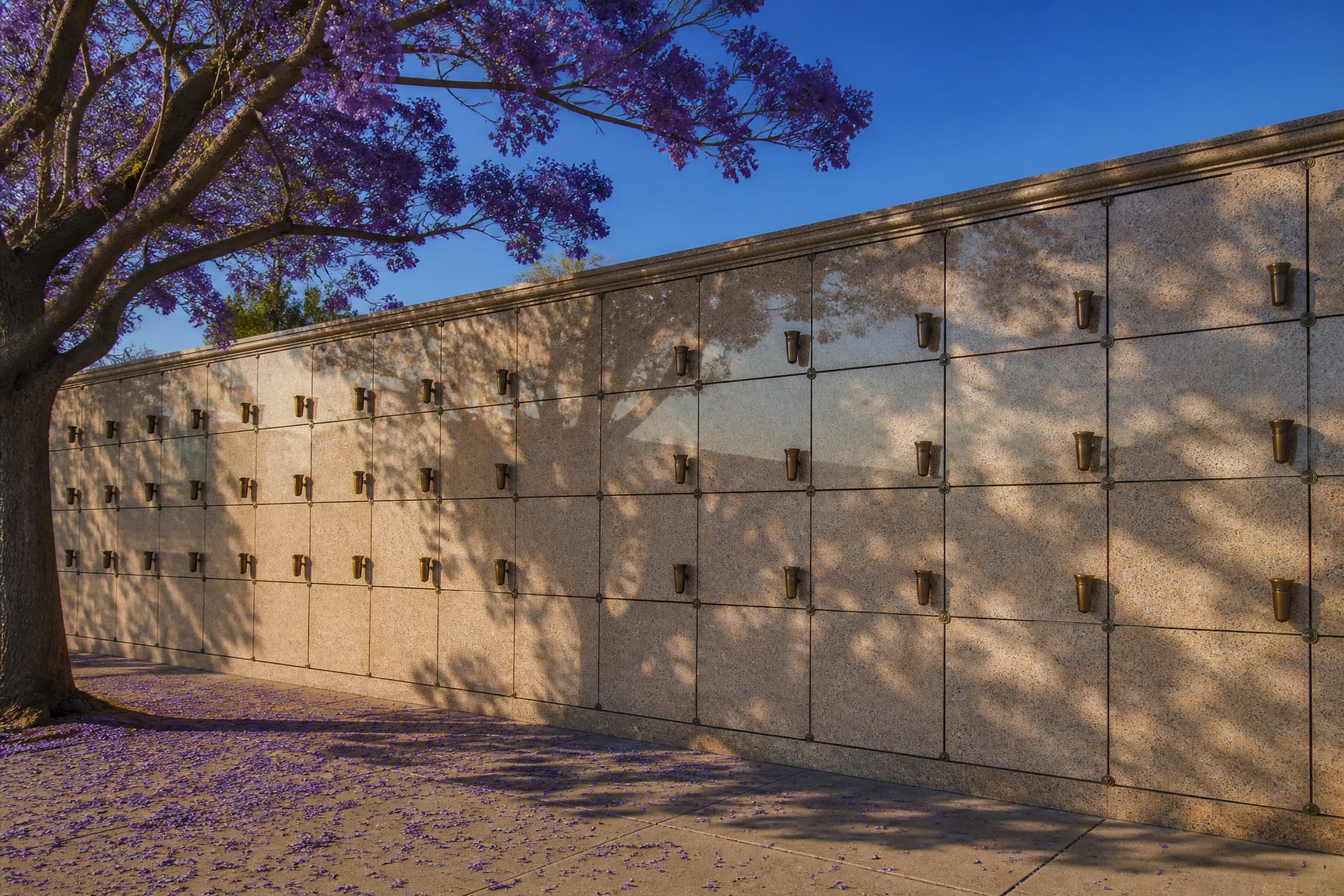
A niche is the other option, and it is priced separately again. California cemeteries sell columbarium space the way they sell graves, so the cremation price on this page is the start of the arithmetic rather than the end of it.
What is the cost of cremation in California? Between $875 and $3,195 for a direct cremation, median $1,642.50 — twentieth cheapest of the fifty states.
How much does it cost to be cremated in California, all in? Add what the list leaves outside the floor: the cremation charge where it is priced separately, the $12 disposition permit, the $11.50 Consumer Affairs fee, and death certificates at $12 to $26 each.
How much does it cost to get cremated in California if you want nothing else? That is what a direct cremation is — the figure on this page. Add a viewing or a service and you are buying from a different kind of provider.
Why do cremation prices California providers publish vary so much? Because two different kinds of business sell the same service: a cremation-only operator with no chapel prices near the floor, and a full funeral home prices that same cremation as one line beside everything else it is set up to do.
What is the cost of cremation in Los Angeles California? Los Angeles is the most searched California city on this question and has no market rate of its own — the lists we read there sit inside the statewide range. Compare the kind of provider, not the city.