🏬Supersize Online Funeral Retailer🪦1000's of Headstones⚱️Over 10,000 Cremation Urns⚰️Caskets Overnight Delivery🛒Funeral & Memorial Superstore🚚FREE Shipping on ALL Orders👨👩👧👦Helping Families for over 20 Years💰Lowest Price Guarantee🏬Supersize Online Funeral Retailer🪦1000's of Headstones⚱️Over 10,000 Cremation Urns⚰️Caskets Overnight Delivery🛒Funeral & Memorial Superstore🚚FREE Shipping on ALL Orders👨👩👧👦Helping Families for over 20 Years💰Lowest Price Guarantee
🏬Supersize Online Funeral Retailer🪦1000's of Headstones⚱️Over 10,000 Cremation Urns⚰️Caskets Overnight Delivery🛒Funeral & Memorial Superstore🚚FREE Shipping on ALL Orders👨👩👧👦Helping Families for over 20 Years💰Lowest Price Guarantee🏬Supersize Online Funeral Retailer🪦1000's of Headstones⚱️Over 10,000 Cremation Urns⚰️Caskets Overnight Delivery🛒Funeral & Memorial Superstore🚚FREE Shipping on ALL Orders👨👩👧👦Helping Families for over 20 Years💰Lowest Price Guarantee
Scattering ashes in hawaii is governed by almost everything except a Hawaii scattering statute. There is no state law that says where cremated remains may be kept or released — a genuine surprise in the most ocean-oriented state in the country, and the reason so much of the advice you will find contradicts itself.
What fills the gap is three separate things: a federal regulation covering the ocean, a permission layer over state land and water, and a cultural dimension that Hawaii's own criminal code explicitly acknowledges. None of them is hard to satisfy. All three are easy to miss if you are looking for one statute that does not exist.
There Is No Hawaii Scattering Statute, and That Cuts Both Ways
The absence is real. Hawaii has no provision equivalent to California's, which sets conditions for land scattering and a distance for the sea. Nothing in Hawaii law fixes where ashes may go.
That means there is no state permission to obtain for scattering as such — and equally, no state authorization to point at if someone objects. The scattering ashes in hawaii law question resolves into the ordinary law of the place: who controls the land or water, and what do they allow.
Two related rules do exist and are worth knowing, because they are often quoted as though they were about ashes when they are about bodies. Hawaii Administrative Rules section 11-22-5 requires burial in a cemetery approved by the Director of Health, with a burial-transit permit obtained first, and Hawaii Revised Statutes section 441-5.5 preserves family burial plots. Those concern the burial of a body, not the scattering of cremated remains, and the distinction matters because the first is genuinely restrictive and does not apply to what most families are planning.
The statute that does reach remains generally is Hawaii Revised Statutes section 711-1108, "Abuse of a corpse". A person commits the offense if, except as authorized by law, they treat a human corpse in a way they know would outrage ordinary family sensibilities. It is a misdemeanor. This is not a scattering rule and should not be read as one — but it is the backstop for genuine mistreatment of remains, and it is the section that carries the cultural provision below.
The Ocean: The Federal Rule Is the One That Counts
Most families asking about Hawaii mean the sea, and here the governing text is federal rather than local.
The general permit for burial at sea, 40 CFR 229.1(a)(3), requires that cremated remains be buried "in or on ocean waters" no closer than three nautical miles from land. That is roughly 3.5 statute miles, and it is measured from the coastal baseline rather than from whatever you can see. 40 CFR 229.1(d) then requires a report within 30 days to the EPA Regional Administrator for the region the vessel departed from.
Two consequences follow, and they are the practical heart of this page.
Can you spread ashes in hawaii from a beach? Not into the water. No point on any shoreline in the state is three nautical miles from land, so a release into the surf does not meet the federal rule. Dry sand above the tide line is a different question and is answered by whoever manages that beach, which in Hawaii is usually the state. Our guide to scattering ashes on a beach works through that distinction in detail.
You need a boat, and that is genuinely the easy part here. Hawaii has a large and established charter sector doing precisely this, on every main island, year-round. An operator that runs scattering ceremonies handles the distance and the 30-day report as routine, which removes both of the federal requirements from the family's list.
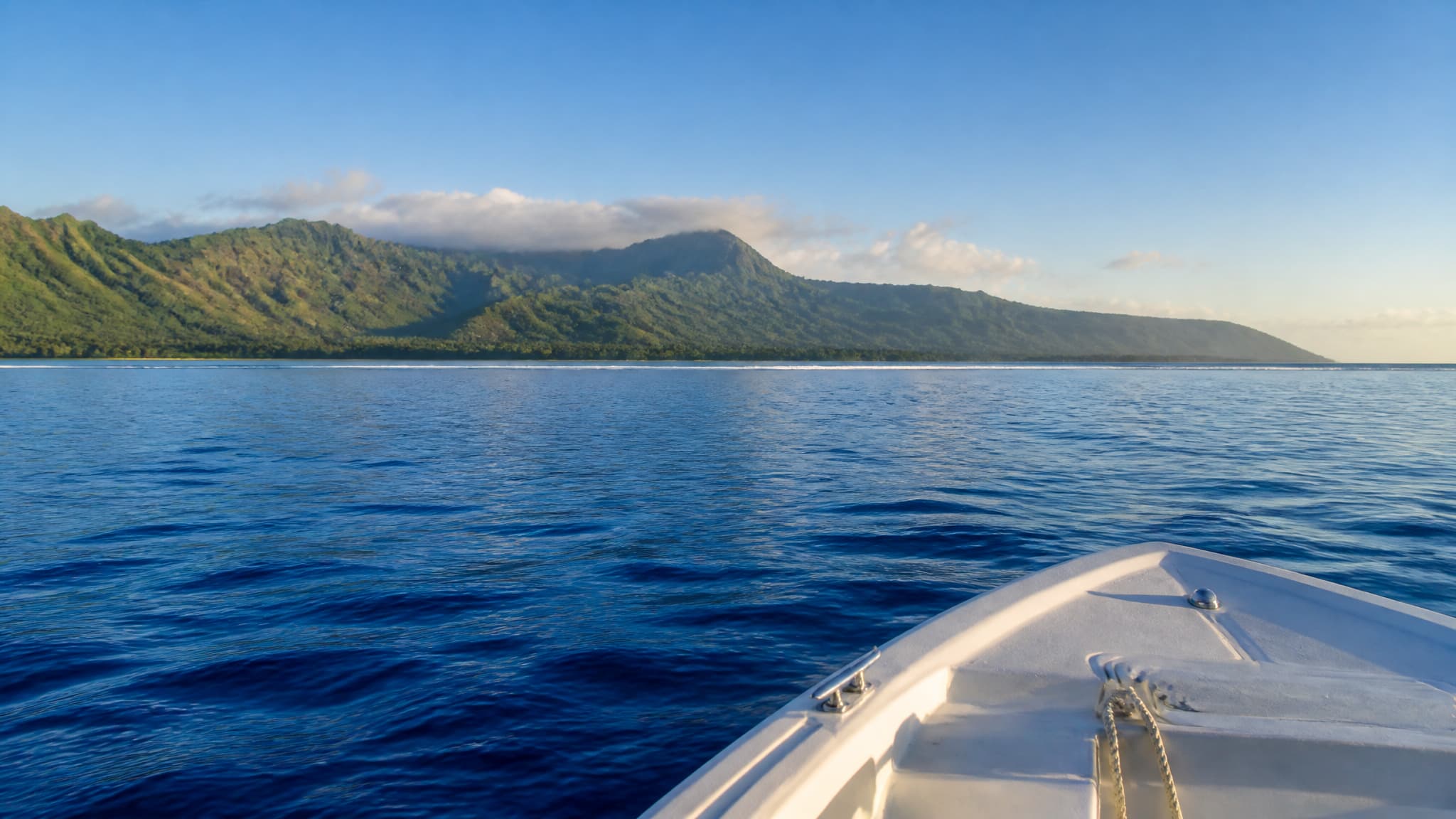
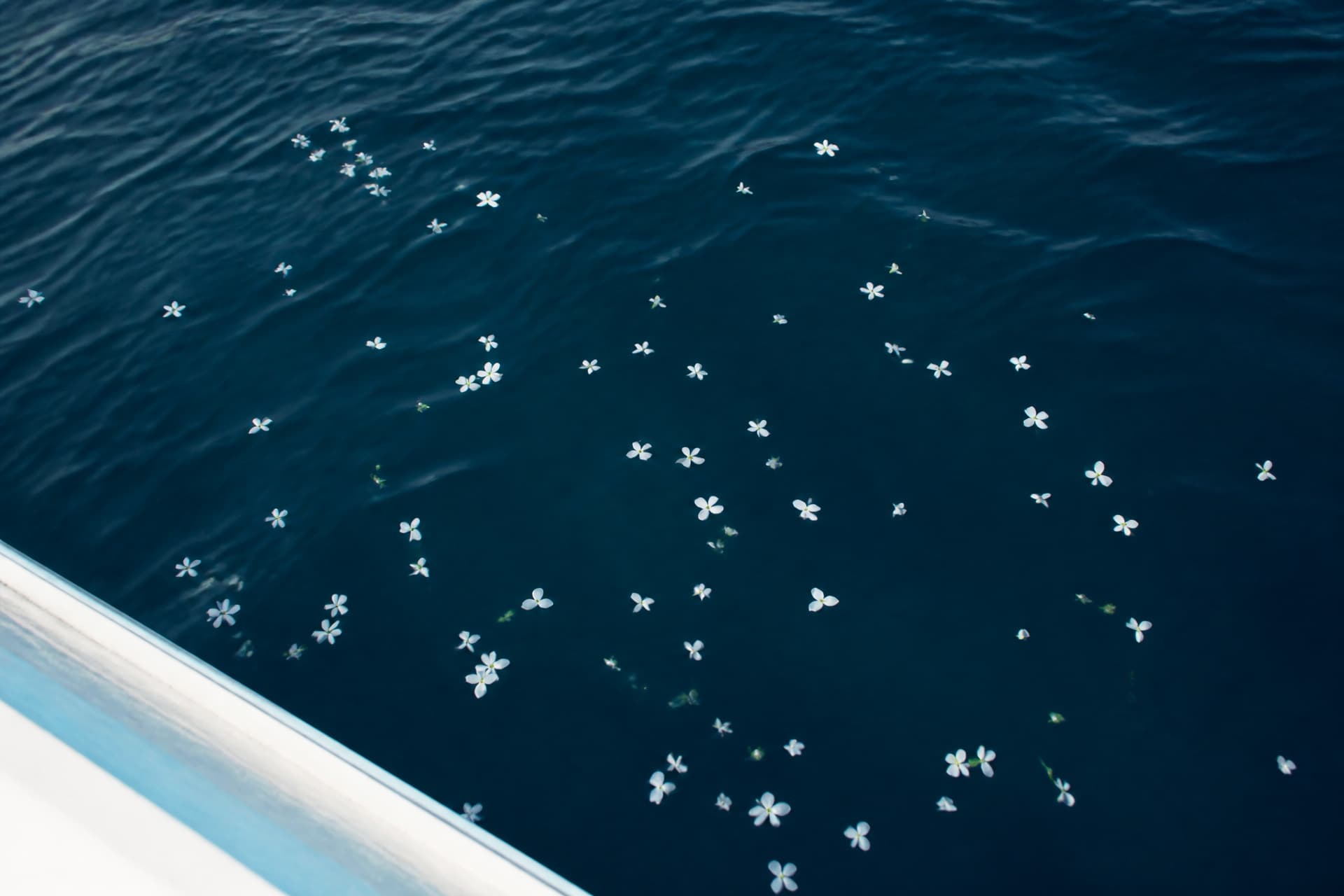
Past three nautical miles, where the federal rule puts a scattering. Flowers are permitted at the same site, but only materials that break down readily in seawater.
State Land, State Water, and the Permit for a Large Ceremony
Hawaii's public land and nearshore water — state parks, most beaches, small boat harbors — sits with the Department of Land and Natural Resources. That is the permission layer, and it works case by case rather than by a published scattering rule.
For a large ocean ceremony, one involving a crowd and several vessels, the DLNR's Division of Boating and Ocean Recreation issues an ocean event permit. It is free, and the request should go in at least 14 days ahead. The purpose is not to police the scattering; it is to make sure ocean uses do not collide at one place and time, which on a busy South Shore weekend is a real concern.
For an ordinary family scattering — a handful of people, one boat — no such permit is required. This is the point most often garbled in guidance that treats the ocean event permit as universal. It applies to events, not to scatterings.
The department also asks, as a matter of courtesy to other ocean users rather than as a regulation, that ashes be dispersed beyond the reef line. That request and the federal three-mile requirement point the same way, so following the federal rule satisfies both.
For a state park or a state beach, the sensible step is to contact the park directly and ask what it permits. Some places will have a view, many will have no written policy, and — as everywhere — no written policy is not the same as permission.
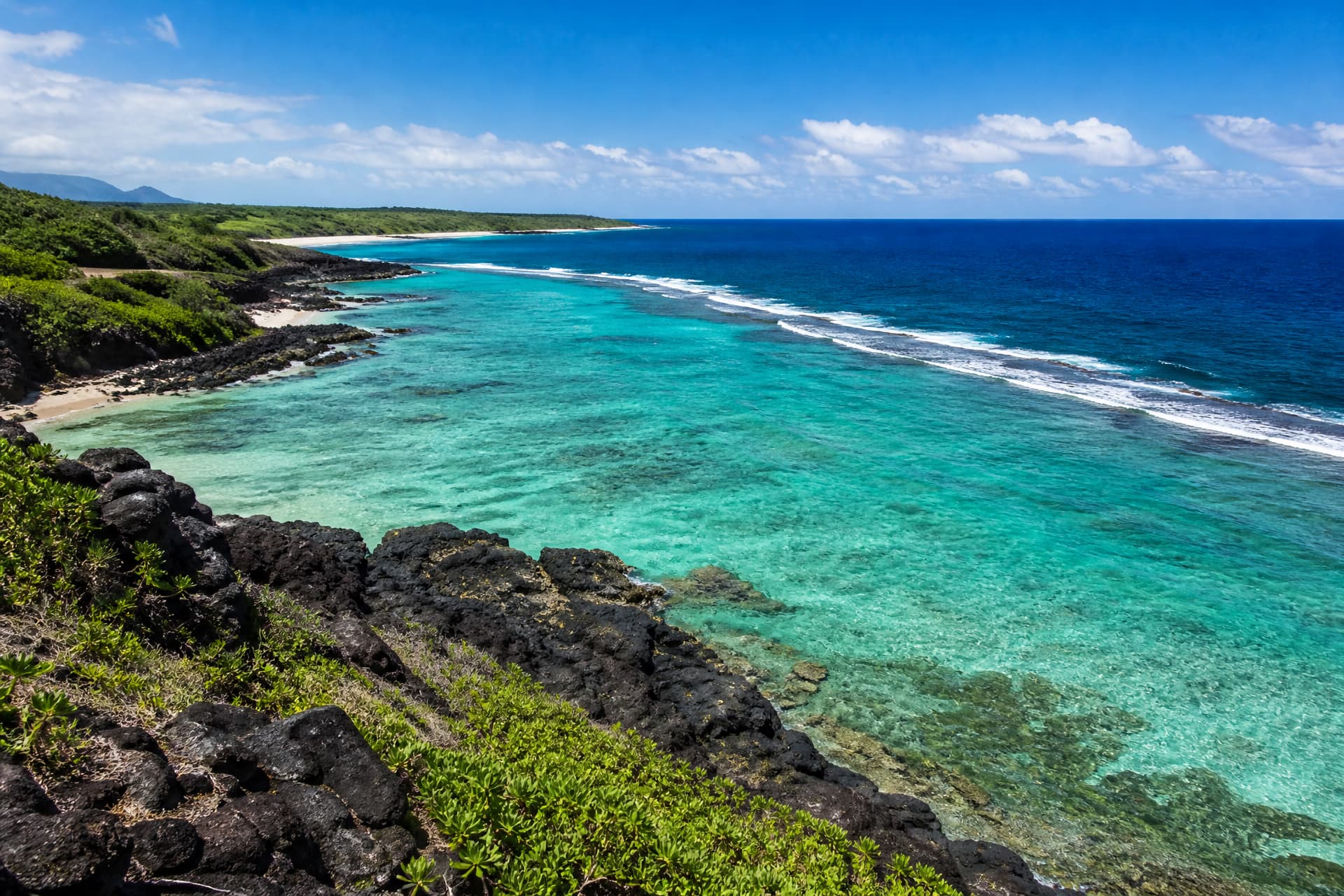
The reef line is visible from shore, and Hawaii's land agency asks that ocean scatterings happen beyond it. The federal three-mile rule sits much further out again.
The Cultural Dimension, and Why to Ask Locally
This is the part of spreading ashes in hawaii that no legal checklist captures, and it deserves more care than a paragraph on distances.
Human remains hold deep significance in Hawaiian culture, and specific places carry meanings that are not apparent to a visitor. Hawaii's legislature wrote that recognition into the criminal code: section 711-1108 was amended in 2015 so that preparing a corpse for burial or cremation in a manner consistent with traditional Hawaiian cultural customs and practices is not a violation of the abuse-of-a-corpse provision, and neither is the burial or cremation of a corpse so prepared. That is a statute going out of its way to protect a cultural practice rather than to restrict one.
The practical implication for a family planning a scattering is straightforward and it is not a legal obligation. Ask locally about the specific place. A charter captain who has worked the same waters for twenty years, a state park office, or a local cultural practitioner will know whether a site carries significance that makes it the wrong choice — and that is knowledge no regulation encodes and no website can substitute for.
Choosing open water beyond the reef, which is where the federal rule puts you anyway, avoids most of this by not involving a culturally significant place on land.
Getting the Ashes There
For most families this ceremony involves a flight, and the logistics are more forgiving than people fear.
Cremated remains travel by air as a matter of routine. What the process actually needs is a container that can be screened — security has to be able to establish what is inside, so a dense stone or thick metal urn is the wrong choice for the journey even though it may be the right one for the mantelpiece — and the cremation paperwork carried rather than packed. Airlines differ on whether remains may go in checked baggage, so the one call worth making is to the carrier.
A temporary transport container for the flight, with the permanent urn shipped or bought afterward, is the arrangement that causes fewest problems. If the plan is a release at sea, the water urn is the thing to have with you and nothing else is needed.
Paperwork for moving remains between states is its own subject, and the document families hear about — the burial-transit permit — is issued by the state the death occurred in rather than by Hawaii. A cremation provider handles it as part of the arrangements. Our guide to burial transit and disposition permits covers when one is needed for a body and when it is needed for ashes, which are not the same answer.
What a Hawaii Scattering Actually Costs
There are two separate costs here and they are usually quoted by two different businesses.
The cremation itself is priced by a provider in the state where the death happened, and if that is Hawaii, our guide to cremation costs in Hawaii sets out what the published price lists there show and what sits outside the package.
The scattering is priced by a charter operator, separately. What is worth asking about, because it varies far more than the headline figure suggests: whether the price is per boat or per person, how long the charter runs, whether it departs from the island you are actually on, and whether the operator files the 30-day EPA report. Departures from the neighbor islands commonly cost more than from Oahu, so an itinerary decision is also a price decision.
The one thing not to pay for twice is the urn. A charter that supplies a biodegradable water urn as part of its package is common, and a family that has already bought one should say so when booking.
What to Use
Two practical choices shape how the moment actually goes.
For a release at sea, use a water urn rather than pouring. A biodegradable urn designed for water floats for a short time and then sinks and breaks down, which gives a family something to watch and lowers the boat as a setting into the background. Pouring from a container over a moving gunwale in an ocean breeze is the version that goes wrong. Our water burial guide covers the charter side and what a service typically includes.
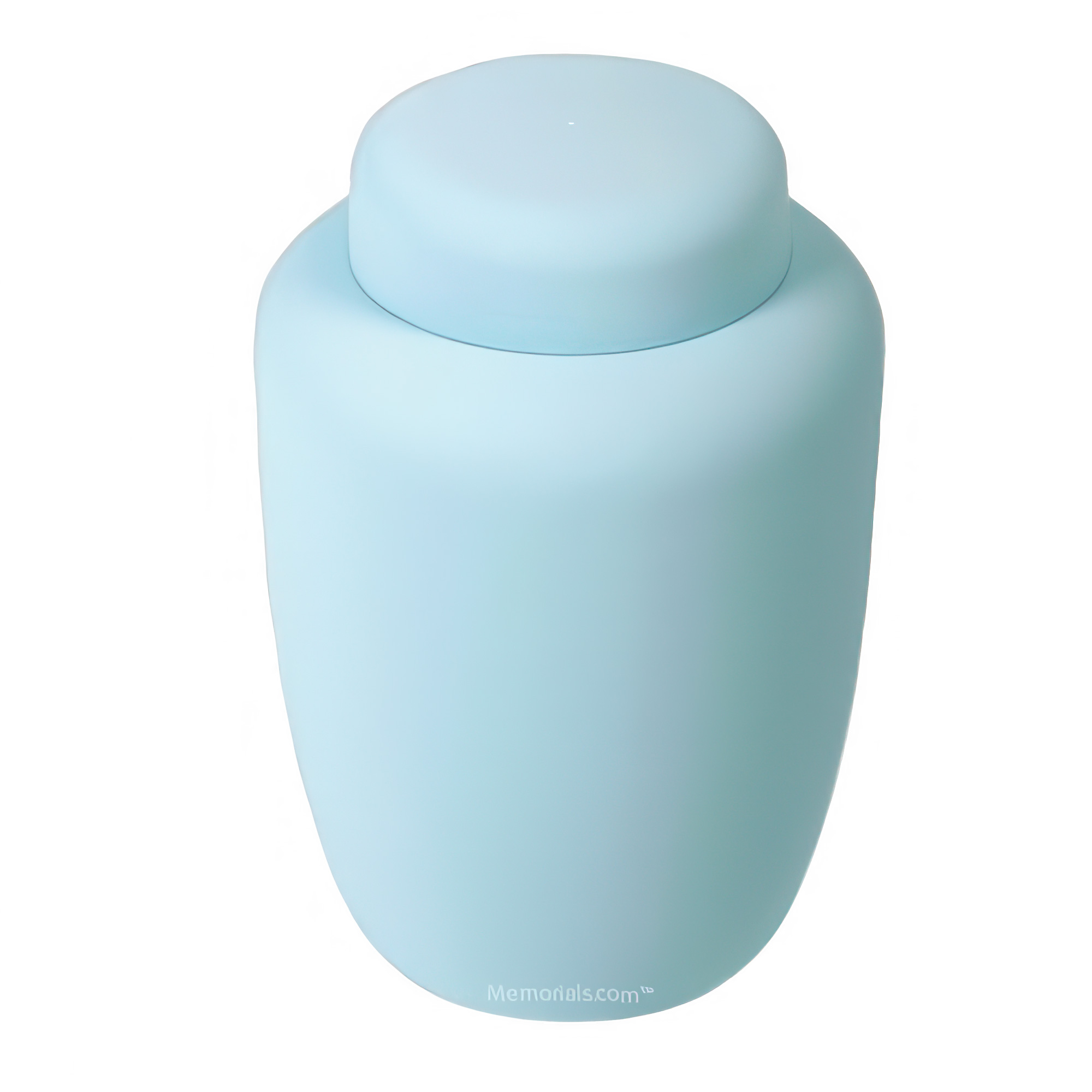
For anywhere on land, a controlled opening matters more than it sounds. A purpose-made scattering urn meters the release, which keeps the ashes where they were meant to go rather than where a trade wind takes them. Both sit within our wider range of cremation urns.
Keep a portion if anyone is unsure. Scattering is not reversible and Hawaii is a long way from most of the mainland, so a family that scatters everything on one trip has no second chance. Our guide to human ashes covers dividing remains and what that involves.
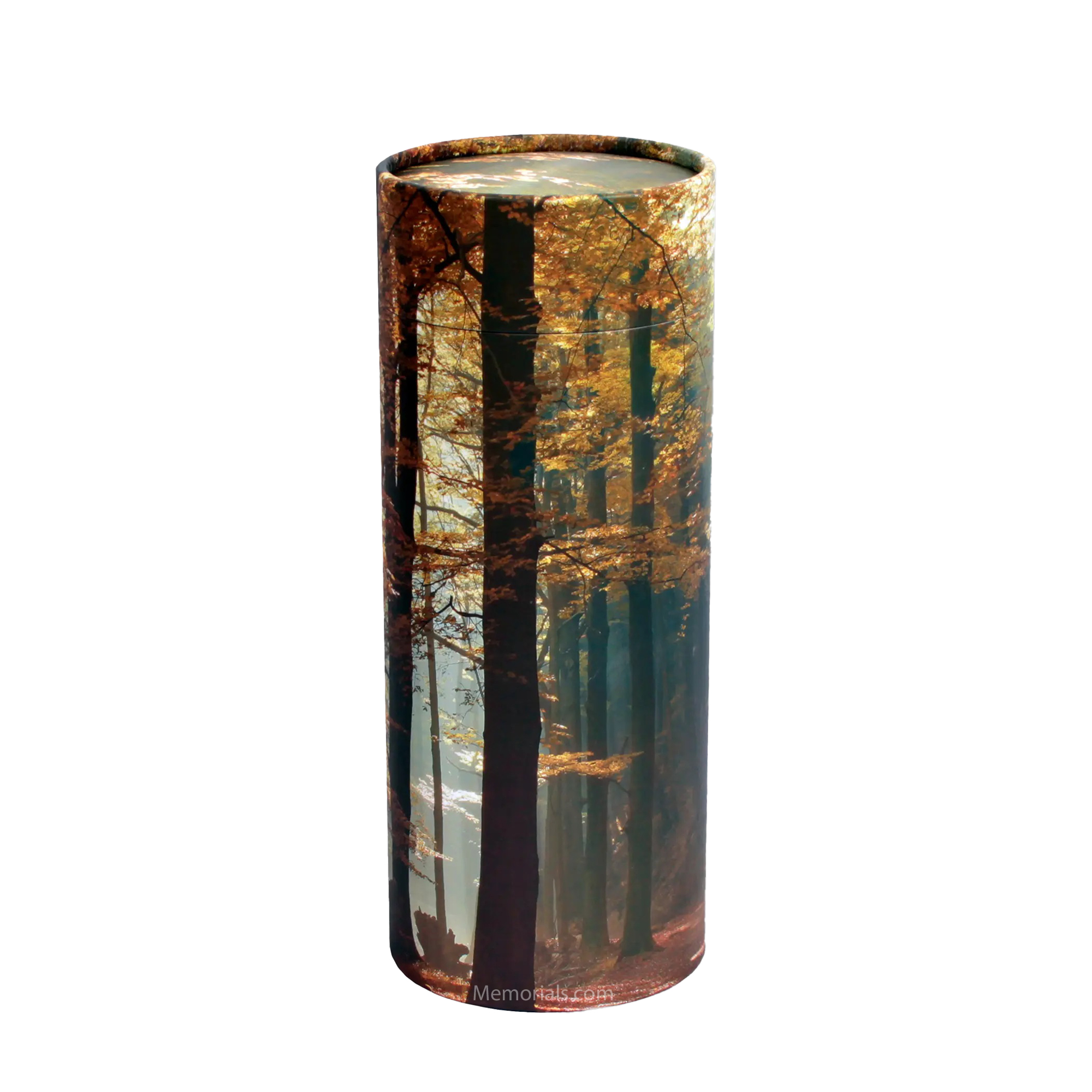
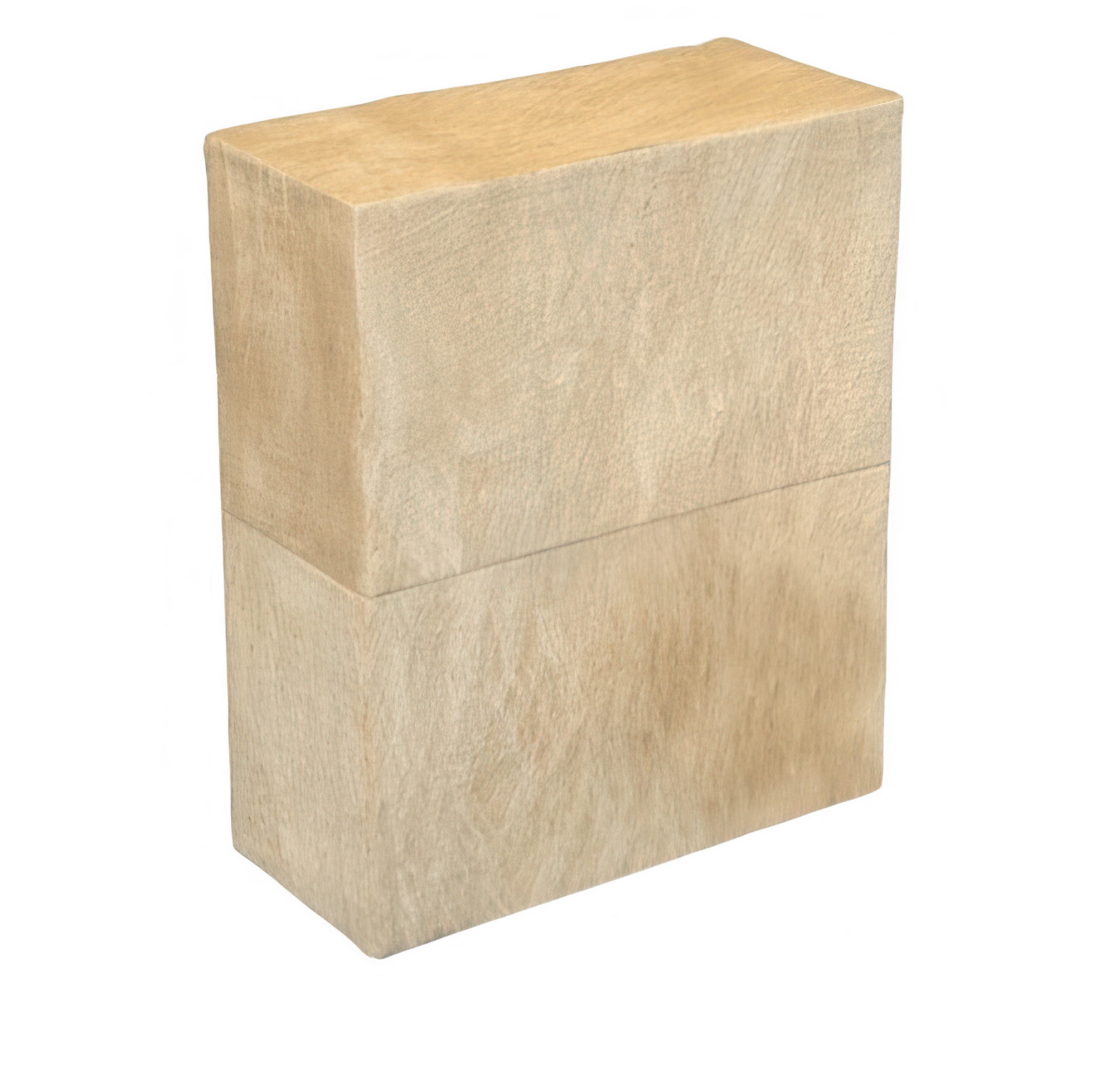
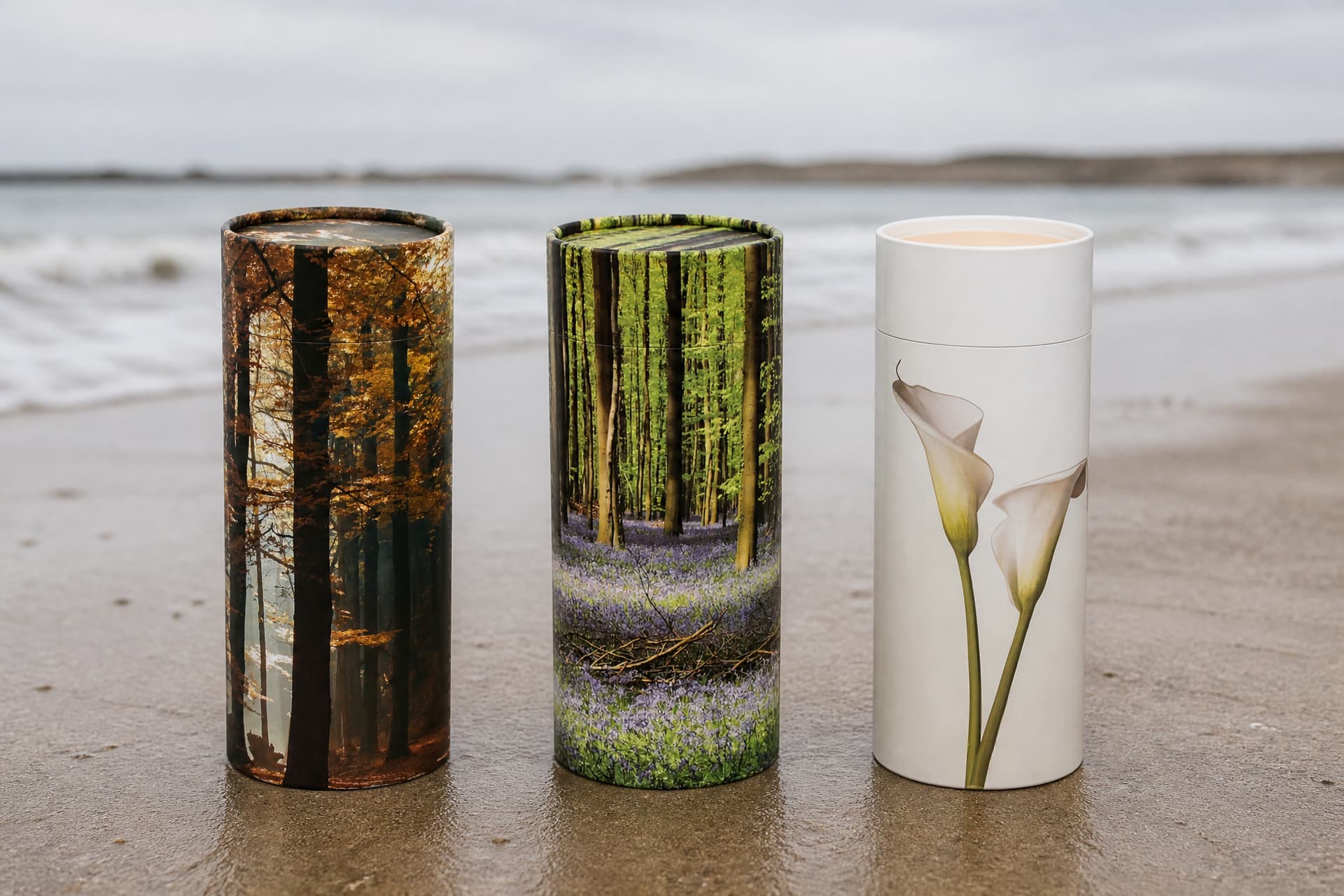
For anywhere on land, a metered opening keeps the ashes where they were meant to go rather than where a trade wind takes them.
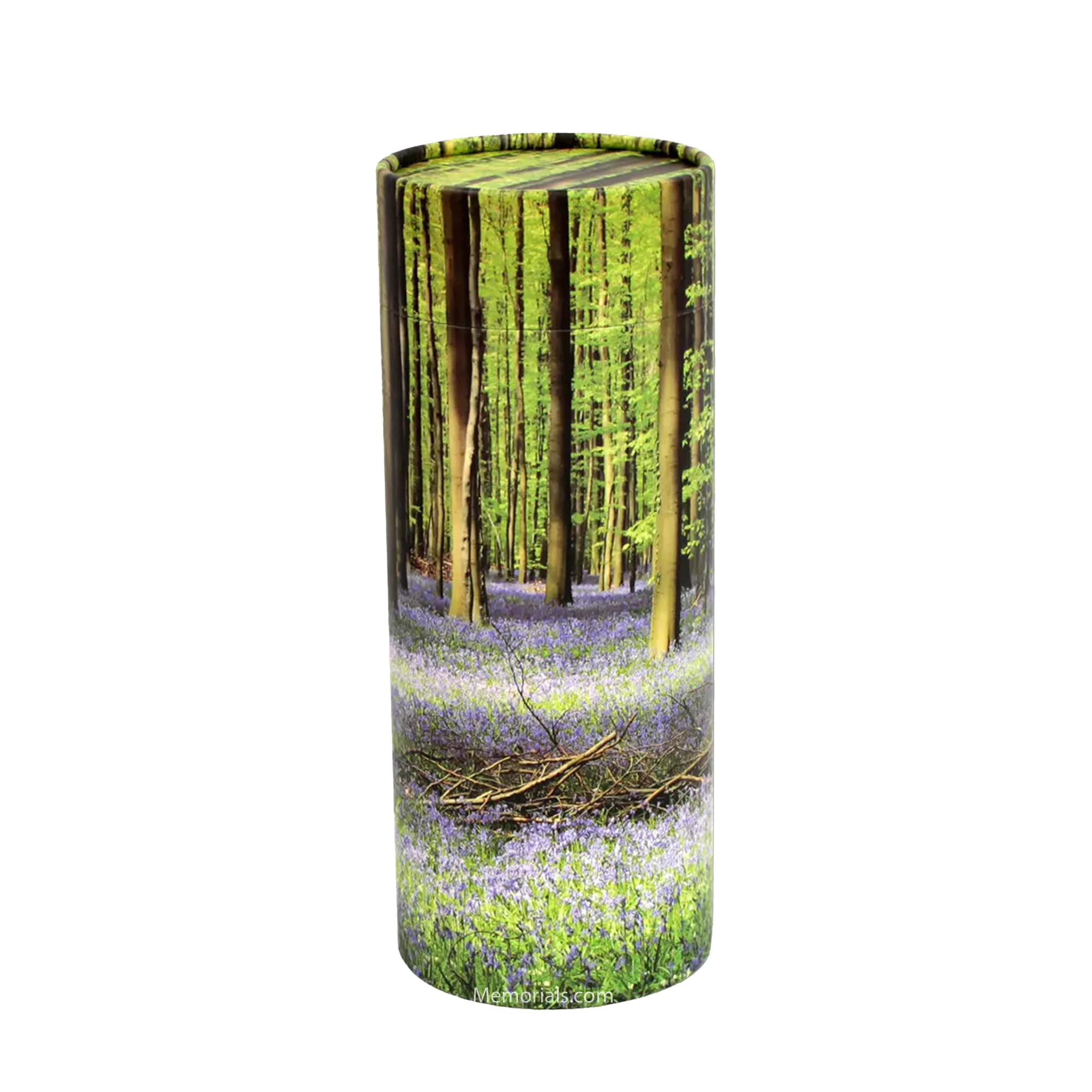
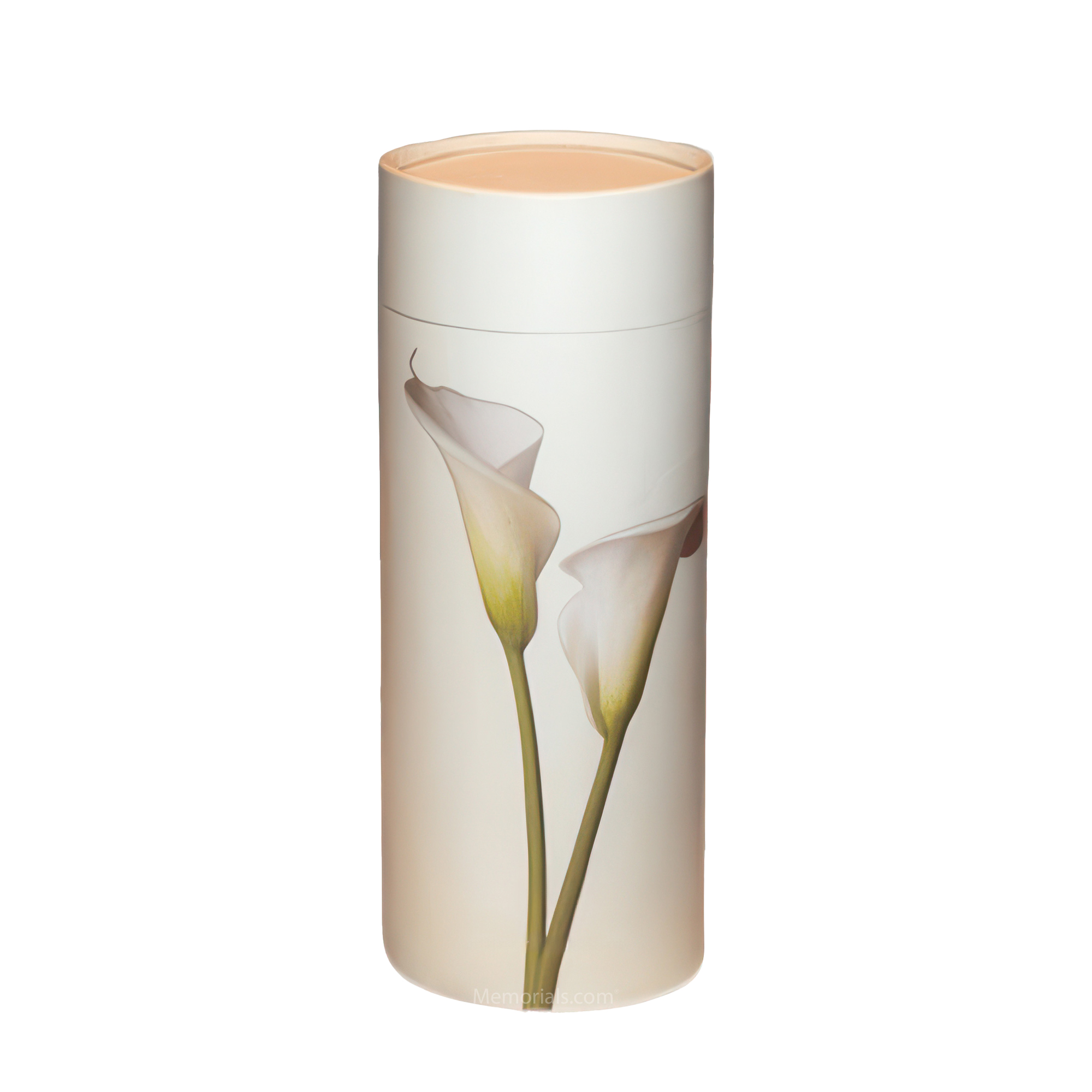
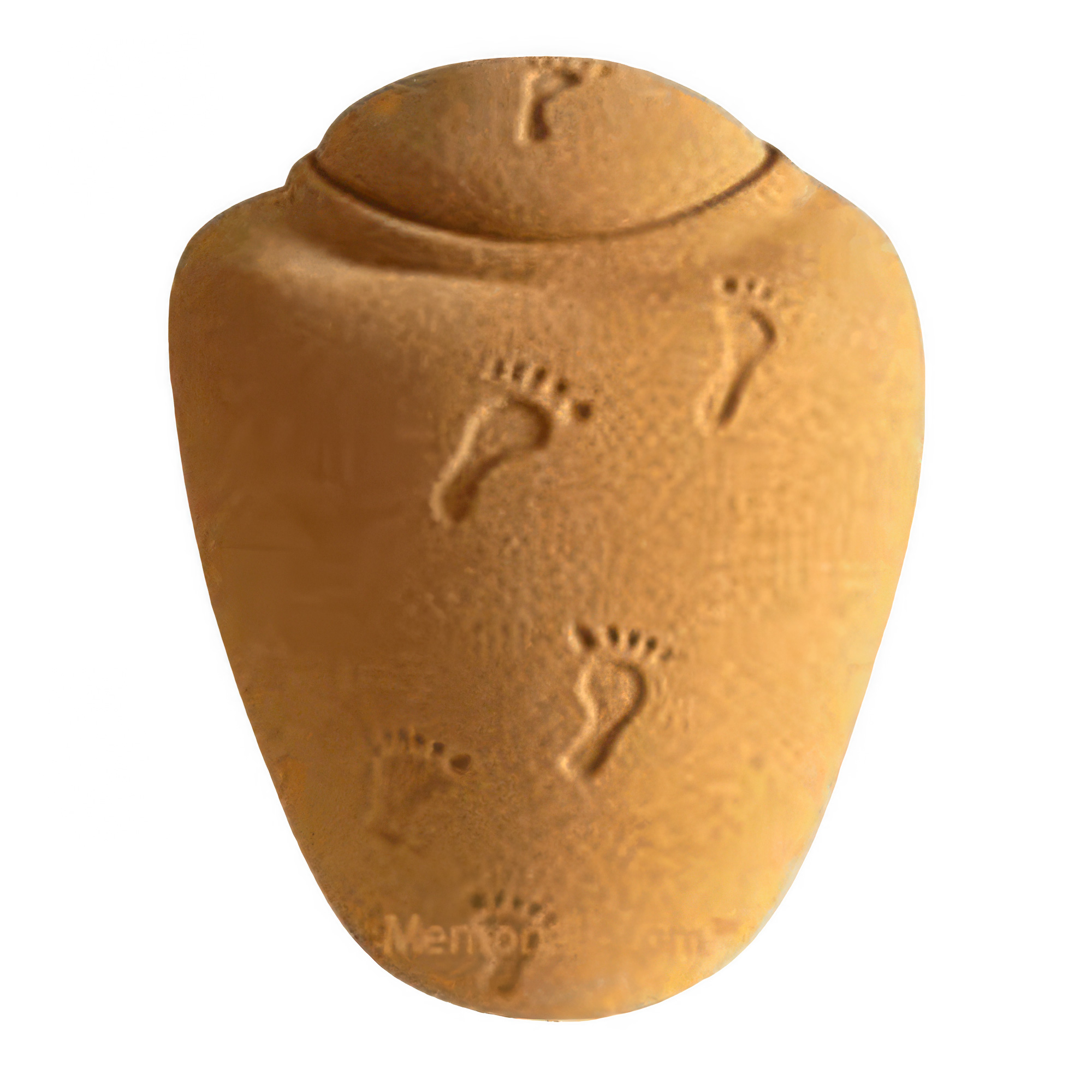
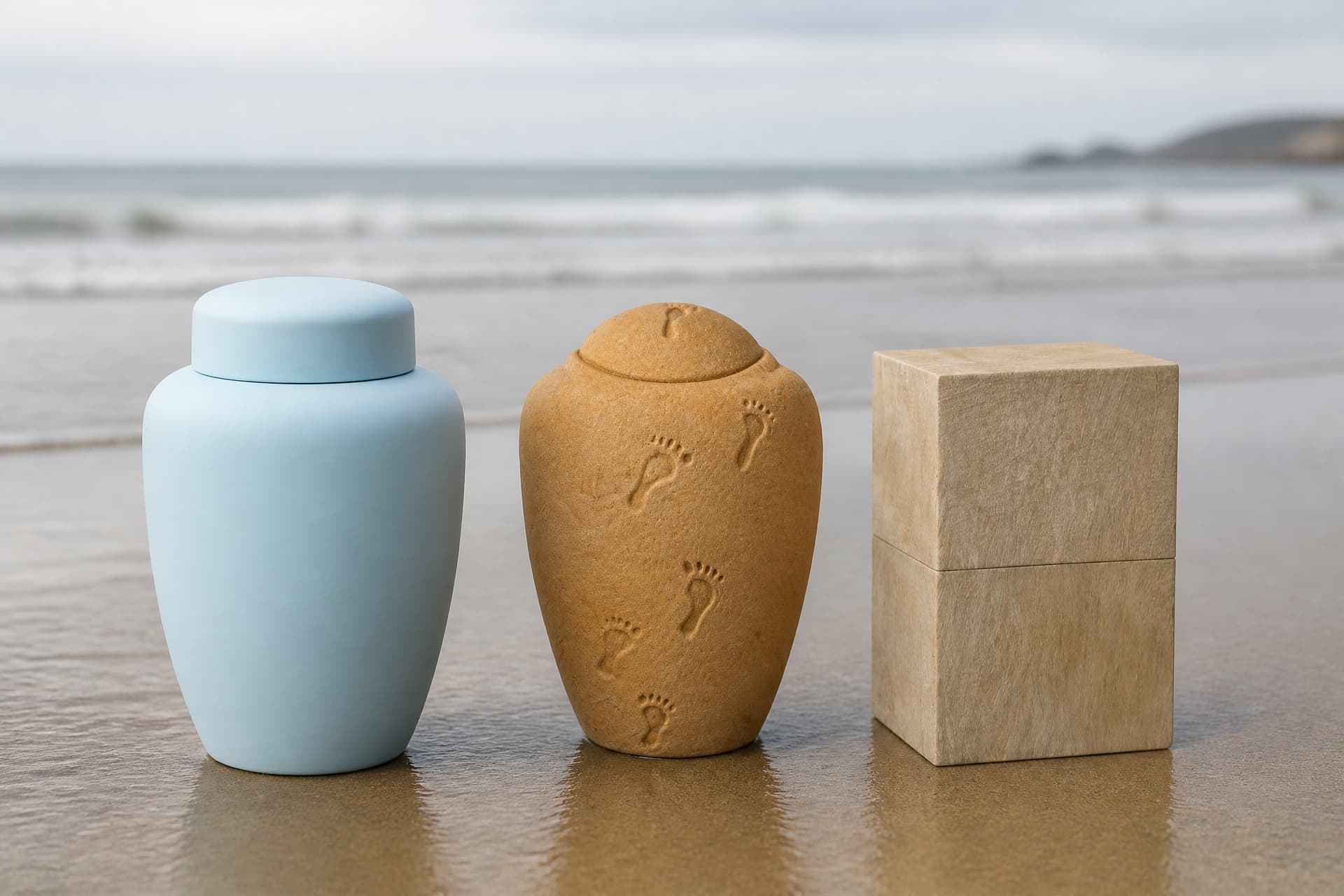
Urns made to be released on water. They hold their shape long enough for a family to watch, then sink and break down, which is what the federal distance rule leaves a family needing.
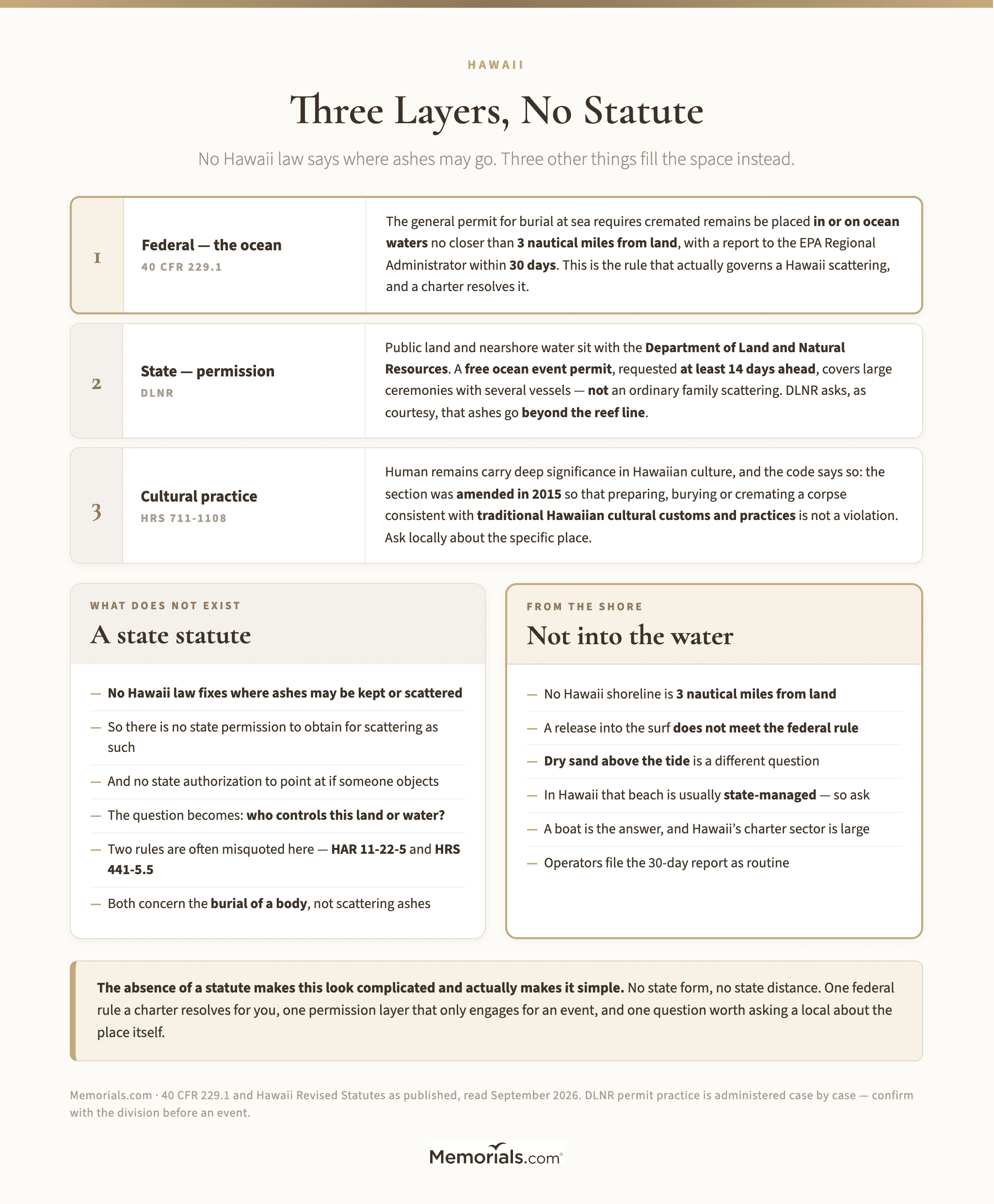
No Hawaii law says where ashes may go. A federal ocean rule, a state permission layer and Hawaiian cultural practice fill the space instead.
Frequently Asked Questions
Is there a Hawaii law about scattering ashes? No. Hawaii has no statute fixing where cremated remains may be kept or scattered. What applies instead is the federal general permit for ocean waters, permission from whoever controls the land or water, and, for public land and nearshore water, the Department of Land and Natural Resources.
How far offshore do I have to go? Three nautical miles from land, under 40 CFR 229.1(a)(3), measured from the coastal baseline. A report goes to the EPA Regional Administrator within 30 days, and a charter that runs scattering ceremonies will normally file it.
Do I need a permit to scatter ashes in the ocean in Hawaii? Not for an ordinary family scattering. A free ocean event permit from the DLNR's Division of Boating and Ocean Recreation, requested at least 14 days ahead, applies to large ceremonies involving a crowd and a number of vessels — it manages competing ocean use, not the scattering itself.
Can I scatter ashes on a Hawaii beach? Into the water, no — a beach is nowhere near three nautical miles from land. On the dry sand, it depends on who manages that beach, which in Hawaii is usually the state, so ask before rather than after.
Can I take ashes to Hawaii on a plane? Yes. Cremated remains travel by air routinely, and the practical requirements are the airline's and the TSA's rather than Hawaii's — a screenable container and the cremation paperwork. Confirm with your airline before you fly, and carry the documents rather than packing them.
Should I ask anyone about the place I have chosen? It is worth doing, and it is a courtesy rather than a requirement. Specific places in Hawaii carry cultural significance that is not visible to a visitor, and a local charter operator or park office will usually tell you plainly if a site is the wrong choice.
A Final Thought
The absence of a Hawaii scattering statute makes this look complicated and actually makes it simple. There is no state form to file and no state distance to measure. What is left is one federal rule that a charter resolves for you, one permission layer that only engages if you are staging an event, and one question worth asking a local about the place itself.
Families come a long way to do this in Hawaii. The version that goes well is almost always the one where somebody who knows the water picked the spot.