🏬Supersize Online Funeral Retailer🪦1000's of Headstones⚱️Over 10,000 Cremation Urns⚰️Caskets Overnight Delivery🛒Funeral & Memorial Superstore🚚FREE Shipping on ALL Orders👨👩👧👦Helping Families for over 20 Years💰Lowest Price Guarantee🏬Supersize Online Funeral Retailer🪦1000's of Headstones⚱️Over 10,000 Cremation Urns⚰️Caskets Overnight Delivery🛒Funeral & Memorial Superstore🚚FREE Shipping on ALL Orders👨👩👧👦Helping Families for over 20 Years💰Lowest Price Guarantee
🏬Supersize Online Funeral Retailer🪦1000's of Headstones⚱️Over 10,000 Cremation Urns⚰️Caskets Overnight Delivery🛒Funeral & Memorial Superstore🚚FREE Shipping on ALL Orders👨👩👧👦Helping Families for over 20 Years💰Lowest Price Guarantee🏬Supersize Online Funeral Retailer🪦1000's of Headstones⚱️Over 10,000 Cremation Urns⚰️Caskets Overnight Delivery🛒Funeral & Memorial Superstore🚚FREE Shipping on ALL Orders👨👩👧👦Helping Families for over 20 Years💰Lowest Price Guarantee
Are executor fees taxable? Yes. A fee paid to an executor is compensation for work performed, and compensation is income to whoever receives it. That is the short answer and it is rarely the useful one, because the question people are actually asking is whether they should take a fee at all.
For a family member serving as executor, that decision is worth thinking about properly. Taking a fee sometimes costs the family money overall, and waiving one sometimes does too — it depends on facts that vary from estate to estate.
This is one of the last things an executor deals with, and it belongs with the rest of the administration in the estate affairs guide.
General information rather than tax advice. Anything involving real money here is worth an hour with a tax preparer, and that hour is itself an estate expense.
The reasoning is simple once stated. An executor performs a service — inventorying assets, paying debts, filing returns, distributing property — and is paid for it. The tax treatment follows the work, not the relationship.
Is an executor fee taxable income? Yes, and it is reported in the year received. This holds whether the executor is a professional, a bank, or the deceased person's daughter.
Are executor fees considered earned income? For most family executors, no — the IRS generally treats a one-off fee as other income rather than as self-employment earnings. That distinction matters because self-employment income carries self-employment tax on top of income tax.
The exception is somebody in the business. A professional fiduciary, an attorney serving as executor, or anybody administering estates regularly is treated as running a trade or business, and the fee is self-employment income with the additional tax that implies.
A one-off family executor is usually in the first category — but "usually" is doing real work in that sentence, and it turns on facts a tax preparer should look at rather than on a rule of thumb from a web page.
An inheritance is different. Money you receive as a beneficiary under a will is generally not taxable income to you. A fee for serving as executor is. The same person can receive both from the same estate and they are treated differently, which is the source of most of the confusion here. A gift is a third category again — are funeral donations tax deductible is a question with one answer for the person giving and a different one for the family receiving.
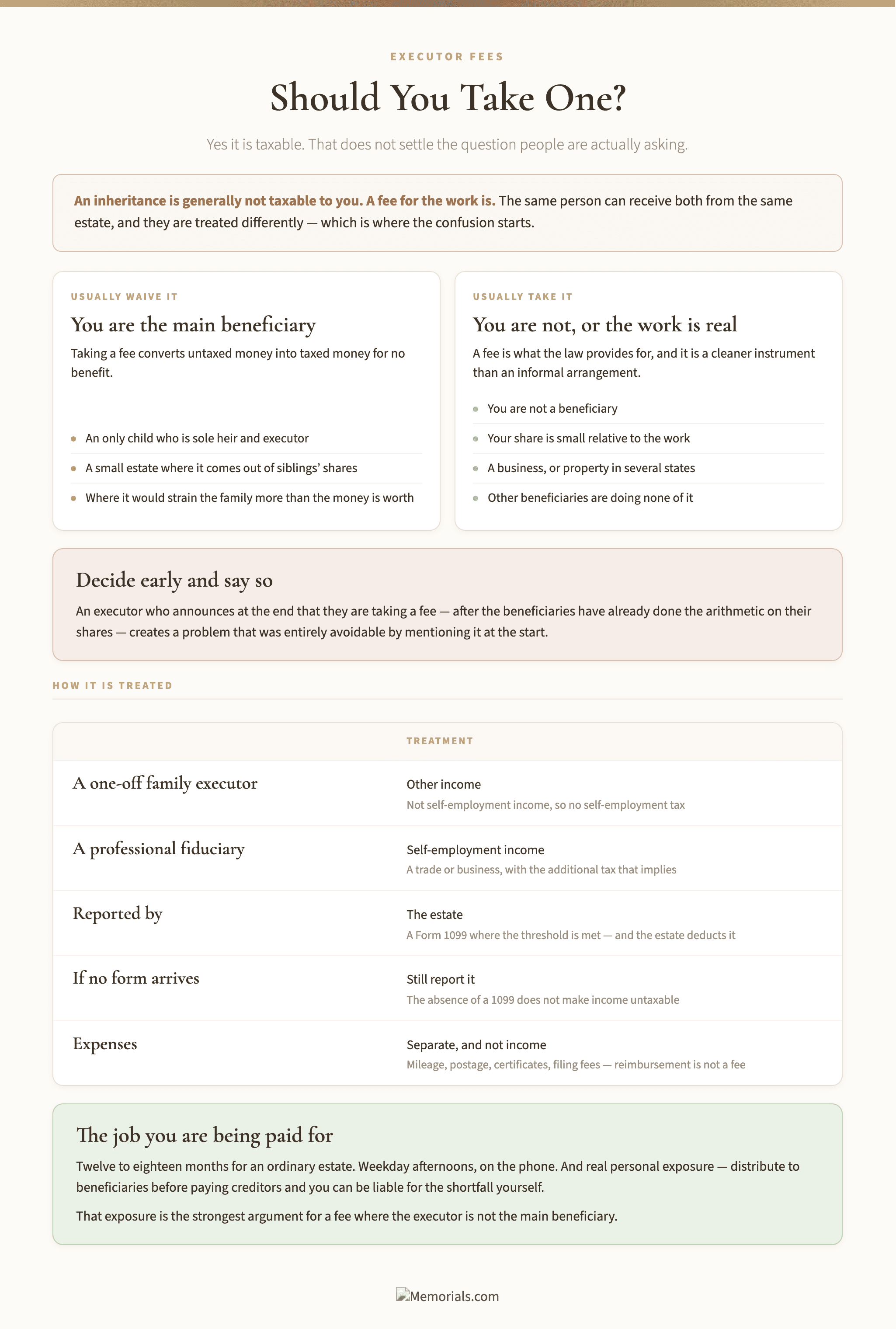
An inheritance is generally not taxable to you. A fee for the work is. The same person can receive both.
If you are the main beneficiary, a fee usually costs the family money rather than saving it.
How Much an Executor Can Charge
Set by state law, and the approaches differ enough to matter.
A statutory percentage. Several states set the fee as a sliding percentage of the estate's value — a few percent on the first tranche, less on the rest. This is mechanical and easy to apply.
Reasonable compensation. Other states simply require the fee to be reasonable, judged on the size of the estate, the complexity, the time spent and the executor's skill. This is more flexible and occasionally more contested.
What the will says. A will may set the fee, and where it does that usually governs. A will directing that the executor serve without compensation is generally enforceable.
Keep a time record from the start. In a reasonable-compensation state you may need to justify the fee, and reconstructing eighteen months of work from memory is both hard and unconvincing. A running note of dates and hours takes minutes a week.
The court may have to approve it, particularly in a supervised administration or where a beneficiary objects.
Expenses are separate from the fee. Mileage, postage, certified death certificates, filing charges and the cost of professional help are reimbursable estate expenses, and reimbursement of a genuine expense is not income. Keep those receipts separately from the fee question entirely.
Whether to Take One at All
Here is where the arithmetic gets interesting, and where a family member should stop and think.
Taking a fee moves money from the estate to you, and it is taxed on the way. If you are also a beneficiary, the same money could have reached you as an inheritance untaxed. In that case taking a fee can leave you — and the family — worse off overall.
A worked shape. An only child who is both sole beneficiary and executor generally should not take a fee. Whatever they take as a fee is taxable to them; whatever they leave in the estate reaches them anyway as an inheritance, untaxed. The fee converts tax-free money into taxable money for no benefit.
When taking one does make sense:
You are not a beneficiary, or your share is small relative to the work.
The estate is large enough to owe estate tax, where the fee is deductible to the estate and may reduce a larger liability than the income tax it creates for you.
The work is genuinely substantial — a business to wind up, property in several states, a contested administration. Eighteen months of real work deserves paying for.
Other beneficiaries are not doing any of it, and fairness between siblings matters. A fee is a cleaner instrument for that than an informal arrangement nobody wrote down.
When waiving it makes sense:
You are the sole or main beneficiary, as above.
The estate is small and the fee would come out of what siblings receive.
Taking it would strain the family more than the money is worth, which is a legitimate reason and not a soft one.
Decide early and say so. An executor who announces at the end that they are taking a fee, after the beneficiaries have already done the arithmetic on their shares, creates a problem that was entirely avoidable by mentioning it at the start.
Fee on one side, inheritance on the other. If you are the main beneficiary, the fee usually costs the family money.
How It Gets Reported
The mechanics, which are less onerous than people fear.
Do executor fees get reported to IRS? Generally yes, and by the estate rather than by you. Where the fee reaches the reporting threshold the estate issues a Form 1099 to the executor and files a copy, and the estate claims the fee as a deduction on its own return.
You report it as income on your personal return for the year you received it, whether or not a form arrives. The absence of a 1099 does not make income untaxable.
Where does it go on the return? For a one-off family executor, usually as other income. For somebody in the business of administering estates, as self-employment income on a business schedule. This is precisely the question worth asking a preparer rather than guessing.
The estate deducts it, which is why the estate has an interest in the fee being documented properly even though the money leaves.
Timing can be chosen, within limits. A fee taken in December and one taken in January fall in different tax years, and where an executor's income differs sharply between two years that is worth a moment's thought. It is not aggressive planning; it is noticing.
State income tax applies too in most states with an income tax, on the same fee.
The absence of a form does not make income untaxable. Report it whether or not a 1099 arrives.
What the Job Actually Involves
Worth setting out, because the fee question only makes sense against the work, and most people accept the role without a clear idea of what they have agreed to.
It runs twelve to eighteen months for an ordinary estate, and longer where there is property to sell or a dispute. People expect weeks.
Most of it happens on weekday afternoons, on the phone, which is why it consumes leave rather than evenings.
The executor carries personal exposure. Distribute to beneficiaries before paying creditors and you can be personally liable for the shortfall. Miss a tax filing and penalties can attach to you. This is a real responsibility rather than an honorary title, and it is the strongest argument for a fee where the executor is not the main beneficiary.
You can decline the role, before accepting it. If you have been named and cannot do it, say so early — an alternate or a court appointee takes over, and stepping back at the start is far easier than resigning midway.
You can also hire help and charge it to the estate. An attorney, an accountant, a probate paralegal. Those are estate expenses, not deductions from your fee, and using them is not an admission of anything.
Frequently Asked Questions
Executor fee taxable — even if I am family? Yes. The tax treatment follows the work, not the relationship. A daughter serving as executor is taxed on a fee exactly as a stranger would be.
Is executor fee taxable if the estate pays no tax itself? Yes. The two are unrelated. Most estates owe no federal estate tax and their executors are still taxed on fees.
I did the work but took nothing. Do I report anything? No. A waived fee is not income and nothing is reported. Waiving is common and requires no paperwork, though a short written note of the decision is worth having.
Can I be reimbursed for expenses without taking a fee? Yes, and this is frequently the right arrangement. Reimbursement of a documented expense is not income, and it does not preclude waiving the fee itself.
Two of us are co-executors. The fee is generally shared, either equally or in proportion to work. Agree the split in writing early, because this is a reliable source of dispute later.
A beneficiary is objecting to my fee. Common where the fee was not discussed in advance. Produce the time record, point to the statutory percentage or the reasonableness standard, and expect the court to be the arbiter if it does not resolve.
Can I take the fee in installments across two years? Often yes, where the work genuinely spans them and the estate remains open. Taking half in December and half in January can matter where a single large payment would push you into a higher bracket. Discuss it with a preparer rather than improvising, and document the basis either way.
Does it affect Social Security or benefits? It can, where the recipient is drawing benefits subject to an earnings test or a means test. Another reason to ask a preparer before taking a large fee in a single year.
Say at the start whether you are taking a fee. Announcing it at the end creates an avoidable problem.
Talking to the Family About It
The tax question is straightforward. The family question is not, and it is the one that actually causes trouble.
Raise it at the first family conversation, alongside everything else. Framed as "the statute allows a fee, here is roughly what it would be, and I am / am not planning to take it," it is an ordinary piece of information. Raised eighteen months later it looks like something that was being kept quiet.
Explain the arithmetic if you are waiving it. People do not always realize that a waived fee stays in the estate and is shared, and an executor who quietly declines several thousand dollars deserves to have that understood rather than unnoticed.
Explain it if you are taking it, too. Particularly the part that catches siblings out — that the fee is taxable to you, so the amount leaving the estate is not the amount reaching you.
Put the time record where they can see it. Not to justify yourself, but because a list of what was actually done is the most effective answer to a vague sense that the estate is taking too long. Most beneficiaries have no idea what the job involves.
Expect the objection to be about something else. Disputes over an executor's fee are frequently a proxy for a dispute about the will, or about who cared for the person at the end. Recognizing that does not resolve it, but it stops the conversation being purely about a number that was never really the issue.
In Closing
Yes, it is taxable, and no, that does not settle whether to take one.
If you are the main beneficiary, taking a fee usually converts untaxed money into taxed money and the family is worse off for it. If you are not, or if the work has been substantial and somebody else is inheriting the benefit of it, a fee is entirely reasonable and it is what the law provides for.
Either way, say which you are doing at the beginning rather than at the end.