🏬Supersize Online Funeral Retailer🪦1000's of Headstones⚱️Over 10,000 Cremation Urns⚰️Caskets Overnight Delivery🛒Funeral & Memorial Superstore🚚FREE Shipping on ALL Orders👨👩👧👦Helping Families for over 20 Years💰Lowest Price Guarantee🏬Supersize Online Funeral Retailer🪦1000's of Headstones⚱️Over 10,000 Cremation Urns⚰️Caskets Overnight Delivery🛒Funeral & Memorial Superstore🚚FREE Shipping on ALL Orders👨👩👧👦Helping Families for over 20 Years💰Lowest Price Guarantee
🏬Supersize Online Funeral Retailer🪦1000's of Headstones⚱️Over 10,000 Cremation Urns⚰️Caskets Overnight Delivery🛒Funeral & Memorial Superstore🚚FREE Shipping on ALL Orders👨👩👧👦Helping Families for over 20 Years💰Lowest Price Guarantee🏬Supersize Online Funeral Retailer🪦1000's of Headstones⚱️Over 10,000 Cremation Urns⚰️Caskets Overnight Delivery🛒Funeral & Memorial Superstore🚚FREE Shipping on ALL Orders👨👩👧👦Helping Families for over 20 Years💰Lowest Price Guarantee
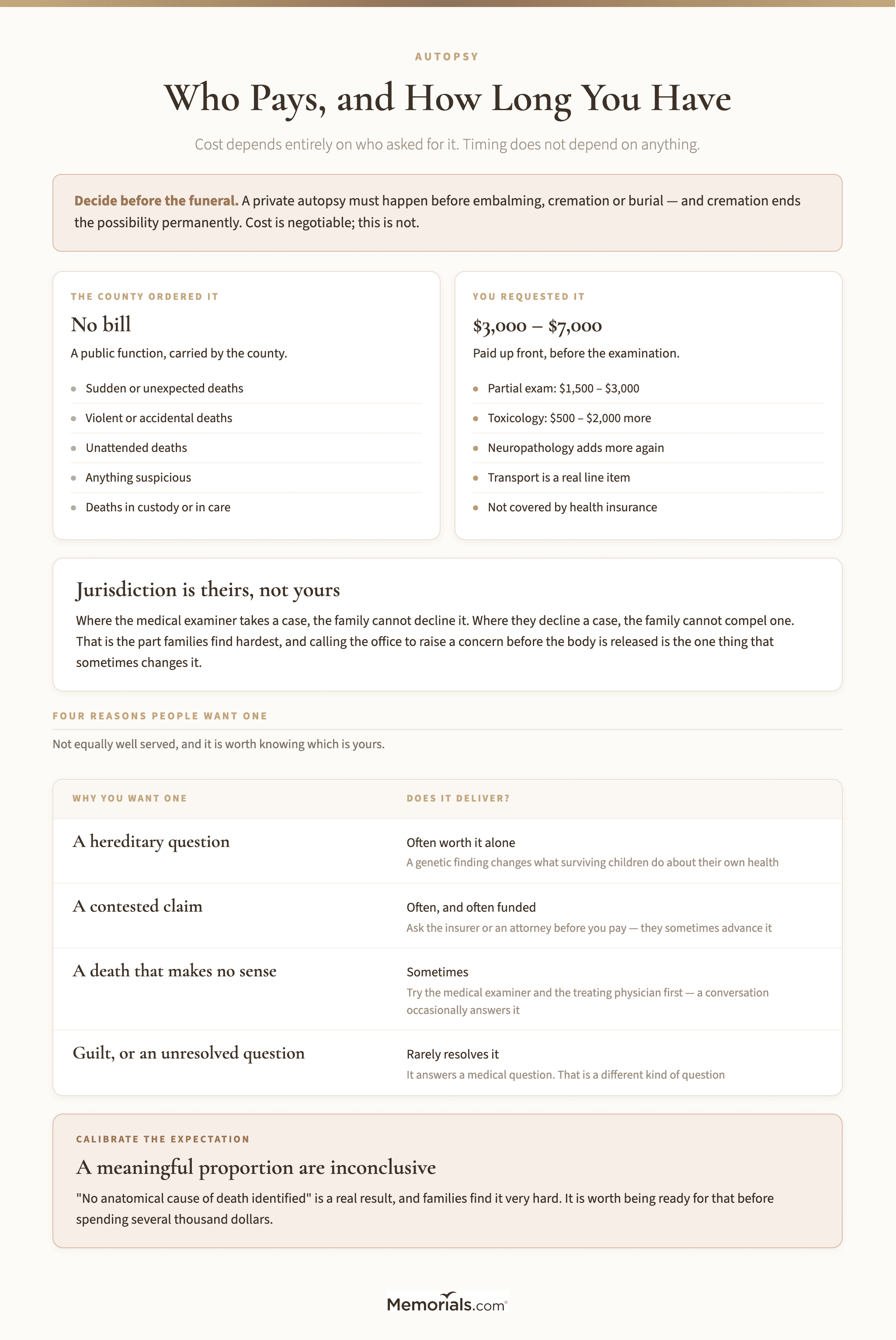
The answer to how much does an autopsy cost depends almost entirely on who is asking for it. If a coroner or medical examiner orders one, the family pays nothing — it is a public function and the county carries it. If the family requests one privately, the figure is usually $3,000 to $7,000, and it is paid up front.
That gap surprises people, and so does the fact that a family cannot simply ask the medical examiner to do one. The two routes are separate systems with separate rules, and knowing which you are in decides everything else.
This sits in the estate affairs guide because it is one of the few estate decisions with a genuine deadline attached.
When the County Pays
A medical examiner or coroner investigates certain deaths as a matter of law, and where they do, there is no bill.
Sudden or unexpected, particularly in someone apparently healthy
Violent — accident, homicide, suicide, or any injury
Unattended, meaning no physician had seen the person recently enough to certify a cause
Suspicious in any way, including where a family raises a concern
In custody, in a state facility, or during a medical procedure
A public health matter, such as a suspected contagious disease
Jurisdiction is theirs, not yours. Where they take a case, the family cannot decline it, and where they decline a case, the family cannot compel one. This is the part that most often frustrates families — the decision belongs to the office.
It also delays the death certificate. A case under investigation frequently produces a certificate with the cause marked pending, which has knock-on effects covered in how many death certificates you need. Toxicology alone commonly takes eight to twelve weeks.
You can ask the office to take a case. If something about a death does not sit right, call and say so before the body is released. They are not obliged to act, and they do listen.
If the coroner takes the case there is no bill — and no choice. Jurisdiction belongs to the office, not the family.
Who ordered it decides who pays. Cost is negotiable and the timing is not.
Private Autopsy Cost
Where no official investigation happens and the family wants answers anyway, a private autopsy is arranged with an independent forensic pathologist.
Private autopsy cost usually runs $3,000 to $7,000 for a complete examination. What moves it within that range:
A full autopsy versus a partial. A limited examination of one organ system or one specific question can run $1,500 to $3,000, and is often all a family actually needs — a question about the heart does not require examining everything.
Where it happens. Metropolitan areas cost more. So does having the pathologist travel to the body rather than the body to the pathologist.
Toxicology, added separately. Commonly $500 to $2,000 on top, and it is usually the piece that answers the question people are actually asking.
Neuropathology, where a brain examination is required — dementia questions in particular — adds several hundred to a couple of thousand and adds weeks.
Transport. Moving the body to and from the facility is a real line item, particularly out of a rural area, and is easy to overlook when comparing quotes.
Autopsy expenses are not usually covered by health insurance, because the patient is no longer a patient. Some life insurance policies will fund one where the cause is contested and it affects a claim; it is worth asking rather than assuming, and asking before you pay.
Get the quote in writing, itemized, and ask specifically what is included. The gap between "autopsy" and "autopsy plus toxicology plus a written report" is the gap between two numbers people compare and think they understand.
Timing, Which Is the Real Constraint
Cost is negotiable. Time is not, and this is the section that matters most.
Decide before the funeral. A private autopsy must happen before embalming, cremation or burial. Cremation ends the possibility permanently — there is no version of this that can be revisited afterward.
Embalming complicates it and does not always prevent it. Some findings survive embalming and some are destroyed by it, particularly toxicology. If an autopsy is even under discussion, tell the funeral home to hold off.
A few days is the usual window before decisions become irreversible. Families are making this call in the worst week of their lives, on very little information, which is precisely why it is worth knowing the constraint exists.
Exhumation is theoretically possible and is expensive, requires a court order in most states, and yields far less. Treat it as not an option.
If you are unsure, pause the funeral rather than the decision. A funeral home can hold a body. A crematorium cannot undo anything.
Who Can Authorize One
The right to authorize follows the same legal order as the right to make funeral arrangements — a spouse first, then adult children, then parents, then siblings. The full order is in next of kin hierarchy.
Disagreement is common and hard. Where one sibling wants answers and another wants the body left alone, the person highest in the legal order decides, which is rarely the resolution anybody wanted. It is worth saying out loud that both positions are reasonable.
Religious objections are real and several traditions prohibit or discourage autopsy. Some pathologists will accommodate this with a limited or non-invasive examination. A written wish carries weight here where a will does not, because a will is generally read after this decision has already been made — the evening somebody spends on an online trust and will is the moment to write the autopsy preference down somewhere the family will actually look.
Non-invasive alternatives exist. A post-mortem CT or MRI — sometimes called a virtual autopsy — is available in some areas at broadly comparable cost, and answers some questions well and others not at all. Worth asking about where an invasive examination is unacceptable.
Cost is negotiable and time is not. Cremation ends the possibility permanently.
What You Actually Get
Worth calibrating, because expectations and outcomes diverge here.
A written report, typically in four to eight weeks, sometimes longer where toxicology is involved. It is technical and most families need the pathologist to walk them through it, which good ones will do and should be included in the fee.
A cause and manner of death, as the pathologist finds them. This may or may not match what was originally certified.
An amended death certificate, sometimes. Where a private autopsy contradicts the official cause, the certifying physician or the medical examiner may amend the certificate. They are not obliged to, and this is where a family's expectations most often exceed what the process delivers.
Findings usable in a claim or a case. A private report is admissible and independent, which is precisely why insurers and attorneys sometimes fund one.
What you may not get is an answer. A meaningful proportion of autopsies are inconclusive, and "no anatomical cause of death identified" is a real result that families find very hard. It is worth being ready for.
Is It Worth It?
The honest answer is that it depends on which of four reasons is yours, and they are not equally well served.
A contested insurance claim, or a possible medical negligence case. Often yes, and often funded by somebody else. Ask the attorney or the insurer first.
A hereditary condition your family needs to know about. Frequently yes, and this is the reason that most often justifies the cost on its own — a genetic finding changes what the surviving children do about their own health.
A death that does not make sense. Sometimes. Try the medical examiner's office first, and ask the treating physician for a full explanation before spending anything — a conversation occasionally answers what a family thought only an autopsy could.
Guilt, or an unresolved question about whether something could have been prevented. This is the hardest one, because an autopsy rarely resolves it. It answers a medical question. Families who go into it hoping for absolution frequently do not find it there, and it is kinder to say so.
A meaningful proportion of autopsies are inconclusive. "No anatomical cause identified" is a real result.
Paying For It
The money question is usually asked after the decision rather than before, which is the wrong way round when the sum is this size.
It is paid up front. Private pathologists generally require payment or a deposit before the examination, not after the report. This is a real obstacle in the week after a death, when the estate's accounts are frozen and nobody has been appointed to anything yet.
Which means it usually comes out of somebody's own pocket and is reimbursed by the estate later. Keep the receipt, record it as an estate expense, and — if there is more than one beneficiary — say out loud at the time that you intend to be reimbursed. Unspoken assumptions about who paid for what are a reliable source of family argument eighteen months on.
Ask the insurer before you pay. Where a death benefit turns on the cause, an insurer occasionally funds an independent examination, and they will not offer.
Ask an attorney before you pay, if there is any possibility of a claim. Where a case has merit, the cost is frequently advanced against the eventual recovery.
Do not let the money delay the decision. The window closes in days and the funding question can be sorted out afterward. Families who spent the week trying to work out how to pay, and lost the option while doing it, is a pattern worth avoiding. Where money is being raised publicly for the funeral anyway, an examination is a legitimate thing to add to it — and worth reading are funeral donations tax deductible first, because the answer surprises most people on both sides of the transaction.
If the estate will be small, this is a large expense against it. That is a legitimate reason to choose a limited examination answering one question rather than a full one, and a pathologist will tell you honestly whether the narrower version would answer what you are asking.
Frequently Asked Questions
Can I ask the coroner to do one for free if they declined the case? No. Where they decline jurisdiction, the private route is the only one.
Will it delay the funeral? Usually by a few days rather than weeks. The examination itself is a matter of hours; scheduling is what takes the time.
Are autopsy expenses deductible as an estate cost? They are generally a legitimate expense of administering the estate, though whether they are deductible depends on the return being filed. Worth asking your tax preparer — the same question that comes up with executor fees.
Can we still have an open casket? Almost always yes. Incisions are placed so that clothing and normal presentation conceal them entirely, and funeral directors handle this routinely.
How do I find a private pathologist? Ask the funeral director, who will usually know who works in your area, or contact a university medical center's pathology department. Independent forensic pathologists also advertise directly.
Is a second autopsy possible after an official one? Yes, and it is not unusual where a family disputes the official finding. It costs the same and yields less, because the first examination has already altered things.
An autopsy answers a medical question well and the other kind not at all. Be clear which one you are asking.
Reading the Report When It Comes
Four to eight weeks later a document arrives, and families are rarely prepared for what it is like.
It is written for other doctors. Dense, abbreviated, and organized by body system rather than by the question you asked. Reading it cold is distressing and frequently misleading.
Ask for the conversation. A competent pathologist will talk you through it, and that walkthrough should be part of what you paid for. Ask before you engage them whether it is included.
Bring your question written down. In the room, families often forget the specific thing they wanted to know. One sentence on a piece of paper solves it.
Take somebody with you, or record the call if the pathologist agrees. Very little of a conversation like that is retained the first time.
The findings section is not the conclusion. Reports list everything observed, including incidental findings of no relevance — an old healed fracture, an unremarkable variation. Families read those as significant when they are not.
If it contradicts what you were told, that is worth pursuing with the certifying physician. It is also worth knowing that two pathologists can reasonably reach different conclusions from the same findings, and a disagreement is not automatically a discovery.
In Closing
If the coroner takes the case, there is no bill and no choice. If they do not and you want one, budget $3,000 to $7,000, get the quote itemized, and — above everything else — decide before the funeral, because cremation closes the door for good.
And be clear with yourself about which question you are paying to have answered. An autopsy is very good at medical questions and no use at all for the other kind.