🏬Supersize Online Funeral Retailer🪦1000's of Headstones⚱️Over 10,000 Cremation Urns⚰️Caskets Overnight Delivery🛒Funeral & Memorial Superstore🚚FREE Shipping on ALL Orders👨👩👧👦Helping Families for over 20 Years💰Lowest Price Guarantee🏬Supersize Online Funeral Retailer🪦1000's of Headstones⚱️Over 10,000 Cremation Urns⚰️Caskets Overnight Delivery🛒Funeral & Memorial Superstore🚚FREE Shipping on ALL Orders👨👩👧👦Helping Families for over 20 Years💰Lowest Price Guarantee
🏬Supersize Online Funeral Retailer🪦1000's of Headstones⚱️Over 10,000 Cremation Urns⚰️Caskets Overnight Delivery🛒Funeral & Memorial Superstore🚚FREE Shipping on ALL Orders👨👩👧👦Helping Families for over 20 Years💰Lowest Price Guarantee🏬Supersize Online Funeral Retailer🪦1000's of Headstones⚱️Over 10,000 Cremation Urns⚰️Caskets Overnight Delivery🛒Funeral & Memorial Superstore🚚FREE Shipping on ALL Orders👨👩👧👦Helping Families for over 20 Years💰Lowest Price Guarantee
People ask how long to keep utility bills after death and mean two different things by it — how long to keep the service running, and how long to keep the paperwork afterward. The answers are different. Service, usually until the property is sold or let. Paperwork, rather longer than instinct suggests.
Utilities are the part of an estate that punishes haste. Cancel too fast and you have an unheated, unlit house that nobody can show to a buyer and that may freeze its own pipes over a winter. Leave everything untouched and the bills accumulate against an account nobody is watching.
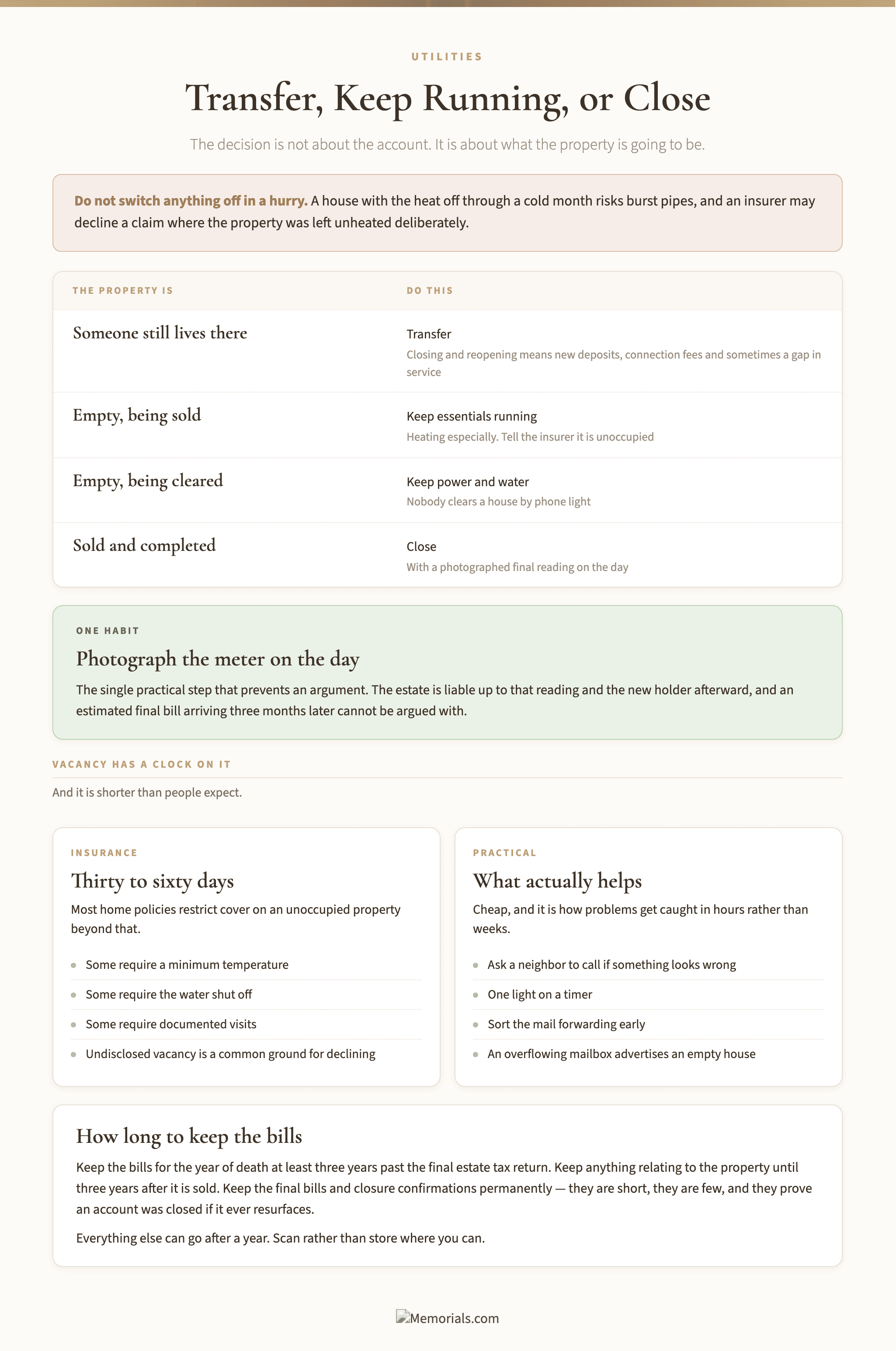
Before touching a single account, work out what the property is going to be, because it decides everything else.
If someone is still living there — a surviving spouse, an adult child — the accounts should be transferred into their name, not closed. Closing and reopening means new deposits, new connection fees, and occasionally a gap in service.
If the house is empty and being sold, keep the essential services running. Heating in particular. A property with the heat switched off through a cold month risks burst pipes, and the resulting damage is both expensive and the kind of thing an insurer may decline where the house was left unheated deliberately.
If the house is empty and being cleared, keep power and water on until it is finished. Nobody clears a house by phone light.
Only when the property changes hands does closing become the right move, and even then the buyer's own supplier switch usually handles most of it.
Check the insurance first. Many home insurance policies restrict cover on a property left unoccupied beyond thirty or sixty days, and some require the heating kept at a minimum temperature. Tell the insurer the house is empty — undisclosed vacancy is a common reason a claim is refused.
Do not switch the heat off in an empty house. Burst pipes are expensive and insurers ask whether it was deliberate.
The decision is not about the account. It is about what the property is going to be.
Transferring Rather Than Closing
Transferring utilities when someone dies is the common case and it is simpler than closing. Most suppliers treat it as a change of account holder rather than a new connection.
What they ask for. Usually a death certificate — often a photocopy is accepted, which is one of the few places it is — the account number, the meter readings on the day, and the new account holder's details. Some run a credit check on the incoming name.
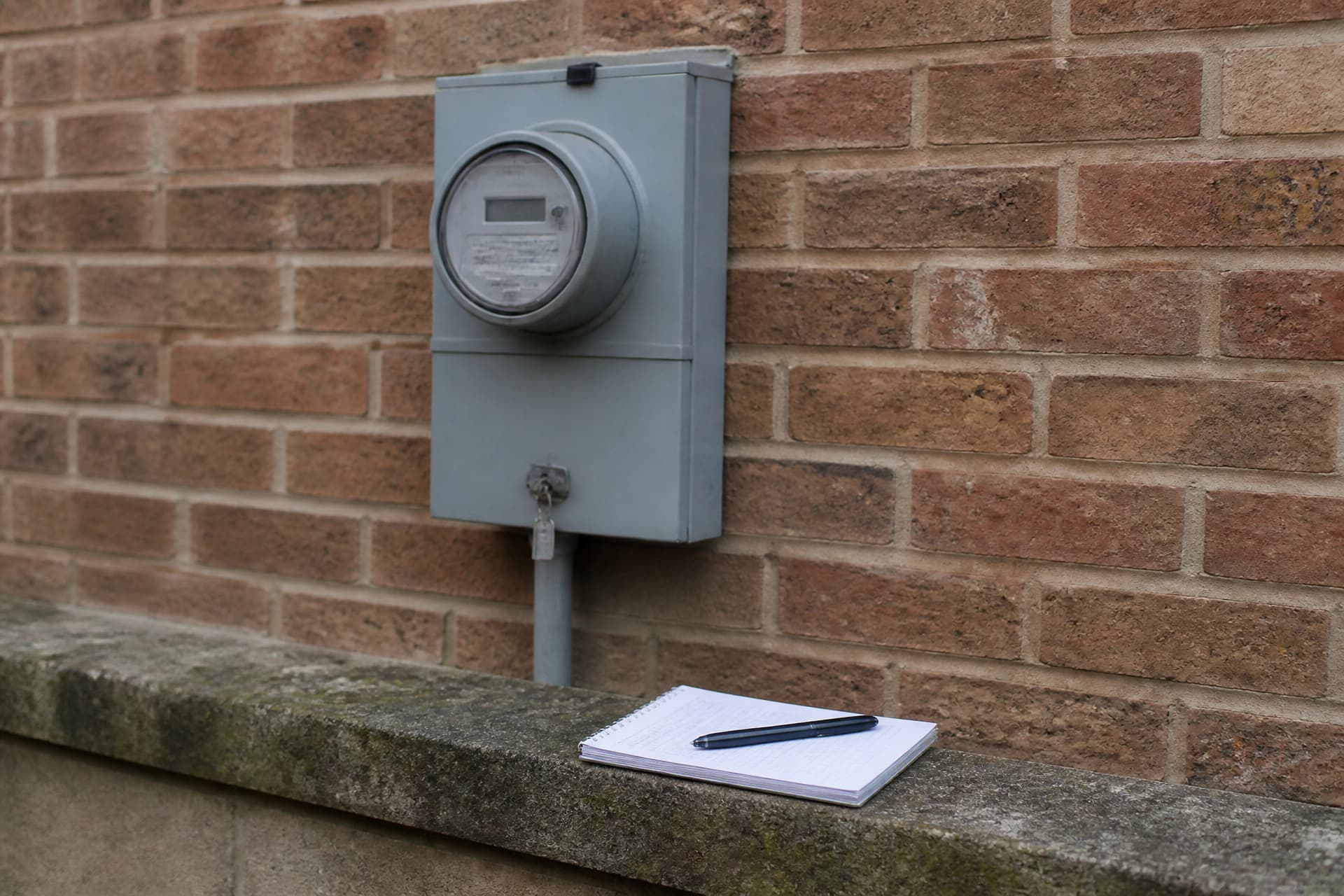
Take meter readings on the day of transfer and photograph the meters. This is the single practical step that prevents an argument, because the estate is liable up to that reading and the new holder afterward.
Changing the name on utility bills after death is usually a phone call. How to change name on water bill after death and how to change name in electricity bill after death are the same procedure at different companies, and water is often the easiest because it is billed to the property rather than to a person.
Ask about the deposit. Where the original account held a security deposit, it belongs to the estate. Suppliers rarely mention it and will usually refund or transfer it when asked.
A surviving spouse usually has an easier route than an executor. Many suppliers will transfer to a spouse on a phone call with minimal documentation, where an executor for an empty property needs the full paperwork.
One transfer this month is not like the others.Transferring ownership of a life insurance policy to a funeral home is an assignment rather than a change of account holder: it signs over an asset to settle a bill, and unlike a utility account it is hard to undo. Worth keeping the two straight in a week when every piece of paper says transfer.
Can You Keep Utilities in a Deceased Person's Name?
The honest answer to can you keep utilities in a deceased person's name is that many families do, for months, and nothing dramatic happens.
Why it works. Utilities keep supplying as long as somebody pays. There is no verification, no annual identity check, and the direct debit does not know anything has changed.
Why it is still a bad idea. Three reasons, in increasing order of seriousness. It complicates the estate accounts, because an executor is meant to be able to show what was paid and by whom. It leaves the direct debit running against a bank account that is about to be frozen, at which point the payments fail and arrears begin quietly. And it is the sort of untidiness that gets discovered at the worst moment — usually at the point of sale, when a title company asks.
Paperless billing is why nobody knows what the accounts are. A house with every bill going to one inbox leaves no paper trail at all, and the login is on a phone nobody can open. This is the small domestic version of what a dead man's switch is for — and in the meantime, twelve months of bank statements is how the list actually gets built.
The compromise most families actually make is to leave the account name alone but redirect the bills, pay them from the estate, and clear it all up at completion. That is defensible so long as somebody is genuinely watching the payments.
What is not defensible is continuing to claim a discount or exemption that belonged to the person who died — a senior discount, a disability tariff, a low-income rate. Those end with them, and continuing to take them is a different thing from administrative inertia.
Canceling, When It Is Time
Working out how to cancel utilities for deceased account holders is the last step rather than the first, and it happens when the property completes or the tenancy ends.
Final readings on the day. Photographed. Again, this is what prevents the estimated final bill that arrives three months later and cannot be argued with.
Ask for the final bill in writing, addressed to the estate at your address rather than the property.
Credit balances are common and rarely volunteered. Where the account is in credit, that money belongs to the estate. Ask directly.
Return equipment. Cable boxes, routers and metering equipment are usually leased, and unreturned hardware generates charges long after everything else is closed.
Do the small ones too. Trash collection, a septic contract, a water softener rental, a lawn service, a security monitoring contract. These are the ones that keep billing for a year because nobody remembered they existed — and the way to find them is the bank statements, which is the same method as the digital subscriptions list.
Photograph the reading on the day. It is the one step that prevents an estimated final bill you cannot argue with.
Writing to a Utility Company
Most of this is done by phone, but some suppliers want it in writing and a written record is worth having regardless. A sample letter to utility company after death does not need to be elaborate — four short paragraphs covering the facts:
Who died and when, with the account number and the service address.
What you are asking for — transfer to a named person, or closure with a final bill. Be explicit; a letter that only reports a death will sit in a queue while somebody works out what you wanted.
Who you are, and on what authority — executor, administrator, surviving spouse — with a note of what you have enclosed.
Where to reply, which should be your address rather than the property, and a phone number.
Enclose a photocopy of the death certificate unless they have specifically asked for a certified copy, which for utilities is unusual. Keep your certified copies for the institutions in the financial directory that will not release them.
Send it and then call. Letters get scanned into queues. A call a week later, quoting the letter, is what moves it.
Three years past the final return. It costs nothing and only matters on the day it turns out to matter.
If the Property Was Rented
A tenancy is a different problem from a house, and it moves faster than everything else in an estate.
The lease does not simply end. In most states a tenancy survives the tenant and becomes an obligation of the estate, which means rent continues to accrue until the lease is terminated or its term runs out. Landlords are usually reasonable about this and are not obliged to be.
Talk to the landlord in the first week. Most will agree to an early termination on a death, particularly if the property can be relet quickly. Get whatever is agreed in writing — a verbal agreement with a letting agent has a way of evaporating.
The security deposit belongs to the estate, less any legitimate deductions. Do a joint walkthrough and photograph everything before the keys go back, exactly as a departing tenant would.
Utilities in a rental are usually simpler, because several will be in the landlord's name already. Close only the ones the tenant held, and take readings on the day the keys are returned rather than the day the last box leaves.
Clear the property before the notice period ends. This is the pressure families feel most acutely, and it is worth asking for more time explicitly rather than assuming there is none.
How Long to Keep the Bills
The paperwork half, and the answer is longer than instinct suggests.
Keep utility bills for the year of death for at least three years after the final estate tax return is filed. They are evidence of expenses where the estate claims them, and of occupancy where that matters.
Keep anything relating to the property for as long as the property is in the estate, plus three years after sale. Utility records establish continuous service, which occasionally matters in a boundary or easement question and more often in an insurance claim.
Keep the final bills and closure confirmations permanently. They are short, they are few, and they are the proof that an account was closed if it ever resurfaces.
Everything else can go after a year. Routine monthly bills from years before the death have no value to an estate and shredding them is fine.
Scan rather than store where you can. A folder of photographs on a drive takes no space, and an executor may need to produce something years after the boxes have gone.
Keep power and water on until the house is cleared. Nobody empties a house by phone light.
The Empty House Problem
An unoccupied property is a category of its own and the utilities decision is only part of it.
Vacancy has a clock on it. Most home insurance restricts cover after thirty or sixty days unoccupied. Some policies require the heating held at a minimum temperature, some require the water shut off at the main, and some require documented weekly visits. Read the policy rather than assuming, and tell the insurer — undisclosed vacancy is one of the most common grounds for declining a claim.
Winter is the expensive season to get this wrong. A burst pipe in an empty house can run for days. Where the property will be empty through a cold spell, either keep the heat on at a low setting or have the system drained properly by somebody who does it for a living.
Mail is a signal to the street. An overflowing mailbox advertises an empty house, which is a separate reason to sort out the mail forwarding early.
Keep one light on a timer. Cheap, and the same logic as the mail.
Tell a neighbor. The single most useful thing anybody does for an empty family house is ask the person next door to call if something looks wrong. It costs nothing and it is how most problems get caught in hours rather than weeks.
Frequently Asked Questions
The direct debit is still running from a frozen account. Payments will fail and arrears will build without anybody being told. Move the billing to an estate account or pay manually until the property is dealt with.
A supplier is refusing to talk to me. They are entitled to want proof of authority. Send it in writing with a photocopy of the death certificate and evidence you are the executor, then call.
A bill has arrived addressed to the deceased for a period after the death. Normal, and payable by the estate up to the closing reading. Check the reading rather than the name.
Can I switch supplier while the estate is open? Yes, and it sometimes saves money on an empty property. Do it in the new account holder's name rather than the estate's, or it complicates the closure later.
What about a shared property? The surviving co-owner or co-tenant transfers the account into their sole name. The estate is liable only for its share up to the date of death, though suppliers will not usually apportion it for you.
There is a large unexpected balance. Ask for a breakdown and check for estimated readings. Estimated bills on an empty property are frequently wrong and are usually corrected on a real reading.
In Closing
Do not switch anything off in a hurry. Transfer where somebody is living there, keep the essentials running where the house is empty, and close only when it changes hands — with a photographed reading on the day.
Then keep the paperwork three years past the final return, which costs nothing and is the sort of thing that only matters on the day it turns out to matter.