🏬Supersize Online Funeral Retailer🪦1000's of Headstones⚱️Over 10,000 Cremation Urns⚰️Caskets Overnight Delivery🛒Funeral & Memorial Superstore🚚FREE Shipping on ALL Orders👨👩👧👦Helping Families for over 20 Years💰Lowest Price Guarantee🏬Supersize Online Funeral Retailer🪦1000's of Headstones⚱️Over 10,000 Cremation Urns⚰️Caskets Overnight Delivery🛒Funeral & Memorial Superstore🚚FREE Shipping on ALL Orders👨👩👧👦Helping Families for over 20 Years💰Lowest Price Guarantee
🏬Supersize Online Funeral Retailer🪦1000's of Headstones⚱️Over 10,000 Cremation Urns⚰️Caskets Overnight Delivery🛒Funeral & Memorial Superstore🚚FREE Shipping on ALL Orders👨👩👧👦Helping Families for over 20 Years💰Lowest Price Guarantee🏬Supersize Online Funeral Retailer🪦1000's of Headstones⚱️Over 10,000 Cremation Urns⚰️Caskets Overnight Delivery🛒Funeral & Memorial Superstore🚚FREE Shipping on ALL Orders👨👩👧👦Helping Families for over 20 Years💰Lowest Price Guarantee
Working out how to cancel accounts after someone dies is a different job from closing their bank accounts, and it catches people out for one reason: there is no counter to walk up to. No certified document opens a Google account. There is a web form somewhere, and finding it is most of the work.
It is also the part that keeps costing money quietly. Subscriptions renew against a card that has not been closed yet, and a streaming service will happily bill a dead person for two years because nobody told it anything.
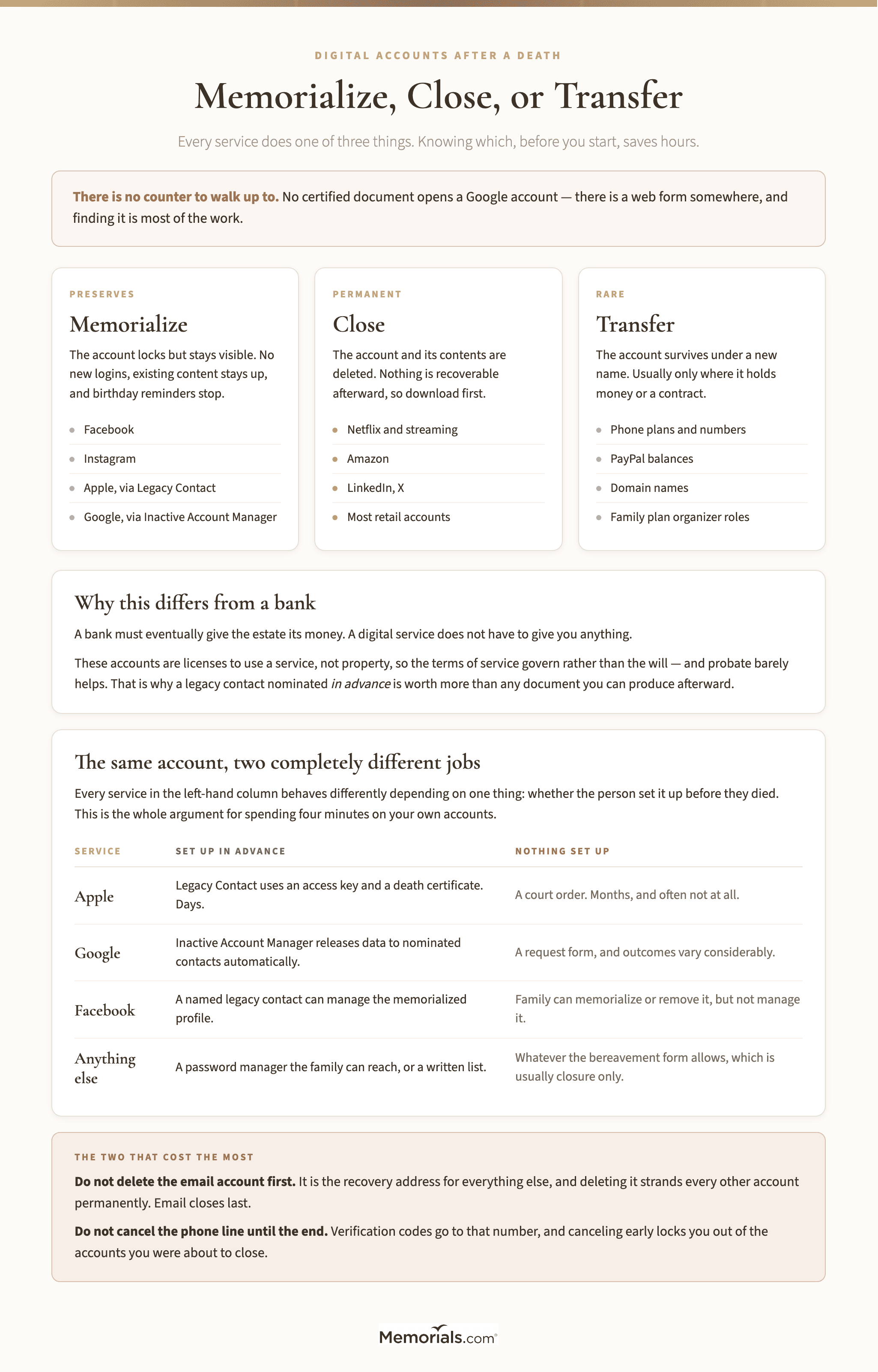
Every service does one of three things, and knowing which before you start saves a great deal of pointless searching.
Memorialize it. The account stays visible but locks — no new logins, often a marker on the profile, and existing content stays up. Facebook, Instagram and, in effect, Apple and Google's legacy tools work this way. This is the only option that preserves anything.
Close it. The account and its contents are deleted. Netflix, most streaming services, most retail accounts. Nothing is recoverable afterward, so download anything you want first.
Transfer it. Rare, and usually only where the account holds money or a contract — a phone plan, a PayPal balance. The account itself survives under a new name.
The decision you cannot undo is deletion, so when you are unsure, memorialize or leave it. There is no deadline on any of this, and an untouched account costs nothing if the card behind it is closed.
Memorialize preserves, close is permanent, transfer is rare. A bank must eventually pay the estate; a digital service owes you nothing.
Memorialize, close, or transfer. Deletion is the one you cannot take back, so when in doubt do nothing.
The Ones With a Real Legacy Feature
These four planned for this, and they are worth doing first because they are the ones that preserve something.
Apple — Legacy Contact. If the person nominated someone before they died, that person needs an access key and a death certificate, and they get the iCloud data. If nobody was nominated, Apple requires a court order, which is a genuinely high bar. The full process is in Apple Legacy Contact, and the difference between "nominated" and "not nominated" is the difference between an afternoon and a lawsuit.
Google — Inactive Account Manager. The same idea, set up in advance: after a period of inactivity, Google hands nominated contacts the data or deletes the account. If it was never configured, there is a request form, and outcomes vary.
Facebook and Instagram — memorialization. Both let a family member memorialize or remove a profile with proof of death. A memorialized profile stops appearing in birthday reminders and "people you may know", which matters more than it sounds — those notifications reaching a grieving family months later is a common and awful experience. See how to memorialize an Instagram account for the steps.
LinkedIn and X both have deceased-member forms. Neither preserves anything; both simply remove the profile.
The pattern worth noticing: every one of these works dramatically better if it was set up before. That is the whole argument for digital estate management as something you do for your own accounts while you can — nominating a legacy contact takes about four minutes and removes a court order from someone else's worst year. A dead man's switch is the same idea taken further.
The Subscriptions, Which Are Just Bleeding Money
No legacy features here. These close, and the only real task is finding all of them.
Netflix. To cancel Netflix after death you generally do not need to prove anything — if you can log in, you can cancel, and if you cannot, customer service will close it with a death certificate. The honest answer to how to cancel Netflix for a deceased person is that it is one of the easier ones. Netflix bills monthly, so the exposure is small but it is also entirely unnecessary.
Amazon. Two separate things, and people do one and forget the other. Canceling Prime and closing the account are different actions — you can cancel Amazon Prime for a deceased person from within the account, but the account itself needs Amazon's bereavement process to close. There is no way to transfer an Amazon account after death; the account is tied to a person and Amazon will close rather than reassign it. Anything bought — Kindle books, video purchases — generally does not survive, which is worth knowing before you close it. See Amazon deceased customer account.
Microsoft covers Outlook, Xbox and OneDrive under one account, and has a next-of-kin process for data release.
PayPal is the one to check even if nobody mentions it, because a balance can sit there for years. PayPal treats it like a financial account — expect to provide the same documents as a bank.
Check whether the family is on the account first. A shared plan is the trap here: a family Netflix profile, an Apple family group, an Amazon Household, a shared cloud storage plan. Canceling the deceased person's account cuts off everybody on it, sometimes including a surviving spouse's photo backups. Where the plan allows it, move another family member into the organizer role before you close anything — Apple and Google both permit this, and it is far easier done while the account is still open than reconstructed afterward.
How to find the rest. There is no master list, so work backwards from money: go through twelve months of bank and card statements and write down every recurring charge. That single pass finds more than any amount of guessing at which services someone used, and you will need the statements anyway.
Twelve months of statements, every recurring charge written down. There is no master list of someone's subscriptions — this is the list.
The Phone, Which Is Its Own Problem
Working out how to cancel a cell phone when someone dies is more complicated than the other subscriptions, for two reasons: the phone is often the key to everything else, and the number may be worth keeping.
All three major carriers — Verizon, AT&T and T-Mobile — will cancel a line with a death certificate, and all three will usually waive an early termination fee. They will also transfer the number to a surviving family member, which is worth considering before you cancel.
Do not cancel the line until you have finished everything else. Two-factor authentication codes go to that number, and canceling it early can lock you out of accounts you were about to close. This is the single most common sequencing mistake in the whole job.
The deepest difference: a bank must eventually give the estate its money, and a digital service does not have to give you anything. These accounts are licenses to use a service, not property, and the terms of service govern rather than the will. That is why a legacy contact nominated in advance is worth so much more than any document you can produce afterward.
The Things That Actually Disappear
Some of what a person owned online does not transfer, cannot be inherited, and is gone the moment the account closes. It is worth knowing which before you close anything.
Purchased media mostly evaporates. Kindle books, movie purchases, music bought from a store rather than streamed — nearly all of it is a license to that person, not property, and licenses end with the person. There is no legal route to move a Kindle library to a family member. If a collection matters to somebody, the practical answer is to keep the account open and the device signed in, which is legally untidy but is what people actually do.
Photos are the ones worth fighting for. They are also the most likely to be recoverable, because Apple and Google both have real processes and both will release data to a legacy contact or, more slowly, to a court order. Do this one before you close anything else, and download rather than trusting the account will stay open.
Cryptocurrency is gone without the keys. No exchange, court order or death certificate recovers a self-custodied wallet — that is the entire design. Coins held at an exchange are recoverable through that exchange's estate process, like any other financial account. Coins in a private wallet need the seed phrase, and if it was not written down somewhere findable, the money no longer exists in any practical sense. Look for a hardware wallet, a sealed envelope, or a note in a safe deposit box.
Domain names and websites lapse quietly. If the person ran a business, a blog, or a family site, the domain renews annually against a card that is about to be closed, and then it drops and somebody else buys it. Registrars do have transfer processes. This one runs on a clock, so if a domain matters, deal with it early.
Loyalty points and airline miles vary wildly. Some programs transfer to an estate, some to a named beneficiary, and some simply void on death. Worth one email each if the balances are meaningful.
Crypto in a private wallet needs the seed phrase. No court order recovers it — that is the design, not an oversight.
Two Things Not to Do
Do not log in as them. It is the obvious shortcut, everybody thinks of it, and it breaches the terms of service of essentially every service named on this page. In some readings it also runs into computer misuse law. Practically, it can also get the account locked at the moment you most need it open. Use the bereavement process, slow as it is.
Do not delete the email account first. It is the recovery address for everything else, and deleting it strands every other account permanently. The email account is the last one to close, not the first.
Email closes last. It is the recovery address for everything else, and deleting it first strands the rest permanently.
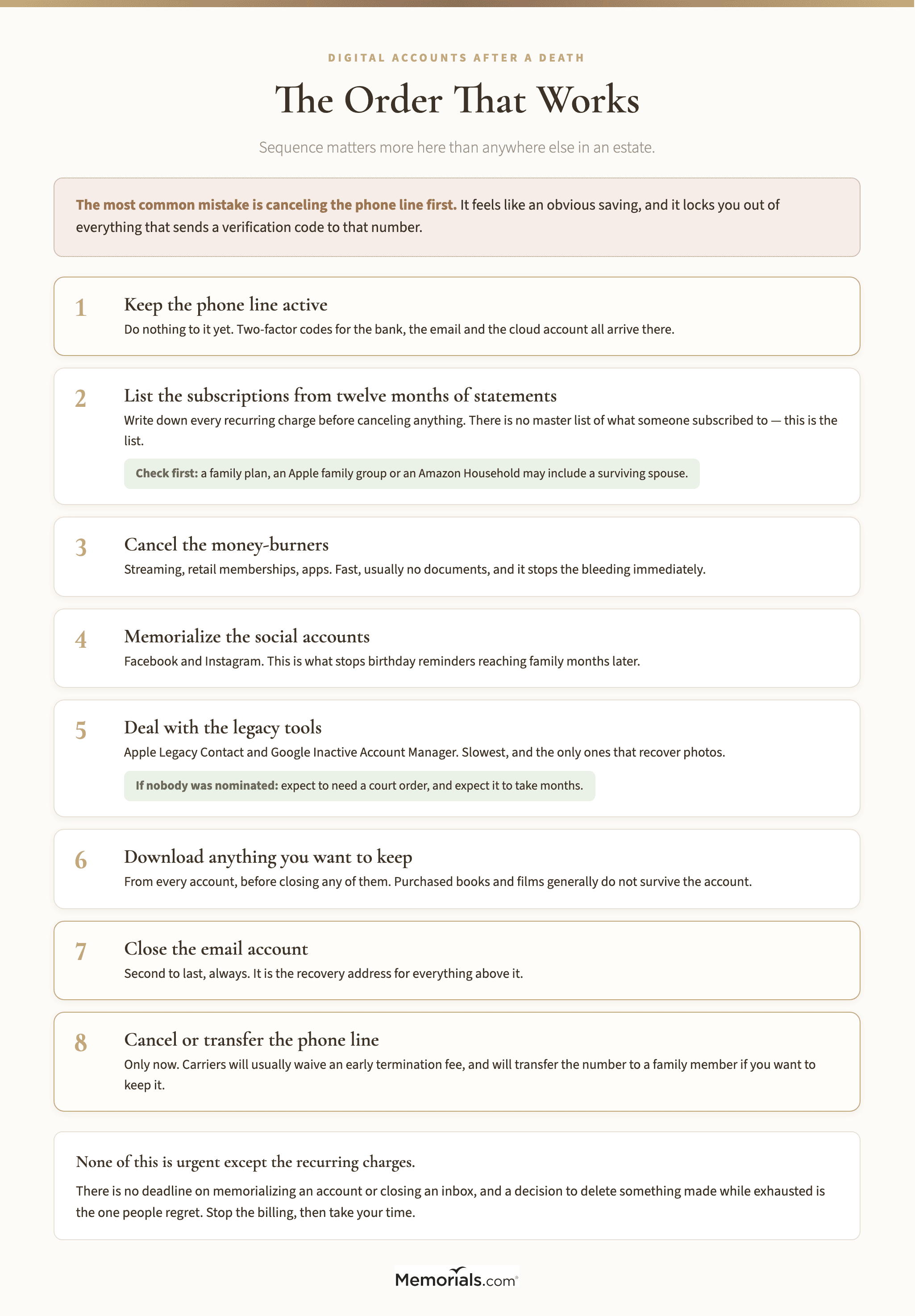
The Order That Works
First, keep the phone line active. Everything else depends on it for verification codes.
Second, list the subscriptions from twelve months of statements before canceling anything.
Third, cancel the money-burners — streaming, retail memberships, apps. Fast, no documents, immediate saving.
Fourth, memorialize the social accounts, so birthday notifications stop reaching people.
Fifth, deal with the legacy tools — Apple and Google — which take longest and matter most.
Sixth, download anything you want to keep, from every account, before closing any of them.
Seventh, close the email account.
Last, cancel or transfer the phone line.
The phone line goes last, not first. Canceling it early locks you out of everything it verifies.
Related: you will need death certificates for several of these, though fewer than for the banks.
Frequently Asked Questions
Do I need a death certificate for all of this? For memorialization and bereavement processes, usually yes. For canceling an ordinary subscription you can still log in to, usually not.
Can I keep their photos? Only if you can get into the account, or if a legacy contact was nominated. This is the strongest practical argument for setting one up on your own accounts today.
They had a password manager and I have the master password. Is that fine? It is a gray area rather than a clear yes. Having the credentials is not the same as being authorized to use them, and terms of service do not care how you got in. Where a bereavement process exists, use it — for anything holding money, use it without exception.
Something is still billing a closed card. The charge will fail and the service will eventually close for non-payment, but it may go to collections against the estate first. Cancel it properly rather than relying on the card being dead, and keep the confirmation when it arrives. The rule is the one in how long to keep utility bills after death: routine statements can go after a year, closure confirmations are worth keeping permanently, because they are the only proof an account was ended if it ever resurfaces.
Nobody knows what accounts existed. Twelve months of statements, then the email inbox for receipts and "welcome to" messages. Between them you will find nearly everything that matters. Paper catches whatever never sent an email, which is why how to forward mail for a deceased person belongs at the front of this job rather than the end — a year of redirected post is an inventory nobody had to assemble.
Is any of this urgent? Only the recurring charges. Everything else can wait until you have the energy — and a decision to delete made while exhausted is the one people regret.
In Closing
The financial side of an estate has rules, departments and people whose job it is to help. The digital side has forms, terms of service, and a strong preference for having been told in advance.
Which makes the most useful thing on this page not a step at all: spend four minutes nominating a legacy contact on your own Apple and Google accounts. It is the one part of this whole job that somebody was able to make easier, and only beforehand.