🏬Supersize Online Funeral Retailer🪦1000's of Headstones⚱️Over 10,000 Cremation Urns⚰️Caskets Overnight Delivery🛒Funeral & Memorial Superstore🚚FREE Shipping on ALL Orders👨👩👧👦Helping Families for over 20 Years💰Lowest Price Guarantee🏬Supersize Online Funeral Retailer🪦1000's of Headstones⚱️Over 10,000 Cremation Urns⚰️Caskets Overnight Delivery🛒Funeral & Memorial Superstore🚚FREE Shipping on ALL Orders👨👩👧👦Helping Families for over 20 Years💰Lowest Price Guarantee
🏬Supersize Online Funeral Retailer🪦1000's of Headstones⚱️Over 10,000 Cremation Urns⚰️Caskets Overnight Delivery🛒Funeral & Memorial Superstore🚚FREE Shipping on ALL Orders👨👩👧👦Helping Families for over 20 Years💰Lowest Price Guarantee🏬Supersize Online Funeral Retailer🪦1000's of Headstones⚱️Over 10,000 Cremation Urns⚰️Caskets Overnight Delivery🛒Funeral & Memorial Superstore🚚FREE Shipping on ALL Orders👨👩👧👦Helping Families for over 20 Years💰Lowest Price Guarantee
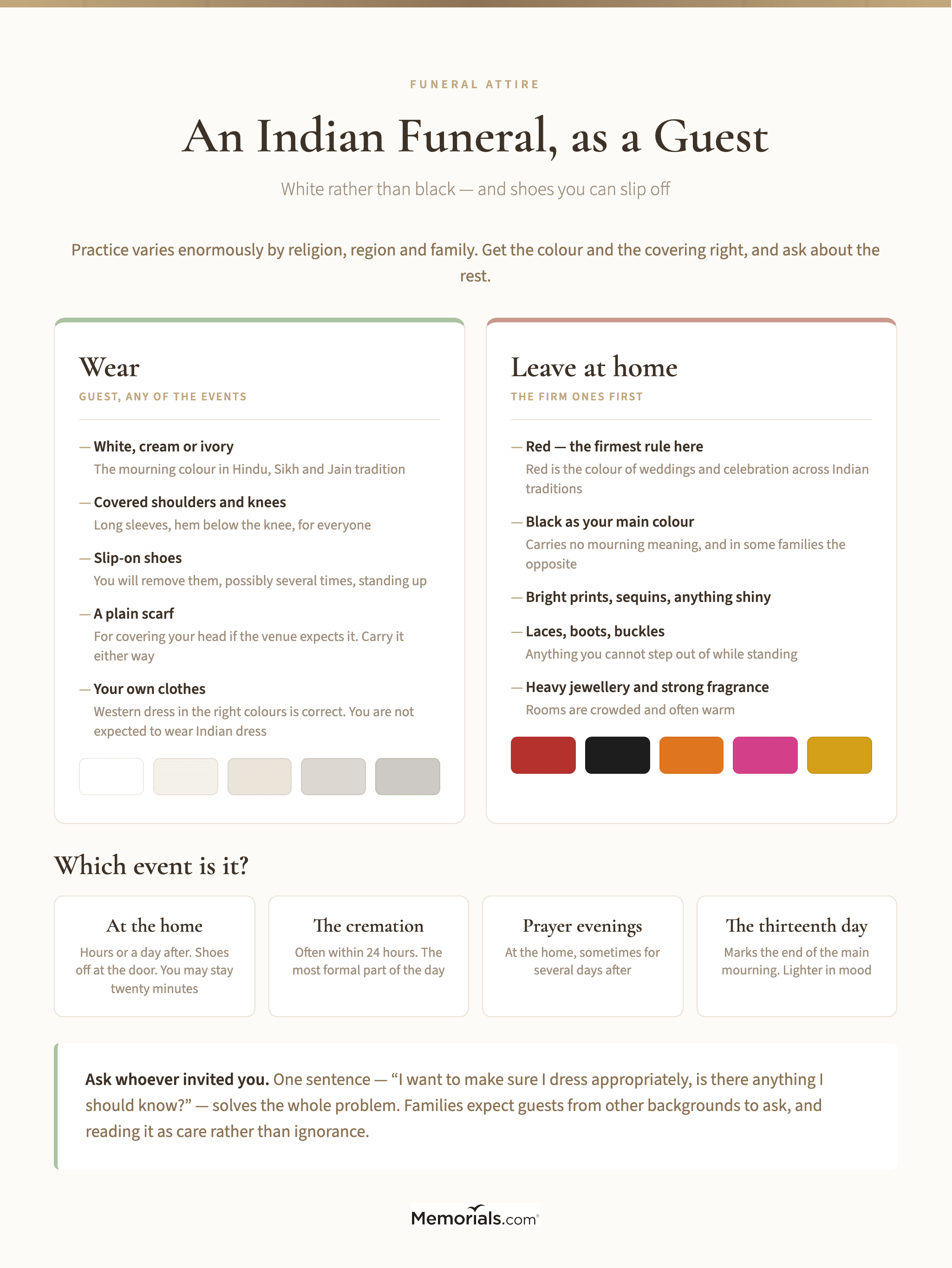
White or pale colors, shoulders and knees covered, and shoes you can slip off without sitting down. That is Indian funeral attire for a guest, and the first of those three is the one that catches almost every Western visitor — because black, the color you would reach for automatically, is the wrong one here.
This page is written for someone attending as a guest rather than as family: a colleague, a neighbor, a partner's relative. It covers what to wear and what to expect, and it says clearly where practice varies, because "Indian funeral" covers an enormous range of religions, regions and families.
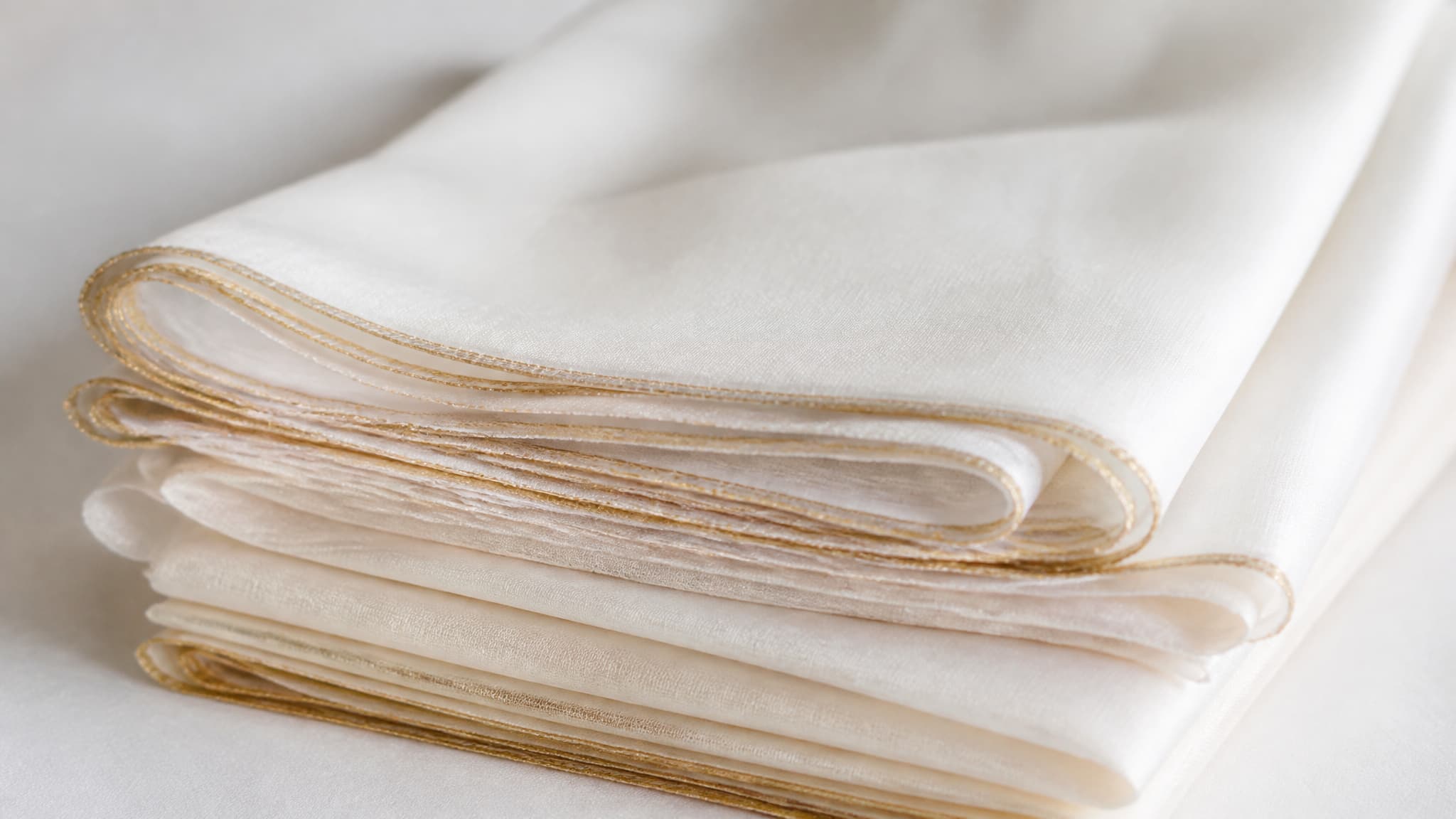
In most Hindu, Sikh and Jain traditions, white is the color of mourning. It signifies purity and the soul's release, and it is what the family and most guests will wear.
Black carries no mourning meaning in these traditions and is in some families associated with inauspiciousness — the opposite of what you intend by wearing it. It is unlikely that anyone would say anything if you arrived in a black suit, but you would look conspicuously foreign to the occasion, which is the one thing funeral clothing exists to avoid.
Safe choices: white, off-white, ivory, cream, oatmeal, pale gray, very pale beige.
Also acceptable in many families: soft muted tones — pale blue, dove gray, sand. If you own nothing white, these are far better than black.
Avoid entirely: red, in any quantity. Red is the color of weddings and celebration across Indian traditions, and wearing it to a funeral reads as a serious misjudgement rather than a small one. The same goes for bright pink, orange and gold.
This inverts the Western convention completely, which is worth knowing if you are used to thinking of dark clothing as the respectful default — see do you have to wear black to a funeral for how loose that rule has become in the West, and Chinese funeral attire for a tradition where white does the same work.
Covering Up, and Your Shoes
Two practical points that matter more than the exact shade of your shirt.
Covering. Shoulders, upper arms and knees should be covered, for men and women alike. This is a requirement at a temple or gurdwara rather than a preference, and it is expected almost everywhere else. Long sleeves or a shawl, and a hemline below the knee. Women may also be asked to cover their head at a gurdwara or a temple — carry a plain scarf and you are ready either way.
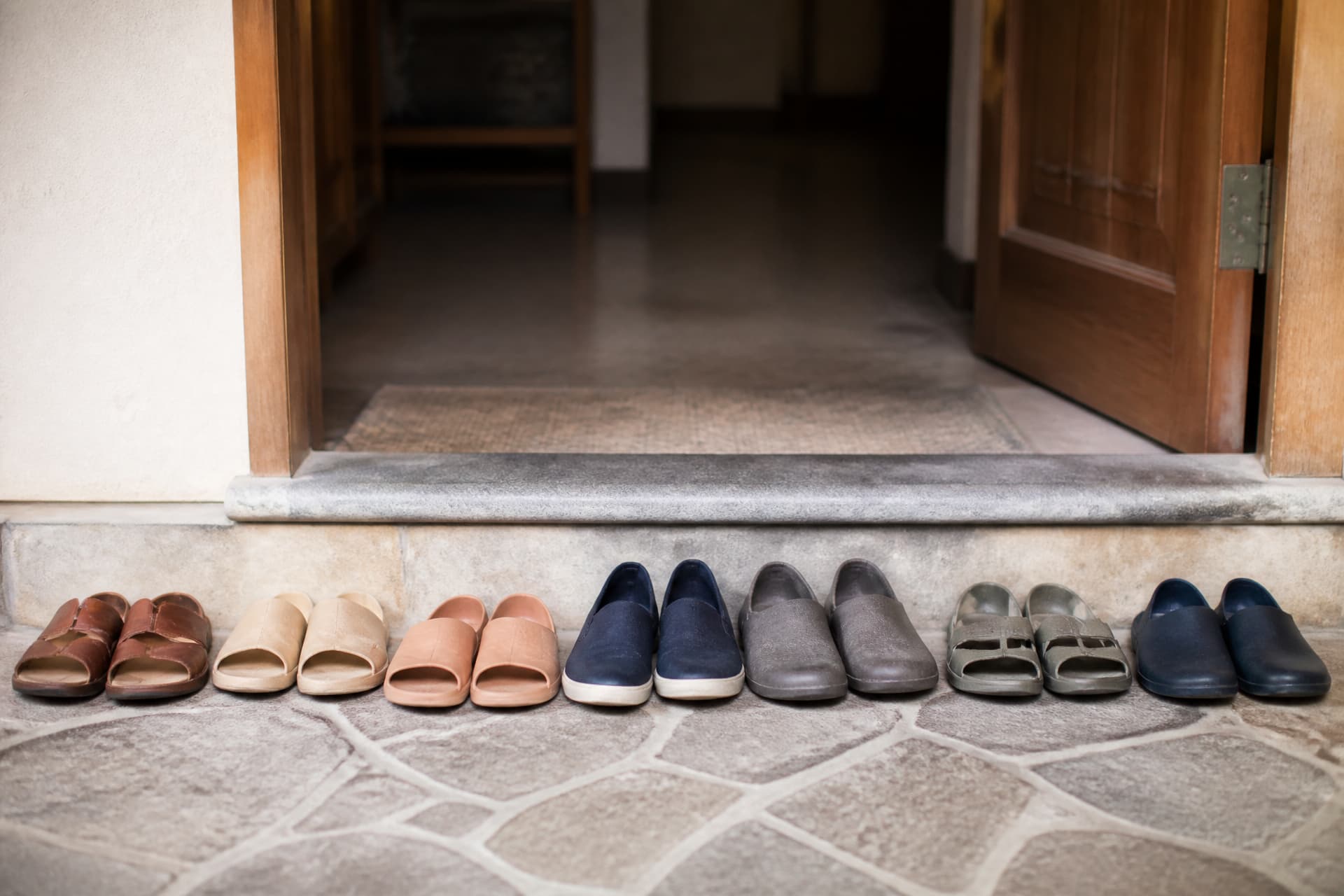
Shoes. You will remove them: at the family home, at a temple, at a gurdwara, and frequently at the crematorium. Sometimes more than once in an afternoon, often while standing in a crowded entrance, and always in front of other people.
Slip-ons, loafers or simple flats. Anything you can step out of without bending down.
Not laces, not boots, not anything with a buckle.
Wear good socks or clean bare feet. Everyone will see them, and holes in socks are the single most reported small embarrassment of the day.
Shoes come off at the door in most homes and at many services. Wear a pair you can slip off without sitting down.
What to Wear as a Woman Guest
Working out what dress to wear to a funeral in this tradition is mostly a question of length, coverage and color.
A white or cream midi or maxi dress with sleeves is the simplest correct answer.
A pale tunic or long top over loose pants is equally correct and often more comfortable for sitting on the floor, which you may be doing.
A long skirt with a covered top.
A plain scarf, large enough to cover your head if needed. Keep it with you rather than deciding in advance.
Flat or low, easily removed shoes.
Minimal jewelry, and nothing that jingles.
You do not need to wear a sari or a salwar kameez. If you own one and feel comfortable, nobody will object — but Western clothing in the right colors is completely appropriate, and a guest visibly borrowing the dress of the tradition can land awkwardly. The full women's guide is at what to wear to a funeral as a woman.
What to Wear as a Man Guest
A white or pale shirt, long-sleeved, with plain pants in white, cream, beige or pale gray.
A light kurta if you own one, though again this is not expected.
No tie needed. Ties are not part of the convention here and can look oddly formal.
A jacket only if it is pale. A black suit jacket is the thing to leave at home.
Slip-on shoes.
Men's practice on head covering varies: at a Sikh gurdwara, all men cover their heads, and cloths are provided at the door if you have nothing. At a Hindu temple it is generally not required.
Which Event Are You Going To?
This is the part nobody explains, and it changes what you wear and how long you stay.
An Indian funeral is usually not a single event.
The gathering at the home. In the hours or day after the death, people come to the family house. Informal in structure but not in dress: pale, covered, shoes off at the door. You may sit on the floor. You may only stay twenty minutes.
The cremation. Often within twenty-four hours of the death, which is why invitations arrive at short notice. Held at a crematorium, sometimes with a short ceremony first. This is the most formal of the events and the one most guests are invited to.
The days after. Prayer gatherings at the home, often for several evenings.
The thirteenth day. A larger gathering marking the end of the main mourning period, sometimes called the terahvin. It is closer to a memorial meal than a funeral, and the mood is noticeably lighter.
The shraddha ceremony. An annual rite performed for ancestors. What to wear for shraddha ceremony gatherings is the same as for the rest — white or pale, covered, plain — though these are usually family occasions rather than ones a guest attends.
If you have been invited and are not sure which of these it is, ask. It is a completely ordinary question, and the answer tells you whether to expect twenty minutes or half a day.
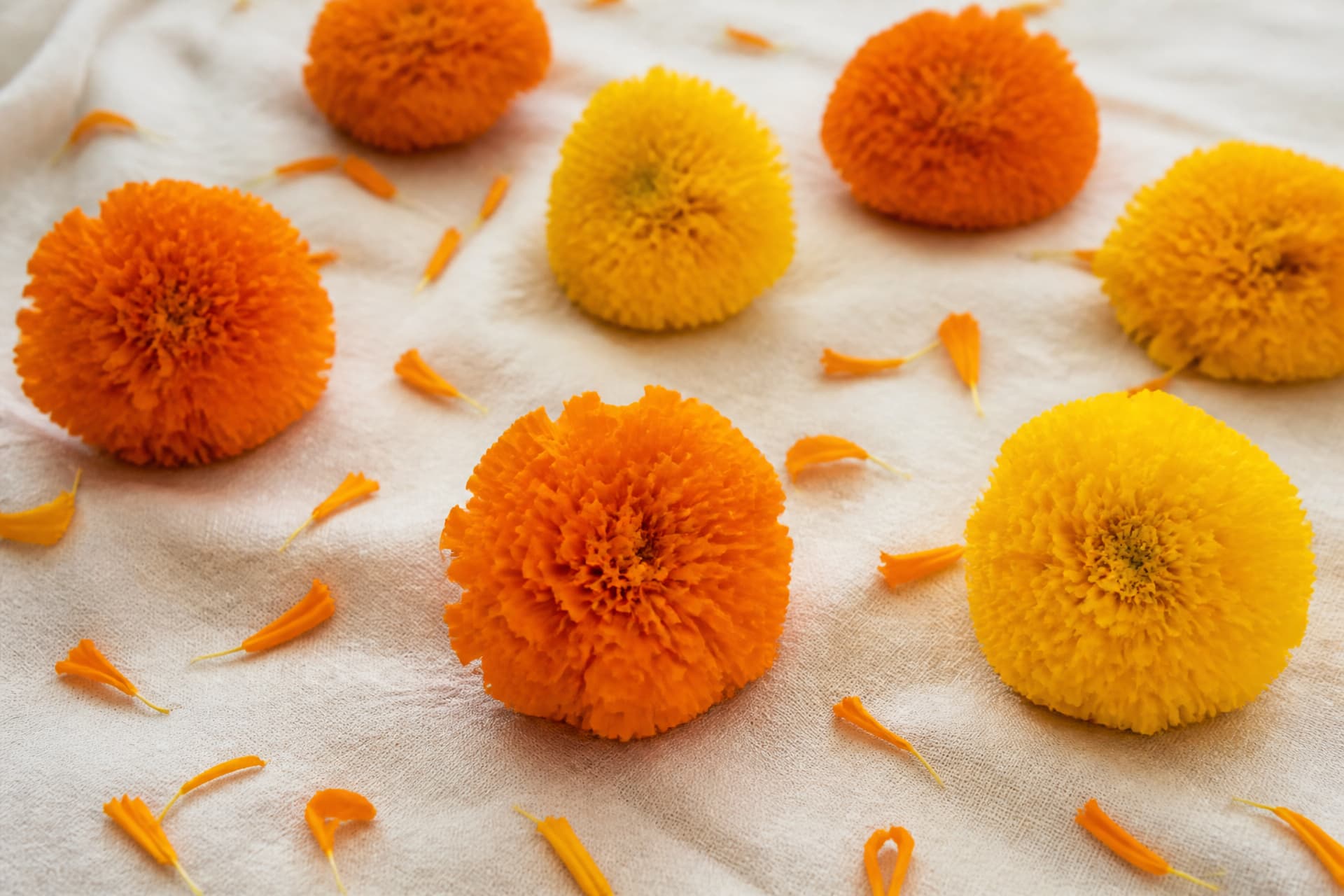
Marigolds belong to the rites rather than to celebration — a normal sight at a Hindu funeral, and not a sign the occasion is a light one.
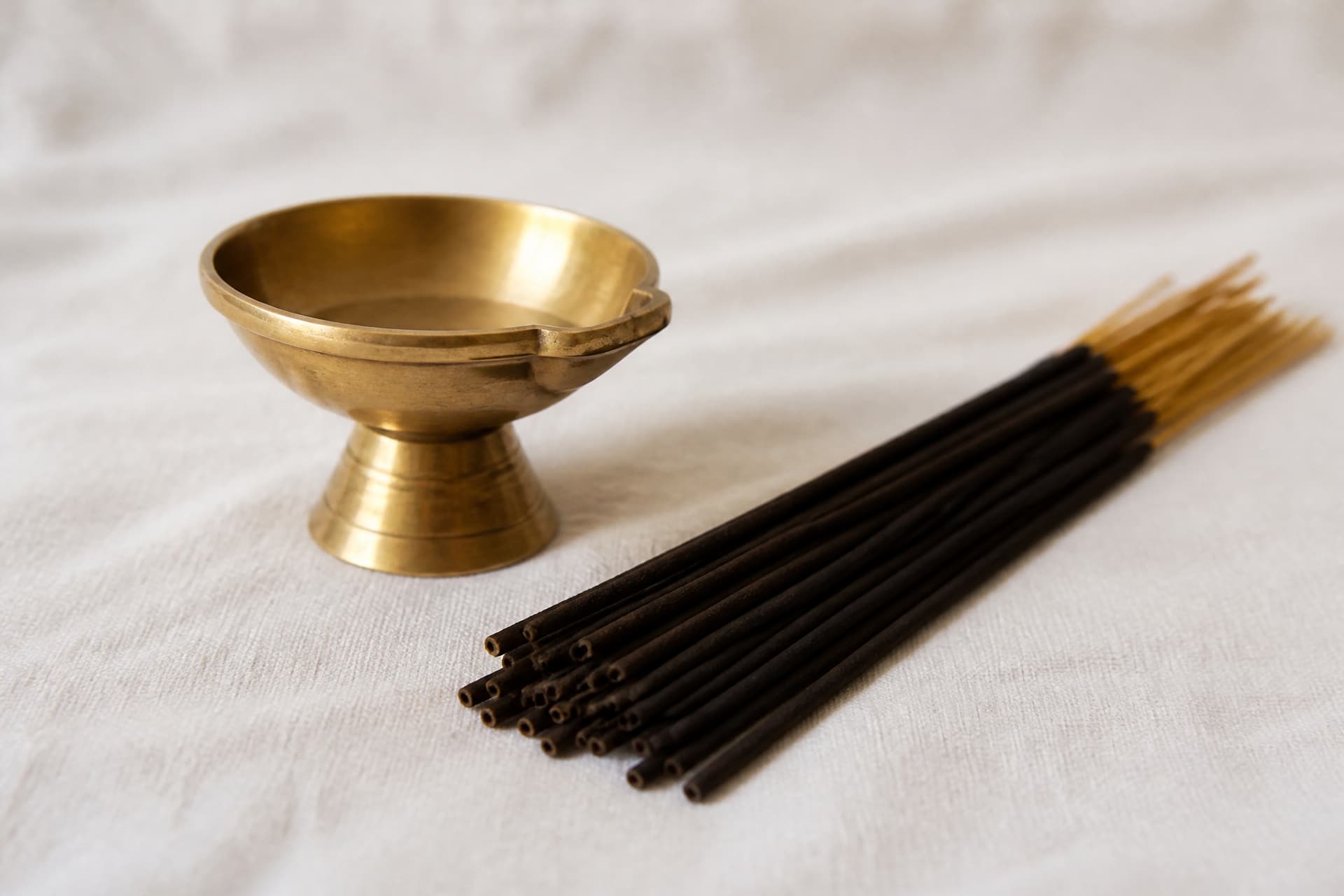
An oil lamp and incense are part of the ceremony, not something a guest brings or handles. Knowing what you will see is most of what preparation means here.
Jewelry, Makeup and What Applies to Whom
Guests routinely over-correct here, so it is worth being precise.
The strictest expectations — no jewelry, no makeup, plain white, sometimes an unstitched garment — apply to the immediate family, and most of all to a widow. They are part of a formal mourning observance, not a dress code for the room.
As a guest, you are expected to be plain and unshowy rather than austere. That means:
Ordinary everyday jewelry is fine. A watch, a wedding ring, small earrings.
Leave off anything large, sparkling or noisy.
Light or no makeup. Nothing bold.
No perfume or aftershave to speak of — rooms are crowded and often warm.
Nails, hair and so on: tidy, not done.
Hindu, Sikh, Muslim and Christian Indian Families
"Indian funeral" is not one thing, and this is the section to read if you know the family's background.
Hindu. Cremation, usually quickly, white mourning dress, shoes off. The most common case and the one this page mostly describes.
Sikh. Cremation, white or pale dress, and head covering for everyone at the gurdwara — men and women both. Cloths are provided. Prayers may run longer than you expect.
Jain. Similar to Hindu practice, with particular emphasis on simplicity and on avoiding leather. If you have a non-leather pair of shoes, wear those.
Muslim Indian families. Burial rather than cremation, usually within a day. Modest dress, covered arms and legs, head covering for women. White is common but not required; muted colors are fine. Men and women are often seated separately.
Christian Indian families. Frequently closer to a Western service, and black may be entirely normal. If the service is in a church, dress as you would for any church funeral.
Practice also differs regionally — North and South Indian customs are not identical — and diaspora families in the US and UK often blend conventions. Guidance on Indian funeral attire in US settings in particular tends to be softer than in India: pale colors matter, but the strictest observances are frequently relaxed.
When you do not know which of these applies, ask whoever invited you. One sentence — "I want to make sure I dress appropriately, is there anything I should know?" — solves the entire problem, and people are almost always glad to be asked.
What Not to Wear
Black, as the main color of your outfit.
Red, in any amount. This is the firmest rule on the page.
Short skirts, shorts, sleeveless tops, low necklines.
Lace-up shoes, boots, or anything you cannot remove standing up.
Leather, at a Jain funeral, and it is a courteous choice at any of them.
Strong fragrance.
A camera or a raised phone. Photography at the cremation is not customary and can cause real offense.
If You Are Not Sure, Ask
The most useful thing on this page is not a color. It is that asking is normal.
Traditions vary by religion, region, caste, generation and how long a family has lived outside India. No page can tell you what your particular host expects, and every family knows that a guest from a different background will not know. Being asked reads as care, not as ignorance.
If the family has requested something specific, that request outranks everything written here.
The guest's checklist for an Indian funeral: wear white or pale colours rather than black; keep shoulders, arms and legs covered; choose shoes you can remove easily; avoid leather at a Hindu or Jain service; and wear your own respectful clothes rather than a borrowed sari or kurta.
Frequently Asked Questions
Can I wear black to an Indian funeral? Better not to. White or pale colors are the mourning convention in Hindu, Sikh and Jain traditions. Black is not offensive in most families but marks you out as unfamiliar with the occasion. At a Christian Indian funeral, black is normal.
Do I have to wear Indian clothing? No. Western clothing in white or pale colors, covered and modest, is entirely appropriate. Wear Indian dress only if you already own it and feel comfortable, or if the family has asked.
Will I need to take my shoes off? Almost certainly, and possibly several times. Wear slip-ons and make sure your socks are in good condition.
What should I wear to a cremation specifically? The same as to any of the events — white or pale, covered, plain, easy shoes. The cremation is the most formal part of the day, so err toward tidier rather than more casual.
Is it rude to ask what to wear? No, and it is the single most useful thing you can do. Families expect guests from other backgrounds to ask, and are generally pleased to be asked.
In Short
White or pale, covered, and shoes that come off easily. Skip black, and skip red completely. Bring a scarf. Keep the jewelry small and the makeup light.
Beyond that, ask. Indian funerals differ enormously from one family to the next, and nobody expects a guest to know which version they are attending. Turning up in the right color, at the right time, having asked — that is the whole of what is being asked of you.