🏬Supersize Online Funeral Retailer🪦1000's of Headstones⚱️Over 10,000 Cremation Urns⚰️Caskets Overnight Delivery🛒Funeral & Memorial Superstore🚚FREE Shipping on ALL Orders👨👩👧👦Helping Families for over 20 Years💰Lowest Price Guarantee🏬Supersize Online Funeral Retailer🪦1000's of Headstones⚱️Over 10,000 Cremation Urns⚰️Caskets Overnight Delivery🛒Funeral & Memorial Superstore🚚FREE Shipping on ALL Orders👨👩👧👦Helping Families for over 20 Years💰Lowest Price Guarantee
🏬Supersize Online Funeral Retailer🪦1000's of Headstones⚱️Over 10,000 Cremation Urns⚰️Caskets Overnight Delivery🛒Funeral & Memorial Superstore🚚FREE Shipping on ALL Orders👨👩👧👦Helping Families for over 20 Years💰Lowest Price Guarantee🏬Supersize Online Funeral Retailer🪦1000's of Headstones⚱️Over 10,000 Cremation Urns⚰️Caskets Overnight Delivery🛒Funeral & Memorial Superstore🚚FREE Shipping on ALL Orders👨👩👧👦Helping Families for over 20 Years💰Lowest Price Guarantee
An honorary pallbearer is someone the family names in the service as a pallbearer, but who does not carry the casket. The title is real, it is announced, it is printed in the order of service — and it comes with no weight.
That is the whole point of it. Funerals ask a specific physical thing of six people, and the list of people a family most wants standing near the casket is almost never the same list as the people who can lift one. The honorary title exists to close that gap without anybody having to explain themselves.
This page covers what the title means, who families usually name, how many to choose, whether an honorary pallbearer has to be there on the day, and how to ask someone. If you are looking for the carrying role instead, see pallbearer duties. For where this sits in the service as a whole, see the .
The word pallbearer comes from the pall — the cloth draped over a coffin — and originally described the people who held its corners rather than the people carrying the weight underneath. The modern split preserves something of that older meaning. An active pallbearer carries. An honorary pallbearer is named in the same breath and does not.
The honorary pallbearer meaning that matters in practice is closer to witness than to helper. The family is publicly saying: this person belonged near him. Whether they could have taken a corner of the casket is beside the point, and the service is arranged so that nobody in the pews can tell the difference.
Our own pallbearer attire guide puts it plainly — the roles are meant to look the same from the pews, and that is the entire reason the title exists.
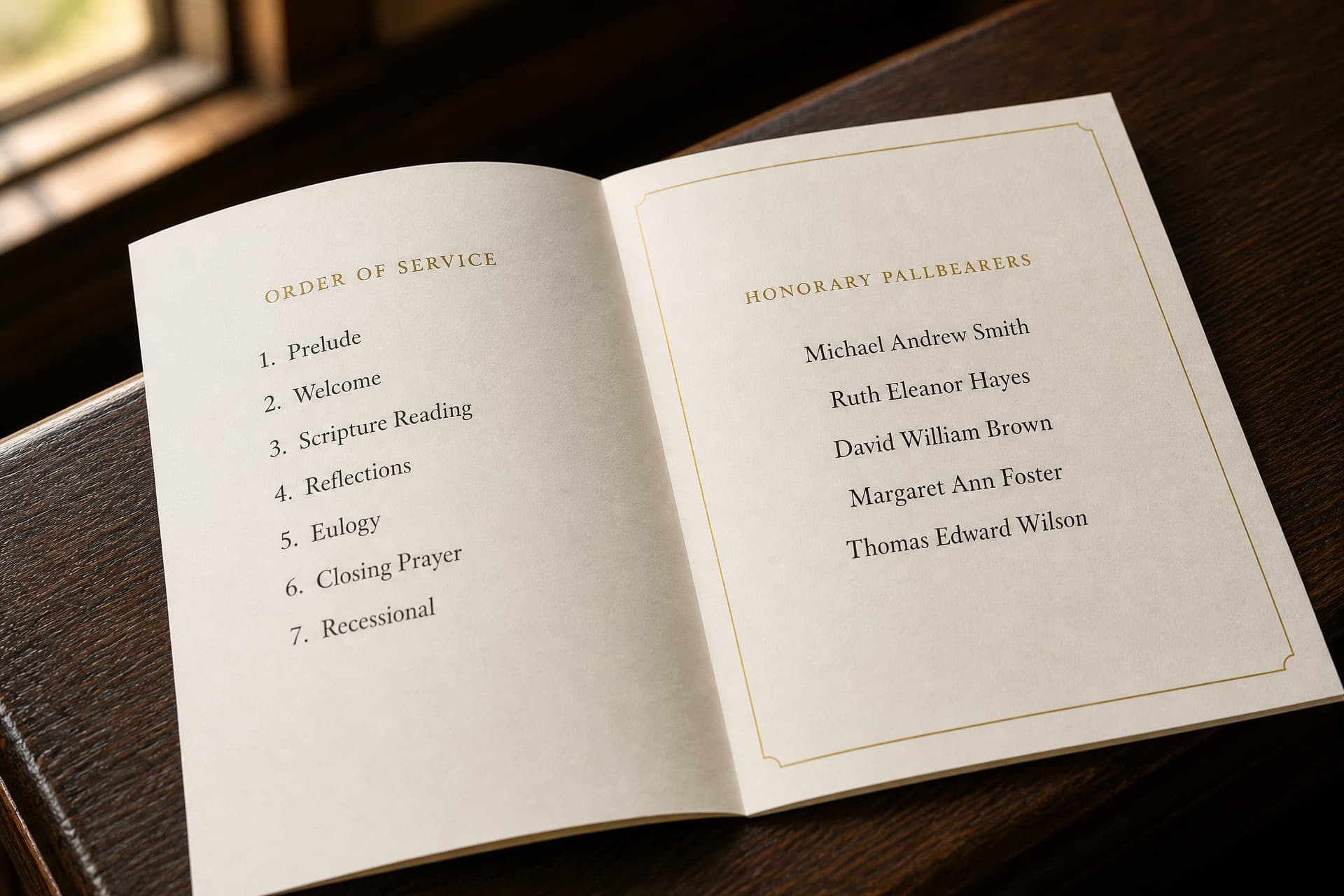
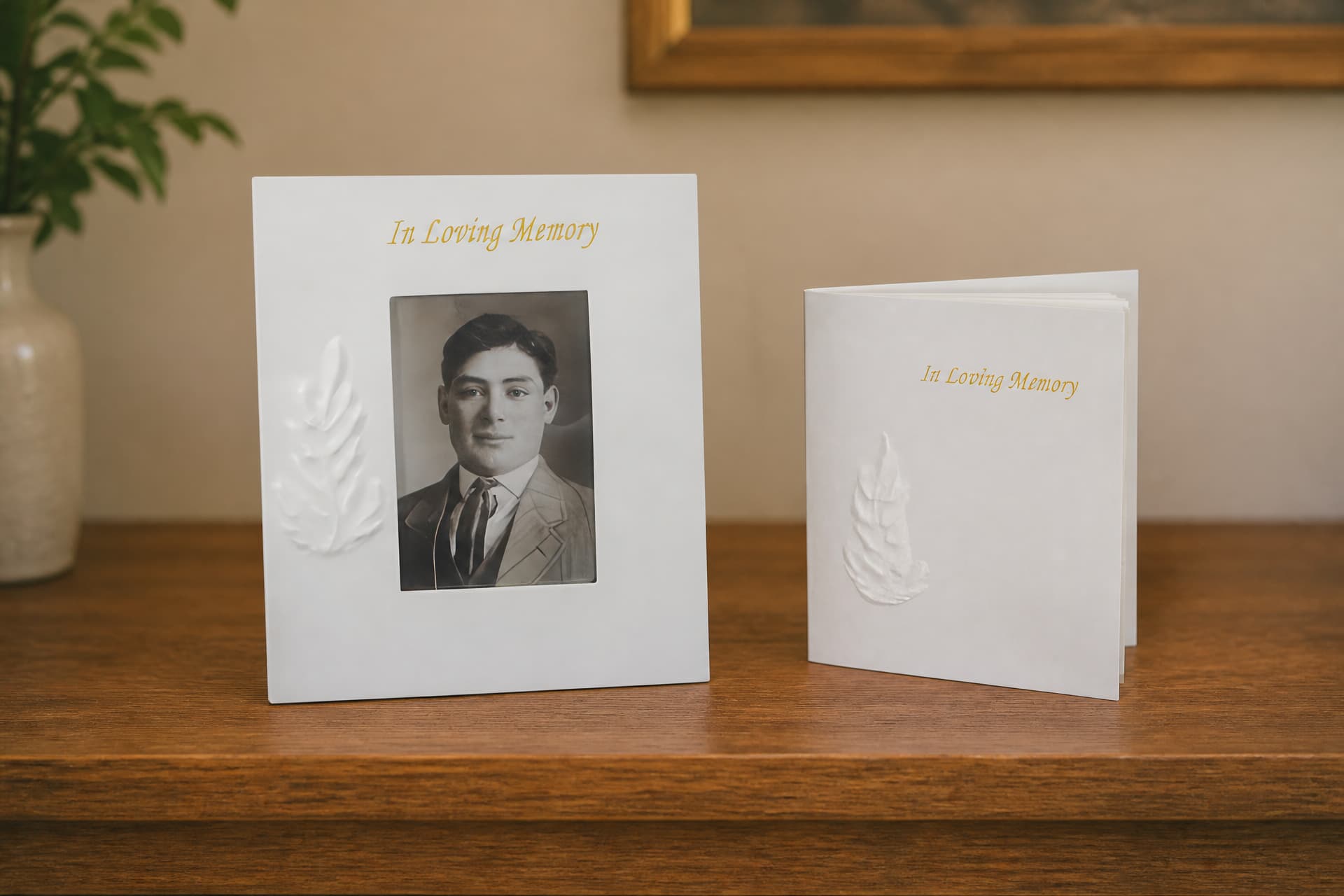
This is where the title actually lives. The honorary pallbearers get their own panel in the order of service, separate from the running order on the facing page — which is why the names have to be final before the program goes to print.
Honorary Pallbearer vs Pallbearer: The Difference
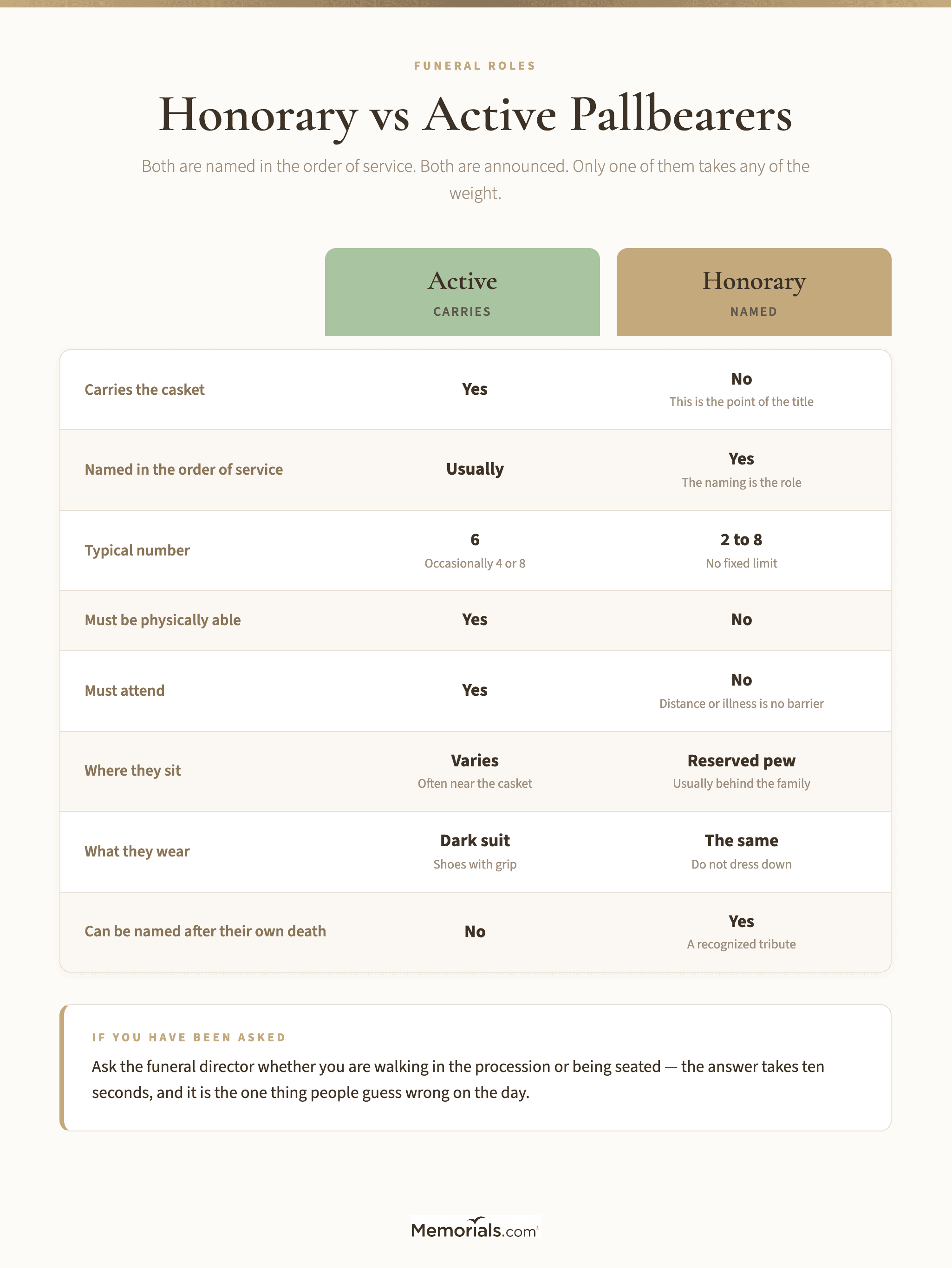
The two roles are announced together and understood differently, and the honorary pallbearer vs pallbearer question is the one families ask the funeral director most often. This is the comparison behind it.
Active pallbearer
Honorary pallbearer
Carries the casket
Yes
No
Named in the order of service
Usually
Yes — this is the role
Typical number
6, occasionally 4 or 8
2 to 8, no fixed limit
Must be physically able
Yes
No
Must attend
Yes
No
Sits with the family
Sometimes
Often, in a reserved pew
Can be named after death
No
Yes
The last row is the one that surprises people. Naming a deceased friend or sibling as an honorary pallbearer is a long-standing practice, and it reads as a tribute rather than as an error.
The two roles side by side. Active pallbearers carry and must be there; honorary pallbearers are named, may be any number, need not attend, and can be named posthumously. Both appear in the order of service, and both are announced.
What Does an Honorary Pallbearer Do?
Less than the name suggests, and that is by design. What does an honorary pallbearer do on the day varies by family and by funeral home, but the common duties are these:
Being named. In the printed program, and usually read aloud by the officiant or clergy.
Walking in the procession. Many funeral homes have honorary pallbearers walk ahead of or alongside the casket, in pairs, without touching it. Some seat them instead. Ask which the family has arranged.
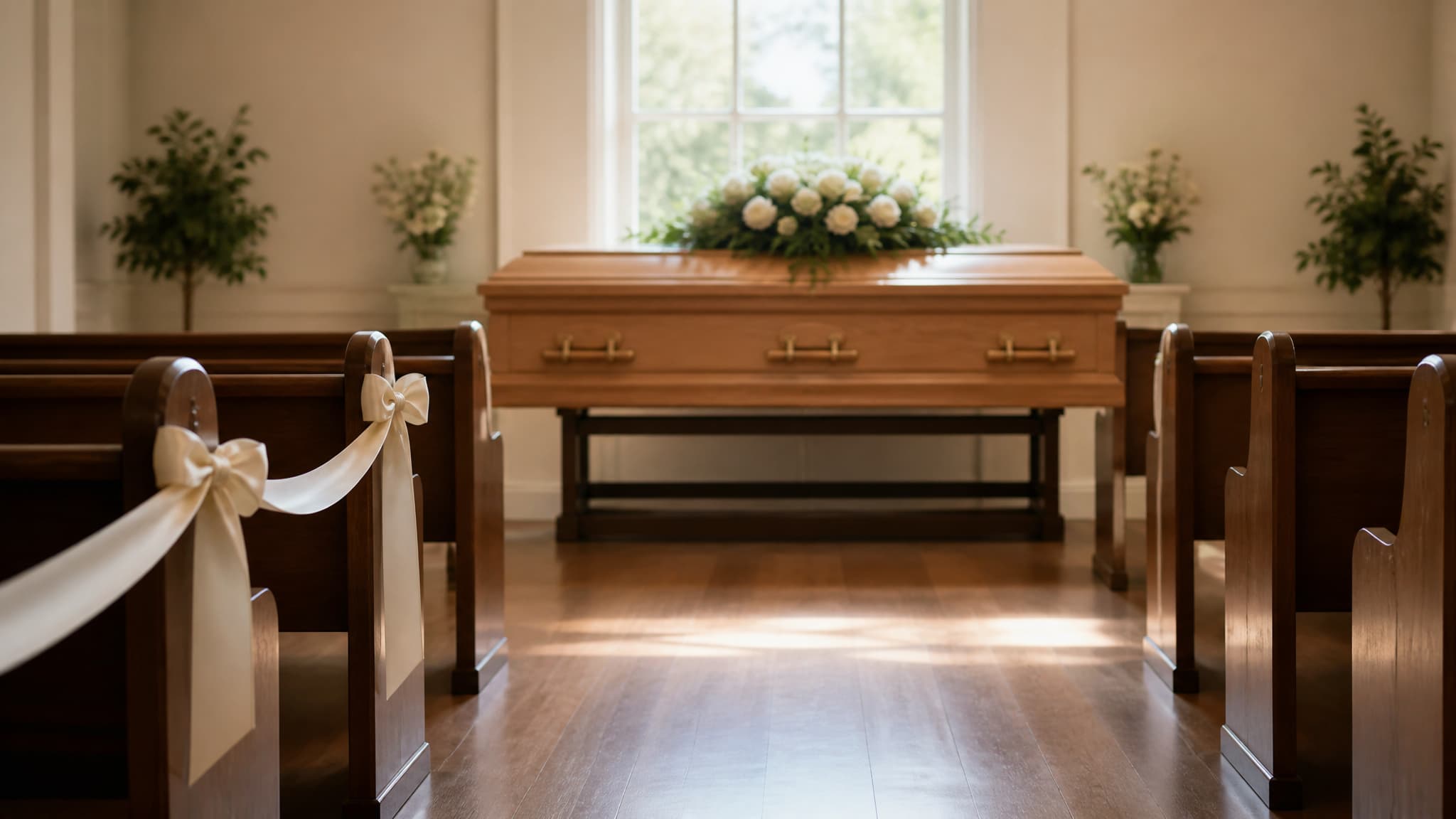
Sitting in a reserved section. Often a pew or two behind the immediate family, marked with a ribbon tied across the aisle end or a small reserved card. If you have been named and nobody tells you where to sit, that ribbon is what to look for.
Standing when the casket passes. A small thing, and the one most people remember afterwards.
Being present for the family. Which is the actual job, and the reason the title was invented.
What honorary pallbearers do not do is lift, steer, or take any share of the weight. If you have been named and you are unsure whether you are expected to help, ask the funeral director rather than deciding on the day — the answer takes ten seconds and guessing wrong is awkward for everyone.
Who Families Usually Name
There is no rule here, only convention. The people most often named as honorary pallbearers are:
Someone too old or unwell to carry. This is the original and still the most common reason.
A close friend who lives too far away to attend.
A grandchild who is too young. Naming children as honorary pallbearers gives them a place in the service, which is often exactly what they need.
A colleague, commanding officer, or long-time business partner. Anyone whose relationship was real but who sits outside the family.
Someone who has already died. A late spouse, sibling or best friend, named as a tribute.
A group. "The men of Engine Company 12" or "her Tuesday bridge club" is a legitimate entry, and some families prefer it to a list of names.
More pallbearers than the casket needs. If ten people should be honored and six can carry, the other four become honorary.
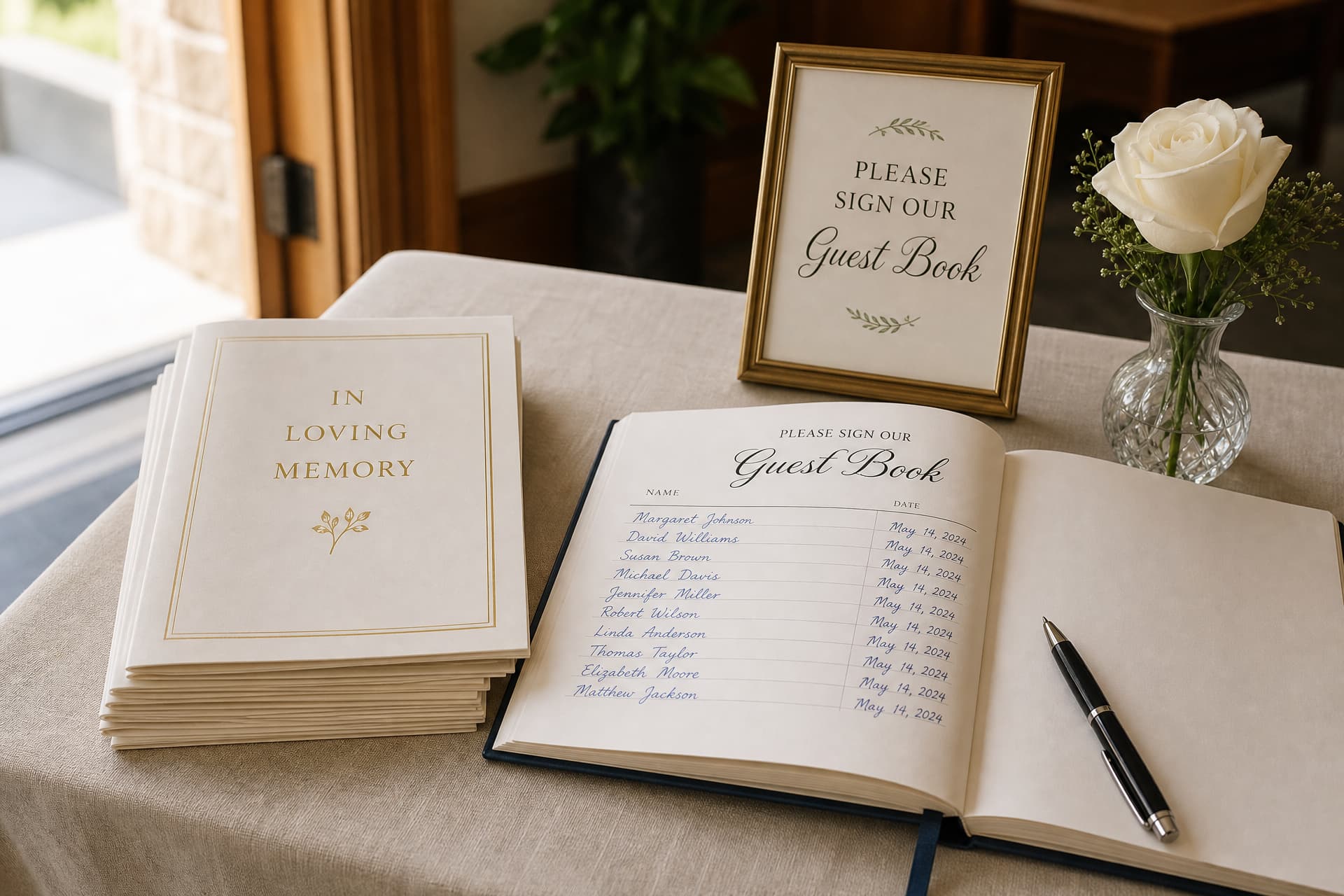
The programs are usually stacked at the door, which is where most honorary pallbearers first see their own name. Count the printing against the list before it goes out — a name added afterward has nowhere to appear.
How Many Honorary Pallbearers Should You Name?
Most families name between two and eight. Six is common because it mirrors the carrying team. There is no maximum, and no funeral director will refuse a longer list.
The practical limits are these two:
The program has to hold the list. A page of thirty names stops reading as an honor and starts reading as a guest list. If the list is genuinely that long, name a group instead.
The reserved seating has to hold them. Tell the funeral home the number early — the ribbons go on the pews before anyone arrives.
Beyond that, name whoever should be named. This is one of the few decisions in a funeral where being generous costs nothing.
Do Honorary Pallbearers Have to Be There?
No. This is the part of the role that people most often get wrong, and it is worth being clear about.
An honorary pallbearer is being named, not rostered. Someone in another country, someone in hospital, and someone who died a decade ago can all appear on the list. The name is the tribute; attendance is separate.
If you have been named and you cannot come, say so — but say so to the family rather than declining the title. Most families would far rather have the name in the program than have the space.
What Do Honorary Pallbearers Wear?
The same as the carrying pallbearers: a dark suit, a white shirt, a plain dark tie, and dark shoes. Gloves, where the funeral home is using them, are usually handed to honorary pallbearers too.
You do not need to dress down to signal that you are not carrying, and you should not. The full answer, including what to do if you own no suit, is in our pallbearer attire guide — the guidance there applies to both roles without change.
Honorary Pallbearers at a Cremation Service
An honorary pallbearer for a cremation is the same role with less to stand beside. Whether there is anything to carry depends on the service:
A cremation with a viewing or a full service first often uses a rental or cremation casket, and there is a genuine carry — so both roles work exactly as they would at a burial.
A memorial service after the cremation has an urn rather than a casket. Some families ask one person to carry it; the rest of the named pallbearers are honorary by circumstance rather than by choice.
A direct cremation with a later gathering has nothing to carry at all. Families still name honorary pallbearers, and the title does the same work it always did.
A military funeral changes the arithmetic, because the carrying is often done by a uniformed casket team rather than by the family's choice of six. That does not remove the honorary role — it usually enlarges it.
At a service with military honors, the body bearers are assigned. Everyone the family would otherwise have asked to carry becomes honorary by default, which is why military funerals frequently list more honorary pallbearers than civilian ones. Old unit members, a commanding officer, and fellow veterans from a post or legion are all common entries, and naming a group rather than individuals is especially usual here.
Two practical notes. Veterans named as honorary pallbearers may wear uniform or their association's cap and blazer rather than a dark suit, and that is correct rather than an exception. And the honor guard's sequence is fixed — the family does not arrange where honorary pallbearers stand during the flag fold, so ask the funeral director or the honors detail rather than assuming. What to expect from the rest of the service is covered in the military memorial guide.
How to Ask Someone
Asking is easier than people expect, because almost nobody says no. Two things to include, and one to avoid.
Include:
The word "honorary", early. It answers the question they are quietly asking, which is whether they will have to lift.
What you would like them to do. Walk in the procession, sit with the family, or simply be named — say which.
The date, time and place, even if you have said it already.
Avoid explaining why they are honorary rather than active. "Because Dad's casket is heavy and you had your hip done" is true and unnecessary. The title carries no implication that needs defusing.
A version you can adapt:
"We're naming you an honorary pallbearer at Dad's service on Saturday. You'd be listed in the program and seated with the family — there's no carrying involved. It would mean a lot to us to have your name there."
If they cannot attend: "You'd still be named in the program. Nothing changes about that."
If you are asking on behalf of the family: "The family has asked me to invite you to be an honorary pallbearer."
Thanking Honorary Pallbearers Afterwards
Pallbearers of both kinds are usually thanked in writing, and honorary pallbearers are the ones most often forgotten — precisely because they did not visibly do anything.
A thank you note to pallbearers can be short. Three lines is enough:
What they did:"Thank you for being an honorary pallbearer at Mom's service."
Why it mattered:"Seeing your name in the program with the others was exactly right, and she would have wanted it that way."
A close:"With love from all of us."
Send them within two to three weeks. Funeral thank you etiquette covers timing and wording for the rest of the list.
Naming pallbearers is one of the last decisions, not one of the first — the list depends on who is traveling, and that is rarely settled early. It does have one hard deadline: the names have to be final before the order of service goes to print.
What is an honorary pallbearer, in one sentence? Someone the family names as a pallbearer in the service and the program, who does not carry the casket.
What does honorary pallbearer mean on a program? Exactly what it says, and nothing diminishing. The names are usually printed in their own short list, either beside or beneath the active pallbearers.
What are honorary pallbearers expected to do? Be named, and be there if they can. Some walk in the procession; some are seated. Nothing physical.
How many honorary pallbearers can you have? As many as the program and the reserved seating can hold. Two to eight is usual; there is no rule.
Can an honorary pallbearer be a woman? Yes, and increasingly is. The same is true of the carrying role.
Can you name someone who has died? Yes. It is a recognized tribute, not a mistake.
What does an honorary pallbearer wear? The same as the carrying pallbearers. Do not dress down to indicate the difference.
Is honorary pallbearer a lesser role? No. It is a different one. The family chose to put that name in the program, and that is the whole of what the title means.
In Short
An honorary pallbearer is named rather than working. They are listed in the order of service, often walk with the casket without touching it, need not attend, and dress exactly as the carrying pallbearers do. Families name anywhere from two to eight, and generosity here has no cost.
If you have been asked, say yes. If you are the one asking, use the word "honorary" in the first sentence and leave the explanation out.