🏬Supersize Online Funeral Retailer🪦1000's of Headstones⚱️Over 10,000 Cremation Urns⚰️Caskets Overnight Delivery🛒Funeral & Memorial Superstore🚚FREE Shipping on ALL Orders👨👩👧👦Helping Families for over 20 Years💰Lowest Price Guarantee🏬Supersize Online Funeral Retailer🪦1000's of Headstones⚱️Over 10,000 Cremation Urns⚰️Caskets Overnight Delivery🛒Funeral & Memorial Superstore🚚FREE Shipping on ALL Orders👨👩👧👦Helping Families for over 20 Years💰Lowest Price Guarantee
🏬Supersize Online Funeral Retailer🪦1000's of Headstones⚱️Over 10,000 Cremation Urns⚰️Caskets Overnight Delivery🛒Funeral & Memorial Superstore🚚FREE Shipping on ALL Orders👨👩👧👦Helping Families for over 20 Years💰Lowest Price Guarantee🏬Supersize Online Funeral Retailer🪦1000's of Headstones⚱️Over 10,000 Cremation Urns⚰️Caskets Overnight Delivery🛒Funeral & Memorial Superstore🚚FREE Shipping on ALL Orders👨👩👧👦Helping Families for over 20 Years💰Lowest Price Guarantee
Few works of memorial art have traveled as far — or touched as many mourners — as the Angel of Grief. The original marble sculpture sits in Rome's Protestant Cemetery, marking a grave that is more than 130 years old, yet its image appears on headstones, garden memorials, and sympathy keepsakes across the world.
The figure of an angel collapsed over a funeral altar, wings drooping, face buried in her arms, speaks to something universal: the weight of loss and the way love endures past it. If you are navigating grief and looking for ways to honor someone you have lost, the complete grief support guide offers a broader look at , memorial ideas, and remembrance traditions that may help.
This article traces the Angel of Grief from its origin as one man's final act of devotion through its transformation into one of the most replicated sculptures in cemetery history — and explores how that legacy continues to shape memorial remembrance ideas today.
The Love Story Behind the Sculpture
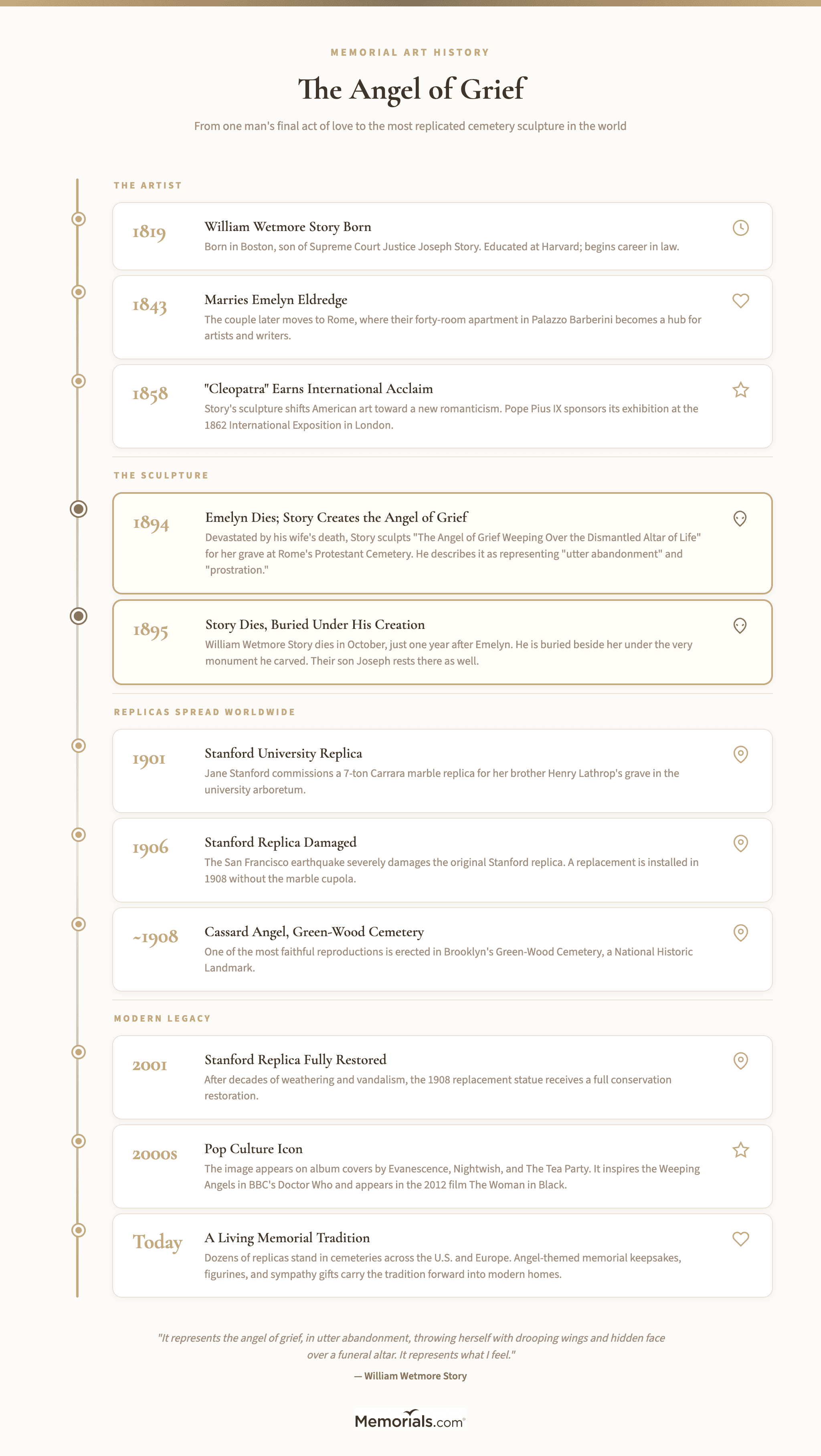
The Angel of Grief was created in 1894 by William Wetmore Story, an American sculptor, poet, and former lawyer who had spent most of his adult life in Rome. Story was born in Boston in 1819, the son of U.S. Supreme Court Justice Joseph Story, and educated at Harvard. After creating a memorial sculpture for his father in 1845, he left law behind and moved his family to Italy to pursue art full-time.
Story's career flourished in Rome. His forty-room apartment in the Palazzo Barberini became a gathering place for writers and artists, including Robert Browning, Nathaniel Hawthorne, and Henry James. His sculpture "Cleopatra" (1858) earned international acclaim and helped shift American sculpture toward a new romanticism that combined realism with psychological depth.
Through all of it, his wife Emelyn Eldredge Story — whom he married in 1843 — was his constant companion. They raised four children together in Rome, and their home was as famous for Emelyn's hospitality as for William's art.
When Emelyn died in 1894, Story was devastated. An account published in an 1896 issue of Cosmopolitan Magazine recorded what happened next: the loss so consumed him that he abandoned his studio entirely. It was his children who convinced him to return to sculpting one last time, suggesting he create a monument for their mother's grave.
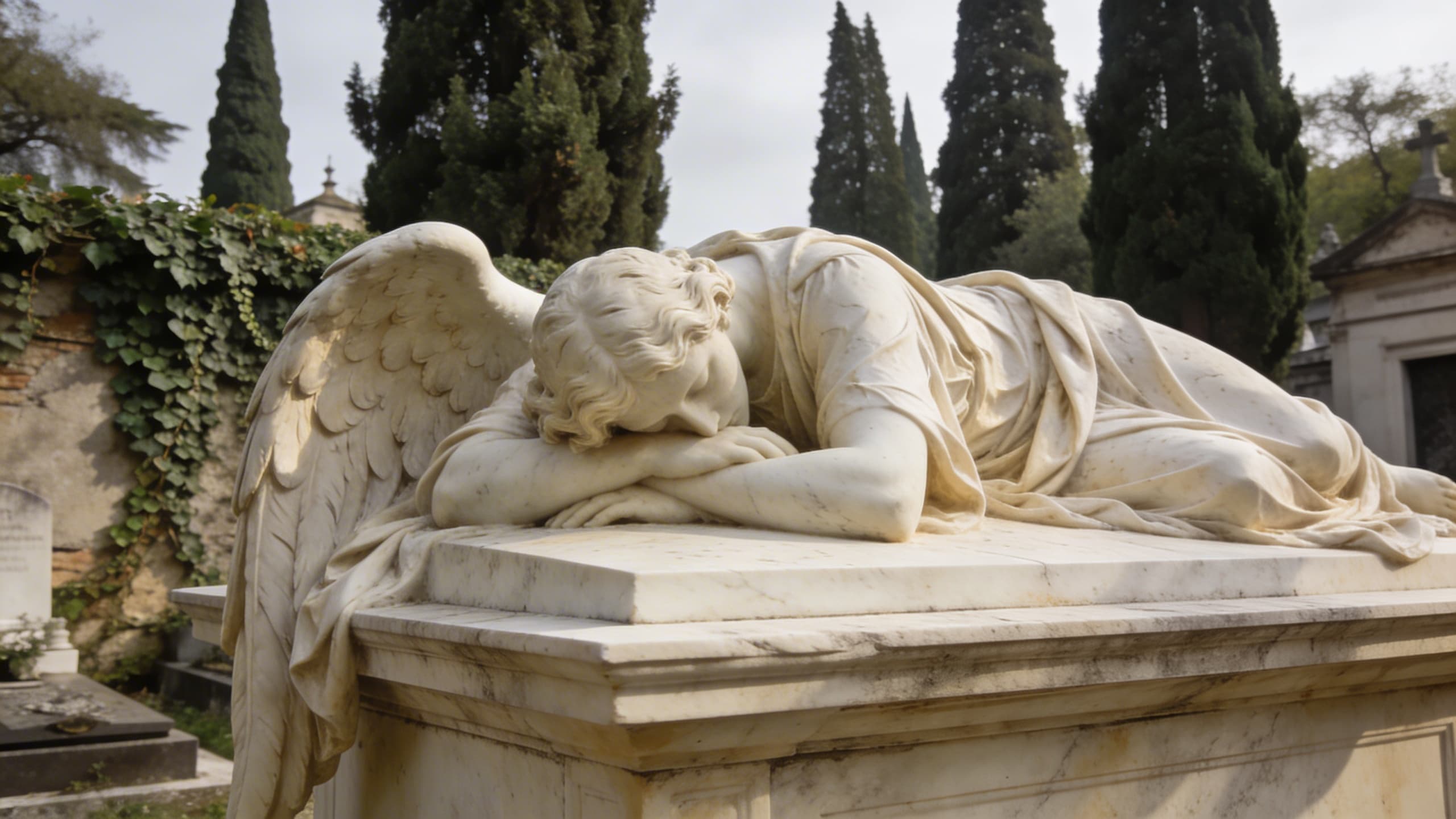
The sculpture he produced — formally titled "The Angel of Grief Weeping Over the Dismantled Altar of Life" — became his final masterpiece. Story himself described it in words that capture both the artwork and the grief behind it: the angel represents utter abandonment, throwing herself with drooping wings and hidden face over a funeral altar. He said it represented what he felt — prostration.
Story died in October 1895, just a year after Emelyn, and was buried beside her under the very monument he had carved. Their son Joseph, who had died in Rome as a young child, also rests there. The sculpture that began as a husband's grief became a shared grave marker for the family itself.
What Makes the Angel of Grief Different
Cemetery angels were nothing new in the 1890s. Funerary art had included winged figures for centuries — guardians watching over the dead, hands clasped in prayer, gazes lifted toward heaven. These traditional angels represented innocence, immortality, and the connection between the earthly and divine.
Story's angel broke that convention entirely. Instead of standing upright and looking skyward, this figure is collapsed. Her wings hang limp. Her face is hidden. Her body drapes over the tomb in a posture that has no dignity left to maintain — only raw, unfiltered sorrow.
That shift in perspective is what made the sculpture so powerful. Where traditional cemetery angel statues comfort visitors by suggesting the deceased is at peace, the Angel of Grief does the opposite. She puts the viewer's own grief on display. She says: this is what it looks like when love loses the person it belongs to. And in doing so, she gave permission for mourners to feel exactly what they feel — not the composed acceptance that Victorian society expected, but the messy, floor-level devastation that grief actually is.
The art historian community has noted that this is part of why the design became, as one major publication put it, one of the most copied memorial images anywhere.
Famous Replicas Around the World
Within a few years of its installation in Rome, replicas of Story's angel began appearing in cemeteries across the United States and Europe. Each copy carries its own story, its own grief, and its own context — but all trace back to the original at the Cimitero Acattolico.
Stanford University, California
One of the most prominent replicas was commissioned by Jane Stanford, co-founder of Stanford University, as a memorial to her brother Henry Lathrop. Already mourning the loss of her husband Leland Stanford Sr., she ordered a replica carved from a single piece of Carrara marble by Italian sculptor Antonio Bernieri. The seven-ton sculpture arrived from Italy in 1901 and was placed under a marble cupola in the university's arboretum cemetery.
The 1906 San Francisco earthquake severely damaged the original replica, and it was replaced in 1908 — this time without the cupola. After years of weathering and vandalism (including someone carving off the angel's arm), the statue was fully restored in 2001. It remains a campus landmark today, used by locals as a place to mourn loved ones and leave offerings.
Green-Wood Cemetery, Brooklyn
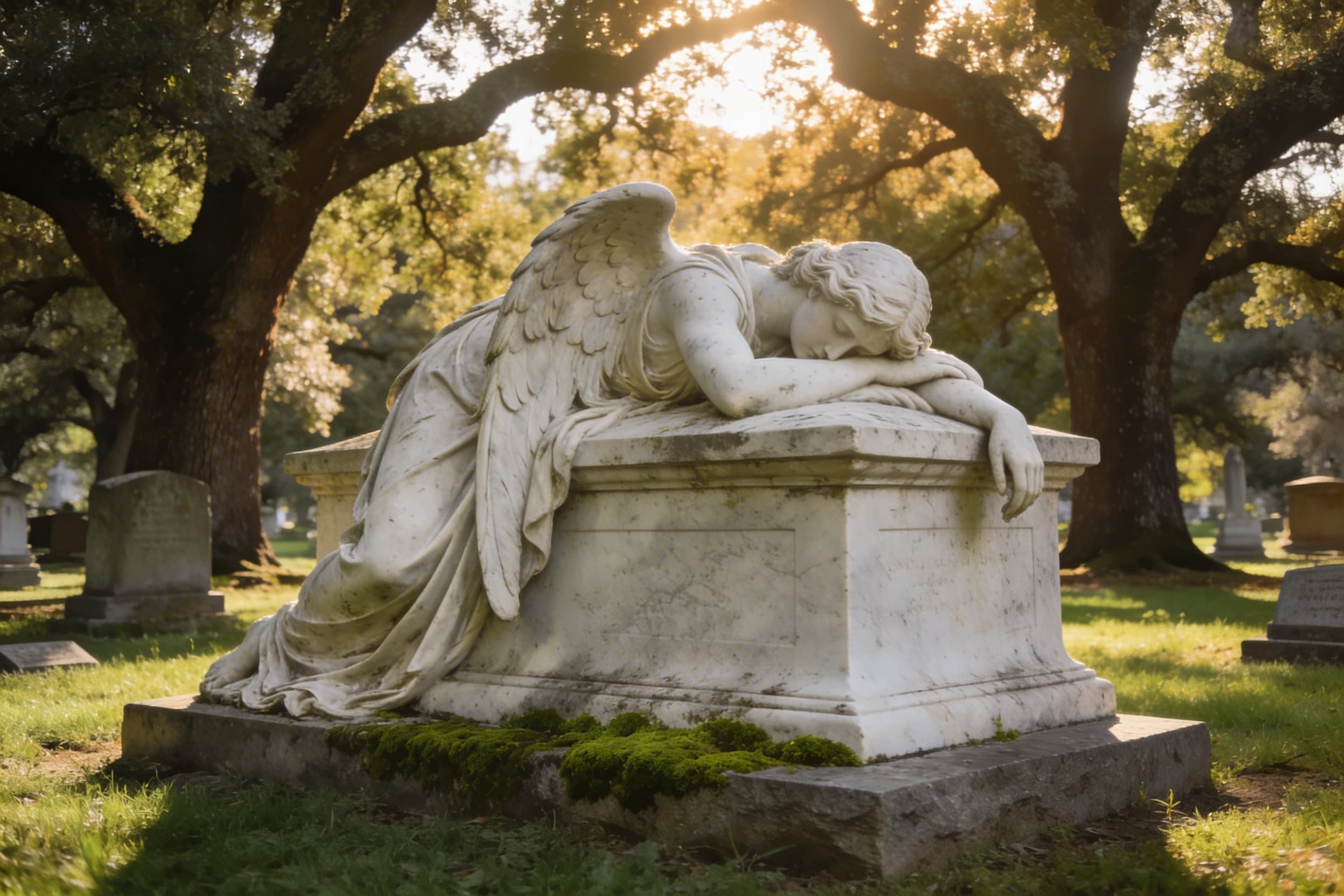
The Cassard Angel, erected around 1908, stands in the historic Green-Wood Cemetery in Brooklyn, New York. This version is one of the most faithful reproductions of Story's original, maintaining the same posture, wing position, and emotional intensity. Green-Wood — a National Historic Landmark cemetery — provides a setting that reinforces the sculpture's power, surrounded by mature trees and ornate Victorian-era monuments.
Metairie Cemetery, New Orleans
The Chapman H. Hyams mausoleum in New Orleans' Metairie Cemetery houses one of the most striking variations. Placed inside the mausoleum rather than outdoors, the sculpture is bathed in blue light from stained glass windows, creating an ethereal atmosphere that transforms the figure into something almost otherworldly.
Replicas Across Texas, California, and Beyond
Cemetery enthusiasts have documented dozens of Angel of Grief replicas across the American South and West. Examples stand in cemeteries in Houston, San Diego, Brenham, Columbus (Mississippi), and Hingham (Massachusetts), among many others. Each varies slightly in detail — the flow of the hair, the position of the hands, whether the angel holds a wreath — but the core posture of collapsed, abandoned grief remains constant.
Angel Symbolism in Memorial Art
The Angel of Grief did not emerge from nothing. It belongs to a rich tradition of angel imagery in funerary art that stretches back centuries — and understanding that tradition deepens appreciation for what Story achieved and why memorials are important as vessels of cultural meaning.
Angels in Cemetery Tradition
Angels have appeared on graves since at least the medieval period. Early Christian funerary art depicted angels as divine messengers — figures who carried the soul from earth to heaven. By the seventeenth and eighteenth centuries, grieving angels had become standard fixtures in European cemeteries, often shown holding trumpets (announcing resurrection), carrying scrolls (recording the life lived), or pointing upward (directing the viewer's attention toward the afterlife).
The Victorian era expanded this vocabulary dramatically. As mourning culture became formalized — with strict dress codes, jewelry conventions, and elaborate funeral rituals — memorial art grew correspondingly ornate. Angels in this period often represented specific qualities: innocence (for children's graves), guidance (for adults), hope (for families), and eternal rest (for the elderly).
What Angel Imagery Means on Memorials
Angel imagery on headstones and memorials carries layered meaning that families can draw from when choosing memorial art for their own loved ones. Weeping or kneeling angels — like the Angel of Grief — express the sorrow of those left behind. Standing angels with upraised hands suggest spiritual ascent and divine welcome. Cherubs and child-sized angels typically mark the graves of infants and young children.
The visual language of colors of remembrance and their meanings connects to angel imagery as well. White marble — the material of most angel sculptures, including Story's original — carries its own symbolism of purity, peace, and spiritual transcendence. The choice of material and color was never accidental in Victorian memorial art; it was another layer of meaning carved into the tribute itself.
The Angel of Grief in Popular Culture
Story's sculpture transcended the cemetery. The image has been reproduced on album covers by bands including Evanescence, Nightwish, and The Tea Party. It appeared in the 2012 film "The Woman in Black." And perhaps most famously, it inspired the Weeping Angels in the BBC television series "Doctor Who" — terrifying creatures that can only move when no one is watching them, a clever inversion of the statue's eternal stillness.
These cultural appearances introduced the Angel of Grief to millions who had never visited a cemetery or encountered the original. They also reinforced a truth about memorial art: the images we create to process grief outlive their immediate context. What began as one man's tribute to his wife in a Roman cemetery became a universal symbol — reproduced in stone, paint, tattoo ink, and digital media around the world.
Bringing Angel Memorial Art Home
The same impulse that drove Story to carve his angel — the need to make grief visible, to give it a physical form that can be touched and revisited — drives families today when they choose memorial products for their homes and gardens.
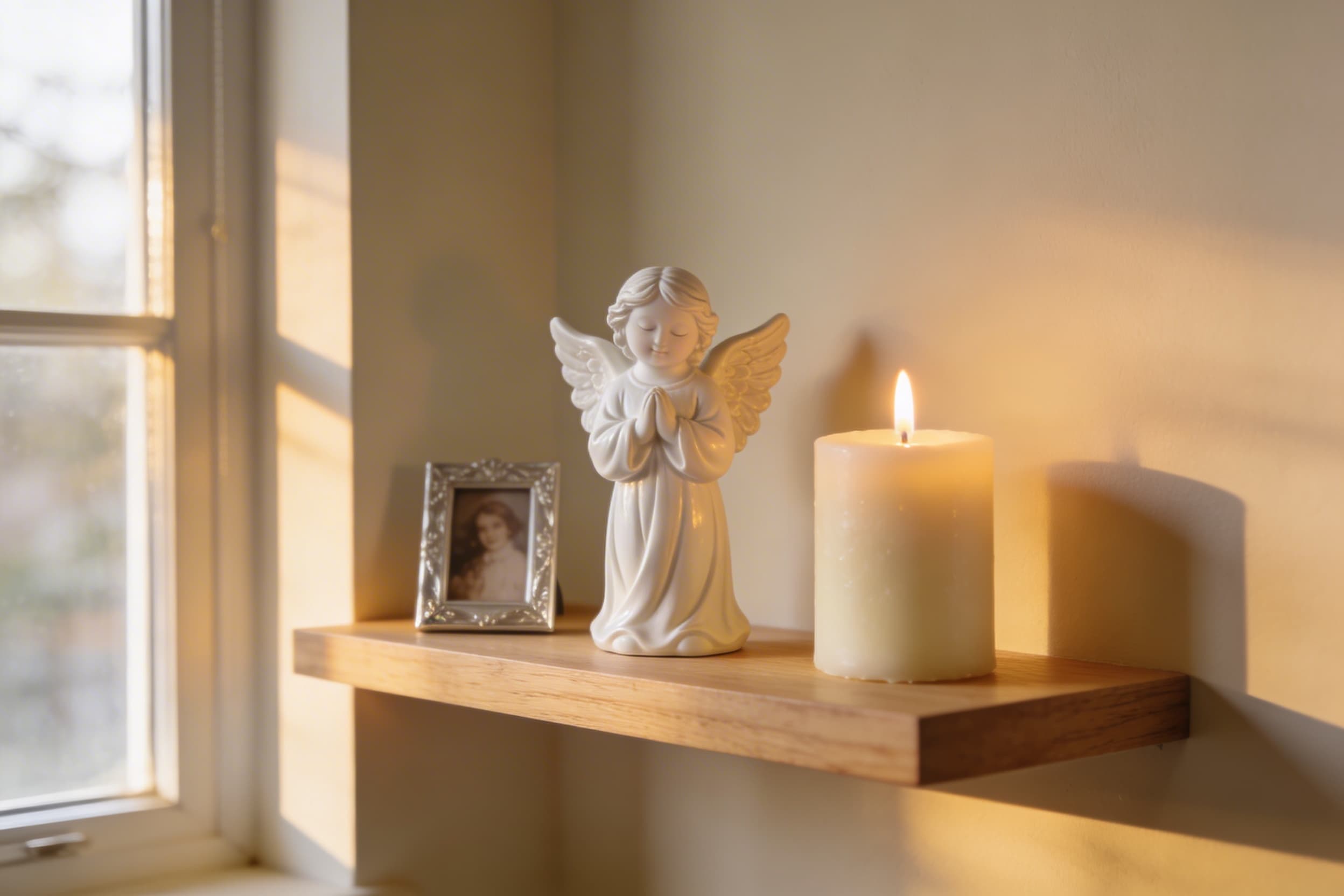
Angel-themed memorial keepsakes offer a way to carry that tradition forward on a personal scale. Gift-boxed angel figurines provide a comforting sympathy gift for someone navigating early grief — small enough to place on a nightstand or bookshelf, meaningful enough to become a lasting tribute. Keepsake angel figurines serve a similar purpose, offering a tangible point of focus for remembrance in the home.
For families creating memorial displays at home, an angel statue or figurine placed alongside a framed photograph, a candle, and a small keepsake can transform a corner of a room into a personal memorial space. Angel vases — ceramic vessels featuring angel designs — add both beauty and function to a home memorial, holding fresh flowers that mark the passage of seasons while the angel figure remains constant.
The connection between Story's monumental sculpture and a small angel keepsake on a family's shelf is direct. Both exist because someone needed to hold onto love after loss. Both give grief a form that can be seen and returned to. The scale is different; the intention is identical.
Visiting the Original
The original Angel of Grief stands in the Cimitero Acattolico (Non-Catholic Cemetery) in Rome's Testaccio neighborhood, near the ancient Pyramid of Cestius. The cemetery — also called the Protestant Cemetery — is the resting place of many notable figures, including the poets John Keats and Percy Bysshe Shelley.
The cemetery is open to visitors and charges a small suggested donation. The Story family grave is located in the newer section of the cemetery, set among cypress trees and paths that wind past centuries of expatriate burials. Visitors often leave flowers and small mementos at the base of the sculpture.
For those who cannot visit Rome, many of the American replicas listed above are accessible in public cemeteries. The Stanford University angel is the easiest to visit on the West Coast, while the Green-Wood Cemetery angel in Brooklyn is the most accessible on the East Coast. Both are worth seeking out if angel memorial art resonates with you — seeing the figure in person, at full scale, surrounded by real graves and real grief, is a fundamentally different experience than viewing a photograph.
Frequently Asked Questions
Who created the Angel of Grief sculpture?
William Wetmore Story, an American sculptor, poet, and former lawyer living in Rome, created the Angel of Grief in 1894. He carved it as a memorial for his wife Emelyn, who died that same year. Story himself died in 1895 and is buried beneath the sculpture alongside his wife and their young son Joseph at Rome's Protestant Cemetery.
What does the Angel of Grief symbolize?
The sculpture represents the raw, unfiltered grief of those left behind after a death. Unlike traditional cemetery angels that suggest peace or divine welcome, Story's angel is collapsed over the funeral altar with drooping wings and a hidden face — a posture of utter abandonment and sorrow. It symbolizes that grief is not weakness but an expression of profound love.
Where is the original Angel of Grief located?
The original stands in the Cimitero Acattolico (Non-Catholic Cemetery) in Rome's Testaccio neighborhood, near the Pyramid of Cestius. The cemetery is open to visitors and also contains the graves of poets John Keats and Percy Bysshe Shelley.
Why are there so many copies of the Angel of Grief?
The sculpture's emotional power made it one of the most requested memorial designs in the late nineteenth and early twentieth centuries. Families commissioned replicas because the figure expressed grief more honestly than traditional cemetery angels. Notable replicas exist at Stanford University, Green-Wood Cemetery in Brooklyn, Metairie Cemetery in New Orleans, and dozens of cemeteries across Texas, California, and the eastern United States.
How is the Angel of Grief connected to modern memorial products?
The tradition of angel imagery in memorial art that the sculpture exemplifies continues in modern sympathy gifts and memorial keepsakes. Angel figurines, garden statues, and decorative angel pieces serve the same purpose as Story's sculpture — giving grief a physical form that can be touched, displayed, and returned to over time.