🏬Supersize Online Funeral Retailer🪦1000's of Headstones⚱️Over 10,000 Cremation Urns⚰️Caskets Overnight Delivery🛒Funeral & Memorial Superstore🚚FREE Shipping on ALL Orders👨👩👧👦Helping Families for over 20 Years💰Lowest Price Guarantee🏬Supersize Online Funeral Retailer🪦1000's of Headstones⚱️Over 10,000 Cremation Urns⚰️Caskets Overnight Delivery🛒Funeral & Memorial Superstore🚚FREE Shipping on ALL Orders👨👩👧👦Helping Families for over 20 Years💰Lowest Price Guarantee
🏬Supersize Online Funeral Retailer🪦1000's of Headstones⚱️Over 10,000 Cremation Urns⚰️Caskets Overnight Delivery🛒Funeral & Memorial Superstore🚚FREE Shipping on ALL Orders👨👩👧👦Helping Families for over 20 Years💰Lowest Price Guarantee🏬Supersize Online Funeral Retailer🪦1000's of Headstones⚱️Over 10,000 Cremation Urns⚰️Caskets Overnight Delivery🛒Funeral & Memorial Superstore🚚FREE Shipping on ALL Orders👨👩👧👦Helping Families for over 20 Years💰Lowest Price Guarantee
Color speaks when words fall short. In the hours and days after losing someone, families reach for specific hues almost instinctively — black clothing laid out for the funeral, white lilies arranged on the altar, a gold ribbon pinned to a lapel. Each choice carries generations of meaning, connecting personal grief to something larger and shared. Understanding what color represents remembrance can help you select meaningful , plan a memorial service that reflects your loved one's spirit, or simply make sense of the traditions unfolding around you. If you are weighing what gesture best fits the moment, our resource on walks through options for every relationship and occasion.
This guide covers the major memorial colors, their roots in world cultures, the awareness ribbon system that has become its own language of remembrance, and practical ways to weave color into tributes that feel personal rather than formulaic.
Traditional Mourning Colors and Their Origins
Black: The Universal Language of Grief
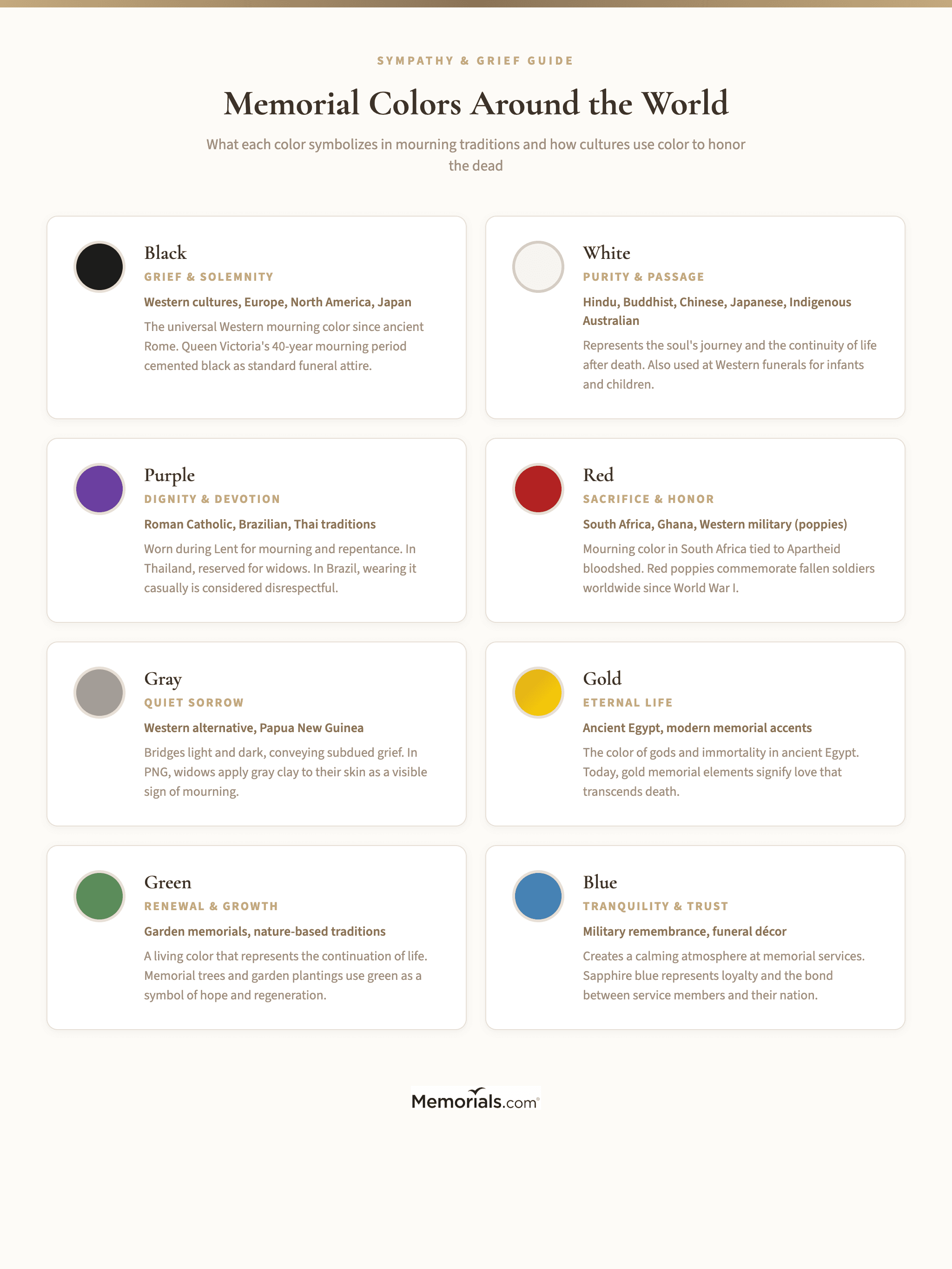
Black is the color most closely associated with mourning in Western culture. The tradition stretches back to ancient Rome, where citizens donned a dark wool garment called the toga pulla after a death in the family. The practice deepened during the Victorian era, when Queen Victoria wore black for the remaining forty years of her life following the death of Prince Albert in 1861. Her example codified black as the expected funeral attire across Britain, Europe, and eventually North America.
Black endures because its symbolism is straightforward — it represents absence, solemnity, and the visual weight of loss. At modern funerals, black remains the safest and most respectful wardrobe choice, though dress codes have loosened considerably in recent decades. What has loosened is mostly the shade rather than the rule — navy, charcoal and deep plum now read as correct where they once did not, which is the ground what to wear to a funeral as a woman covers in detail.
White: Purity, Peace, and Passage
White carries the opposite emotional charge of black, yet it serves the same purpose — honoring the dead. In many Eastern traditions, white is the primary mourning color. Hindu funeral rites call for white garments to symbolize the soul's journey toward liberation. Buddhist ceremonies in China, Japan, and Cambodia use white to represent the continuity of life beyond death. In parts of Australia, Indigenous mourning customs include wearing white for periods ranging from one week to several months.
White is also common at Western funerals for infants and children, where it represents innocence and the brief, unblemished life that was lived. Increasingly, families planning a celebration of life choose white décor to signal hope and peace rather than sorrow alone.
Purple: Dignity, Devotion, and Spiritual Depth
Purple occupies a unique space in memorial color symbolism. Its historical association with royalty and the sacred makes it a natural fit for honoring someone with dignity. In Roman Catholic tradition, purple vestments are worn during Lent, a forty-day period of mourning, repentance, and spiritual preparation. In Brazil, wearing purple outside of a funeral context is considered disrespectful because the color carries such strong devotional meaning. In Thailand, purple is the color worn by widows during their mourning period.
Purple's connection to remembrance extends beyond religion. The purple ribbon has become one of the most recognized awareness symbols worldwide, representing causes from Alzheimer's disease to domestic violence to pancreatic cancer. When families choose purple flower vases or memorial accents, they tap into centuries of meaning that say: this person was worthy of reverence.
Red: Sacrifice, Blood, and Honor
Red's role in mourning varies dramatically by culture. In South Africa, red is worn to funerals as a direct acknowledgment of the bloodshed during the Apartheid era. In Ghana, close family members wear red alongside black to celebrate the life of the deceased. But in China, red is strictly forbidden at funerals because it symbolizes happiness, festivals, and good fortune — the opposite of grief.
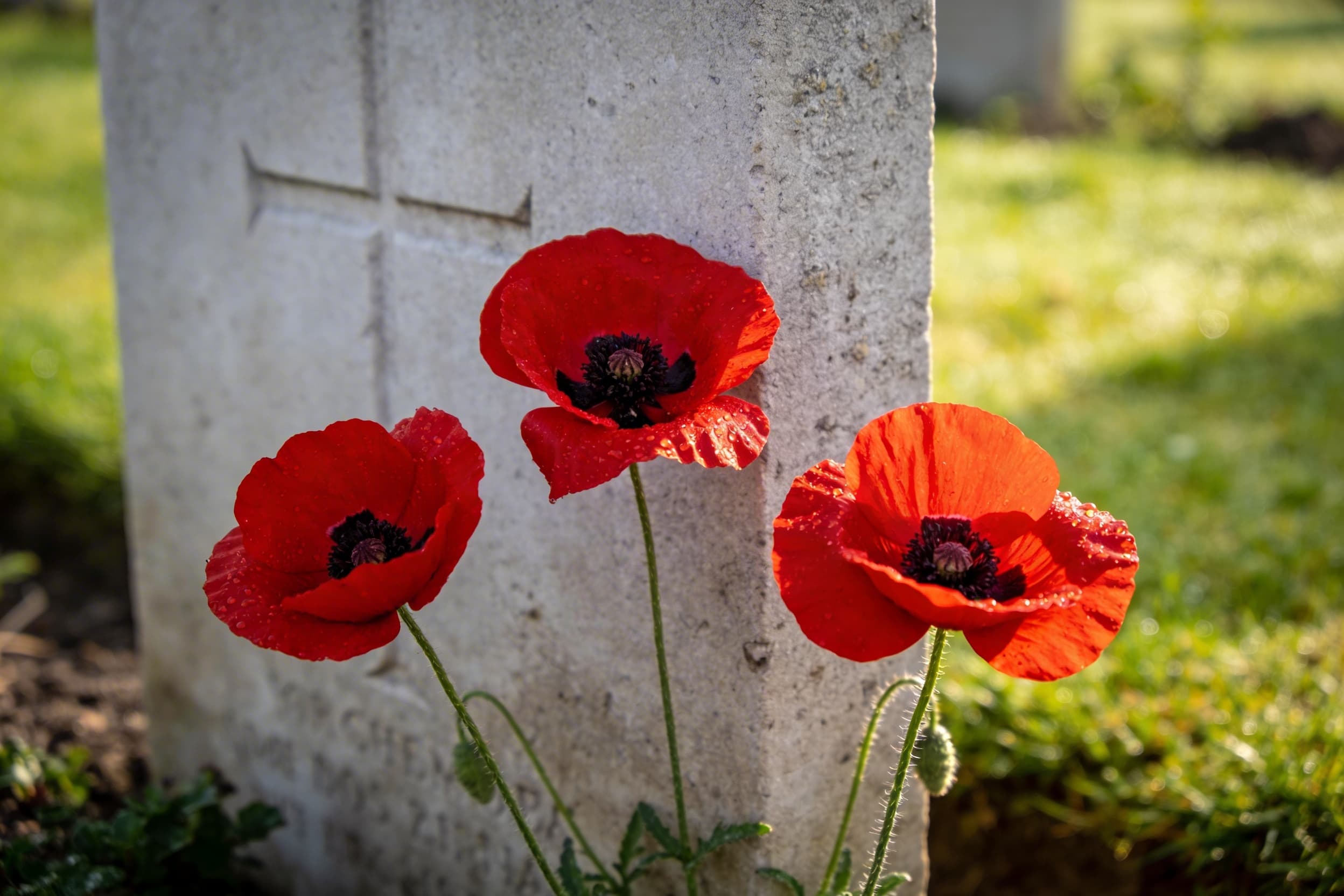
In Western memorial traditions, red appears most often through the poppy, a flower adopted after World War I as a symbol of remembrance for fallen soldiers. Red roses at a funeral typically signify deep love and respect for the person who has died.
Gray and Silver: Quiet Sorrow and Timeless Reflection
Gray and silver are subtler mourning colors that convey dignity without the intensity of black. Gray bridges light and dark, making it a fitting symbol for the complicated emotions families navigate between the sharpest grief and gradual acceptance. In Papua New Guinea, widows apply a gray stone-colored clay to their skin after the death of a husband — one of the most striking visual mourning practices in the world. Silver carries connotations of wisdom, elegance, and the passage of time, and appears frequently in memorial stones and engraved keepsakes.
Gold: Eternal Life and Imperishable Love
In ancient Egypt, gold was the color of the gods and of eternity. The flesh of Ra, the sun god, was believed to be formed from gold, and pharaohs were buried in golden sarcophagi to signify their passage into immortality. Gold appears in modern memorial contexts through gold-leaf accents on urns, golden frames around memorial photographs, and the gold ribbon — which in the awareness ribbon system represents childhood cancer. When a family chooses gold memorial elements, they are making a statement about love that refuses to dim.
Awareness Ribbon Colors and Memorial Meanings
The awareness ribbon has become one of the most powerful visual languages of modern remembrance. What began with yellow ribbons tied to trees during the Iran hostage crisis in 1979 has expanded into a system of dozens of colors, each representing a specific cause, illness, or community. Many families incorporate ribbon colors into memorial services, graveside displays, and keepsake gifts to honor someone who lived with or died from a particular condition.
Here are the ribbon colors most commonly connected to memorial and remembrance contexts:
Pink: Breast Cancer Remembrance
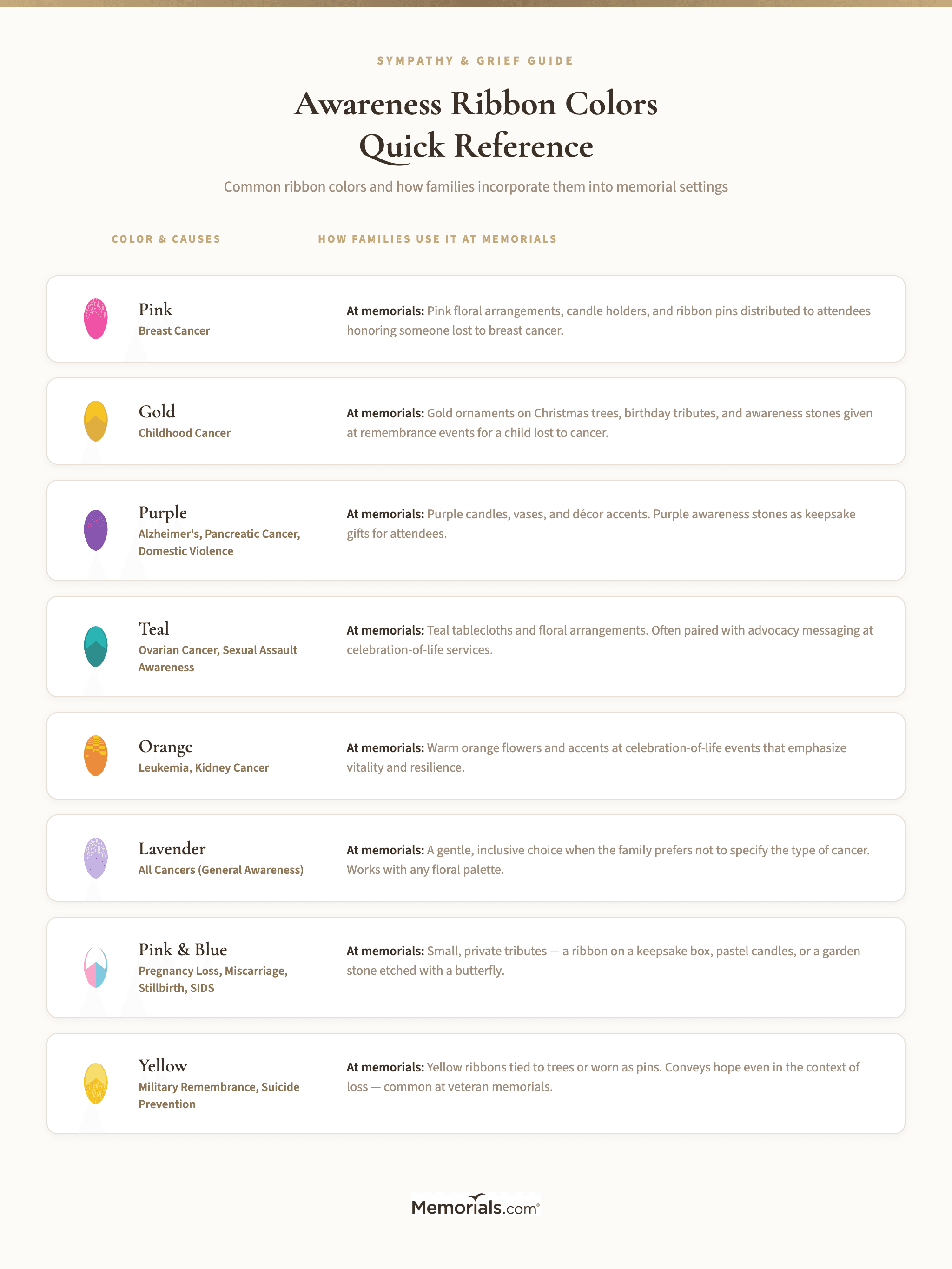
The pink ribbon is arguably the most universally recognized awareness symbol. Since its widespread adoption in the early 1990s, pink has come to represent solidarity with breast cancer patients, survivors, and those who have died from the disease. Memorial services for someone lost to breast cancer often feature pink floral arrangements, pink candle holders, and pink ribbon pins distributed to attendees.
Gold: Childhood Cancer Remembrance
Gold ribbons honor children who fought cancer. The color was chosen because children are precious and irreplaceable — like gold itself. Families who have lost a child to cancer often incorporate gold into annual remembrance events, birthday tributes, and holiday decorations. For those remembering loved ones at Christmas, gold ornaments and ribbon can serve as both a seasonal decoration and a deeply personal act of tribute.
Purple: Alzheimer's, Pancreatic Cancer, and Domestic Violence
Purple carries one of the broadest portfolios in the ribbon system. It represents Alzheimer's disease awareness, pancreatic cancer, lupus, epilepsy, and domestic violence. For families honoring someone lost to Alzheimer's, purple memorial accents help communicate a specific story — not just that someone died, but what they endured and why their memory matters to a larger cause.
Teal: Ovarian Cancer and Sexual Assault Awareness
Teal ribbons represent ovarian cancer awareness as well as sexual assault awareness. Because ovarian cancer is often diagnosed late, memorial tributes using teal frequently carry an advocacy message alongside the personal remembrance.
Orange: Leukemia and Kidney Cancer
Orange represents the fight against leukemia and kidney cancer, among other conditions. Its warm, energetic tone makes it a natural fit for celebration-of-life services that emphasize vitality and resilience.
Lavender: General Cancer Awareness
When a memorial honors someone who fought cancer but the family prefers not to specify the type, lavender serves as the universal cancer awareness color. It is a gentle, inclusive choice.
Pink and Blue: Pregnancy and Infant Loss
A combined pink-and-blue ribbon represents pregnancy loss, miscarriage, stillbirth, and SIDS. Families navigating miscarriage grief sometimes incorporate these paired colors into small, private memorials — a ribbon tied around a keepsake box, a candle in alternating pastel hues, or a garden stone etched with a butterfly. The butterfly is the most-used emblem in this whole vocabulary, and what the butterfly has meant, culture by culture, is older and stranger than the modern grief reading of it.
Yellow: Military Remembrance and Suicide Prevention
Yellow ribbons have a dual legacy. They originated as symbols of hope and support for military service members, and they also represent suicide prevention. The color conveys optimism even in the context of loss, making it a meaningful addition to memorials honoring veterans or individuals lost to suicide.
How to Use Memorial Colors in Everyday Remembrance
Understanding the symbolism behind memorial colors is one thing; putting that knowledge into practice is another. Here are tangible ways families incorporate color into ongoing tributes.
Memorial Displays and Home Altars
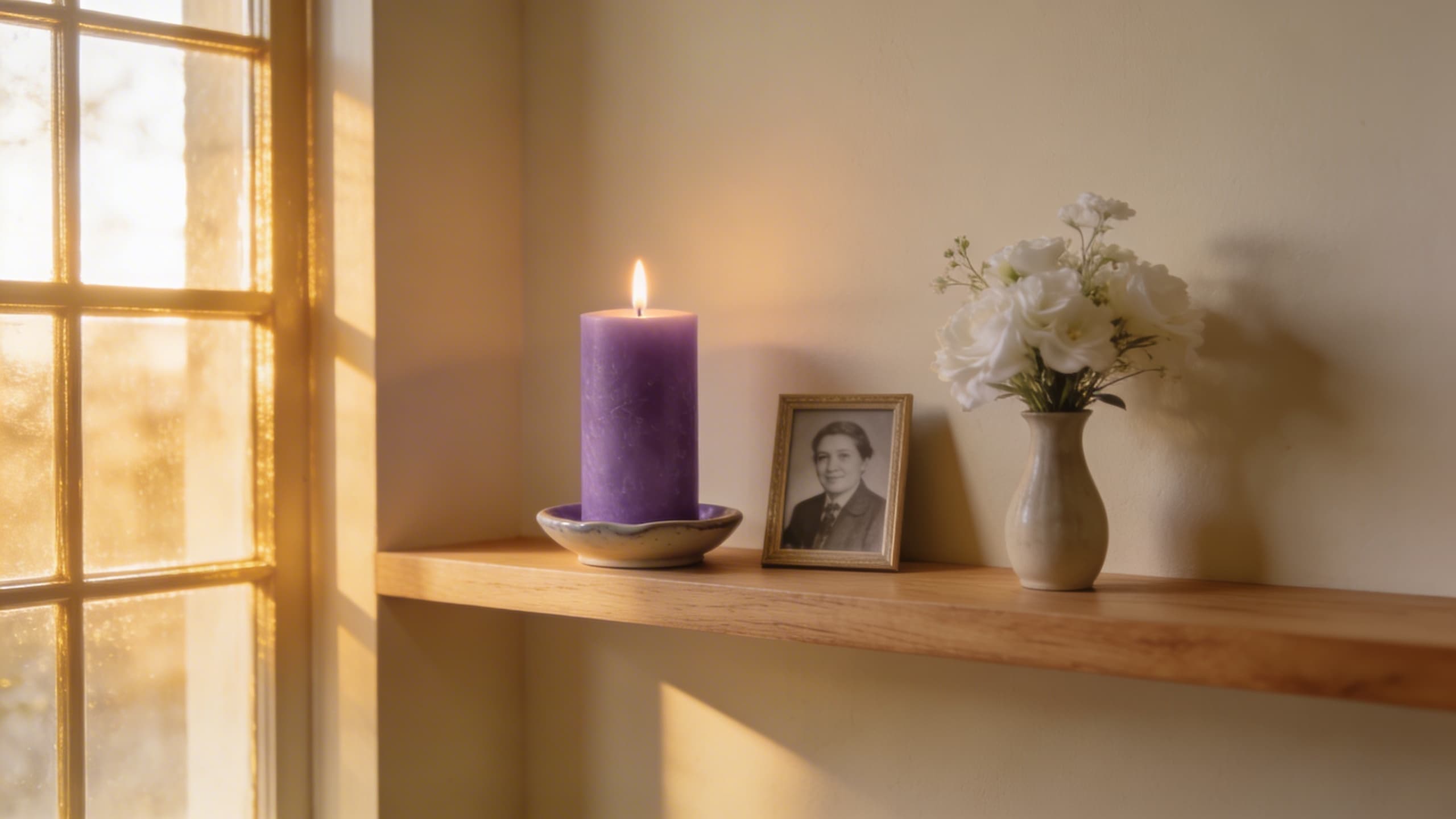
A small shelf or tabletop display featuring an urn, a framed photograph, and a few color-coordinated accents creates a dignified space for daily remembrance. A purple candle for an Alzheimer's tribute. A gold picture frame for a child lost to cancer. A simple white vase with fresh flowers for a Buddhist family honoring their tradition. The colors you choose tell a story without requiring explanation.
Awareness Stones and Keepsake Gifts
Awareness stones are small acrylic touchstones featuring embedded colored ribbons — pink, purple, gold, green, and others. They work as pocket-sized comfort objects, and because they come in sets, they can be distributed at memorial services so everyone in attendance carries the same symbol of solidarity home with them. A pink ribbon stone at a breast cancer memorial. A gold ribbon stone at a childhood cancer remembrance. The physical weight of the stone in a pocket or purse becomes a tactile anchor for grief, connecting the person carrying it to the cause and to the community of people who cared about the same individual.
Funeral and Memorial Service Décor
Color choices at a funeral service shape the emotional atmosphere more than most people realize. A service draped entirely in black conveys traditional solemnity. Adding touches of the deceased's favorite color — a teal tablecloth, orange flowers, a purple sash — personalizes the tribute and signals to attendees that this service is about the individual, not just the ritual.
Increasingly, families planning celebration-of-life services move away from black entirely, choosing bright hues that reflect the personality and passions of the person being honored. Some request that attendees wear a specific color, creating a visual sea of solidarity. If you are the one invited rather than the one planning, what to wear to a celebration of life is the harder half of that instruction: bright does not mean casual, and an invitation that says "wear his favorite color" still expects the rest of the outfit to be respectful.
Holiday and Anniversary Tributes
The absence of a loved one sharpens at holidays and anniversaries. Incorporating a memorial color into seasonal decorations — a gold ornament on the Christmas tree, a purple wreath on the front door during Alzheimer's Awareness Month, a single white candle lit at the Thanksgiving table — weaves the memory of the person into the fabric of the celebration rather than leaving their absence as an unspoken void.
The Role of Art and Symbolism in Memorial Color
Color does not exist in isolation at memorials — it works alongside shapes, textures, and cultural symbols to create meaning. The weeping angel, for example, has appeared in cemeteries since the late 1800s as a marble embodiment of mourning, and its white or gray stone carries its own color symbolism of purity and quiet sorrow. You can explore the full history and meaning behind the Angel of Grief statue, one of the most replicated memorial sculptures in the world.
Stained glass windows in chapels and mausoleums use jewel tones — deep blues, rich purples, radiant golds — to frame scenes of comfort and transcendence. Garden memorials use green as a living color of renewal, planting trees or shrubs that change with the seasons as a reminder that life continues even after loss. The choices are deeply personal, and there is no wrong answer. The only principle that matters is that the colors you select carry meaning for you and for the person you are honoring.
Frequently Asked Questions
What color is most associated with remembrance?
Black is the most universally recognized mourning color in Western culture, but "remembrance" specifically is often associated with purple (dignity and awareness causes), red poppies (military remembrance), and gold (eternal love and childhood cancer tribute). The answer depends on the cultural tradition and the type of loss being honored.
Can I wear colors other than black to a funeral?
Many modern memorial services welcome colors beyond black, especially celebrations of life. If the family has not specified a dress code, dark or muted tones — navy, charcoal, deep plum — are generally safe choices. When in doubt, ask the funeral director or a family member. Some families specifically request a favorite color of the deceased. The longer answer, including which services still expect black and which no longer do, is in do you have to wear black to a funeral.
What do awareness ribbon colors mean at a memorial service?
Awareness ribbons at a memorial indicate that the deceased lived with or died from a specific condition. Pink represents breast cancer, gold represents childhood cancer, purple can represent Alzheimer's or pancreatic cancer, and teal represents ovarian cancer, among many others. Distributing ribbon pins or awareness stones at the service invites attendees to honor both the individual and the broader cause.
Is it appropriate to use bright colors at a funeral?
Bright colors are increasingly common at celebration-of-life services, where the tone is meant to honor the person's vitality rather than focus solely on loss. If the deceased was known for their love of a particular color — sunflower yellow, ocean blue, vibrant red — incorporating it into the service can feel more authentic than defaulting to black. The key is respecting the family's wishes and the overall tone of the event.
What color represents remembrance for military service members?
Red poppies are the most recognized symbol of military remembrance, dating back to World War I and the poem "In Flanders Fields." Yellow ribbons represent support for active service members and hope for their safe return. On Memorial Day, the red, white, and blue of the American flag take on heightened significance, with each color representing valor, purity, and justice.