🏬Supersize Online Funeral Retailer🪦1000's of Headstones⚱️Over 10,000 Cremation Urns⚰️Caskets Overnight Delivery🛒Funeral & Memorial Superstore🚚FREE Shipping on ALL Orders👨👩👧👦Helping Families for over 20 Years💰Lowest Price Guarantee🏬Supersize Online Funeral Retailer🪦1000's of Headstones⚱️Over 10,000 Cremation Urns⚰️Caskets Overnight Delivery🛒Funeral & Memorial Superstore🚚FREE Shipping on ALL Orders👨👩👧👦Helping Families for over 20 Years💰Lowest Price Guarantee
🏬Supersize Online Funeral Retailer🪦1000's of Headstones⚱️Over 10,000 Cremation Urns⚰️Caskets Overnight Delivery🛒Funeral & Memorial Superstore🚚FREE Shipping on ALL Orders👨👩👧👦Helping Families for over 20 Years💰Lowest Price Guarantee🏬Supersize Online Funeral Retailer🪦1000's of Headstones⚱️Over 10,000 Cremation Urns⚰️Caskets Overnight Delivery🛒Funeral & Memorial Superstore🚚FREE Shipping on ALL Orders👨👩👧👦Helping Families for over 20 Years💰Lowest Price Guarantee
A mausoleum is a building that holds the dead above ground rather than in the earth. Instead of a grave, the casket goes into a sealed stone chamber called a crypt, set into a wall inside or outside the building. Urns go into smaller compartments called niches. That is the whole idea, and everything else is a variation on it.
The reason the word confuses people is that it covers two completely different purchases. One is a single crypt in a building the cemetery already owns and maintains, bought the way you would buy a plot. The other is a private structure your family designs and pays to have built. The first is usually a few thousand dollars. The second starts near six figures. Nobody tells you this, so people either dismiss the idea as far out of reach or assume it is cheaper than a grave, and both are common.
If you are working through the broader set of choices — where the cemetery is, what a plot costs, what the rules are — our covers the ground underneath all of it. What follows is specific to above-ground entombment.
What a mausoleum is, and how it differs from burial
The mausoleum meaning most people carry around comes from the famous ones — the Taj Mahal, Grant's Tomb, the tomb of Mausolus at Halicarnassus that gave the word its name in the first place. Those are mausoleums. So is the plain granite building at the back of a municipal cemetery with two hundred numbered fronts, and so is the low wall of crypts facing a landscaped path. Grandeur is not part of the definition. Above ground is.
The technical word for placing someone in a mausoleum is entombment, as distinct from burial (in the ground) and inurnment (placing an urn). If a funeral director has used all three in one sentence, that is what they were separating.
Two words do most of the work inside a mausoleum:
A crypt is a chamber sized for a casket.
A niche is a much smaller compartment sized for an urn. A wall or building made up of niches is a columbarium, which may be its own structure or a section inside a mausoleum.
The practical differences from a grave are worth knowing before you decide anything. There is no digging, so there is no grave to settle and no sod to re-establish. Nothing is lowered in front of the family — a committal at a mausoleum happens at the crypt front, and the casket is usually placed afterward rather than during the service. Visiting is different too: an indoor mausoleum can be visited in bad weather, which matters more to some families than they expect. And there is no headstone. The front of the crypt carries a plaque instead.
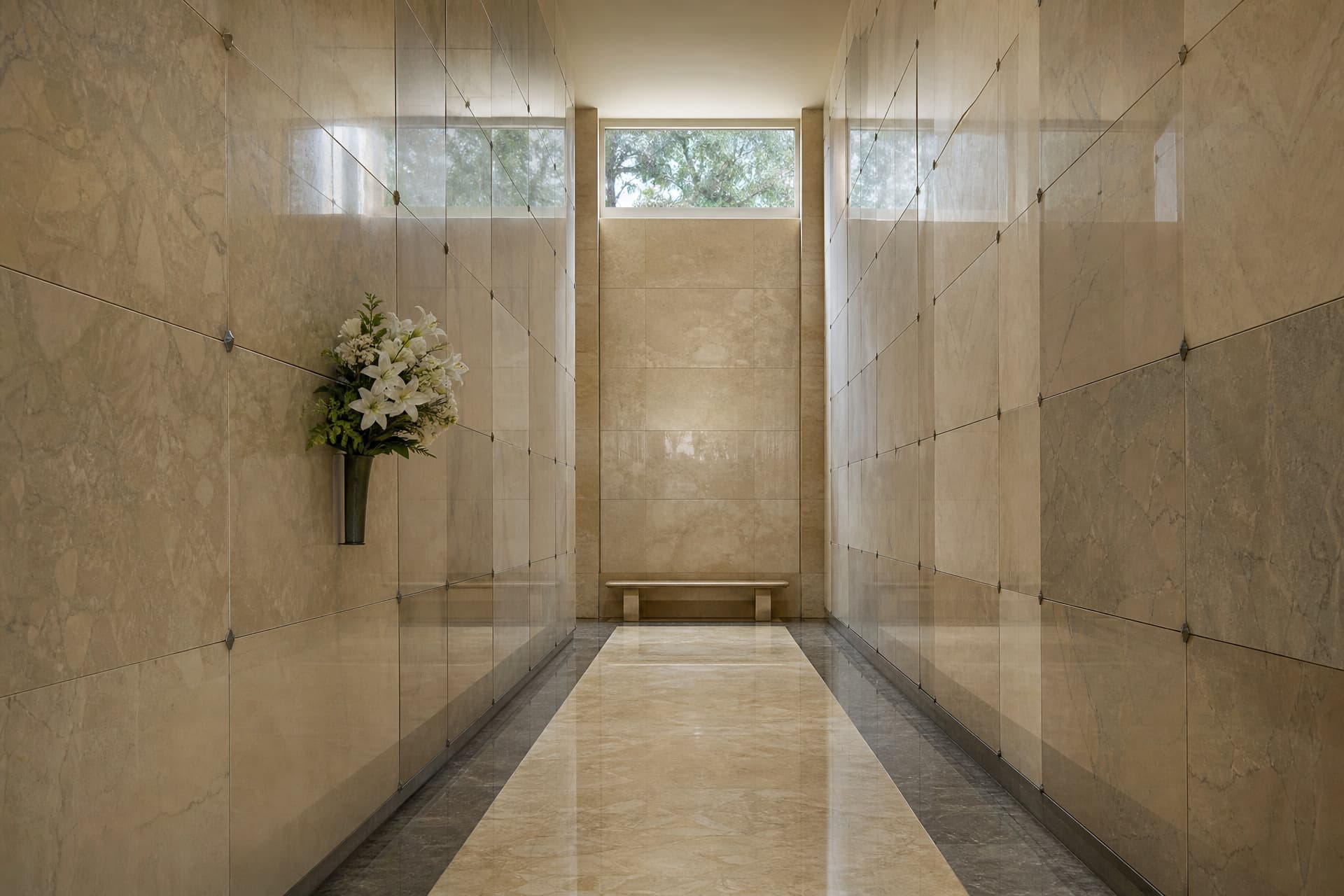
Inside a community mausoleum: sealed crypt fronts line the corridor, lit from above, with a bench at the far end.
Types of mausoleums
The types of mausoleums a family is actually offered come down to five, and the differences matter more for cost and upkeep than for anything else. Which ones exist near you depends on the cemetery — this is worth asking early, because not every cemetery offers above-ground entombment at all, and the types of cemeteries in a given area vary more than most people realize.
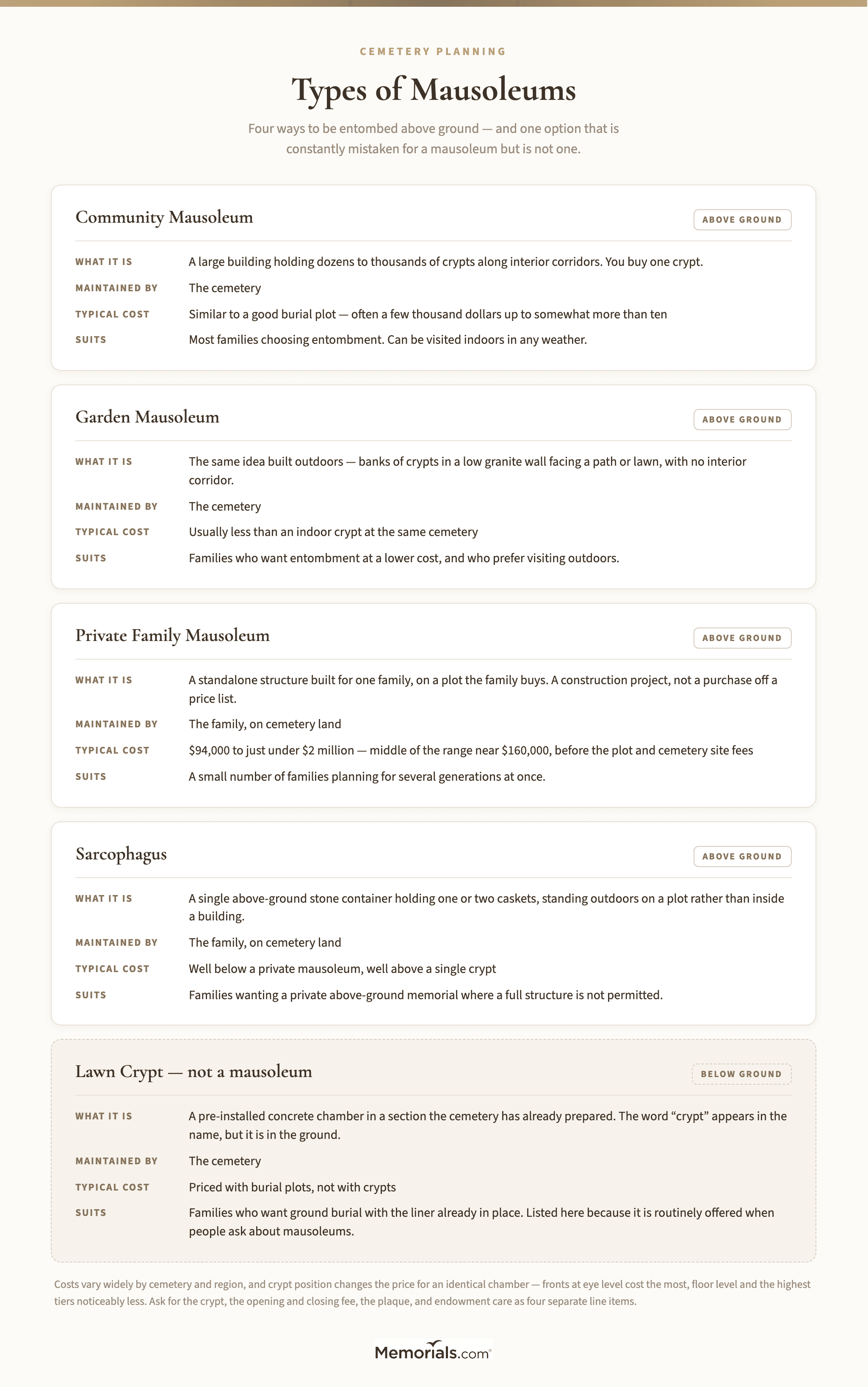
Community mausoleum. A large building owned and maintained by the cemetery, holding anywhere from dozens to thousands of crypts along interior corridors. You buy one crypt, the way you would buy one plot. This is what most people end up choosing, and it is the least expensive way into a mausoleum by a wide margin.
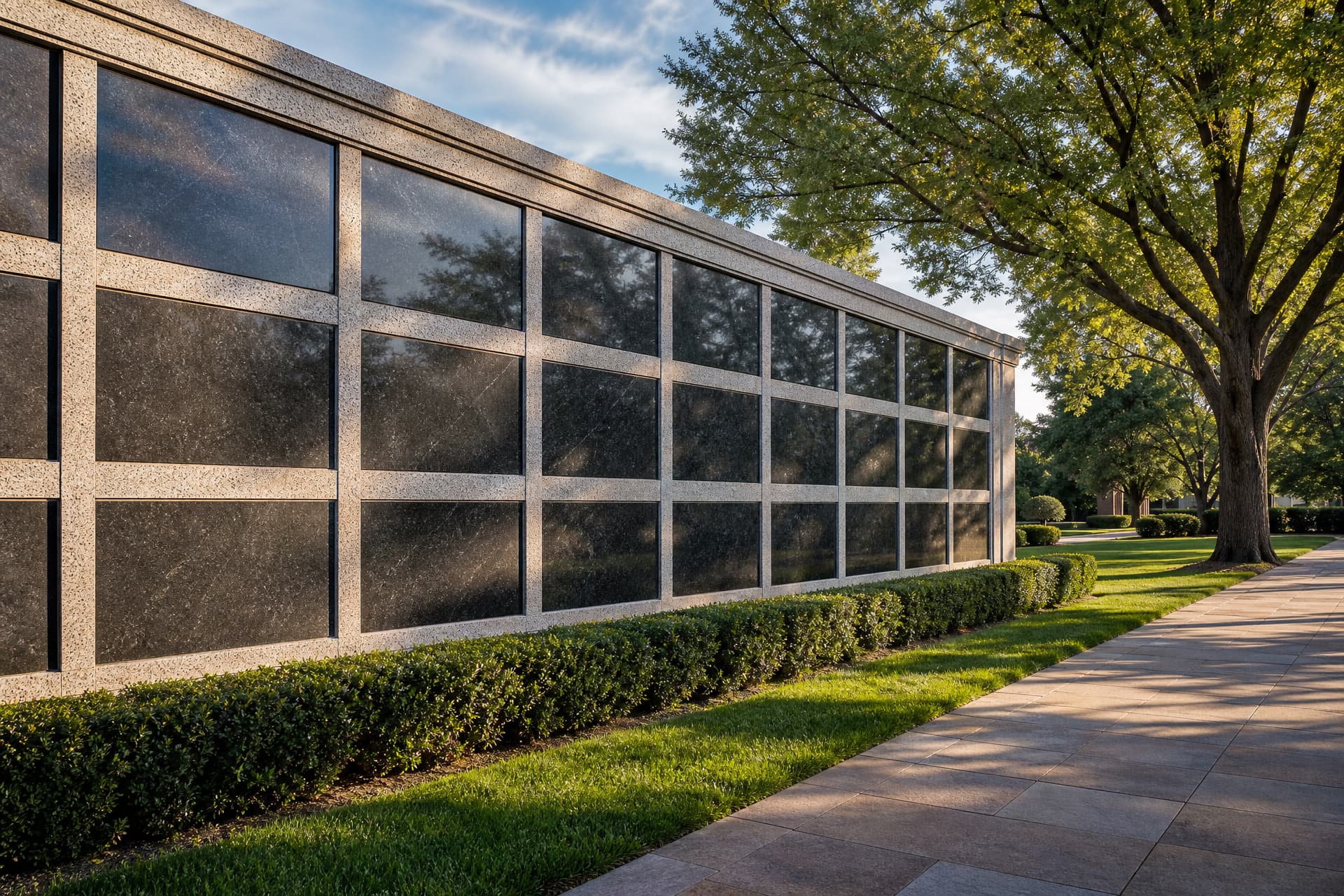
Garden mausoleum. The same idea, built outdoors — banks of crypts in a low granite wall facing a path or lawn, with no interior corridor. Usually cheaper than an indoor crypt in the same cemetery, because there is no building to heat, light, and clean.
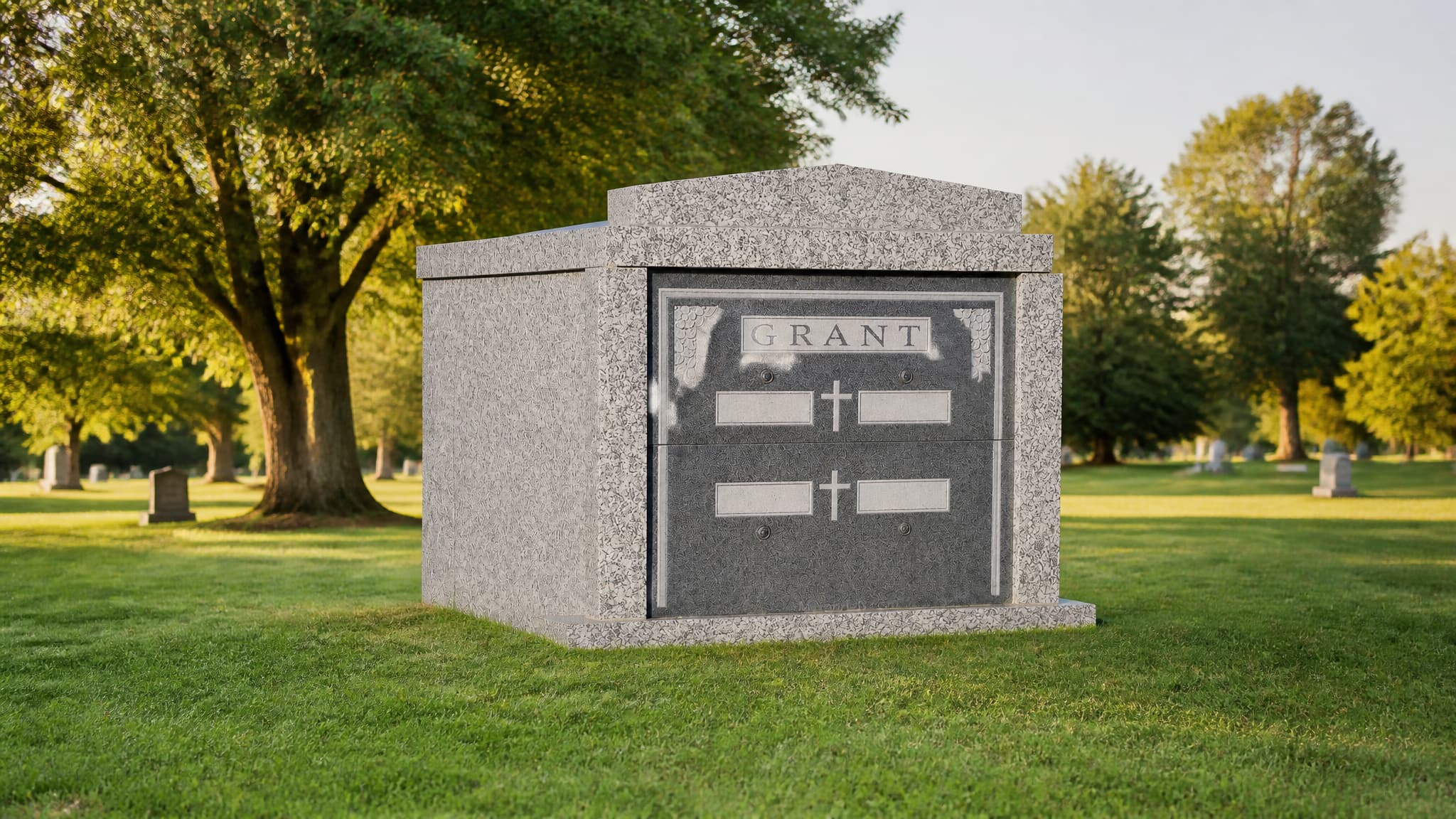
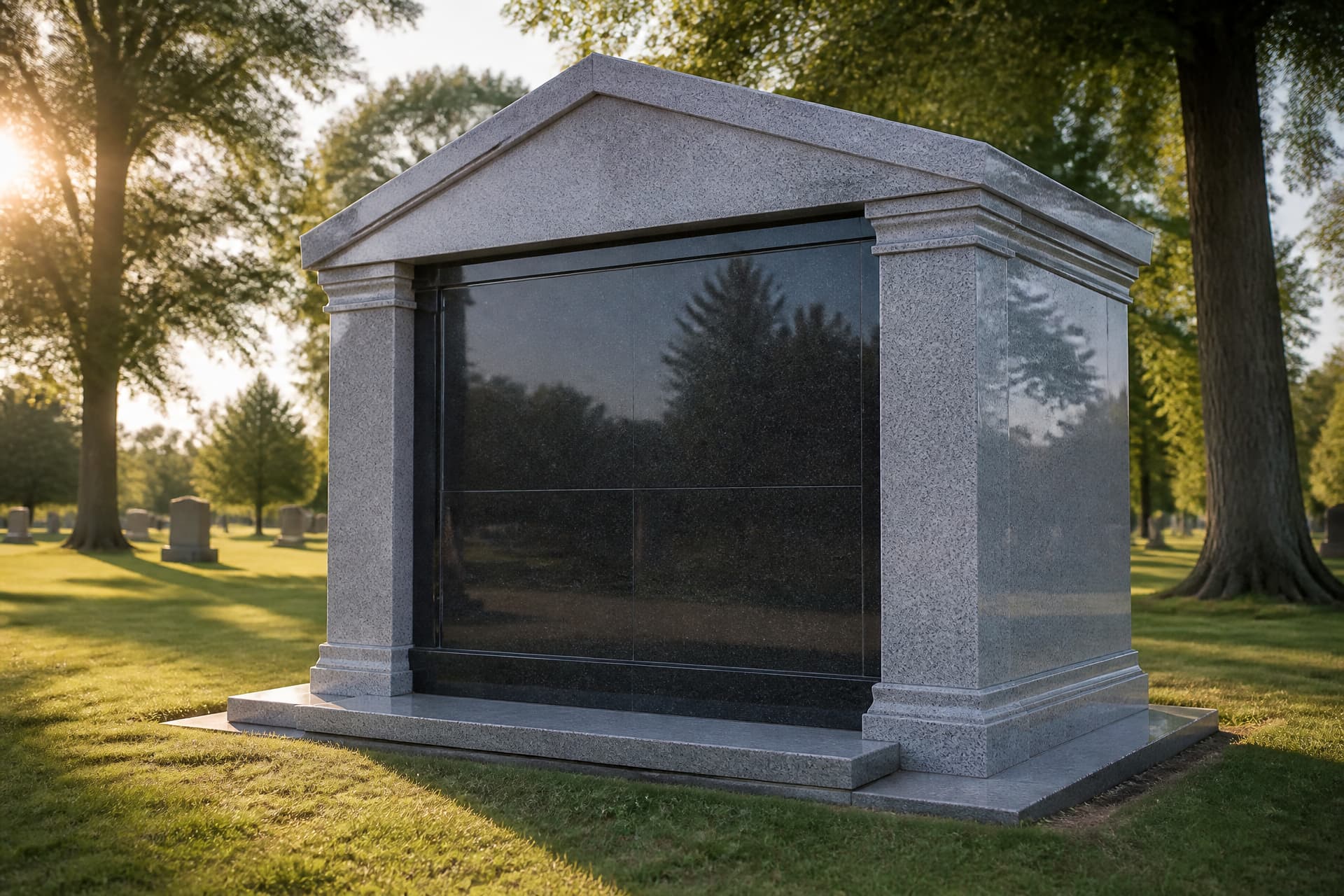
Private family mausoleum. A standalone structure built for one family, on a plot the family buys. This is the kind people picture, and it is a construction project: design, granite, foundation, engraving, and a site fee to the cemetery. A private mausoleum is a serious commitment and priced accordingly — more on that below.
Sarcophagus. A single above-ground stone container holding one or two caskets, standing outdoors on a plot rather than inside a building. Smaller and simpler than a private mausoleum, and sometimes offered where a full structure is not permitted.
Lawn crypt. Worth naming because it is constantly confused with the others: a lawn crypt is below ground. It is a pre-installed concrete chamber in a section the cemetery has already prepared, so it is not a mausoleum at all, even though the word crypt appears in it. Families are sometimes shown lawn crypts when they ask about mausoleums, and the two are priced and visited quite differently.
How entombment actually works
This is the part almost nobody explains, and it is what most people are quietly wondering about.
A crypt is a rectangular chamber, roughly casket-sized, built into a bank of others. The opening faces the corridor or the outdoor path. On the day of the entombment, the family typically gathers at the crypt front for a committal service, and the casket is placed into the chamber either at the end of the service or shortly after everyone has gone — cemeteries differ, and it is a fair question to ask in advance if it matters to you.
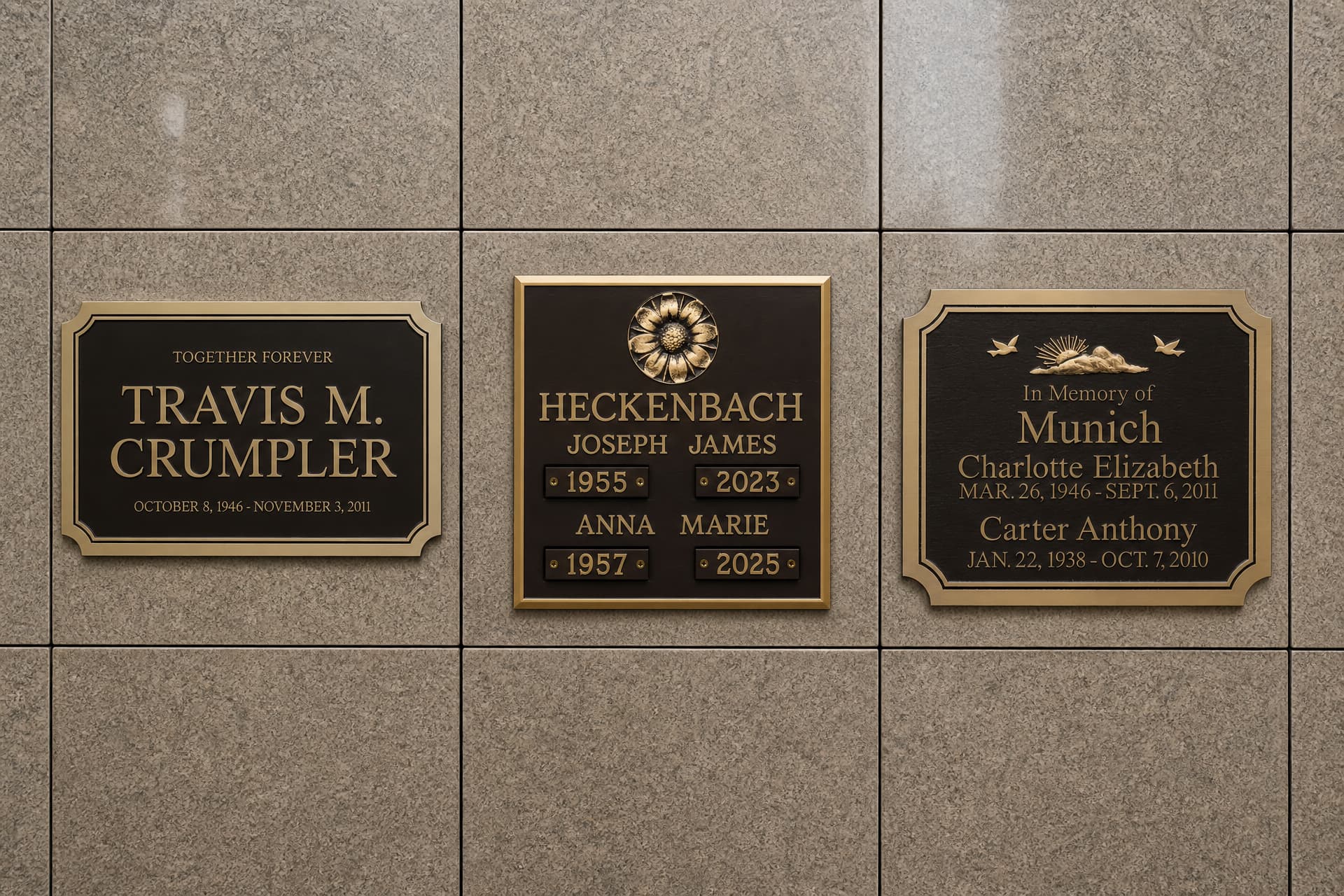
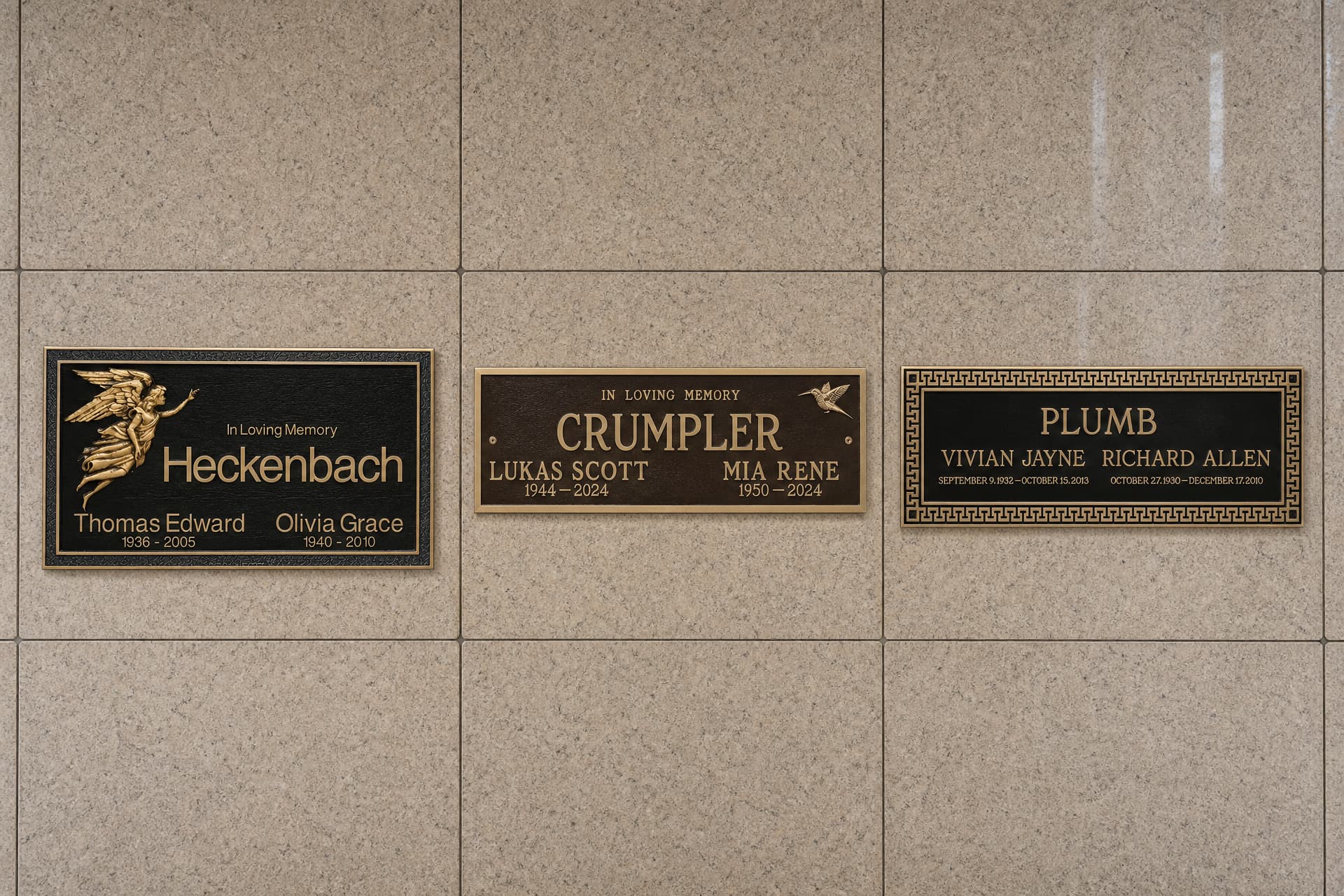
Once the casket is in, the chamber is sealed. There is usually an inner seal or shutter across the opening, and then the visible front — a slab of granite or marble — is fitted over it and secured. The plaque carrying the name and dates is attached to that front. From the corridor, a sealed crypt looks like a panel of polished stone with a small bronze plate on it.
A few practical points that come up:
Crypt position affects the price. Fronts at eye level, often called heart level, cost the most. Floor level and the highest tiers cost noticeably less for exactly the same chamber.
A crypt may hold more than one person. A companion crypt takes two caskets side by side. A tandem crypt takes two end to end, one behind the other. Both cost less than two single crypts.
Most cemeteries have requirements. Entombment commonly requires a sealed casket, and some cemeteries require embalming. Ask before you buy the casket, not after.
A sealed crypt is not reopened casually. It can be, under the cemetery's disinterment rules and usually with permits and family consent, but it is a formal process rather than a matter of asking.
A garden mausoleum: the same rows of crypts, built outdoors and visited from a path rather than a corridor.
What a mausoleum costs
Mausoleum cost is really two questions wearing one name, and answering the wrong one is why people give up on the idea early.
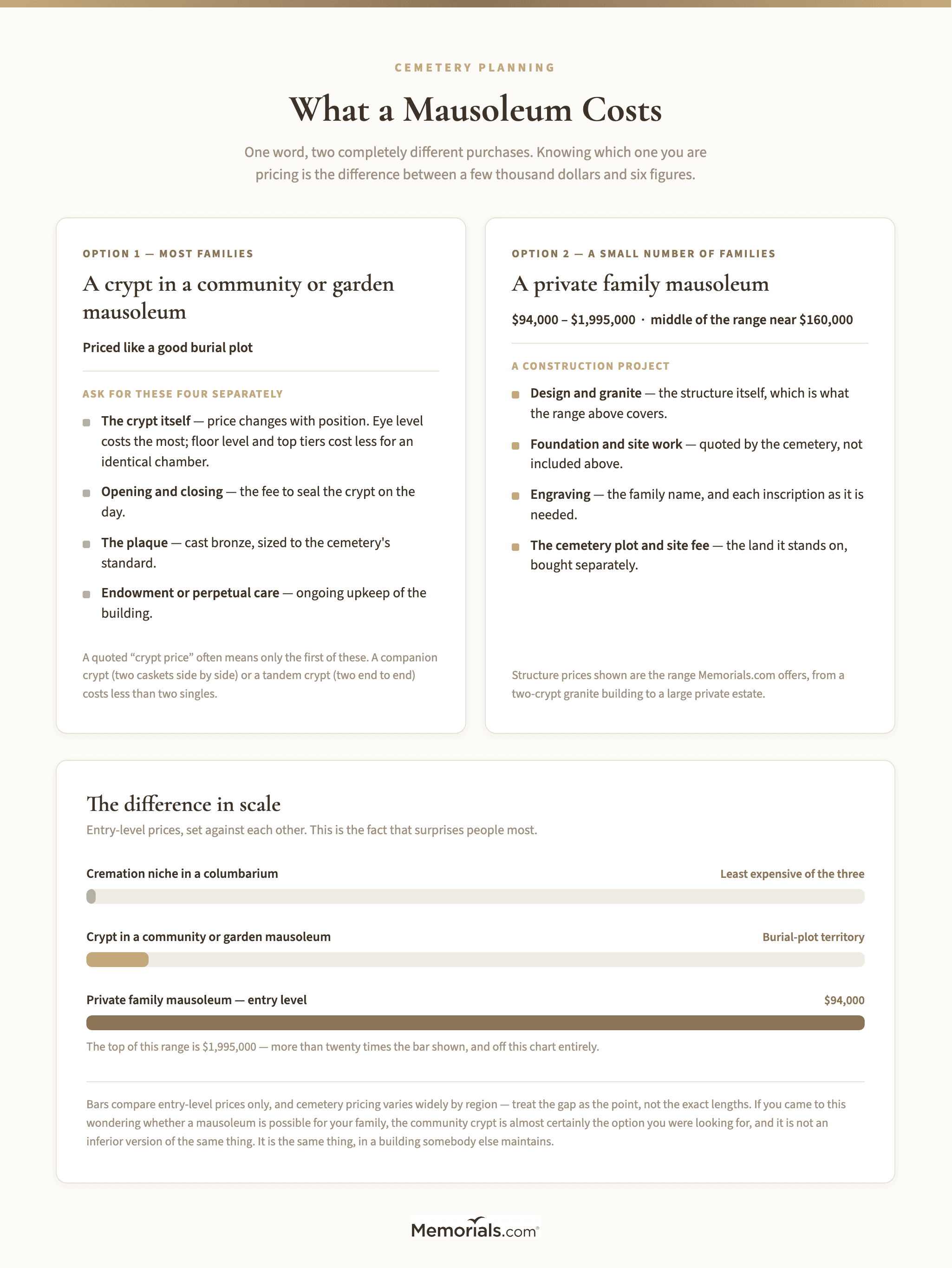
A crypt in a community or garden mausoleum is the ordinary case. Cemeteries price these individually and the spread across the country is wide — regional land values move this more than anything else — but for most families a single crypt lands in the same broad territory as a good burial plot, often a few thousand dollars to somewhat more than ten. Level matters, as above. On top of the crypt itself, expect an opening and closing fee, the cost of the plaque, and in most cemeteries a perpetual or endowment care charge. Ask for all four as separate line items; a quoted "crypt price" often means only the first. Because this sits so close to the in-ground decision, our breakdown of cemetery plot cost is the better place to compare the two properly, and the numbers there apply directly.
A private family mausoleum is a different order of expense, and this is where being plain is more useful than being encouraging. Across the private mausoleums we offer, prices run from roughly $94,000 for a two-crypt granite structure to just under $2 million for a large private estate, with the middle of the range sitting near $160,000. Those are structure prices; the cemetery plot it stands on, and the cemetery's own site and foundation fees, are separate.
That is a real number and it is worth saying out loud. A private mausoleum is chosen by a small number of families, usually ones planning for several generations at once. If you came to this page wondering whether a mausoleum is possible for your family, the community crypt is almost certainly the option you were looking for, and it is not an inferior version of the same thing — it is the same thing, in a building somebody else maintains.
A private family mausoleum stands on its own foundation, far larger than the markers around it.
Mausoleum, ground burial, or a cremation niche
Most families are not really choosing between five kinds of mausoleum. They are choosing between three places a person can end up.
Ground burial is the familiar path and usually the cheapest at the low end. It comes with its own requirements: nearly every cemetery now requires a grave liner or one of the burial vaults that keep the ground from settling, which is a line item people rarely anticipate. If that is new to you, we have written a full explanation of what vaults do and why cemeteries insist on them. A grave is marked with one of the grave markers set flat or upright, depending on what the section allows.
A mausoleum crypt costs more than a plot in most cemeteries, is entirely above ground, needs no vault, and gives a family a clean stone front to visit rather than a lawn. For some people the appeal is practical — an indoor corridor is easier to visit in January than a hillside. For others it is that the idea of burial is genuinely unbearable, and above ground is the answer to something a price comparison does not capture.
A cremation niche is the least expensive of the three by a long way, and it is a real mausoleum option rather than a lesser one — many mausoleums include a columbarium section, and many columbaria stand alone. If cremation is on the table, our guide to choosing a cremation niche covers sizing and cemetery rules, and our comparison of a columbarium against a burial plot puts the costs next to each other. Niches are closed with a stone or glass front and identified with niche plaques in the same way a crypt is.
Whatever a family spends on the crypt itself, the part they actually choose — and look at every time they visit — is the front.
A crypt plaque is a cast bronze plate carrying the name, the dates, and usually an emblem: a cross, a rose, praying hands, a military insignia. Cemeteries generally set the maximum size and the mounting pattern, so the choice happens within limits the cemetery gives you, and it is worth getting those in writing before ordering. Our mausoleum crypt plates are made to standard crypt-front dimensions and can be cast with an inscription and emblem of your choosing.
Beyond the plaque, most of what a family adds falls under cemetery products: a bronze vase that mounts to the crypt front or the wall beside it, a photo medallion set into the plaque, an emblem marking military service. Fresh flowers are often restricted inside an indoor mausoleum — the humidity and the cleanup are the reasons — so a permanent vase and silk arrangements are common indoors, while garden crypts usually allow fresh.
How are caskets placed in a mausoleum? The casket slides into the crypt chamber horizontally through the opening in the front, usually on rollers or a lift, with the head end going in first. In most cemeteries this happens after the committal service rather than in front of the family, though some will do it while everyone is present if you ask. The chamber is then sealed, and the granite or marble front is fitted over the opening and the plaque attached.
How much does a mausoleum cost? It depends entirely on which kind you mean. A single crypt in a community or garden mausoleum is priced like a burial plot — a few thousand dollars up to somewhat more than ten in most areas, plus opening and closing, the plaque, and care fees. A private family mausoleum is a construction project: ours run from about $94,000 to just under $2 million, with the middle near $160,000, before the cemetery's own plot and site fees.
How much does it cost to put ashes in a mausoleum? Considerably less than a casket crypt. A niche in a columbarium — inside a mausoleum or standing alone — is the least expensive option of any of these, typically a fraction of the price of a crypt, because the compartment is far smaller. You will still pay an inurnment fee and for the niche plaque.
What is the difference between a crypt and a niche? Size and what goes in them. A crypt is a chamber built to hold a casket. A niche is a much smaller compartment built to hold one or two urns. Both are sealed above-ground compartments with a stone front and a plaque, and both can be found inside the same building.
Can a mausoleum be opened after it is sealed? Yes, but not casually. Reopening a sealed crypt is a disinterment, and it requires the cemetery's permission, usually a permit, and the consent of the rights holder and next of kin. Families sometimes ask because they want a spouse added later — for that case, buy a companion or tandem crypt up front rather than planning to reopen a single one.
Choosing a resting place you can actually visit
The honest summary is that a mausoleum is not one decision. If you are looking at a crypt in a building the cemetery already owns, you are making a choice close in cost and character to buying a plot, and the real questions are which level, whether you need room for two, and what the fees around it come to. If you are looking at building something for your family, you are commissioning architecture, and the number is what it is.
What should not enter into it is the idea that spending more honors someone better. A name cast in bronze on a crypt front in a corridor a family can walk into on a cold day does the same work as a name on a granite building. The thing that matters is whether the people left behind will go, and whether going is bearable when they get there.
When you know which kind of front you are working with, the plaque is the straightforward part. Ours are cast to the standard crypt and niche dimensions with emblems and photo medallions available on most designs, and the matching cemetery vases mount to a crypt front or the wall beside it where the cemetery allows one.