🏬Supersize Online Funeral Retailer🪦1000's of Headstones⚱️Over 10,000 Cremation Urns⚰️Caskets Overnight Delivery🛒Funeral & Memorial Superstore🚚FREE Shipping on ALL Orders👨👩👧👦Helping Families for over 20 Years💰Lowest Price Guarantee🏬Supersize Online Funeral Retailer🪦1000's of Headstones⚱️Over 10,000 Cremation Urns⚰️Caskets Overnight Delivery🛒Funeral & Memorial Superstore🚚FREE Shipping on ALL Orders👨👩👧👦Helping Families for over 20 Years💰Lowest Price Guarantee
🏬Supersize Online Funeral Retailer🪦1000's of Headstones⚱️Over 10,000 Cremation Urns⚰️Caskets Overnight Delivery🛒Funeral & Memorial Superstore🚚FREE Shipping on ALL Orders👨👩👧👦Helping Families for over 20 Years💰Lowest Price Guarantee🏬Supersize Online Funeral Retailer🪦1000's of Headstones⚱️Over 10,000 Cremation Urns⚰️Caskets Overnight Delivery🛒Funeral & Memorial Superstore🚚FREE Shipping on ALL Orders👨👩👧👦Helping Families for over 20 Years💰Lowest Price Guarantee
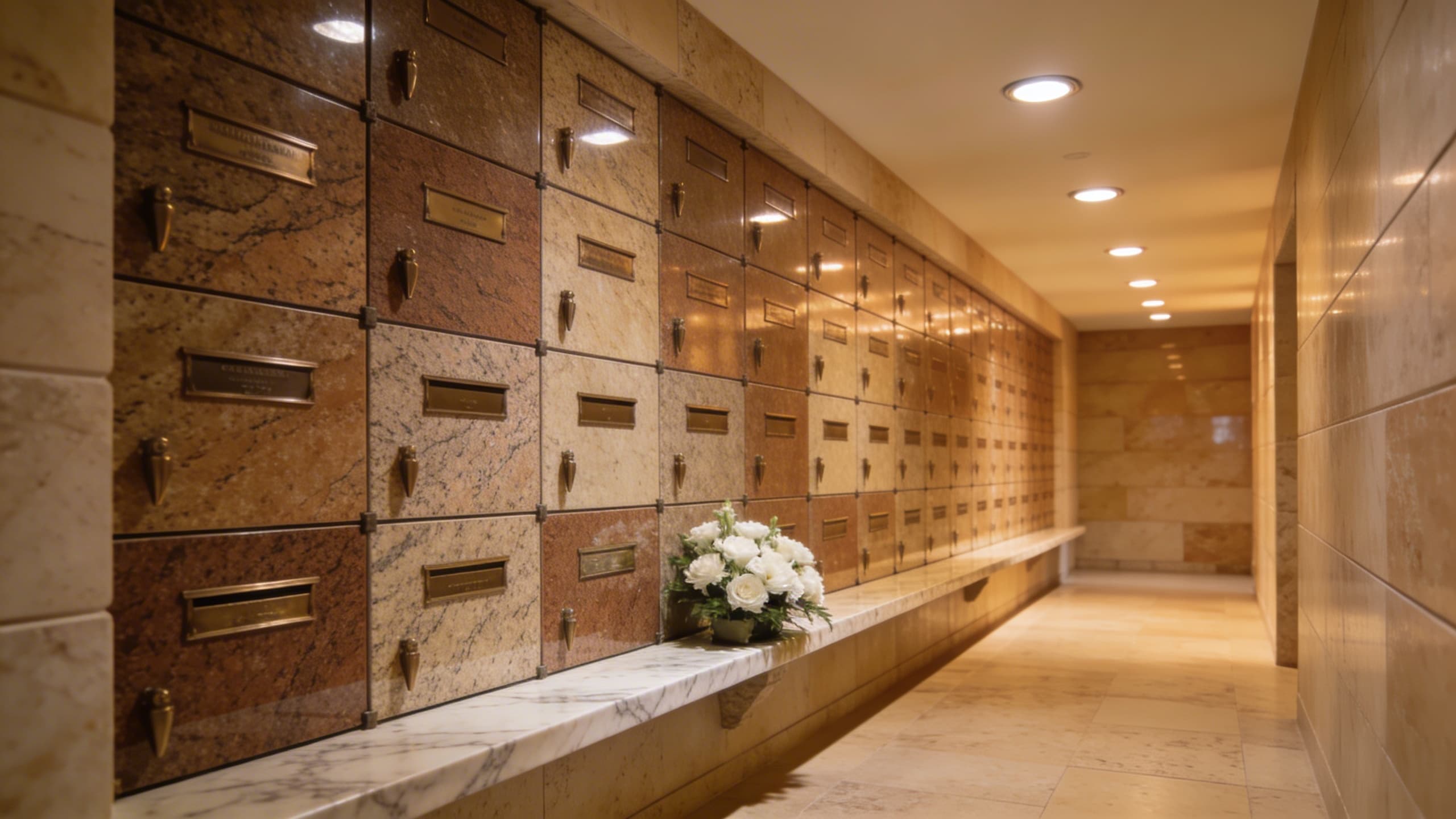
A cremation niche is a recessed compartment designed to hold a cremation urn as a permanent memorial. Niches are built into structures called columbariums — walls, towers, or buildings that house many individual compartments in a cemetery, church, funeral home, or memorial park.
With cremation now chosen by more than 60 percent of American families, columbariums and cremation niches have become an increasingly common way to memorialize loved ones. A niche offers a dedicated, visitable location for cremated remains — a meaningful alternative to keeping an urn at home or scattering ashes.
This guide covers what a columbarium niche is, the types available, typical costs, standard dimensions, how to select an urn that fits, and what to ask a cemetery before purchasing. A columbarium niche is just one of several paths families consider — our walks through every option, from traditional plots to cremation gardens. If you're still exploring urn options specifically, our covers every factor to consider.
A columbarium (plural: columbaria) is a structure built specifically to house cremation urns in individual compartments. The word comes from the Latin columba, meaning "dove" — a reference to the dovecote-like rows of small compartments.
Columbaria can take many forms. Some are freestanding outdoor walls built from granite in a cemetery garden. Others are indoor rooms within a mausoleum or chapel, with climate-controlled environments and seating areas for quiet reflection. Churches, universities, memorial parks, and even private estates sometimes include columbarium spaces.
Each individual compartment within a columbarium is called a niche. A single columbarium may contain dozens or hundreds of niches, arranged in rows and columns.
Types of Cremation Niches
Not all niches look the same. The type you choose affects both the visual presentation and the cost.
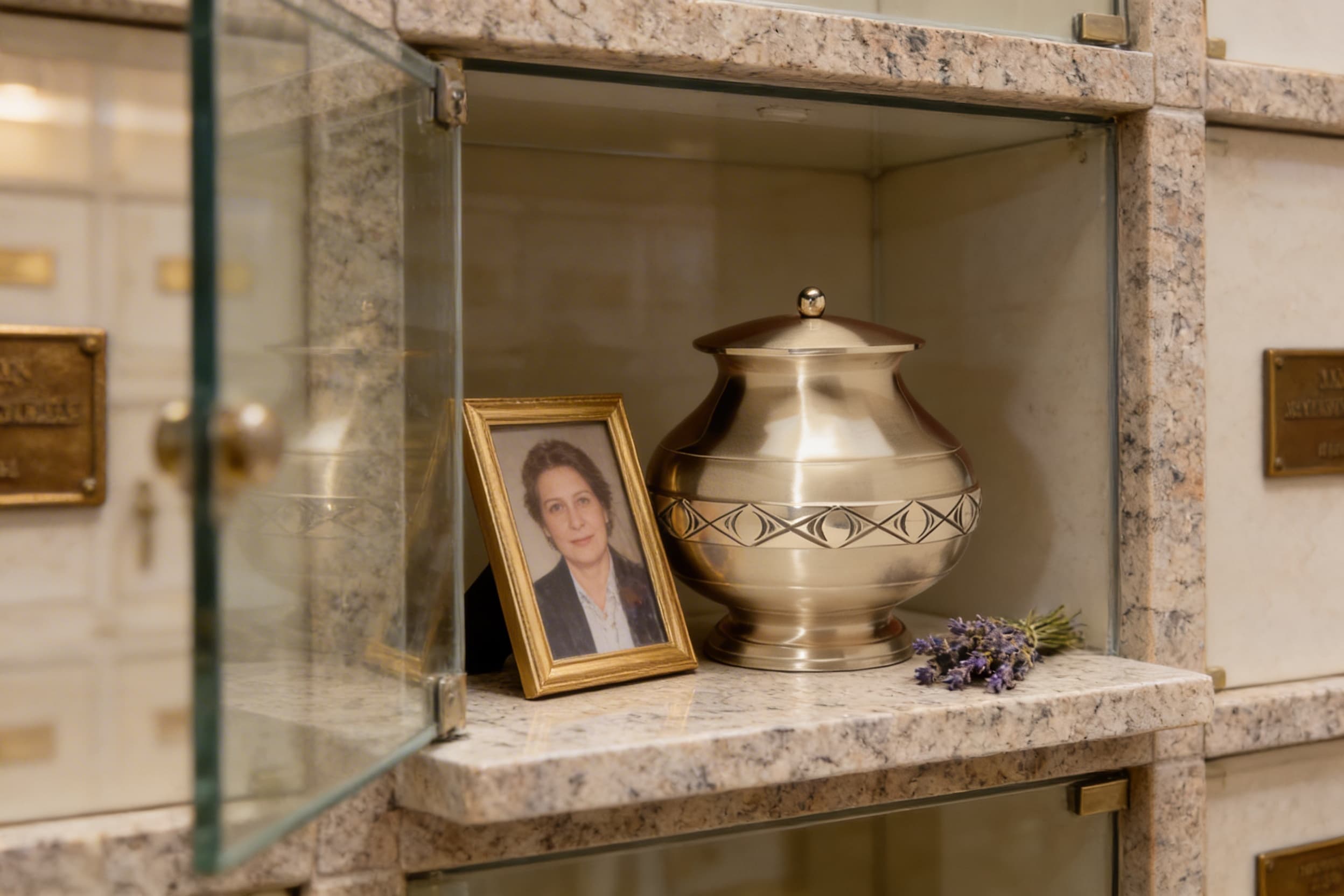
Glass-Front Niches
Glass-front niches allow visitors to see the urn and any keepsakes placed inside. Families often display photographs, religious symbols, small mementos, or seasonal decorations behind the glass. These niches are typically available only in indoor columbaria, since weather exposure would damage displayed items.
Glass-front niches tend to cost more than sealed options, but they create a personal, visible memorial that families can update over time.
Granite, Marble, or Bronze-Front Niches
Sealed niches have a solid front panel — usually granite, marble, or bronze — engraved with the person's name, birth and death dates, and sometimes a short epitaph or symbol. These are the most common type in both indoor and outdoor columbaria.
Sealed niches offer a clean, uniform appearance and require less maintenance than glass-front options. Niche plaques can be customized with engraved text, ceramic photographs, and decorative borders. For help with materials, lettering styles, and design options, our guide to choosing a niche plaque covers the full selection process.
Indoor vs. Outdoor Niches
Indoor niches sit within enclosed buildings — mausoleums, chapels, or dedicated columbarium rooms. They offer protection from weather, a comfortable visiting environment year-round, and often a more formal aesthetic.
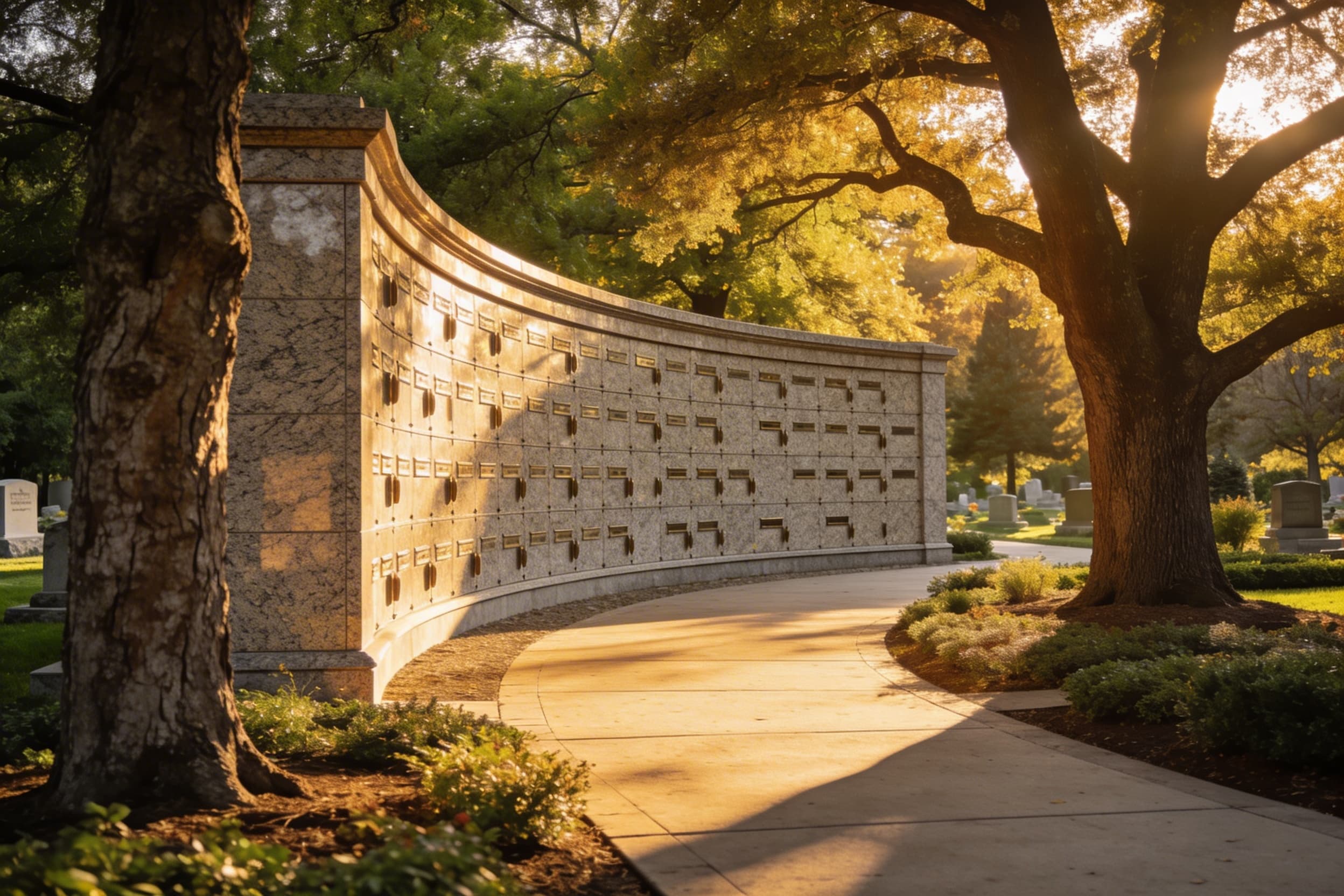
Outdoor niches are set into freestanding walls, towers, or garden structures within a cemetery. They provide a natural setting surrounded by landscaping, and they typically cost less than indoor options.
Single, Companion, and Family Niches
Niches come in several capacity options:
Single niches hold one urn and are the most common and affordable option
Companion niches (also called double niches) hold two urns, designed for couples or family members who wish to rest together — similar in concept to companion urns
Family niches hold four or more urns, allowing multiple family members to share one larger compartment
Standard Cremation Niche Dimensions
Knowing the dimensions of a niche is essential before purchasing an urn. Standard niche sizes vary by facility, but most fall within a predictable range.
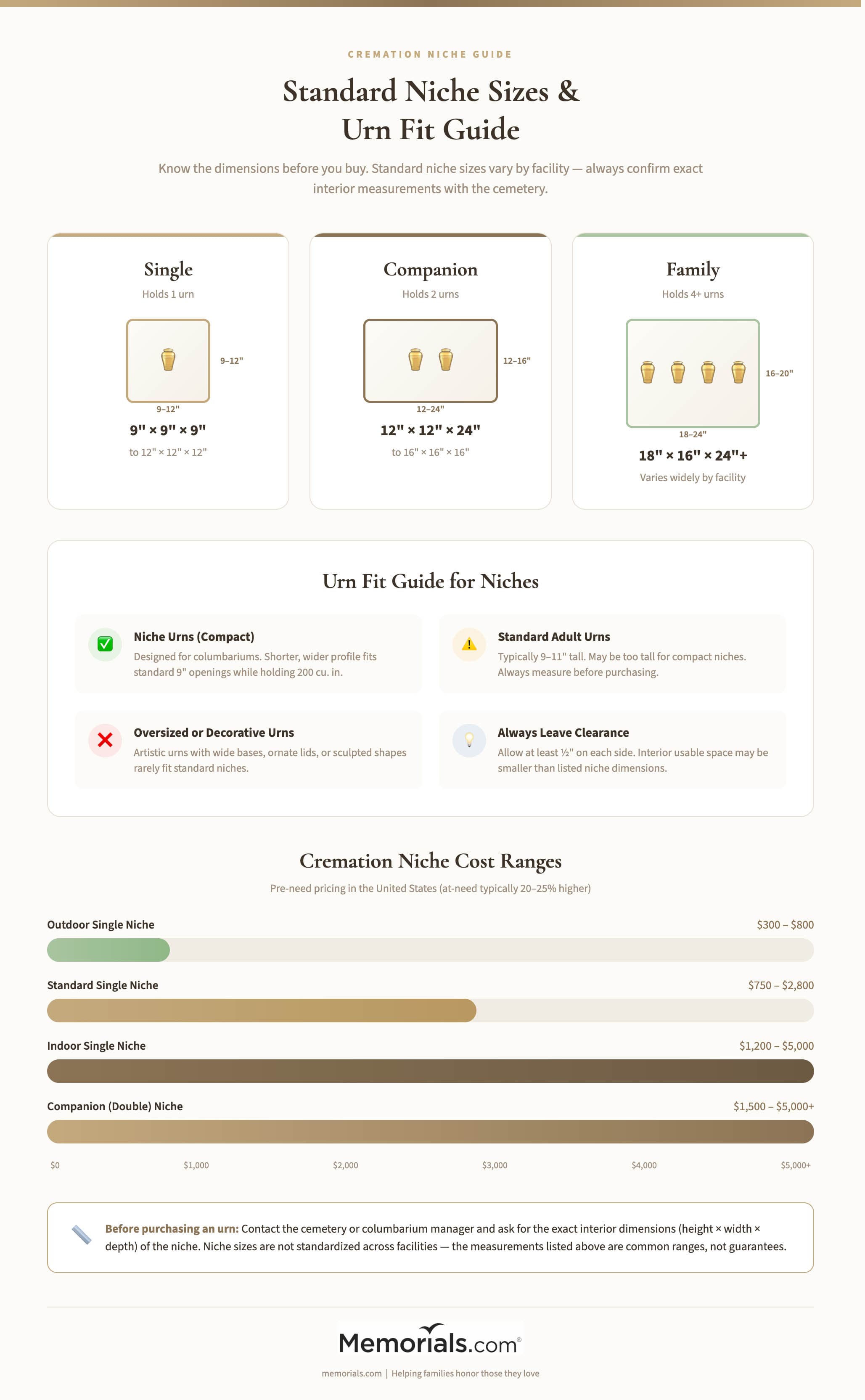
Single niches typically measure between 9" × 9" × 9" and 12" × 12" × 12" on the interior. A 9-inch cube is the most common standard size.
Companion niches are wider or deeper to accommodate two urns. Common dimensions range from 12" × 12" × 24" to 16" × 16" × 16", though sizes vary.
Family niches are larger still, with interior space for four or more standard urns.
The critical step before buying any urn is measuring the niche or confirming its exact interior dimensions with the cemetery or columbarium manager. If you're unsure where to start, our guide on what size urn do I need covers general sizing for every situation. An urn that is even half an inch too tall or too wide will not fit. Always measure height, width, and depth — and remember that the interior usable space may be slightly smaller than the niche's listed dimensions due to the front panel and any interior shelf hardware.
How Much Does a Cremation Niche Cost?
Cremation niche pricing depends on several factors: location, indoor vs. outdoor placement, niche size, front material, and whether you purchase pre-need (before death) or at-need (at the time of death).
Typical cost ranges in the United States:
Niche Type
Pre-Need Cost Range
Notes
Outdoor single niche
$300 – $800
Freestanding granite columbaria
Standard single niche
$750 – $2,800
Most common range nationally
Indoor single niche
$1,200 – $5,000
Mausoleum or chapel settings
Companion (double) niche
$1,500 – $5,000+
Varies widely by location
Glass-front niche
Premium over sealed
Typically 20–40% more than granite-front
Purchasing at-need (at the time of death) typically costs 20 to 25 percent more than pre-need pricing.
What's Included in the Cost
Niche fees generally cover the right to use the space, endowment or perpetual care, the initial inurnment (placing the urn), and a basic inscription or plaque. However, the specific inclusions vary by cemetery.
Additional Fees to Ask About
Beyond the niche purchase price, cemeteries may charge separately for:
Inurnment fee — the labor cost for opening the niche, placing the urn, and resealing it
Inscription or plaque engraving — adding names, dates, or custom text to the niche front
Niche opening for visitation — some facilities charge each time a glass-front niche is opened to update keepsakes
Second inurnment — placing an additional urn in a companion niche at a later date
Perpetual care or maintenance fee — ongoing grounds and building upkeep (sometimes included, sometimes annual)
Transfer or disinterment fee — if remains need to be relocated in the future
Ask the cemetery for a complete itemized price list before committing. Some facilities bundle everything into one price, while others charge à la carte.
Choosing an Urn That Fits a Columbarium Niche
Selecting the right urn for a niche requires attention to both dimensions and material.
Size Matters Most
Standard adult cremation urns hold approximately 200 cubic inches of cremated remains, which accommodates most adults. However, the external dimensions of the urn are what determine whether it fits in a niche.
A typical adult urn stands 9 to 11 inches tall — which may be too large for a compact 9" × 9" × 9" niche. Many urn retailers and manufacturers produce "niche urns" or "columbarium urns" specifically designed with compact proportions to fit standard niche openings. These urns hold the same 200 cubic inches of volume but have a shorter, wider profile.
Before purchasing, confirm these measurements:
Interior niche dimensions — get exact height, width, and depth from the cemetery
Urn exterior dimensions — check the product listing for height, width, and depth (not just cubic inch capacity)
Leave clearance — allow at least half an inch of clearance on each side for easy placement and removal
Material Considerations
Cemetery products intended for columbarium use should be durable and stable. Metal urns (brass, bronze, stainless steel) and stone urns (marble, granite) are the most popular choices for niches because they resist moisture, temperature changes, and the test of time.
Some columbaria restrict certain materials. Biodegradable urns and some wooden urns may not be accepted because they can deteriorate in enclosed, humid environments. Always confirm material restrictions with the facility.
Keepsake Urns for Shared Memorials
Some families choose to divide cremated remains among multiple memorials — a portion placed in a niche urn and smaller portions kept in keepsake urns or cremation jewelry for individual family members. Our comparison of keepsake urns vs. full-size urns can help you decide how to divide remains. This approach allows a permanent columbarium memorial while giving each family member a personal keepsake.
Cremation Niche vs. Other Memorial Options
Families choosing cremation have several options for their loved one's final resting place. Understanding how a niche compares can help clarify the decision. For a broader look at every placement option — from columbariums and garden plots to scattering areas — see our guide on where urns go in a cemetery.
Ground burial of cremated remains places the urn in a traditional cemetery plot, either in its own small plot or alongside a previously buried family member. Costs for cremation ground burial typically run $1,000 to $2,000 for the plot plus opening and closing fees — our cemetery plot pricing breakdown covers the full range. Most cemeteries also require an outer container — our guide to urn vault requirements explains what to expect. For more on selecting the right container, see our article on cremation urns for burial, and for a full expense breakdown, our guide to the cost to bury cremated ashes. Families weighing the trade-offs between a niche and a traditional plot will find a detailed side-by-side in our article comparing a columbarium to a burial plot.
Scattering remains at sea, in a scattering garden, or at a meaningful location costs little beyond the cremation itself — typically $200 to $800 for a facilitated scattering service. Scattering provides no permanent marker or location to visit.
Keeping an urn at home has no additional cost but does not create a public memorial. Some families find comfort in having the urn nearby; others prefer a dedicated space separate from the home.
A columbarium niche falls in the middle range — more affordable than a full burial plot and headstone, while still offering a permanent, dedicated, visitable location with the person's name and dates displayed.
Columbarium vs. Mausoleum: They Are Not the Same Building
The two words get used interchangeably and they describe different things, which matters because the costs are an order of magnitude apart.
A columbarium holds cremated remains. Its compartments are niches — typically around a foot square, sized for one or two urns — and a wall may hold several hundred of them. A mausoleum holds caskets. Its compartments are crypts, each sized for a full-size casket, and a building holds a fraction as many.
That single difference drives everything else:
Columbarium
Mausoleum
Holds
Cremated remains in urns
Caskets
Compartment
Niche, about a foot square
Crypt, casket-sized
Space per person
A fraction of a crypt
Many times a niche
Relative cost
The lower of the two by a wide margin
Among the most expensive options there is
Front
Granite, bronze or glass
Usually a granite or marble crypt front
Where the confusion comes from. Many cemeteries build both into one structure — a mausoleum building with a columbarium wall inside it, or a bank of niches set into a mausoleum’s exterior. So a family can be standing in a mausoleum looking at a columbarium, and both words are correct for what they are looking at. If you are quoted a price, the question that settles it is simply whether the space holds an urn or a casket.
There is a third term in the same family worth knowing: a cremation niche inside a mausoleum is sometimes sold as an “inurnment space” or a “cremation crypt,” which are the same thing described in the cemetery’s own vocabulary rather than a different product. Ask what the dimensions are and you will know which you are buying.
What to Ask Before Purchasing a Niche
Visiting a columbarium in person is the best way to evaluate the space. Bring these questions:
About the niche itself: What are the exact interior dimensions? What front material options are available? Is a glass-front option offered? Can the niche hold more than one urn?
About costs: What is included in the purchase price? Are there separate fees for inurnment, inscription, or future niche openings? Is perpetual care included or billed separately? What is the price difference between pre-need and at-need purchasing?
About policies: Are there restrictions on urn materials or sizes? Can keepsakes or photographs be displayed? How often can a glass-front niche be opened? What happens if the columbarium reaches capacity — are there plans for expansion? Can remains be relocated if the family moves?
About the setting: Is the columbarium indoor or outdoor? Are visiting hours restricted? Is seating available nearby for quiet reflection?
Frequently Asked Questions
What is the difference between a cremation niche and a columbarium?
A cremation niche is a single compartment — the individual space where one or two urns are placed. A columbarium is the larger structure that contains many niches. Think of a niche as an apartment unit and the columbarium as the building.
How much does a cremation niche cost on average?
Most single niches in the United States cost between $750 and $2,800 when purchased pre-need. Outdoor niches at the lower end of that range may start around $300, while premium indoor glass-front niches can exceed $5,000. Location and cemetery prestige are the biggest cost drivers.
What size urn fits in a standard columbarium niche?
Standard niches measure approximately 9" × 9" × 9" to 12" × 12" × 12" inside. A compact "niche urn" designed for columbarium placement will fit most standard openings, but you should always confirm the exact interior measurements with the cemetery before purchasing an urn.
Can you put two urns in one cremation niche?
Yes, if the niche is large enough. Companion niches are specifically designed to hold two urns, either side by side or stacked. Some standard-size niches can also fit two smaller or keepsake-size urns. Confirm the arrangement with the cemetery staff before purchasing.
Do cremation niches require ongoing maintenance fees?
It depends on the facility. Some cemeteries include perpetual care in the purchase price. Others charge annual or periodic maintenance fees for grounds upkeep, building maintenance, or niche access. Ask for a full fee schedule before purchasing.
A cremation niche offers families a permanent, dignified space to honor a loved one's memory — a place to visit, reflect, and remember. Whether you choose an indoor glass-front niche in a chapel or an outdoor granite niche in a garden setting, the right urn and the right space create a lasting tribute.
Browse Memorials.com's selection of cremation urns sized for columbarium niches, or explore cemetery products including niche plaques and memorial accessories to complete the memorial.