🏬Supersize Online Funeral Retailer🪦1000's of Headstones⚱️Over 10,000 Cremation Urns⚰️Caskets Overnight Delivery🛒Funeral & Memorial Superstore🚚FREE Shipping on ALL Orders👨👩👧👦Helping Families for over 20 Years💰Lowest Price Guarantee🏬Supersize Online Funeral Retailer🪦1000's of Headstones⚱️Over 10,000 Cremation Urns⚰️Caskets Overnight Delivery🛒Funeral & Memorial Superstore🚚FREE Shipping on ALL Orders👨👩👧👦Helping Families for over 20 Years💰Lowest Price Guarantee
🏬Supersize Online Funeral Retailer🪦1000's of Headstones⚱️Over 10,000 Cremation Urns⚰️Caskets Overnight Delivery🛒Funeral & Memorial Superstore🚚FREE Shipping on ALL Orders👨👩👧👦Helping Families for over 20 Years💰Lowest Price Guarantee🏬Supersize Online Funeral Retailer🪦1000's of Headstones⚱️Over 10,000 Cremation Urns⚰️Caskets Overnight Delivery🛒Funeral & Memorial Superstore🚚FREE Shipping on ALL Orders👨👩👧👦Helping Families for over 20 Years💰Lowest Price Guarantee
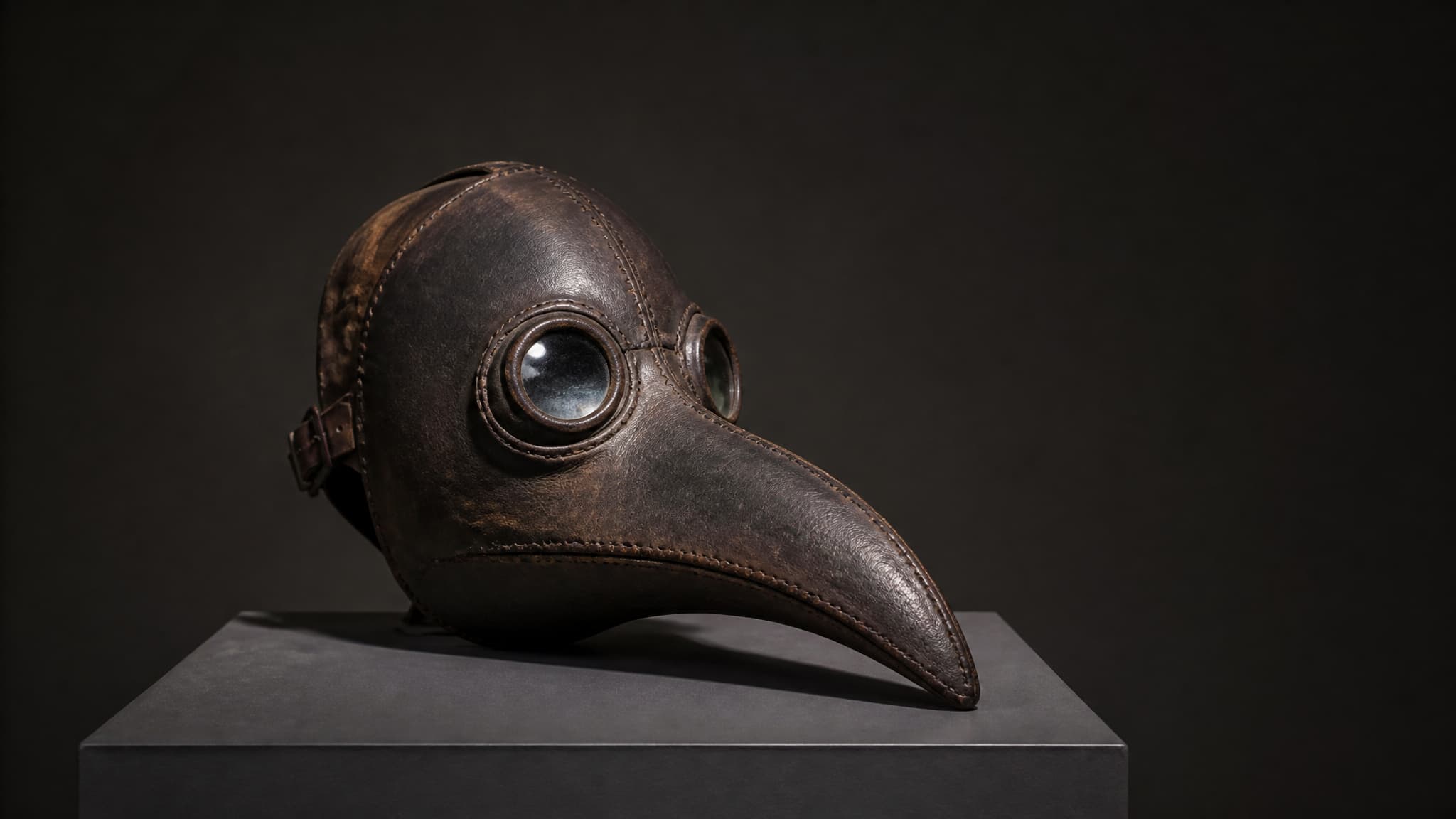
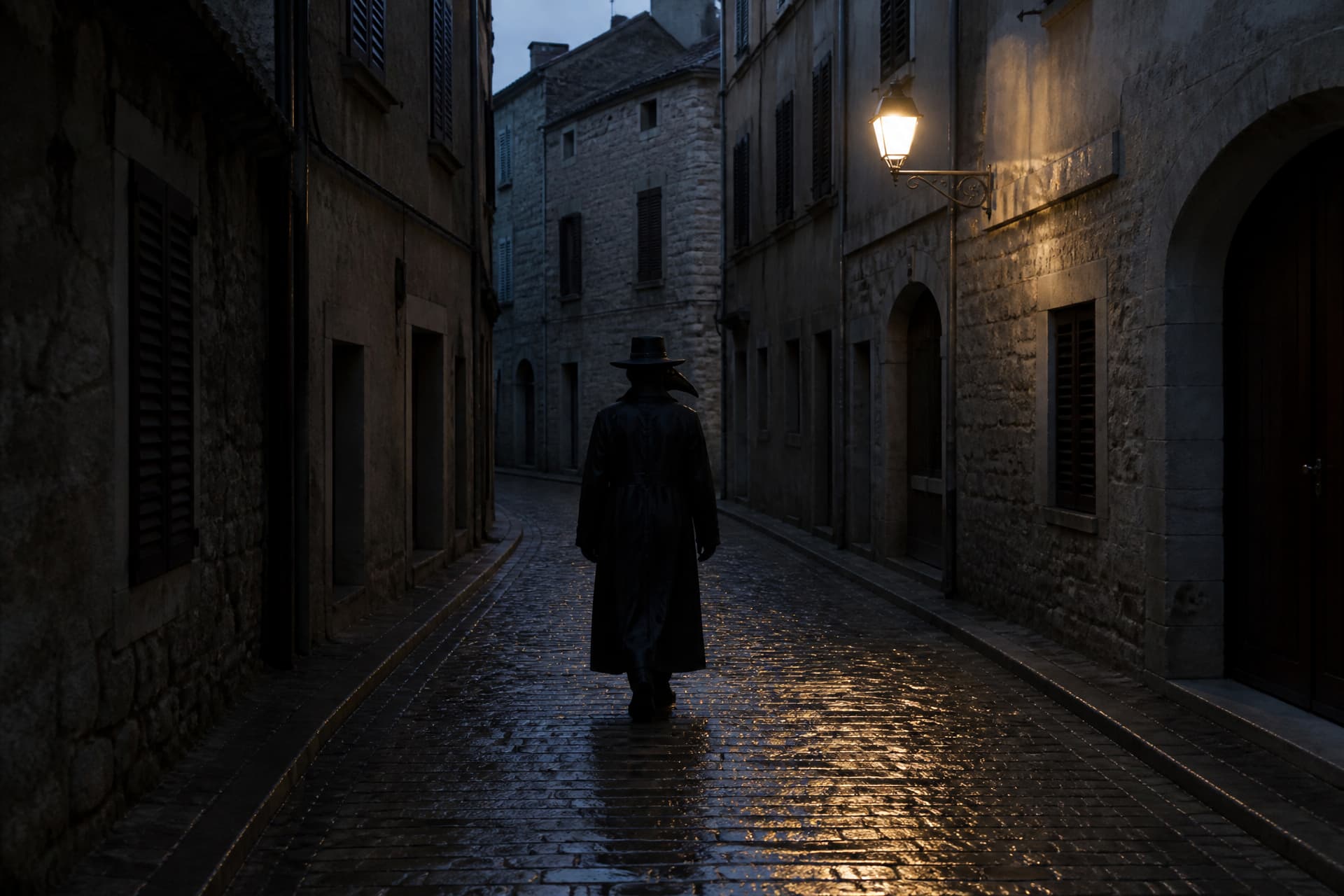
A bubonic plague mask is a real object, and it looks almost exactly the way you are picturing it: a long curved beak, two round glass eyepieces, and a hood of dark waxed leather covering the head to the shoulders. Real people wore one, for pay, into the houses of the dying. The part that is wrong is when. The beaked costume belongs to the seventeenth century, and the pandemic almost everyone associates it with — the Black Death, which tore through Europe in the fourteenth — was roughly three centuries gone before anyone stitched the first beak.
That gap is why the object confuses people, and it is also, in a strange way, why it survived. It was designed late enough to be written down, drawn, printed and copied, and it was odd enough that the drawings kept circulating long after the last physician took one off. The mask has outlived its job by so far that it now sits with the we still recognize without being able to explain — the same company as the medieval dance of death, which our guide to this hub covers alongside it.
This article is about the object rather than the legend: what it was made of, what was inside the beak, what the rest of the costume did, whether any of it worked, and whether the ones for sale today have anything to do with it.
What a Bubonic Plague Mask Actually Was
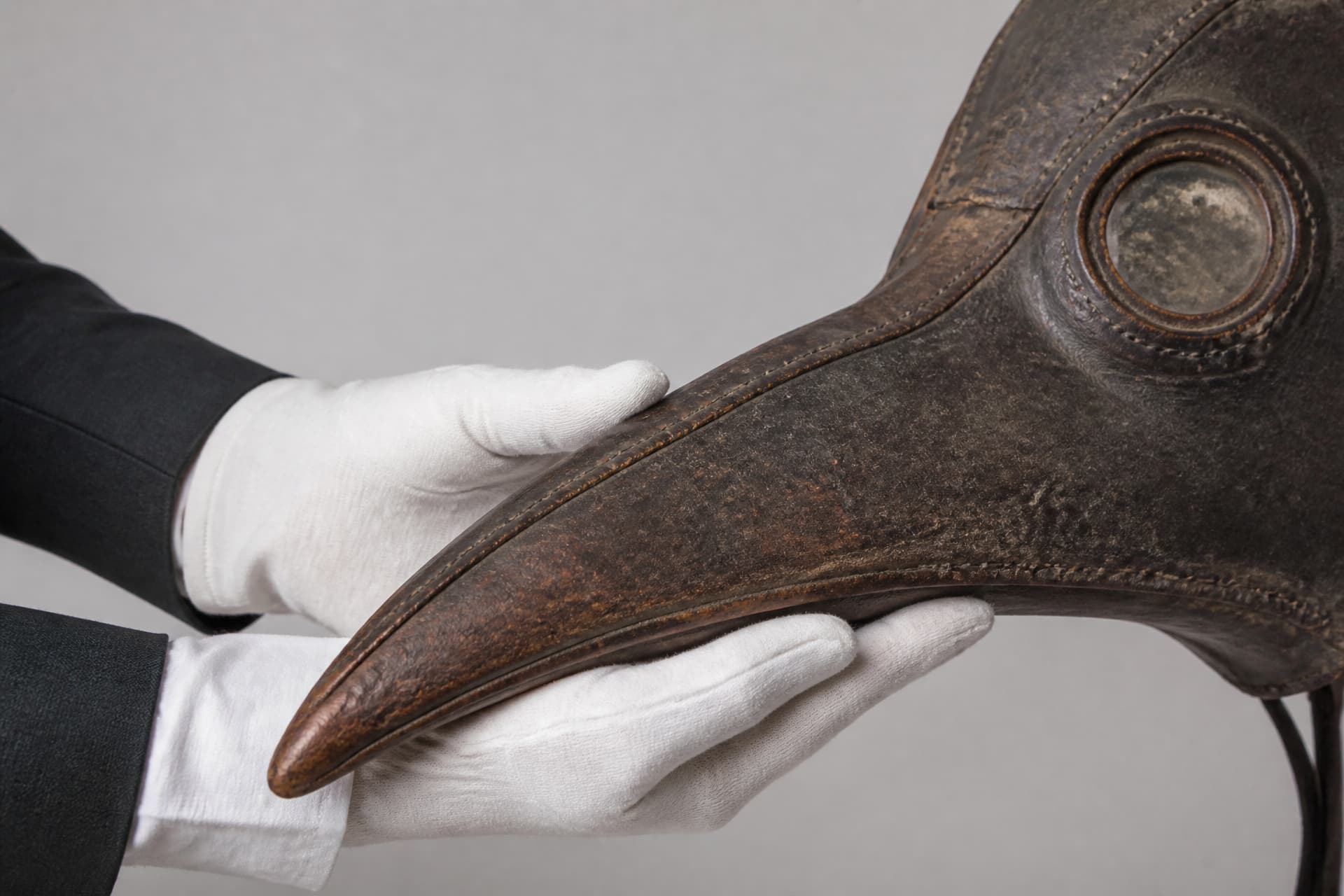
Strip away four hundred years of illustration and the thing itself is fairly plain. It was a hood and a face covering worked from leather, treated with wax or oil so that it shed liquid rather than soaking it up. Two glass discs sat over the eyes and were held in place by the leather around them. The beak projected forward from the nose and mouth — hollow, roughly the length of a hand or longer, and closed at the tip except for small openings that let the wearer breathe.
The beak is the part that makes the object famous and the part that makes it least intuitive. It was not decorative and it was not a costume flourish. It was a container. The physician packed it with dried and aromatic material and then breathed through that packing all day, which is a strange thing to do unless you believe something very specific about how disease travels.
The hood covered the hair and the neck, which mattered more than it sounds. There was no gap at the collar for anything to reach the skin, and the mask was strapped rather than simply set over the face, so a doctor bending over a bed did not have to hold it on.
The seams are the tell. A mask made to be worn is stitched to hold a shape under weight and to seal at the edges; a mask made to be looked at is not, and the difference is usually visible before any test is run on the leather.
The Mask Is Centuries Younger Than the Black Death
Almost every popular image of the Black Death includes a beaked figure, and almost every one of them is an anachronism. The medieval pandemic and the beaked costume are separated by about three hundred years. Nobody in the fourteenth century saw one.
What the fourteenth century did produce was a body of imagery about death itself — skeletons leading the living away by the hand, the dance of death, the reminder that rank buys nothing. That material is medieval. The beaked mask is early modern, and it arrived during the later waves of plague that kept returning to European cities for centuries after the first one.
The confusion is easy to explain and hard to dislodge. Both belong to "the plague" in ordinary speech, both are visually memorable, and the mask is by far the more photographable of the two, so it gets attached to whichever plague a picture editor needs. The result is that the single most recognizable image of a fourteenth-century catastrophe is a seventeenth-century piece of workwear.
Getting the chronology right is not pedantry. It changes what the object means. A mask invented during the Black Death would be a symbol of panic. A mask invented three hundred years later is something else — evidence that European cities had by then been living with recurring epidemics long enough to have professionalized the response, hired staff for it, and issued them a uniform.
Why Did Plague Doctors Wear Bird Masks?
So why did plague doctors wear bird masks rather than something simpler? Because of a theory of disease that was wrong in its mechanism and not entirely unhelpful in its consequences.
The prevailing explanation for epidemics was miasma — the idea that illness traveled in corrupted air, and that the corruption could be smelled. Foul air made you sick. It followed, with a certain internal logic, that air which had been cleaned and sweetened on its way to your lungs would not. The beak was the apparatus for doing that.
Accounts of what went inside it are consistent about the general category and vary about the specifics: dried flowers, herbs such as rosemary and mint, spices, cloves, camphor, sometimes a sponge soaked in vinegar. The physician breathed through the packing, the packing perfumed the air, and under miasma theory the air arrived safe.
Two details follow from that and are worth noticing, because they explain the shape rather than just the purpose. The beak had to be long, because the packing needed volume and the air needed a path through it. And it had to be rigid, because a soft covering pressed against the face would collapse the airway the packing was supposed to fill. A long, hard, hollow projection is what you get when you solve those two constraints at once. The bird resemblance is a consequence of the engineering, not the goal of it.
This was the filter. Nothing in the beak could stop a bacterium, but a mask packed with dried herbs and vinegar did make an unbearable room bearable enough to work in — which is a real benefit, just not the one anybody was claiming.
What Did Plague Doctors Wear Besides the Mask?
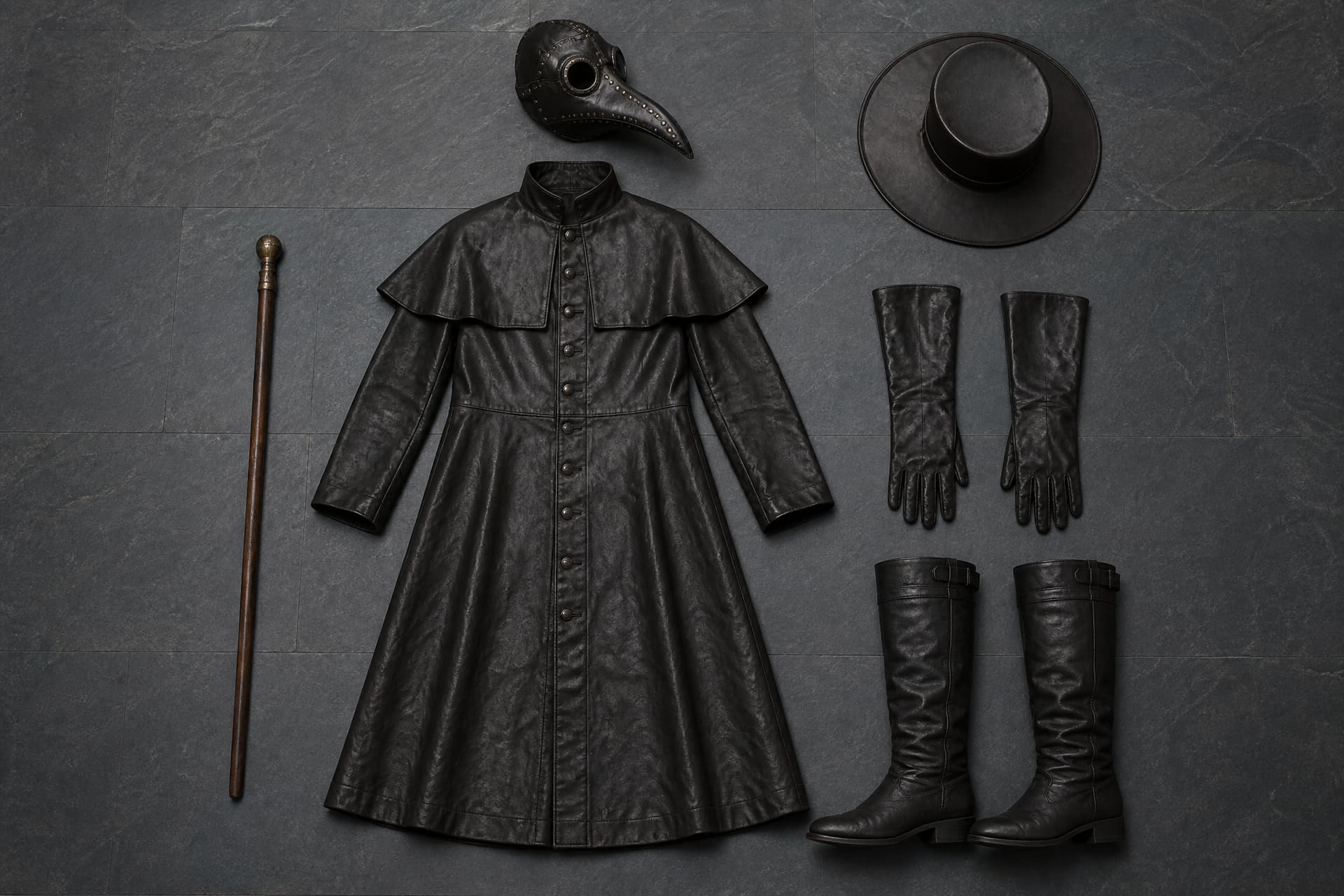
The mask gets the attention, but it was one piece of a full outfit. Asking what did plague doctors wear below the neck turns up a more interesting list than the beak does, once you know what each part was for.
A long overcoat, ankle length, in waxed or oiled leather or heavy canvas. The treatment mattered: a waxed surface sheds fluid instead of absorbing it, and it can be wiped.
Gloves, often gauntleted, so that no wrist showed between sleeve and hand.
Boots, tall, worn under or over the coat so the leg was covered end to end.
A wide-brimmed hat. Partly weather, partly identification — the hat marked the wearer as a physician at a distance, which is useful when nobody wants to meet you and everybody needs to know who you are.
A cane or rod. The most quietly revealing item on the list. It was used to move bedding, to indicate where a patient should go, and to examine without touching. It was also a way of holding people at arm's length, and contemporary descriptions are frank that this was part of the point.
Put together, the outfit covered every square inch of skin in a wipeable material and gave the wearer a tool for keeping a body's length between himself and everyone else. That is a plausible description of protective equipment. It is also, as the next section explains, almost entirely an accident.
Laid out, the costume reads as workwear rather than as theater. Every element is either sealed, wipeable, or designed to put distance between two people, and the cane is doing as much work as the mask.
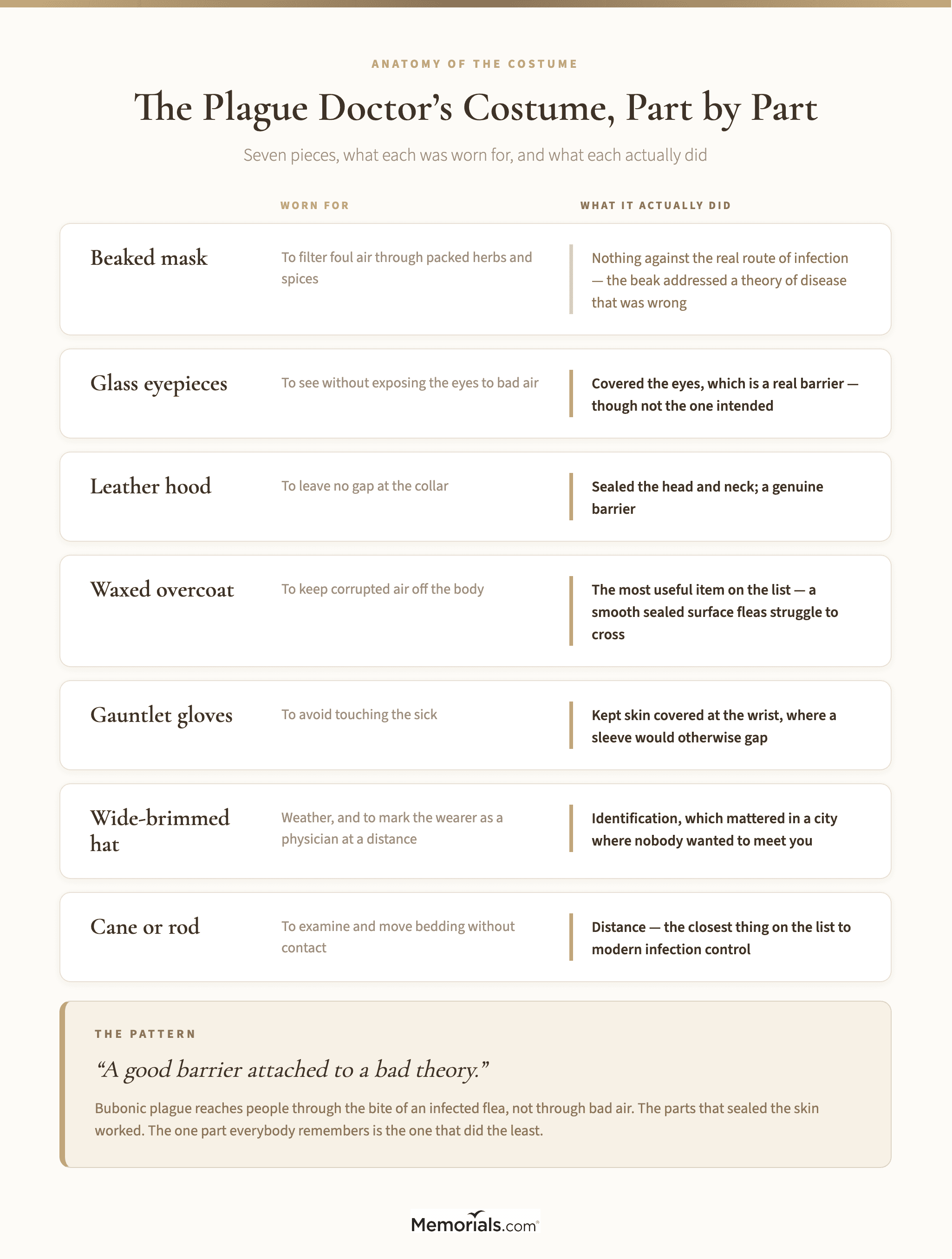
Seven parts, each with a stated purpose and an actual one — and they rarely match. The mask was worn to filter bad air and did nothing of the kind; the coat and gloves were worn as a barrier against smell and were the only parts that offered real protection, because they kept fleas off the skin.
Did Any of It Work?
Partly, and for none of the reasons its wearers gave.
Bubonic plague is caused by the bacterium Yersinia pestis, and in its bubonic form it reaches people through the bite of an infected flea, with rats and other rodents carrying the fleas. Bad air has nothing to do with it. The beak, its packing, and the whole theory behind them addressed a route of transmission that does not exist.
The coat, gloves, boots and hood are a different story. A sealed, smooth, waxed garment covering every inch of skin is a poor surface for a flea to reach, and a physician who came home and took the whole thing off outside had done something genuinely useful without knowing it. The cane, used to avoid touching patients and bedding, has the same accidental logic behind it.
One important exception cuts against the costume. Plague also occurs in a pneumonic form that settles in the lungs and can pass from person to person through the air, in droplets, without any flea involved. Against that route a mask stuffed with dried lavender is close to useless, and the doctor breathing through it was as exposed as anyone else in the room.
So the honest verdict is mixed and worth stating plainly rather than tidying up: the outfit was a good barrier attached to a bad theory, and the single component everybody remembers is the one that did the least.
Plague doctors were usually municipal hires rather than private physicians, contracted by a city for a term and often required to quarantine themselves. Several surviving contracts describe a job closer to a public official's than a healer's.
What the Epidemic Did to Burial
It is worth stepping out of the museum voice for a paragraph, because the costume exists as a response to something appalling.
An epidemic does not only kill people. It dismantles the arrangements the living had made for burying them. Where a town's ordinary practice was a coffin, a service, a churchyard plot and a named marker, sustained mortality collapses all four at once — into shared graves, hurried committal, and burials without the people who should have been standing there, because those people were sick or forbidden to gather. Families lost not only the person but the whole shape of the goodbye.
Some of that pressure left permanent marks on European burial custom. The history of coffins and caskets is in part a history of periods when there were not enough of them. The habit of keeping something of the dead close to the body — the tradition that eventually produced Victorian mourning jewelry — belongs to cultures that had learned how quickly a person could go and how little might be left to hold. Even the far older practice of placing a coin with the dead, the obol laid in the mouth for a journey, is an answer to the same anxiety in a different century: the fear of a death without its rites.
The plague doctor is easy to read as a grotesque. He is better read as evidence that people kept showing up.
Is There Such a Thing as a Real Plague Doctor Mask?
This is the question underneath most searches on the subject. Somebody typing "real plague doctor mask", or hammering out "real life real plague doctor mask" in one go, is asking a single thing: is the object in front of me the actual historical article, or is it a prop?
The answer has three parts.
The design is documented. The costume is described in period sources, and the specification is usually credited to Charles de Lorme, a seventeenth-century French court physician. Illustrated prints of beaked figures circulated widely — the best known shows a masked doctor above a caption naming him a beak-doctor of Rome — and they are the reason the image is familiar at all. So the garment is not folklore. Somebody specified it, and somebody drew it from life or close to it.
Surviving originals are another matter. Leather does not last well, plague clothing was not treasured, and an item worn into infected houses was not the sort of thing a family kept in a chest. Museums do display beaked masks, and their labels vary a great deal in how much they claim: some present an object as period, others describe it as of uncertain date, and others are explicit that the piece is a later reconstruction made to show visitors what the descriptions meant. When you meet one in a case, read the label rather than the beak.
Almost everything sold today is a replica, and that is not a criticism. Modern beaked masks are made for costume, theater, carnival and display, in leather, resin or molded plastic, and they are copied from prints rather than from surviving garments. A well-made leather one can be a faithful reconstruction of a documented design. It is still a reconstruction, and any listing that implies otherwise is selling you a story.
From Beak Mask to Carnival Mask to Costume Rack
The beak mask had a second life that has nothing to do with medicine, and it is the reason the shape never faded.
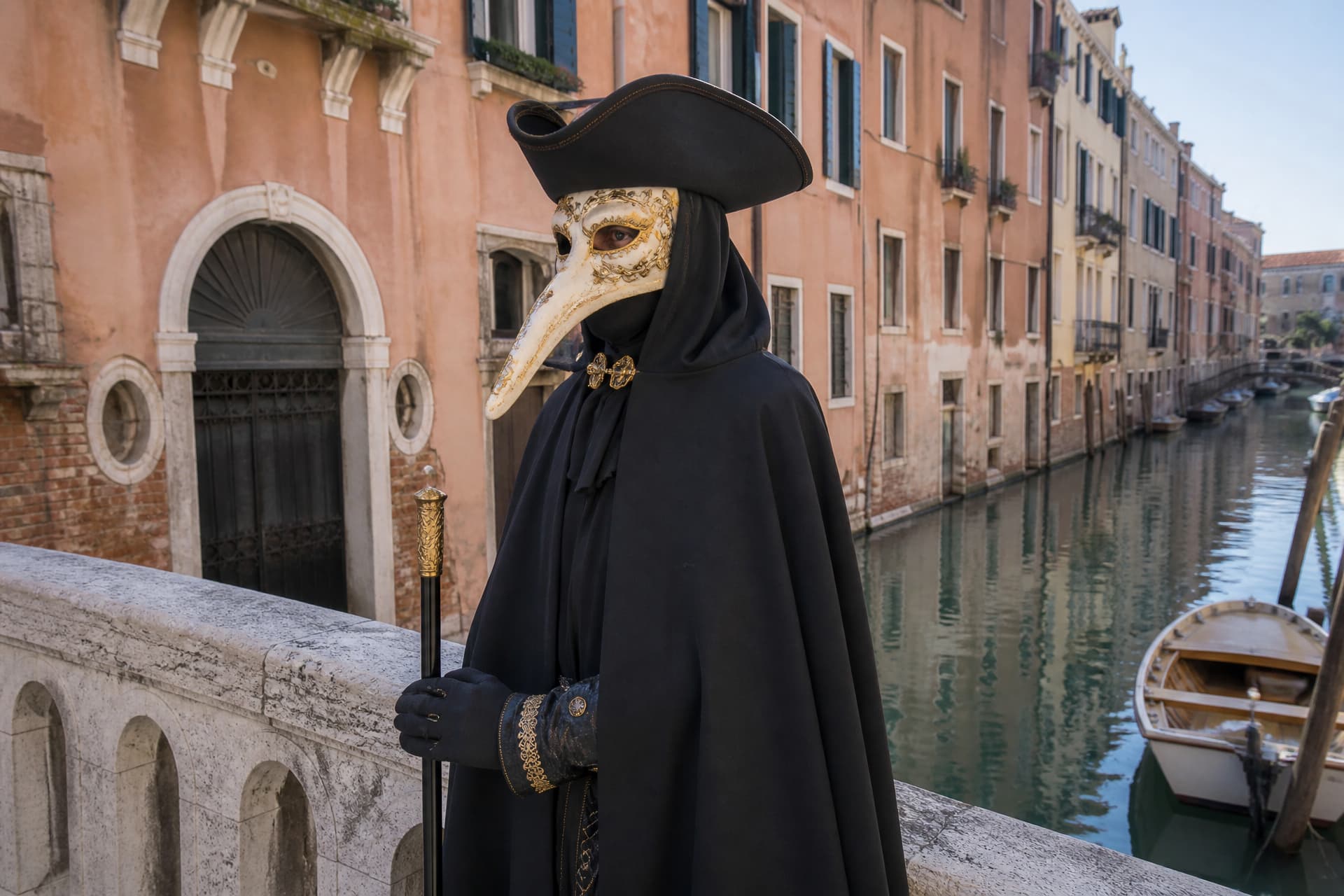
In Venice it became the medico della peste, one of the standard characters of the carnival — the same silhouette rendered in white, gold and paint, worn with a tricorn hat and a cloak. A mask with a beak had been an object of dread; on a bridge in February it became one of the most photographed costumes in Europe. That transformation is the ordinary fate of frightening imagery in a festival, where the point of putting on a terrible face is to be able to take it off again.
From carnival it moved outward into everything else: stage design, illustration, tattoo work, album covers, video games and, every fall, a costume rack. The version most people have actually met is a game character or a party mask rather than a museum object, which is exactly why so many searches begin by asking whether the real thing existed.
The Venetian medico della peste is the same silhouette with the fear taken out of it. It is also why the shape is still legible to people who have never read a word about the seventeenth century.
The Plague Doctor as a Symbol of Death
Ask what the bubonic plague symbol is and most people will describe the beak before they describe a skull, which is remarkable for an object that was in service for a comparatively short stretch of history. Three things gave it that staying power.
First, it has a silhouette. A symbol has to survive being reduced to a shape at small size, and the beak does that better than almost any other death image. Second, it is a person, not an emblem — a figure who walks, points and arrives, which is what makes personifications of death so durable across cultures. The Greek Thanatos works the same way, and so does the Japanese shinigami, a figure most Western readers met through fiction rather than folklore. Third, it is ambiguous: the plague doctor is neither the killer nor a rescuer, and an image you cannot settle stays interesting.
The pattern is a familiar one in this hub. A sugar skull began inside a specific religious observance and is now sold as decoration to people who could not name the feast. Carved headstone symbols and their meanings traveled the other way, from ordinary visual shorthand to something modern visitors read as mysterious. A death image that becomes decorative has not been trivialized so much as detached — it keeps its shape and loses its sentence.
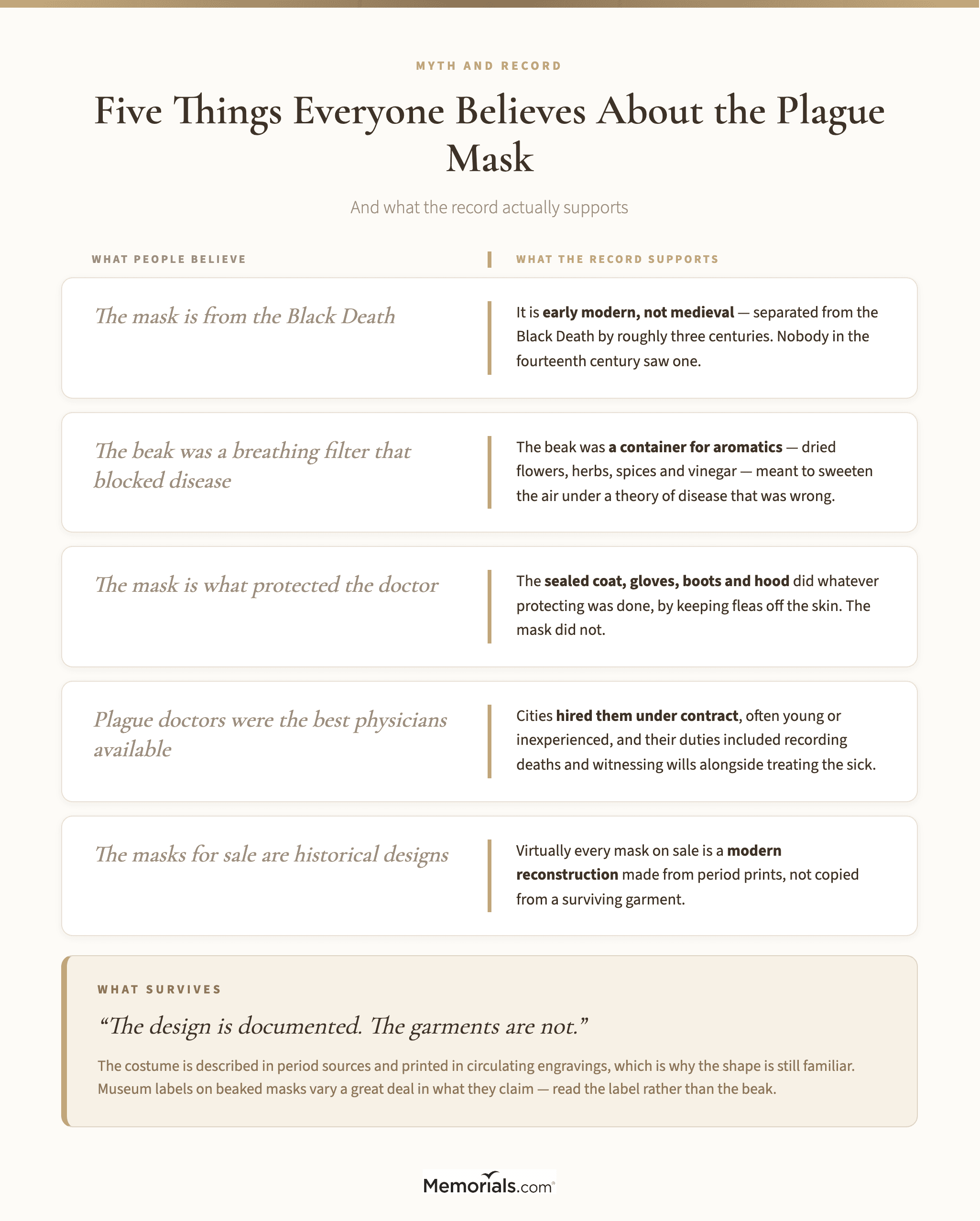
Five beliefs, and what the record supports instead. The mask is real but early modern rather than medieval; the beak was a perfume filter, not a barrier; the coat and gloves, not the mask, did whatever protecting was done; plague doctors were often municipal appointees of varying qualification; and virtually every mask on sale is a modern reconstruction from period prints.
Frequently Asked Questions
What are plague doctor masks called? There is no single historical name in English. They are usually described by what they are — a beaked mask, or the mask of a plague doctor. In Italian carnival tradition the character and the mask are both called the medico della peste, the plague physician, and that name is still used for the Venetian version today.
Why did doctors wear bird masks? Because the beak was a container for aromatic material. Under miasma theory, disease traveled in foul air, so air filtered through dried herbs, flowers, spices and vinegar was believed to be safe to breathe. The bird appearance was a by-product of needing a long, rigid, hollow chamber in front of the face.
What was inside the beak? Dried flowers and herbs, spices such as cloves, camphor, and sometimes a vinegar-soaked sponge. Period accounts agree on the sort of thing and differ on the exact recipe, which is roughly what you would expect from something each physician packed himself.
Did the plague doctor costume actually protect anyone? Partly, and by accident. The sealed leather coat, gloves, boots and hood made it hard for infected fleas to reach skin, which is a real defense against bubonic plague. The mask itself did nothing against the actual route of infection, and offered little against the pneumonic form that spreads between people through the air.
Were plague doctors real doctors? Some were and some were not. Cities hired them under contract during outbreaks, and the role often fell to physicians who were young, inexperienced or otherwise unable to build a private practice. Their duties frequently included recording deaths and witnessing wills alongside treating the sick.
Can you buy a real plague doctor mask? You can buy an excellent reconstruction. Genuine period examples are scarce and their provenance is often uncertain even in museum collections, so anything on general sale should be understood as a modern piece made from historical descriptions and prints, however well it is made.
Why the Beak Outlasted the Plague
The plague doctor is one of the few pieces of medical history most people can draw from memory, and the reason has almost nothing to do with medicine. It survived because it was written down and printed, because its shape reads at any size, and because Venice gave it somewhere to go once the epidemics that made it stopped.
What it says about the people who wore it is the part usually left out. Somebody in each city took the contract. Somebody put on a sealed coat in summer, packed a beak with lavender, picked up a cane and walked into the house. Their theory of the disease was wrong in almost every particular, and they went in anyway.
That is the register this hub tends to find at the end of things: the object turns out to be less about death than about what the living did in front of it. If you want the wider map — the birds, flowers, coins, colors and figures that people have used to say what they could not say plainly — the symbols of grief and mourning guide is the place to start.