🏬Supersize Online Funeral Retailer🪦1000's of Headstones⚱️Over 10,000 Cremation Urns⚰️Caskets Overnight Delivery🛒Funeral & Memorial Superstore🚚FREE Shipping on ALL Orders👨👩👧👦Helping Families for over 20 Years💰Lowest Price Guarantee🏬Supersize Online Funeral Retailer🪦1000's of Headstones⚱️Over 10,000 Cremation Urns⚰️Caskets Overnight Delivery🛒Funeral & Memorial Superstore🚚FREE Shipping on ALL Orders👨👩👧👦Helping Families for over 20 Years💰Lowest Price Guarantee
🏬Supersize Online Funeral Retailer🪦1000's of Headstones⚱️Over 10,000 Cremation Urns⚰️Caskets Overnight Delivery🛒Funeral & Memorial Superstore🚚FREE Shipping on ALL Orders👨👩👧👦Helping Families for over 20 Years💰Lowest Price Guarantee🏬Supersize Online Funeral Retailer🪦1000's of Headstones⚱️Over 10,000 Cremation Urns⚰️Caskets Overnight Delivery🛒Funeral & Memorial Superstore🚚FREE Shipping on ALL Orders👨👩👧👦Helping Families for over 20 Years💰Lowest Price Guarantee
Shinigami (死神) means death god. The first character is death, the second is the word Japanese uses for a god or a spirit, and that is the whole shinigami meaning in two characters. If you type grim reaper in Japanese into a translator, shinigami is what comes back, and that is the right answer as far as it goes.
It is the closest word. It is not the same figure, and the gap between the two is where almost every confusion about shinigami lives — including the one about shikigami, which is a different word for a completely unrelated thing.
Here is what the word says, where it came from, which figures Japanese tradition actually uses for death, and why none of them turn up at a Japanese funeral. It sits alongside the other personifications of death in our death symbolism guide.
死 — shi — death. The same character sits inside the ordinary Japanese words for dying, for a corpse, and for a death anniversary. It is a plain, unadorned word.
神 — kami — god, or spirit, or power. This is the half that gets mistranslated. Kami is not God in the sense an English reader brings to it. In Shinto usage it covers an enormous range: great deities, ancestors, and the presence in a waterfall, an old tree, a mountain or a storm. It is closer to a power worth respecting than to a deity who rules.
Joined together, shi + kami becomes shinigami, the second word softening from kami to gami the way Japanese compounds routinely do. So what does shinigami mean in Japanese has a literal answer and a truer one. Literally, death god. In practice, something more like a death spirit — a presence associated with dying rather than a ruler who governs it.
Two other details are worth having before anything else.
Shinigami is normally a class, not a name. Japanese does not mark plurals the way English does, so the same word covers one of them and any number of them. When people talk about shinigami they are usually talking about a kind of being, in the way English speakers talk about ghosts. The Western Death is a single character with a definite article in front of him. Shinigami usually are not.
There is no scythe. The reaper's hooded robe, the hourglass and the harvest blade are a specific European visual tradition, and none of it carries over. A shinigami has no fixed appearance at all — the look changes with whoever is telling the story, which is a real difference between the two and not a translation problem.
Is a Shinigami the Japanese Grim Reaper?
Close enough to translate, and different enough to be worth explaining.
What they share. Both are personifications: a way of turning the fact of death into somebody you can picture, argue with, run from or bargain with. Both belong to popular culture rather than to formal doctrine. And both do the same job for a storyteller, which is why translators reach for one when they meet the other. If someone asks you what the Japanese grim reaper is called, shinigami is not a wrong answer.
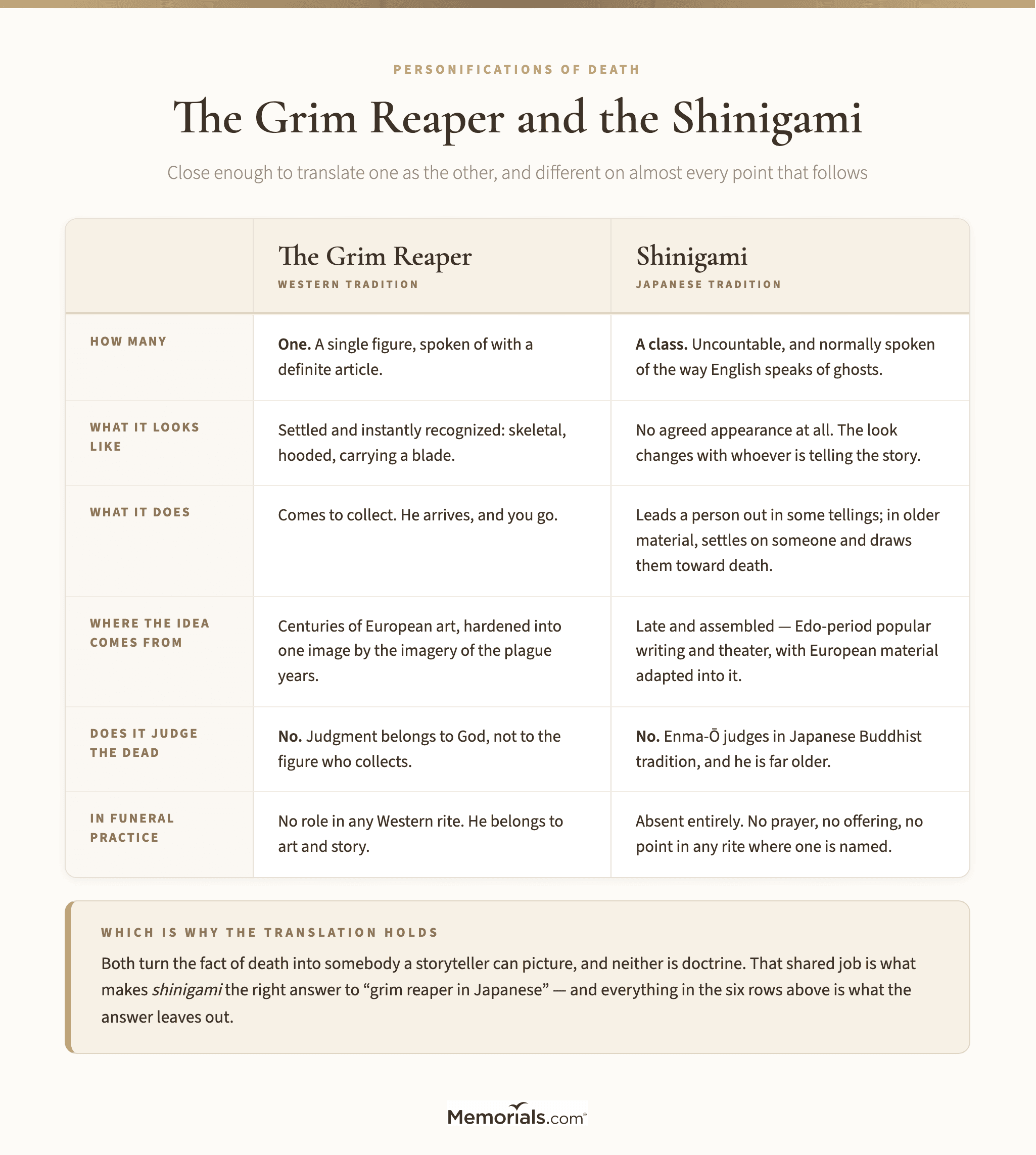
What they do not share. The Grim Reaper is one figure with a settled costume — skeletal, hooded, carrying a blade — built up over centuries in European art and hardened by the imagery of the plague years. He comes, and you go. Shinigami are a loose category with no agreed number, no agreed appearance and no single job description. In some tellings they lead a person out. In older material the shinigami is closer to an influence than an escort: a presence that settles on someone and pulls them toward death, which survives in the Japanese expression for being possessed by a shinigami — seized by a compulsion toward one's own end. That is a haunting, not a collection.
Other traditions split the work differently again, and the comparison is the fastest way to see the shape of it. Greek myth gives the escort and the ruler of the dead two separate names, which is the distinction behind Thanatos and Hades. Islamic tradition names a single specific agent with a defined role, which is what makes the angel of death in Islam so different from an uncountable class of spirits.
And neither figure judges you. That matters, because the being who does the judging in Japanese Buddhist tradition is somebody else entirely, and he is far older than shinigami. He comes up below.
The two figures line up on function and separate on almost everything else: the Grim Reaper is one being with a fixed costume who comes to collect, while shinigami are an uncountable class with no agreed appearance who influence a death as often as they attend one. Neither judges the dead, and neither has any role in an actual funeral.
Where Shinigami Came From
This is where honest sources start hedging, and this page will too.
Shinigami are not in the old mythology. Japan's oldest surviving chronicles, the Kojiki and the Nihon Shoki, are full of gods, and there is no shinigami among them. Neither is the word a fixture of classical Buddhist writing in Japan. Whatever shinigami are, they are a late addition to a very old religious landscape.
The word surfaces in the Edo period, in popular writing and in the theater, and it arrives already carrying the sense of a spirit that draws people toward death — turning up in stories about suicide pacts and sudden compulsions rather than in stories about funerals. That is a folk figure entering popular entertainment, not a deity entering a pantheon.
And at least some of it is imported. The best-known piece of shinigami folklore is a classic rakugo story called Shinigami, usually credited to the Meiji-era storyteller San'yūtei Enchō, in which a desperate man is granted the ability to see a death spirit standing at a sick person's bed — and learns that whether the spirit stands at the head or at the feet decides whether the patient lives. That story is not native. It is an adaptation of European material that had reached Japan, and the borrowing is well documented.
So the picture most scholars work with is a figure assembled rather than inherited: Buddhist ideas about death and karma, Chinese underworld imagery that had come to Japan centuries earlier, and a European personification of Death arriving late and being naturalized into something Japanese. Nobody can point to a single origin, and anyone who tells you the tradition is ancient is going further than the record does.
That European personification traveled with imagery of its own — the skeleton, the shroud, and the beaked silhouette of the plague doctor's mask — which is part of why the Western reaper is so much more visually fixed than the Japanese figure ever became.
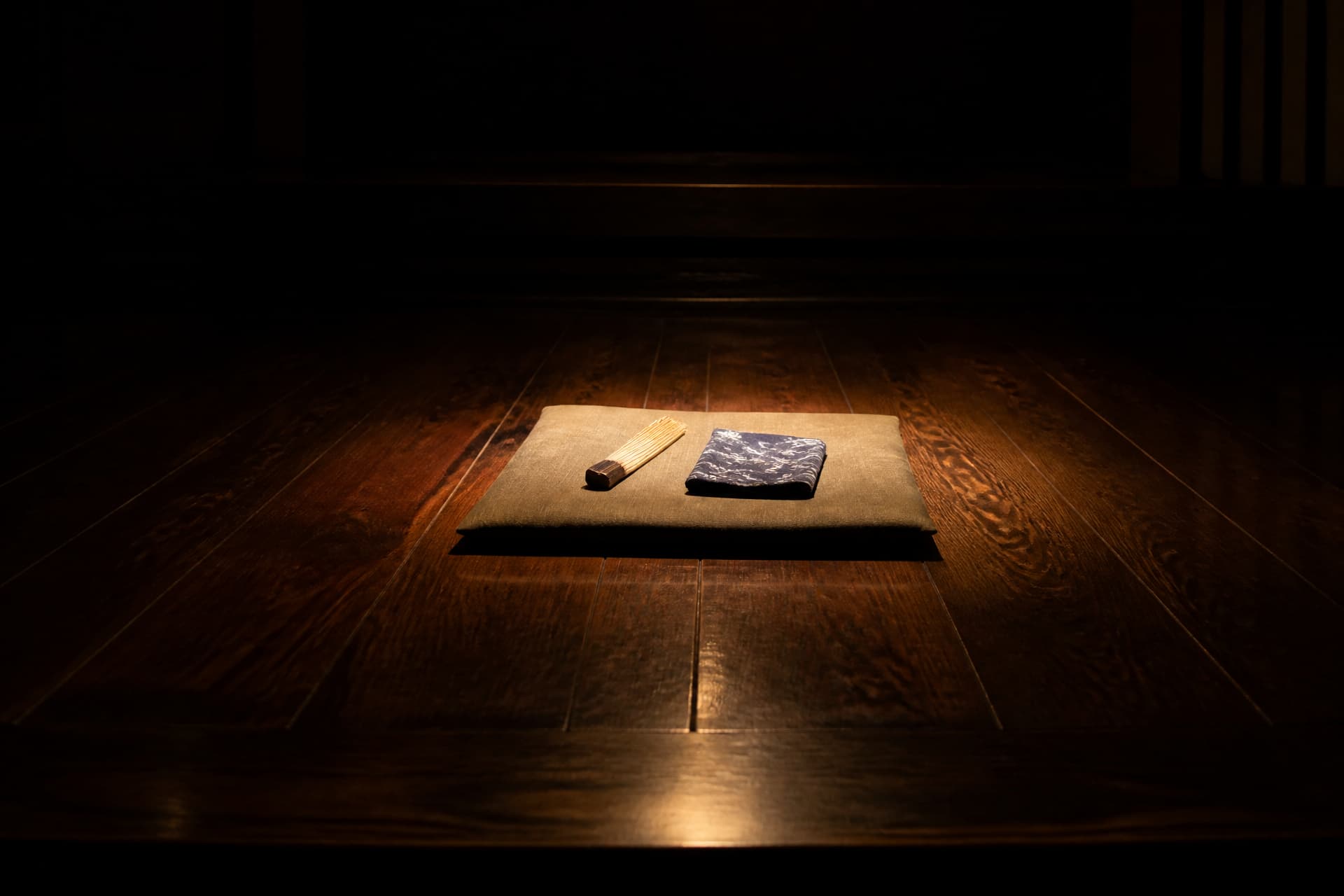
A rakugo storyteller works seated, with a folding fan and a cloth as the only props. The most famous shinigami story in Japan is a rakugo piece — and it was adapted from a European tale, which is the clearest evidence we have that the figure was partly borrowed.
Shikigami vs Shinigami — One Letter, Two Unrelated Things
The shikigami vs shinigami question gets asked often enough to have its own search demand behind it, and the answer is that the two words have nothing to do with each other.
Shikigami (式神) takes shiki — formula, rite, ceremony — and the same kami. A shikigami is a spirit summoned and commanded by a practitioner of Onmyōdō, the Japanese tradition of divination and ritual that was once a court profession. In stories they are servants: sent to spy, to carry a message, to fight on the practitioner's behalf, and often described as conjured out of a folded slip of paper. They are associated above all with the famous court diviner Abe no Seimei.
They have nothing to do with death. A shikigami is a familiar, closer to a summoned tool than to a spirit of the dead. It does not come for you, does not escort you anywhere, and has no place in any account of dying.
The confusion is easy to explain. The two words differ by a syllable in romanized spelling, both end in -gami, and modern manga and anime use both freely — sometimes in the same series — with only the story to tell you which is which. If you are trying to keep them straight, the useful test is the first half of the word: shi means death, shiki means rite. One is about the end of a life. The other is about a ritual somebody is performing.
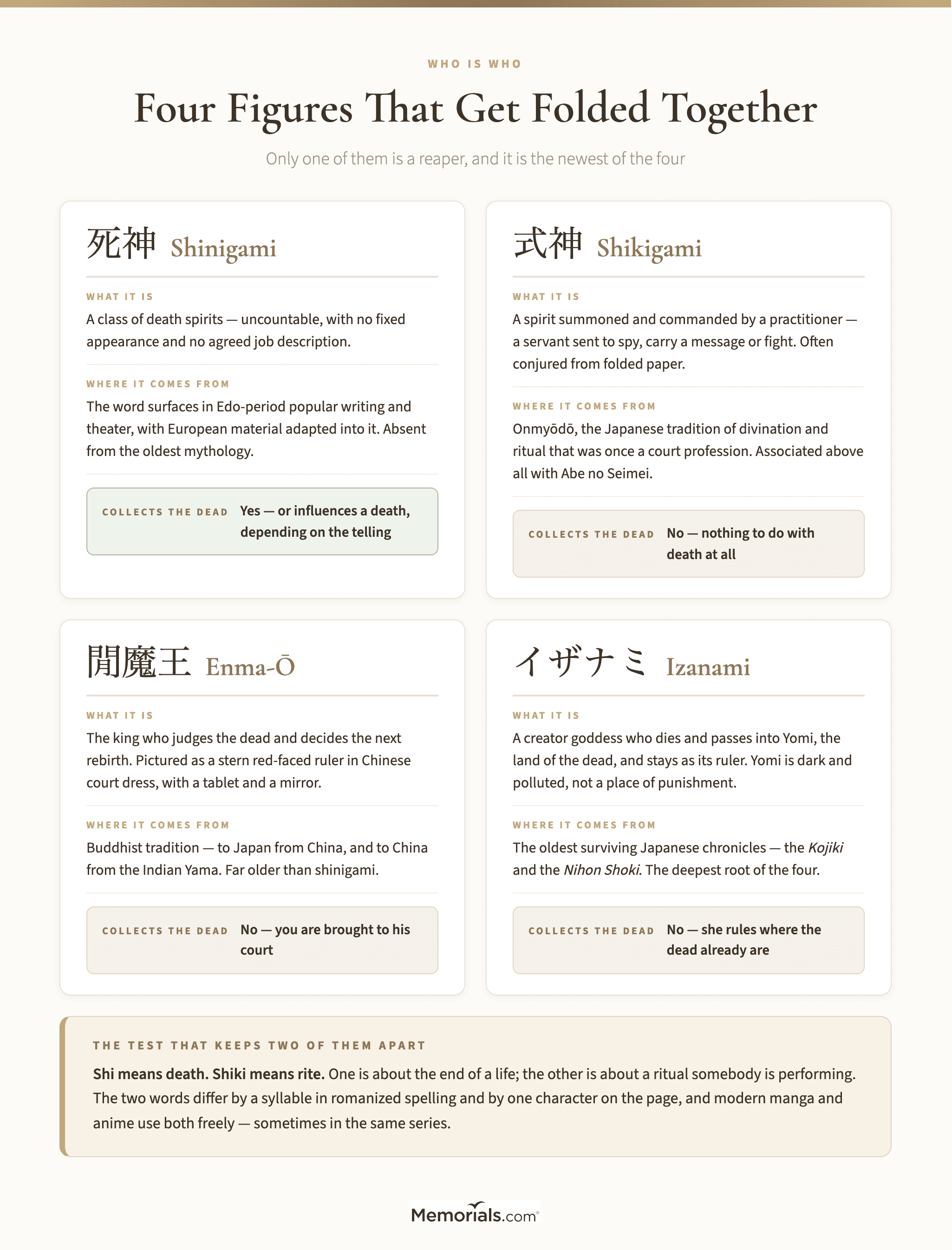
Four figures that get folded together and should not be. Shinigami are a late class of death spirits; shikigami are summoned servants with no connection to death at all; Enma-Ō is the Buddhist judge who decides where the dead go; and Izanami is a creator goddess of the oldest mythology who becomes ruler of the land of the dead. Only one of the four is a reaper, and it is the newest.
The Death Figures Japan Actually Has
Strip the shinigami away and the tradition is not empty. It is crowded, and the figures in it are much older.
Izanami and the land of the dead. In the oldest mythology, the creator goddess Izanami dies and passes into Yomi, the land of the dead — a dark, polluted place beneath the world rather than a court of judgment. Her husband Izanagi follows her there and flees when he sees what she has become, and the two of them part with a bargain about the living and the dead that has stood ever since. Yomi is not hell, nobody is punished in it, and no one is sent there by a reaper. It is simply where the dead are.
Enma-Ō, who judges. The figure who actually decides the fate of the dead in Japanese Buddhist tradition is Enma — Enma-Ō or Enma Daiō, the great king Enma. He came to Japan from China, and to China from the Indian Yama, so he arrived with a very long history already attached. He is usually pictured as a stern red-faced king in Chinese court dress, holding a tablet, and often with a mirror that shows the dead person everything they actually did. He is a judge, not a collector. He does not come to your bedside. You are brought to his court.
The river, and the fare for crossing it. Japanese Buddhist tradition holds that the dead must cross the Sanzu River — the river of three crossings — and that how they cross depends on how they lived: a bridge for the good, a shallow ford for the ordinary, and deep, dangerous water for the rest. At the far bank stands an old woman, Datsue-ba, who strips the clothes from the dead, and her companion who hangs them on a tree branch to see how far it bends under the weight of a life.
The Sanzu River is crossed three ways depending on the life behind you — a bridge, a shallow ford, or deep water. It is a sorting, not a punishment, and it has no reaper anywhere in it.
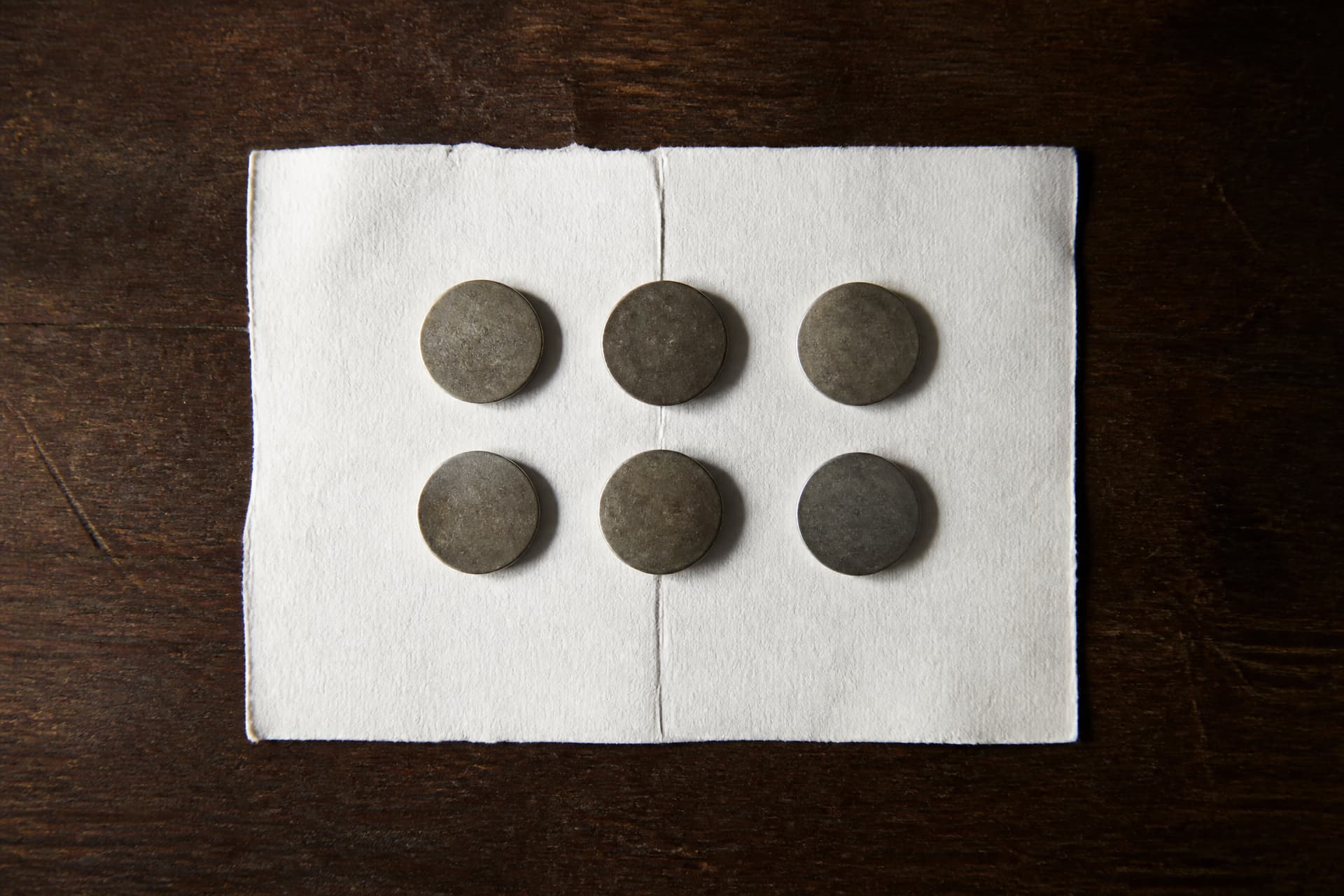
And the crossing has a price. Six coins are traditionally placed with the dead to pay the way — the rokumonsen, six coins for the six realms of rebirth. Because a modern Japanese funeral ends in cremation and metal cannot go into the chamber, the coins today are usually represented in printed or paper form rather than as real currency, but the custom itself is old and still observed.
If that sounds familiar, it should: paying for passage to the land of the dead is one of the most widely repeated ideas in human burial custom, and the Greek version — a coin for the ferryman — is the one most Western readers already know. Two traditions with no contact between them arrived at the same idea, which says something about how universally people have imagined death as a journey with a toll on it.
Six coins, one for each of the six realms of rebirth, placed with the dead to pay the river crossing. Greek custom put a single coin in the mouth for the same reason, and the two traditions never met.
None of Them Show Up at a Japanese Funeral
This is the part the shinigami question almost never reaches, and it is the most useful thing on this page.
A Japanese funeral is, overwhelmingly, a Buddhist one, and it has a shape: a wake the evening before, a funeral service the following day, and then cremation, which is close to universal in Japan. Practice varies a great deal by sect, by region and by family, and no short description covers everybody — but shinigami are absent from all of it. There is no prayer addressed to a shinigami, no offering made to one, no point in any rite where one is named. The figure that dominates every search result for this word has no liturgical existence at all.
What the rites do contain is quite specific. After the cremation comes kotsuage, in which the family gathers at the tray and lifts the remaining bones into the urn with long chopsticks, often passing a bone from one pair of chopsticks to another so that two people carry it together. It is the reason passing food directly from chopsticks to chopsticks is avoided at a Japanese table — the gesture belongs to a funeral, and nowhere else. The urn it goes into has its own conventions of size, material and lid, which we cover separately in our guide to Japanese urns.
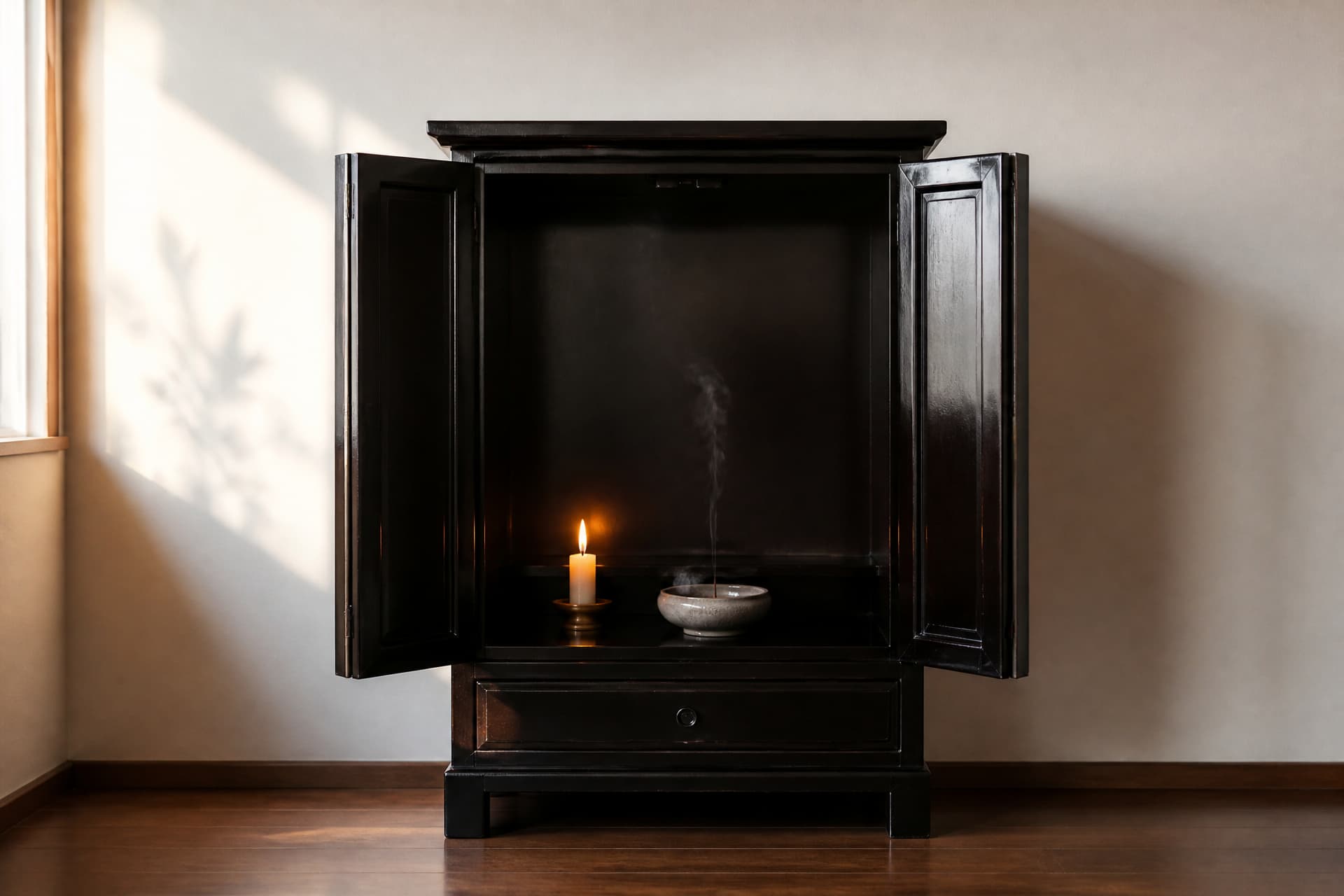
Afterward, remembrance moves into the home. A butsudan, the household Buddhist altar, holds memorial tablets for the family's dead, and daily offerings of incense, water, rice or flowers are made there. Memorial services continue at set intervals, of which the forty-ninth day is the most significant — the point at which the deceased's next state is traditionally understood to be settled.
The household altar is where Japanese remembrance actually lives — incense, water and flowers offered daily to the family's dead. Nothing in it addresses a shinigami, because nothing in Japanese funeral practice ever has.
Sending things to the dead by burning them is a thread that runs across East Asia in many forms, and the meanings people attach to it are worth their own page — see burning paper for the dead.
If you have been invited to a Japanese funeral rather than reading about one, the practical questions are dress and the condolence envelope, and those are answered in our guide to what to wear to a Japanese funeral. And the single most useful thing anyone can do is ask the family what they would like. It is an ordinary question and nobody will be offended by it.
Why the Word Is Everywhere Now
Almost everyone who searches what are shinigami met the word in fiction, and the fiction is doing something specific with it.
Death Note made shinigami into a bureaucracy: beings from their own realm who hold notebooks that kill whoever is written in them, bound by rules, bored, and rather funny. Bleach built an entire world of them — and its English release translated shinigami as Soul Reaper, which is why soul reaper in Japanese is a question people ask and why the answer is simply shinigami. Soul Eater put a shinigami at the head of a school. Each of these is a strong, specific invention, and each is now what a large part of the world pictures when it hears the word.
The important thing is the direction of the borrowing. Folklore gave fiction a vague, unfixed idea, and fiction handed back a detailed one. The notebooks, the ranks, the realms, the uniforms and the rules are the work of authors within living memory. They are not old, they are not religious, and no one in Japan encounters them in a temple. A Japanese reader knows the difference in the way an American reader knows that a movie vampire is not a folk belief.
None of that makes the fictional versions worth less. It just means japanese shinigami as a search often has two answers layered on top of each other, and it is worth knowing which one you are being given. The same thing happens to other traditions when their death imagery travels: sugar skulls are read abroad as a costume and at home as an offering to a named relative.
Frequently Asked Questions
What does shinigami mean in English? Death god, literally — 死 death plus 神 god or spirit. In practice death spirit is the truer translation, and grim reaper is the usual loose one.
Are shinigami real in Japanese folklore? Yes, in the sense that the word and the figure genuinely exist in Japanese popular tradition. No, in the sense of being ancient or religious: shinigami are a comparatively recent addition, absent from the oldest mythology and from formal Buddhist teaching, and partly assembled from imported European ideas about Death.
What is the difference between shikigami and shinigami? Everything except two syllables. A shinigami is a death spirit. A shikigami is a spirit summoned and commanded by a practitioner of Onmyōdō — a servant or familiar, with no connection to death at all.
Is shinigami the same as the Grim Reaper? It is the standard translation and the closest equivalent, but the figures differ. The Grim Reaper is a single being with a fixed appearance who comes to collect. Shinigami are an uncountable class with no agreed appearance, who in older tellings influence a death as much as attend one.
Is Enma a shinigami? No. Enma-Ō is the Buddhist king who judges the dead and decides their next rebirth. He is far older than shinigami, he came to Japan through China from the Indian Yama, and his role is judicial rather than that of an escort.
Do shinigami appear in Japanese funerals? Not at all. Japanese funeral rites are Buddhist in form and contain no prayer, offering or reference to a shinigami at any point. The figures that do appear in the tradition around death are Enma, the Sanzu River and its crossing, and the household altar afterward.
In Closing
Shinigami means death god, and that translation is correct in the way most translations are correct — it gets you into the right room and then leaves you to work out the furniture. The figure behind the word is younger than most people assume, less fixed than the Grim Reaper, partly borrowed from Europe, and completely absent from the funerals of the country it belongs to.
What Japanese tradition actually offers instead is richer: a judge with a mirror, a river with three crossings and a fare to pay, and an altar in the corner of a room where a family talks to its dead every day.
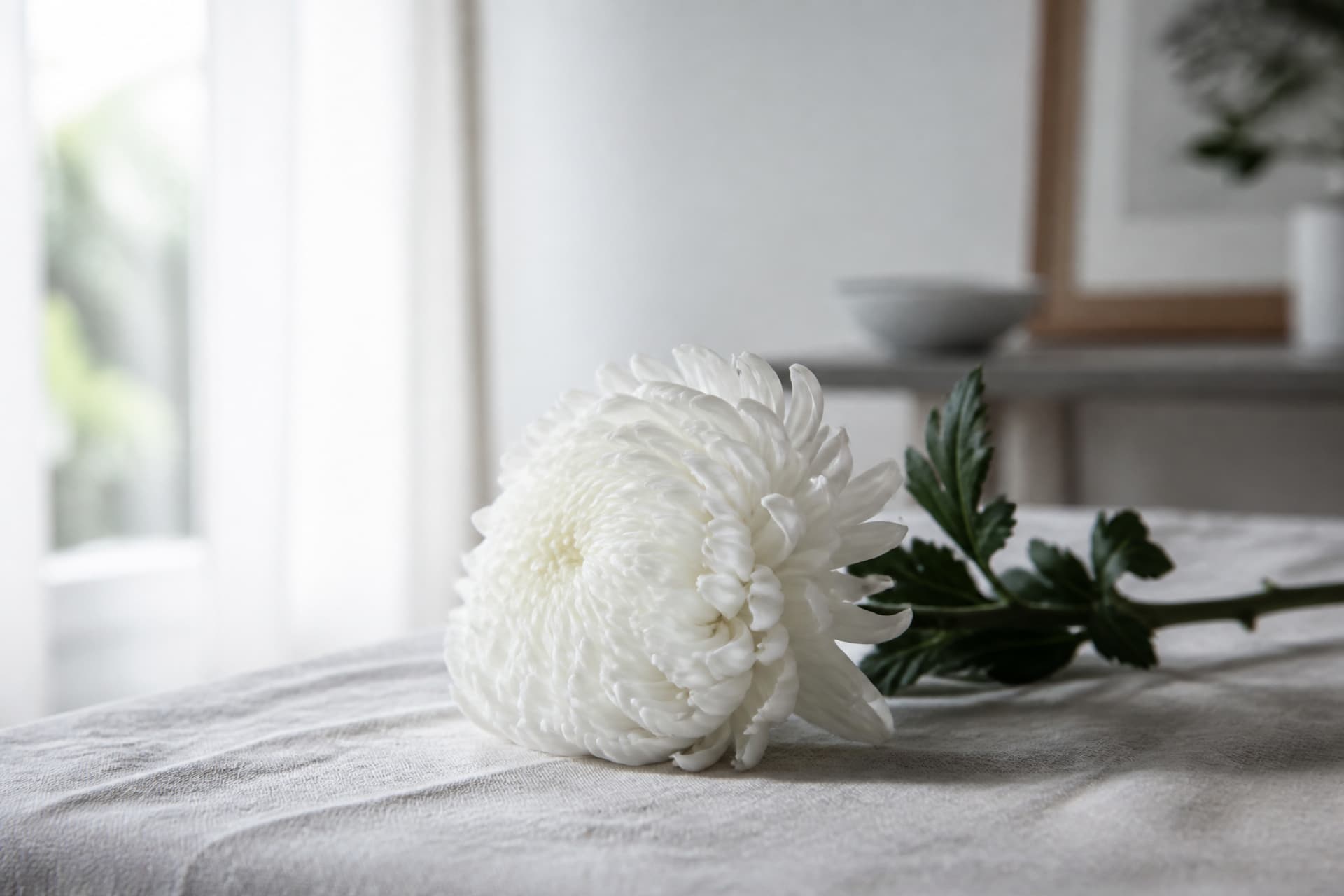
The white chrysanthemum is the funeral flower in Japan, as the lily is in much of the West. Death symbolism is mostly carried by objects like this one rather than by figures with names.
If personified death is what brought you here, the rest of the hub covers how other traditions have pictured it. For the visual language instead of the figures, see the symbols of grief and mourning that recur across cultures, or the far longer catalog of headstone symbols and their meanings carved on graves. And if you are choosing something for a family whose tradition is not your own, our guide to an urn that honors faith and culture is the place to start.