🏬Supersize Online Funeral Retailer🪦1000's of Headstones⚱️Over 10,000 Cremation Urns⚰️Caskets Overnight Delivery🛒Funeral & Memorial Superstore🚚FREE Shipping on ALL Orders👨👩👧👦Helping Families for over 20 Years💰Lowest Price Guarantee🏬Supersize Online Funeral Retailer🪦1000's of Headstones⚱️Over 10,000 Cremation Urns⚰️Caskets Overnight Delivery🛒Funeral & Memorial Superstore🚚FREE Shipping on ALL Orders👨👩👧👦Helping Families for over 20 Years💰Lowest Price Guarantee
🏬Supersize Online Funeral Retailer🪦1000's of Headstones⚱️Over 10,000 Cremation Urns⚰️Caskets Overnight Delivery🛒Funeral & Memorial Superstore🚚FREE Shipping on ALL Orders👨👩👧👦Helping Families for over 20 Years💰Lowest Price Guarantee🏬Supersize Online Funeral Retailer🪦1000's of Headstones⚱️Over 10,000 Cremation Urns⚰️Caskets Overnight Delivery🛒Funeral & Memorial Superstore🚚FREE Shipping on ALL Orders👨👩👧👦Helping Families for over 20 Years💰Lowest Price Guarantee
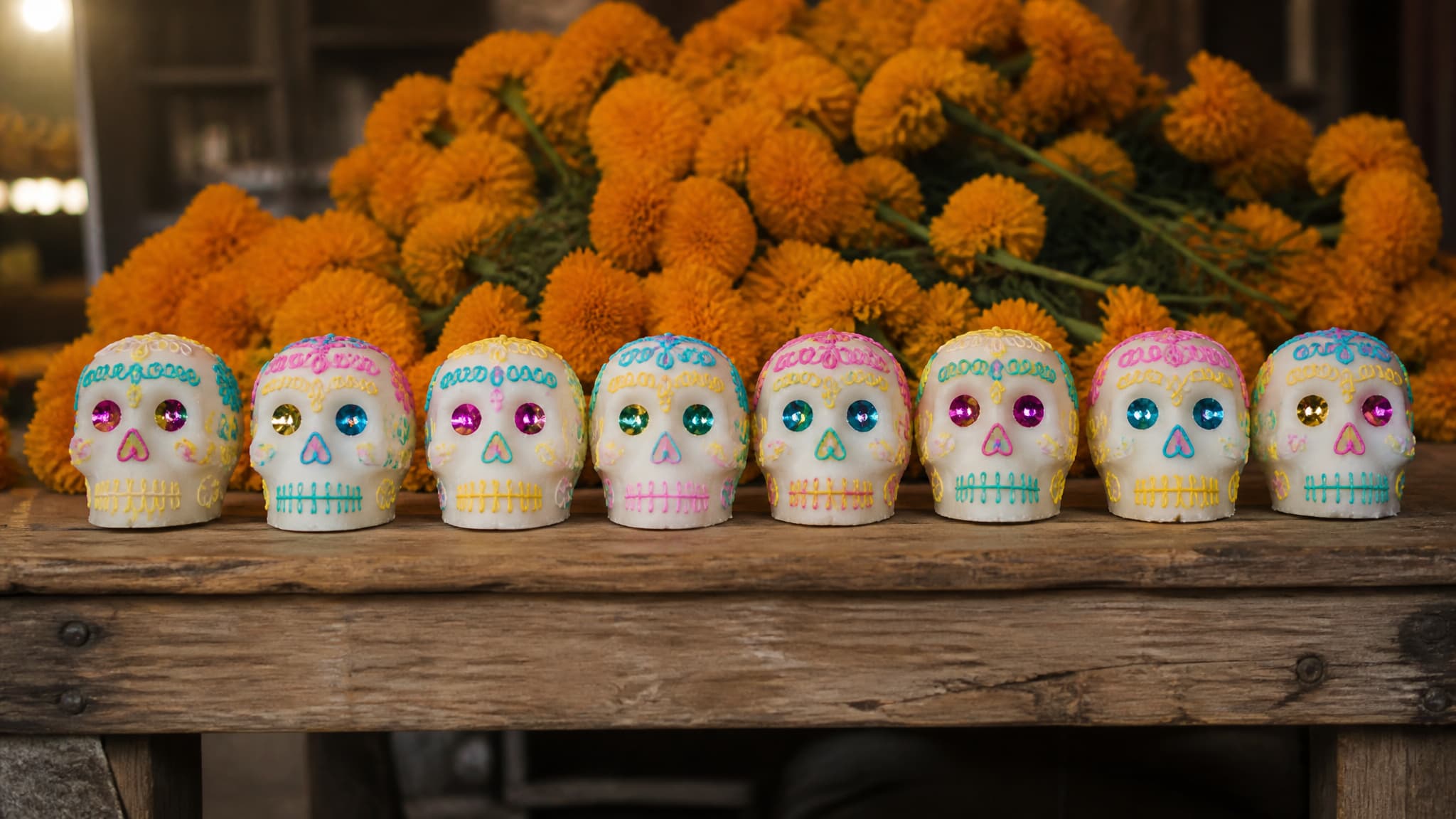
A sugar skull is not a Halloween prop and it is not a warning about mortality. The sugar skull meaning almost everyone misses is the plainest part of it: the skull is a person. Somebody's grandmother, somebody's brother, named in icing across the forehead, set on a table at home beside the food he liked, and left there for two nights while his family stands around talking about him.
That single fact reorganizes everything else. The grin is not creepy, because the guest is welcome. The bright colors are not irreverent, because nobody is at a funeral. And the object is not decorative, because it has a name on it and the name belongs to one particular dead person.
Here is what the skull is made of, why a name is written on it, where it sits, whether you can eat it, and what it is routinely mistaken for. It sits alongside the other objects and figures cultures use to handle their dead in our death symbolism guide.
What a Sugar Skull Means
Calavera is Spanish for skull. Calaveras de azúcar are sugar skulls. Ask what are calaveras de azúcar and you will usually be handed that translation, which is accurate and explains nothing.
The explanation is the holiday. Día de los Muertos falls on the first and second of November, sitting on top of the Catholic observances of All Saints' Day and All Souls' Day. The first is generally kept for children who died — los angelitos, the little angels — and the second for adults. The premise is that on those nights the dead come home. Not summoned, not raised, not feared: they visit, the way relatives visit, and the household's job is to make the visit worth making.
So the skull smiles. It is a portrait of a guest, and a guest who is being welcomed does not need to look grim. This is where the imagery separates itself most sharply from the European skull, which exists to remind the living that they are going to die. The sugar skull is not about the viewer at all. It is about somebody who already died and is expected back on Sunday.
Two traditions are braided into this and both matter. Central Mexico before the Spanish arrived kept skulls in the open — displayed at temple sites on racks, worked into carvings, present rather than hidden. Catholicism arrived with All Saints and All Souls, a calendar for praying for the dead and a theology of what happens to them. What is practiced now grew out of both, and the sugar skull sits exactly on the seam: an indigenous comfort with the skull, rendered in a Spanish confectionery technique, for a date on the Catholic calendar. Historians argue about how direct the line back to the pre-Hispanic period really is. Nobody argues about the syncretism.
What Are Calaveras de Azúcar Made Of
Sugar, mostly, and the reason is economic.
The craft is called alfeñique — sugar paste worked like clay. The usual account traces it to Spain, which had it from the Arab world, and it took hold in colonial Mexico because sugar was one of the few decorative materials that was cheap and everywhere. A family that could not buy carved wood or worked silver could buy sugar.
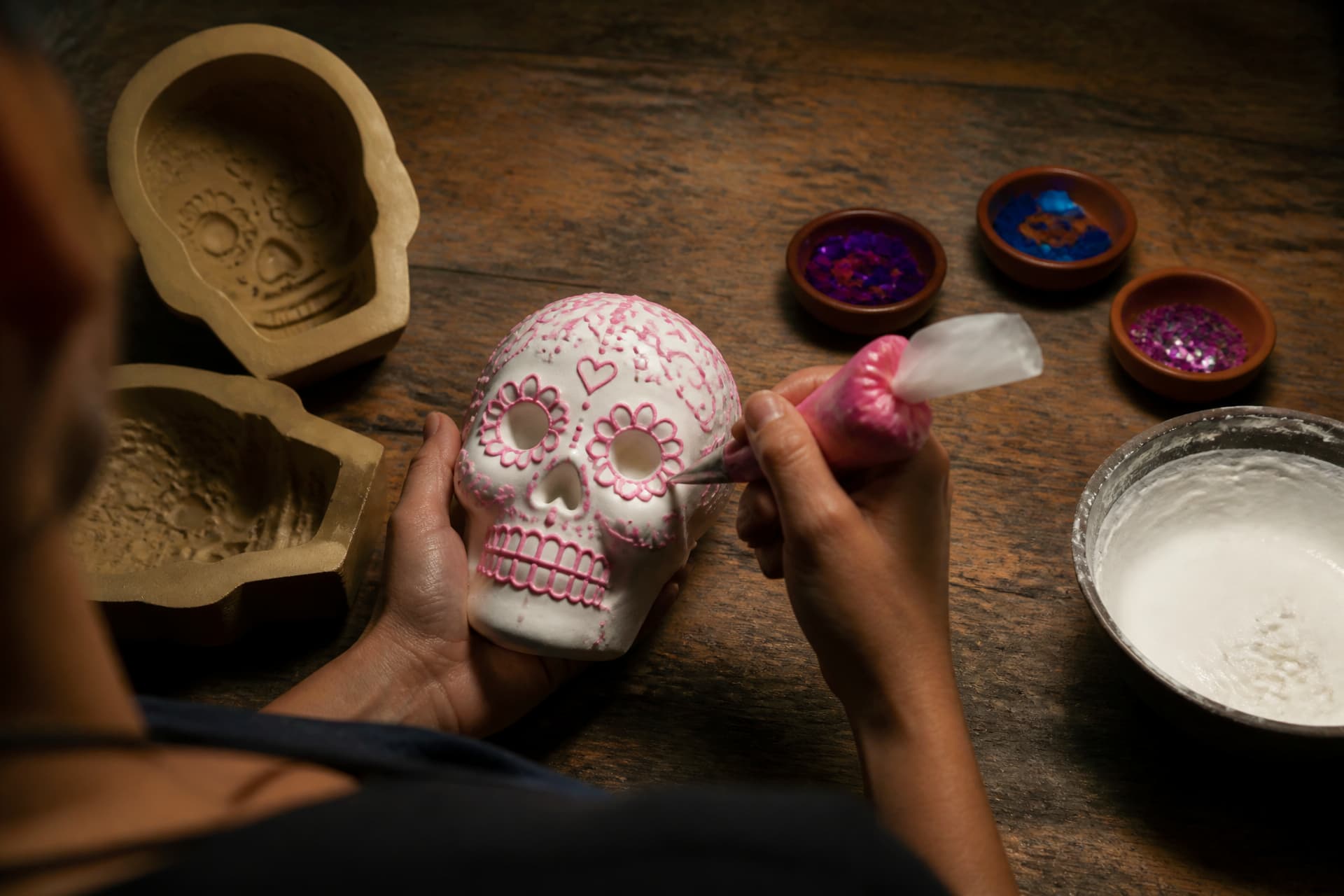
The method has not changed much. Sugar is boiled with water, beaten until it turns opaque and workable, then pressed into a two-part mold — clay traditionally, plastic now — one half for the face and one for the back of the head. The halves dry hard, get joined with icing, and the blank white skull comes out of the mold with no features at all. Everything you recognize is added afterward by hand.
That decoration is where the object stops being a candy and starts being a portrait:
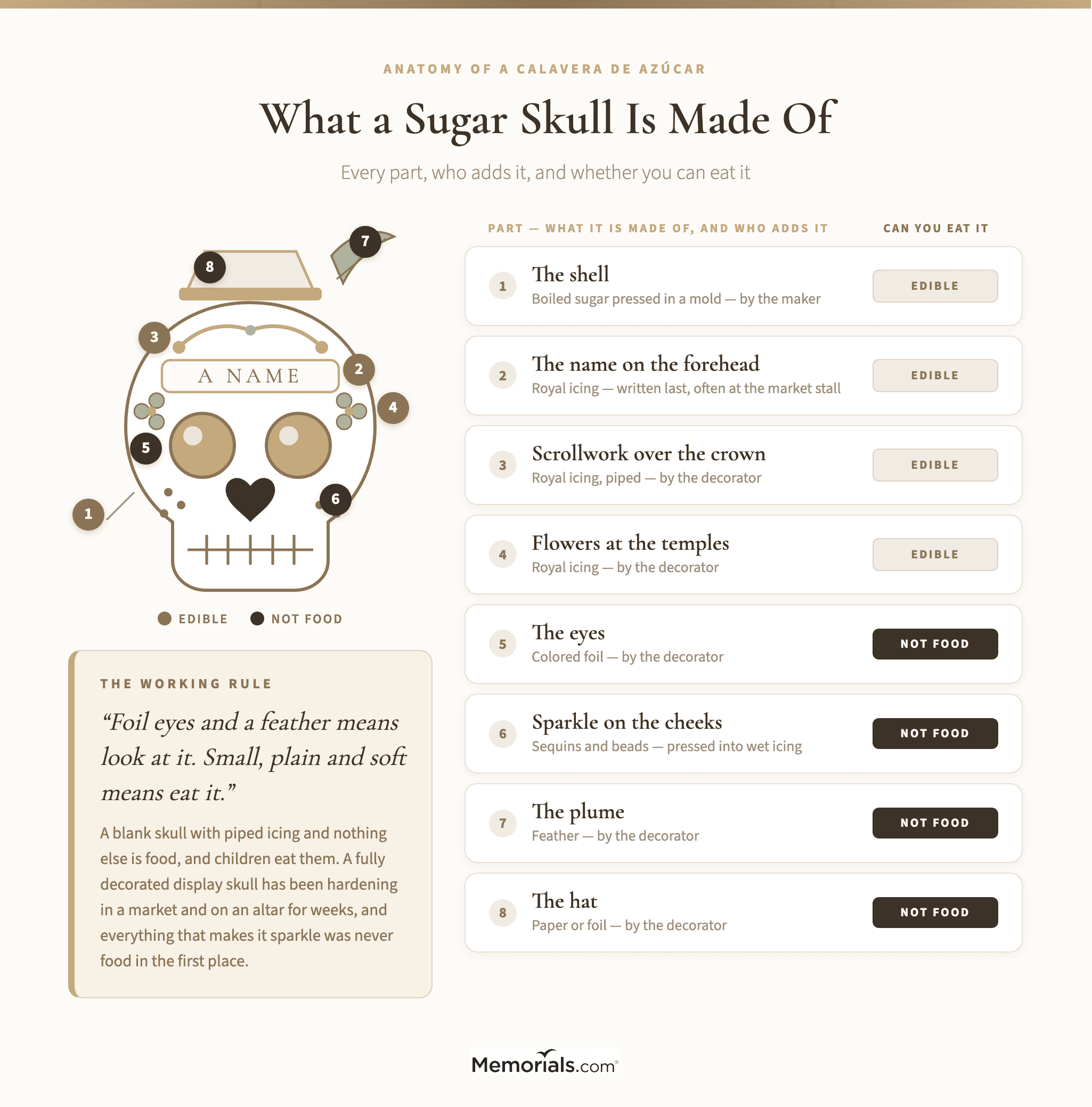
Royal icing, piped in loud colors, for the eyebrows, the looping scrollwork over the crown, the flowers at the temples and the stitched line of the teeth.
Colored foil for the eyes, which is why the eyes catch the candlelight.
Sequins, beads and feathers pressed into the icing while it is wet.
Paper or foil hats on the larger ones, sometimes a full La Catrina hat with a brim and a plume.
They are made in every size from a thumbnail to a human head, and in materials other than sugar — chocolate, and alegría, a pressed cake of amaranth seed and honey. Ceramic and clay skulls are made for families who want to keep the same one year after year. The city of Toluca holds an entire fair for the craft, and market stalls across Mexico fill with skulls in the weeks beforehand.
Only the shell and the icing are food. The eyes are foil, the sparkle is sequins, and the plume is a feather — which is why a fully decorated skull is a sculpture that happens to be made of sugar rather than a candy that happens to look like a skull.
The skull comes out of the mold blank. Everything a person recognizes about a sugar skull — the scrollwork, the flowers, the foil eyes and above all the name — is put on afterward by hand, which is what makes each one a portrait of somebody rather than a shape.
The Name on the Forehead
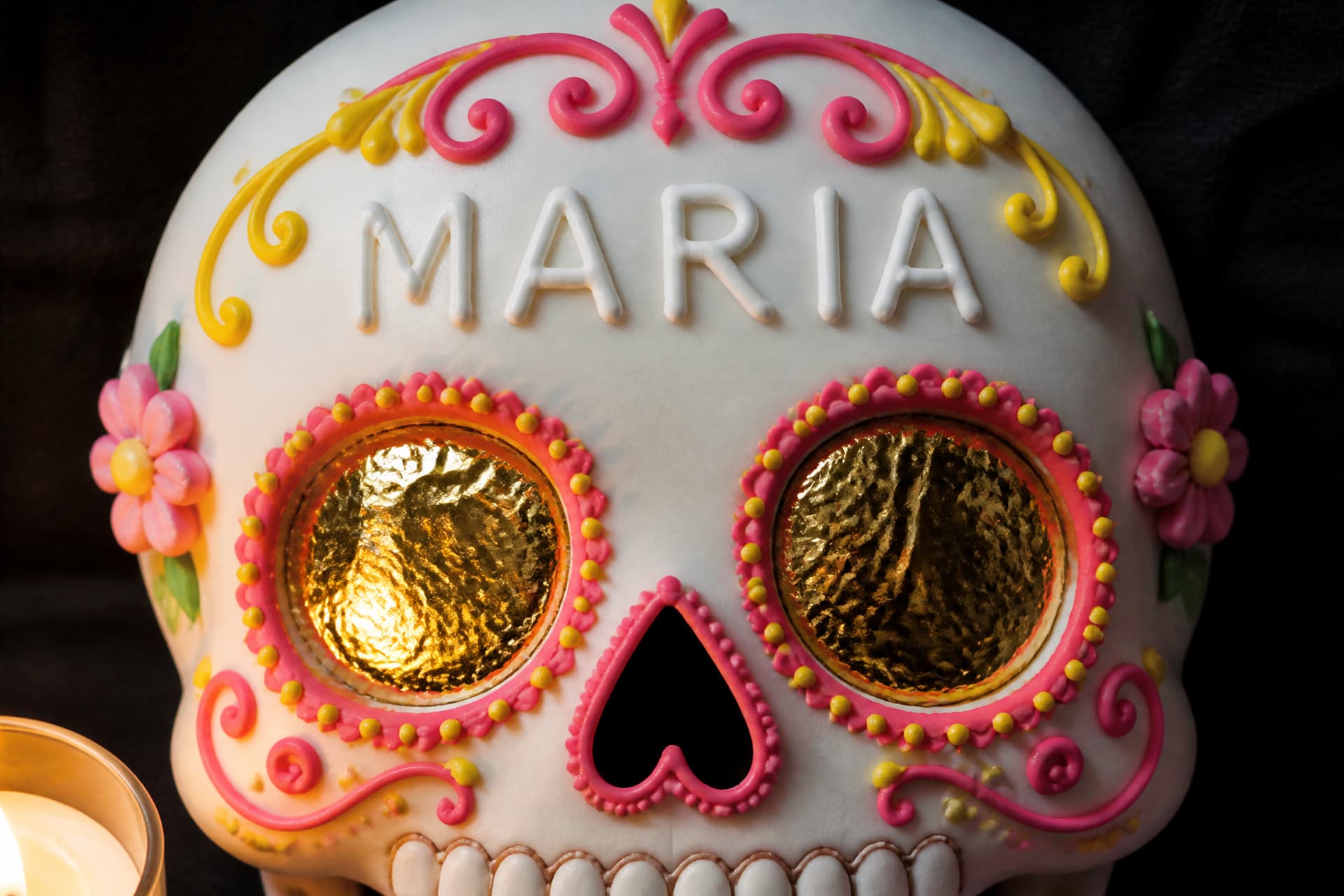
The band of decoration across a sugar skull's forehead is not always decoration. Very often it is a name, written there in icing.
It is the name of the dead person the skull is for. A stall in the market will pipe it on while you wait, because the skulls are sold blank for exactly that reason — the seller does not know whose grandfather you are expecting. That is the entire mechanism by which a mass-produced sugar shape becomes an offering for one specific individual, and it is the same instinct that puts a name on a grave marker instead of a decorative stone.
There is a second, cheerier use. You can give a sugar skull to somebody who is very much alive, with their own name on the forehead, and it is received as affection rather than as a threat. Friends do this. Children do it to teachers. The joke is the holiday's central joke — death is coming for all of us and it is funnier to say so out loud — and it is not read as a curse or an omen.
Not every skull carries a name. Plenty are sold and displayed blank, particularly the small ones bought by the bagful. But a named skull and an unnamed skull are doing different jobs, and if you only take one thing from this page, take that one.
The name is written rather than printed because it is added at the last moment, for one person, often at the market stall. An unnamed sugar skull is an ornament; a named one is a place set at the table for somebody in particular.
The Other Day of the Dead Writing
Searches for day of the dead writing land in two completely different places, and the second one is the more interesting of the two.
The first is the forehead. The second is the calavera literaria — a short satirical verse, rhymed, written about a living person as though death had already come for them. They run in newspapers in the days before the holiday, get read aloud in classrooms and offices, and are aimed at politicians, bosses, celebrities and whoever else has been irritating lately. The form is teasing rather than cruel; the punchline is always the same, which is that the mayor is no more permanent than anybody else.
The printed tradition behind them produced the most recognizable image in the whole holiday. José Guadalupe Posada, an engraver who died in 1913, illustrated these broadsides with skeletons dressed as everyone in Mexican society — dandies, generals, revolutionaries, drunks — all of them bones under the costume. One of them, a skeleton in an enormous feathered European hat, was a jab at Mexicans who denied their indigenous roots and dressed like Spanish gentry. Diego Rivera later put her at the center of a mural painted in the 1940s, gave her a full dress and the name by which everybody now knows her: La Catrina.
Medieval Europe had made the same joke centuries earlier in the danse macabre, where death leads pope, king and laborer off in a single line. The two traditions arrived at the same image independently, and Posada's version is the one that survived into a living holiday rather than into an art-history chapter.
Where the Sugar Skull Sits on the Ofrenda
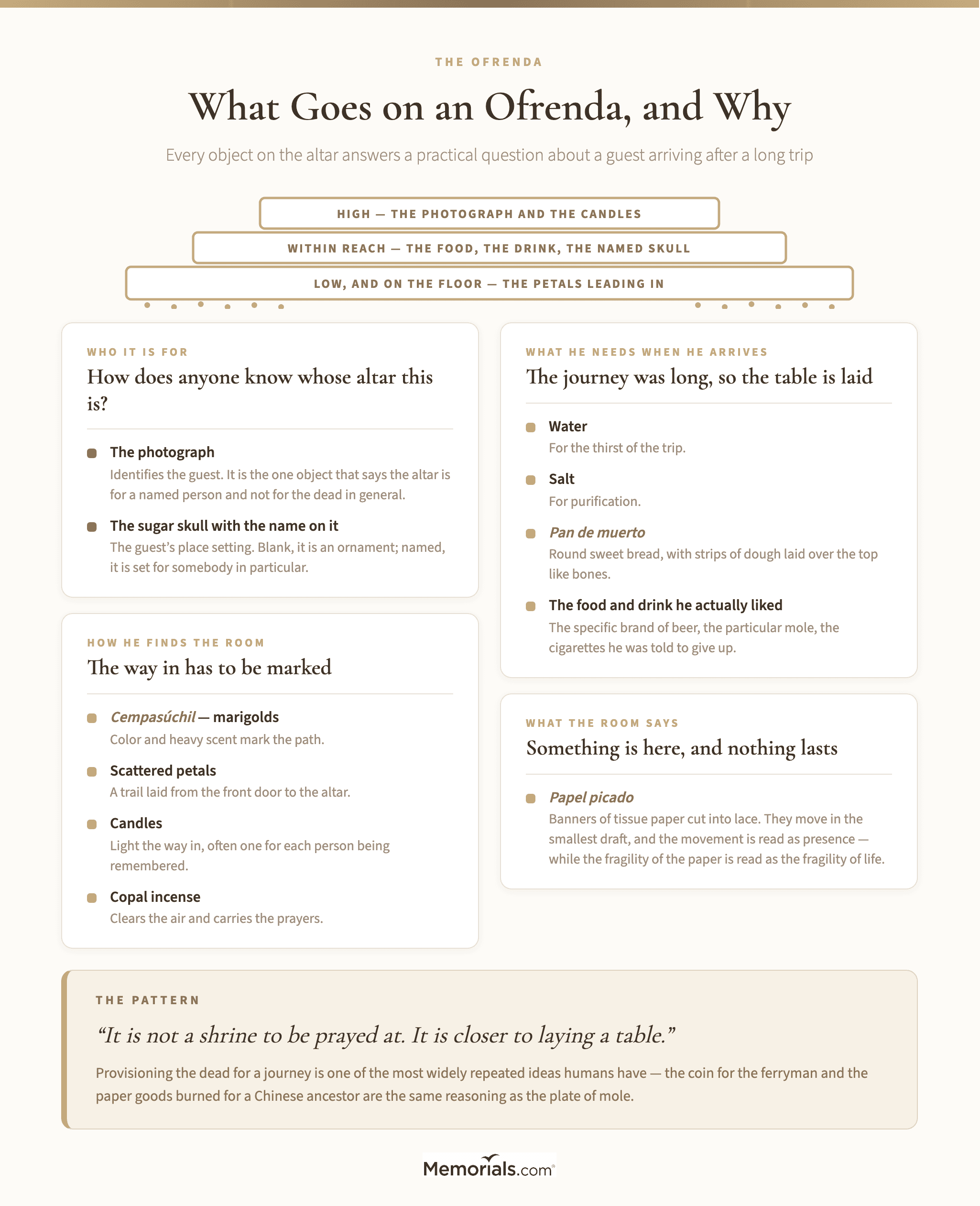
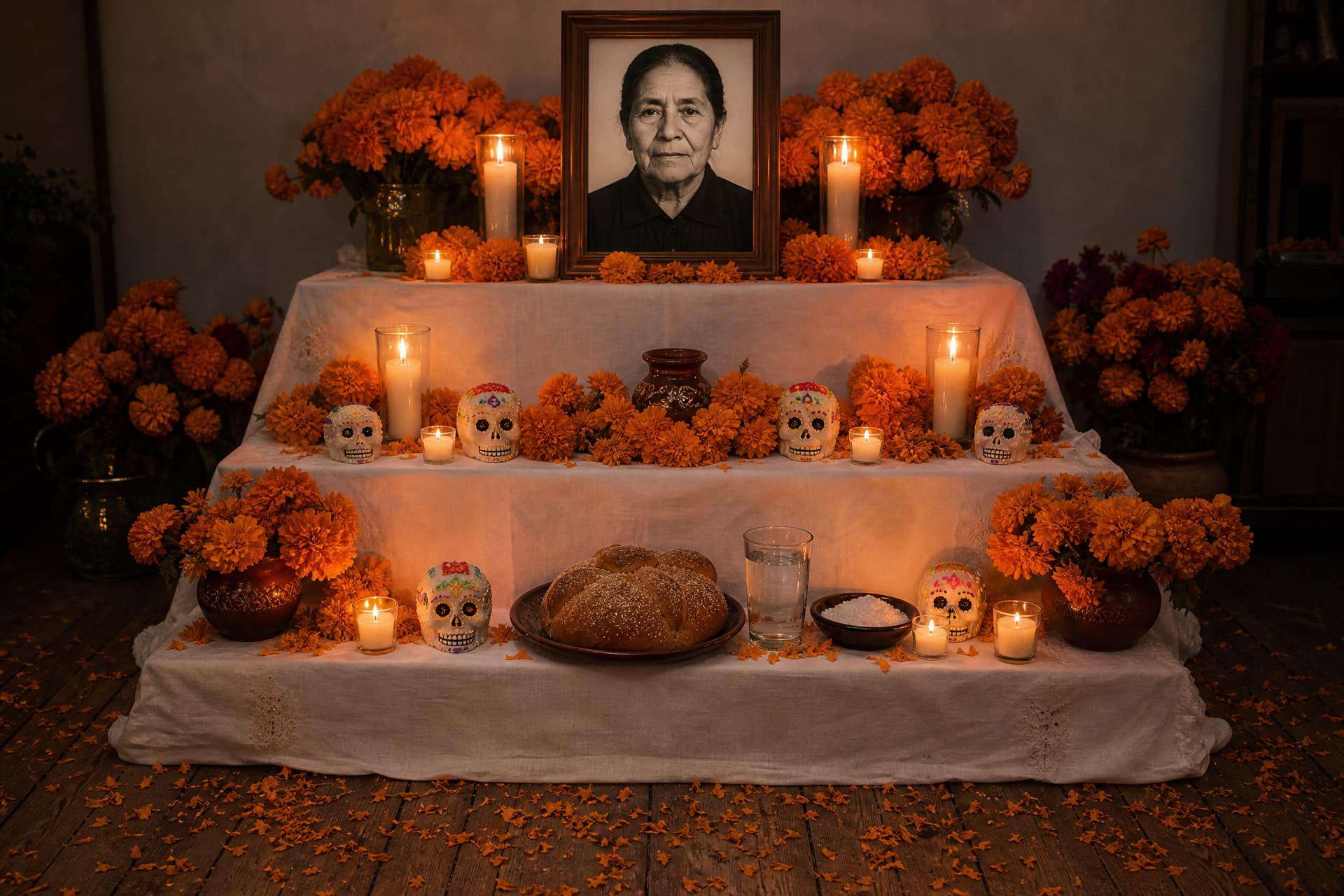
The ofrenda — the word means offering — is the altar a family builds at home, usually on tiers, sometimes also at the grave. It is not a shrine to be prayed at. It is closer to laying a table.
At the center is a photograph of the dead person, which is what tells everyone who the altar is for. The rest is provisioning:
Cempasúchil, the marigolds. Their color and their heavy scent are understood to mark the path, and petals get scattered in a trail from the front door to the altar so the guest can find the room.
Candles, one for each person being remembered, to light the way in. Which tier the velas on an ofrenda sit on, and what their colors mean, is a convention of its own.
Water, because the journey is long, and salt, for purification.
Copal incense, which clears the air and carries the prayers.
Pan de muerto, the round sweet bread with strips of dough laid over the top like bones.
The food and drink that person actually liked — a specific brand of beer, a particular mole, the cigarettes she was told to give up.
Papel picado, banners of tissue paper cut into lace. They move in the smallest draft, which is the point: the movement is read as the presence of something, and the fragility of the paper is read as the fragility of life.
The sugar skull, with the name on it, which is in effect the guest's place setting.
The marigold is worth pausing on, because it is the one element that people who have never built an altar still recognize. Its orange is doing the same work that white does at a Western funeral and black does in mourning dress — a color agreed on by a culture to mean this is about the dead — and it is a good example of why what color represents remembrance has no single answer. The monarch butterflies that reach the fir forests of Michoacán at the beginning of November get folded into the same reading, and the association between returning butterflies and returning souls is old and widespread enough to have its own entry in butterfly symbolism.
Setting out food and drink for the dead is not a Mexican peculiarity either. Chinese families burn paper money, paper houses and paper goods so the dead have them, and the reasoning behind burning paper for the dead is exactly the reasoning behind the plate of mole. The Greeks put a coin for the ferryman in the mouth of the corpse. Provisioning the dead for a journey is one of the most widely repeated ideas humans have.
The domestic version of this is not exotic, and it is closer to something a lot of American families already do than they realize. A shelf with a photograph, a candle and two or three objects that were his is an ofrenda in every respect except the name and the date, which is why building a home altar is a familiar practice with an unfamiliar vocabulary. The candles are not incidental to it — the lighting is most of what makes such a space read as deliberate rather than as clutter, and memorial candles have their own conventions worth knowing.
Every object on an ofrenda answers a practical question about a guest arriving after a long trip: how does he find the room, what does he drink when he gets here, and how does he know the table is set for him rather than for the neighbors. The named sugar skull answers the last one.
The tiers are not decorative. Most households read them as levels — the photograph and the candles high, the food and drink where a guest can reach them, the marigold petals leading in from the floor.
Are Sugar Skulls Edible?
Technically yes. Practically, mostly no, and the honest answer has two halves.
The shell is food. Sugar, water and either egg white or meringue powder, which is a recipe with nothing alarming in it. The royal icing is food too. If you bought a plain white skull with piped decoration and nothing else, you could eat it, and children do.
The rest of a decorated skull is not food. Foil eyes, sequins, beads, feathers, wired flowers and a paper hat are all sitting in that icing, and none of them are meant to be swallowed. On top of that, a display skull has often been sitting in a market for weeks and on an altar for two more days, hardening the whole time. It is closer to a sculpture that would technically dissolve than to a dessert.
So the working rule is simple. Foil eyes and a feather means look at it. Small, plain and soft means eat it. The chocolate and amaranth versions are made to be eaten outright, and they are what most children are actually handed.
What happens afterward varies by household and there is no rule about it. Some families eat the plain ones once the holiday is over. Some crumble them for the garden. Some put the special ones in a box in a closet and bring the same skull out every year until it finally cracks.
The Night in the Cemetery
The altar at home is only half of it. The other half happens at the grave.
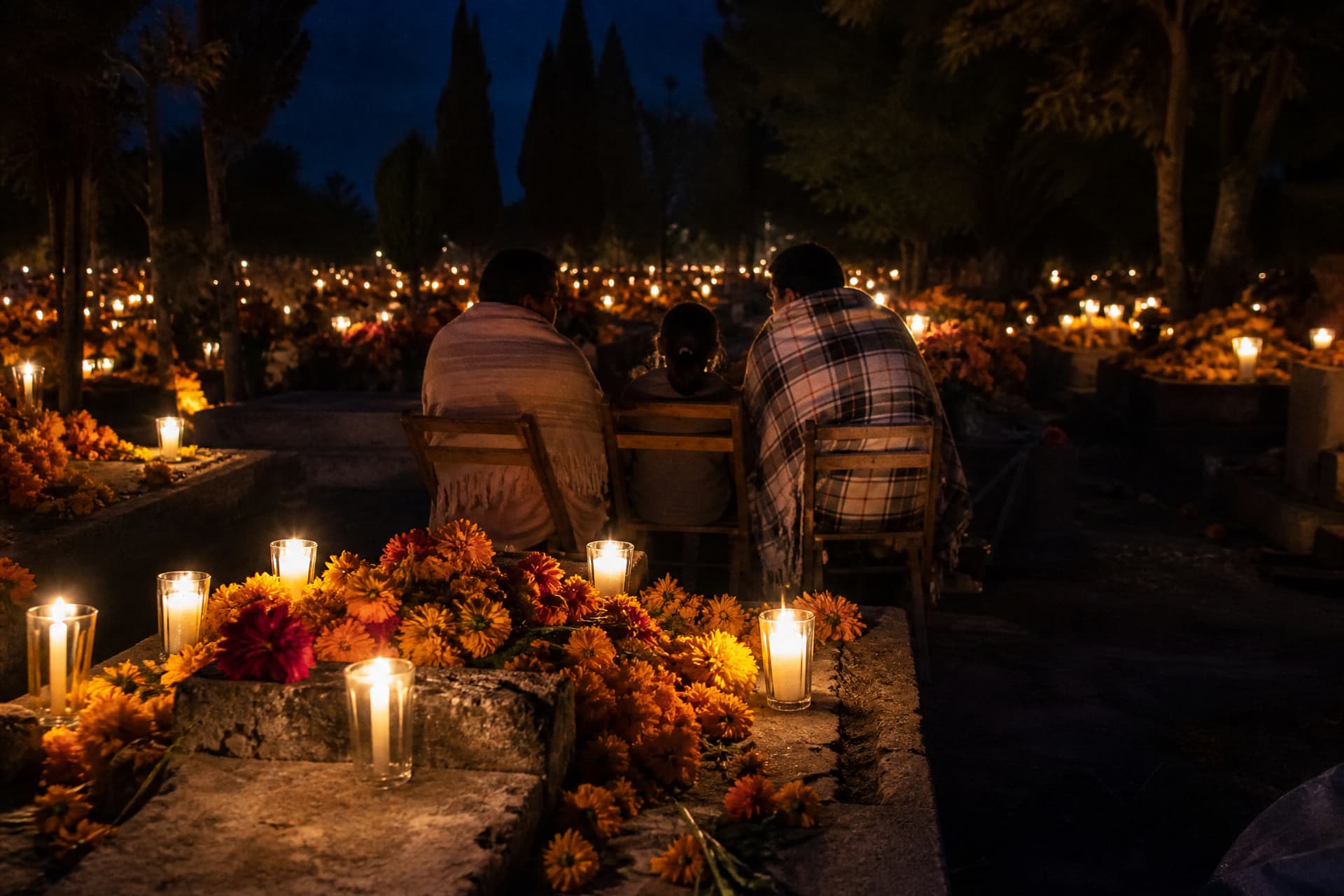
In the days beforehand, families go to the cemetery and put the plot back in order — pulling weeds, scrubbing the stone, repainting the ironwork, replacing anything that has weathered. Then on the night itself they come back with marigolds, candles, food and folding chairs, and stay. In parts of Michoacán, particularly around Pátzcuaro and the island of Janitzio, and in much of Oaxaca, whole cemeteries stay lit and occupied until dawn. It is not silent. There is music, and there are children asleep across laps.
The impulse to clean and dress a grave before an anniversary is not confined to Mexico, and the practical questions are the same everywhere — what survives weather, what the cemetery's rules permit, what will still look cared for in a month. Anyone thinking about decorating a grave for a specific date is working the same problem a family in Pátzcuaro works every October.
One thing worth knowing, because it is the most common thing Americans get backwards: the enormous costumed parade through central Mexico City is not an old tradition. It did not exist until the year after a James Bond film opened with a fictional version of it, and the city then built a real one. It is now genuinely popular and genuinely Mexican, but it is a recent public spectacle, not the ancient rite it is frequently described as.
Families clean and repaint the grave in the days before, then come back on the night with chairs and stay until morning. The vigil, not the parade, is the part of the holiday that is genuinely old.
The Skull That Is Not a Sugar Skull
A lot of the confusion around this image comes from other skulls standing too close to it.
It is not a memento mori. The European skull in a painting, on a mourning ring or carved into a seventeenth-century headstone is addressed to the living and says you are next. The sugar skull is addressed to nobody and says he came back. Same bone, opposite grammar.
It is not a Halloween skull. The dates are adjacent and the traditions are unrelated in origin, which is a coincidence of the calendar and not a family resemblance.
It is not a voodoo skull. The overlap is entirely visual — a painted face, a skull, sometimes a top hat — and costume shops have blurred the two into one look. Baron Samedi and La Catrina belong to different continents, different religions and different centuries, and nothing in Day of the Dead practice descends from the voodoo symbols for death.
It is not a death god. Cultures that personify death hand the job to a being — Japan's shinigami, the hooded Reaper of northern Europe, the winged Greek Thanatos. La Catrina looks like she belongs on that list and does not. She is a satirical cartoon of a social climber, not an agent who collects anybody, and she has no power over anything.
Sugar Skull Face Paint and Tattoos
This is the question most readers actually arrive with and it deserves a straight answer rather than a hedge.
Día de los Muertos is not a closed rite. Families invite guests, cities hold public celebrations, and being welcomed into it is the ordinary case rather than the exception. The line is not who you are; it is whether you are participating or wearing a costume.
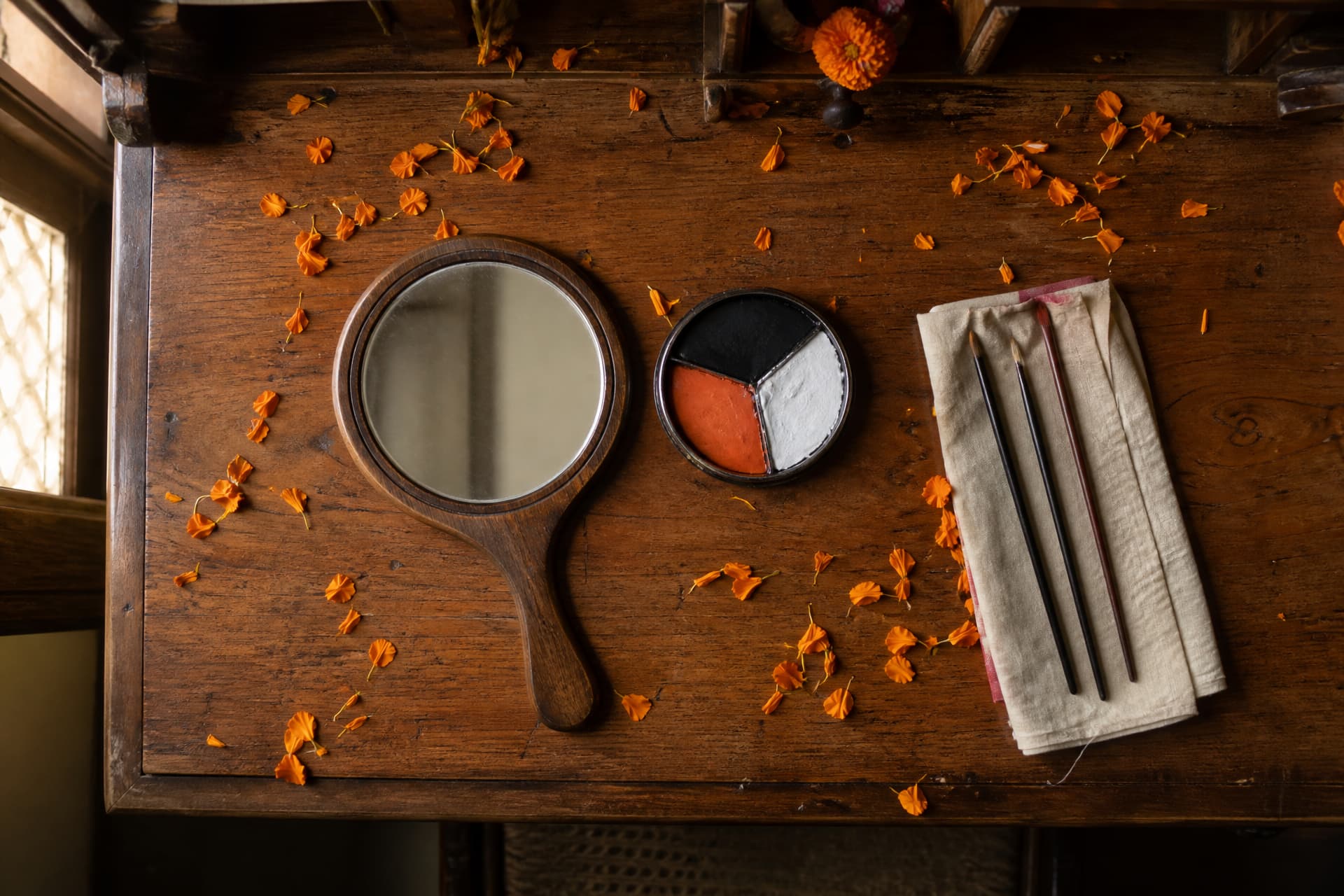
Participation looks like being at something that is actually a Day of the Dead observance, painting your face there, and knowing whose name is on the skull you are holding. Costume looks like the same face at a Halloween party with no dead person anywhere in the picture, a "sexy Catrina" outfit off a rack, the imagery used as generic spooky decor in October, or calling the holiday Mexican Halloween in front of people for whom it is the day they visit their mother. The paint is not the problem. The emptying-out is.
Tattoos work the same way, and sugar skull tattoos are extremely common on people with no Mexican heritage at all. The ones that carry weight are the ones that carry a name — the same move as the forehead, made permanent — and a named skull inked for a specific person is a memorial tattoo in the full sense. An unnamed one is a style, which is a legitimate thing to want and a different thing to claim.
If you are going as a guest to a family's ofrenda and want to say something to them, the register is not the American funeral register, and what to say in Spanish at a remembrance is worth reading first. Asking whose photograph is on the altar is almost always the right opening.
The face paint is not the line. Painting it to attend a remembrance and painting it for a costume party are two different acts that look identical in a photograph, and only one of them has somebody's name attached.
Frequently Asked Questions
What does a sugar skull symbolize?
A specific dead person, welcomed back for a visit. The skull's smile reflects the premise of the holiday — that the dead return as guests rather than as threats — and the name written across the forehead attaches the object to one individual. Without the name it is a symbol of the tradition generally; with it, it is an offering.
Whose name goes on a sugar skull?
Usually the person the family is expecting: a parent, a grandparent, a child. The skulls are sold blank and the name is piped on at the stall or at home. Names of living people are also written on them and given as gifts, which is an affectionate joke rather than a bad omen.
Can you eat a sugar skull?
The sugar shell and the icing are food, so a small plain one can be eaten and often is. A fully decorated display skull generally should not be — the eyes are foil, the sparkle is sequins, the plume is a feather, and it has been hardening in a market and on an altar for weeks. Chocolate and amaranth versions are made specifically to be eaten.
Is Day of the Dead the same as Halloween?
No. They fall on adjacent dates and share skeleton imagery, and that is where it ends. Halloween descends from northern European harvest-season traditions; Día de los Muertos is a Mexican observance built on All Saints' and All Souls' Days and on much older local practice, and its subject is not fright but hospitality toward named relatives.
Is it disrespectful to wear sugar skull makeup?
It depends entirely on the context. Worn while taking part in an actual remembrance, it is normal and welcomed. Worn as a Halloween costume, detached from any dead person, it takes a mourning practice and uses it as decoration — which is the thing people object to, rather than the paint itself.
What does a sugar skull tattoo mean?
Most often remembrance, and most strongly when it names somebody. A named sugar skull tattoo does what the icing on the forehead does and makes it permanent. Unnamed, it reads as an aesthetic borrowed from the holiday rather than a memorial to anyone.
One Culture's Answer to Everyone's Question
Every culture has to decide what to do about the fact that the dead do not stop mattering. Some build monuments. Some burn things. Some put a coin in a mouth or a stone on a grave. The answers look wildly different and they are all attempts at the same problem, which is why the symbols of grief and mourning that different traditions settled on rhyme so often once you look at what they are for rather than what they look like.
Mexico's answer is unusual in that it is cheerful, and unusual again in that it is edible. But the mechanism underneath a sugar skull — write the name, set the place, expect him — is the same mechanism as an engraved stone or an inscription inside a ring. It is a way of saying this one, not the dead in general.
That instinct travels. A family with no connection to Mexico who reads this page and then goes and puts a photograph, a candle and a bottle of his beer on a shelf has not appropriated anything; they have arrived at the same idea from another direction. And a family choosing how to hold somebody's ashes runs into exactly this question of whose customs a container should speak in, which is what an urn that honors faith and culture has to weigh. The sugar skull's answer is worth borrowing wherever you land: put the name on it.