🏬Supersize Online Funeral Retailer🪦1000's of Headstones⚱️Over 10,000 Cremation Urns⚰️Caskets Overnight Delivery🛒Funeral & Memorial Superstore🚚FREE Shipping on ALL Orders👨👩👧👦Helping Families for over 20 Years💰Lowest Price Guarantee🏬Supersize Online Funeral Retailer🪦1000's of Headstones⚱️Over 10,000 Cremation Urns⚰️Caskets Overnight Delivery🛒Funeral & Memorial Superstore🚚FREE Shipping on ALL Orders👨👩👧👦Helping Families for over 20 Years💰Lowest Price Guarantee
🏬Supersize Online Funeral Retailer🪦1000's of Headstones⚱️Over 10,000 Cremation Urns⚰️Caskets Overnight Delivery🛒Funeral & Memorial Superstore🚚FREE Shipping on ALL Orders👨👩👧👦Helping Families for over 20 Years💰Lowest Price Guarantee🏬Supersize Online Funeral Retailer🪦1000's of Headstones⚱️Over 10,000 Cremation Urns⚰️Caskets Overnight Delivery🛒Funeral & Memorial Superstore🚚FREE Shipping on ALL Orders👨👩👧👦Helping Families for over 20 Years💰Lowest Price Guarantee
The thanatos vs hades question has a short answer, and it is not the one most comparisons give. Thanatos ends a life. Hades rules the place the dead go afterward. They are not rivals, not two versions of one god, and not a strong death god and a weak one — they are two different jobs, and confusing them is like confusing a paramedic with a mayor.
There is also a third name, and leaving it out is why so many explanations feel incomplete. Somebody has to get the dead from the one to the other, and in Greek myth that somebody is Hermes.
What follows is what each of the three actually does, where the Greeks got the idea, and which parts of the modern version — the villain in the black cloak, the boss fight at the end of the level — the Greeks would not recognize at all. It sits alongside the other personifications of death in our death symbolism guide.
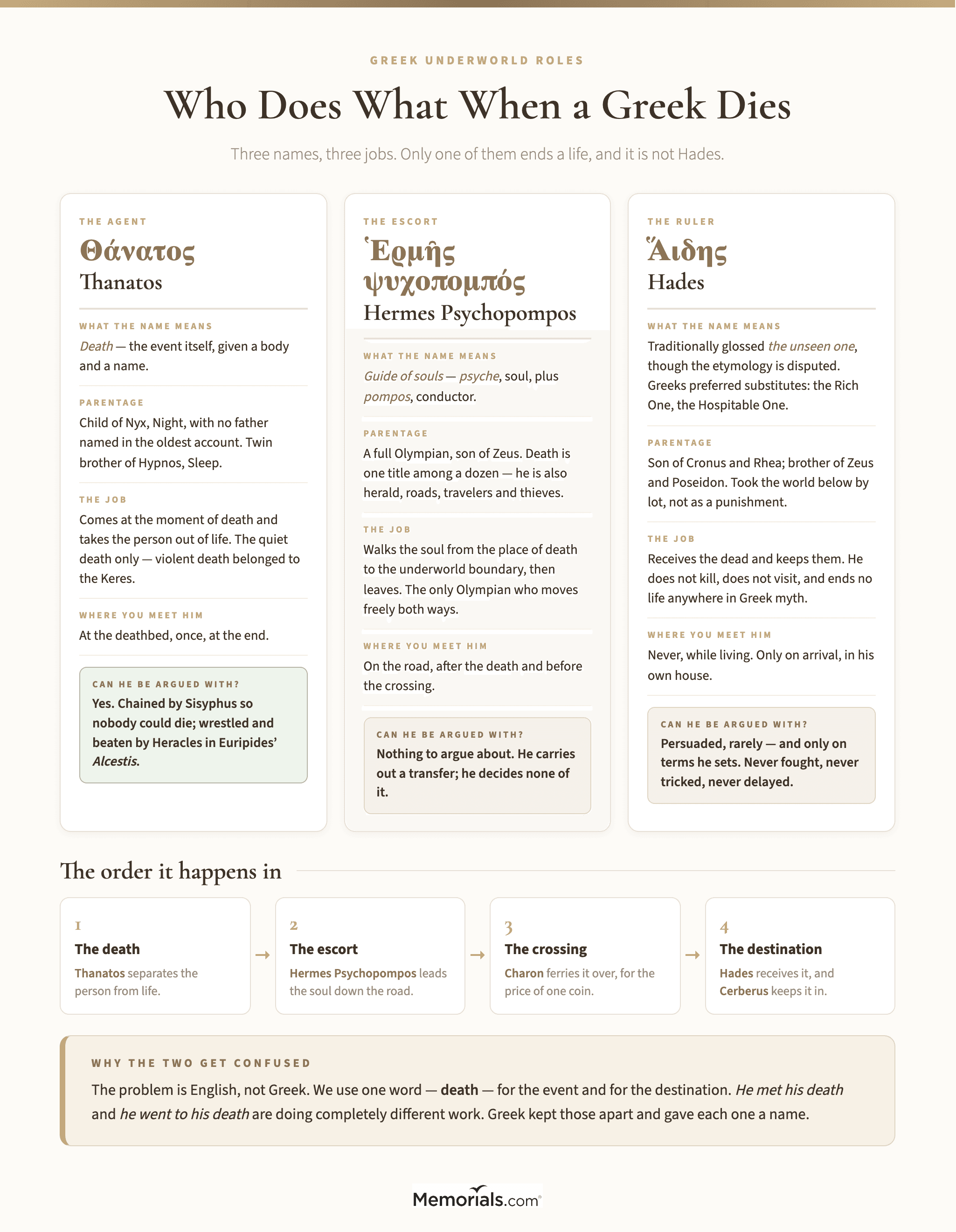
Set thanatos and hades side by side and every real difference sorts into three questions: what they are, what they do, and whether you can argue with them.
What they are. Thanatos is a personification — the fact of dying, given a body and a name. Hades is an Olympian-born god with a domain, a palace, a wife and a staff. One is an event wearing a face; the other is a landlord.
What they do. Thanatos comes at the moment of death and takes the person out of life. Hades never comes for anyone. He does not kill, does not visit, does not stalk the living. He receives what arrives and keeps it, which is a very different job description from the one the word death god suggests.
Whether you can argue with them. Thanatos can be wrestled, tricked and delayed, and in the surviving stories he is all three. Hades is essentially immovable. The handful of figures who get someone back out of his kingdom do it by persuading Hades himself, not by beating him — and the terms he sets are the point of every one of those stories.
The reason hades and thanatos get merged is a problem in English rather than in Greek. We use one word, death, for the event and for the destination — "he met his death" and "he went to his death" are doing completely different work. Greek kept those separate and gave each one a name.
Three figures, three jobs, in order. Thanatos ends the life, Hermes Psychopompos escorts the soul, Charon ferries it across, and Hades receives it and keeps it. Only the first two ever meet a living person, and only the first can be fought.
Thanatos: The One Who Does the Job
Thanatos is far less famous than Hades, and that is not an accident — the Greeks were never very interested in him.
His parentage tells you what he is. He is a child of Nyx, Night, born without a father in the oldest Greek account of how the world got assembled, and his twin brother is Hypnos, Sleep. Putting sleep and death in the same cradle is an old and durable idea, and Greek art ran with it: a celebrated painted vase of the late sixth century BC shows the two brothers as winged young men, lifting the body of the fallen hero Sarpedon to carry him home from the battlefield. That episode comes from the Iliad, traditionally dated to around the eighth century BC, and it is the gentlest thing anyone in Greek myth does for a corpse.
That gentleness is deliberate. Thanatos handles the quiet death — the one that arrives at the end. Violent death had its own personnel: the Keres, a swarm of female spirits who tore the life out of men on the battlefield, greedy and numerous where Thanatos is single and calm. A Greek audience heard the difference immediately, and English flattens it into one word again.
Two stories are worth having, because they are the ones people half-remember.
Sisyphus binds him. In one version of the story, the trickster king Sisyphus gets chains onto Thanatos himself — and while Death sits tied up, nobody on earth can die. The gods have to send someone to free him. It is a comic premise and it makes a serious point: Thanatos is a mechanism, and mechanisms can jam.
Heracles wrestles him. In Euripides' play Alcestis, a young wife dies in her husband's place and Heracles goes to the tomb, ambushes Thanatos there, and wins her back by force. It is the only fight of its kind in Greek literature, and it is possible only because Thanatos is a functionary. Nobody wrestles Hades.
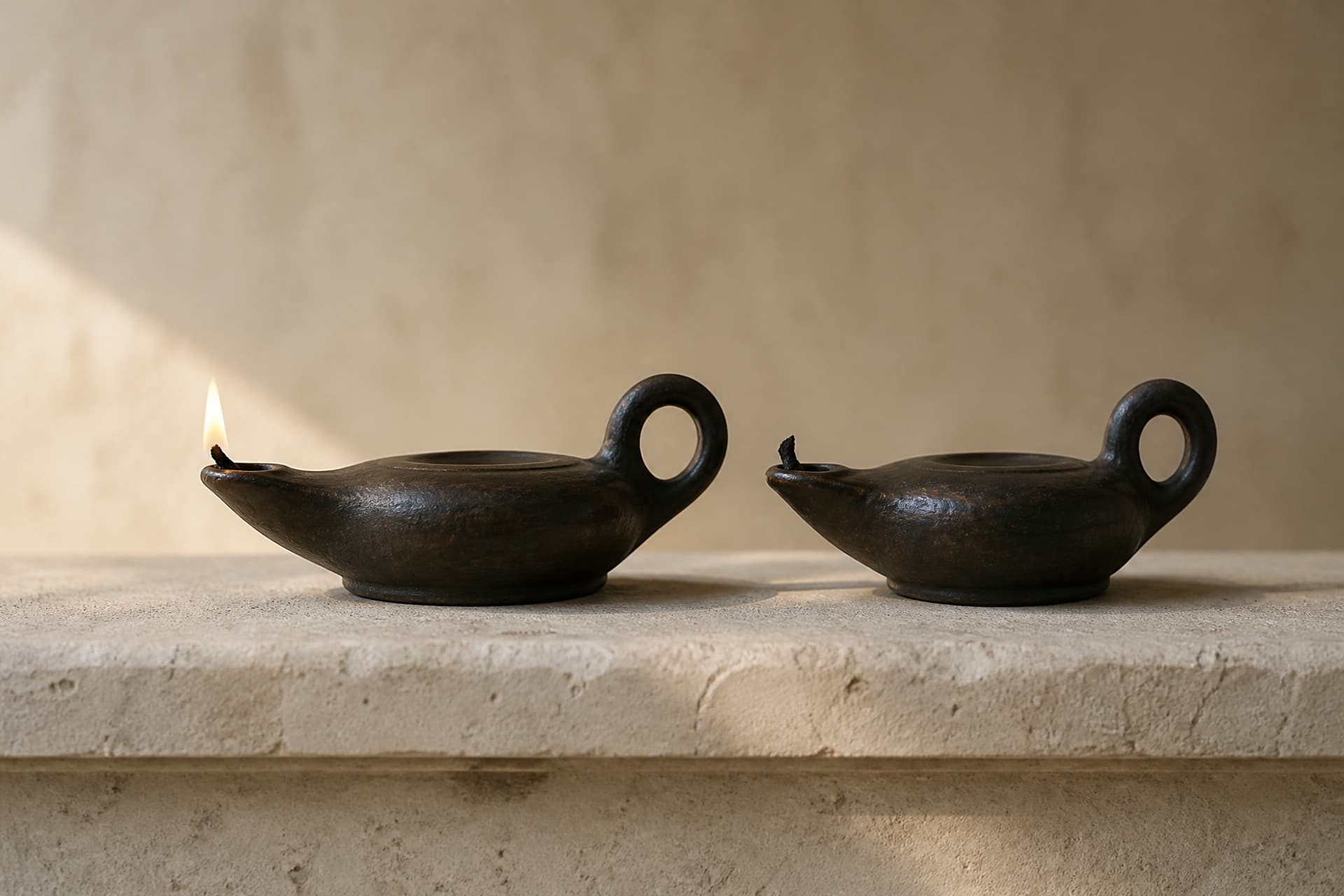
Sleep and Death were twins in Greek thought, which is why the two states get the same imagery — one lamp lit, one lamp out, the same object either way. Thanatos was the peaceful death; the violent ones had different names entirely.
He attracted almost no worship. There is no great festival of Thanatos, no oracle, no priesthood worth naming — the Greeks saw no sense in praying to the moment of death itself, and they said as much in the way they wrote about him: needed, honest, and not liked.
The name survived anyway, and it is still working. Euthanasia is Greek for a good death, eu plus thanatos, and it entered English meaning exactly that before it acquired its modern legal sense. Thanatology — the academic study of death, dying and bereavement — is the same root, and it is a live field with journals and university departments. Two of the most clinical words English has for death come from the god nobody prayed to.
Hades Is Not the Greek God of Death
The phrase people actually type is Greek god of death Hades, and it fuses two separate figures into one. It is an easy mistake, and undoing it explains most of what is strange about him.
Hades is one of three brothers, sons of Cronus and Rhea, alongside Zeus and Poseidon. After the older generation of gods was overthrown, the three divided the world between them — Zeus took the sky, Poseidon the sea, and Hades what lay beneath. The division is described as a matter of lots drawn, not of merit or punishment, which means Hades is not in exile and not being penalized. He runs a third of everything.
His name is usually glossed as the unseen one, and that gloss is traditional rather than settled — the ancient etymology is disputed and the modern ones do not agree either. What is not disputed is that Greeks avoided saying it. You called him the Rich One, or the Hospitable One, or simply the god below, the way people still avoid saying cancer out loud. The commonest of those substitutes was Plouton, the wealthy one — because everything that grows and every metal that is mined comes out of the ground he owns. Rome borrowed that name rather than the frightening one, which is why he reaches English as Pluto.
Where he was worshiped at all, it was usually under the kinder name. Ancient writers describe a temple of his at Elis that opened one day of the year and admitted only its priest, which is about as close to a normal cult as he gets.
He owns one famous object, and it is not a scythe. It is a helm that makes the wearer invisible — the gods' equivalent of a spare key, lent out to Perseus and to others when a job needed it. And he has one famous story, the taking of Persephone, in which he carries off Demeter's daughter to be queen below and the earth stops growing until a compromise is reached. Read it as an abduction myth and it is grim; read it as a seasonal myth and it is agricultural. The Greeks read it as both.
A threshold, not a throne. Hades governs a place with a door, and the one rule everyone in Greek myth knows is that the door opens inward far more easily than out.
What he is not is a devil. This is the single largest distortion in the modern picture, and it comes from mapping Greek furniture onto Christian theology. Hades does not tempt anyone, does not want souls, does not oppose the sky gods, and is not the author of evil. His realm is not hell — it is where everyone goes, the decent and the wicked alike, and the punishments happen in one corner of it rather than throughout. He is a warden, not a torturer, and he is notably strict about the rules he did not write.
There is one clean summary of the difference. Search for the Greek god of death Hades and you will find him described as the one who ends lives, and he does not end a single one anywhere in Greek myth. He receives.
Hermes Psychopompos: The Third Name Most Comparisons Leave Out
Once the two roles are separated, an obvious gap opens up. Thanatos ends the life. Hades receives the dead. Who does the walking?
Greek gives him a title for it: Hermes Psychopompos, from psyche, soul, and pompos, guide or conductor. It is written Hermes Psychopompos in Greek and usually shortened in English to Hermes Psychopomp, and English kept the second half of it as an ordinary noun — a psychopomp is now the standard comparative term for any figure whose job is escorting the dead, in any tradition.
Hermes is the right god for it because of what he already was. He is the messenger, the herald, the god of roads and boundaries and travelers and — tellingly — of thieves, which is a job about crossing lines that are not supposed to be crossed. He is the only Olympian who moves freely in both directions between the living world and the world below. This is Hermes the underworld guide, not Hermes the trickster of the cattle-stealing stories, but they are recognizably the same god: the one who can be somewhere he does not belong.
It is the psychopomp Hermes who opens Book 24 of the Odyssey. The suitors have just been killed, and Hermes summons their souls with his golden wand — they follow him squeaking like bats, down past the gates of the sun to the meadow of asphodel where the dead live. Nothing in the passage is a punishment. It is a transfer, conducted by a god with a staff, and it reads more like an escort than an arrest.
The escort is the part the modern versions cut. Greek funerary vases are full of this moment — a figure being led along a road — and almost empty of anything resembling a reaper coming to collect.
Hermes in the underworld is a visitor, never a resident. He goes down and he comes back, which is exactly why he is also the one sent to bring Persephone up when the compromise is struck. Charon ferries and stays. Hades rules and stays. Hermes arrives, hands over and leaves, and that is the whole distinction between an escort and a keeper.
Athenian funeral pottery shows him doing it constantly — leading the dead toward the riverbank, sometimes gesturing them onto the ferry. If you have ever wondered why the Greek underworld has so many staff, this is the reason: the Greeks thought of dying as a journey with stages, and a journey with stages needs a guide, a ferryman and a destination, not one hooded figure who does everything.
Getting In: Charon, the Fare and the Rivers
The journey has a toll, and it is the detail everybody remembers.
Charon is the ferryman, an old man with a pole, and he does not work for free. The dead were sent off with a small coin — an obol — placed in the mouth to pay him, and a soul who arrived without one could be left waiting on the near bank. The custom is one of the most durable images in Western culture and it has a page of its own: see our guide to the obol coin for where the practice came from, how widespread it really was, and what the archaeology actually shows.
It is worth saying plainly that the coin-on-a-grave customs alive in America today are not descended from this one. The tradition of leaving coins at a military headstone has its own, much more recent history, and if that is what brought you here, the real story behind why coins are left on headstones is a modern American one.
Past the ferry there is the dog. Cerberus faces inward, which is the joke most retellings miss — his job is not keeping the living out but keeping the dead in.
The geography beyond that got tidier over time, and the tidying is later than the myths. In the oldest Greek picture, the underworld is one dim, undifferentiated place where everyone ends up equally diminished; the famous line in the Odyssey has the greatest of the heroes saying he would rather be a poor man's laborer alive than king of all the dead. Only later does the map acquire compartments: Tartarus far below for the punished, the Elysian Fields for a favored few, and the asphodel meadows in the middle for everyone else. The three judges who sort them — Minos, Rhadamanthys and Aeacus — arrive later still, in philosophy rather than in epic. If a summary of Greek myth reads like an organized afterlife with a sorting process, it is describing the late version.
Why the Search Splits Two Ways
Search it as hades vs thanatos and you get the identical confusion pointed from the other end, which is a sign that the trouble is not in either name but in three things that happened to them.
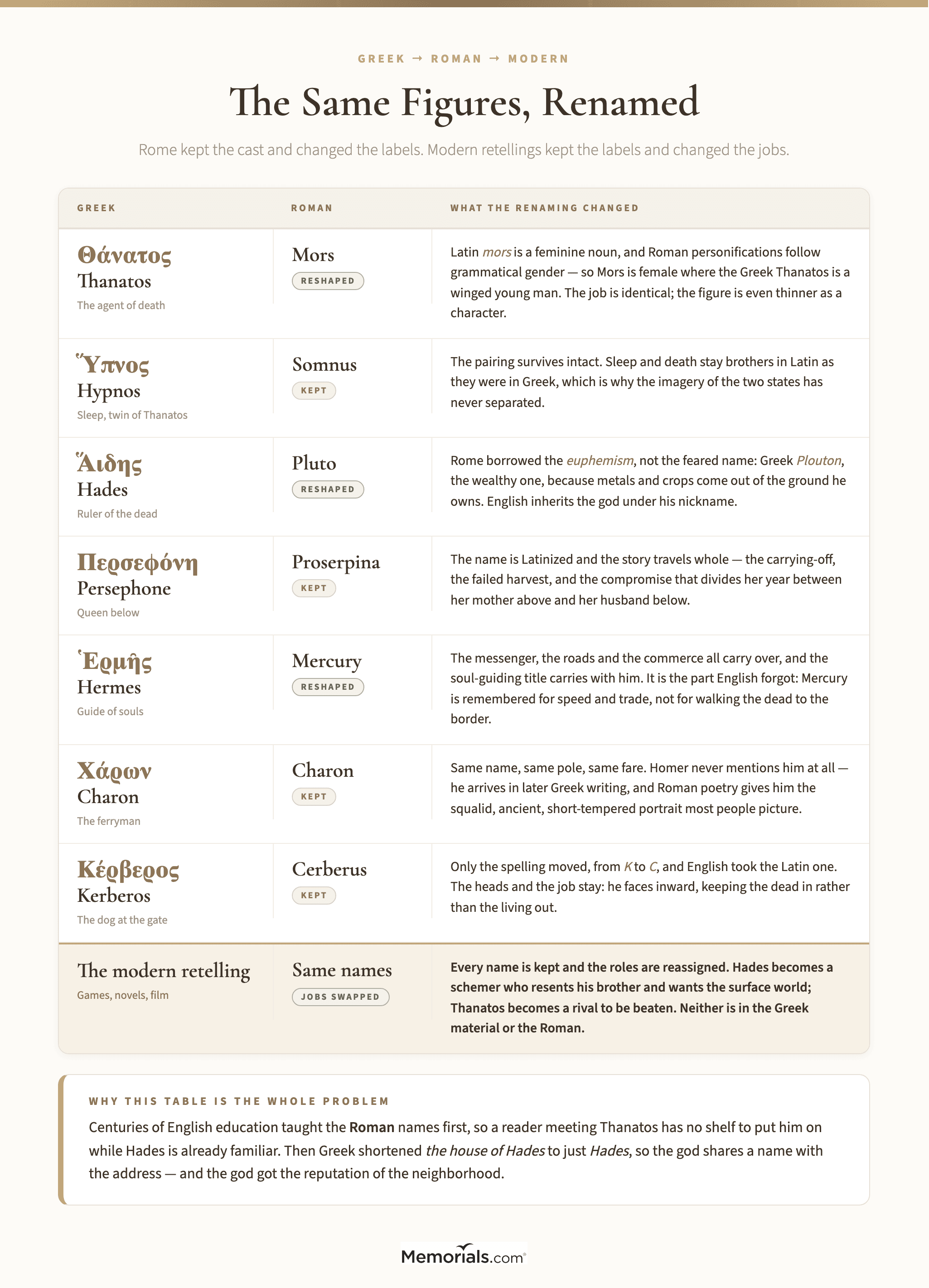
Rome renamed everyone. Hades became Pluto, Thanatos became Mors, Hypnos became Somnus, Hermes became Mercury. The Roman versions are not identical to the Greek ones, and centuries of English education taught the Roman names first, so a reader meeting Thanatos for the first time has no shelf to put him on while Hades is already familiar.
The name became a place. Greek said the house of Hades and then shortened it, so Hades is both the god and the address. When Greek-speaking translators needed a word for the realm of the dead in scripture, Hades is the word they used — and English inherited it sitting suspiciously close to hell, a very different concept with a very different job. The god got the reputation of the neighborhood.
Modern entertainment needed a villain. Games, novels and films have to give a story an antagonist, and a god who rules the dead is the obvious candidate — so the modern Hades schemes, resents his brother and wants the surface world, none of which is in the Greek material. Thanatos gets a parallel promotion: in the modern versions he is frequently a rival or a boss to be beaten, where the Greek Thanatos is closer to a civil servant. If you arrived here from a game, you were not misled about the names. You were shown a rewrite, and the rewrite is genuinely good — it is just not the source.
The same object, transmitted twice. Most confusion about these figures is breakage in transmission — a Greek name, a Roman renaming, and then a modern retelling that needed a villain.
Every figure in the Greek underworld picked up a Roman name, and several picked up a different personality with it. The last row is the one doing the most damage today: the modern retelling, which keeps the names and changes the jobs.
Every Tradition Splits the Job Differently
The three-way split is not universal, and comparing it outward is the fastest way to see that it was a choice.
Japan divides it differently again. The word an English speaker would translate as grim reaper is shinigami, and it is not one being at all but an uncountable class of death spirits — no fixed appearance, no agreed number, and in the older stories closer to an influence that settles on a person than an escort who arrives for them.
Islamic tradition goes the other way and consolidates. Where Greek myth needs three names, Islam names one specified agent with one defined duty, which is what makes the angel of death in Islam so unlike a loose pantheon of underworld staff. One figure, one appointed task, no bargaining.
And some traditions decline the figure entirely and put the emphasis on the dead themselves. The sugar skull of the Mexican Day of the Dead names an individual person rather than a deity — it is the returning dead who matter, not whoever brought them.
Seen against those, the Greek arrangement looks like what it is: a bureaucracy. An agent for the moment, a guide for the road, a ferryman for the crossing, a warden for the destination, and later a panel of judges. It is the most administrative afterlife in ancient literature, and the Greeks seem to have found that reassuring.
What the Greeks Actually Did About Death
None of these figures turns up in a Greek funeral. The rites were for the family and the community, and they had a shape that would be recognizable at a funeral home today.
The body was washed, anointed with oil, dressed and laid out at home on a bier — the prothesis — with the women of the household keeping watch and leading the lament. Before dawn the ekphora, the carrying-out, moved the body to the burial ground outside the city walls, in procession and deliberately out of public view. Both burial and cremation were practiced, side by side, in the same cities and sometimes in the same families; the choice appears to have been a matter of period, region and cost rather than doctrine. The idea that a body must return to the earth is older and wider than the Christian phrase that carries it in English, and the same instinct sits behind ashes to ashes, dust to dust.
Then came the marker and the visits. Greek graves were marked with carved stone slabs, painted vessels and small offerings, and families returned to them on set days with food, drink and oil. The container mattered — the vessel a person's ashes went into was chosen and sometimes decorated for them, which is a thread that runs through the history of coffins and caskets and has never really been broken.
A grave marker is the part of Greek death practice that survived intact. The gods changed names and then changed jobs; the upright stone with a name on it did neither.
One thing above all was non-negotiable: the dead had to be buried. Leaving a body unburied was not a discourtesy in Greek thought, it was a violation with consequences — the whole plot of Sophocles' Antigone turns on a woman choosing burial for her brother over obedience to a king, and losing everything for it. That is the closest the Greeks came to a doctrine about death, and it says nothing about Hades at all. It is about the living.
Frequently Asked Questions
Is Thanatos more powerful than Hades? No, and the comparison does not really apply. Hades is a ruling god with a domain, a cult and a place in the divine hierarchy; Thanatos is a personified event who carries out one function. Thanatos can be chained by a mortal king and beaten in a wrestling match, and neither is imaginable for Hades.
Is Hades the Greek god of death? He is the god of the dead, not of death — the distinction the Greeks kept and English lost. Hades rules the place the dead go and never causes a death anywhere in the mythology. The god who ends a life is Thanatos.
What is the difference between Thanatos and Hermes? Thanatos separates a person from life; Hermes Psychopompos escorts the soul from there to the underworld boundary. One is the event, the other is the journey. Hermes is also a full Olympian with a dozen other jobs, where Thanatos does one thing.
Are Thanatos and Hades brothers? No. Hades is a son of Cronus and Rhea, brother to Zeus and Poseidon. Thanatos is a child of Nyx, Night, from an older and separate line, and his actual twin is Hypnos, Sleep. They work in the same system without being related.
Is Thanatos evil? Nothing in the Greek material presents him that way. He is described as hard, unbending and impossible to persuade, which is not the same as malicious — he is the one figure who treats every person identically. Later art softened him further into a winged youth with a lowered torch. The scythe and the skull are a medieval European invention with no Greek ancestry at all.
In Closing
Three names, three jobs. Thanatos ends the life, Hermes walks the soul to the border, and Hades receives it and keeps it. The reason the question is asked so often is that English collapsed two ideas into one word, Rome renamed the whole cast, and modern retellings needed somebody to fight.
What is worth taking from the Greek version is the shape of it rather than the personnel. They imagined dying as a sequence with stages, and gave every stage a name, a job and a rule — which is a way of saying that death has parts, and that each part can be prepared for. That is not a bad description of what a funeral still does.
If it is the imagery rather than the mythology that brought you here, the recurring symbols of grief and mourning are where the visual language is set out, and the much longer catalog of headstone symbols and their meanings covers what families have actually chosen to carve. And if you are choosing something for a family whose tradition is not your own, our guide to an urn that honors faith and culture is the place to start.