🏬Supersize Online Funeral Retailer🪦1000's of Headstones⚱️Over 10,000 Cremation Urns⚰️Caskets Overnight Delivery🛒Funeral & Memorial Superstore🚚FREE Shipping on ALL Orders👨👩👧👦Helping Families for over 20 Years💰Lowest Price Guarantee🏬Supersize Online Funeral Retailer🪦1000's of Headstones⚱️Over 10,000 Cremation Urns⚰️Caskets Overnight Delivery🛒Funeral & Memorial Superstore🚚FREE Shipping on ALL Orders👨👩👧👦Helping Families for over 20 Years💰Lowest Price Guarantee
🏬Supersize Online Funeral Retailer🪦1000's of Headstones⚱️Over 10,000 Cremation Urns⚰️Caskets Overnight Delivery🛒Funeral & Memorial Superstore🚚FREE Shipping on ALL Orders👨👩👧👦Helping Families for over 20 Years💰Lowest Price Guarantee🏬Supersize Online Funeral Retailer🪦1000's of Headstones⚱️Over 10,000 Cremation Urns⚰️Caskets Overnight Delivery🛒Funeral & Memorial Superstore🚚FREE Shipping on ALL Orders👨👩👧👦Helping Families for over 20 Years💰Lowest Price Guarantee
An obol coin was a small silver coin used in ancient Greece, and it has a second life as the most famous object in the Greek afterlife: the fare placed with a dead person to pay Charon, the ferryman who carried souls across the river into the underworld. The custom has a name in modern scholarship — Charon's obol — and a very long afterlife of its own in painting, opera, novels and games.
The short version is that the story is true, the object was real, and almost every confident detail attached to it is shakier than it sounds. The Greeks did put coins in graves. They did not all do it, they did not always put them in the same place, and the tidy picture of a coin resting on each closed eyelid comes from somewhere else entirely.
What follows is what an obol was as money, what the ancient writers actually say about the fare, what archaeologists actually find in the ground, and where the modern versions came from. It sits alongside the other emblems and figures in our . And if you arrived here because you saw coins resting on a headstone at a cemetery and went looking for an explanation, that is a different custom with a much more recent history — the honest answer to is an American one, not a Greek one.
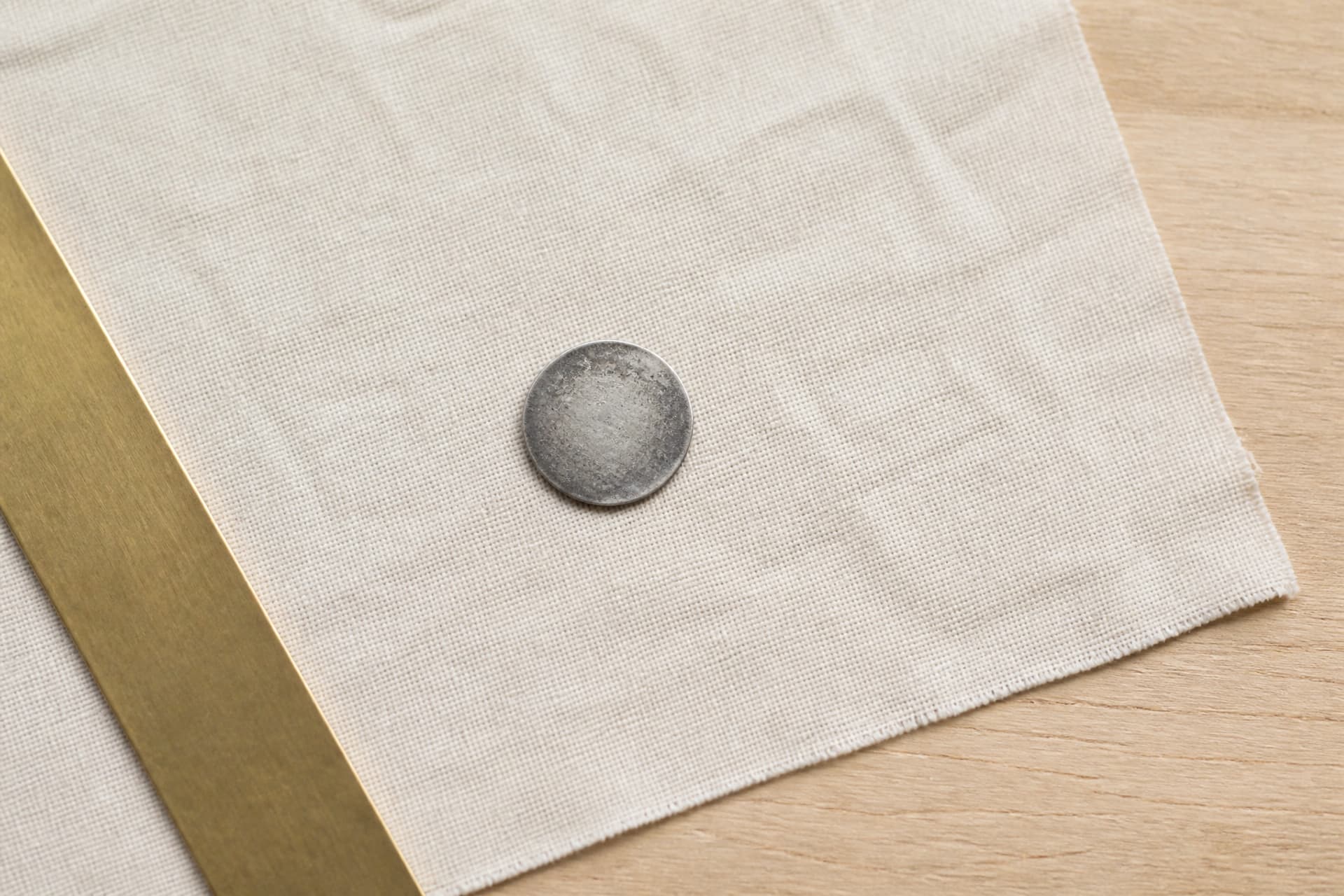
The obol was a denomination of ancient Greek silver coinage, and it was a small one: six obols made one drachma. That ratio is the whole of what the name guarantees. Weights, purity and buying power moved around considerably between cities and across centuries, and any single figure quoted for what an obol would buy is a reconstruction rather than a fact — so it is worth resisting the urge to translate it into modern money at all. The useful thing to hold onto is that a Greek obol was small change, physically as well as financially. Many surviving examples are the size of a fingernail and thin enough to be awkward to pick up.
The name has a memorable derivation, and it is the traditional one rather than a settled one. Obolos is usually connected to obelos, a spit or skewer — the iron rods that are thought to have served as a bulky pre-coinage currency. Six of them made a handful, and drachma is linked in the same account to a verb meaning to grasp. Whether the etymology is history or a later rationalization, it stuck, and it explains why the two denominations are locked to each other at six to one.
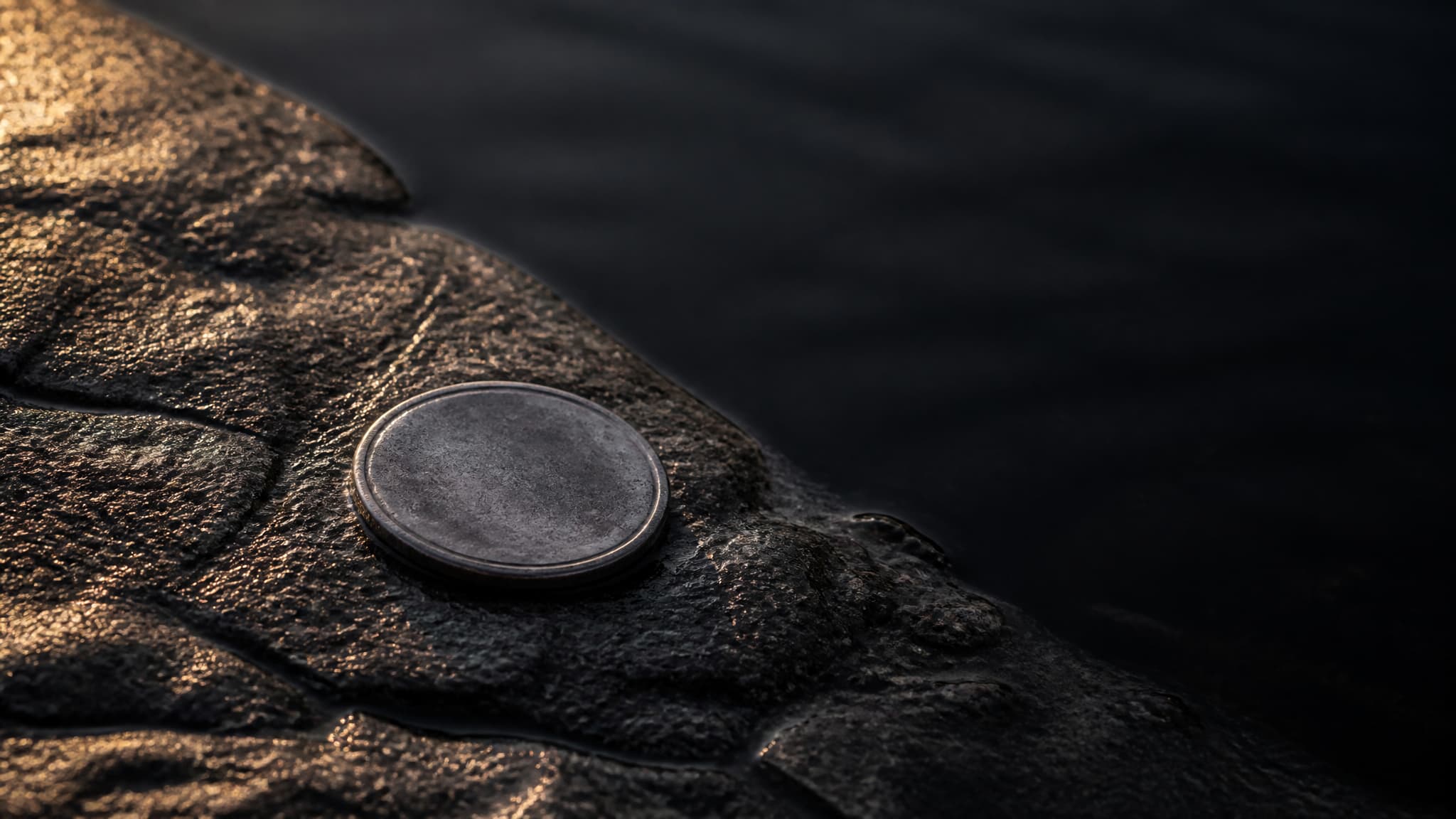
The scale is part of the story. An obol was small change, often not much wider than a fingernail — which is exactly why it could be carried in a mouth without anyone thinking it strange.
That smallness matters for the burial custom. The fare was not a treasure and was never described as one. It is a token payment: enough to satisfy a rule, not enough to be worth stealing. Every version of the story depends on the amount being trivial and the obligation being absolute.
Charon's Obol: Paying the Ferryman
The Greek underworld had staff, and Charon was the one you could not go around.
In the arrangement the Greeks described, a person's death and a person's destination were separate jobs handled by separate figures — an account this hub sets out in full under Thanatos, Hermes and Hades. Between the dying and the arriving there was a crossing, and the crossing had a boatman. Charon is drawn as an old man with a pole and a bad temper, working a flat-bottomed boat over a dark river, and he does not work for nothing.
That is the whole mechanism behind Charon's coin. The fare buys passage. A soul who arrives without it is described as being left on the near bank, and the near bank is the worst place in the system to be — not punished, just stuck, belonging to neither side. The dread in the story is not of the ferryman. It is of being the one person he will not take.
The fare turns up in comedy, which is a good sign that the audience knew it cold. Aristophanes staged Frogs in 405 BC, and in it the god Dionysus is briefed on the trip to the underworld like a traveler being told what a taxi costs; the boat fare is quoted at two obols, with a joke attached about who introduced the charge. Centuries later Lucian, writing in Greek in the second century AD, returns to the fee repeatedly in his satirical dialogues of the dead, with Charon complaining about collection the way any ferryman would. Between them, those two tell you that Charon's obol coin was a stock idea for a very long time and that people were comfortable enough with it to laugh.
Charon poles rather than rows, in most of the descriptions and most of the pictures. The boat is a working river ferry, not a funeral barge — which is the point of the fare.
Charon also survives in pictures. Athenian potters made white-ground lekythoi — slim oil flasks painted for graves — and Charon appears on them with his boat and his pole, sometimes with a figure being led toward him. That is worth pausing on. These were objects made specifically to be left with the dead, decorated with an image of the journey the dead were about to make. The people buying them clearly took the picture seriously, whatever they privately believed about a literal river.
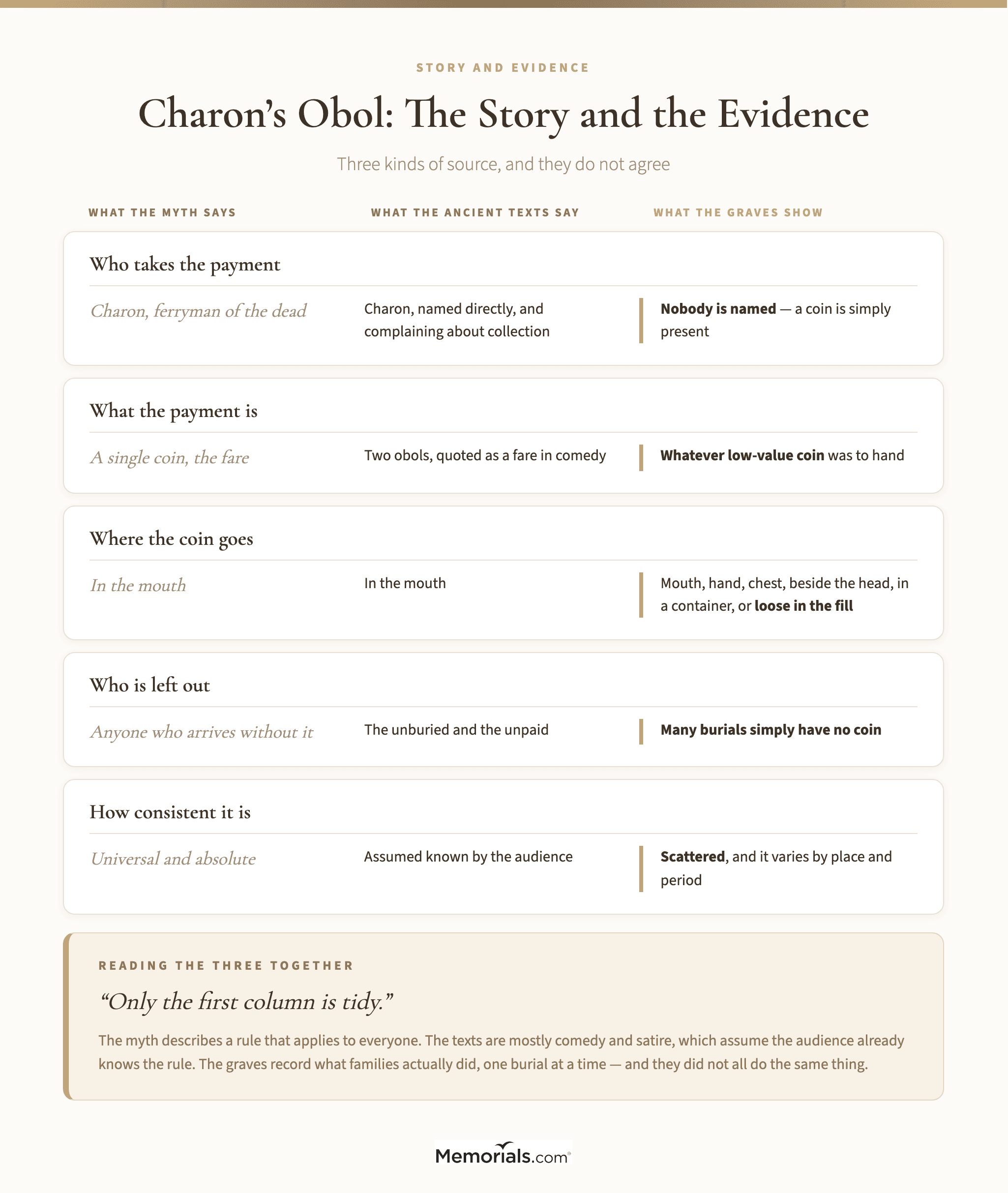
Three different kinds of source, and they do not agree. The myth describes a rule that applies to everyone, the texts are mostly jokes and satire that assume the audience knows the rule, and the grave evidence is scattered and inconsistent. Only the first of the three is tidy.
What the Graves Actually Show
Here the story and the evidence come apart, and the gap is the most interesting thing on this page.
Coins are genuinely found with ancient burials around the Greek and Roman world. Archaeologists have a name for them — Charon's obol is the standard term for a coin recovered from a grave in a position that suggests it was deliberately placed. What the finds do not support is the version most retellings imply: that this was a universal, uniform, obligatory rite performed the same way everywhere.
Three things complicate it.
Not every grave has one. Coins appear in some burials and not in others, in the same cemeteries and the same periods. Whatever governed the choice — local custom, family means, religious conviction, plain habit — it was not a rule everybody followed.
The coin is not always in the mouth. Excavated coins turn up in the mouth, yes, but also in a hand, on the chest, beside the head, inside a container placed with the body, or simply loose in the grave fill where they may have been thrown in at the graveside. Several of those positions carry a completely different implication from a fare tucked under the tongue.
The coin is not always an obol. What was deposited was frequently whatever low-value coin was to hand. Ancient glossaries also preserve the word danake for a coin given to the dead — a term borrowed from Persian currency — which suggests the idea was portable across coinages and that the denomination mattered less than the gesture.
Put together, that produces a much more human picture than the mythology does. Some families sent someone off with a coin because it was what you did. Some did not. Some put it where the story says, and some put it wherever felt right. The custom was real; the uniformity is a later tidying-up, and the same tidying happens to almost every burial practice once it becomes a symbol. The physical containers changed constantly too — the history of coffins and caskets is a long record of local variation getting smoothed into a standard only quite recently.
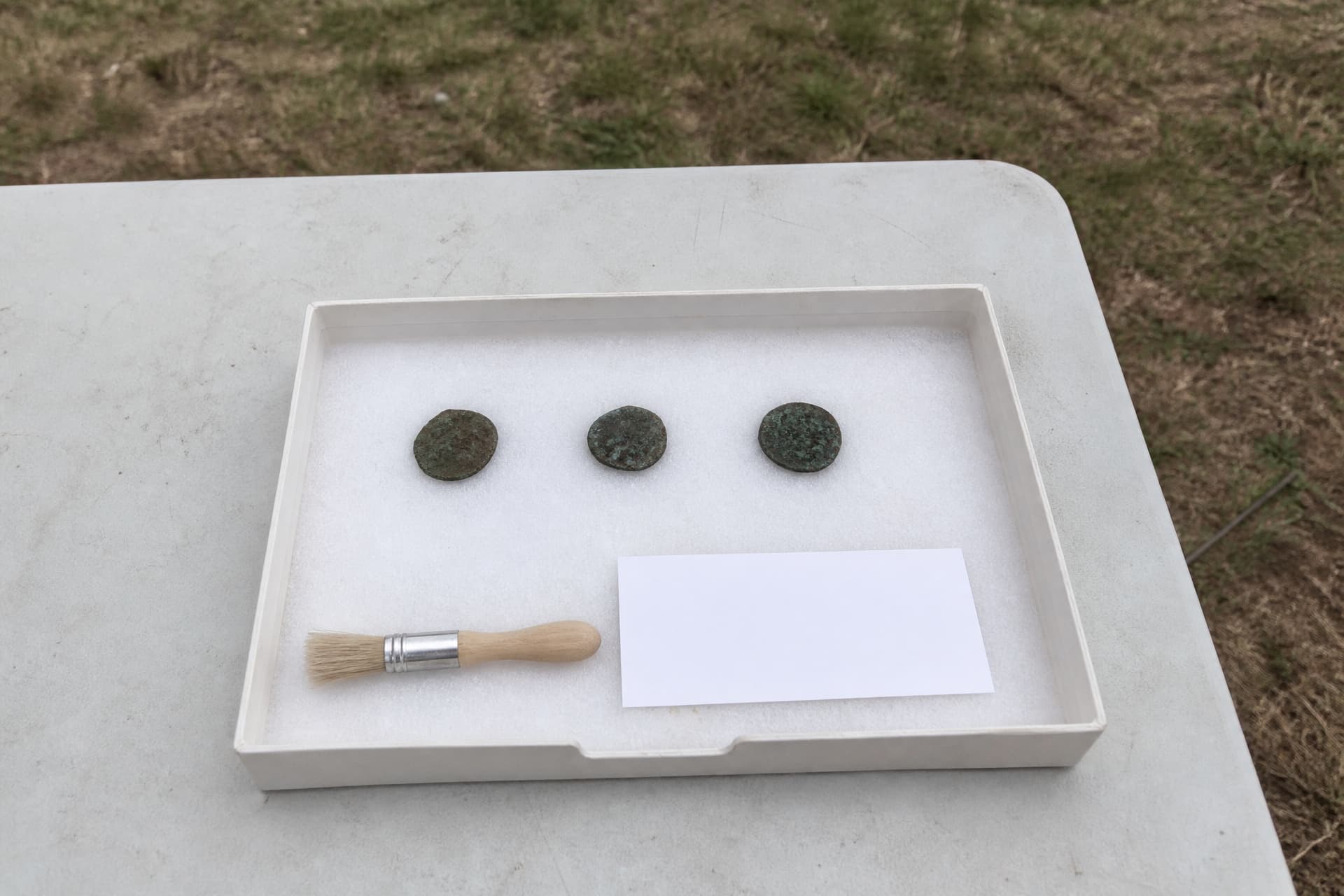
A grave coin usually reaches us like this — corroded, low in value, and easy to miss. That is part of why the evidence is patchy: a small coin in disturbed soil is one of the easiest things on a site to lose.
The honest summary is the one the sources support: placing a coin with the dead was a recognizable practice over a long period across a wide area, it was understood in terms of the ferryman, and it was never something all Greeks did in one agreed way.
The Coins-on-the-Eyes Problem
Ask most people to picture this custom and they will describe two coins resting on closed eyelids. That image is extremely durable, and it is not what the Greek material describes.
The ancient accounts of Charon's fare put the coin in the mouth. That is the position the texts name, it is the position the term in the mouth preserves, and it is one of the positions excavation supports. A payment carried in the mouth also makes obvious sense for a payment: it is held, it is hidden, it stays put.
Coins on the eyes are a separate custom from a different world. Placing weights on the eyelids of a body is documented in relatively recent English and American folk practice, and it has a blunt practical rationale — eyelids do not reliably stay closed, and a small flat weight holds them until they do. Pennies were simply the flat weight everybody had in a pocket. Whether that practice descends from the Greek one, borrowed its meaning later, or arrived independently and got attached to Charon afterward by people who knew the myth, is genuinely unsettled. The connection is asserted far more often than it is demonstrated.
It is worth separating them for a reason beyond pedantry. One is a payment made by the dead person, to a specific figure, at a specific gate. The other is a piece of practical care performed by the living for the body in front of them. They are not the same idea in two costumes, and merging them loses both.
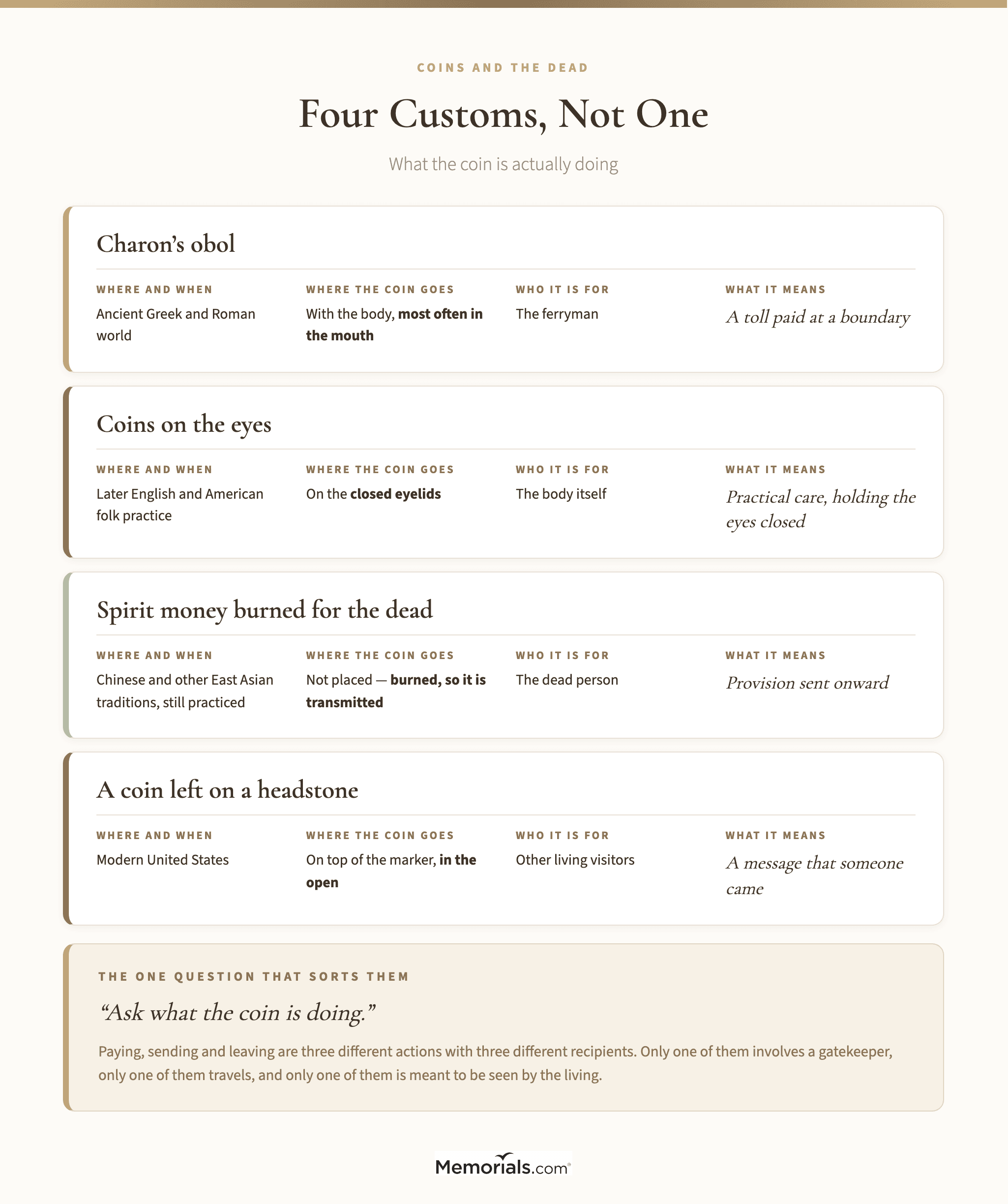
Four customs that get filed together under "coins and death" and share almost nothing. The obol is a toll paid at a gate. Coins on the eyes are practical care for a body. Burned paper money is currency sent onward. A coin on a headstone today is a message left for the living.
Paying, Sending and Leaving Are Three Different Things
Once the eyes version is set aside, a cleaner way of sorting these customs appears, and it works across cultures rather than only inside Greek myth. Ask what the coin is doing.
Paying. The obol is a toll. There is a barrier, an official, a fixed price and a consequence for arriving without it. The transaction happens once, at a boundary, and the dead person is the one making it. This is a surprisingly bureaucratic idea of death, and the Greeks seem to have found it reassuring rather than grim.
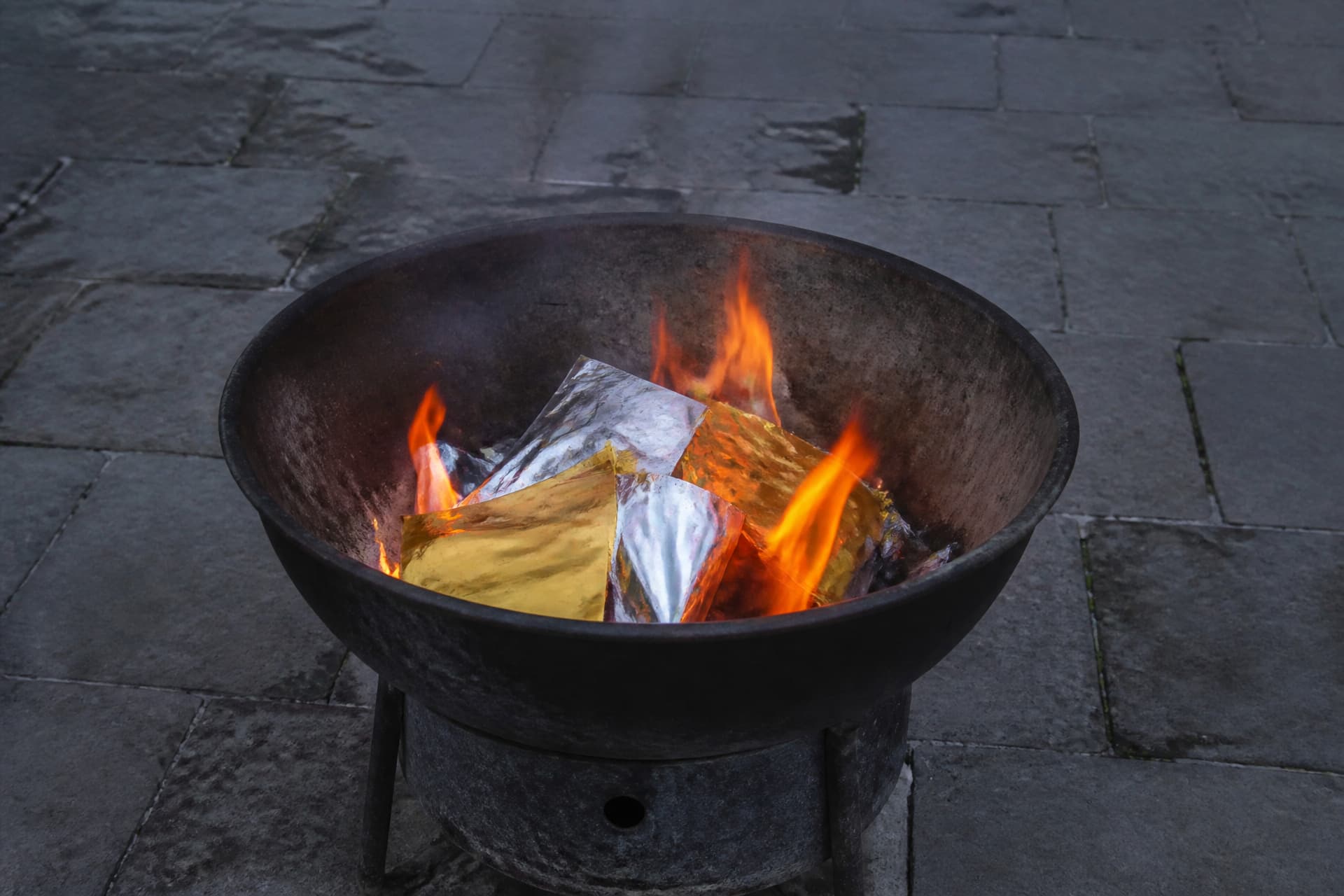
Sending. In Chinese and other East Asian traditions, paper representations of money and goods are burned so that what they represent reaches the dead and is theirs to spend. The mechanism is transmission rather than payment: there is no gatekeeper taking a cut, and the point is provision, not permission. The custom is still widely practiced and the reasoning behind burning paper money for the dead is a different theology from Charon's, not a variation on it.
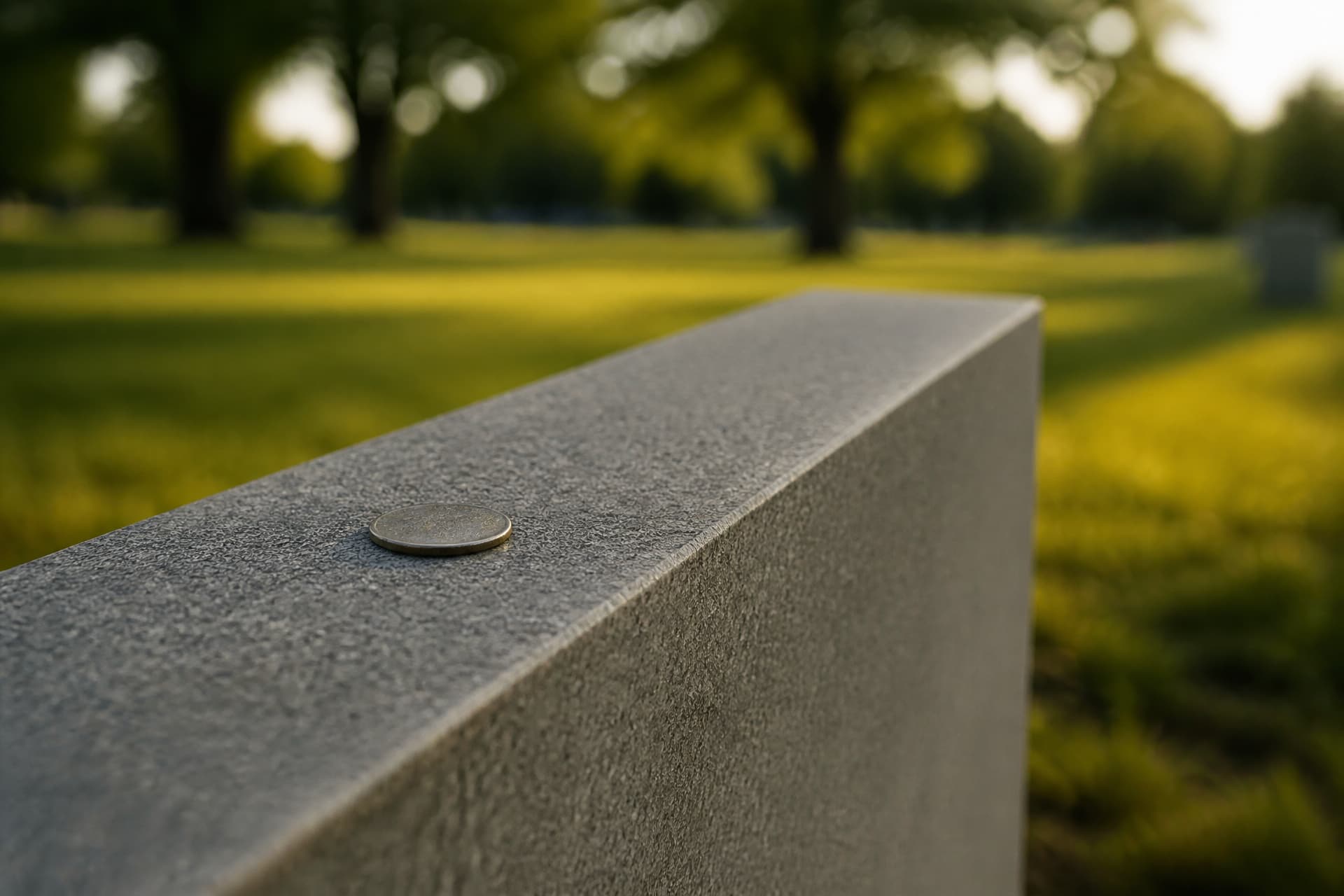
Leaving. A coin left on a grave today is neither paid nor sent. It stays on the stone, in the open, where other living people will see it — and being seen is the whole function. The most codified version in the United States is the practice of coins left on military graves, where different denominations are widely said to carry different messages about the visitor's connection to the person buried there. It is a communication between the living, using a grave as the noticeboard. Whether the modern custom borrowed anything at all from the ancient one is the question that page takes up, and the answer is less romantic than the internet usually reports.
Burning sends; the obol pays. The distinction sounds small and it is not — one custom assumes the dead need resources of their own, the other assumes they need clearance to arrive.
A fourth category sits slightly outside the money question and is worth naming, because it explains why the sorting matters. Some traditions do not give the dead anything to carry at all — they set out things for the dead to come back to. A sugar skull on a Day of the Dead altar names an individual person and waits for them. Nobody is being paid, nothing is being transmitted, and the direction of travel is reversed.
Why the Image Lasted
A small, inconsistent, low-value burial deposit became one of the most recognizable images in Western culture. That is worth accounting for.
The reason is compression. The obol packs an entire theology into an object you can hold: there is somewhere else, getting there is a journey, the journey has a boundary, the boundary has a keeper, and the keeper has terms. Nothing else in the Greek picture does that much work in one gesture. A painting can show it, a sentence can carry it, a film can put it in a hand in two seconds, and every audience since has understood it immediately without a footnote.
It also survives because it is transactional, and transactions are memorable in a way that atmospheres are not. Most funeral symbolism is about mood and continuity — the recurring symbols of grief and mourning run to doves, urns, willows and clasped hands, images that suggest rather than state. The obol states. It has a price.
That single-object durability is common in memorial culture generally. The vocabulary that families actually carve is a small, stubborn set that changes far more slowly than fashion would predict — the catalog of headstone symbols and their meanings is largely the same handful of motifs across centuries, and the shifts that do happen are usually shifts in material and craft rather than in meaning. You can watch the same thing in the stones themselves: the types of old gravestones change with the quarry and the tooling while the things people wanted said stay remarkably constant.
What This Means for a Family Today
Nobody is arranging a funeral around a ferryman. But the instinct underneath the obol is not ancient at all, and most funeral directors see it every week.
Families put things in with people. A photograph, a letter, a wedding ring, a child's drawing, a fishing lure, a folded note nobody else reads. The reasoning is rarely theological and almost never articulated — it is closer to not wanting to send someone somewhere empty-handed, which is exactly the impulse the obol formalized. Whatever the Greeks believed about the river, they were doing something recognizable.
Two practical notes, because this is the point where the question usually becomes real. If a cremation is planned, a coin will not come through it — metal objects are removed beforehand, and what may accompany a body into the chamber is narrower than most families expect. And what can be placed in a casket, or later inside an urn, varies by funeral home, by crematory and sometimes by cemetery. Ask, early, rather than assuming; it is an ordinary question and the answer takes one phone call. The same practicality runs through the older language families still use at a graveside, including ashes to ashes, dust to dust — a phrase about the physical fact of what happens to a body, said out loud so that everyone present has heard it.
The gesture outlived the theology. Almost nobody leaving a coin today thinks a ferryman is collecting, and almost everybody understands it anyway.
Frequently Asked Questions
What is an obol coin? An obol was a small denomination of ancient Greek silver coinage, with six obols to one drachma. In funeral contexts the phrase usually refers to Charon's obol — a coin placed with a dead person as payment for passage across the river into the underworld.
What is Charon's obol? Charon's obol is both a story and a technical term. In Greek myth it is the fare paid to Charon, the ferryman of the dead, without which a soul is left waiting on the near bank. In archaeology it is the standard name for a coin found deliberately placed with a burial, whether or not the coin is an obol.
Why was a coin put in the mouth of the dead? Because the mouth holds a small payment securely and keeps it with the person rather than with the grave. The ancient descriptions of the fare name the mouth specifically, and excavation supports it as one of the positions used — though not the only one.
Did the Greeks put coins on the eyes of the dead? That is not what the Greek sources describe. Coins on the eyelids are documented mainly in much later English and American folk practice, where the practical purpose was to hold the eyes closed. Whether that custom descends from Charon's obol or was linked to it afterward is unsettled, and the connection is claimed more often than it is shown.
Do people still put a coin with the dead today? Not as a fare, and not as a general custom. Families do still place small personal objects with someone, which is the same instinct without the mythology. A coin will not survive a cremation, and what may go into a casket or an urn depends on the funeral home and the crematory — worth asking rather than assuming.
In Closing
An obol was small change. Charon's obol is what happens when small change is asked to carry a whole idea about death: that there is somewhere to go, that going there is a journey, and that a journey has a threshold somebody stands at. The Greeks did put coins in graves, they did think about it in those terms, and they did not do it uniformly or universally — which makes it a genuine custom rather than a rule, and considerably more interesting for that.
The parts worth keeping are the ones the evidence supports. The coin went in the mouth, not on the eyes. The finds are scattered rather than standard. The modern coins you see resting on a headstone in an American cemetery are their own tradition with their own meaning, and reading them as a survival of the Greek one gets both stories wrong.
If it is the wider symbolism that brought you here, the rest of this hub sets out the figures, emblems and customs that surround death across cultures. And if you are actually choosing something for a family whose tradition is not your own — which is where a question about what belongs with a person usually starts — our guide to an urn that honors faith and culture is the place to begin.