🏬Supersize Online Funeral Retailer🪦1000's of Headstones⚱️Over 10,000 Cremation Urns⚰️Caskets Overnight Delivery🛒Funeral & Memorial Superstore🚚FREE Shipping on ALL Orders👨👩👧👦Helping Families for over 20 Years💰Lowest Price Guarantee🏬Supersize Online Funeral Retailer🪦1000's of Headstones⚱️Over 10,000 Cremation Urns⚰️Caskets Overnight Delivery🛒Funeral & Memorial Superstore🚚FREE Shipping on ALL Orders👨👩👧👦Helping Families for over 20 Years💰Lowest Price Guarantee
🏬Supersize Online Funeral Retailer🪦1000's of Headstones⚱️Over 10,000 Cremation Urns⚰️Caskets Overnight Delivery🛒Funeral & Memorial Superstore🚚FREE Shipping on ALL Orders👨👩👧👦Helping Families for over 20 Years💰Lowest Price Guarantee🏬Supersize Online Funeral Retailer🪦1000's of Headstones⚱️Over 10,000 Cremation Urns⚰️Caskets Overnight Delivery🛒Funeral & Memorial Superstore🚚FREE Shipping on ALL Orders👨👩👧👦Helping Families for over 20 Years💰Lowest Price Guarantee
People type death cardinal memorial tattoo into a search bar for a reason that is almost always the same: somebody died, a red bird started showing up in the yard, and the noticing has gone on long enough that they want to keep it. The phrase is clumsy, but what it describes is not. It is a permanent mark for a specific person, using an image that already means something to the family before any artist touches it.
Wanting that is an ordinary response to a death, and this page is not going to talk anyone out of it. What it will do is separate the two halves of the decision that usually get made together and should not be. One half is symbolic — what the bird means, which is the subject of our wider guide to death traditions and, for the red bird specifically, of our fuller answer to what does it mean when you see a red cardinal. The other half is practical, permanent, and much less discussed: where it goes, how big, in color or not, whose name is on it, and how soon after a death is too soon.
Why the Cardinal, and Why a Tattoo
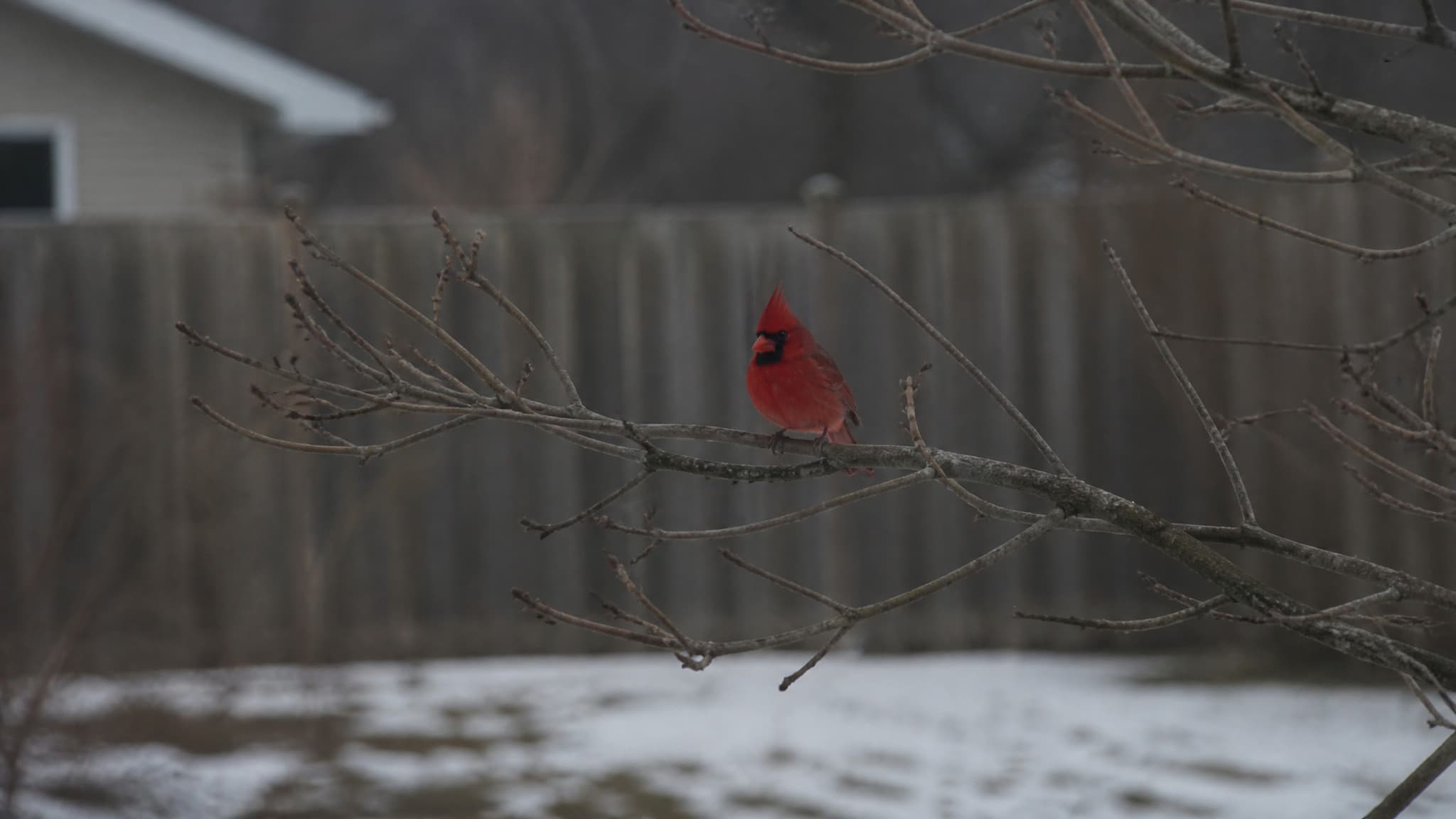
The northern cardinal is the bird most likely to be involved because of four unglamorous facts about the species. It does not migrate, so it is there in February when everything else has gone. It is loud. It is the single most visible thing in a gray yard. And a mated pair will use the same half-acre for years, which means the bird at the feeder in March is genuinely the bird that was there the week of the funeral.
Put those together and you get a bird that is reliably present during the worst stretch of somebody's life and still present a year later. That is the whole mechanism. It does not make the experience less real to say so — people do not report signs from species they have never seen, and the folklore of every region is built out of whatever was already in the garden.
The step from noticing a bird to marking it permanently is a different step, though, and it is worth naming what it does. A tattoo converts a private experience into a public statement. The cardinal on the fence was between you and the bird. The cardinal on your forearm is between you and everyone who serves you coffee. Most people who get one are glad of that — being asked about it is a way of getting to say the person's name out loud, which is otherwise hard to arrange. But it is a change in kind, not a change in degree, and it is better to decide it deliberately than to discover it.
Bring a photograph of the actual bird if you have one. Artists draw a better bird from a real one than from a reference sheet, and the difference shows most in the tail and the crest.
Seeing birds after someone dies is common enough to be unremarkable, and the interval between the sighting and the booking is often very short. People sit with a cardinal at the window for three weeks and then call a studio. There is a standing piece of advice that circulates about this — wait a year — and it is worth understanding what that advice is actually about, because it is usually delivered as a rule and it is not one.
The thing it is trying to protect against is narrow. In the first months after a death, grief is loud and specific, and it tends to attach itself hard to one object or one image. That attachment is real, but it is not always durable, and occasionally the thing that carried the whole weight in month two is a thing people would rather not look at in year three. It is not that the feeling was fake. It is that grief moves, and a tattoo does not.
Against that, there is a reasonable argument for not waiting at all. Some people want the mark precisely because the first year is the year they need it, and a tattoo made in the acute stretch is a record of that stretch. Nobody regrets having had the feeling.
The practical middle is not a waiting period, it is a test. Draw the design, or have the artist draw it, and then live with it for a few weeks — as a photo on your phone, printed and taped inside a cabinet door, whatever puts it in front of you without ceremony. If you still want it after you have stopped noticing it, that is a better signal than any interval. And if you want it more, book it.
What a Bird Tattoo Reads As
Here is the part that is genuinely about the tattoo rather than about the bird. Two people can look at the same design on the same arm and import opposite meanings, because bird symbolism is regional and inherited and nobody consults you about which version they are running.
The question that shows up first is usually the blunt one: what bird is a sign of death. There is no single answer, and the traditions that produced the idea disagree with each other. What is true is that a handful of species carry an association strong enough that a stranger will read it into your skin whether or not you meant it.
The birds of death in European folklore were mostly nominated by behavior rather than by anything anyone believed about their souls. They ate carrion, they called at night, they were black, or they gathered where something had already died. Ask what bird signifies death and most people raised in that tradition will say a raven or a crow before they say anything else, and they will be repeating a reputation the bird earned by following armies. Owls come next, mostly from Roman augury and mostly because of the face and the silence. People often ask what bird is the sign of death as though there were one, and the search history of a single evening usually contains the question in three or four phrasings, because no answer that comes back quite matches the bird they actually saw.
That matters for a tattoo in one specific way. A raven is a beautiful piece of line work and it is also the single least ambiguous death image available. If that is what you want it to say, it says it perfectly. If you wanted it to say this bird sat with me, half your audience will get the other message.
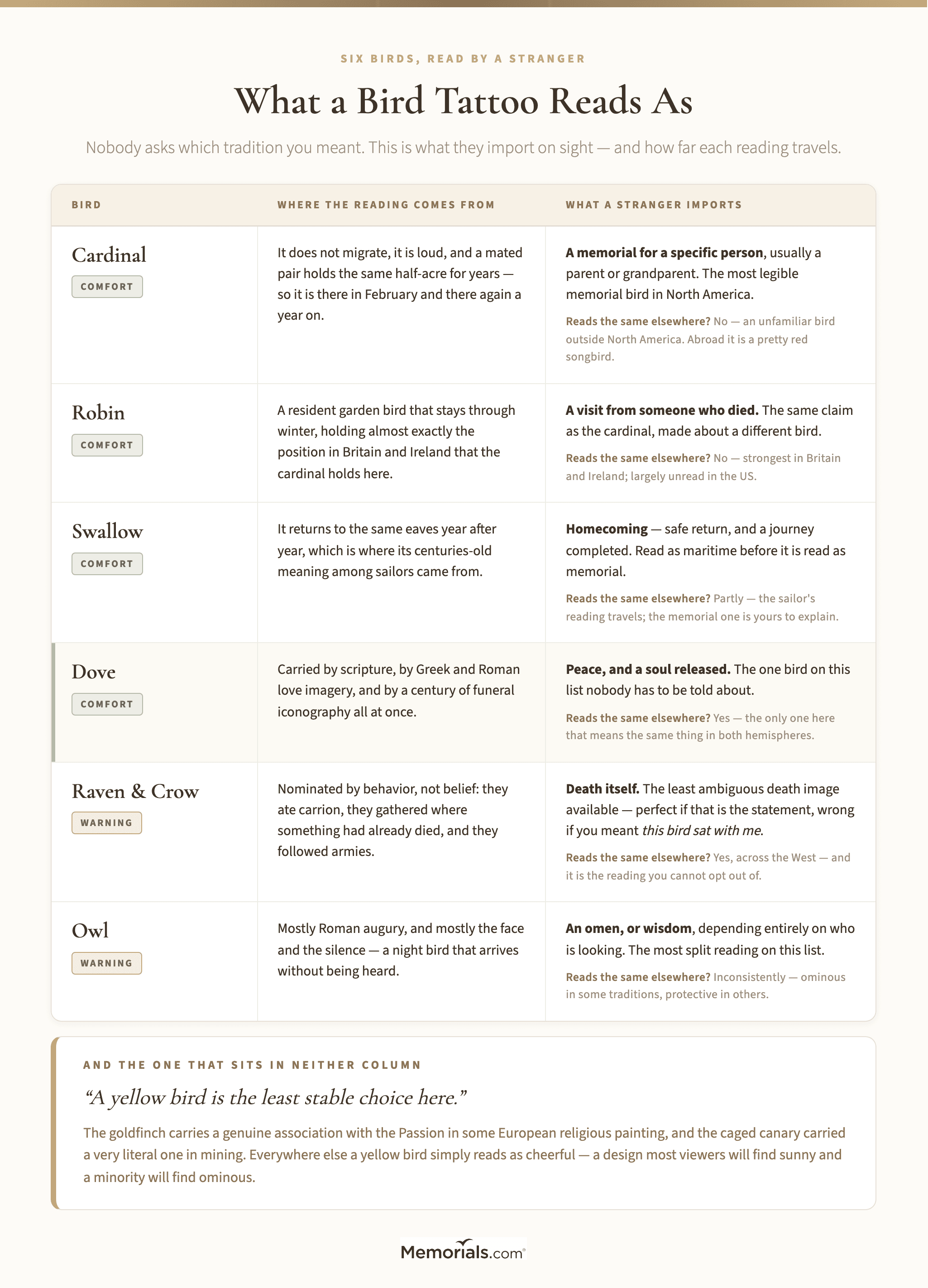
Set against that group are the birds that read as comfort rather than warning, and they are mostly the small resident ones. The cardinal in North America. The robin in Britain and Ireland, which sits in almost exactly the position the cardinal holds here. Hummingbirds, which are fast and brief and gone before you are certain, which is the shape of the experience people are trying to describe. Swallows, which return to the same eaves every year and have carried a homecoming meaning among sailors for centuries. Doves, which are the most legible of all and the only bird on the list that reads the same way almost everywhere.
The yellow bird is the odd one, and people search yellow bird meaning death far more than the size of the folklore would suggest. Goldfinches carry a genuine association with the Passion in some European religious painting, and caged canaries carried a very literal association with death in mining. Everywhere else a yellow bird reads as cheerful, which makes it the least stable choice on this list — a design most viewers will find sunny and a minority will find ominous.
If you want the folklore itself rather than how it reads on skin, our page on bird symbolism takes the omens on their own terms, and the wider vocabulary of symbols of grief covers what these images have meant outside of tattooing. The connection between birds and death is old enough to appear in nearly every tradition and loose enough that no two of them agree, which is exactly why the same design can be read three ways. The same vocabulary shows up carved rather than inked, and the headstone symbols families choose follow the same regional lines.
Six birds, and what a viewer imports before you have said anything. The pattern is consistent: birds that return read as comfort, birds that arrive where death already was read as warning, and only the dove means the same thing in both hemispheres.
Fine line work is at its sharpest the week it heals. Ask your artist to show you their own five-year-old work, not their portfolio — the portfolio is all fresh.
Design Decisions You Cannot Undo
Placement is the decision people revisit most, and the pattern in the regret is specific: it is almost never about the design, and almost always about being able to see it. A memorial tattoo on the inner forearm is in the wearer's field of view several hundred times a day. In the first year that is often the point. Later, some people find that a grief they had begun to set down is being handed back to them every time they reach for a cup. Others find the opposite and would not move it for anything. Neither reaction is predictable in advance, which is the argument for the upper arm, the shoulder blade, the ribs — somewhere it exists without insisting.
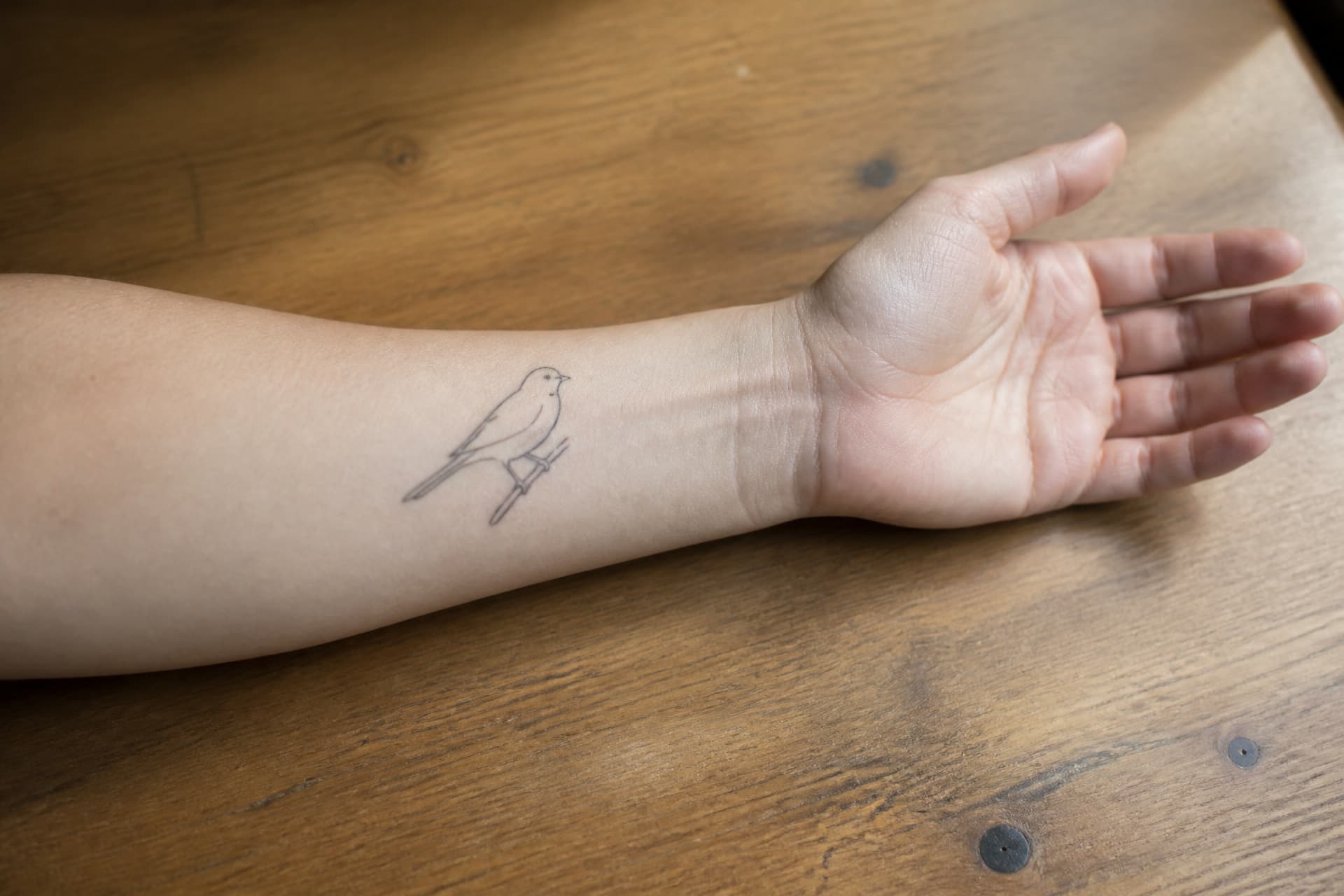
Scale is the one artists raise and clients ignore. Fine detail closes up. A bird rendered small with individually drawn feathers is legible the month it heals and gradually becomes a dark shape as the lines spread, and the smaller and more intricate the design, the faster that happens. If you want a small tattoo, ask for a design built out of few lines rather than many. If you want feather detail, it needs room.
Color is a real choice for a cardinal specifically, since red is most of what makes the bird recognizable — a cardinal in black and gray reads as a crested songbird and not much else. Red holds reasonably well but every color fades faster on skin that gets sun, so a piece on a forearm will ask for touching up sooner than one on a shoulder. Red is also among the strongest of the colors of remembrance in Western mourning, which is part of why the bird lands as hard as it does. Anyone who reacts badly to red pigment should say so before the session rather than after; it is the pigment most often implicated in reactions.
Then there is the question of whether anything goes on the tattoo besides the bird. Three options, and they age differently.
A name is the most common and the most permanent commitment. It is also the one that makes the piece unambiguously a memorial rather than a decoration, which some people want and others do not.
A date is smaller and quieter, and it is the one most likely to be misread — a bare year beside a bird means nothing to a stranger, which can be a feature.
Handwriting traced from something the person actually wrote — a signature on a card, the way they wrote your name — ages better than any font, because it is a real object rather than a style. If there is a letter in a drawer, photograph it before you go.
Finally, style. A realistic cardinal is a portrait and lives or dies on the artist's ability to render feathers; it is the most impressive version and the most expensive to fix. Illustrative and line-work birds are simpler, hold their shape over decades, and are easier to add to later — which matters more than people expect, since second losses happen and a design with room around it can be extended. If the bird is not the right image at all, butterfly symbolism does the same work on the same logic of something small, brief and unsummoned, and it is the other most-tattooed memorial motif by a wide margin.
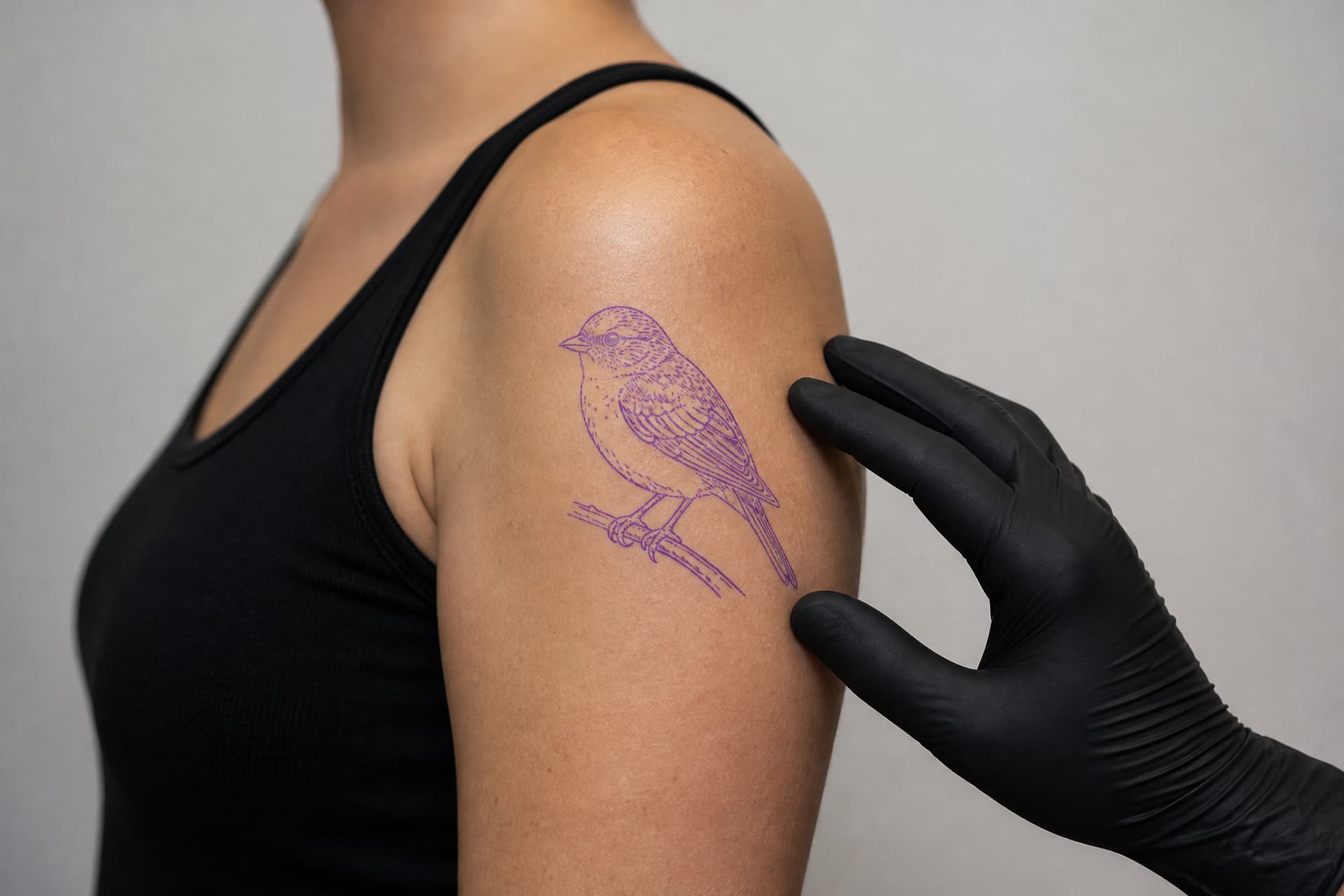
The stencil stage is free to redo and the tattoo is not. Ask to see it on three different spots and to walk to a mirror with each one before anybody starts.
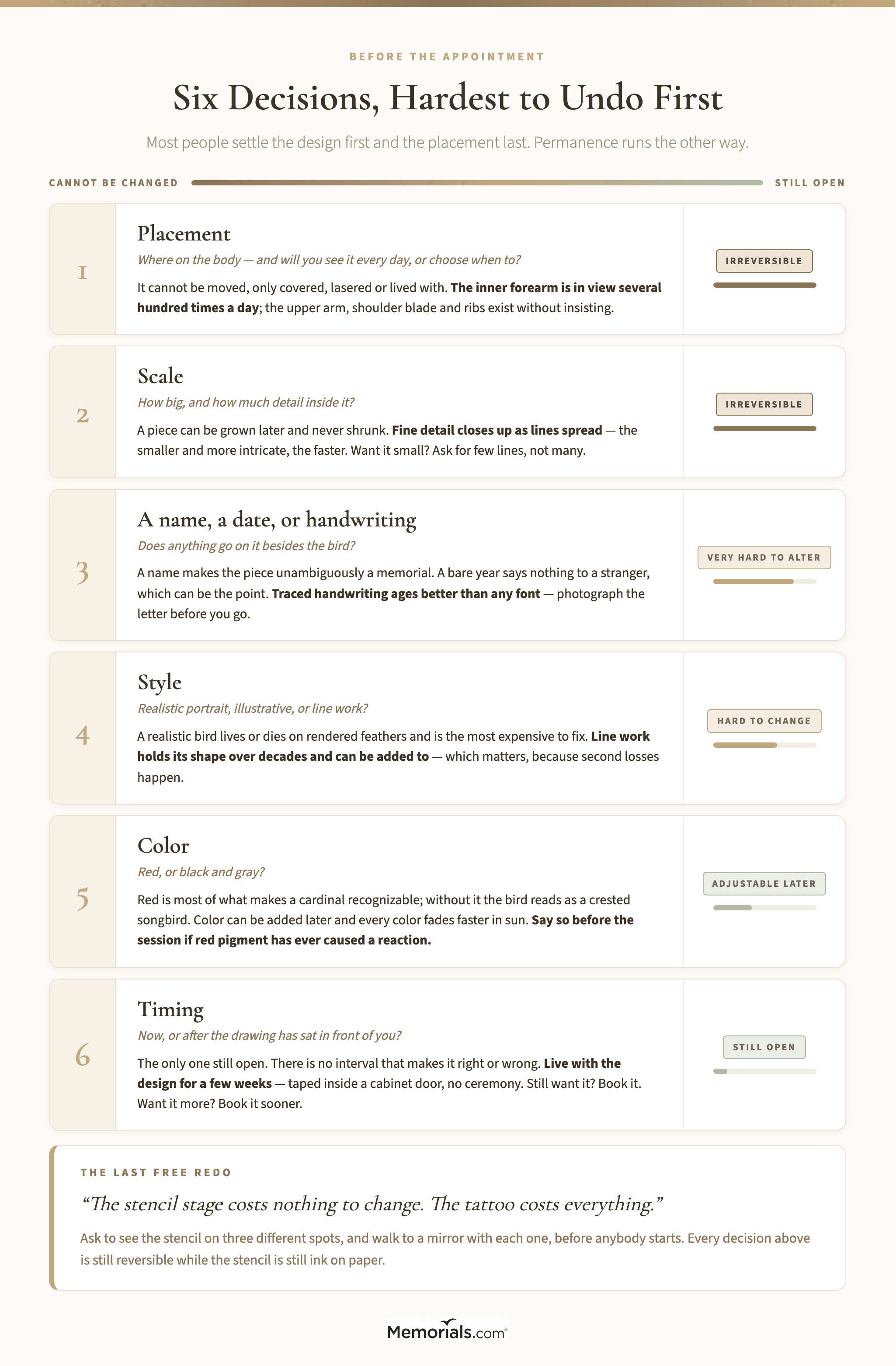
The six decisions, hardest to undo at the top. Placement and scale sit above design, which is the reverse of the order most people settle them in.
About Mixing Ashes Into the Ink
This comes up in nearly every conversation about a memorial tattoo, and it deserves a straight pointer rather than a paragraph of hedging. Adding cremated remains to tattoo ink is a real practice. The questions worth asking are about sterility, about what regulation does and does not cover, and about whether an artist will agree to it at all — many will not, and their reasons are worth hearing.
None of that is answerable in passing, so we answer it properly elsewhere: our article on ashes in tattoo ink covers what actually happens under the skin and what to ask before you book. Read it before you raise it with a studio.
If the Tattoo Is Not the Only Thing You Want
A lot of families end up wanting the bird in more than one place, and some decide against skin altogether once they have thought it through. Neither is a retreat. The image is doing the same job in every form; the only thing that changes is who can see it and who can share it.
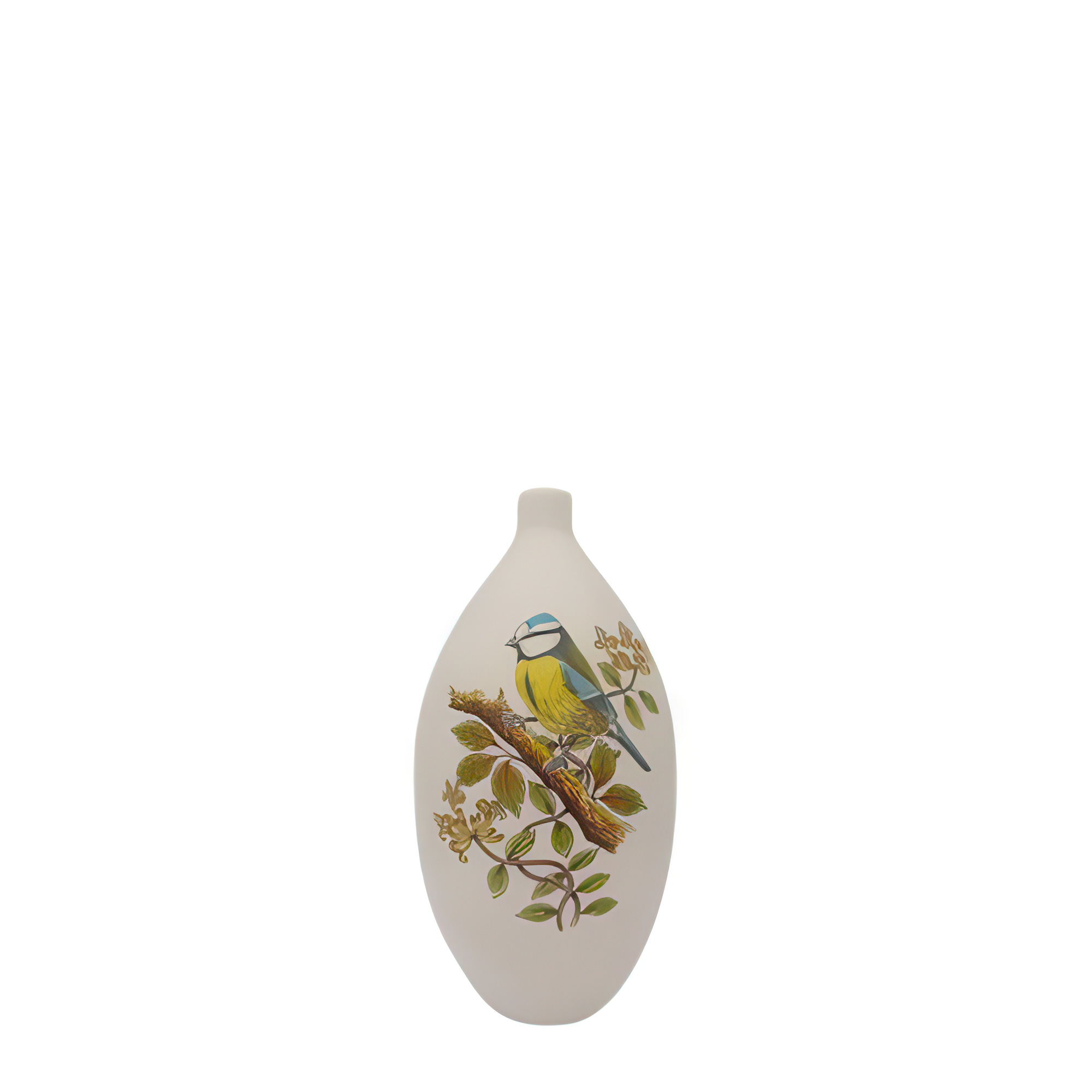
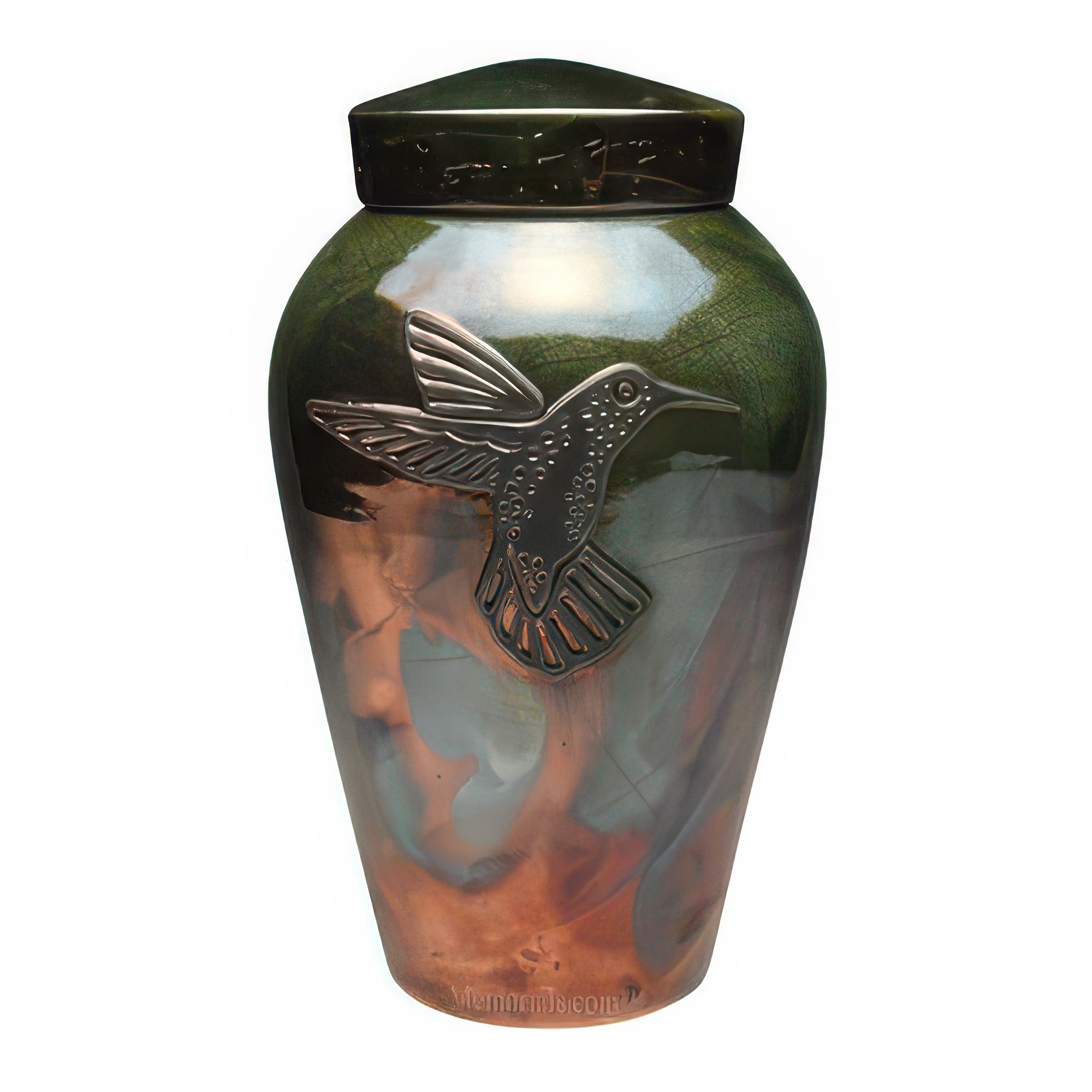
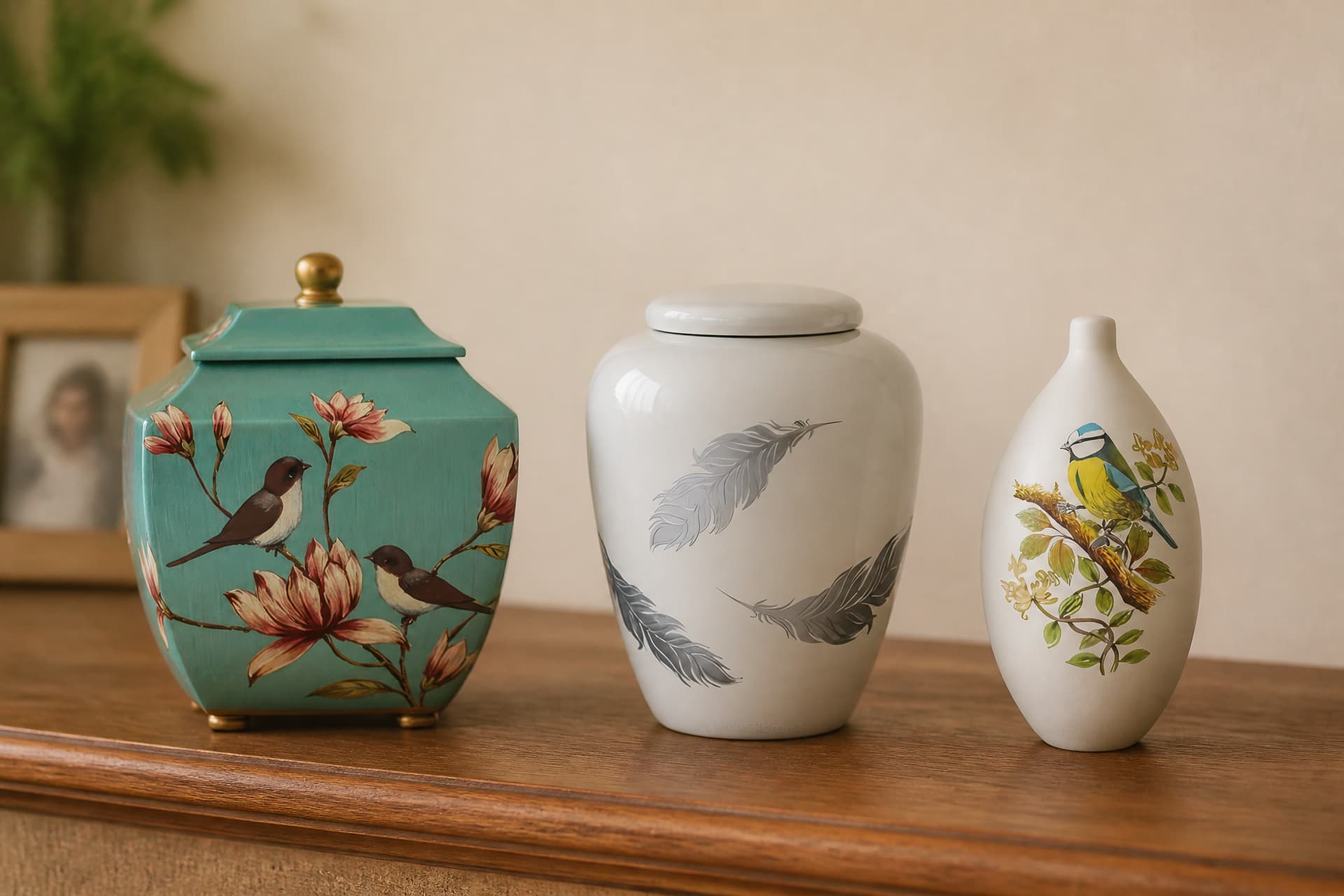
Indoors, the bird most often ends up on the urn itself. There is a real bird vocabulary in ceramic cremation urns — pairs perched together, a single bluebird, blossom and songbirds worked around the whole body of the piece — and it is a gentler way of carrying the same motif than a headstone inscription, because it sits on a shelf at eye level rather than in a cemetery an hour away.
Outdoors is the version a family shares rather than wears, and it has one advantage nothing else on this page has: it brings the actual birds back. A memorial bird bath put where the cardinal already feeds turns a spot in the yard into something the whole household visits, and it keeps working long after the first year. Put it where the bird goes, not where the planting looks best.
And if what you want is something permanent that is not an image at all, fingerprint memorial ideas use the person themselves rather than a symbol for them, which is a different kind of answer to the same question.
Frequently Asked Questions
Are birds a sign of death?
The question people type is are birds a sign of death, and the honest answer is that no tradition agrees with any other and none of them can be tested. Several species carry an inherited association — ravens, crows, owls — earned mostly by scavenging and by calling at night. Whether a particular bird on a particular morning meant anything is not a question this page can settle for anyone, and it is not the question that decides a tattoo.
What does a cardinal tattoo mean?
Across North America it reads specifically and almost unanimously as a memorial for someone who has died, usually a parent or grandparent. That legibility is its strength, and it is also worth knowing that it does not travel: in most of the world the northern cardinal is an unfamiliar bird and the design reads as a pretty red songbird and nothing more.
Is it too soon to get a memorial tattoo?
There is no interval that makes it right or wrong. The useful test is not time but stability — settle the design, then live with it in front of you for a few weeks without ceremony. If you still want it once it has stopped being new, that tells you more than a date on a calendar.
Where is the best place to put a memorial tattoo?
Somewhere you can choose to look at rather than somewhere you must. The upper arm, shoulder blade and ribs all give you that; the inner forearm does not. If you are certain you want it in view every day, that is a legitimate choice — just make it knowing that a grief you are actively carrying now will not be the same weight in three years.
Can you put someone's ashes in a tattoo?
It is done, and it raises questions about sterility and about artist willingness that deserve a real answer rather than a sentence. Our separate article on the practice covers what to ask before you book, and it is the piece to read first.
Whatever You Choose, Decide It Twice
The bird is not the memorial. The bird is a place the memorial rests, and it will keep working as one whether it ends up on your arm, on a shelf, or in the corner of the yard where the feeder hangs. That is worth remembering if the decision starts to feel enormous — nothing here is the last chance to mark this person, and none of these options rules out any of the others.
The outdoor version is the one the rest of the family uses. A tattoo belongs to one person; a spot in the yard belongs to everyone who visits it.
So decide it twice. Once now, while the feeling is loud and clear about what it wants, and once again a few weeks later with the drawing in front of you and the first decision already made. If the answer comes back the same, book it and stop deliberating. And if the answer changes, nothing has been lost — the bird will still be there in the morning, which is most of what made it matter in the first place.