🏬Supersize Online Funeral Retailer🪦1000's of Headstones⚱️Over 10,000 Cremation Urns⚰️Caskets Overnight Delivery🛒Funeral & Memorial Superstore🚚FREE Shipping on ALL Orders👨👩👧👦Helping Families for over 20 Years💰Lowest Price Guarantee🏬Supersize Online Funeral Retailer🪦1000's of Headstones⚱️Over 10,000 Cremation Urns⚰️Caskets Overnight Delivery🛒Funeral & Memorial Superstore🚚FREE Shipping on ALL Orders👨👩👧👦Helping Families for over 20 Years💰Lowest Price Guarantee
🏬Supersize Online Funeral Retailer🪦1000's of Headstones⚱️Over 10,000 Cremation Urns⚰️Caskets Overnight Delivery🛒Funeral & Memorial Superstore🚚FREE Shipping on ALL Orders👨👩👧👦Helping Families for over 20 Years💰Lowest Price Guarantee🏬Supersize Online Funeral Retailer🪦1000's of Headstones⚱️Over 10,000 Cremation Urns⚰️Caskets Overnight Delivery🛒Funeral & Memorial Superstore🚚FREE Shipping on ALL Orders👨👩👧👦Helping Families for over 20 Years💰Lowest Price Guarantee
Bereavement leave California law is unusual, because most American workers have no legal right to time off after a death at all. There is no federal entitlement — none — and in most states whether you get any days is entirely a matter of what your employer decides to offer.
California is one of a small number of states that changed that. Since January 2023, most California employees have had a statutory right to five days, and knowing that before you ask changes the conversation from a request into a notification.
This page is about the California law specifically. If what you need is the wording — what to write to a manager, how to phrase the request — that is a different page: how to tell work about a death in the family. This one sits in the with the rest of the paperwork.
This is general information rather than legal advice. California's Civil Rights Department publishes the authoritative guidance, and an employment attorney is the right call for anything contested.
What the Law Actually Provides
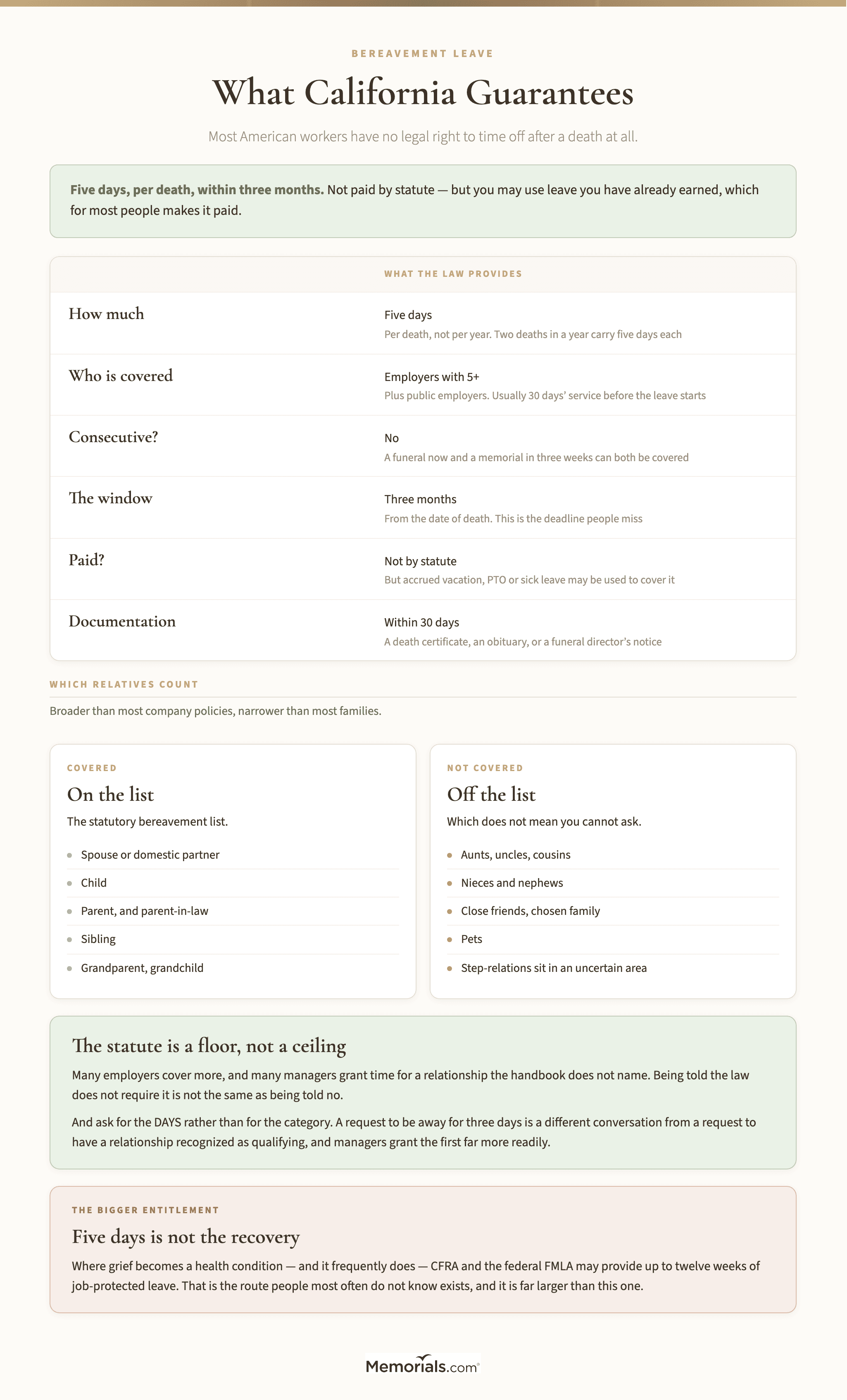
Five days. Per death, not per year. If two family members die in a year, each death carries its own five days.
Who is covered. Employees of employers with five or more employees, and public employers. You generally need to have been employed for at least 30 days before the leave starts.
The days do not have to be consecutive. This matters more than it sounds. A funeral now and a memorial in three weeks can both be covered, and so can a day for the paperwork.
You have three months. The leave must be completed within three months of the date of death. This is the deadline people miss, because the third month is often when the estate work finally lands and the leave has quietly expired.
It is protected. An employer cannot refuse it, cannot retaliate for taking it, and cannot require you to find cover as a condition of it.
Is Bereavement Leave Paid in California?
The honest answer to is bereavement leave paid in California is: not by law, but often in practice.
The statute requires the leave to be available. It does not require it to be paid. But it also gives you a right that matters almost as much — you may use your existing paid leave to cover it. Accrued vacation, paid time off, or paid sick leave where the employer's policy allows it. So for most people with any accrued balance, the five days are paid, out of time they had already earned.
If your employer's own policy is more generous, the policy wins. The law sets a floor, not a ceiling. A company offering ten paid days still offers ten paid days.
If you have no accrued leave, the five days are unpaid but still protected. You cannot be disciplined for taking them, and the job is still there afterward.
Ask which bucket it comes out of. Employers vary in whether they draw from vacation or sick leave first, and it affects what you have left for the rest of the year — which matters, because grief does not confine itself to five days.
Five days, per death, within three months. Not paid by law — but you can use leave you already earned.
Five days, per death, within three months. The statute is a floor rather than a ceiling.
Which Relatives Count
The bereavement list — meaning which relationships the statute actually covers — is broader than most company policies and narrower than most families.
Not covered by the statute: aunts, uncles, cousins, nieces, nephews, close friends, chosen family, and pets. Step-relations and in-laws beyond a parent-in-law sit in an uncertain area and are worth asking about rather than assuming.
Two things worth knowing about the gaps.
First, the statute is a floor. Many employers cover more, and many managers will grant time for a relationship the handbook does not name. Being told the law does not require it is not the same as being told no.
Second, ask for the days rather than for the category. A request to be away for three days is a different conversation from a request to have a relationship recognized as qualifying. Managers grant the first far more readily than they adjudicate the second.
Reproductive loss is separate and also covered. California added a distinct five-day leave for reproductive loss — miscarriage, stillbirth, failed adoption, failed surrogacy or an unsuccessful assisted reproduction procedure. It is its own entitlement with its own rules, and it is not drawn from the bereavement days.
Documentation
Your employer may ask for it, and if they do, you have 30 days from the first day of leave to provide it.
What counts is broad. A death certificate, a published obituary, or written verification from a funeral home, mortuary, burial society, crematorium, religious institution or government agency. A funeral director's notice is the easiest of these to get quickly, and it does not require waiting for the certificate — which is useful, because certificates take one to three weeks and the leave does not wait for them. The full picture on those is in how many death certificates you need.
They must keep it confidential. Documentation provided for this purpose cannot be shared beyond those who need it.
They cannot demand it up front. The leave is not conditional on producing paperwork before you go.
What This Does Not Cover
Worth being clear, because the five days run out fast and people assume they are the whole entitlement.
Longer absences. Where grief becomes a health condition — and it frequently does — the California Family Rights Act and the federal FMLA may provide up to twelve weeks of job-protected leave for a serious health condition, including a mental health condition, either your own or a family member's. This is the route people most often do not know exists.
Caring for someone who is dying. That is family care leave under CFRA, not bereavement leave, and it is a separate and larger entitlement. Ask before the death rather than after.
Paid family leave benefits. California's Paid Family Leave program pays partial wage replacement in some caregiving situations. It is administered separately from any leave your employer grants and is worth checking independently.
Time for the estate work. No statute covers the weeks of phone calls in the financial accounts directory. Most people use vacation, and it is worth budgeting several days of it rather than assuming the five will stretch. Nor does any of it run the other way: the evening somebody spends on an online trust and will is nobody's leave to grant, and it is the hour that shortens this list for the family after them.
The days need not be consecutive — a funeral now, a memorial in three weeks. But everything must fall inside three months.
The statute is a floor. A handbook offering ten paid days still offers ten paid days.
How California Compares
Worth knowing, because the answer explains why this page exists and most states have no equivalent.
Most states guarantee nothing. There is no federal bereavement entitlement, and in the majority of states an employer may offer three days, or one, or none, and change it next year. Whatever your handbook says is the whole of your protection.
A handful of states have acted, and the details differ enough that a rule learned in one is wrong in another — different qualifying relationships, different windows, different employer-size thresholds, different rules on pay.
Which state's law applies is where the employment actually is, not where the company is headquartered. A California employee of a Texas company is generally covered; a Texas employee of a California company is generally not. Remote work has made this genuinely unsettled and it is worth asking rather than assuming.
Public sector employees often do better than the statutory minimum, through union agreements or civil service rules that predate any of these laws. Check the collective agreement before the statute.
Union contracts are the other floor worth checking. Where a contract provides more, it provides more, and the statute does not reduce it.
The practical upshot for a family spread across states: siblings arranging one funeral may have completely different entitlements, and the person with the least protection is often the one doing the most. Worth knowing before anyone assumes everyone can take the same week.
If an Employer Refuses
Rare, and it happens, and it is worth knowing what the ground is.
Get the refusal in writing, or write your own note confirming what was said and when, and send it to yourself by email. A contemporaneous record is worth more later than a recollection.
Check the employee count. The obligation applies at five or more employees. Below that, the statute does not reach and you are back to the employer's own policy.
Retaliation is separately unlawful. Being granted the leave and then punished for taking it — a lost shift pattern, a sudden performance review, a withdrawn promotion — is its own violation and is often easier to demonstrate than the refusal itself.
Where to take it. California's Civil Rights Department handles complaints under this law, and there are filing deadlines, so acting sooner is better than acting when the estate is settled.
Talk to an employment attorney before doing anything formal. Many offer a free initial consultation, and the specific facts matter enormously in this area.
Five days is the floor, not the recovery. The larger entitlement is CFRA, and most people never hear of it.
Planning the Five Days
Since the days need not be consecutive and the window is three months, there is an actual choice to make here, and most people make it by default.
The instinct is to take all five at once, around the funeral. That is the week you are least able to use them well — logistics, relatives, and no capacity for anything requiring a phone call.
A shape that works better for many people: two or three days around the funeral, one day two or three weeks later for the institutions that only answer on weekdays, and one held back. The financial accounts and the agencies all keep business hours, and doing that work in stolen lunch breaks is how it stretches over months. Some of it is a form rather than a call — a small estate affidavit California PDF can be filled in at a kitchen table on a Sunday — and separating the forms from the calls is what decides how many weekdays you actually need.
Hold one day for something unscheduled. An estate produces at least one appointment nobody predicted — a court date, a property matter, a call that has to happen now.
But do not lose them to the window. Three months passes faster than it sounds, and unused days are simply gone.
Tell your manager the plan rather than the total. "Three days now and I will likely need two more in the next few weeks" is easier to accommodate than an open-ended absence, and it makes the second request a reminder instead of a new negotiation.
Frequently Asked Questions
Does bereavement leave in California apply to part-time workers? Yes. The statute does not distinguish by hours, though the 30-day employment requirement still applies.
Can I take the five days months later, for the anniversary? No. The three-month window is firm. Anything after that is your employer's discretion.
My employer says they have no bereavement policy. For employers with five or more employees in California, the statute applies whether or not a policy exists. The absence of a policy is not the absence of an obligation.
I work remotely for a company based in another state. Generally the law of the state where you actually work applies, which for a California-based remote worker is usually California. Worth confirming, as this area is genuinely unsettled.
Does it cover travel time for an out-of-state funeral? The five days are days, and how you use them is yours. Travel is a common and entirely legitimate use.
Can I take one day now and the rest later? Yes. Non-consecutive days are explicitly permitted, provided everything falls within three months.
What if I need more than five days? Ask. Then ask about CFRA leave if grief is affecting your health, which is a far larger entitlement and the one people most often do not know about.
In Closing
Five days, per death, within three months, unpaid by law but coverable from leave you already have, for a list of relatives that is broader than most handbooks.
The most useful thing to know is the last part of that sentence: the statute sets a floor. Employers routinely offer more, managers routinely grant more, and asking for what you need is a better opening than asking for what you are owed.