🏬Supersize Online Funeral Retailer🪦1000's of Headstones⚱️Over 10,000 Cremation Urns⚰️Caskets Overnight Delivery🛒Funeral & Memorial Superstore🚚FREE Shipping on ALL Orders👨👩👧👦Helping Families for over 20 Years💰Lowest Price Guarantee🏬Supersize Online Funeral Retailer🪦1000's of Headstones⚱️Over 10,000 Cremation Urns⚰️Caskets Overnight Delivery🛒Funeral & Memorial Superstore🚚FREE Shipping on ALL Orders👨👩👧👦Helping Families for over 20 Years💰Lowest Price Guarantee
🏬Supersize Online Funeral Retailer🪦1000's of Headstones⚱️Over 10,000 Cremation Urns⚰️Caskets Overnight Delivery🛒Funeral & Memorial Superstore🚚FREE Shipping on ALL Orders👨👩👧👦Helping Families for over 20 Years💰Lowest Price Guarantee🏬Supersize Online Funeral Retailer🪦1000's of Headstones⚱️Over 10,000 Cremation Urns⚰️Caskets Overnight Delivery🛒Funeral & Memorial Superstore🚚FREE Shipping on ALL Orders👨👩👧👦Helping Families for over 20 Years💰Lowest Price Guarantee
Working out how to say death in the family professionally is a strange task to be handed. Somebody has died, you are not thinking clearly, and the next thing required of you is a short, composed sentence to a manager.
This page is the wording, so you do not have to compose it. Copy something, send it, and put your phone down. Nobody at work is grading the message, and everything below is written on the assumption that you have about ninety seconds of capacity.
The short version: say what happened, say who it was, say roughly how long you will be gone, and say who is covering. That is the whole professional standard. The sympathy and condolence guide is the wider starting point if you also have people to write to.
Say It in One Sentence
The sentence that works is plainer than people expect:
My father died last night. I need to be away from work this week. Priya has the client list and knows where everything is.
Three facts and a handover. No apology, no explanation of the illness, no promise to check email.
Name the relationship, not the details.My mother, my brother, my grandfather. That is enough for anyone to understand what kind of absence this is. Cause of death, hospital detail, and family circumstances are yours and nobody at work needs them.
Give a rough length, and say it is rough.At least the rest of this week, and I will know more after Thursday. An estimate you can revise beats a precise date you will have to walk back.
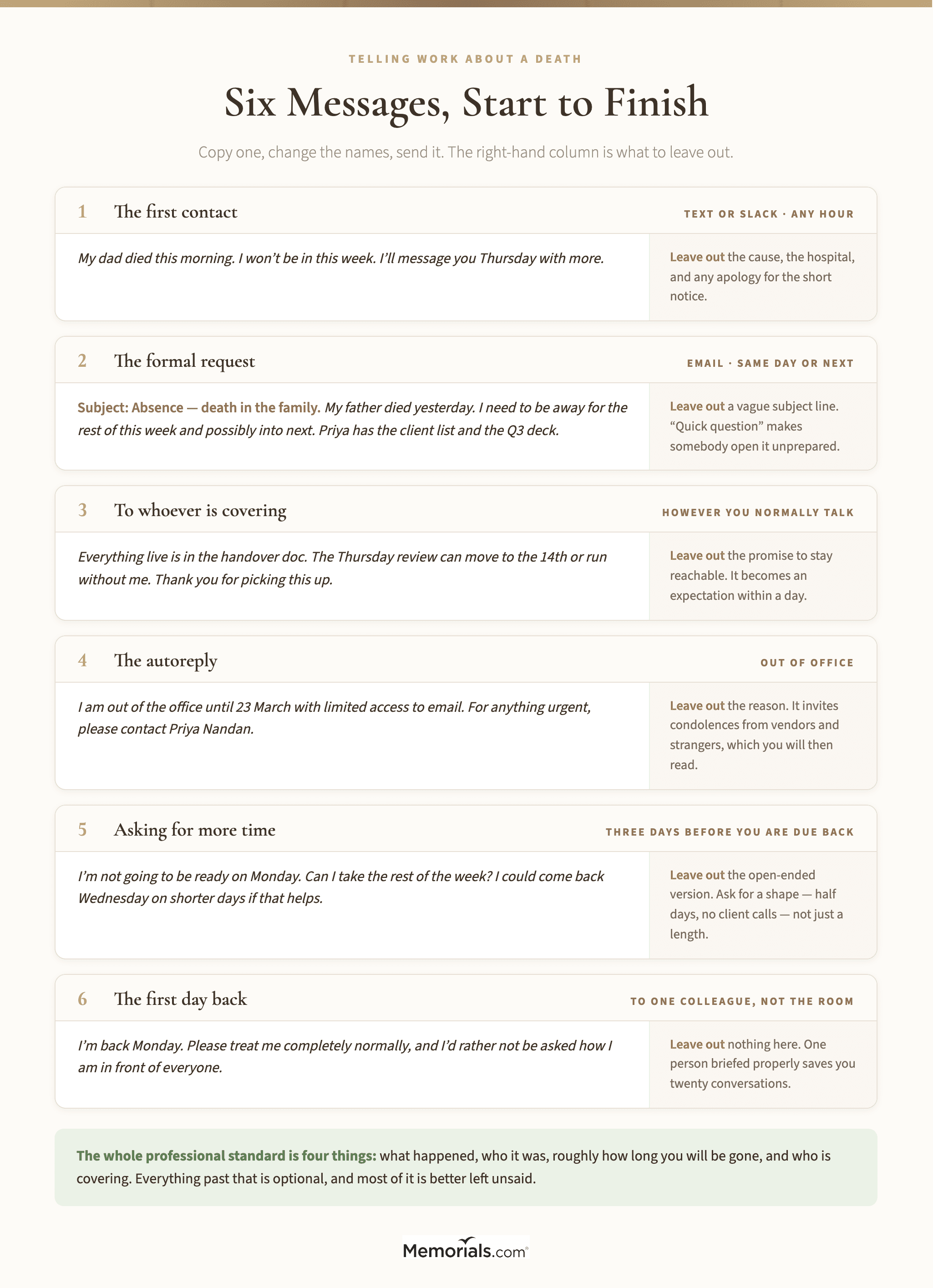
Do not apologize.Sorry for the short notice invites a response about the inconvenience. Nothing about this is your fault and the sentence works better without it.
Do not offer to work.I will keep an eye on my inbox becomes an expectation within a day. If you genuinely want to, decide that later, from a position where you can change your mind.
Three facts and a handover. Nobody at work is grading the message.
Your direct manager first, by whatever channel is fastest. A text or a Slack message at six in the morning is entirely appropriate. Waiting until office hours so it can be an email is a courtesy nobody needs from you today.
Then HR, or ask your manager to. Most people are relieved to be asked to do this. If you are managing it yourself, one message is enough and it can wait a day.
Then whoever is directly affected — the colleague covering, the client with a meeting on Thursday. Short and factual. You do not owe your team an announcement; ask your manager to pass it on in whatever way is normal there.
Say once how you want it handled.Please tell the team, I would rather not repeat it or I would rather this stayed between us for now. Say it early, because it is much harder to claw back afterward.
The First Message: Text, Slack, or Email
For the first contact, use whatever you would normally use for something urgent. Copy whichever bereavement leave template below matches that channel and change the names.
Text or Slack, out of hours
My dad died this morning. I won't be in this week. I'll message you Thursday with more.
Bad news — my sister died last night. I need some time. Priya has everything for the Wednesday review.
My mother died overnight. I'll be off for the next few days at least. Can you let the team know?
A bereavement leave email, if email is the normal channel
Subject: Absence — death in the family
Ravi,
My father died yesterday morning. I need to be away from work for the rest of this week, and possibly into next; I will know more after the funeral is arranged.
Priya has the client list and the Q3 deck. The Thursday review can either move to the 14th or run without me.
I would rather not be contacted about work in the meantime unless something is genuinely urgent.
Thank you,Sam
That is also the answer to the two search phrases people arrive here with — death in the family email to boss sample and how to ask for bereavement leave sample. There is no special register for this. Plain sentences, one paragraph of facts, one of handover.
Do not write a subject line that hides it.Quick question or This week makes somebody open it unprepared and reply badly. Absence — death in the family or Bereavement leave is kinder to everyone. Our page on the subject line for a condolence email covers the other direction — writing to someone who has lost somebody.
Six messages covering the whole absence. Every one of them is short on purpose.
How to Request Bereavement Leave Formally
If your employer wants something in writing, the format is dull and that is correct. Whatever your company calls it — a bereavement request, compassionate leave, funeral leave — the document underneath is the same one.
A bereavement letter for work — or a bereavement leave letter, which is the same document under a different name — contains four things and nothing else: the relationship, the dates, the handover, and a line offering documentation if it is required.
Dear Ravi,
I am writing to request bereavement leave following the death of my father, David Ellis, on 12 March.
I would like to take leave from 13 March to 20 March inclusive, returning on Monday 23 March. Priya Nandan has agreed to cover the client accounts in my absence.
I can provide a copy of the death certificate or the funeral director's notice if that is required.
Sincerely,Sam Ellis
Knowing how to request bereavement leave in a system rather than a sentence is the other half of it. If your company uses an HR portal, file the bereavement leave request there as well as sending the message — the two do not talk to each other, and an absence logged nowhere becomes a payroll problem in six weeks. A bereavement leave email sample of the kind above is usually enough to attach.
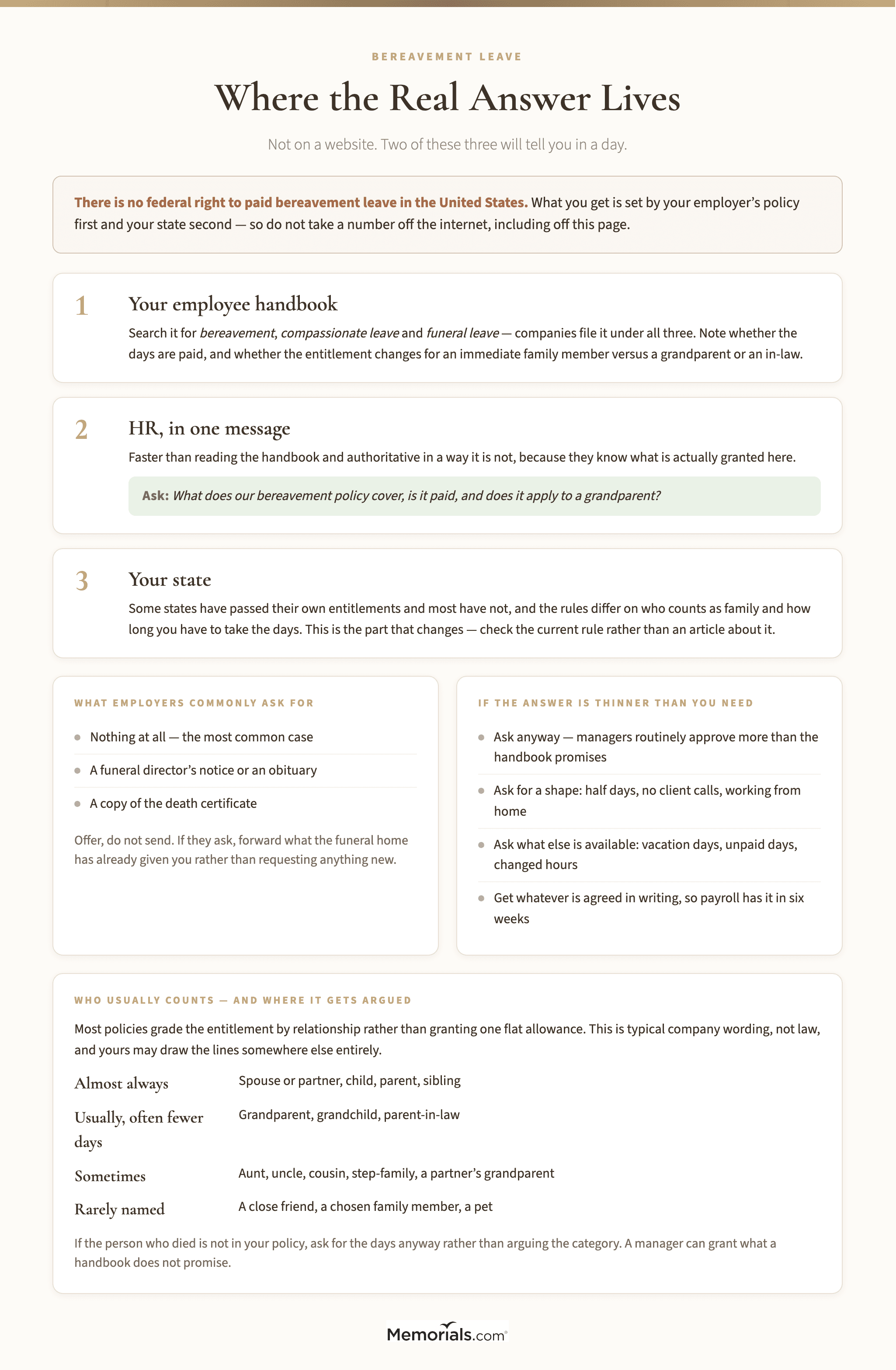
On documentation: many employers ask for none, some ask for a funeral director's notice or an obituary, and a few ask for a death certificate. Offer, do not send. If they ask, forward whatever the funeral home has already given you rather than requesting anything new.
What You Are Actually Entitled To
Here is the honest answer, and it is more useful than a number.
What does bereavement leave mean? It is time away from work after a death, and unlike sick leave or vacation it is not a single guaranteed thing. It is defined by your employer's policy first, by your state second, and by federal law not at all — the United States has no national right to paid bereavement leave.
How much bereavement leave do you get? It depends entirely on where you work and where you live. Three to five days is the most common company policy, often more for an immediate family member than for a grandparent or an in-law, and sometimes nothing at all for a friend or a cousin. Some states have passed their own entitlements and others have not.
So do not take a number off the internet, including this page. Two places have the real answer: your employee handbook, under bereavement, compassionate leave or funeral leave; and HR, who will tell you in one message. Ask plainly — What does our bereavement policy cover, and is it paid? — because you may need to plan around unpaid days.
And if the policy is thin, ask anyway. Managers routinely approve more than the handbook promises, particularly for a first request. The worst outcome is being told to use vacation days, which is still an answer you need before you book anything.
Most people underestimate the second half. The funeral is arranged, and then there is an estate, a house, and a body that has stopped sleeping.
Ask before you run out. A message three days before your leave ends is a request. A message on the morning you were due back is a problem for somebody else.
I'm not going to be ready on Monday. Can I take the rest of the week? Happy to talk about how we cover it.
The funeral is on the 20th, which is later than we expected. I need to extend to the 24th.
I'd like to come back Wednesday rather than Monday, and start on shorter days if that's possible.
Ask for a shape, not just a length. Half days, no client calls for two weeks, or working from home for a week are all easier to grant than an open extension, and often more useful than more days off.
Be specific about what you cannot do yet.I can do the reporting but I cannot chair a meeting this month gives a manager something to work with. I am not really coping leaves them guessing.
If you are the one arranging everything, the first week after a loss sets out what actually has to happen in that period, which makes the length far easier to estimate.
Ask three days before your leave ends, not on the morning you were due back.
Out of Office, and the Handover
Keep the autoreply vague. You do not owe the internet your bereavement.
I am out of the office until 23 March with limited access to email. For anything urgent, please contact Priya Nandan at priya@example.com.
Say who is covering, by name. An autoreply without a person in it generates a second email to you.
Do not say why.I am on bereavement leave is fine if you want it known, but it invites condolences from strangers and vendors, which you will then read.
Hand over in one document, not in conversation. Ten lines is plenty: what is live, what is due, where the files are, what can wait. Write it once so nobody has to call you for it.
Ten lines is plenty. Write the handover once so nobody has to call you for it.
Then turn off the notifications. Not the phone — people need you — the work ones. This is the single most useful thing on this page and almost nobody does it.
Going Back
The return is harder than the leave, and it catches people out because they expect to feel better by then.
Tell one person what you want.Please treat me completely normally or I would rather not be asked how I am in front of everyone. One colleague briefed properly saves you twenty conversations.
Expect the first day to be strange and the fourth to be worse. The initial sympathy carries you through the first morning; the drop after that is what people describe as the real return.
Grief is not finished at three days, and work is where that shows. Concentration goes, small decisions become hard, and people burst into tears in stairwells. Grief at work covers what that is like from the inside, physical symptoms of grief covers what it does to a body, and how long grief lasts is worth reading if you are surprised to still feel this way in month four.
If it is not lifting at all, that is worth checking.Normal grief versus grief depression draws the line, and most employers have an assistance program you have forgotten exists.
The first morning is carried by sympathy. It is the fourth day that people describe as the real return.
If You Are the Manager or the Colleague
Managers land on this page too, usually searching how to respond to bereavement leave email at eight in the morning with a message in front of them they were not expecting.
Reply within the hour, and make it three lines.I'm so sorry, Sam. Take whatever time you need — I'll sort the Thursday review and tell the team. Don't think about work. Approve first, ask about process later.
Say yes to the length they asked for, and say it in the first message. Negotiating days with somebody whose father died last night is the thing they will remember about working for you.
Do not ask for documentation in your first reply. If the system needs it, ask in a week.
Then write it down. Put the return date in your calendar, and a note two weeks after it. The second one matters more.
The order matters: handbook, then HR, then your state. Two of the three will answer in a day.
Frequently Asked Questions
How do I say death in the family professionally without oversharing? Name the relationship, give a rough length, and name whoever is covering. My father died last night, I'll be out this week, Priya has the client list. Cause of death and family circumstances are yours to keep.
Should I call or email my boss? Whatever is fastest, including a text at six in the morning. Formality is not the point and nobody will hold the channel against you.
Do I have to say who died? The relationship, yes — it is what tells an employer what kind of absence this is. The name, the cause and the details, no.
What if my employer refuses or offers almost nothing? Ask what is available instead — vacation days, unpaid days, or a temporary change of hours — and get the answer in writing. If the policy itself looks wrong for your state, that is a question for HR or a local employment advice service, not for a memorial website.
How soon do I have to go back? Whatever you agreed, and it is normal to revise it. Ask three days before it ends rather than on the morning.
Is bereavement leave paid? Sometimes. It is set by your employer's policy and your state, and there is no federal guarantee either way in the United States. Ask HR directly, because unpaid days change what you can afford to arrange.
Can I ask for time off for a friend, or a pet? You can ask. Many policies cover only immediate family, but managers frequently grant time for anyone the loss genuinely warrants. Ask for the days rather than for the category.
In Closing
Send the plain sentence. Name the person, name the days, name whoever is covering, and stop there.
Then turn off the work notifications and go and be with your family. The rest of it — the handbook, the portal, the exact number of days — will still be there on Thursday, and it will be much easier to read then.