🏬Supersize Online Funeral Retailer🪦1000's of Headstones⚱️Over 10,000 Cremation Urns⚰️Caskets Overnight Delivery🛒Funeral & Memorial Superstore🚚FREE Shipping on ALL Orders👨👩👧👦Helping Families for over 20 Years💰Lowest Price Guarantee🏬Supersize Online Funeral Retailer🪦1000's of Headstones⚱️Over 10,000 Cremation Urns⚰️Caskets Overnight Delivery🛒Funeral & Memorial Superstore🚚FREE Shipping on ALL Orders👨👩👧👦Helping Families for over 20 Years💰Lowest Price Guarantee
🏬Supersize Online Funeral Retailer🪦1000's of Headstones⚱️Over 10,000 Cremation Urns⚰️Caskets Overnight Delivery🛒Funeral & Memorial Superstore🚚FREE Shipping on ALL Orders👨👩👧👦Helping Families for over 20 Years💰Lowest Price Guarantee🏬Supersize Online Funeral Retailer🪦1000's of Headstones⚱️Over 10,000 Cremation Urns⚰️Caskets Overnight Delivery🛒Funeral & Memorial Superstore🚚FREE Shipping on ALL Orders👨👩👧👦Helping Families for over 20 Years💰Lowest Price Guarantee
A Jewish burial shroud is not one sheet of cloth. It is a set of plain white garments — a tunic, pants, a head covering, a belt, and an outer sheet to wrap the whole — hand-stitched from linen or muslin, made without pockets, and identical for someone who died wealthy and someone who died with nothing. The set has a name you will hear from the funeral home and the rabbi: tachrichim. If that word arrived on a phone call this morning and meant nothing to you, that is the ordinary condition, not a failure of upbringing.
Two questions account for nearly every search that lands on this page: what is in the set, and who provides it. Both are answered below, in that order, along with the reasoning behind a tradition that deliberately refuses to let a burial say anything about a bank balance. Our funeral traditions guide sets this practice beside the way other communities answer the same questions. Nothing here overrides the rabbi or the burial society serving your family — practice varies by community and by movement, and where it varies this page says so rather than smoothing it over.
What a Jewish Burial Shroud Is
Tachrichim is the Hebrew word for the garments a Jewish body is dressed in for burial. It is plural, and that plural is the single most useful fact on this page: tachrichim are clothes, not a wrapping. A body is dressed, piece by piece, in a specific order, and only then laid in an outer sheet. People who have only encountered the English word "shroud" tend to picture a single length of fabric drawn around a body, and that picture is close to what several other traditions do and quite far from this one.
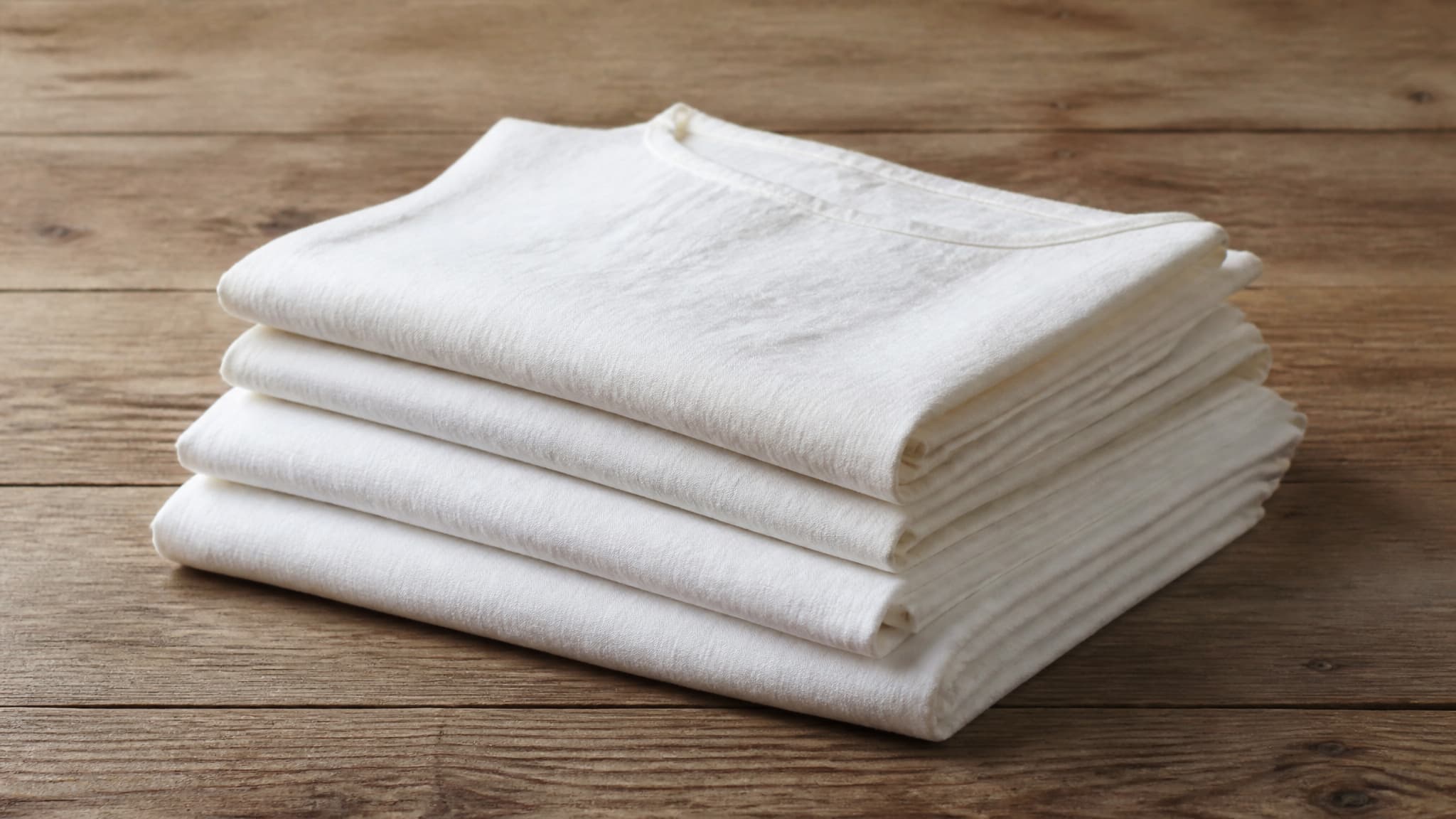
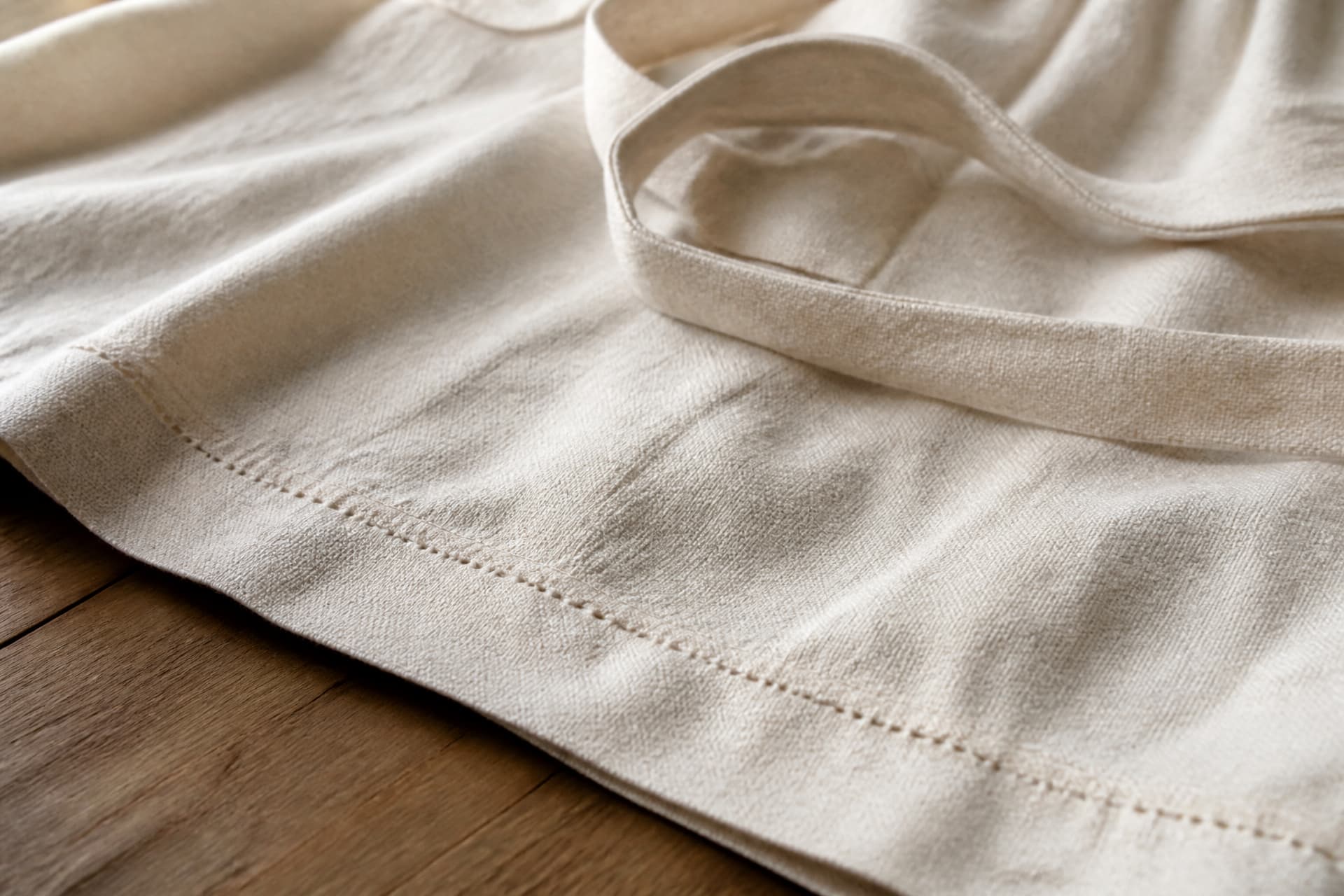
The garments are white, undyed, and unadorned. They are sewn by hand where possible, from linen or muslin — inexpensive natural fiber, chosen because it is inexpensive. There are no buttons, no zippers, no hooks and no fasteners of any kind; pieces are held closed by ties and sashes. There are no pockets. And there is no range of quality: a community does not offer a basic set and a premium set, because the entire design of the practice is that nobody at the graveside can tell which of the two graves in front of them belonged to the more successful person.
You will hear the word most often in one of two conversations. The first is with a funeral director confirming what will happen in the hours before the service. The second is with a member of the chevra kadisha, the volunteer burial society, who may use it alongside tahara, the ritual washing that precedes the dressing. The two rites are consecutive and separate, and it is easy to hear them as one thing on a hard day.
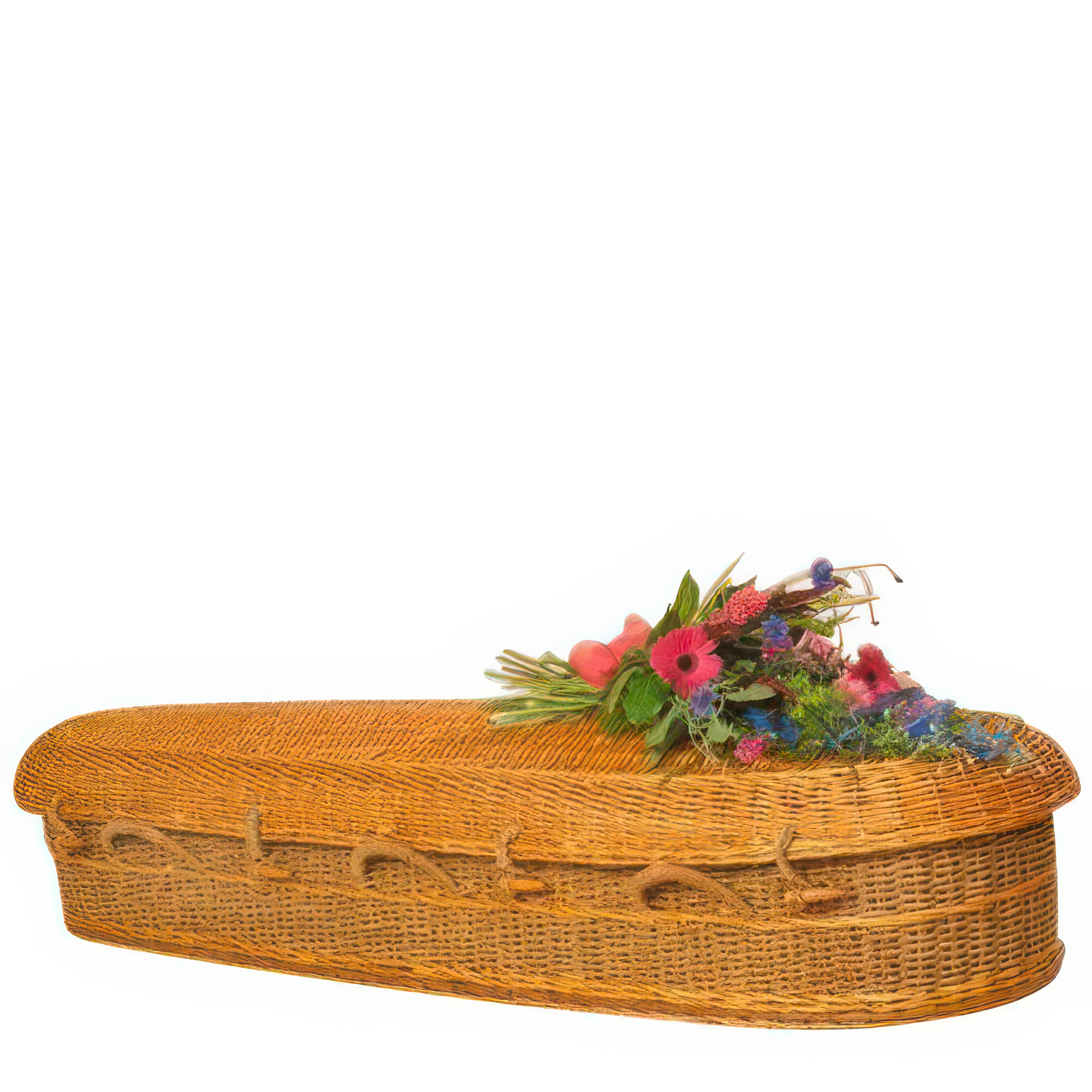
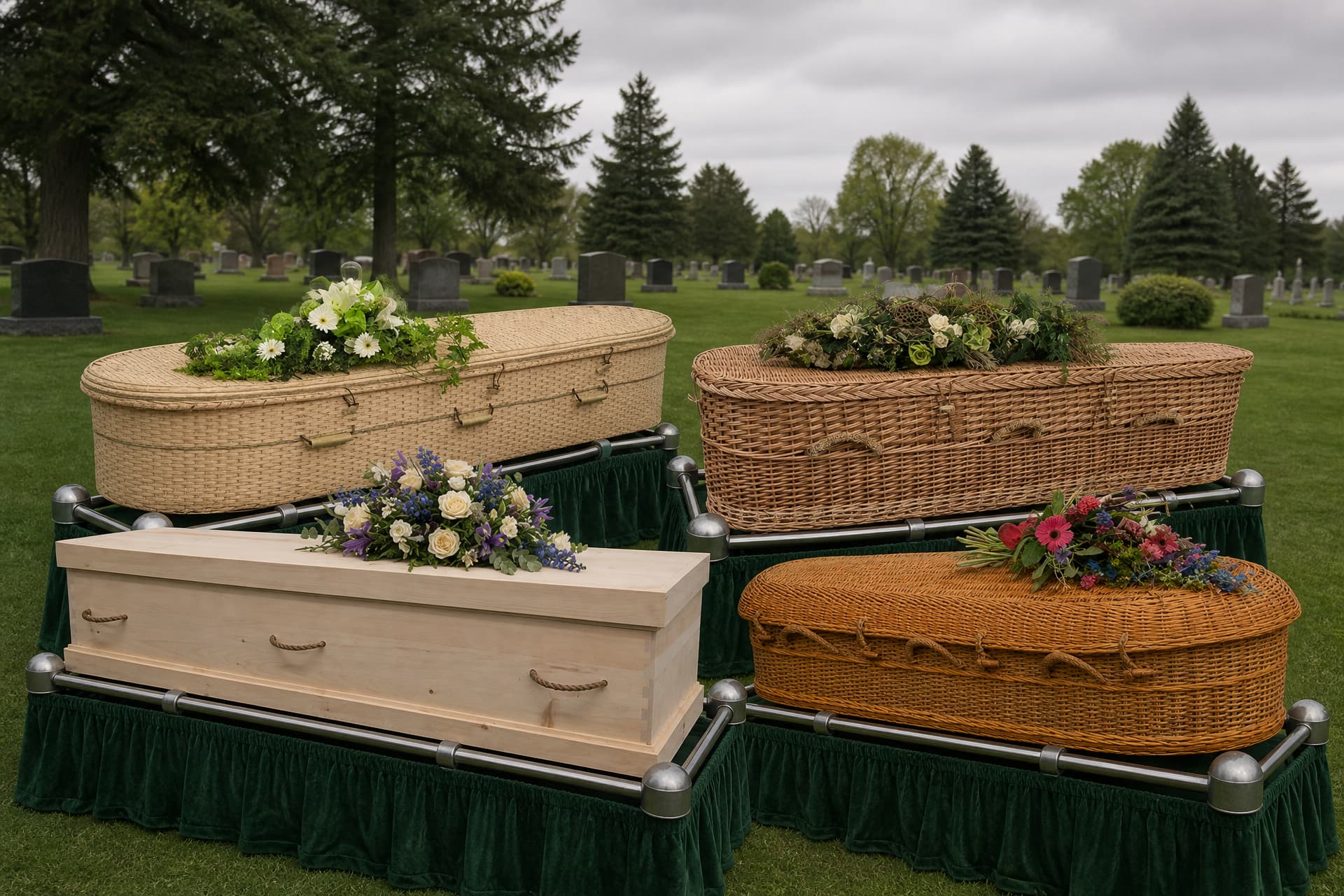
Plain Wood and Woven Caskets
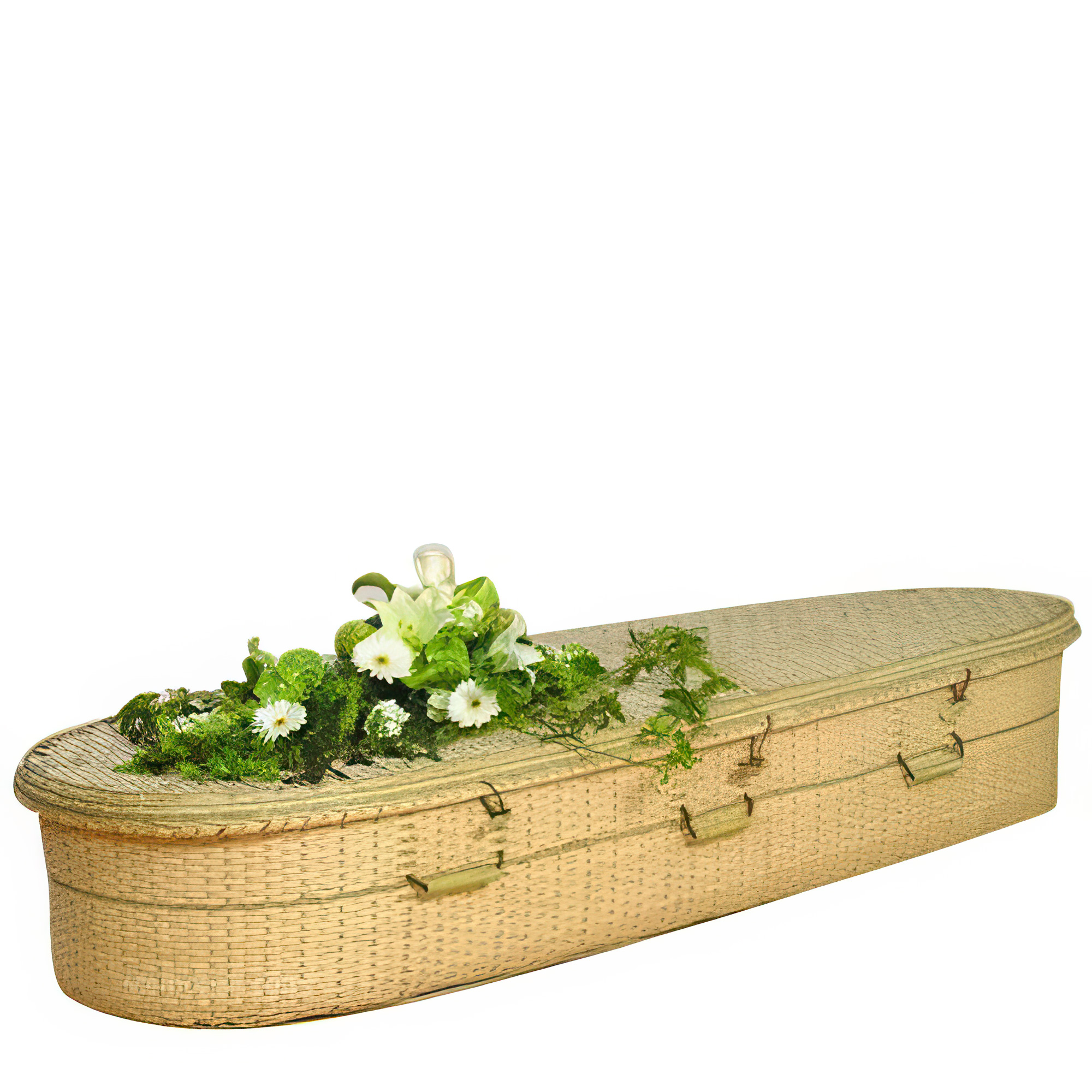
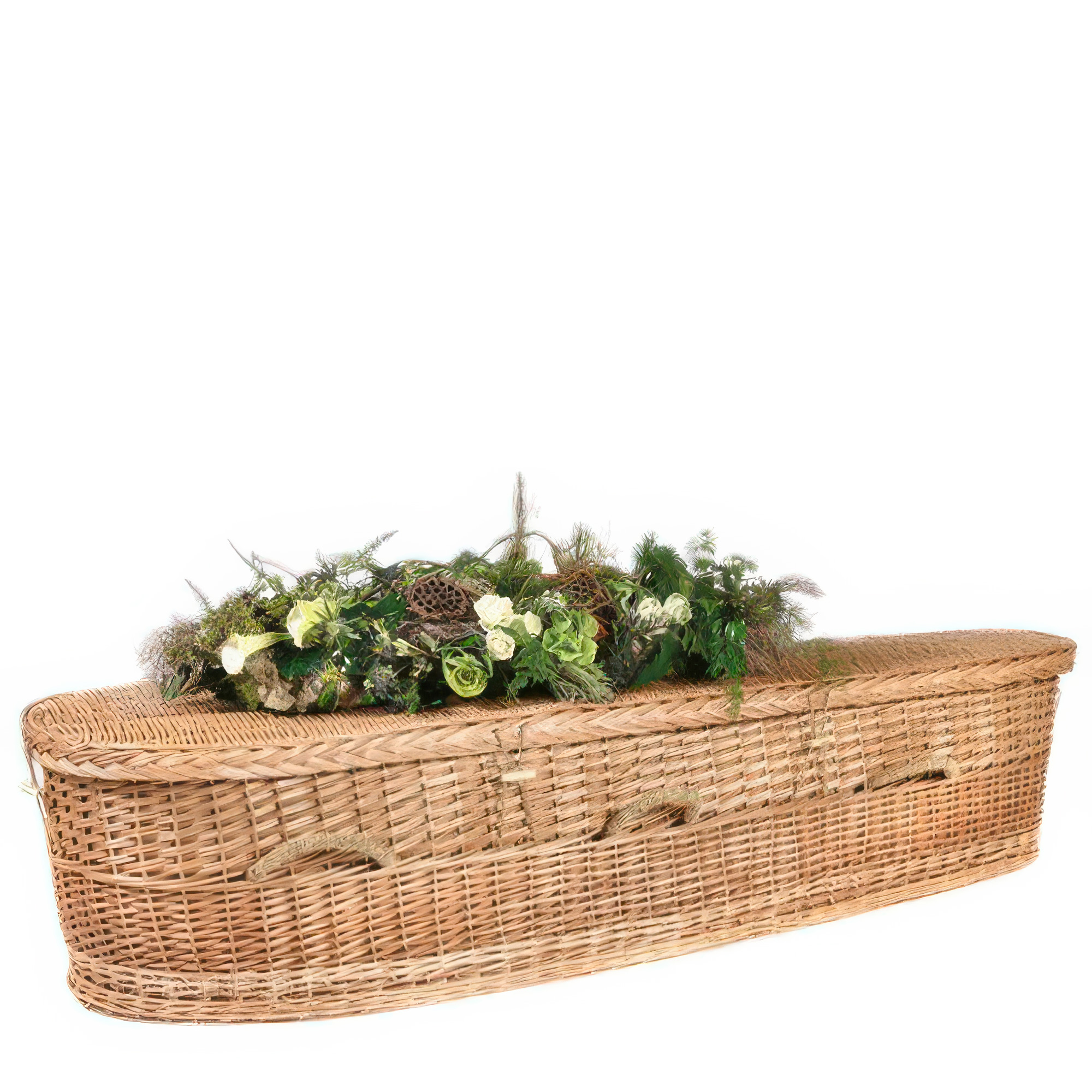
Unlined, natural-material caskets from our green burial range
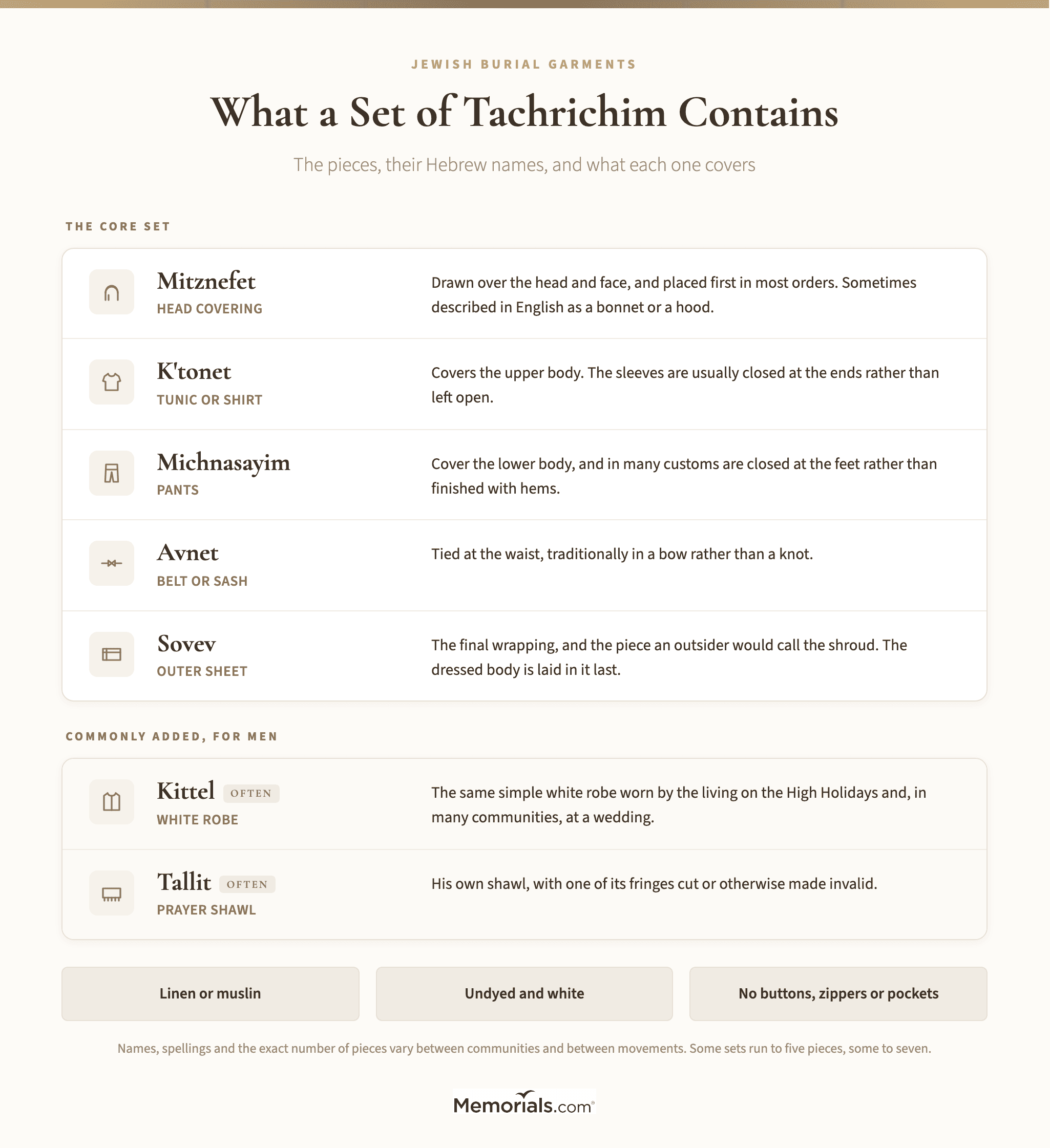
Families searching for jewish burial clothes are usually after one specific thing: the plain white set the funeral home will use, and whether anyone expects them to supply it. Here is what is in it. Names and spellings vary between communities, and so does the exact count of pieces — some sets have five, some seven.
A head covering (mitznefet, sometimes described as a bonnet or hood) is placed first in most orders, drawn over the head and face. A tunic or shirt (k'tonet) covers the upper body, with sleeves that are usually closed at the ends rather than left open. Pants (michnasayim) cover the lower body and are, in many customs, closed at the feet in the same way — a single continuous garment rather than something with hems. A belt or sash (avnet) is tied at the waist, traditionally in a bow rather than a knot, and in many communities it is arranged in a shape meant to recall a Hebrew letter. Over everything goes an outer sheet (sovev), the piece that most resembles what an outsider would call a shroud, in which the dressed body is finally wrapped.
Two additions are common. Men are frequently dressed in a kittel, the simple white robe worn while living on the High Holidays and, in many communities, at a wedding — the same garment, worn at the beginning of a marriage and at the end of a life. And a man is often wrapped in his own tallit, his prayer shawl, with one of its fringes cut or otherwise made invalid, because the obligations the garment represents end with the person who carried them.
What is absent is the design. No buttons, no zippers, no hooks — the pieces close with ties, and the stitching is meant to be visible rather than concealed.
A typical set runs head covering, tunic, pants, belt and outer sheet, with a kittel and a tallit added for men in many communities; the number of pieces and their names vary between traditions.
Why Plain White, and Why No Pockets
The reasoning has three parts, and the tradition makes all three arguments about itself without needing anyone to editorialize.
The first is equality. Burial is the one moment where a community can guarantee that two people are treated identically, and the garments are the instrument. The rabbinic tradition preserves a memory of why this became fixed practice: funerals had grown so competitive and so ruinously expensive that families were abandoning their dead rather than face the cost, until a leading sage of the first century asked to be buried in plain linen himself and the custom followed him. Whatever the historical detail, the principle survived intact — the expense of a burial should not be a public statement, and it should never be a burden.
The second is humility. Undyed cloth, hand-stitched, without ornament, is what a person is understood to stand in before God — the same reason the kittel is white and unadorned when it is worn by the living on the Day of Atonement. Nothing about the garment is meant to flatter the body inside it.
The third is the one that most readers remember afterward: there are no pockets, because nothing goes with you. It is a plain physical statement of a plain idea, and it is why the question comes up on nearly every search about this topic. The garments have nowhere to put anything, so nothing is put anywhere. What a person accumulated stays behind for the people who are still using it.
There is a fourth, quieter reason worth naming, because it matters practically to a family in a hurry. A standard set of garments removes an entire class of decision from the worst forty-eight hours most people ever have. Nobody has to choose an outfit, nobody has to guess at a preference, and nobody has to wonder afterward whether they chose well.
Who Dresses the Body: The Chevra Kadisha
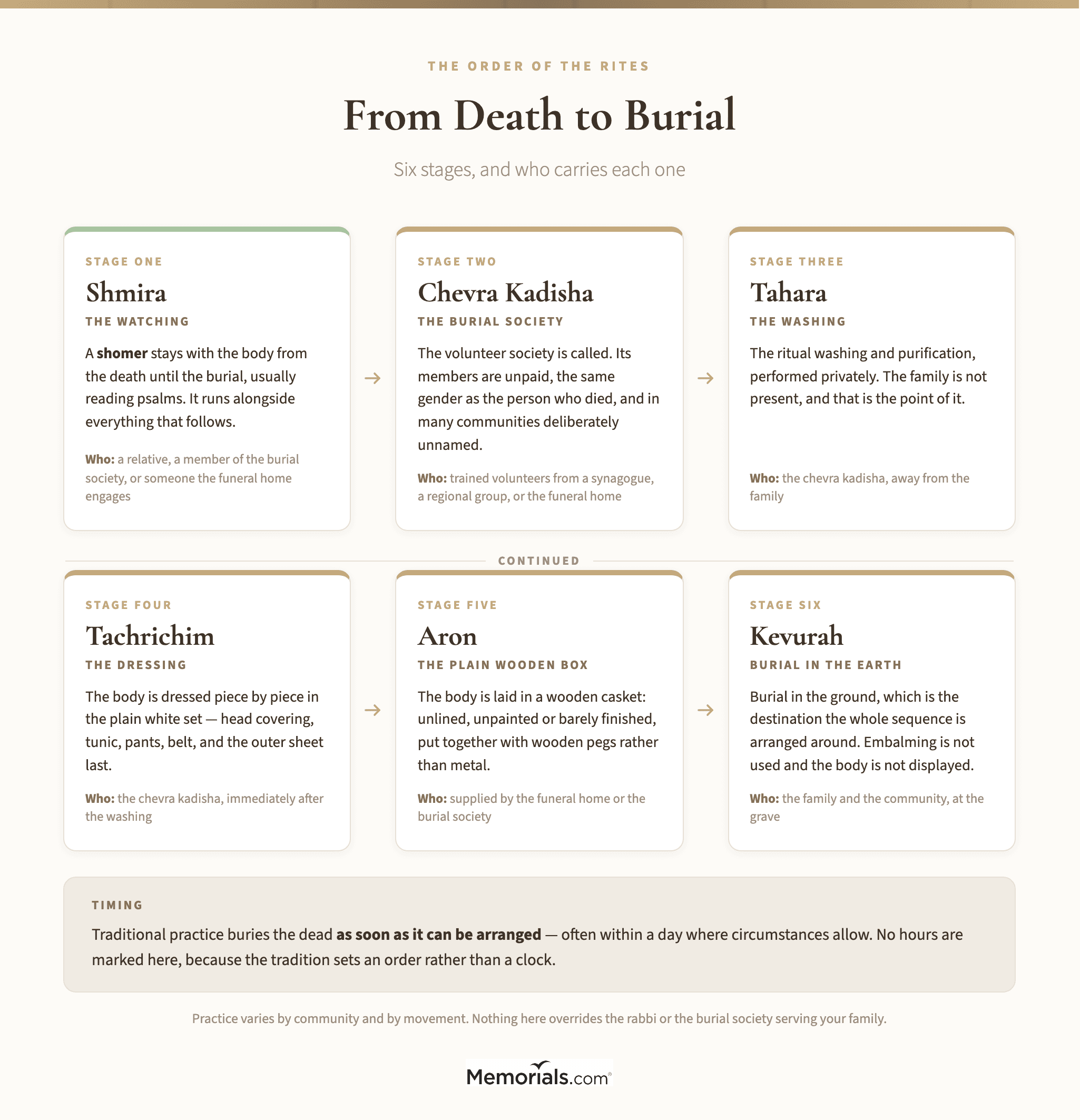
The dressing is done by the chevra kadisha — the holy society, or burial society — a group of trained volunteers attached to a synagogue, a regional organization, or in smaller communities the funeral home itself. They are unpaid, they are the same gender as the person who died, and in many communities they are deliberately not named, so that nobody can be thanked for it. The tradition calls the work chesed shel emet: a kindness that cannot be repaid, because the person receiving it has no way to return it.
Before the dressing comes the washing. Tahara is a rite in its own right, with its own sequence and its own rules, and it is performed privately, without the family present — the point being that someone else carries this so a grieving household does not have to. From the moment of death until the burial a shomer, a watcher, stays with the body, usually reading psalms; that continuous watching is called shmira.
The whole sequence moves fast, and it is worth understanding why, because it constrains scheduling. Traditional practice buries the dead as soon as it can be arranged, often within a day where circumstances allow, and it does not use embalming — the body is neither preserved nor displayed. That is a real limit on how long a service can wait for relatives to fly in, and it is one of the first things to raise with the funeral director rather than assume.
The preparation happens away from the family, usually overnight, and the room is left as plain as the garments.
Watching, washing, dressing, the plain wooden box, and burial in the earth — the sequence is fixed, and tradition holds that it should be completed as soon as it reasonably can be rather than on any measured schedule.
The Shroud and the Casket
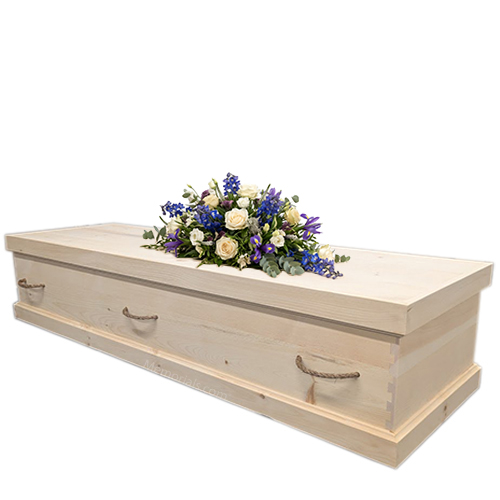
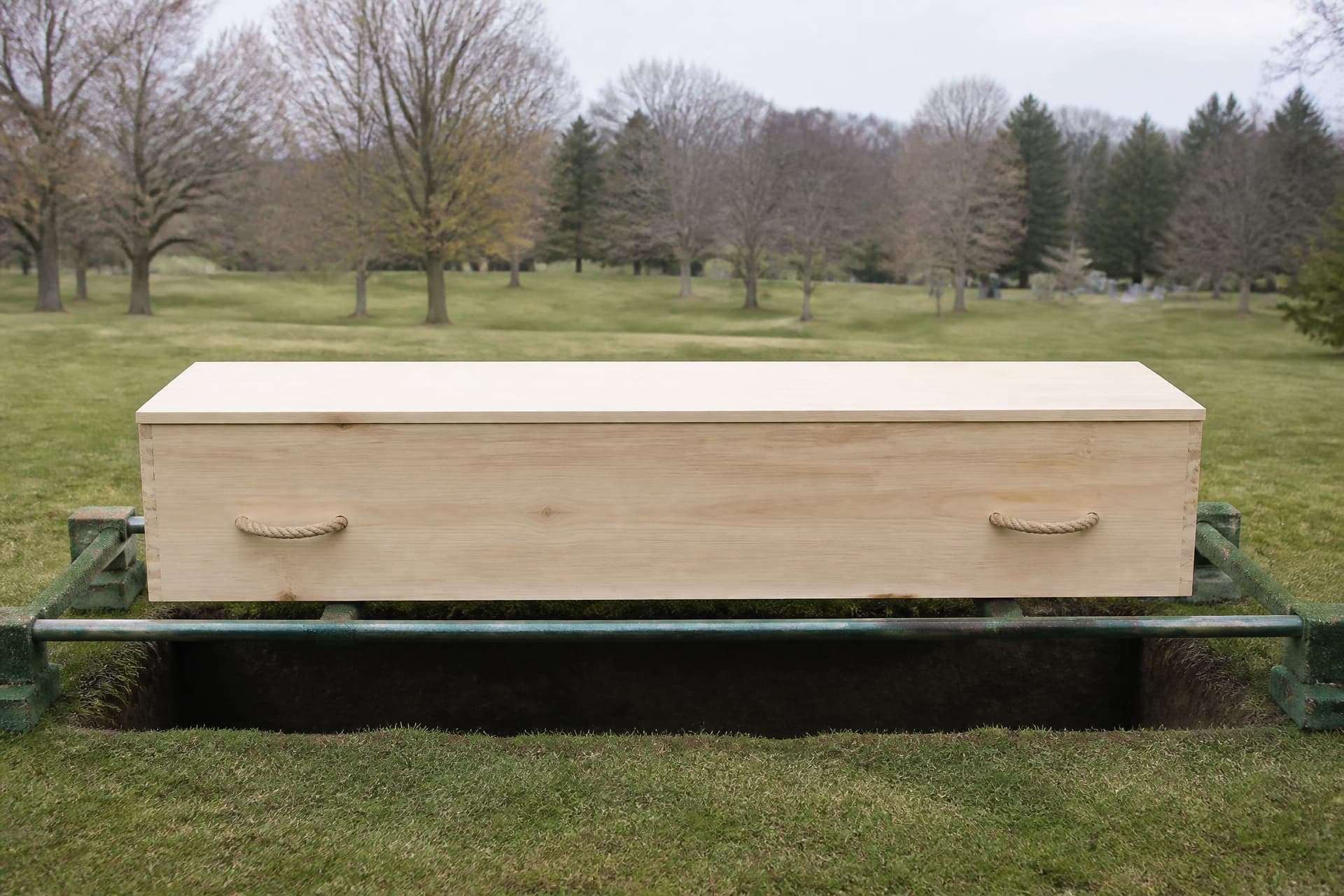
The reasoning that governs the garment governs the container too, which is why the two subjects belong on one page. A traditional Jewish casket — the aron — is wood and nothing else: unlined, unpainted or barely finished, put together with wooden pegs instead of metal screws, and in many communities bored with holes in the base so that nothing stands between the body and the earth it is returning to.
In practical terms that usually means a pine casket, or the plainest wooden box the funeral home can supply. It is nearly always among the least expensive options on offer, which is the intended outcome rather than a compromise. A family that finds itself being steered toward something heavier, lined, or fitted with metal hardware is being steered away from the tradition, and it is entirely reasonable to say so out loud.
The same all-wood construction turns up well outside Jewish practice: green burial caskets are built without metal for an ecological reason rather than a religious one, and much of what the green burials movement now argues for arrives at conclusions Jewish law reached a very long time ago by a different route. That resemblance is genuine and it has a hard edge: a family observing halacha should let the funeral home or the chevra kadisha supply the aron rather than sourcing one independently. Nothing sold on this site is certified for Jewish burial, and we make no such claim about it.
Burial in the earth — kevurah — is the destination all of this is arranged around, and it is the reason the tradition has historically not permitted cremation; Jewish views on cremation differ sharply between movements in ways this page does not attempt to settle.
A plain wooden box is close to the whole specification — an aron is judged by what has been left out of it rather than by anything added.
Where Families Get Tachrichim
Search jewish burial shrouds for sale and you will find Judaica suppliers, Israeli manufacturers and general funeral retailers side by side, which is exactly the confusion worth clearing up: in most communities the shroud is not something the family buys.
The usual arrangement is that the funeral home or the chevra kadisha keeps sets on hand and supplies them as part of the preparation. The cost, where there is one, is typically folded into the funeral home's charge or covered by the honorarium a family gives the burial society, and it is small relative to everything else on the invoice — again, by design. A great many families never see a separate line for it and never handle the garments at all.
There are real reasons a family might buy a set directly. Someone may want to prepare a set in advance for themselves. A person may be dying far from any organized Jewish community, or the local funeral home may serve very few Jewish families and keep nothing in stock. Some people want a set sewn by a particular person, or by a community group that does this work. In each of those cases the sets are available from Judaica suppliers and from manufacturers who make almost nothing else.
The answer to give anyone who is unsure, though, is the same one every time: ask the rabbi or the funeral director before ordering anything. They will know what is already provided, what the local burial society expects, and whether a set bought online meets the standard the community actually keeps. That single question saves more families money and worry than any purchase does. To be plain about our own position: we do not stock tachrichim, and no product on this site should be represented as such.
How This Compares to Other Shrouded Traditions
The nearest parallel is the kafan, the plain white cotton cloth used at a muslim funeral. The two traditions arrived independently at strikingly similar conclusions — a washing performed by community members, undyed white cloth, no adornment, no embalming, and burial without delay. They differ in the details, and the Islamic practice wraps rather than dresses, but the shared instinct is unmistakable: what a person wears into the ground should carry no information about them.
Strip the religious specifics away and what is left is a burial shroud in the ordinary sense — cloth instead of a container — which has its own long history and its own modern revival among families choosing simpler burials for reasons that have nothing to do with observance. The vocabulary overlaps and the objects do not. Tachrichim are tailored garments for a specific rite; a shroud in the general sense is fabric, and the two should not be shopped for interchangeably.
Frequently Asked Questions
What is a Jewish burial shroud called?
Tachrichim. The word is plural because the shroud is a set of garments rather than a single wrapping — typically a head covering, a tunic, pants, a belt and an outer sheet, with a kittel added for men in many communities. Spellings vary in English transliteration; the garments do not.
What are tachrichim made of?
Linen or muslin, undyed and white, hand-sewn where possible. Both are inexpensive natural fibers, and the low cost is a requirement rather than an economy — a burial garment is not supposed to be an expenditure. Nothing synthetic, nothing dyed, and no metal fastenings of any kind.
Why do Jewish burial shrouds have no pockets?
Because nothing accompanies a person out of this life. The absence of pockets is a physical statement of that idea, and it is the detail most people remember afterward. It also reinforces the equality the garments exist to protect: with nowhere to carry anything, no grave can be furnished more richly than another.
Are men and women buried in the same garments?
The sets are essentially the same in construction, materials and color, with the same pieces serving the same purposes. The differences are in customary details rather than in quality — a kittel and a tallit are traditionally part of a man's set, and communities vary in how the head covering is arranged. No version of the set is finer than another, which is the entire point of standardizing them.
Where do you buy Jewish burial shrouds?
In most cases you do not. The funeral home or the chevra kadisha supplies them as part of the preparation, usually within the cost of the funeral or the society's honorarium. Families who need to buy a set directly — for advance planning, or where no Jewish burial society is nearby — can order from Judaica suppliers and specialist manufacturers. Ask the rabbi or the funeral director first; they will know what is already provided.
One Thing You Do Not Have to Solve
If you are reading this inside the first day after a death, here is the short version. The garments are standard, the burial society has them, they are the same ones everyone gets, and nobody is judging your choices because there are no choices to make. The tradition took this decision away from families on purpose, centuries ago, for exactly the reason you are feeling right now.
What is left for you is the part that only you can do: deciding who to call, who sits with the body, and who speaks at the grave. Those are the questions worth your attention today. Everything after the burial — the week at home, the month that follows, the yahrzeit candle a year from now — comes in its own time, and there will be people around to tell you when.