🏬Supersize Online Funeral Retailer🪦1000's of Headstones⚱️Over 10,000 Cremation Urns⚰️Caskets Overnight Delivery🛒Funeral & Memorial Superstore🚚FREE Shipping on ALL Orders👨👩👧👦Helping Families for over 20 Years💰Lowest Price Guarantee🏬Supersize Online Funeral Retailer🪦1000's of Headstones⚱️Over 10,000 Cremation Urns⚰️Caskets Overnight Delivery🛒Funeral & Memorial Superstore🚚FREE Shipping on ALL Orders👨👩👧👦Helping Families for over 20 Years💰Lowest Price Guarantee
🏬Supersize Online Funeral Retailer🪦1000's of Headstones⚱️Over 10,000 Cremation Urns⚰️Caskets Overnight Delivery🛒Funeral & Memorial Superstore🚚FREE Shipping on ALL Orders👨👩👧👦Helping Families for over 20 Years💰Lowest Price Guarantee🏬Supersize Online Funeral Retailer🪦1000's of Headstones⚱️Over 10,000 Cremation Urns⚰️Caskets Overnight Delivery🛒Funeral & Memorial Superstore🚚FREE Shipping on ALL Orders👨👩👧👦Helping Families for over 20 Years💰Lowest Price Guarantee
Tahara is the ritual washing, purification and dressing of a body before a Jewish burial, and the word itself is Hebrew for purity. It is carried out by a small team of trained volunteers, usually three or four, always the same gender as the person who died. It happens privately, and the family is not present — not because they are shut out, but because the entire design of the rite is that someone else carries it so a grieving household does not have to. If a funeral director or a rabbi said the word to you a few hours ago and you have never heard it before, that is the ordinary condition rather than a failure.
Every tradition answers the same handful of questions about the hours between a death and a burial: who touches the body, what it is dressed in, who sits with it, how quickly the burial comes. Our funeral traditions guide sets those answers side by side. Judaism's answer is unusually specific — the preparation has five named parts, performed in a fixed order — and the rest of this page walks through all five, then covers who to call, what varies between communities, and when the rite is changed or set aside.
Tahara comes from a Hebrew root that means ritual purity, and you will see it transliterated several ways: tahara, taharah, occasionally tahorah. The spelling changes; the word does not. Anyone looking up the taharah meaning and anyone looking up the tahara meaning is asking the same question, and the honest answer has two halves.
The first half is the plain translation. Tahara is purity, and specifically ritual purity rather than cleanliness — it belongs to the same family of words as mikvah, the ritual bath a living person immerses in. What happens to a body before burial is understood as the last of those immersions.
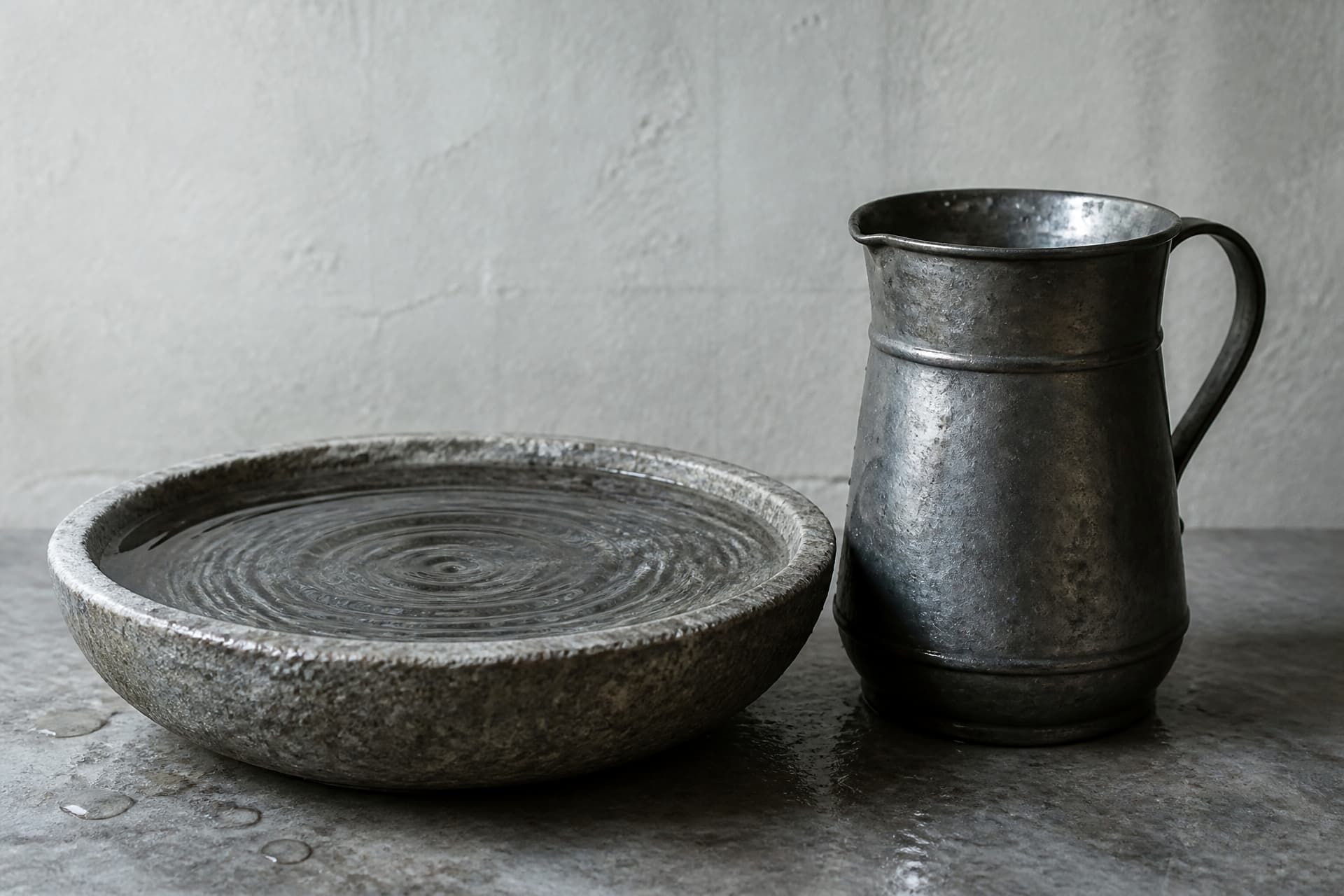
The purification is defined by the pour rather than by the scrubbing — an unbroken stream of water, poured without pause, is what the second step of tahara requires, and the rings on the water are all that is left of it a moment later.
The second half is where nearly every explanation gets tangled, and it is worth stating flatly. Tahara names the whole rite and it names one specific step inside that rite. When a funeral home says tahara has been done, they mean the full preparation: washing, purification, dressing, and laying the body in the wooden box it will be buried in. When a member of a burial society says taharah, they may mean only the second of those steps, the pouring of water. Both usages are correct and both are in daily use, which is why somebody searching tahara Jewish burial customs can read three pages and come away less certain than when they started.
One more piece of vocabulary is worth having, because you will hear it in the same conversation. Shmirah is the watching — someone stays with the body from the moment of death until burial. Tahara is the preparation. They cover the same stretch of hours and they are not the same thing.
Who Performs Tahara: The Chevra Kadisha
The team is called the chevra kadisha, which translates roughly as holy society or sacred society. In most communities it is a group of volunteers attached to a synagogue, a burial society, or a regional organization that serves several congregations. They are not funeral home staff, they are not paid, and in many communities the people on the team are deliberately not named, so that no one can be thanked and no one accrues social credit for the work.
That anonymity is the theological point. Preparing a body is described as chesed shel emet — true kindness, meaning a kindness that cannot possibly be repaid, because the person who receives it is beyond any position to return it. Everything else you do for someone can be reciprocated. This cannot, and in the tradition that makes it the purest form of the act.
The team is the same gender as the person who died: men prepare men, women prepare women. Three to four people is typical, with one leading. Modesty governs the whole procedure — the body stays covered except for the part being attended to, is never left alone in the room, and is never placed face down. Members work in a set order and speak little, and what speaking there is tends to be psalms and prayers rather than conversation.
Practice varies more than most pages admit. In large cities with an established chevra kadisha, volunteers do the entire preparation in a room at the funeral home or at a facility the society maintains. In smaller communities, funeral home staff trained in the rite may perform it, sometimes with one member of the society present. Some communities have a chevra kadisha for men and a separate one for women; some share a single group. If you want to know exactly who will do this for your family, that is a question for the rabbi or the funeral director, and it is a normal question to ask.
The Five Parts of Tahara
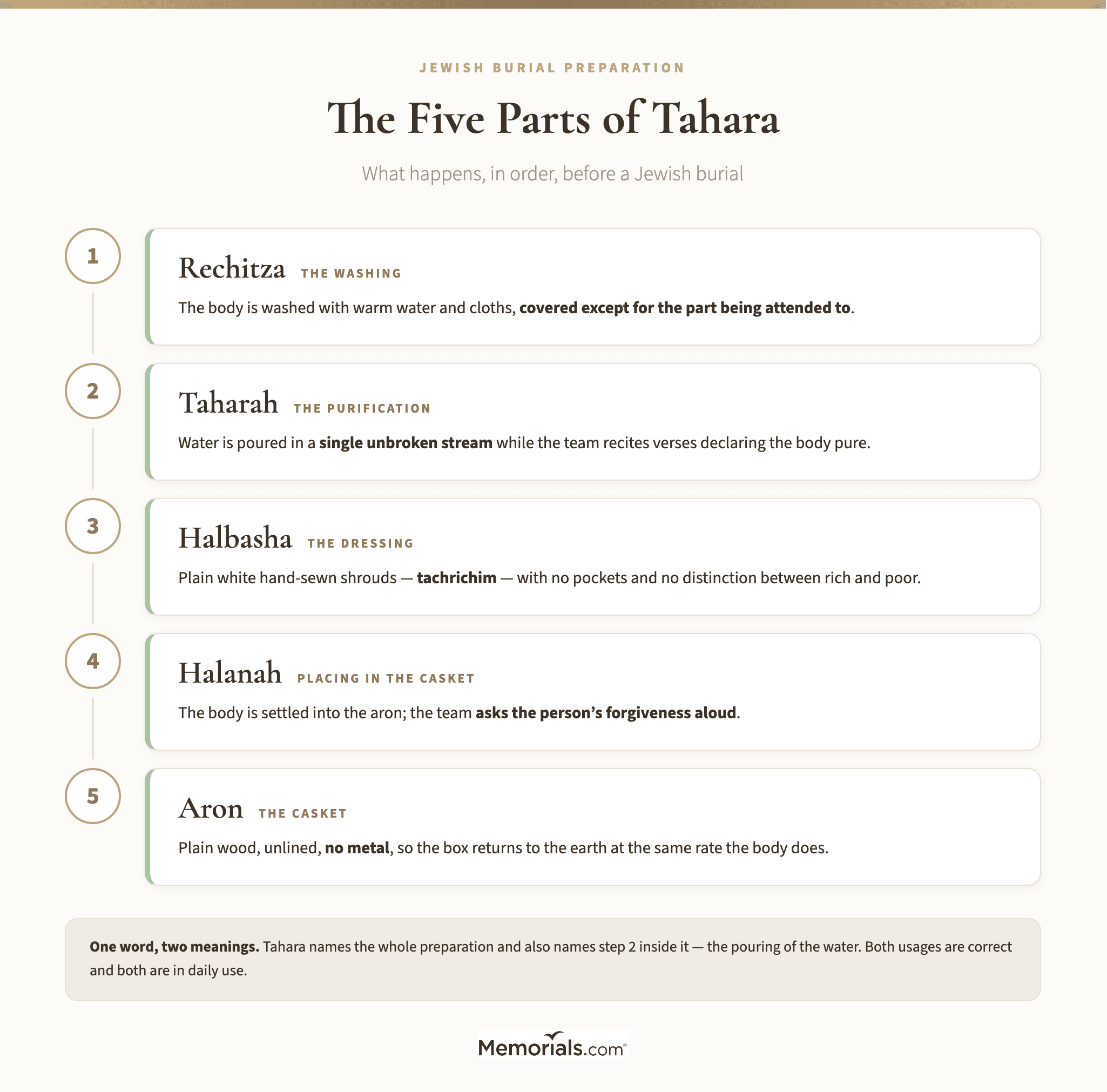
Most descriptions of tahara either blur the steps into a general impression of respectful washing, or set them out for volunteers who already know what they are doing. Here they are in order, described for someone who simply wants to understand what is being done and why.
Rechitza: The Washing
The body is undressed and washed — ordinary, careful cleaning with warm water and cloths, working in a prescribed order and keeping the body covered apart from the section being washed. Any bandages, dressings and medical tape are removed. Fingernails and toenails are cleaned. It is a physical preparation and it is done thoroughly, which is the reason the whole thing takes longer than people expect.
Taharah: The Purification
This is the step the whole rite is named after, and it is not more washing. Water is poured over the body in a continuous, unbroken flow — traditionally reckoned as nine kavim, a biblical measure usually rendered as around twenty-four quarts — while the team recites verses declaring the body pure. The continuity matters more than the quantity: the pour is not allowed to stop and restart, which is why some communities use several containers passed hand to hand, and others use a purpose-built immersion pool.
Halbasha: The Dressing
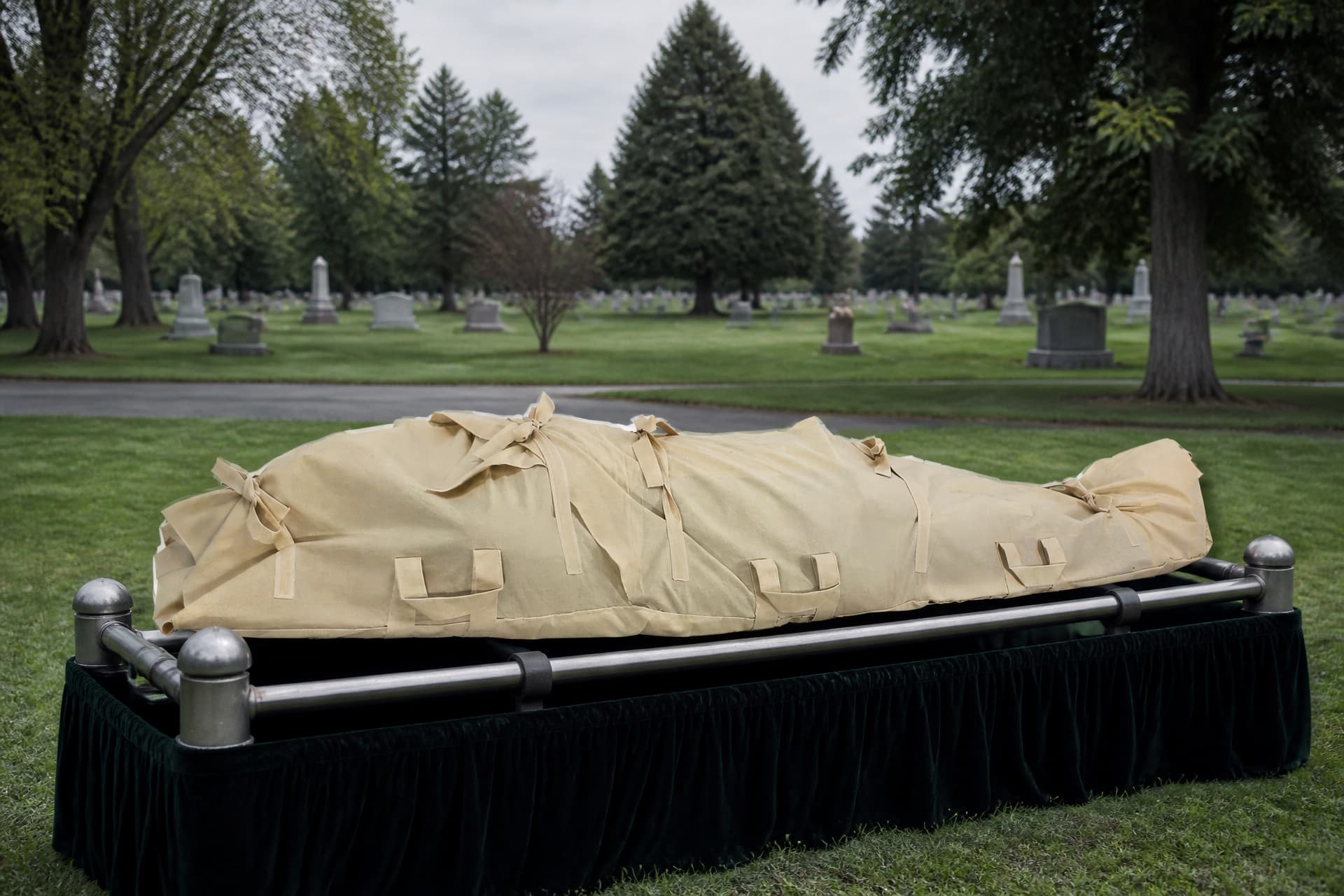
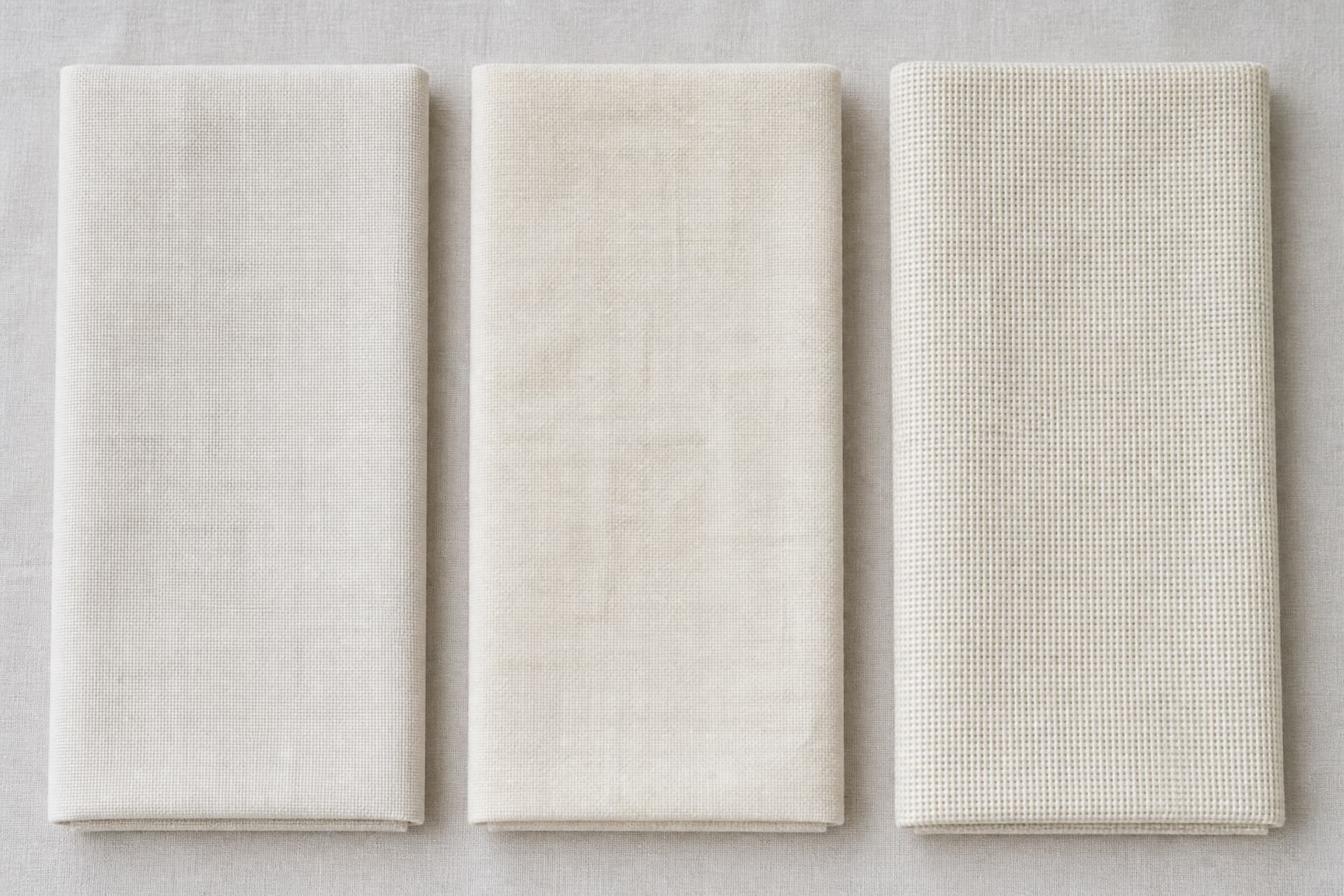
The body is dried and dressed in tachrichim, the plain white garments used for every Jewish burial. They are hand-sewn from linen or muslin, made without pockets, and identical for everyone — no grades, no upgrades, nothing that would distinguish a wealthy person from a poor one at the graveside. The set typically includes a head covering, a shirt, pants, a belt or sash, and an outer wrapping sheet called the sovev. Men are often also dressed in a kittel, the white robe worn on the High Holidays and at a wedding, and wrapped in their own tallit with one of the tzitzit fringes cut, because the garment's obligations end with life. What each community includes and how the pieces are tied varies, and our article on the Jewish burial shroud goes through the set piece by piece.
Plain, undyed, pocketless cloth is the whole idea — a burial garment is not supposed to say anything about what the person owned. Product shown: Biodegradable Cotton Shroud .
Halanah: Placing the Body in the Casket
The dressed body is lifted into the casket and settled, and in many communities a small quantity of earth is placed inside — often earth brought from Israel, sometimes sprinkled over the eyes and heart, sometimes placed beneath the body. Broken pieces of pottery are used in some traditions for the same purpose. At the end of the preparation the team asks the person's forgiveness aloud, for any indignity they may have caused in handling them, and that request is a fixed part of the rite rather than a flourish.
Aron: The Casket
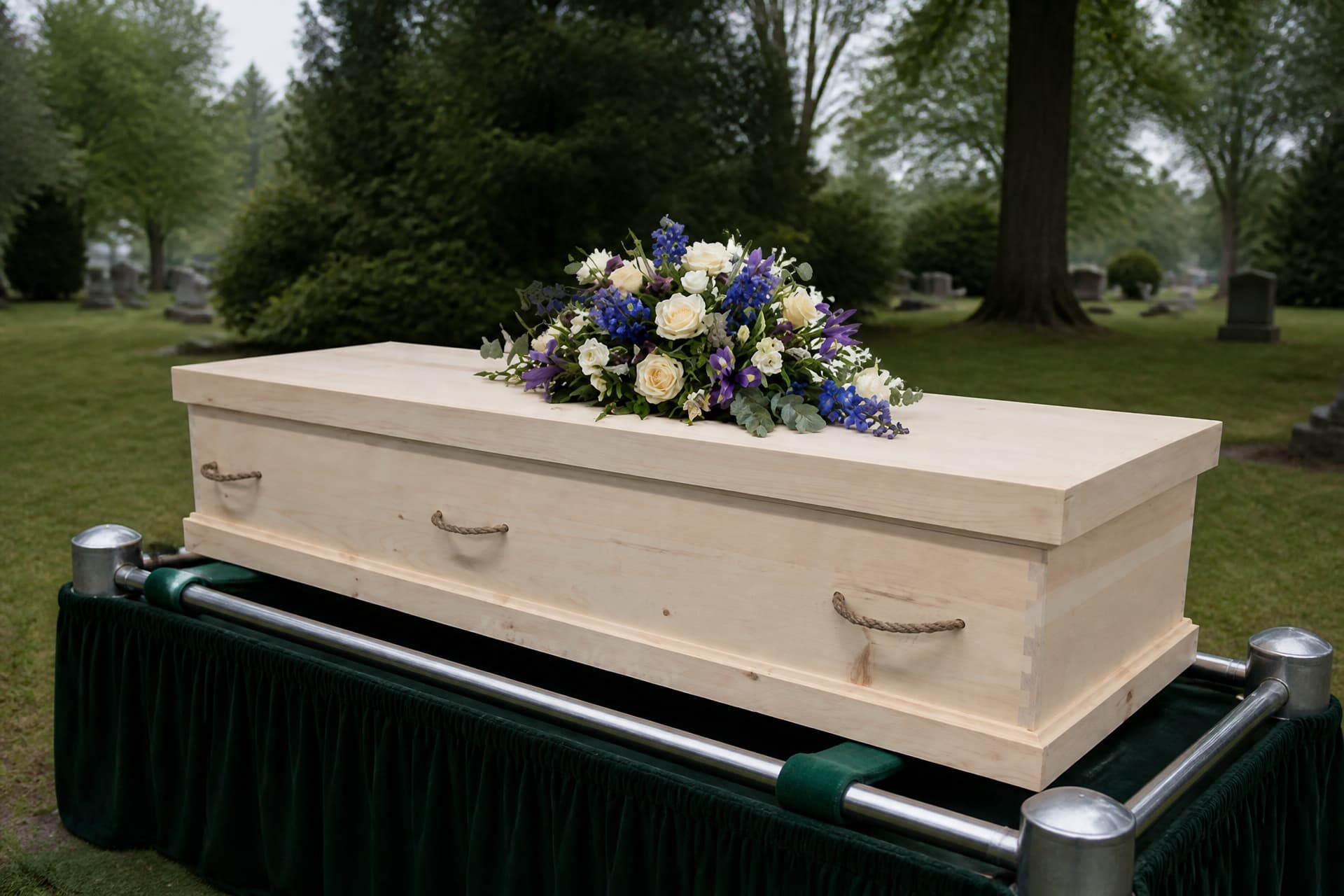
The aron is the box itself, and its requirements are the shortest list in the whole rite. It is wood, unlined, unfinished or plainly finished, with no metal in it — assembled with wooden pegs or dowels, sometimes with holes bored in the base. In practice that means a plain pine casket or something very close to it. The reasoning is that the body and the box should both return to the earth at roughly the same rate, and nothing should be spent on the container that could be given to the living instead.
This is also why Jewish burial anticipated by centuries much of what modern green burials now aim at. There is no embalming, no viewing, no vault where the cemetery does not demand one, and no sealed container. A family looking at the same values today would be shopping for a biodegradable casket; a Jewish family has been buying the simplest available wooden box for a very long time, for entirely different reasons that arrive at the same place.
An aron is judged by what is absent from it: no lining, no metal, nothing built into the box that will outlast the person inside. Product shown: Duxbury Wood Casket.
Rechitza is the washing, taharah the purification pour, halbasha the dressing in tachrichim, halanah the placing into the aron, and the aron itself the plain unlined wood box — five steps, always in this order.
What the Family Does While Tahara Happens
Nothing, and that is intentional. The family is not in the room, does not watch, and is not asked to help. What they do instead is arrange for the body never to be left alone.
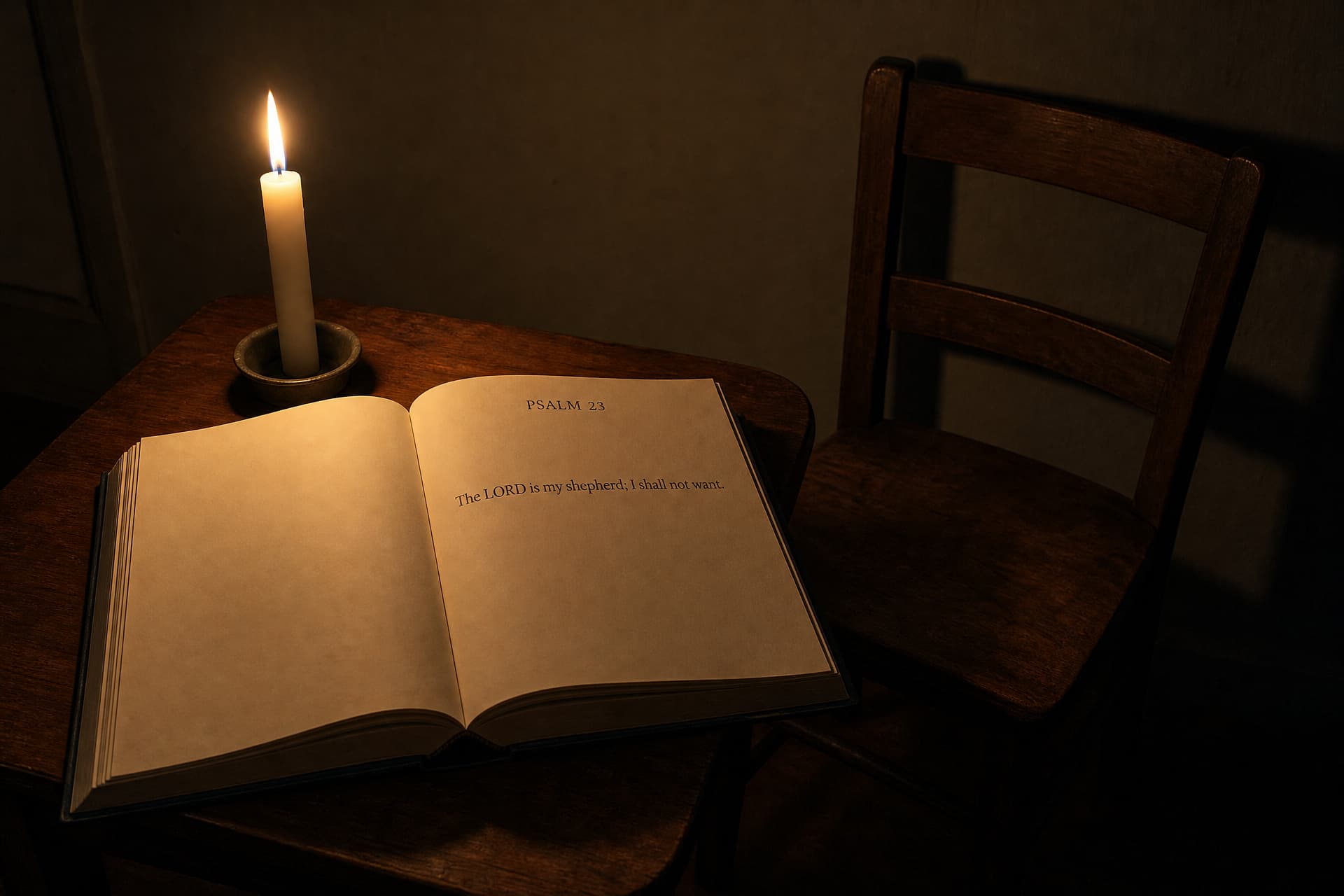
That is shmirah, the watching. From the moment of death until the burial, someone sits with the body — a shomer or shomeret, which may be a relative, a member of the burial society, or someone the funeral home engages. Traditionally they read psalms aloud, and the reading is understood as company for the person rather than as a performance. Shifts are usually a few hours each. A candle is kept lit beside them. Families often carry the same practice forward long after the burial, lighting a yahrzeit candle on each anniversary of the death, and there is a wider set of customs around memorial candles that grows out of the same instinct.
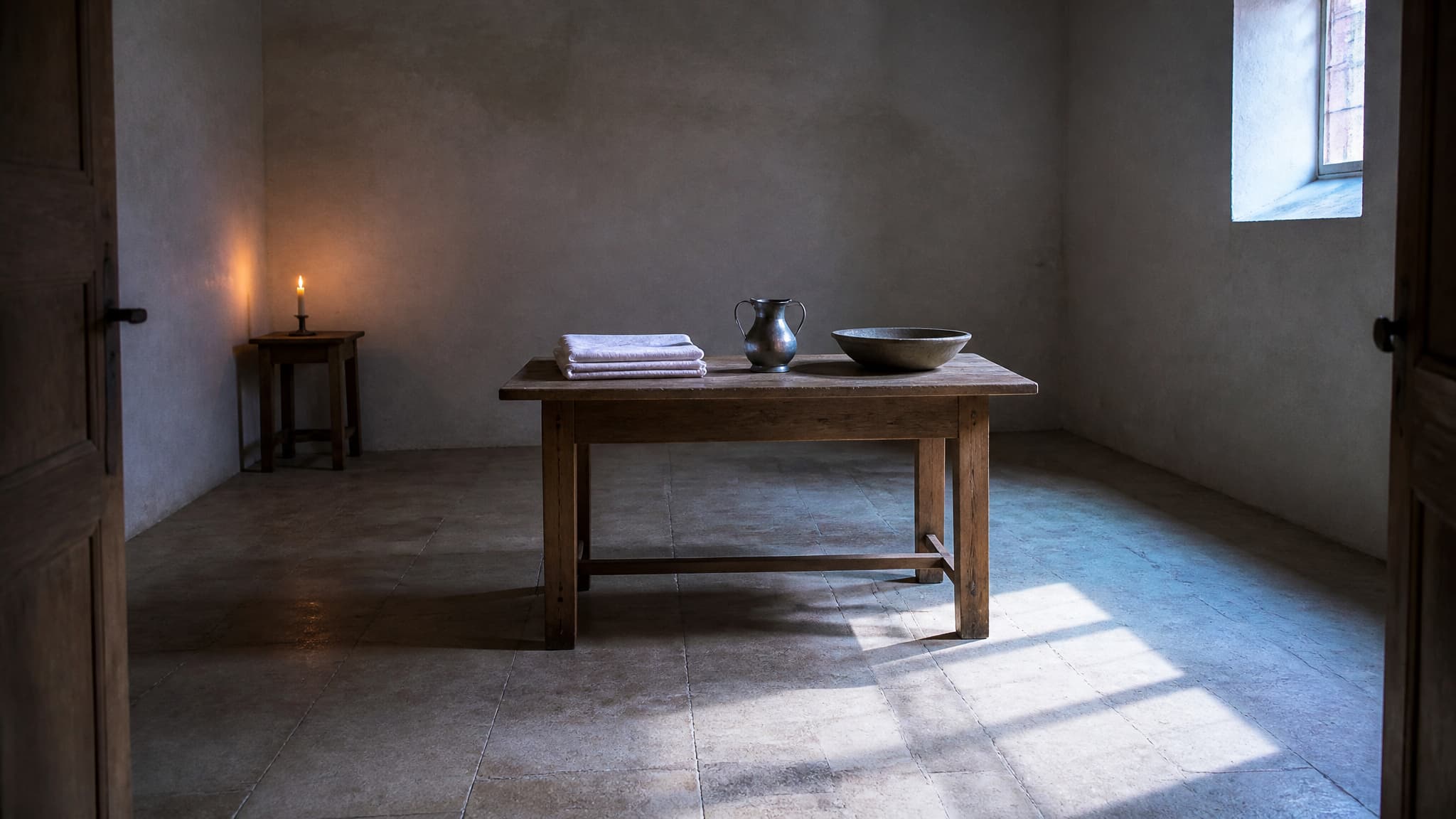
Shmirah is usually described as watching, but what it actually looks like is an occupied chair, an open book of psalms and a candle that nobody lets go out.
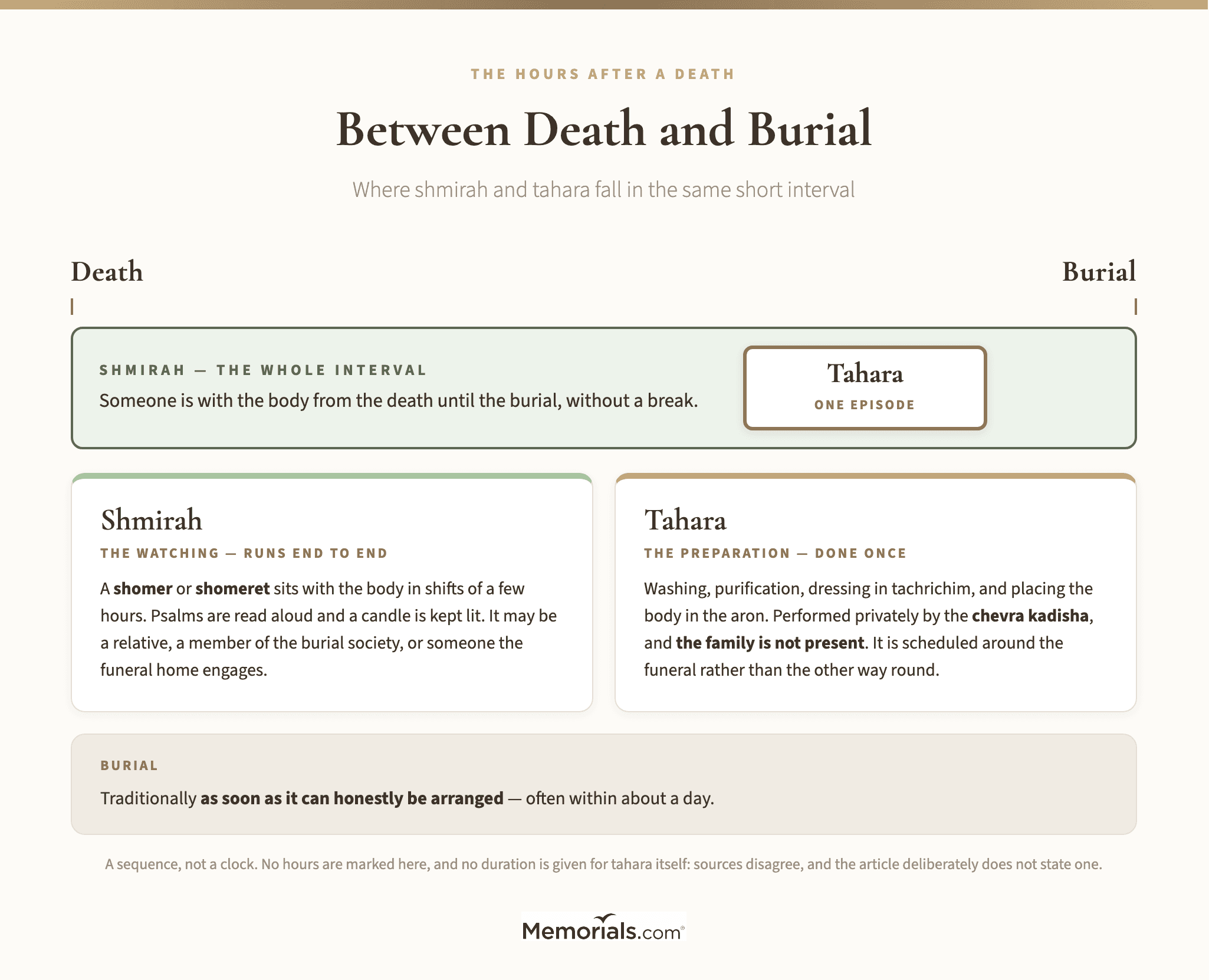
Shmirah and tahara occupy the same short stretch of time and answer different obligations, which is easier to see laid out than described.
Shmirah runs unbroken from the death to the burial; tahara is a single episode inside it, close to the funeral; and the burial itself is meant to follow as soon as it honestly can, traditionally within about a day.
At home, the household is doing its own preparation. Mirrors are covered — there are several explanations for why people cover mirrors when someone dies, and they differ by community. Chairs are lowered or cushions removed for the week of shiva that follows the burial. Food is arriving. Somebody is fielding the phone. None of it overlaps with what the chevra kadisha is doing, and that separation is the design working as intended.
How to Ask for Tahara
Say the word. To a funeral director: "we want tahara, and we want a chevra kadisha." That sentence is enough, and any funeral home that serves a Jewish community will know exactly what it means and who to call.
If there is a rabbi involved, ask the rabbi first — congregations generally have a standing relationship with a particular burial society, and the rabbi can make one phone call that saves you four. If there is no rabbi and no synagogue connection, ask the funeral home directly whether they work with a chevra kadisha, and if they do not, ask which nearby one they can reach. Societies routinely serve families who are not members of any congregation.
Cost varies too much to name a number here, and anyone who gives you a single national figure is guessing. The pattern is consistent even when the amounts are not: the volunteers themselves are unpaid, the shrouds are usually covered by a donation to the society rather than billed as a product, and the funeral home charges for the use of its preparation room and its staff time in the ordinary way. Ask for the two to be itemized separately, so you can see which part is a fee and which part is a contribution.
Two things worth confirming while you have someone on the phone. First, timing — Jewish burial is meant to happen quickly, so the preparation is scheduled around the funeral rather than the other way round. Second, whether the person who died left any instruction, because a stated wish carries weight in this decision. If you are also trying to work out what the service itself will be like and what is expected of the people attending, our guide to funeral etiquette covers the general ground.
When Tahara Is Modified, or Not Performed
The rite bends more often than its description suggests, and knowing that in advance spares families a second shock.
Where a death was violent or a body was badly injured, the washing is usually limited or omitted, because blood is treated as part of the body and is buried with it rather than washed away — clothing and dressings go into the casket instead. After an autopsy, or where organs have been donated, the society adapts in the same direction. Where there is a communicable disease or a public health restriction, the team follows the medical requirement and does what remains possible. In each case the principle holds: some honor is done, and a partial rite is not a failed one.
Distance is the other common obstacle. A death far from any Jewish community may mean no chevra kadisha is reachable in the time available, and a body is sometimes transported. Practice also differs across movements — tahara is close to universal in Orthodox communities, common in Conservative ones, and a choice families make individually in Reform and unaffiliated settings.
Cremation is the clearest case. Traditional Jewish law opposes it, and where a body is to be cremated, tahara is generally not performed at all, since the rite is a preparation for burial specifically. Some communities will provide shmirah even then; some will not. Movements differ, and families are increasingly making the request anyway, which is a separate conversation worth having on its own terms — our page on Jewish views on cremation sets out where the movements actually stand.
Washing and Shrouding in Other Traditions
Anyone who reads about tahara and then reads about Islamic burial notices the resemblance immediately. Ghusl is the washing, kafan the plain undyed cloth, and both are performed by the community rather than an industry, for the dead of every income, in the same short window before a quick burial. The differences are real and matter to the people observing them, but the shape is close enough that funeral directors who serve both communities describe the logistics in nearly identical terms. Our article on the janazah covers the Islamic sequence from washing to burial.
Plain white cloth, hand-finished and identical for everyone, is one of the few burial practices that several unrelated traditions arrived at independently.
Plain cloth on the body turns up far outside either tradition, which is the argument for reading burial shrouds as a practice in their own right rather than a detail of one religion. At the far end of the same instinct, families in parts of Madagascar periodically raise their dead and wrap them in fresh cloth during famadihana — a completely different theology, arriving at the same conviction that cloth on a body is an act of care that can be renewed.
The interval itself gets filled in comparable ways too. Shmirah's psalms have a rough counterpart wherever a community organizes prayer over its dead rather than leaving it to individuals: Catholic families often mark the days after a death with nine days of novena prayers for the dead, said together and on a schedule. What the traditions share is the refusal to let the hours after a death go unattended.
Frequently Asked Questions
What does tahara mean?
It is Hebrew for purity, in the ritual rather than the hygienic sense, from the same root as mikvah. It names two things at once: the complete preparation of a body before burial, and the specific step within that preparation where water is poured in an unbroken flow. Context tells you which one a speaker means.
Who performs tahara?
A chevra kadisha — a burial society made up of trained volunteers, typically three or four, always the same gender as the person who died. They are unpaid and in many communities intentionally unnamed. In smaller communities, funeral home staff trained in the rite may perform it instead.
Can the family be present during tahara?
No. It is performed privately, and that privacy is part of the dignity being extended rather than an exclusion of the family. What the family does instead is arrange shmirah, the continuous watching, and the two together mean the person is never handled carelessly and never left alone.
What is the difference between tahara and shmirah?
Shmirah is the watching, tahara the preparation. Shmirah runs from the moment of death until the burial and consists of someone sitting with the body, usually reading psalms. Tahara is the washing, purification, dressing and placement, done once, in a room, in about the time it takes to do it properly. They cover the same hours and answer different obligations.
Is tahara performed before cremation?
Traditionally no. The rite prepares a body for burial in the earth, and traditional Jewish law does not permit cremation, so a chevra kadisha usually declines. Some societies will provide shmirah in that situation even when they will not perform tahara, and practice differs sharply between movements and between individual societies.
A Rite You Are Allowed to Ask For
If there is one thing to take from this page, it is that tahara is not a service a family has to qualify for. It is not reserved for the observant, it is not restricted to synagogue members, and asking for it is not an imposition on anyone. A burial society exists in order to be asked. The volunteers have arranged their week around the possibility of your phone call.
The rest of what happens in the next day is genuinely hard, and much of it will be decided in a hurry. This part does not have to be. A team you will probably never meet will wash and dress someone you love with more care than most of us receive while living, ask that person's forgiveness on the way out, and go home without telling anybody they did it. Knowing that is happening down the hall is, for a great many families, the steadiest thing about the day.
If you want to see how other communities answer the same questions in the hours between a death and a burial, how different faiths prepare their dead is the place to start.