🏬Supersize Online Funeral Retailer🪦1000's of Headstones⚱️Over 10,000 Cremation Urns⚰️Caskets Overnight Delivery🛒Funeral & Memorial Superstore🚚FREE Shipping on ALL Orders👨👩👧👦Helping Families for over 20 Years💰Lowest Price Guarantee🏬Supersize Online Funeral Retailer🪦1000's of Headstones⚱️Over 10,000 Cremation Urns⚰️Caskets Overnight Delivery🛒Funeral & Memorial Superstore🚚FREE Shipping on ALL Orders👨👩👧👦Helping Families for over 20 Years💰Lowest Price Guarantee
🏬Supersize Online Funeral Retailer🪦1000's of Headstones⚱️Over 10,000 Cremation Urns⚰️Caskets Overnight Delivery🛒Funeral & Memorial Superstore🚚FREE Shipping on ALL Orders👨👩👧👦Helping Families for over 20 Years💰Lowest Price Guarantee🏬Supersize Online Funeral Retailer🪦1000's of Headstones⚱️Over 10,000 Cremation Urns⚰️Caskets Overnight Delivery🛒Funeral & Memorial Superstore🚚FREE Shipping on ALL Orders👨👩👧👦Helping Families for over 20 Years💰Lowest Price Guarantee
A burial shroud is a length of cloth wrapped around a body and buried with it, in place of a rigid container. It is legal in every state, it is what most of humanity has done for most of history, and it is not a fringe request — it is the oldest and plainest version of the thing. If someone has suggested that a shroud will not be allowed, or that it is somehow less respectful than the alternative, that is worth checking rather than accepting. What actually decides the question is one cemetery's written policy, and most of the restrictions families run into concern the equipment used to carry and lower, not the cloth itself.
This page covers the three things families ask about in roughly this order: how a shroud burial works in practice, what shrouds are made of and what a cemetery will accept, and where the whole practice came from. It sits inside our funeral traditions guide alongside the individual traditions that still use one.
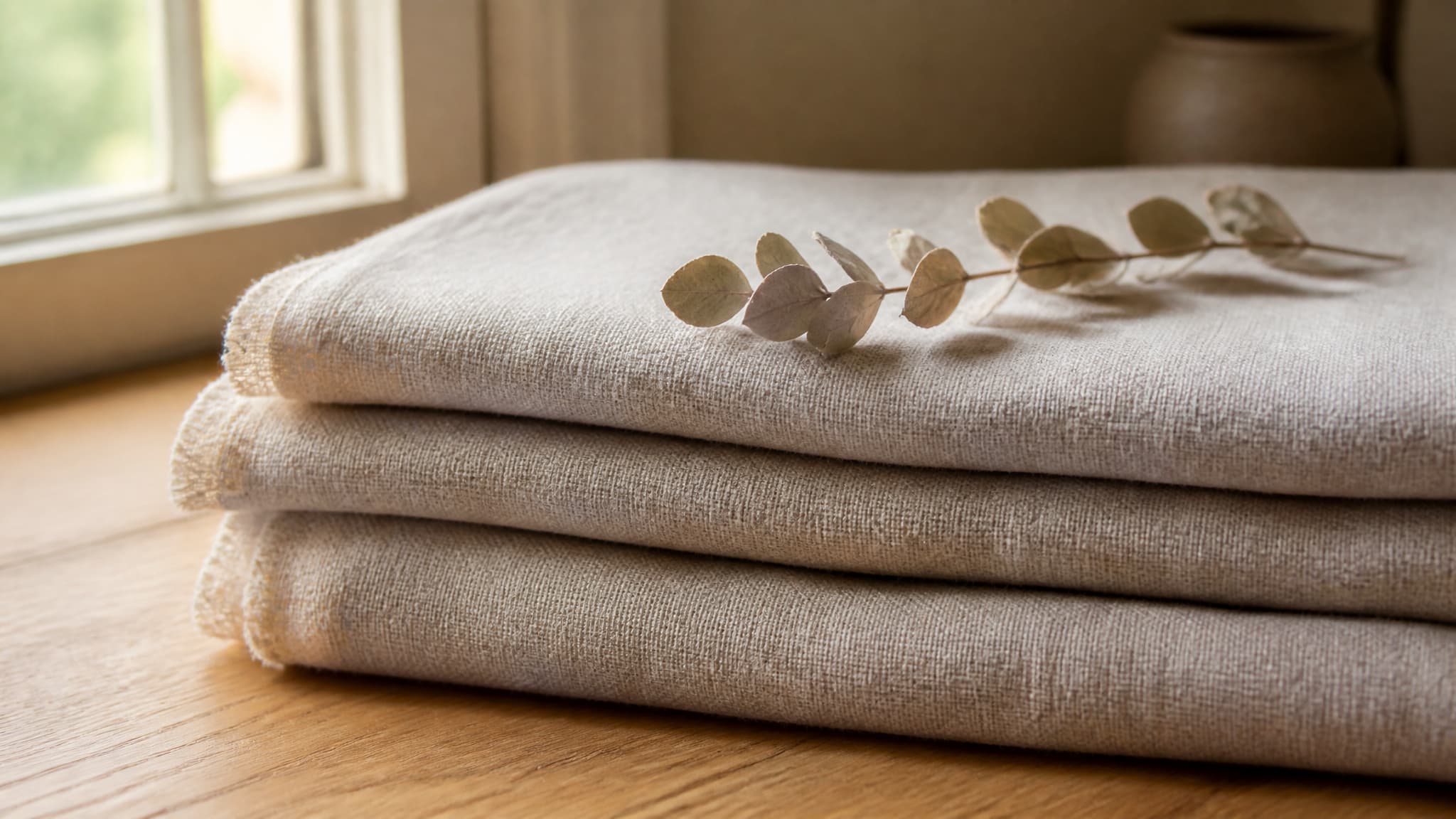
A shroud is cloth and nothing else — a rectangle of woven fabric, usually undyed, wrapped around the body and secured with ties cut from the same material. No lining, no hardware, no metal fasteners, no glue. A funeral shroud and a burial shroud are the same object under two names; the first is used more often when the cloth is present at a service, the second when the emphasis is on what goes into the ground.
Search burial shroud meaning and you get two answers at once — the plain object, and everything a culture has ever asked the cloth to say. In practice the first answer is the one families need. A shroud is a wrapping. Everything else about it is a decision somebody makes: which fiber, how it is folded, whether anything is tucked inside it, who does the wrapping.
The word is familiar to most Americans for a reason that has little to do with burial. The Shroud of Turin, a linen cloth kept in an Italian cathedral, has been argued over for centuries as a relic, and that argument is a different subject entirely — this page is about the object families actually buy and use.
Most American funerals still use caskets, and families choose them for good reasons. Nothing here is an argument against that. A shroud is simply the other option, and it is available far more widely than most people are told.
How a shroud burial works, from wrapping to lowering
The sequence is short, and the parts that surprise people are all near the end.
The body is washed and dressed, or left undressed, depending on family preference and religious practice. It is then laid on the open shroud and wrapped — typically the feet first, then each long side folded across the body, then the head. Ties are knotted at the ankles, waist and shoulders. Many families place the cloth over a board or a woven carrier before wrapping, so that the finished bundle never has to be lifted by the fabric alone.
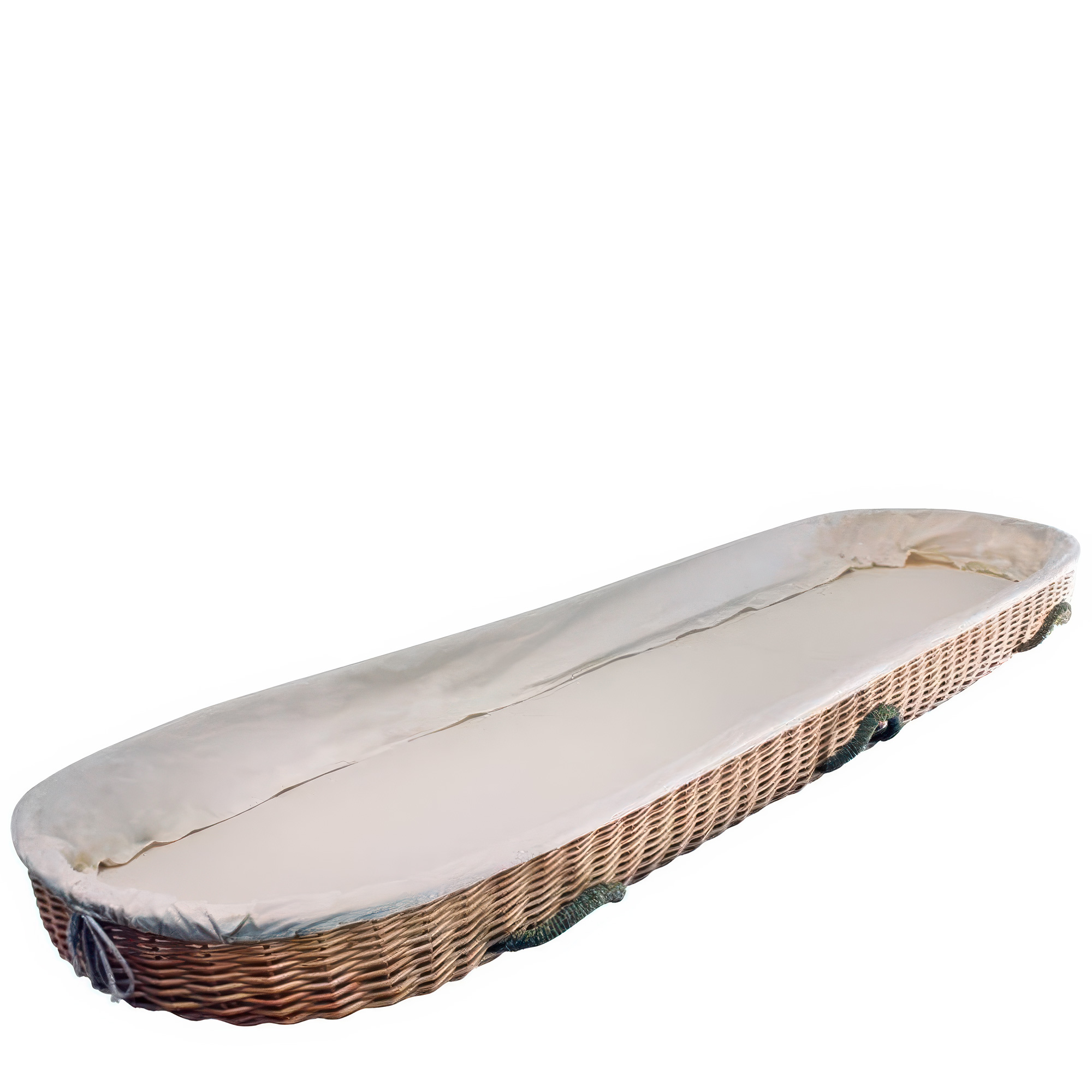
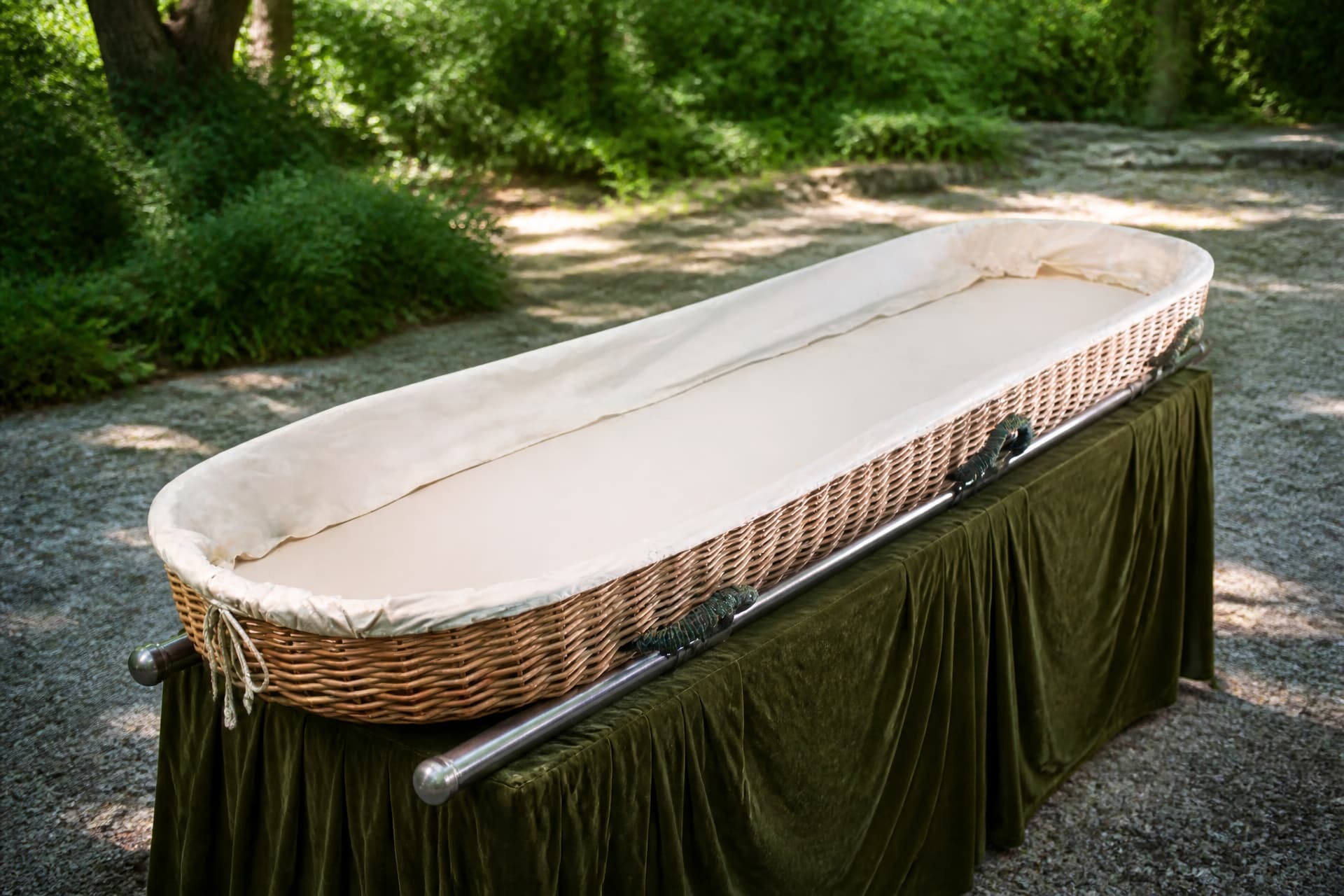
That carrier is the piece most people have not thought about. Cloth has no rigidity, so something has to bear the weight between the vehicle, the graveside and the bottom of the grave. Three arrangements are common: a rigid board with fabric straps, a woven carrying tray, or a set of long lowering straps run under the body and held by pallbearers on both sides. Cemeteries frequently have an opinion about which of these they will accept, and it is a better question to ask early than to discover on the day.
The carrier does the work the cloth cannot. Ask the cemetery which kind they accept before you buy one — a board, a woven tray and a set of hand-held straps are three different answers, and not every ground allows all three. Product shown: Biodegradable Small Willow Carrier.
Lowering is done with straps or with a mechanical lowering device, the same equipment used for a container. Where the grave is hand-dug on a conservation ground, families often lower by hand with six or eight people on straps, which takes longer and is usually the part people remember.
Two rules operate independently of the cloth and catch families out. First, some cemeteries require a burial vault or grave liner in every plot, so the ground does not settle over time. That requirement is about the grave, not about what the body is in, and a shroud can be placed inside one. Second, a rigid outer container may be required for transport by a funeral home or across a state line even where the cemetery itself allows a shroud. Neither rule forbids the practice; both change the shopping list.
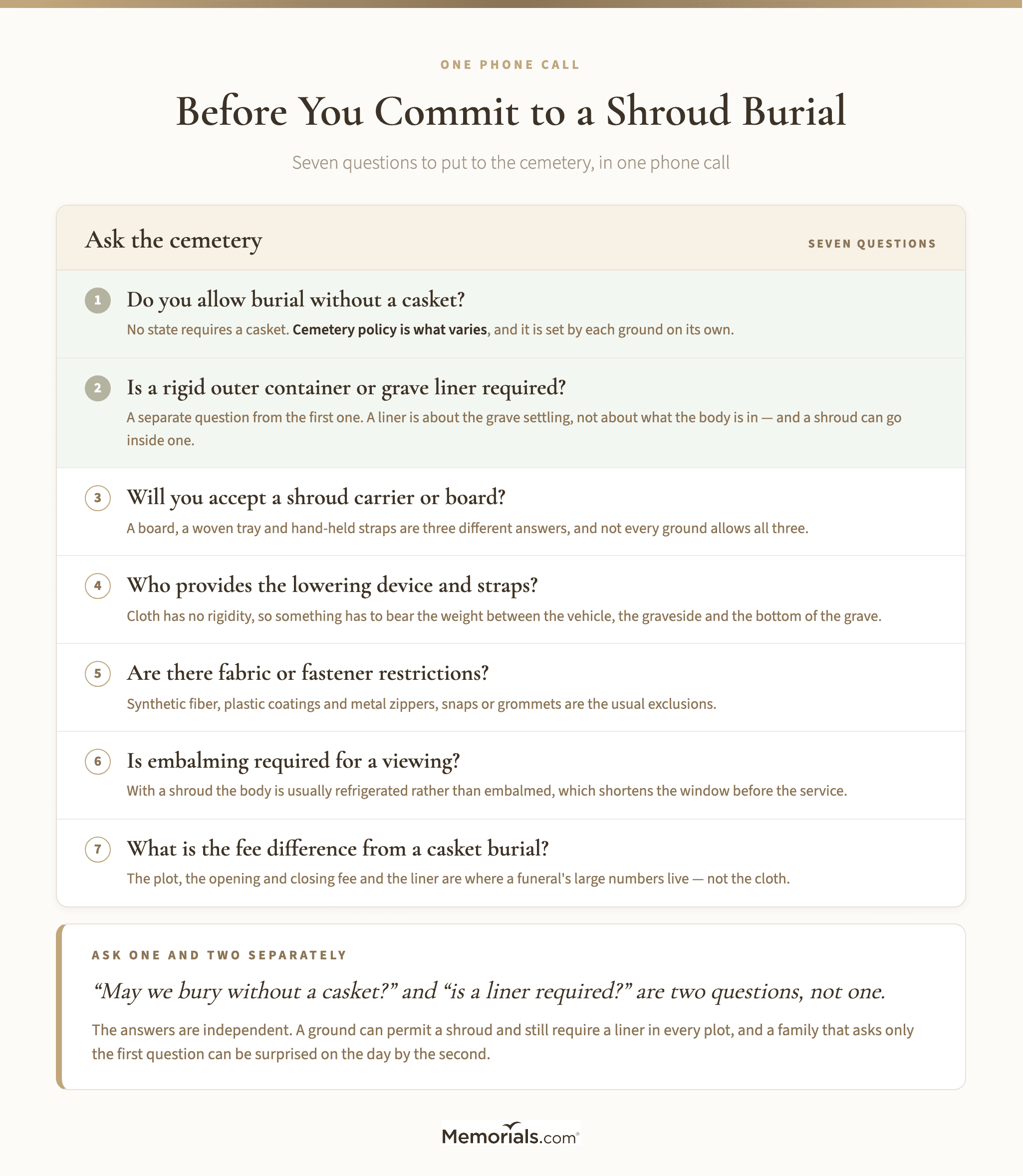
Seven questions, asked once, prevent nearly every surprise. The three that most often change a family's plan are the grave liner requirement, who supplies the lowering straps, and whether the ground will accept the carrier you already bought.
Shroud materials and what cemeteries accept
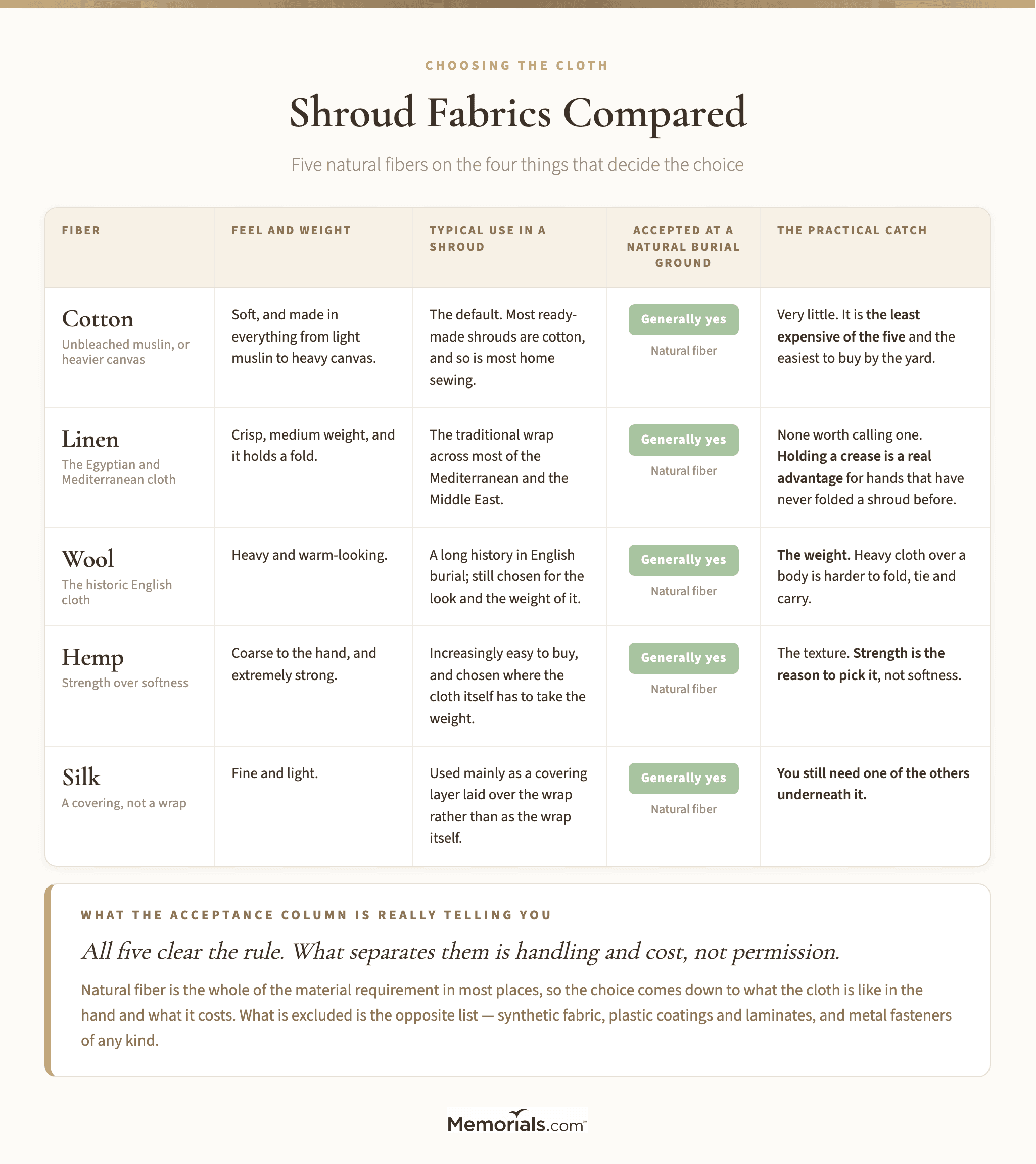
Natural fiber is the whole of the material requirement in most places. A natural burial shroud is one made of fabric that will break down in soil at roughly the rate the body does, which in practice means cotton, linen, hemp, wool or silk, undyed or dyed with something harmless, and stitched with thread of the same fiber.
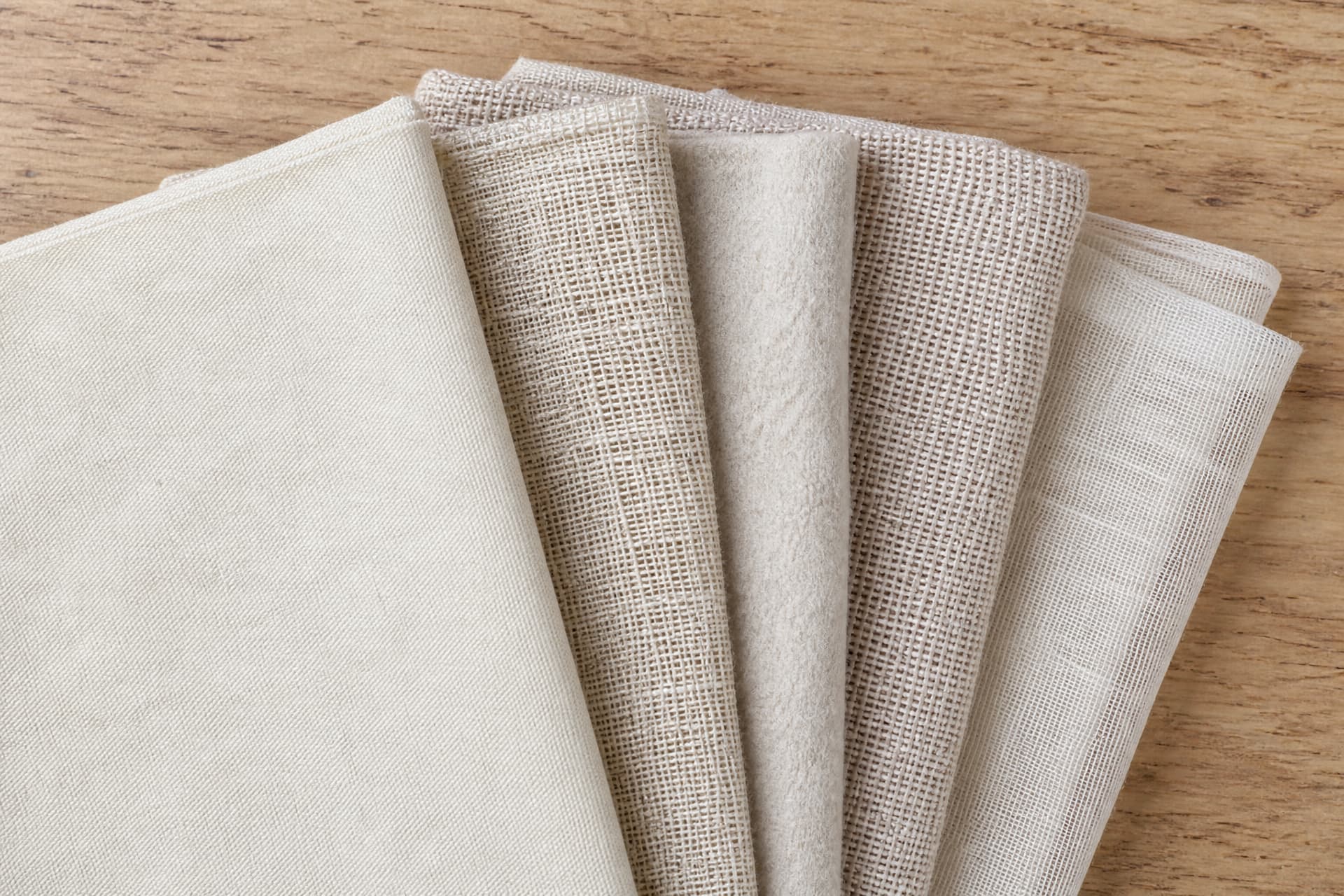
The whole of the material rule is that the fiber be natural. What separates one bolt from the next is the hand of it — how heavy it is to lift, how it takes a fold, and what it costs by the yard.
Cotton is the most common and the least expensive; unbleached muslin and heavier cotton canvas are both widely used. Linen is the traditional choice across most of the Mediterranean and Middle East and it holds a crease beautifully, which matters more than it sounds when the cloth is being folded over a body by people who have never done it before. Wool is warm-looking, heavy, and has its own long history in English burial. Hemp is coarse, extremely strong and increasingly easy to buy. Silk is used mainly as a covering layer rather than as the wrap itself.
Five fibers compared on the four things that decide the choice. Every one of them is accepted at a typical natural burial ground; the real differences are handling weight and cost, not permissibility.
What is usually forbidden is the opposite list: synthetic fiber, plastic-coated fabric, metal zippers, snaps or grommets, and embalming fluid in the body. The rules that matter come from the cemetery, and they are the same rules that govern green burials generally — one written policy per ground, and they vary more than anyone expects.
One material deserves a sentence and no more here, because it has a page of its own: the mushroom or mycelium garment sometimes called a mushroom burial suit, which is a manufactured product with a specific claim about decomposition rather than a plain wrap.
Shroud or casket: what actually changes
Three things change, and a great deal does not.
Shroud
Rigid container
Cost of the object
Roughly $280 to $560 ready-made
A few hundred to several thousand
Carrying
Needs a board, tray or straps
Carries itself
Viewing
Face may be left open; refrigeration usual
Standard, lid controls it
Cemetery policy
Ask first — some grounds decline
Universally accepted
Grave liner
Required in some plots either way
Required in some plots either way
What does not change: you can still hold a full service, still have pallbearers, still have a graveside committal, still bury in a conventional cemetery if it permits the practice, and still buy a headstone. A shroud is not a reduced funeral. It is a different container decision inside the same funeral.
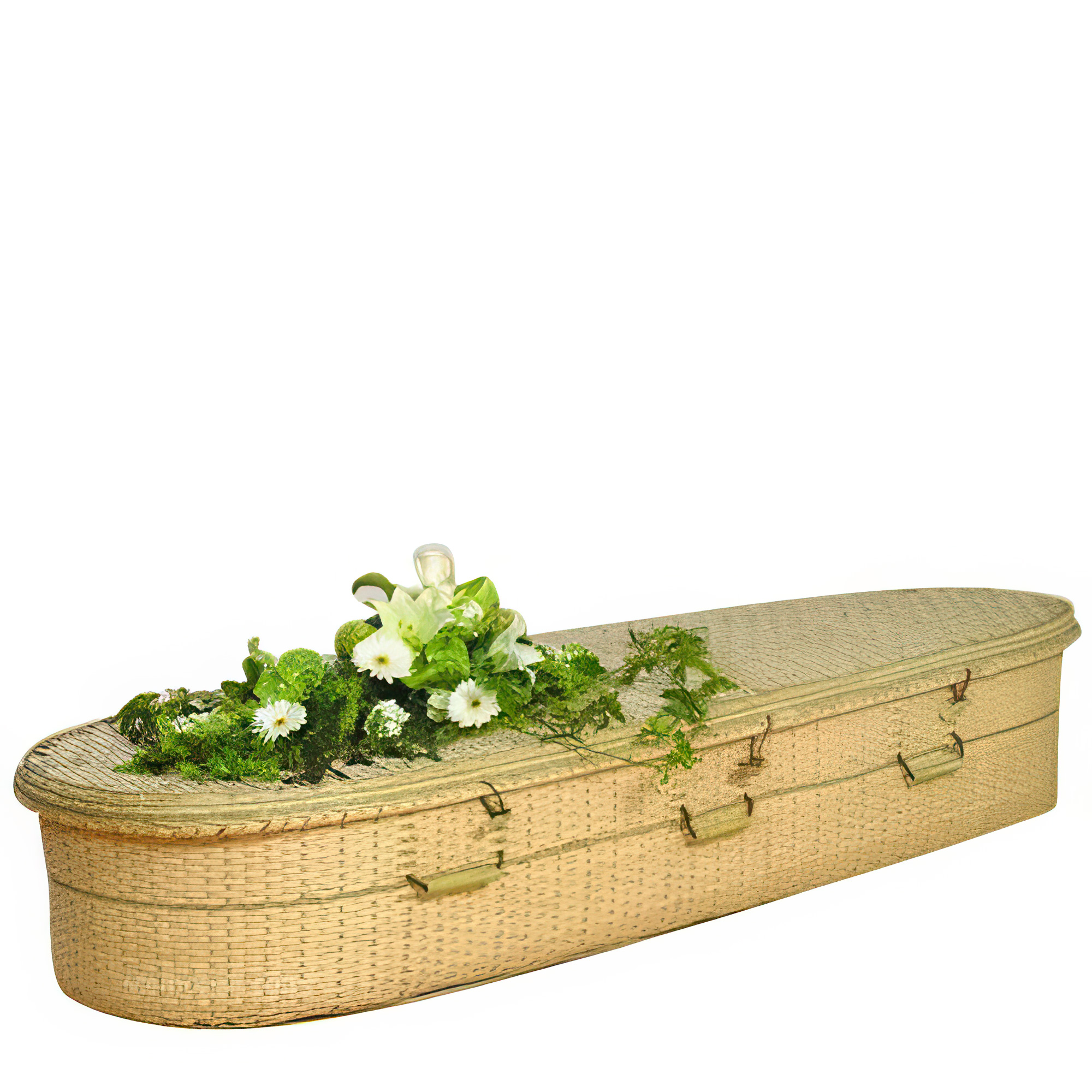
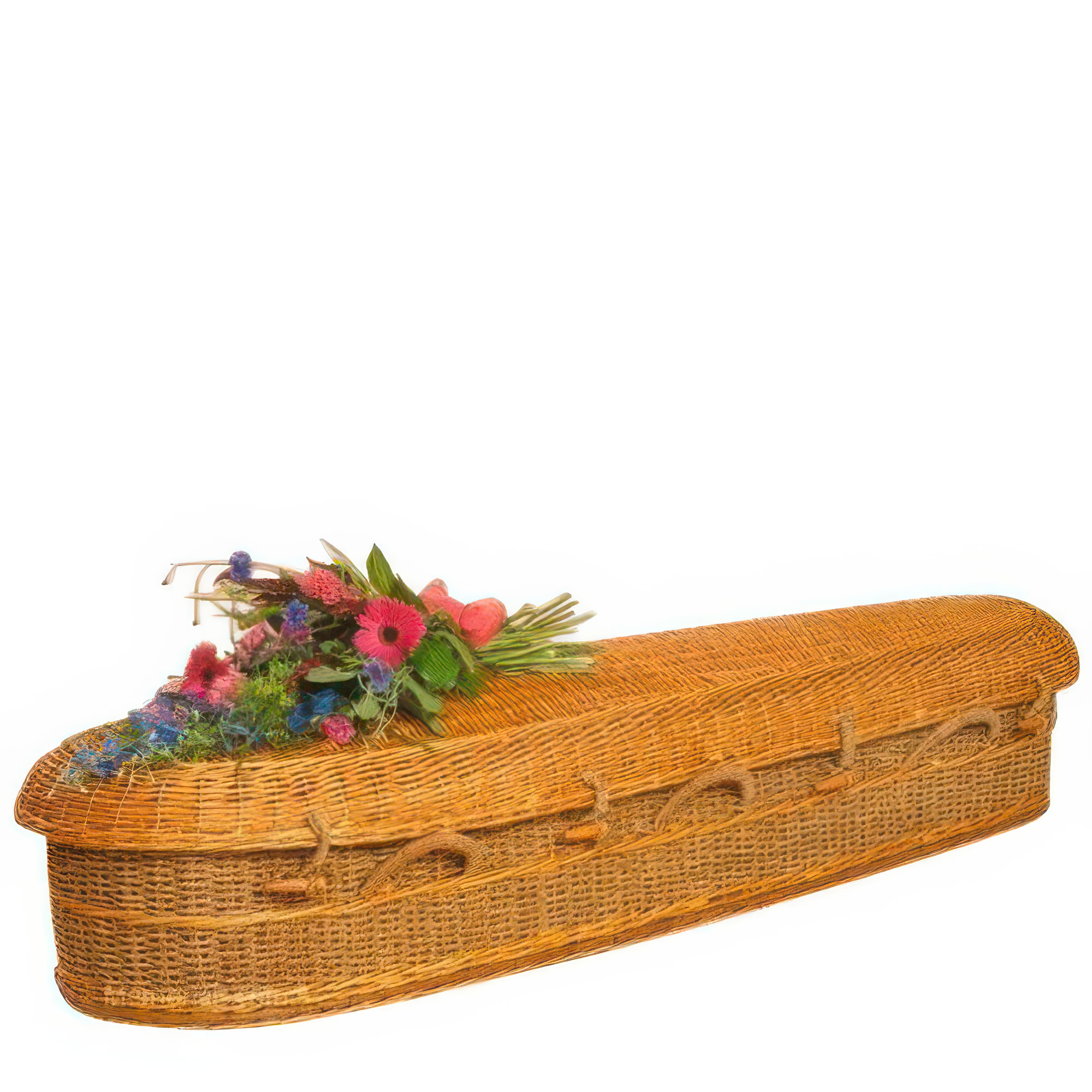
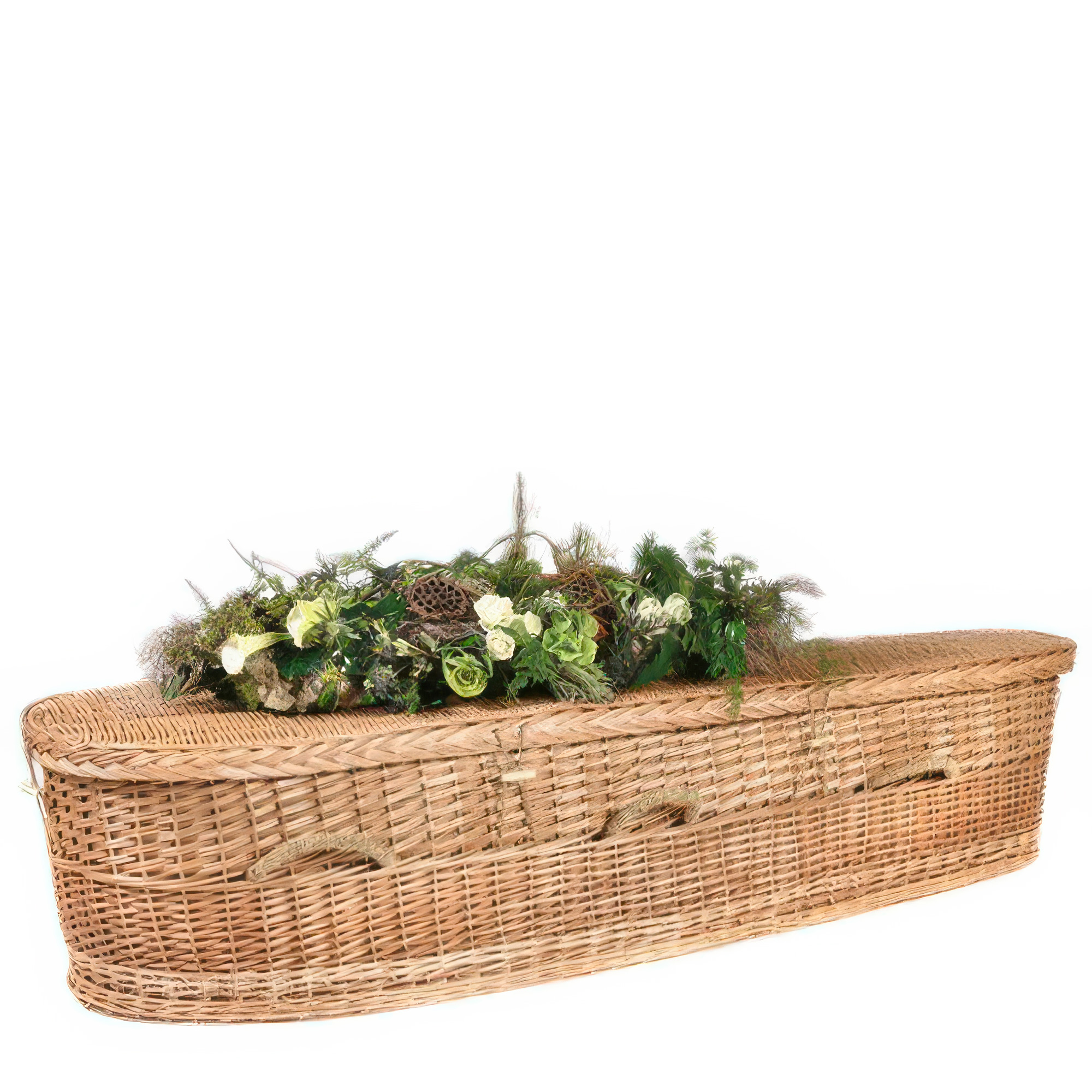
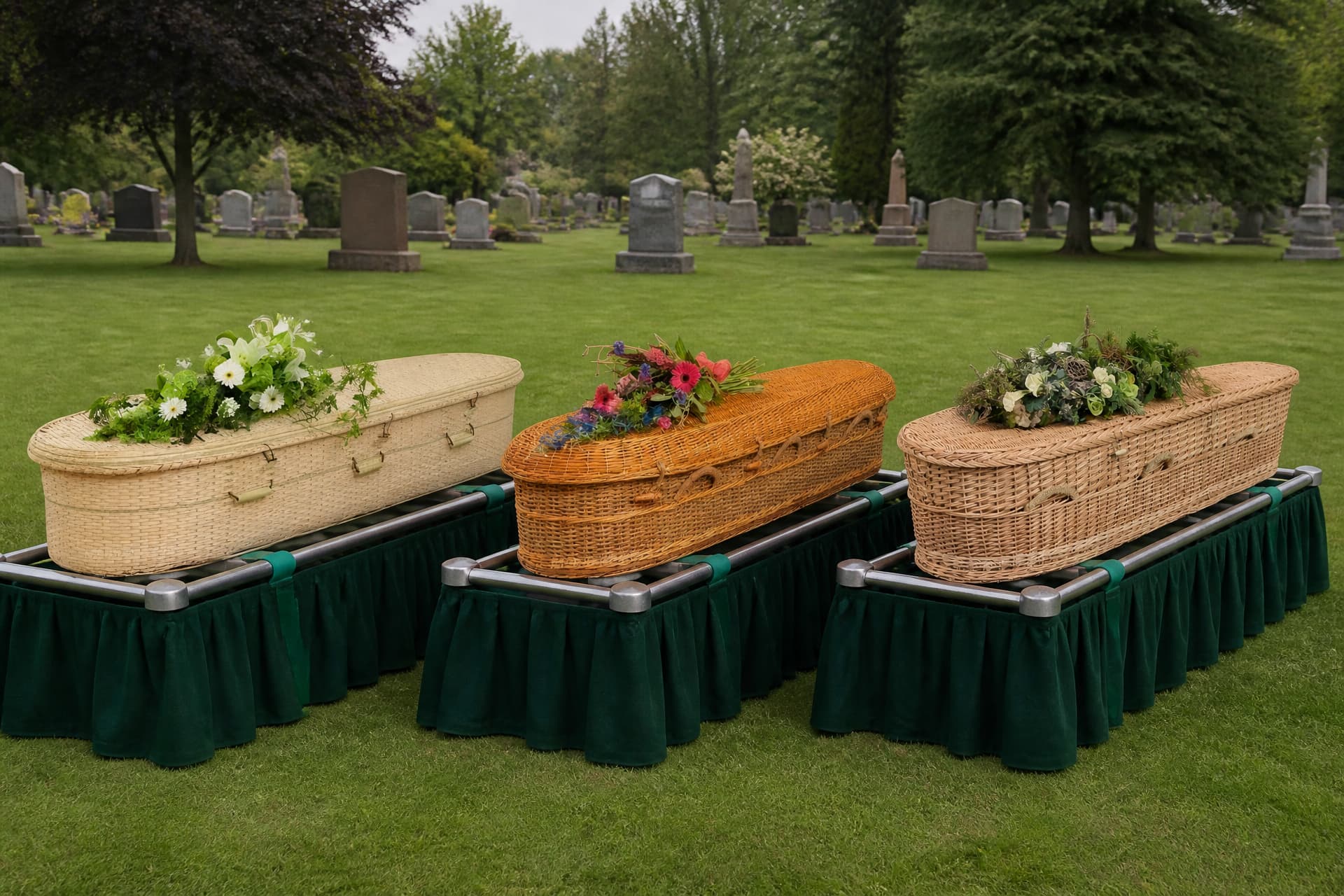
Families who want the same natural materials with more structure often land on a wicker casket instead, and the same shelf carries the shrouds — so the comparison can be made in one place rather than across two suppliers. Our separate guide to willow and bamboo caskets covers that side of the decision in more detail.
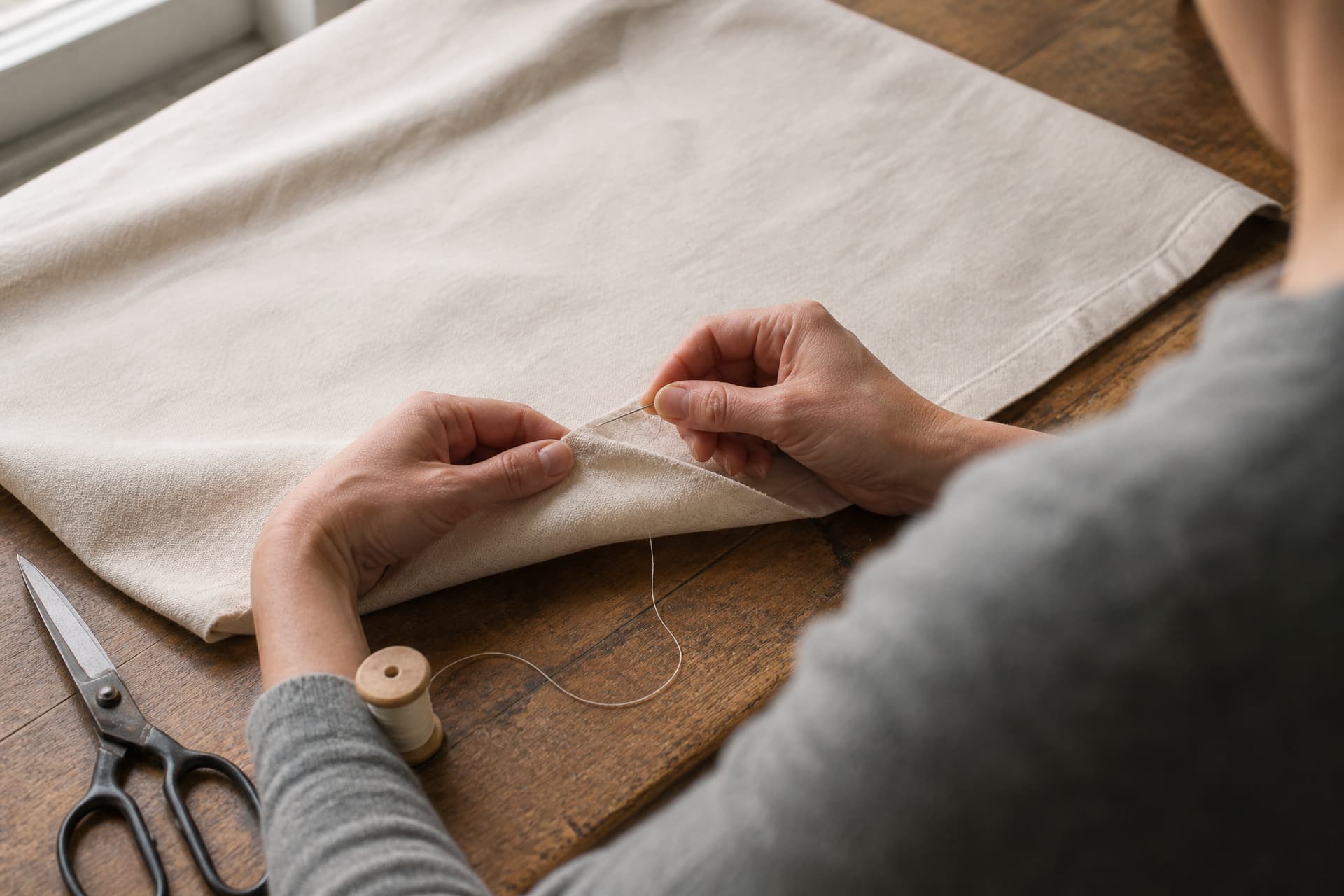
Families ask how to make a burial shroud far more often than the funeral trade expects, and it is one of the few remaining parts of a funeral that a family can genuinely do with their hands. It requires ordinary sewing skill and no specialist equipment.
A burial shroud pattern is not a garment pattern. In its simplest form it is a rectangle: wide enough to wrap the body with a generous overlap, and long enough to fold over the head and the feet with material to spare. Most home sewers work from fabric between 54 and 90 inches wide and buy length rather than piecing panels together, because a center seam sits directly under the body and is the one place a seam is worth avoiding.
A plain hem, cotton thread, and ties cut from the same bolt. The one seam worth avoiding is a center seam down the length, which sits directly under the body.
Two shapes cover nearly every case. The rectangular wrap is a single hemmed panel with sewn-on ties, folded in the sequence described above; it is forgiving, and it suits a family doing this for the first time. A shaped or fitted shroud is closer to a sleeping bag — a sewn envelope with a fold-over hood — which holds its form better when the body has to be moved more than once, at the cost of a more demanding cut.
Three details are worth getting right. Hem every raw edge, because an unfinished edge frays while it is being handled and the fraying is distracting at exactly the wrong moment. Cut the ties from the same bolt rather than buying webbing, so the whole object is one material. And if the shroud will be carried by its own fabric rather than on a board, sew reinforced carrying straps across the width at shoulder, waist and knee — three doubled bands, stitched through, tested with weight before the day.
Choosing a shroud for burial when you have sewn it yourself changes the object. Several funeral directors will tell you the same thing: the families who make one are the families who handle the days afterward differently, and the sewing is a large part of why.
Shrouds in religious tradition
Wrapping the dead in plain cloth is the majority practice worldwide, and several traditions treat the specification of the cloth as a religious matter rather than a preference.
In Jewish practice the dead are dressed in tachrichim, simple white garments of linen or muslin made without pockets and traditionally without knots, so that no distinction of wealth survives into the grave. A man is often also wrapped in his kittel. Our page on the jewish burial shroud covers the garments and the customs around them in full.
In Islamic practice the body is wrapped in the kafan, plain undyed cloth, conventionally three lengths for a man and five for a woman, tied above the head and below the feet. The wrapping happens after washing and before the funeral prayer; our guide to the janazah describes the prayer and the sequence around it.
In both traditions the washing that precedes the wrapping is itself the older and more carefully specified rite. The Jewish rite of tahara is performed by a burial society whose members are not paid and are not named, and it explains why the shroud is deliberately plain: the honor is in the care, not in the cloth.
White cloth also appears where there is no grave at all. Before a tibetan sky burial, the body is wrapped in white and carried to a charnel ground, the wrapping serving as transport and as observance rather than as anything that will be buried.
A short history of the burial shroud
Burial shrouds are older than every other funeral product on the market, and they are older than writing.
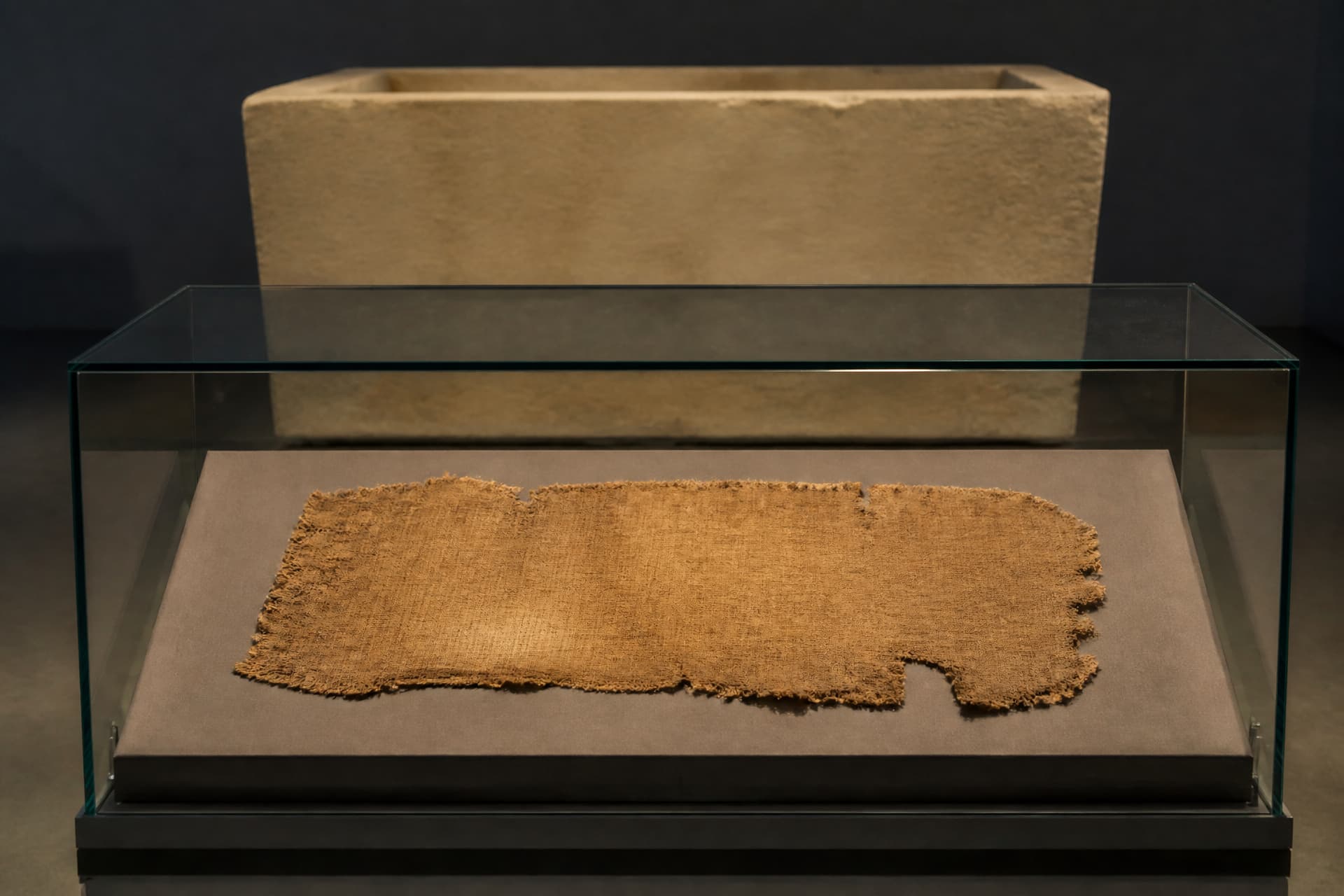
Egypt is where most people first meet the idea, usually in a museum. Museum labels put the two words side by side, which is why people search for what is a shroud and a sarcophagus in one breath: the shroud is the cloth against the body, the sarcophagus is the stone box around it. Egyptian practice used both, in layers, with linen wrappings applied in enormous quantity and the outer container carrying the identity and the inscription.
The cloth and the container are two different objects doing two different jobs — one against the body, one around it — and museums display them together often enough that the words get confused.
Not every culture wrapped. Some built containers and then put them somewhere startling, as with the hanging coffins of cliff faces in southern China and the Philippines, where the placement carried the meaning that the wrapping carries elsewhere.
In medieval and early modern England the cloth was called a winding sheet, and the word cerement covered the waxed variety. A mortcloth was the parish's own pall, rented out to cover the body on its way to the churchyard. From 1666 a series of Burial in Woollen Acts required English burials to use wool, in a deliberate effort to support the domestic wool trade; families who preferred linen paid a fine, and the acts stood for well over a century. That is the clearest historical example of shroud material being set by economics rather than by belief.
The container overtook the cloth in the English-speaking world during the nineteenth century, alongside embalming, the funeral trade, and the rise of the furniture-maker's coffin — a shift covered in our history of coffins. The return since about 2000 has come from the conservation burial movement rather than from any revival of older belief.
What a burial shroud costs and where to find one
A ready-made shroud is the least expensive part of a burial, and that surprises families who have priced everything else.
Our own shelf runs roughly $280 to $560 for a biodegradable cotton shroud, with the larger sizes and the versions with sewn-in carrying handles at the upper end of that band. Prices move, so treat these as a range rather than a quote. Woven willow carriers — the tray that solves the carrying problem — run substantially higher, in the high hundreds to around a thousand, and a woven willow, seagrass or bamboo container is higher again.
Sewing your own costs whatever the fabric costs. Eight to ten yards of a wide natural fabric plus thread will generally come in well under a hundred dollars, and less if the fabric is already in the house.
The costs that actually decide a funeral's total are elsewhere: the plot, the opening and closing fee, the grave liner if one is required, transport, and whether the funeral home is handling the arrangements or the family is. A shroud saves money against a container, but it is not where the large numbers live, and choosing one for that reason alone tends to disappoint.
Frequently Asked Questions
Is shroud burial legal in the U.S.?
Yes. No state requires a casket for burial. What varies is cemetery policy, which is set by each ground individually and is a private matter rather than a legal one — a cemetery is free to require a rigid container even where the state does not. Conservation and natural burial grounds are built around the practice; conventional cemeteries range from routine acceptance to refusal, and the only way to know is to ask that cemetery.
What fabrics are typically allowed for a green burial shroud?
Natural fibers: cotton, linen, hemp, wool and silk, undyed or dyed without heavy metals, sewn with thread of the same material. What is excluded is synthetic fabric, any plastic coating or laminate, and metal fasteners of any kind. Some grounds also decline anything treated with flame retardant, which rules out certain upholstery-weight fabrics that would otherwise seem ideal.
Will a cemetery require a container even if we want burial without a casket?
Sometimes, and the requirement usually turns out to be about the grave rather than the body. A grave liner or vault keeps the ground from settling and is required in many conventional cemeteries regardless of what is inside it. A shroud can be placed inside a liner. Ask two separate questions — whether they permit burial without a casket, and whether a liner is required — because the answers are independent.
Can we still have a funeral service with a shroud burial?
Yes, in full. Visitation, a service at a funeral home or place of worship, pallbearers, a procession and a graveside committal are all unaffected. The practical differences are that the body is usually refrigerated rather than embalmed, which shortens the window before the service, and that the face may be left uncovered for viewing and wrapped at the end.
What is a burial shroud made of?
Woven natural fabric, most commonly unbleached cotton or linen, in a single hemmed panel with ties of the same material. Ready-made versions are sold in standard and oversized widths, some with reinforced carrying handles sewn across the width. Nothing in a shroud is designed to last: the whole object is chosen so that it breaks down in soil at about the rate the body does.
Choosing what feels right
There is no version of this decision that is more respectful than the others. A family that wants a polished container and a family that wants a linen wrap are doing the same thing for the same reason, and both are ordinary.
What is worth doing is asking the cemetery early, before anything is bought. Three answers — whether they allow burial without a container, whether a liner is required, and what they will accept for carrying and lowering — determine everything else on the list, and they take one phone call.
If a shroud is what you want, our green burial shelf carries the cloth, the sizes and the woven carriers together in one place, so the object and the thing that carries it can be chosen at the same time rather than a week apart.