🏬Supersize Online Funeral Retailer🪦1000's of Headstones⚱️Over 10,000 Cremation Urns⚰️Caskets Overnight Delivery🛒Funeral & Memorial Superstore🚚FREE Shipping on ALL Orders👨👩👧👦Helping Families for over 20 Years💰Lowest Price Guarantee🏬Supersize Online Funeral Retailer🪦1000's of Headstones⚱️Over 10,000 Cremation Urns⚰️Caskets Overnight Delivery🛒Funeral & Memorial Superstore🚚FREE Shipping on ALL Orders👨👩👧👦Helping Families for over 20 Years💰Lowest Price Guarantee
🏬Supersize Online Funeral Retailer🪦1000's of Headstones⚱️Over 10,000 Cremation Urns⚰️Caskets Overnight Delivery🛒Funeral & Memorial Superstore🚚FREE Shipping on ALL Orders👨👩👧👦Helping Families for over 20 Years💰Lowest Price Guarantee🏬Supersize Online Funeral Retailer🪦1000's of Headstones⚱️Over 10,000 Cremation Urns⚰️Caskets Overnight Delivery🛒Funeral & Memorial Superstore🚚FREE Shipping on ALL Orders👨👩👧👦Helping Families for over 20 Years💰Lowest Price Guarantee
Somewhere on every funeral home's price list there is a group of charges that are not the funeral home's prices at all. They are printed under a heading like cash advance items, and the payment to the officiant sits among them, which is why how much to pay a pastor for a funeral is a question the price list itself will not answer. These are things the home buys on your behalf and then puts on your bill: the clergy, the musicians, the death certificates, the flowers, the newspaper notice, sometimes the cemetery's own charges. The money passes through the funeral home on its way to somebody else.
That single distinction does two useful things. It tells you which numbers on the bill are still yours to change, and it stops you comparing two funeral homes on charges that belong to neither of them.
What a Cash Advance Item Is
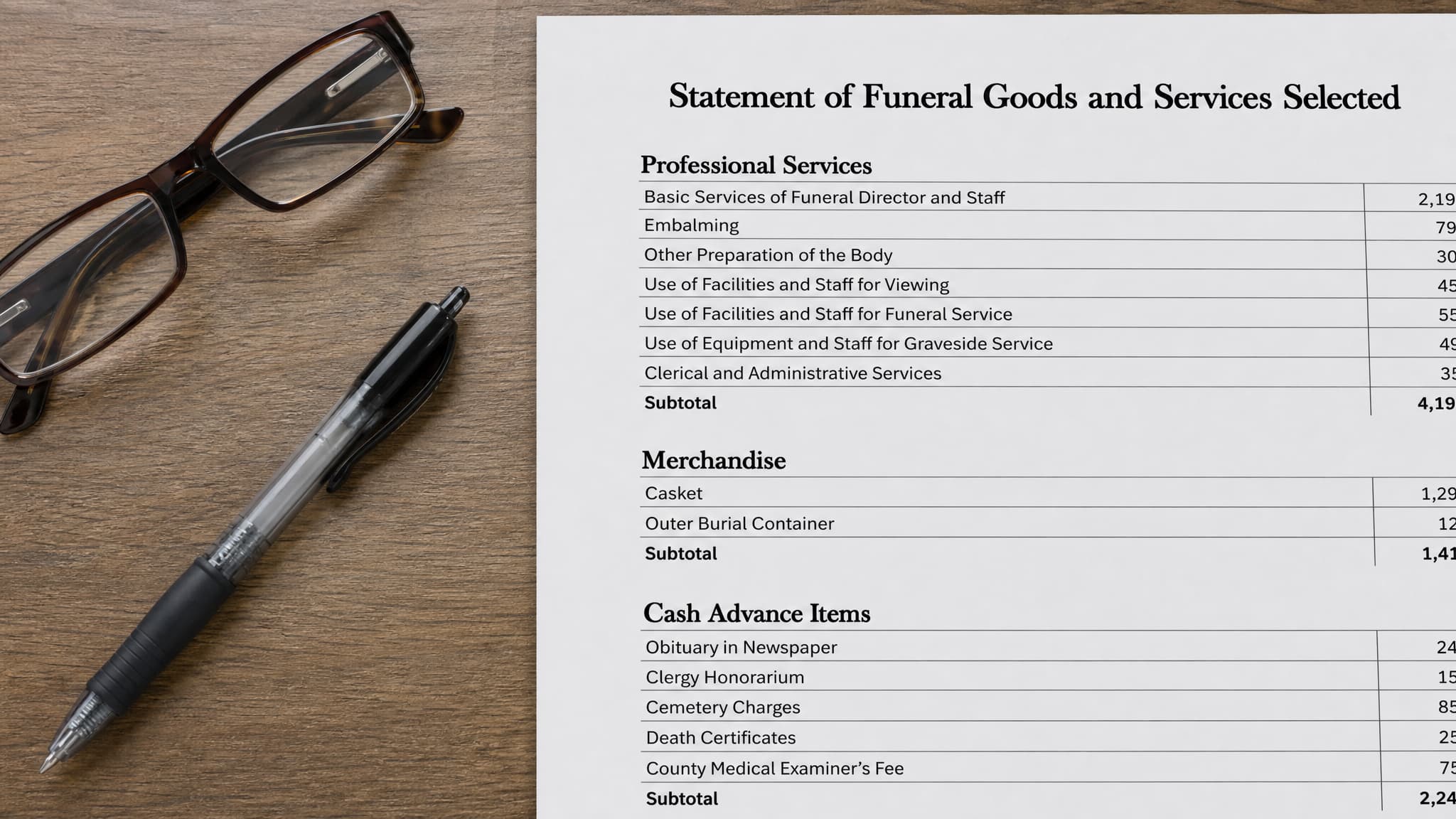
A cash advance item is a good or service the funeral home buys from a third party on your behalf and then charges to your account. On those lines the home is acting as your agent rather than as the seller. The Federal Trade Commission's Funeral Rule, which has governed these documents since 1984, names the category and sets rules for how it must be disclosed.
A payment to the clergy member, celebrant or officiant who leads the service
Organists, soloists, other musicians, sometimes a bagpiper or a singer from the congregation
Certified copies of the death certificate
Burial, transit and cremation permits
Flowers, including the casket spray
Obituary and death notice fees charged by newspapers
Cemetery or crematory charges, when the funeral home arranges them on your behalf
An honor guard, a police escort for the procession, or gratuities where local custom expects them
The cash advance items funeral homes list are not standardized, and neither is the handling of them. Some run everything through the bill. Others ask you to pay the officiant and the musicians directly. Ask early which way this home works, because it changes how much cash you need in the first week.
What is not a cash advance item
Two things get mistaken for one, and both cost money.
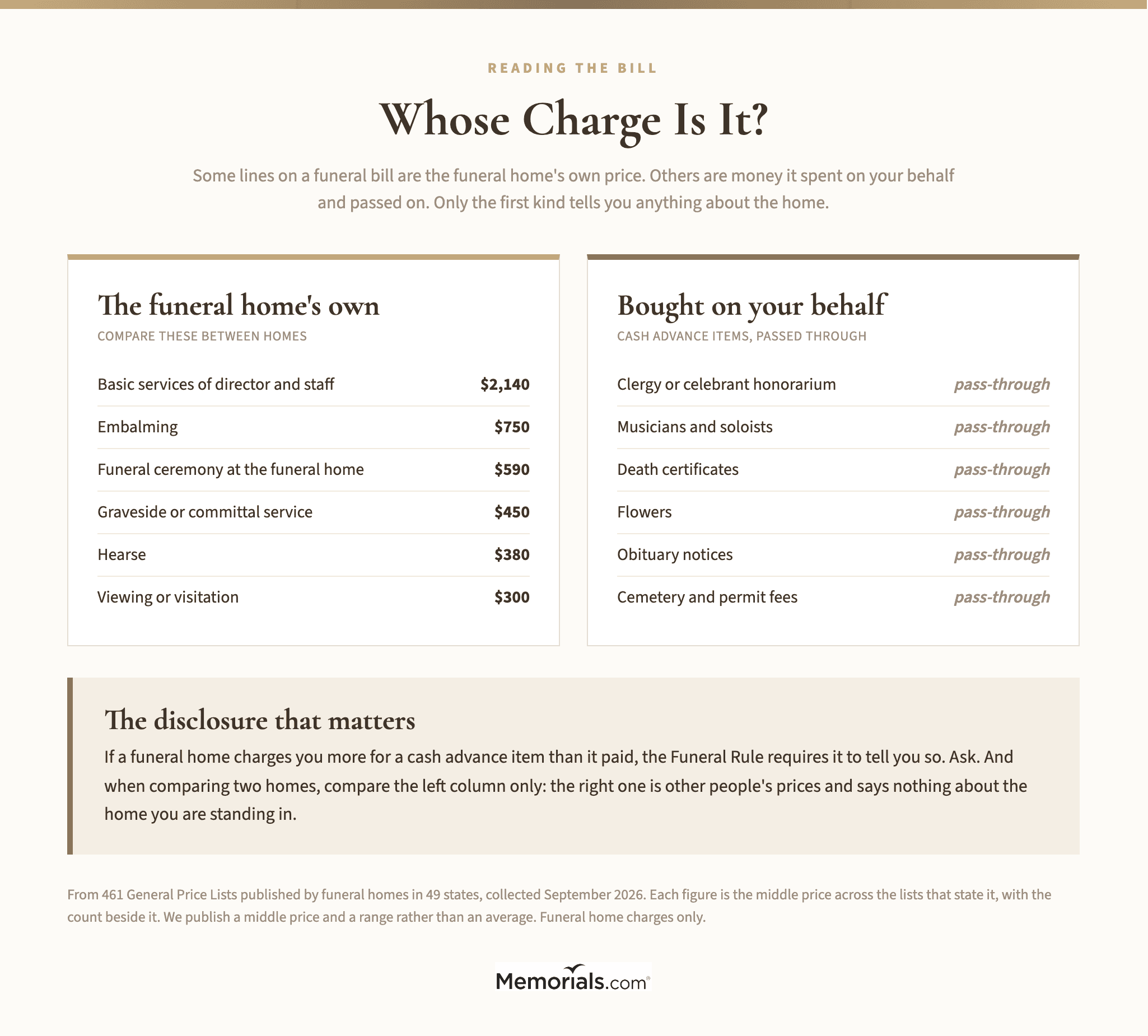
The funeral home's own services. Basic services of the director and staff, embalming, the viewing, the ceremony room, the hearse: these are what the home sells, and they carry the home's own margin. Across the 461 General Price Lists we collected and read in September 2026, the basic services fee had a middle price of $2,140, with half of homes between $1,346 and $2,895 and a full range from $125 to $7,500 across the 398 lists that stated it. That charge is non-declinable and it is not a pass-through. It is the number that most separates an expensive funeral home from an inexpensive one, and it is covered in detail on our guide to what a funeral costs.
Merchandise. The casket and the urn are goods the funeral home sells you from its own stock, not things it buys on your behalf. That difference matters because merchandise comes with a right attached: under the Funeral Rule the home must accept a casket or urn you bought elsewhere, must use it, and cannot charge you a handling fee. Our own caskets range currently lists 63 adult caskets from $284 to $13,200, with a middle price of $1,880. Nothing on a cash advance line carries that right, because those charges were never the home's to mark up in the first place.
Here is the part worth knowing before you sign anything. A funeral home is allowed to charge you more for a cash advance item than it paid, but if it does, it has to tell you. The Funeral Rule requires the home to disclose in writing when it is charging a service fee on top of its actual cost for these items, or when it receives a rebate, discount or commission from the supplier.
In practice that means the amount printed beside "clergy honorarium" may be exactly what reaches the clergy member, or it may include something for the home's trouble in arranging it. You are entitled to know which. The question to ask is plain: is this the amount you paid, or does it include a fee to you?
The same rule sits inside a larger set of protections. A funeral home must give you an itemized General Price List on paper, to keep, before it discusses arrangements. It must quote prices over the telephone, let you buy only what you want rather than a package, state in writing when a law genuinely requires something, and give you a written statement of everything you selected, with the total, before you sign. Our guide to the General Price List every funeral home must show you goes through that document section by section, and the cash advance block is usually near the end of it.
Take the list away and read it somewhere quieter. Nobody has to decide anything at the table.
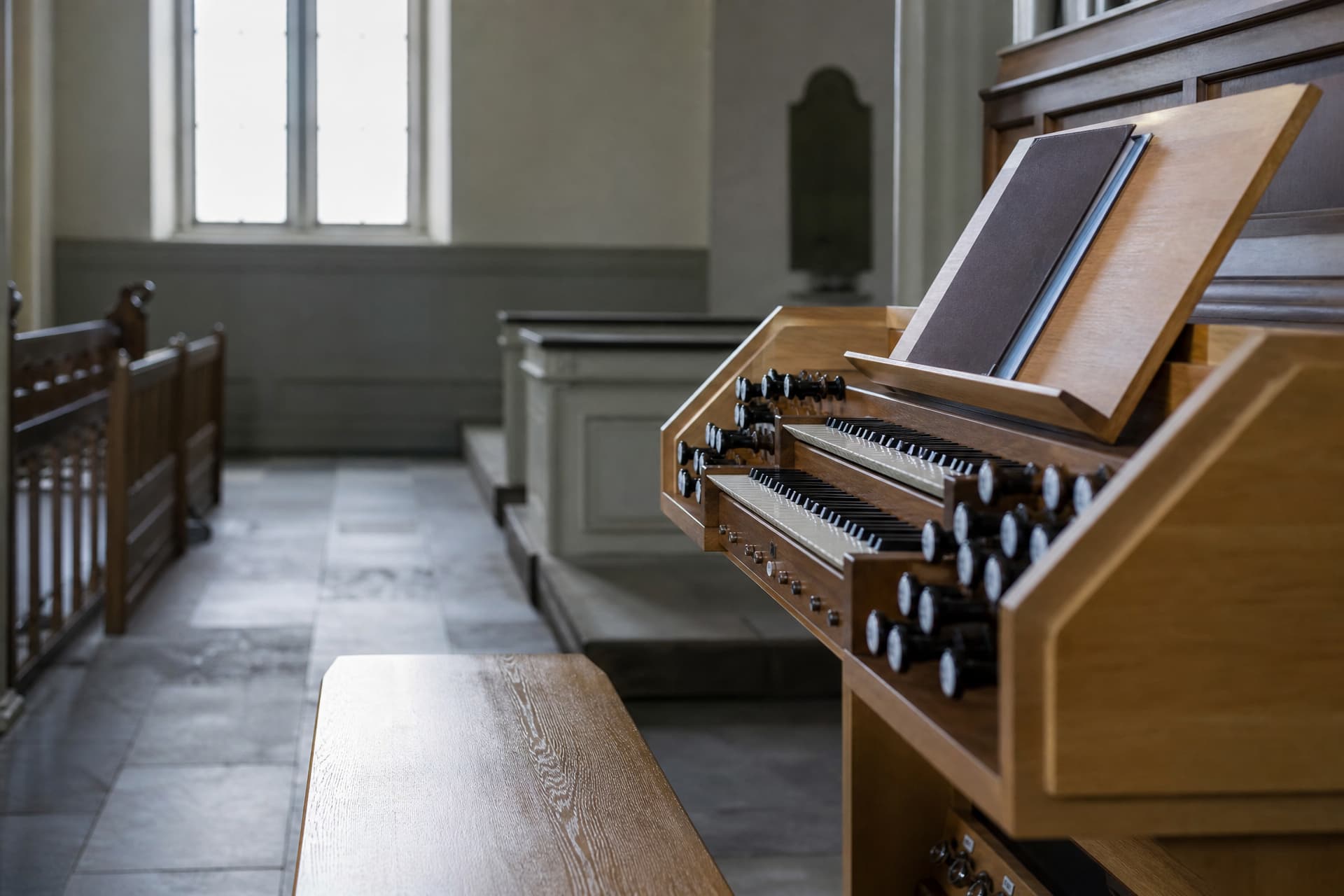
An organist is paid, not billed. The amount is customary rather than set, the church often has a stated figure, and asking is a great deal less awkward than guessing.
The Honorarium
A funeral honorarium is a gift, not a fee. That is the whole difficulty. A clergy member, a celebrant, an organist or a soloist performs at a funeral as part of a pastoral or musical role, and the payment acknowledges the work without being a price. Nobody quotes it, most people will not name a figure if you ask them directly, and families are left guessing at a moment when guessing is expensive.
We are not going to invent a number for you. Our research is 461 price lists, and a cash advance item is by definition not on them as the home's own price, so those documents cannot answer it. What we can do is tell you exactly where the answer lives, because it does exist and somebody near you knows it.
How to find out what to pay
Ask the church, temple or mosque office first. Many congregations have a written schedule for funerals covering the use of the building, the officiant, the organist and sometimes a custodian. Where a stated fee exists, that is your answer. Ask for it in writing, and ask whether it differs for members and non-members, because it often does.
Ask the funeral director second. Directors arrange services with the same officiants week after week, and they know what families in that congregation customarily give. This is one of the few questions where the funeral home has no interest in the answer. Phrase it as "what do families here usually give?" rather than "what should I pay?" and you will get a real number.
Ask the officiant last, and only if the first two fail. Many will deflect. If one names a figure, take it at face value.
Two things adjust the figure once you have it. Length of commitment: an officiant who meets the family twice, writes a eulogy from what they learn, leads a service and then travels to the graveside has done several hours of work, not one. And distance, because mileage should be covered before the payment acknowledges anything else.
When do you pay the pastor for a funeral
Families ask when do you pay the pastor for a funeral more often than they ask how much, and the answer is before the service, not after. The usual practice is that the payment is ready in advance and changes hands quietly, either on the day or at the last planning meeting.
Who hands it over is a small decision that nobody prepares for. It should not be the closest mourner. A sibling, an adult child who is holding up better than the rest, or the funeral director is the right person, and the director will do it as a matter of course if you ask. Many families never see this happen at all, which is the point.
The form is a check in a plain envelope, with a short note of thanks written on a card inside if you want to write one. Cash is fine and is normal for musicians. What you should not do is leave it until the reception, when the officiant may already have gone, or mail it a week later, when the family is dealing with far more than it can hold.
If the funeral home is paying it for you as a cash advance, none of this applies. Confirm with the director that it is covered, and confirm what amount the home is passing on, so that nobody ends up paid twice or not at all.
The organist, the soloist and the rest of the music
The same question comes up for musicians, usually phrased as "how much to pay organist for funeral," and it follows the same route: the congregation's own schedule first, the funeral director second. Music tends to be more clearly priced than clergy, because an organist is often a paid employee of the congregation with a set rate for weddings and funerals, and because a soloist brought in from outside is doing straightforward freelance work.
Count the people rather than the service. An organist, a cantor, a soloist and a bagpiper at the graveside are four separate payments, and each appears as a separate line if the funeral home is arranging them. Rehearsal time counts too, where a soloist has to learn something the family chose.
When payment is declined
It happens, particularly at a graveside, with a hospital or hospice chaplain, or when the officiant knew the person who died. Some clergy will not accept payment for a funeral in their own congregation, and some denominations discourage it.
Do not press a second envelope on someone who has already said no. A donation to the congregation, to its music program, or to a charity the person supported is the customary alternative, and saying so in the thank-you note closes the loop. Someone who declines payment may still accept reimbursement for mileage.
The Other Pass-Throughs
Clergy and music get the attention, but most of the cash advance block is administrative, and some of it is larger than the honorarium.
Death certificates. Certified copies are issued by a state or county office at a set fee per copy, and that fee is a pass-through. The director's time in obtaining them is not; that sits inside the basic services fee. Order more than you think you need. Banks, insurers, pension administrators and the county recorder each want their own certified copy and most will not return it.
Permits. Burial, cremation and transit permits are issued by a government body at a fixed fee. There is nothing to negotiate here, beyond checking the amount matches the office's published fee.
Obituary and death notices. Newspapers charge by length, and by the inch in print, which is why a notice can arrive at a startling figure. This is the cash advance item families most often cut without regretting it. A short paid notice in print alongside a full obituary posted free online does the job. Our guide on how to write an obituary covers what belongs in each version.
Flowers. The casket spray and the standing arrangements are usually ordered by the funeral home from a local florist and passed through. You can order them yourself and have them delivered, and many families do.
Cemetery charges. When the funeral home arranges the grave, these can reach your bill as cash advances, and they are the largest items in the block by a wide margin. They are also a separate business's prices: the plot, the opening and closing of the grave, and usually a required outer burial container. Of the 774 burial packages we read, only 44 included the outer burial container. One price list said it outright: "This package does not include outer burial container (vault), grave space or open close fees." Our guide to cemetery plot cost covers what drives the price of the ground itself.
What may already be paid for. A veteran is generally entitled to a grave, a marker and a committal service in a national cemetery at no charge, which removes most of the cemetery block entirely. The Department of Veterans Affairs also administers burial allowances in some circumstances, and our guide to VA burial benefits explains who qualifies. The Social Security Administration pays a small lump-sum death benefit to a surviving spouse or child. Neither is automatic and both are worth asking about in the first week.
This is the whole ritual. Ready in advance, handed over quietly before the service by someone other than the closest mourner, and never discussed again.
Why These Are a Poor Way to Compare Two Funeral Homes
Comparing funeral homes is worth doing, and the spread is real: the basic services fee alone ran from $125 to $7,500 in our sample. But do the comparison on the home's own charges, not on the cash advance block.
The reason is straightforward. Two quotes can differ by a thousand dollars in this block and tell you nothing about either home. One may have assumed more death certificates. One may have included the cemetery's opening and closing where the other left it for the cemetery to bill directly. One may have guessed high on flowers. The same funeral, arranged by the same family, produces different cash advance totals at different homes because the homes are estimating different things.
Compare the lines that are genuinely theirs: basic services, embalming, the viewing, the ceremony, the hearse, and the merchandise. Then treat the cash advance block as a budget item you control, because you largely do.
Questions Families Ask
Do I have to pay cash advance items through the funeral home?
Usually not. Most homes will let you pay the officiant, the musicians and the florist directly if you prefer, and some expect you to. Say so early so the amounts come off the estimate.
Can the funeral home charge me more than it paid?
Yes, but only with disclosure. The Funeral Rule requires the home to tell you in writing when it adds a service fee to its cost on a cash advance item, or when it receives a rebate, discount or commission from the supplier. Ask, and read the written statement before you sign.
How many death certificates should I order?
More than feels reasonable. Every institution holding an asset, a policy or a title usually wants its own certified copy and will not send it back. Ordering extra at the time costs a small per-copy fee; ordering later costs a trip to the vital records office.
The officiant is a family friend. Do we still pay?
Offer, in the same form as you would anyone else, and let them decline. The offer is the part that matters.
Flowers are usually bought on your behalf and passed through at cost. They belong on the bill and they say nothing about whether the funeral home is expensive.
The Short Version
Cash advance items are other people's prices on your funeral bill. The funeral home is buying them for you, it has to tell you if it is charging you more than it paid, and most of the block is yours to shrink or to handle yourself. The honorarium is the awkward one, and the answer is never printed anywhere: ask the congregation office, then the funeral director, and have a check ready in an envelope before the service rather than after it.
For the decisions that come before all of this, our funeral planning guide covers them in the order you will meet them.
Where to Take This Next
Cash advance items are one column of the bill. Unnecessary funeral expenses takes the other one, the funeral home's own charges, and says which of those can be refused and which cannot.
Cash advances are also the part a prepaid contract almost never guarantees, because the home cannot fix a price it does not set. Prepaid funeral plans explains which items a preneed agreement locks in and which are left to rise.
Prices in this article come from 461 General Price Lists published by funeral homes in 49 states, collected in September 2026. We publish the middle price and the middle half of the range rather than an average, and name the number of price lists behind every figure. We publish no figure for honoraria, because a cash advance item is not the funeral home's price and these documents do not record it.