🏬Supersize Online Funeral Retailer🪦1000's of Headstones⚱️Over 10,000 Cremation Urns⚰️Caskets Overnight Delivery🛒Funeral & Memorial Superstore🚚FREE Shipping on ALL Orders👨👩👧👦Helping Families for over 20 Years💰Lowest Price Guarantee🏬Supersize Online Funeral Retailer🪦1000's of Headstones⚱️Over 10,000 Cremation Urns⚰️Caskets Overnight Delivery🛒Funeral & Memorial Superstore🚚FREE Shipping on ALL Orders👨👩👧👦Helping Families for over 20 Years💰Lowest Price Guarantee
🏬Supersize Online Funeral Retailer🪦1000's of Headstones⚱️Over 10,000 Cremation Urns⚰️Caskets Overnight Delivery🛒Funeral & Memorial Superstore🚚FREE Shipping on ALL Orders👨👩👧👦Helping Families for over 20 Years💰Lowest Price Guarantee🏬Supersize Online Funeral Retailer🪦1000's of Headstones⚱️Over 10,000 Cremation Urns⚰️Caskets Overnight Delivery🛒Funeral & Memorial Superstore🚚FREE Shipping on ALL Orders👨👩👧👦Helping Families for over 20 Years💰Lowest Price Guarantee
Most of what a funeral costs is settled in a single conversation, at a table, within a day or two of a death. That is also where unnecessary funeral expenses are agreed to, and usually not because anyone is being deceived. A list of items is read aloud, each one sounds like part of the job, and saying no to any of them feels like saying no to the person who died. Federal law takes a different view. You are entitled to buy the parts you want and refuse the rest, and a funeral home has to let you.
This article goes down the bill charge by charge and says plainly which ones you can refuse. The prices come from 461 General Price Lists published by funeral homes in 49 states, which we collected and read in September 2026. For the whole picture of what a funeral costs, including the cemetery bill that arrives separately, start at the hub. This page is about one thing: the line items, and which of them are optional.
One point before the list. Declining a charge is a legal right, not a verdict on anybody. Families who buy the viewing, the limousines and the printed cards are not being foolish, and families who buy none of them are not being cold. The only thing worth avoiding is paying for something because nobody told you it was optional.
The One Charge Nobody Can Decline
Start with the exception, because it changes how you read everything else.
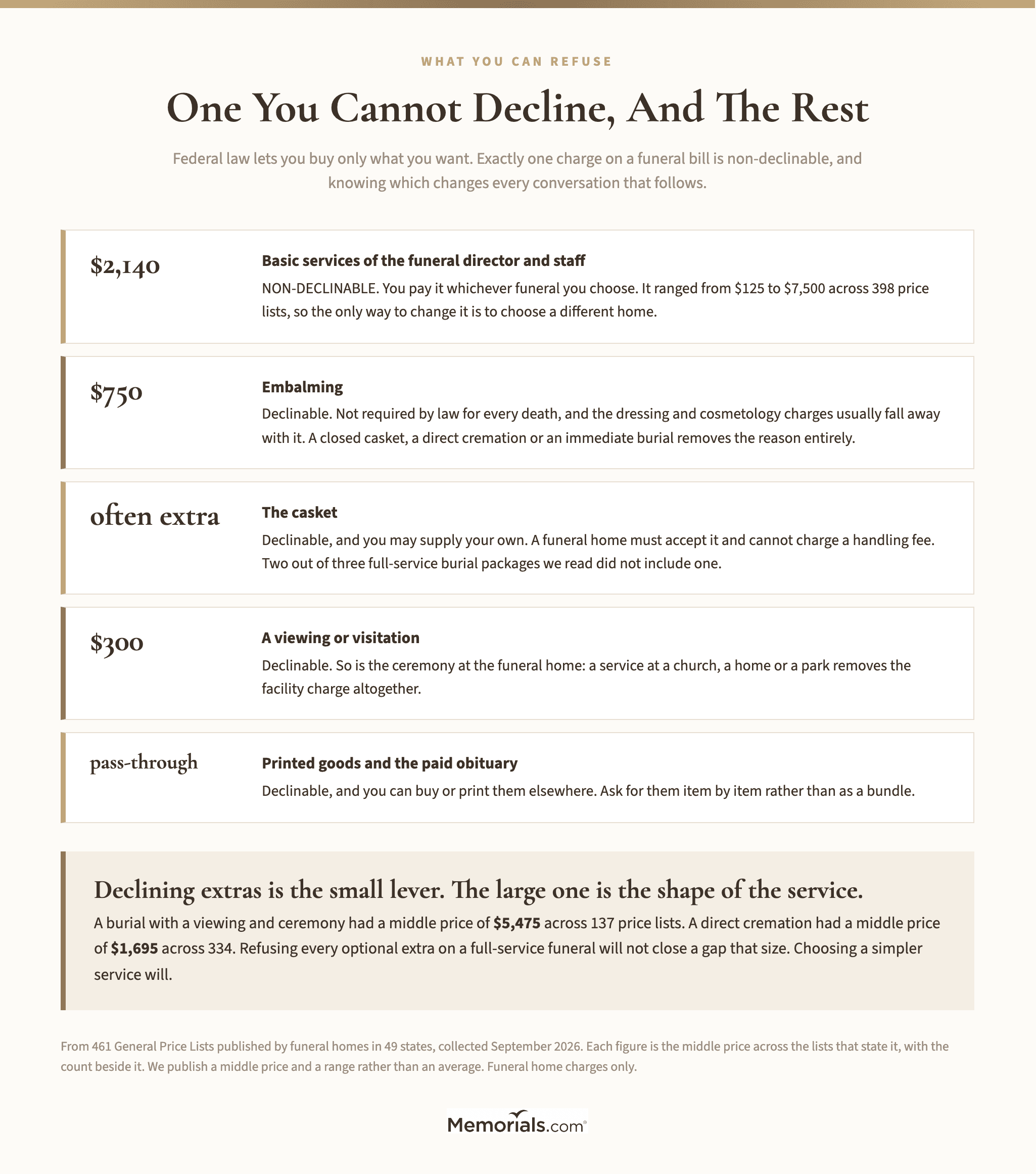
Every funeral home charges a fee for the basic services of the director and staff. It covers the director's time, the permits, filing the death certificate, the overhead of the building, and the coordination with the cemetery or crematory. Across the 398 price lists that stated it on its own, the middle charge was $2,140, with half of homes between $1,346 and $2,895. The full range ran from $125 to $7,500.
Price lists print these in their own language, usually as non declinable funeral fees, and the label is accurate. You pay this whether you buy a full funeral with a viewing or the cheapest direct cremation on the list. There is no version of the transaction that removes it.
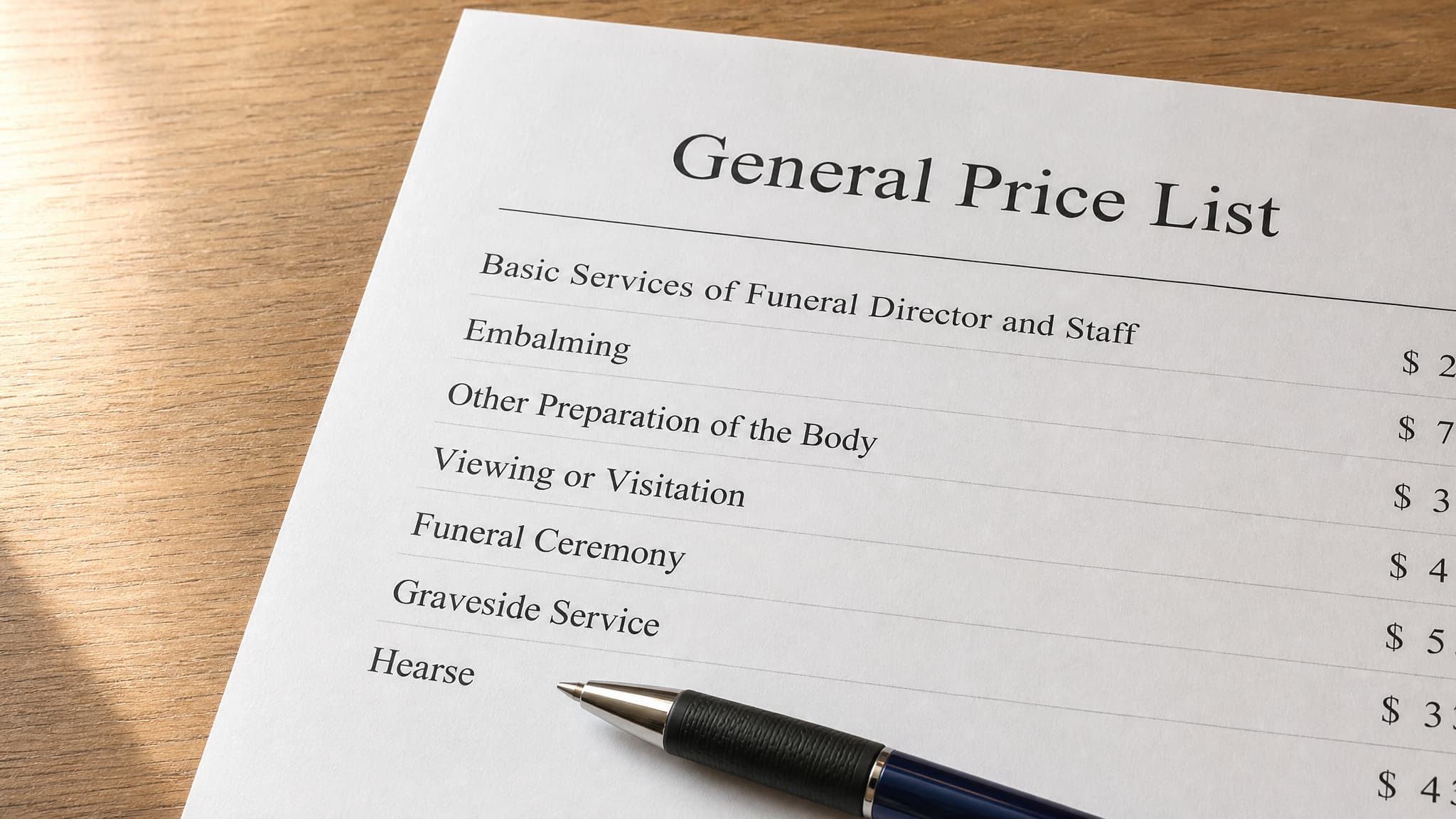
That matters more than it first appears. Because the fee cannot be refused, the only way to change it is to choose a different funeral home, and the range above shows how much that decision is worth. A gap of thousands of dollars for the same administrative work is not unusual between two homes a few miles apart. Getting three itemized price lists early is the single highest-value hour in this whole process, and our guide to the General Price List every funeral home must show you explains how to read one section by section.
Everything below this line is different. If you have been wondering what can you decline at a funeral home, this is the answer: everything below this line is yours to refuse.
Do you have to be embalmed? Not as a matter of law. No state requires embalming for every death, and a funeral home is forbidden from telling you it is legally required when it is not. Some situations create a genuine requirement or a practical need: a public viewing with an open casket, where many homes have their own policy, a long delay before the service, or remains crossing state lines. Outside of those, it is a choice.
Across the 369 price lists that priced embalming on its own, the middle charge was $750, with half of homes between $650 and $950 and a full range of $250 to $2,500.
The saving is usually larger than that single figure, because the charges that travel with embalming tend to fall away with it. Dressing, casketing and cosmetology are preparation steps that exist to present a body for viewing. Take away the viewing and the reason for them goes too. Some homes bill these as one combined preparation charge and some itemize all four separately, which is worth knowing when you compare two lists side by side.
Refrigeration is the usual alternative where there is a short delay, and it is generally cheaper. Ask what the home charges for it, because it is often on the list and rarely mentioned at the table. If you want to understand what the procedure actually involves before deciding either way, our guide to the embalming process walks through it step by step.
Exactly one charge on a funeral bill is non-declinable. Everything under it is yours to refuse.
The Casket, and Where You Buy It
The casket is usually the largest single item on a funeral bill, and it is the one where your rights are strongest.
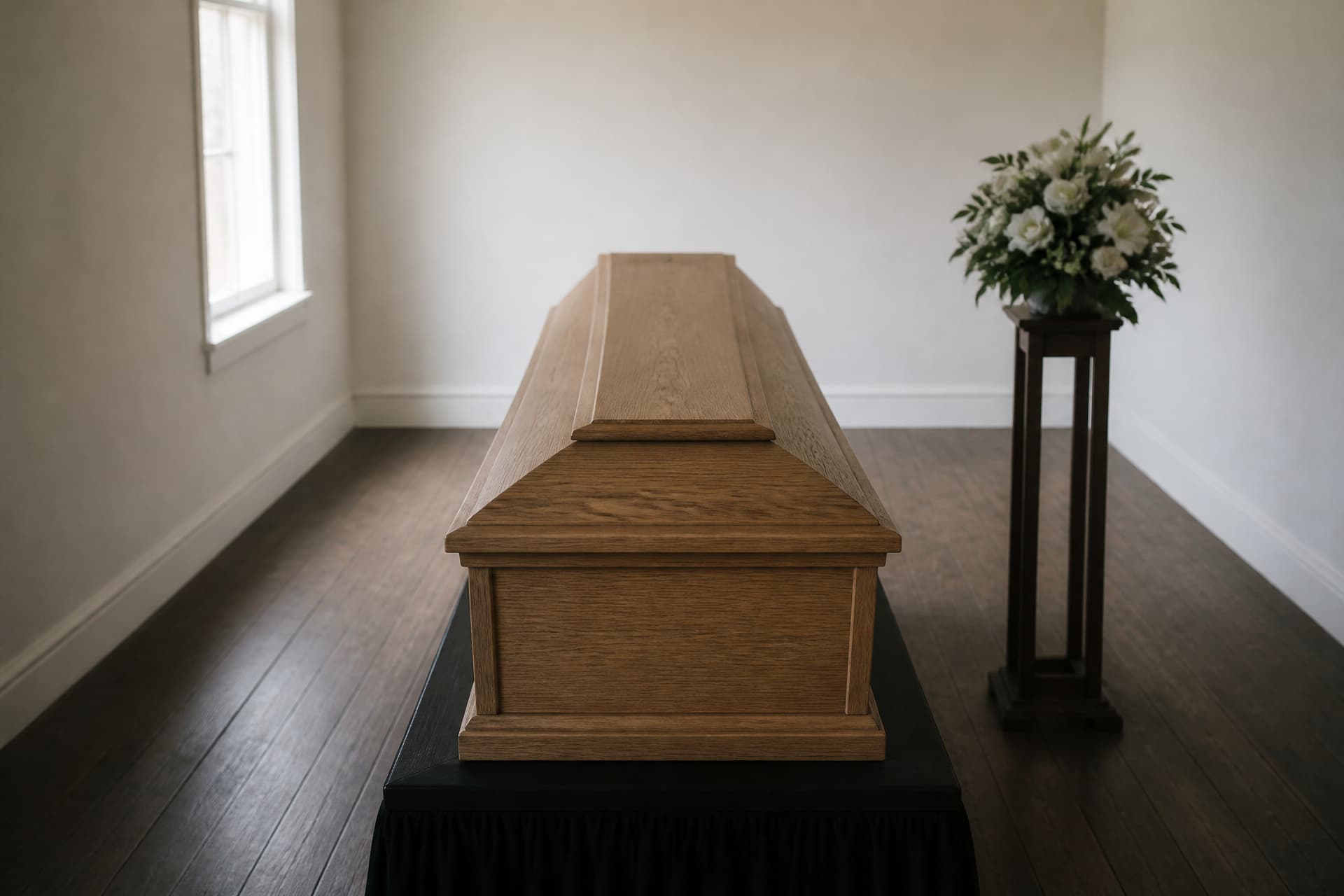
Under the Funeral Rule, a funeral home must accept a casket you bought somewhere else, must use it, and cannot charge a handling fee for doing so. It cannot refuse, it cannot add a surcharge under another name, and the same protection covers an urn. This is not a courtesy and it is not open to interpretation. It has been federal law since 1984.
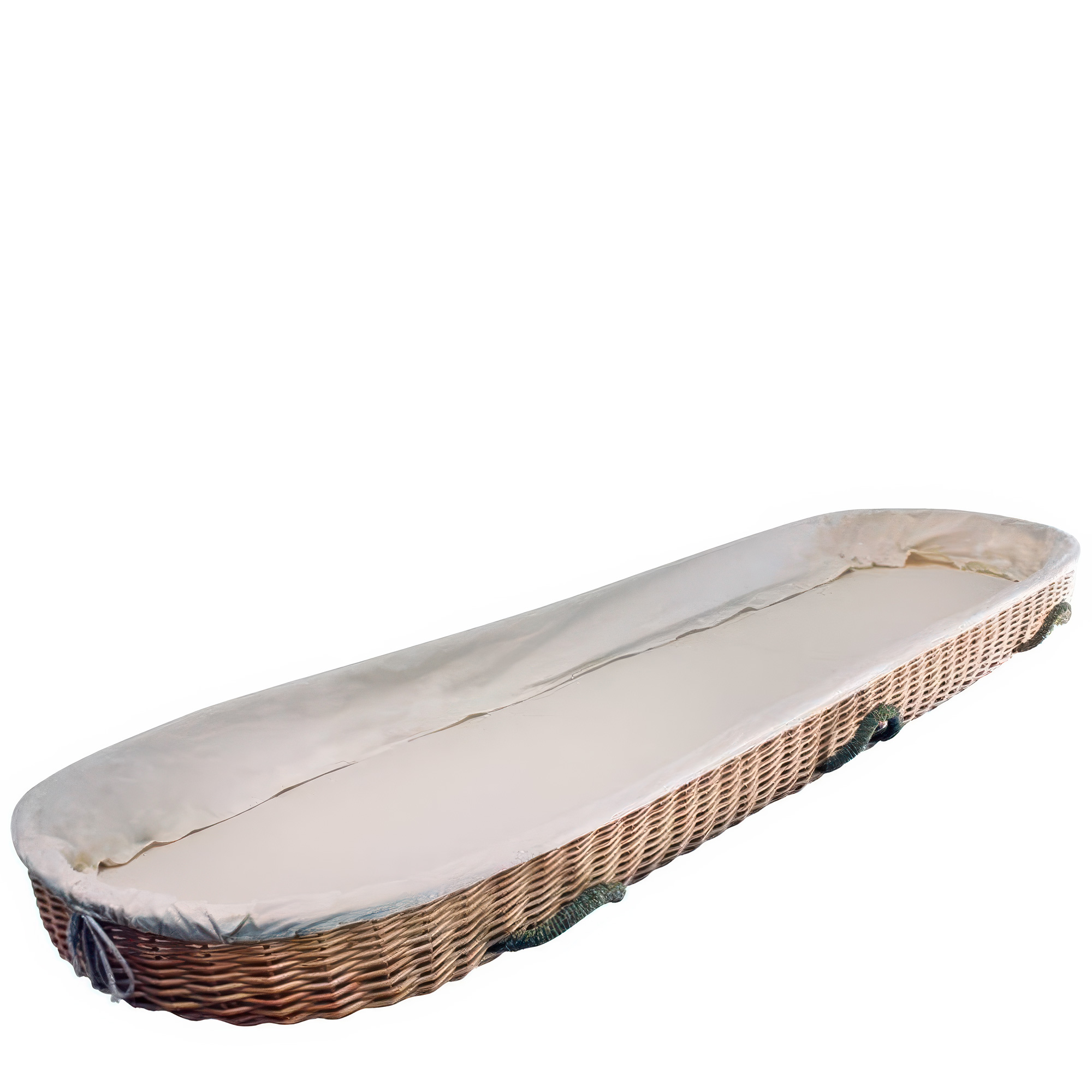
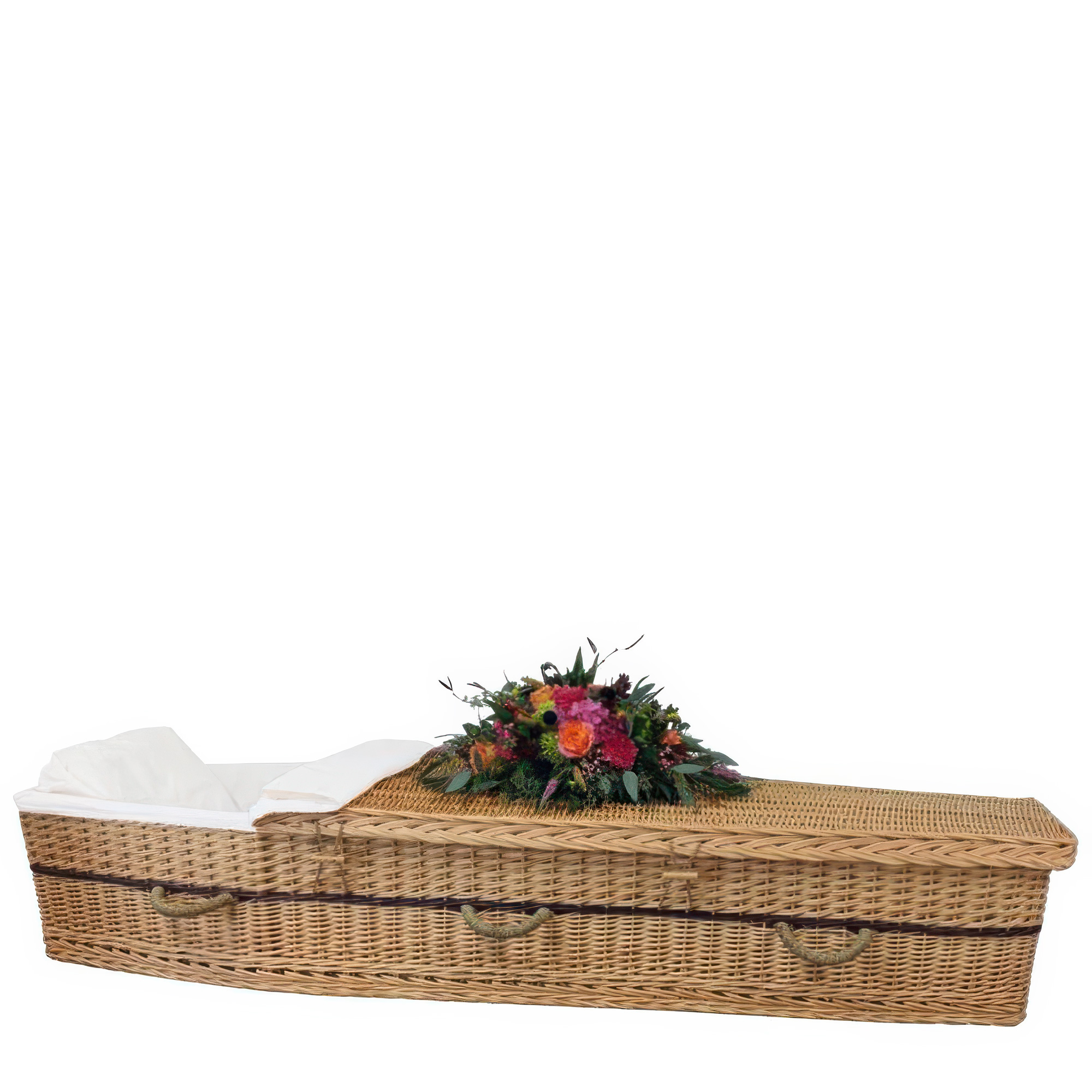
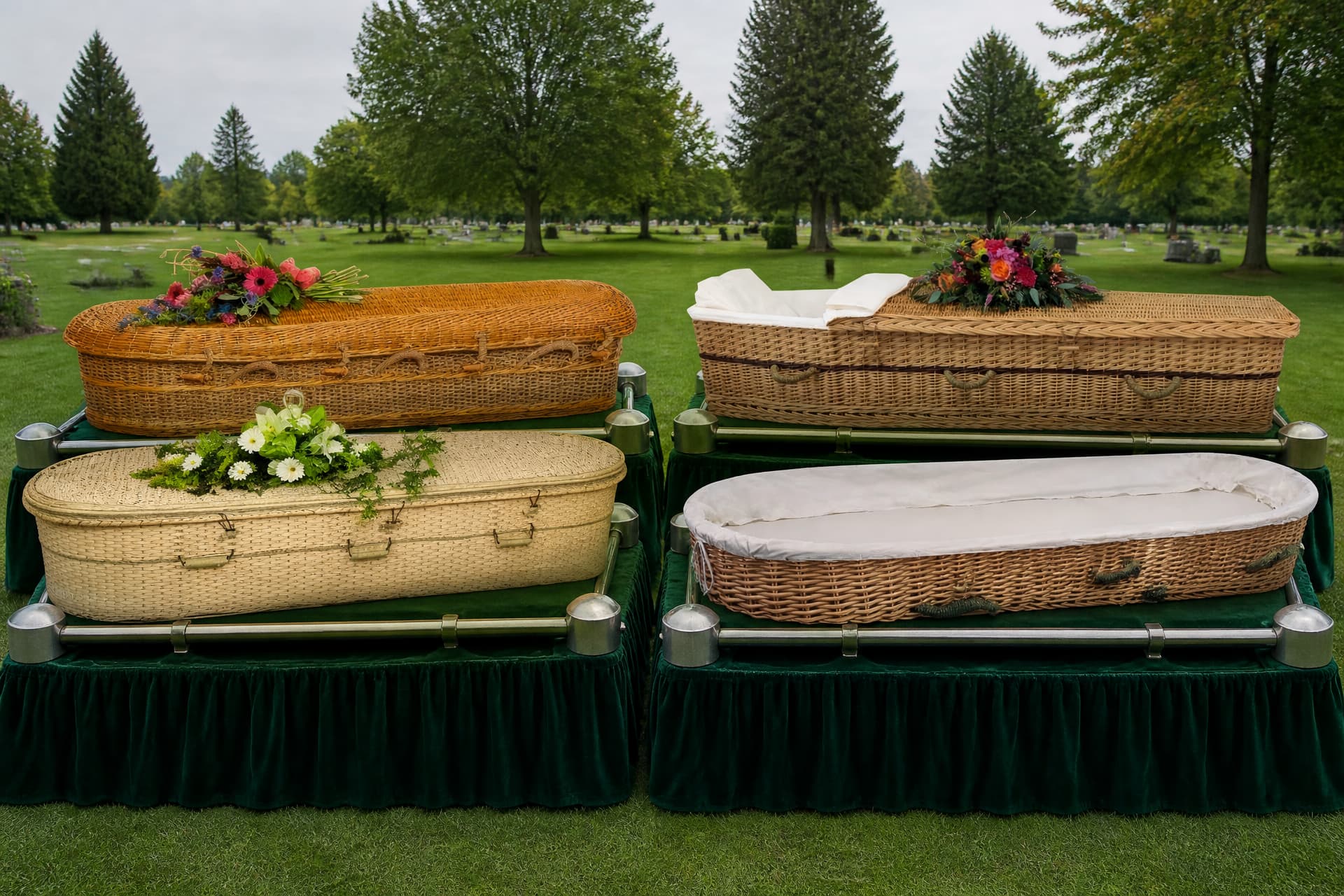
It matters because the casket list you are shown at the funeral home is a captive market. You are looking at it on the worst day of your life, in a room where asking about price feels inappropriate, and there is nothing beside it to compare against. For a sense of the range outside that room, our own caskets selection currently lists 63 adult caskets from $284 to $13,200, with a middle price of $1,880. They are delivered to the funeral home.
There is a second reason to treat the casket as its own decision. Of the full-service burial packages we read where the price list said one way or the other, two out of three did not include a casket at all. Packages that included one had a middle price of $6,543 across 48 price lists; packages that priced it separately had a middle of $5,115 across 98. Those are two different groups of funeral homes rather than the same homes quoted twice, so the gap between them is not what a casket costs. What they do tell you is that a cheaper-looking package may simply be missing the most expensive thing you are going to buy.
Sealed, protective and gasketed caskets
A sealed casket, sometimes called protective or gasketed, carries a rubber seal and a price premium over the same casket without one. It is often presented as protecting the body from the elements.
The Federal Trade Commission forbids a funeral provider from claiming that any casket or vault will preserve a body indefinitely. If you hear a preservation promise, what you are hearing is a sales claim the rule does not allow. Whether you want a sealed casket for your own reasons is a separate question and a perfectly reasonable one. Just do not buy it on the strength of that promise.
The room is a charge, and it is declinable. A viewing had a middle price of $300 across 372 price lists, and a gathering somewhere you already belong costs nothing.
The Vault, and Whether the Cemetery Actually Requires One
An outer burial container, usually a vault or a grave liner, surrounds the casket in the ground so the soil does not settle over time. No state law requires one. Many individual cemeteries do, as a condition of their own maintenance, and that requirement is real.
The question to settle is which of those you are dealing with, and the answer comes from the cemetery, not the funeral home. Ask the cemetery directly, and ask for it in writing.
Two details are worth knowing before you agree to one. A grave liner and a full vault are not the same product at the same price, and where a cemetery permits a liner the difference is usually substantial. And the container is almost never included in what the funeral home quoted you: of the 774 burial packages we read, only 44 included it. One price list said so in plain terms:
"This package does not include outer burial container (vault), grave space or open close fees." — one of the price lists we read, stating it plainly.
The same question comes back for a cremation, in smaller form. Where ashes are buried rather than kept or scattered, many cemeteries want an urn vault around the urn for the same reason they want one around a casket. It is a far cheaper object than a burial vault, and it is just as declinable if the cemetery does not require it. Ask the cemetery the same way, and get the same answer in writing.
If the cemetery does require one, you are still free to buy it elsewhere rather than from the funeral home. Our guide to what a burial vault is covers the types and what separates them.
The Viewing, the Ceremony and the Cars
These are the charges most obviously tied to the shape of the service you want, which makes them the easiest to think about clearly.
A viewing or visitation had a middle charge of $300 across the 372 price lists that stated it, with a full range from $50 to $1,800. A funeral ceremony held at the funeral home had a middle of $590 across 358 lists. A graveside or committal service had a middle of $450 across 353. Read those as three separate questions rather than three parts of one, because they are three separate medians over three different sets of homes and they do not add up to a funeral.
Any of them can be declined. A service held at a church, a home or a park removes the facility charge for the funeral home's chapel entirely, and many families find the room they already belong to suits them better.
The hearse is a charge of its own, with a middle of $380 across 371 price lists and a range from $75 to $1,295. It is usually necessary for a burial, though some cemeteries and some families arrange transport differently.
Limousines are the line to look at hardest. They appear as a separate item on most lists, they are priced by the vehicle and often by the hour, and the family drives itself to the cemetery in a great many funerals with nobody thinking twice about it. Declining the cars changes nothing about the service and removes a charge outright.
A closed casket removes the reason for embalming, and the dressing and cosmetology charges usually go with it. No state requires embalming for every death.
Printed Goods, Memorial Cards and the Obituary Notice
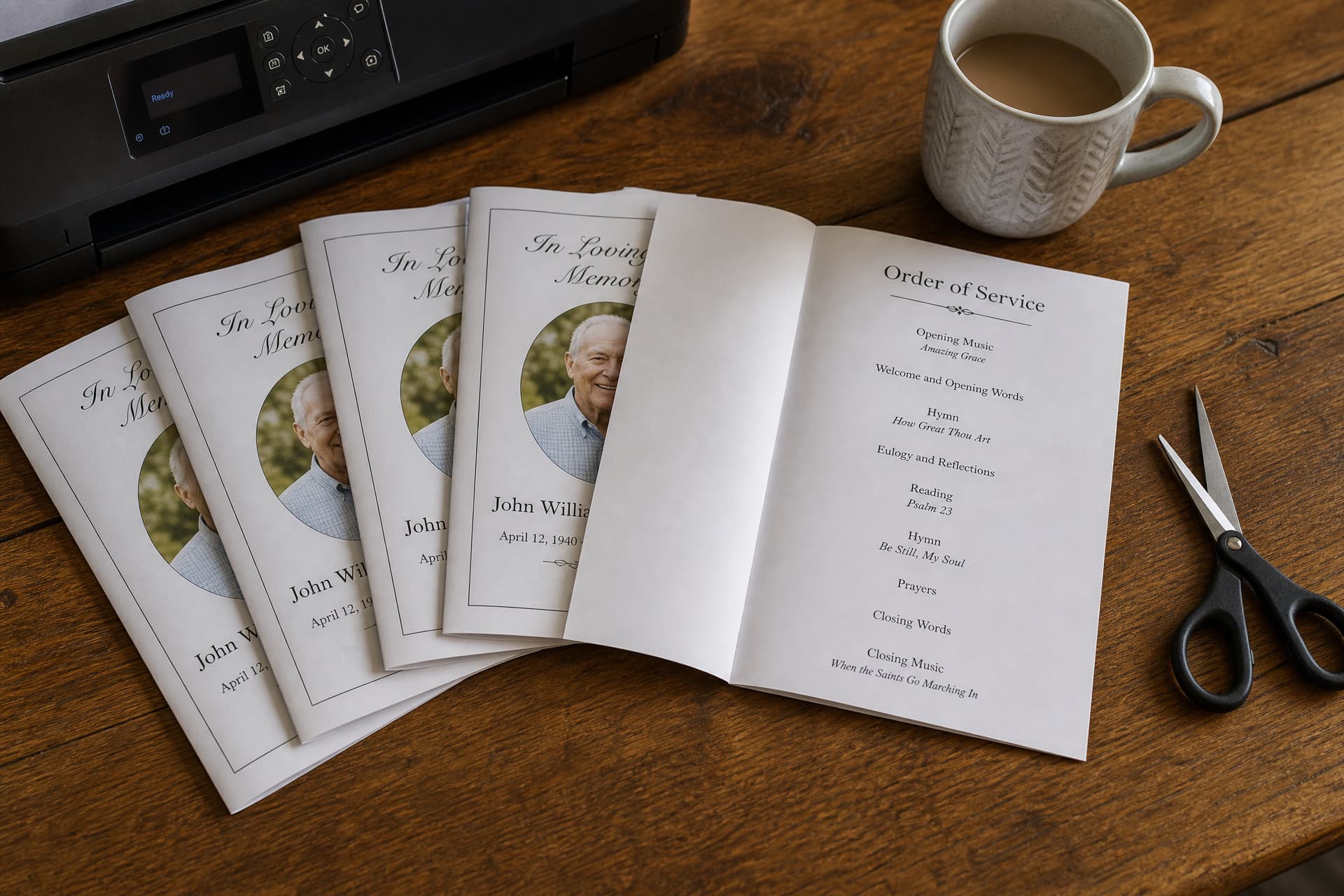
Register books, memorial or prayer cards, acknowledgment cards and printed programs are merchandise. They are priced as merchandise, they carry a markup like any other merchandise, and none of them is required.
You can decline them, buy them elsewhere, or print them yourself, and a program printed at home by someone who knew the person is frequently better than the stock design. If you do want the funeral home to supply them, ask for the prices item by item rather than as part of a package, because a bundled stationery charge hides how each piece is priced.
The obituary is the one that surprises families. A death notice placed in a newspaper is charged by the line or the column inch, it is billed by the newspaper rather than the funeral home, and it usually reaches the bill as a cash advance item passed through at cost plus, in some cases, a service charge for arranging it. It can run to a serious figure for a long notice in a large paper. Nothing obliges you to place one. Funeral home websites, online memorial pages, social media and a mailed letter all carry the same information to the people who need it, at no cost. If you want to write one, our guide on how to write an obituary covers what belongs in it.
The same buy-it-anywhere right that covers caskets covers urns. A funeral home must accept an urn you supply and cannot charge you a fee for using it, which is worth remembering when the only urns you have seen are the ones in the selection room. Our cremation urns selection shows what the container itself costs.
What Can You Decline at a Funeral Home: The Short List
Families ask the question in almost exactly those words, so here is the answer in one place. Set out plainly, the funeral costs you can avoid are these:
Embalming, unless there is an open-casket public viewing or a genuine legal or practical requirement.
Dressing, casketing and cosmetology, which generally follow embalming out the door.
The casket bought through the funeral home. Supply your own, with no handling fee.
A sealed or protective casket, which cannot lawfully be sold to you on a promise of preservation.
An outer burial container, where the cemetery does not require one, and from a different seller where it does.
The viewing or visitation, and the facility charge that comes with it.
The ceremony at the funeral home, if you hold it somewhere else.
Limousines, and sometimes other vehicles.
Register books, memorial cards, programs and acknowledgment cards.
A paid newspaper obituary.
The urn, on the same terms as the casket.
And the one you cannot: the basic services fee.
Printed goods are declinable and easy to do yourself. A program made by someone who knew the person is usually better than the stock design, and it costs the paper.
The Largest Lever Is Not Declining Anything
Here is the part that gets lost in a charge-by-charge conversation. Refusing individual items saves real money, but the biggest number on the page is decided before you reach the itemized list. It is decided by which kind of service you are having at all.
A burial with a viewing and ceremony had a middle price of $5,475. A cremation with a viewing and ceremony had a middle of $5,150, which is closer than most families expect, because the ceremony is most of the cost rather than what happens to the body afterward.
Against those, a direct burial with no service had a middle price of $2,885 across 127 price lists. A direct cremation with no viewing and no ceremony had a middle of $1,695 across 334 price lists, with a quarter of homes at $1,195 or less and a full range from $570 to $5,130.
That single choice moves the figure further than every declined line item combined. And it does not mean going without a funeral. A great many families choose a direct cremation and then hold their own gathering, in a home or a church or a park, on a date that suits everyone rather than the one the schedule allowed. What they have removed is the funeral home's staffing and facilities from the event, not the event.
How To Say No Without a Confrontation
None of this requires an argument, and in most cases nobody will push back. A few habits make it easier.
Ask for the itemized General Price List before any discussion of arrangements. You are entitled to it on paper, to keep, and you can take it away and read it somewhere quieter. Prices over the telephone are also your right, which means two more homes can be compared without leaving the house.
When you do sit down, work from the list rather than the conversation. Say which items you want, ask for the rest to be removed, and ask for the written statement of everything selected with the total before you sign anything. If you are told a law requires something, ask for that in writing too, because the rule says you are owed it.
And take the time. Nobody has to decide anything at the table.
The families who spend the least are rarely the ones who cared the least. They are the ones who saw the whole list early, knew which charges were theirs to refuse, and asked the cemetery what it wanted before the funeral home's bill arrived.
Where to Take This Next
Refusing things is only half the lever. Direct burial cost and direct cremation are the other half, and the difference between them is larger than the printed numbers suggest once the cemetery has been counted.
Two of the charges above deserve their own pages. How much to pay a pastor for a funeral covers the pass-through items, which you can decline or simply arrange yourself. And if you want the reasoning behind the fee you cannot decline, why are funerals so expensive takes the structural answer rather than the cynical one.
If the problem is that the money is not there at all, charities that help with funeral costs sets out the benefits, funds and entitlements worth chasing, and the order to chase them in.
Prices in this article come from 461 General Price Lists published by funeral homes in 49 states, collected in September 2026. We publish the middle price and the middle half of the range rather than an average, and name the number of price lists behind every figure. Funeral homes that publish their prices online may not be typical of every home in the country.