🏬Supersize Online Funeral Retailer🪦1000's of Headstones⚱️Over 10,000 Cremation Urns⚰️Caskets Overnight Delivery🛒Funeral & Memorial Superstore🚚FREE Shipping on ALL Orders👨👩👧👦Helping Families for over 20 Years💰Lowest Price Guarantee🏬Supersize Online Funeral Retailer🪦1000's of Headstones⚱️Over 10,000 Cremation Urns⚰️Caskets Overnight Delivery🛒Funeral & Memorial Superstore🚚FREE Shipping on ALL Orders👨👩👧👦Helping Families for over 20 Years💰Lowest Price Guarantee
🏬Supersize Online Funeral Retailer🪦1000's of Headstones⚱️Over 10,000 Cremation Urns⚰️Caskets Overnight Delivery🛒Funeral & Memorial Superstore🚚FREE Shipping on ALL Orders👨👩👧👦Helping Families for over 20 Years💰Lowest Price Guarantee🏬Supersize Online Funeral Retailer🪦1000's of Headstones⚱️Over 10,000 Cremation Urns⚰️Caskets Overnight Delivery🛒Funeral & Memorial Superstore🚚FREE Shipping on ALL Orders👨👩👧👦Helping Families for over 20 Years💰Lowest Price Guarantee
At the graveside, in the pause before the first earth is turned, the officiant says a line almost everyone recognizes and almost nobody catches in full. Ashes to ashes dust to dust is the part that stays with people. It belongs to the committal — the formal moment of giving a body back to the ground — and if you are reading this a day or two after standing there, you are in good company. The words go past quickly, they are spoken quietly, and they are only ever heard once.
They are also only part of the sentence. The full form has three clauses rather than two, and the clause that comes immediately after them is not about decay at all. What follows is the whole line, where it came from, which of the many half-remembered versions is the right one, and what any of it means for a family who chose cremation. The phrase sits alongside the other sayings, omens and emblems collected in our , which sets out what each of them was originally meant to do.
So what does ashes to ashes dust to dust mean, in plain terms? It means that a human body is made of ordinary material, that it came out of the earth, and that it is now being given back. Nothing in the phrase is metaphorical. Ashes and dust are the two things a body actually becomes, by fire or by time, and the line names them without flinching.
That directness is the point, and it is why the words have survived so long. A funeral is full of language that steps carefully around what has happened. This line does the opposite. It states the physical fact at the exact moment the physical fact is happening — as the casket is lowered, or as the earth is scattered on it — and in doing so it gives the family permission to acknowledge it too.
The ashes to ashes dust to dust meaning that most explanations stop at is decay, and stopping there gets the sense of it backwards. In the burial service the phrase is the first half of a sentence whose second half is a statement of hope. The words are not the conclusion. They are the ground the conclusion is built on: this much is true, and here is what we believe anyway. A family that hears only the first half hears a much bleaker sentence than the one that was said.
There is one more thing worth knowing before the line is taken apart clause by clause. Ashes to ashes, dust to dust is liturgy — it is a form of words written for a church service. It reads like scripture, it is built out of scripture, and it is not itself a verse in the Bible. That distinction matters more than it sounds, and it comes up again below.
Urns That Return to the Earth
Biodegradable and scattering urns for a committal, a burial or a scattering
The full saying: earth to earth, ashes to ashes, dust to dust
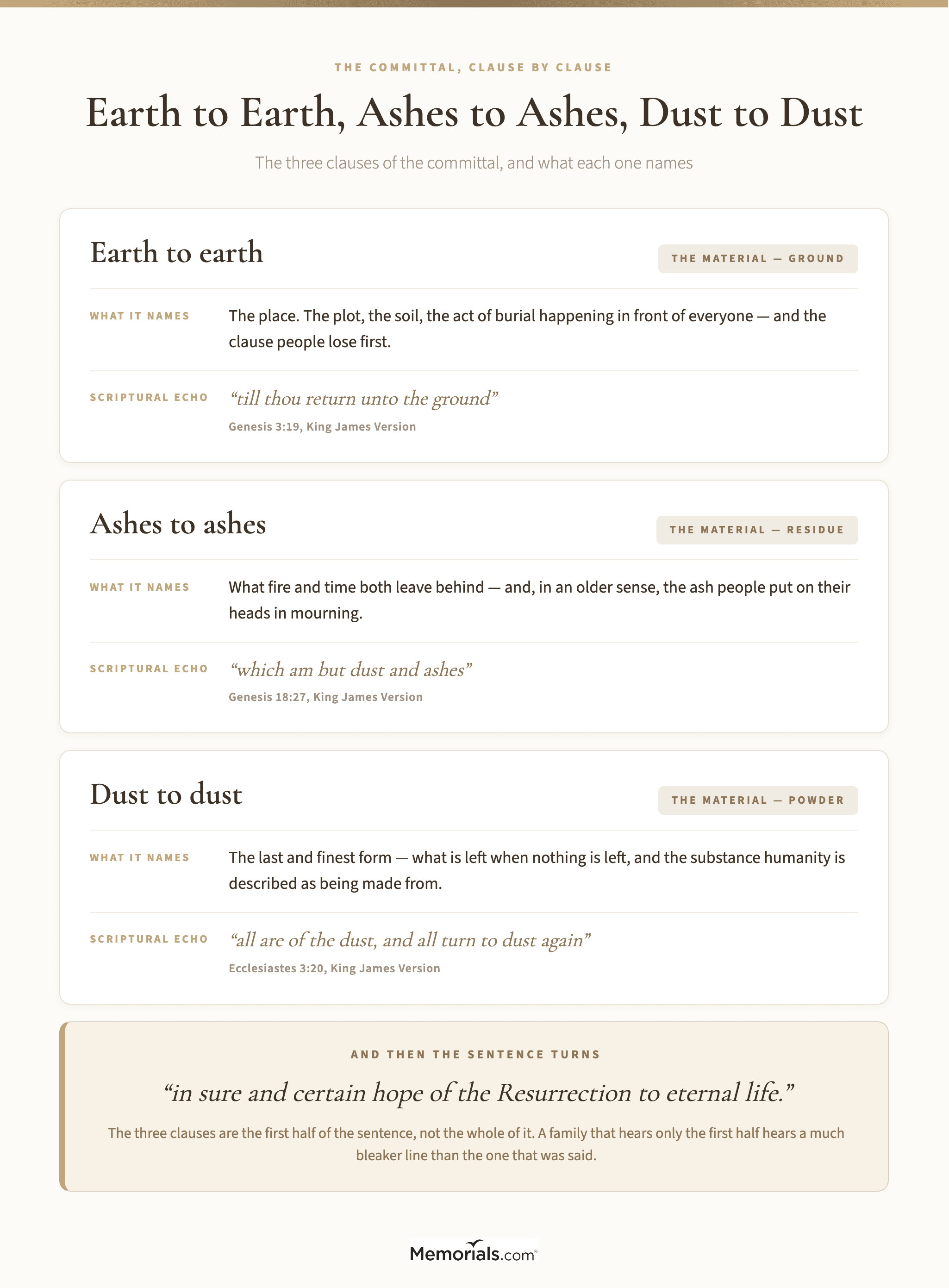
The complete phrase has three clauses:
"We therefore commit his body to the ground; earth to earth, ashes to ashes, dust to dust; in sure and certain hope of the Resurrection to eternal life."
Most people carry away the middle two and lose the first, which is why so many searches ask for the full version. The three clauses are not repetition. Each one names a different form the body takes, and together they trace a sequence.
Earth to earth. The body is returning to the same substance the ground is made of. This is the clause about place — the plot, the soil, the physical act of burial happening in front of everyone. It is also the clause that disappears first from memory, because it is the least strange of the three and the most easily absorbed into the rest of the sentence.
Ashes to ashes. So what does ashes to ashes mean when the body in front of you has not been burned? The ashes to ashes meaning is not really about cremation, though it fits a cremation exactly. It is about what fire and time both leave behind, and it carries an older sense as well: ashes are what people in the ancient Near East put on their heads in mourning and in repentance. The clause names both the residue and the grief.
Dust to dust. The dust to dust meaning is the oldest of the three and the most literal. Dust is what a body eventually becomes when nothing is left of it at all — the finest form, the last one. It is also the substance humanity is described as being made from in Genesis, which is where the whole line takes its authority.
Read in order, the three clauses move from the largest scale to the smallest: the ground, the residue, the powder. Then the sentence turns, and the turn is the reason a funeral says it out loud at all.
Each clause names a different form the body takes, and the order runs from the ground itself down to the finest dust — which is why the first clause, earth to earth, is the one people most often lose.
Where the phrase comes from
The funeral phrase origin most people expect is the Bible, and it is close but not correct. The line as everyone knows it comes from the burial service in the Book of Common Prayer, the English-language prayer book written for the Church of England after the Reformation. Its committal — the words spoken at the graveside as the body is placed in the ground — is where earth to earth, ashes to ashes, dust to dust first appears in that shape and that order.
From there it spread further than its own denomination ever did. The Book of Common Prayer was the template for Anglican and Episcopal services, and its burial office was borrowed, adapted and quietly absorbed by other Protestant traditions, by military and civic funerals, and eventually by American funeral directors of no particular denomination at all. That is why you can hear the same three clauses at a church burial, at a veteran's graveside service, and at a funeral with no religious content whatsoever. The phrase outlived its own liturgy and became simply what one says.
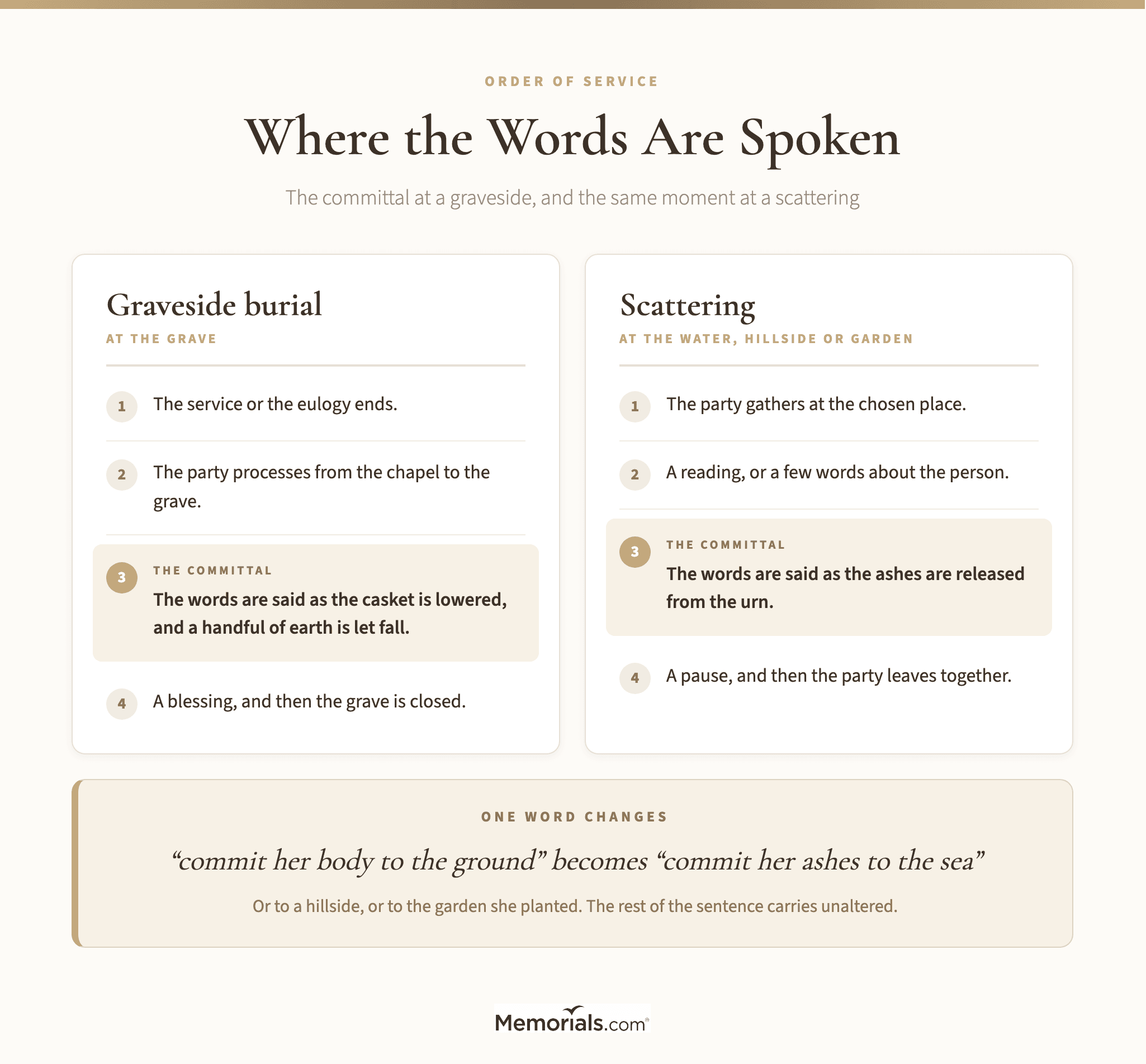
The committal is the shortest part of a funeral and the only part spoken at the graveside itself, which is why it is so often the piece a family remembers least clearly.
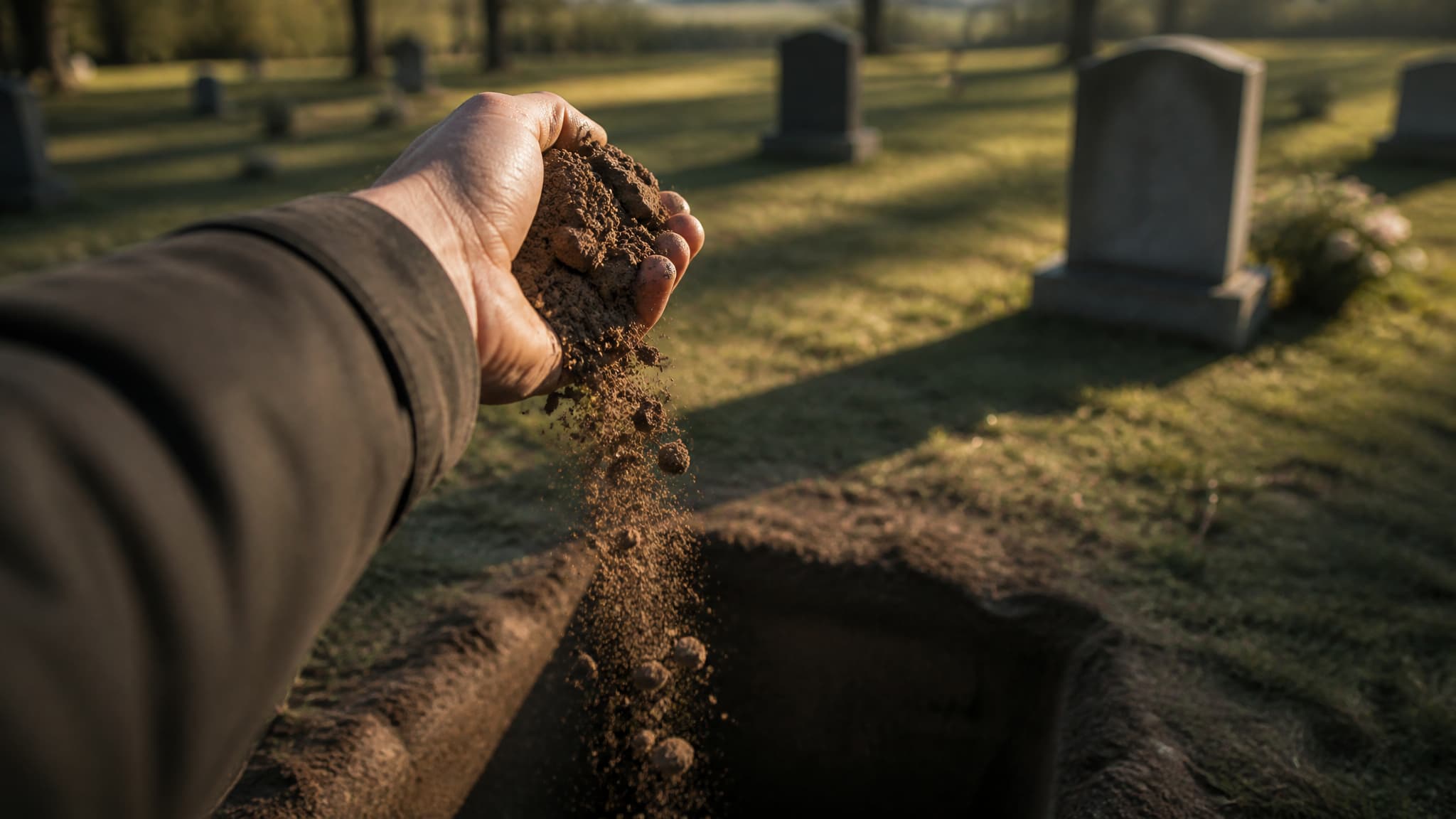
The officiant says it at a specific moment, and the timing is part of the meaning. It comes after the eulogy, after the procession to the grave, at the point where the casket is already lowered or is being lowered. In many services the person leading it takes a handful of earth and lets it fall while speaking. The words and the gesture are one action: the phrase describes exactly what the hand is doing.
The Bible verses behind ashes to ashes, dust to dust
There is no single dust to dust bible verse to point to, because the line is a composition rather than a quotation. It is assembled out of several passages, and once you have seen them the phrase reads differently.
The foundation is Genesis 3:19, in the King James Version: "for dust thou art, and unto dust shalt thou return." That is the sentence the whole committal rests on — the statement that a human being is made of dust and is going back to it. Ecclesiastes 3:20 says the same thing about everything alive: "All go unto one place; all are of the dust, and all turn to dust again."
The pairing of dust with ashes comes from elsewhere. In Genesis 18:27 Abraham describes himself as "but dust and ashes" while speaking to God, and Job says of himself, "I am become like dust and ashes." In both places the phrase is an expression of smallness rather than of death. Whoever wrote the committal took a formula about human insignificance and turned it into a formula about a human body, which is a substantial piece of rewriting and part of why the line lands the way it does.
The same Genesis verse gives Ash Wednesday its words — "Remember that thou art dust, and to dust thou shalt return" — spoken while ash is marked on a forehead. Two rites, one verse, and the same idea approached from opposite ends: one says it to the living, the other says it over the dead.
All of these are quoted here from the King James Version, which is in the public domain. If you are reading them alongside a modern translation the wording will differ; the sense does not. For the wider question of what scripture says about burning a body rather than burying it, we have a separate piece on what the Bible says about cremation.
Ash to ash, dust to dust, and the versions people half-remember
A line heard once at an emotional moment does not survive intact, and this one gets remembered several different ways. None of them is a mistake worth being embarrassed about, but it is useful to know which is the original.
The most common variant is ash to ash dust to dust, in the singular. It scans well and it sounds right, and it is not the liturgical form — the burial service uses the plural throughout. Nearly as common is the reversed order, dust to dust ashes to ashes, which puts the finer substance first and the coarser second. The original runs the other way, from earth to ashes to dust, because it is describing a sequence rather than a pair.
Then there is the two-clause version, ashes to ashes and dust to dust, which is what most people say when asked to recite the phrase cold. It is the middle of the line with the beginning and the end taken off. And there is the childhood echo — ashes, ashes, we all fall down — which many people are certain refers to plague burials. Folklorists have argued about that for a long time and the connection is generally treated as a later story attached to an older rhyme rather than a documented origin. It is worth knowing as a common belief; it is not evidence about the funeral line.
If you are choosing wording for a service, a headstone or a printed program, the safe form is the one in the prayer book: earth to earth, ashes to ashes, dust to dust. If you are simply trying to settle an argument about how it goes, the plural is correct and the ashes come before the dust.
Does it still apply when the body is cremated
This is the question underneath most searches for the phrase, and it usually arrives with a worry attached: if the words are about dust and earth, did a cremation somehow fall outside them?
It did not. The words fit a cremation more exactly than they fit a burial. At a graveside the ashes and the dust are a prediction — a description of what will happen slowly, over years, out of sight. After a cremation they are a description of what is already in the container. The family is not being told what the body will become. They are being told what it is.
That is not a modern accommodation, either. Ashes were part of the phrase long before cremation was common in the United States, which means the line was already carrying the word for a state that most bodies of the time would never visibly reach. Cremation simply caught up with the liturgy. Many officiants now say the identical committal at a scattering or an inurnment, changing nothing but the verb.
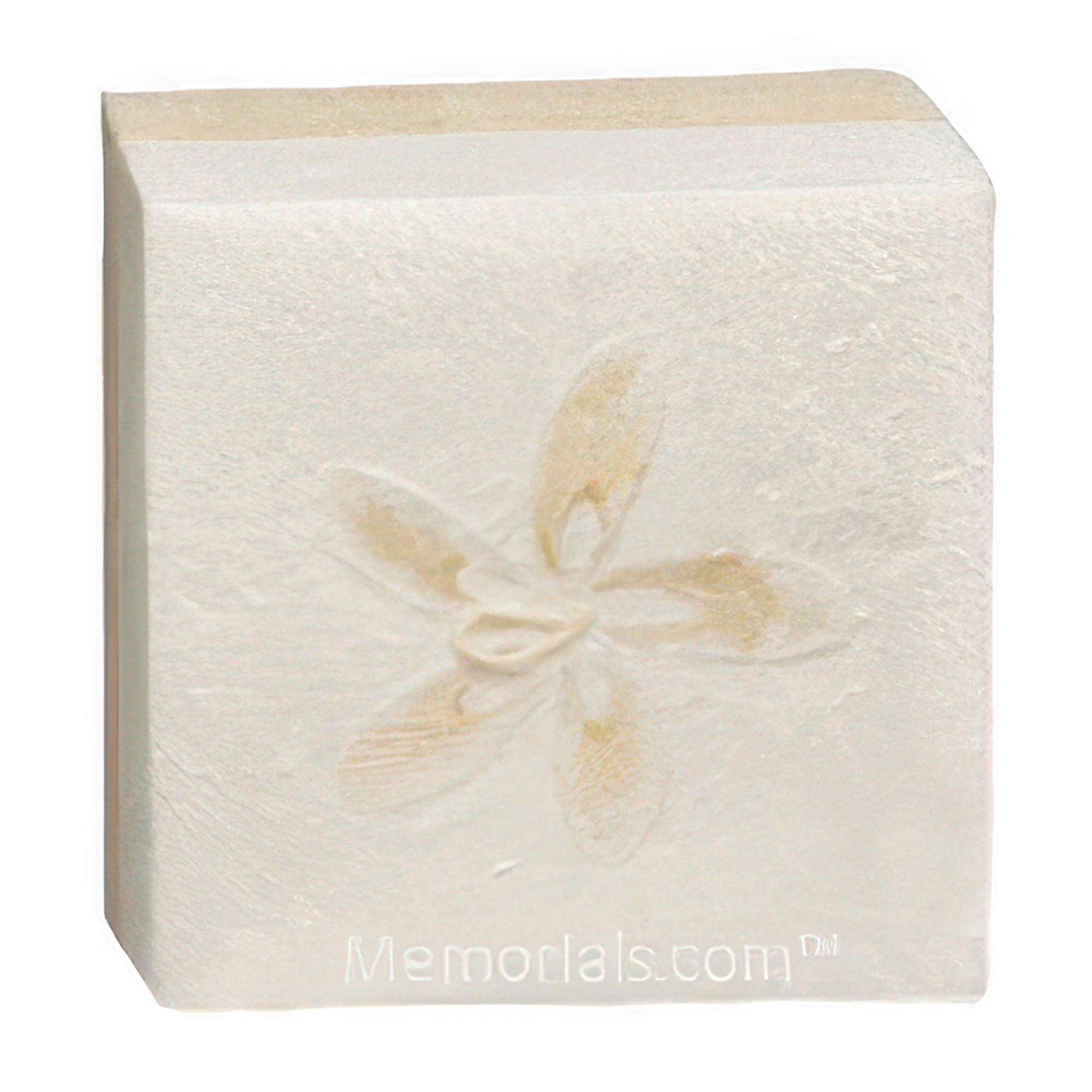
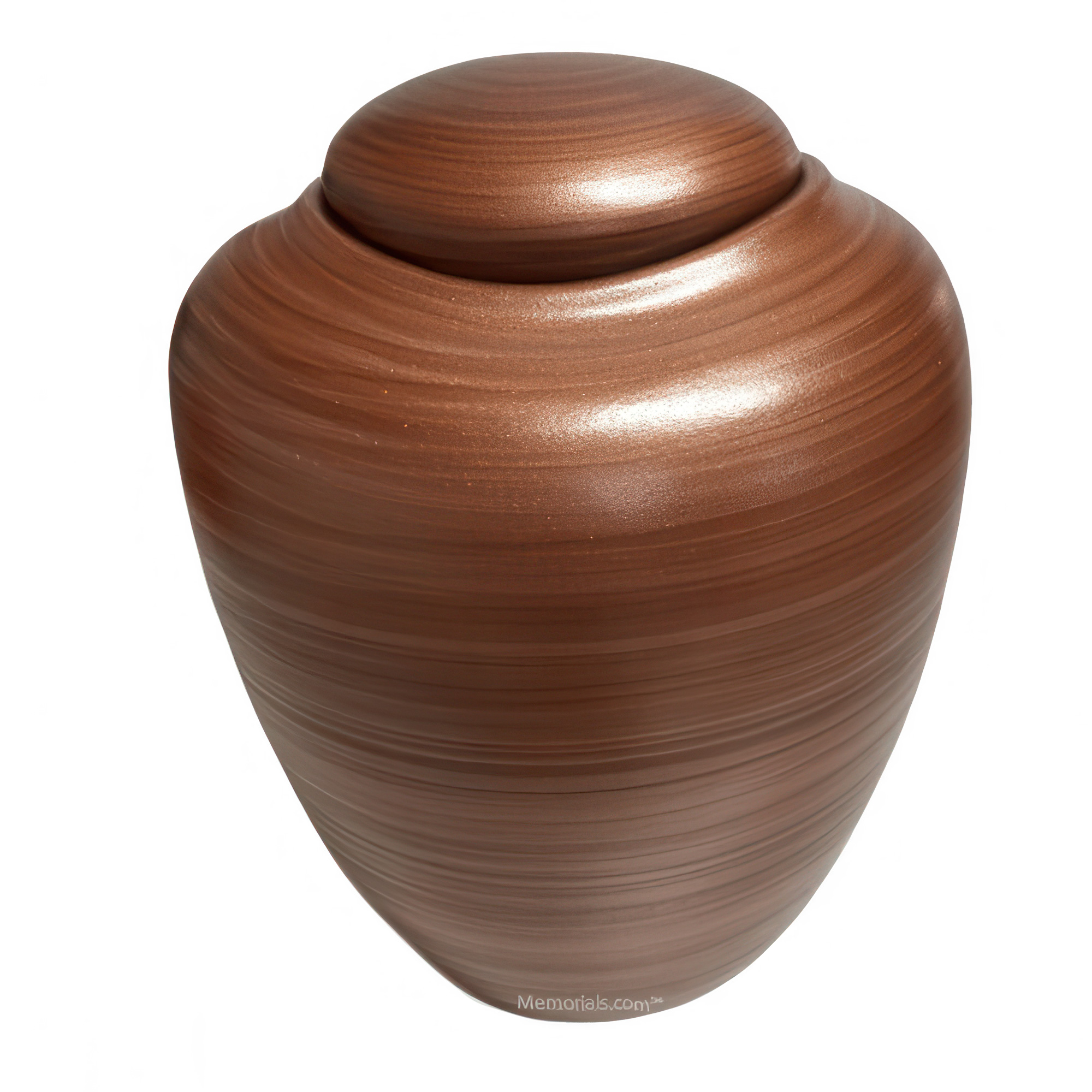
What does change is the container, and the choice in front of a family maps onto the phrase more closely than most people expect. Cremation urns fall broadly into ones designed to stay and ones designed to go. An urn of metal, wood or stone is meant to be kept, displayed or placed in a niche, and it holds the ashes indefinitely. A biodegradable urn is built to do the opposite: made from paper, salt, sand or plant fiber, it dissolves in water or breaks down in soil, and it returns what it carries to the ground on its own schedule. It is, in the most literal sense available, the committal performed as an object.
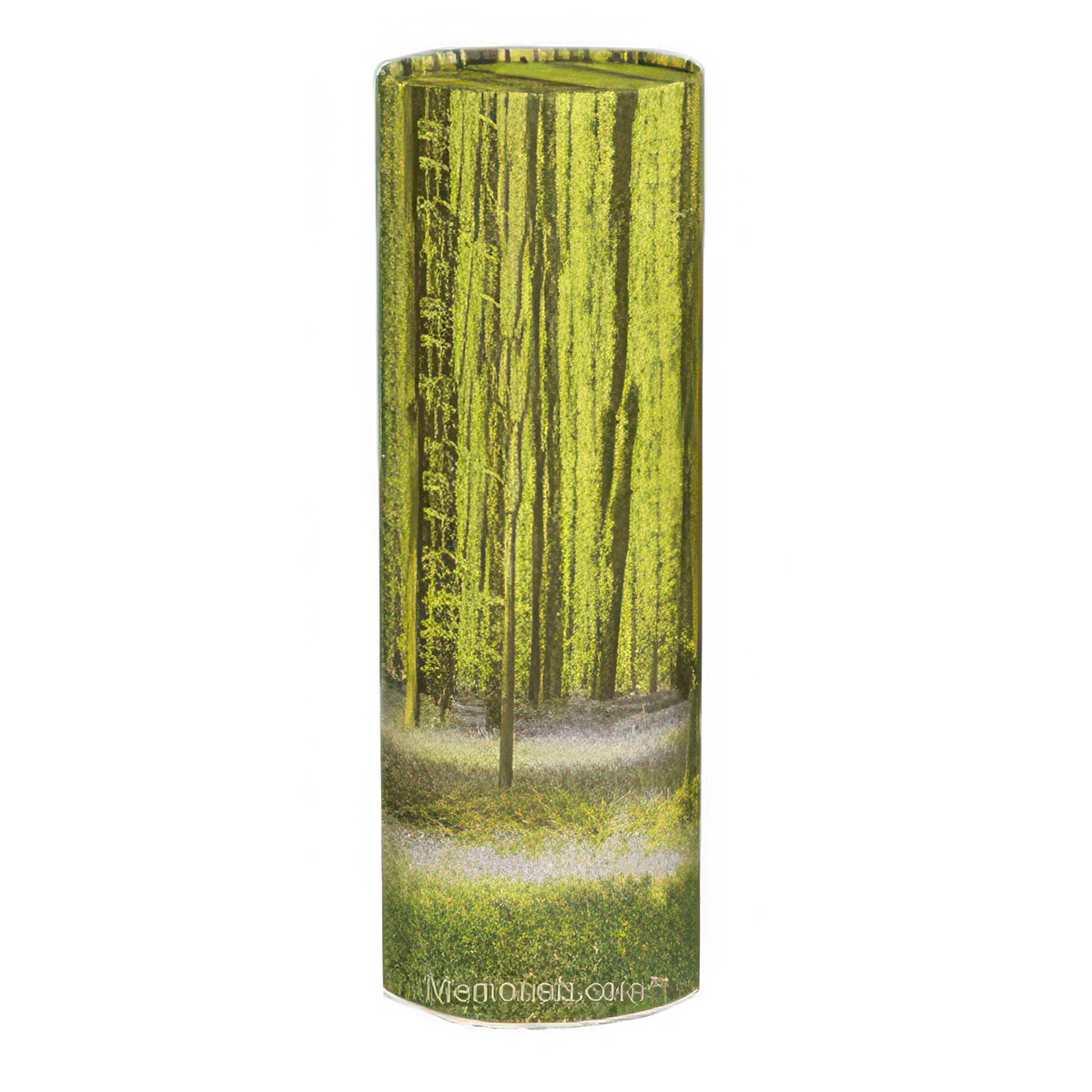
For a family scattering rather than burying, the practical question is what to carry the ashes in and how to release them without a struggle in the wind. That is what scattering urns for ashes are for: a lightweight tube or box with an opening designed to pour cleanly and slowly, so the moment is controlled rather than improvised. Our scattering ashes guide covers the mechanics in full, and for anyone unsure what cremated remains physically are, we describe what cremated remains actually are in a separate piece.
Families who want the whole arrangement to match the words often go further and choose a green burial, which uses no vault and no embalming so that the return happens as directly as possible. The phrase and the practice line up completely.
Using the words at a funeral or a scattering
Plenty of people arrive at this phrase not because they heard it but because they have been asked to say something. A family member is leading a graveside gathering, or a scattering is happening months after the funeral and nobody has thought about wording until the day before.
You may use the committal. It is centuries old, it is in the public domain, and no permission is required. The traditional form runs: "we therefore commit his body to the ground; earth to earth, ashes to ashes, dust to dust; in sure and certain hope of the Resurrection to eternal life." Substitute her, or the person's name, as fits.
For a scattering, the second word is the one to change. Commit her body to the ground becomes commit her ashes to the sea, or to this hillside, or to the garden she planted. The rest of the sentence carries perfectly. For a family without religious belief, the closing clause is the one that will not sit right — and it can simply be dropped, leaving the three clauses and a full stop, or replaced with something the family means. In love, and in gratitude for the years we had is not liturgy, but it is honest, and honest is what the moment needs.
The committal adapts to a scattering by changing one word — the body given to the ground becomes the ashes given to the water.
The committal is the same short act in both settings: a sentence, a gesture, and a pause — the only difference is what the ashes or the body are being given to.
Other traditions that say the same thing in their own symbols
The idea underneath the phrase — the body goes back, something else does not — is not particular to one faith, and the death symbolism hub is full of other ways of saying it.
The closest structural match is Masonic. At a Masonic graveside service a sprig of acacia is dropped into the grave, an evergreen laid on the earth precisely to make the argument the committal makes in words: this part returns to the ground, and this part does not.
In Chinese and Vietnamese practice, paper goods are burned as offerings to the dead, and the spiritual meaning of burning paper turns on the same transformation the committal names — the object is reduced to ash in order to reach the person it is meant for. Ash there is not an ending but a means of transit.
Japanese folklore takes a different route to the same place. A shinigami is a figure who accompanies or invites a death rather than one who explains what happens to the body, which is why the tradition produces a character where the English service produces a sentence. And the flowers laid around a committal carry their own vocabulary: black carnations have picked up an association with mourning and loss that has nothing to do with any liturgy and everything to do with what people reach for.
An evergreen dropped into a grave makes the committal's argument without words: the earth takes the body, and the branch that does not brown says the rest.
The phrase beyond the funeral
Once you know the line you start meeting it away from graves. It has been a song title, an album title and a lyric many times over — a death song does not have to be mournful, and this phrase has been used for everything from elegy to swagger. It turns up as a tattoo, usually for someone specific. It is carved on headstones, sometimes in full and sometimes as the two middle clauses alone.
What all those uses share is the compression. Six words state something enormous and state it calmly, which is a rare quality in any language about death and the reason people keep borrowing them.
Frequently Asked Questions
What does ashes to ashes, dust to dust mean?
It means the body came from the earth and is being returned to it. The words are said at the committal, the moment during a funeral when a body is placed in the ground, and they name what a body physically becomes. In the burial service they are followed immediately by a statement of hope, which is the half most people never hear.
Where does "ashes to ashes, dust to dust" come from?
From the burial service in the Book of Common Prayer, which is where the three clauses appear in the order everyone now knows. It spread from there into Anglican and Episcopal practice, then into other Protestant traditions and eventually into general funeral use in America, including services with no religious content at all.
Is "ashes to ashes, dust to dust" in the Bible?
Not as a sentence. It is liturgy built out of scripture. Genesis 3:19 supplies the core — "for dust thou art, and unto dust shalt thou return" — and Genesis 18:27 and Job supply the pairing of dust with ashes. The prayer book combined them into a single formula for use at a graveside.
Is it "ash to ash" or "ashes to ashes"?
The plural is correct. The prayer book form is earth to earth, ashes to ashes, dust to dust. The singular is a very common way to remember it and nothing is lost by saying it that way in conversation, but the plural is the form to use on a headstone, in a program or in a spoken service.
Can you say it at a cremation or a scattering?
Yes, and it fits at least as well. Officiants commonly use the same committal at an inurnment or a scattering, changing the ground to the sea, a garden or a hillside. Cremation makes the phrase describe the present rather than predict the future, which if anything makes it more apt, not less.
Giving the body back to the earth
The reason the line has lasted is that it refuses to pretend. It says the hard thing at the hardest moment, out loud, in front of everybody, and then it turns and says something else. Families who find it comforting are not misreading it. That is the shape it was built to have.
If you are the one now holding the ashes and deciding what happens next, the phrase is worth taking as a genuine question rather than a formality. Some families want the remains kept close, in a form that lasts. Others want the return the words describe, and want it soon. Neither answer is more faithful to the line than the other — the committal was written for people burying a body, and it has accommodated every choice made since without losing anything.
There is no deadline on deciding. An urn that stays can be replaced later by one that goes, and a scattering can happen a year after the funeral just as well as a week after it. What the words ask is only that the choice be made deliberately, by the people who loved the person, rather than left to happen by default.