🏬Supersize Online Funeral Retailer🪦1000's of Headstones⚱️Over 10,000 Cremation Urns⚰️Caskets Overnight Delivery🛒Funeral & Memorial Superstore🚚FREE Shipping on ALL Orders👨👩👧👦Helping Families for over 20 Years💰Lowest Price Guarantee🏬Supersize Online Funeral Retailer🪦1000's of Headstones⚱️Over 10,000 Cremation Urns⚰️Caskets Overnight Delivery🛒Funeral & Memorial Superstore🚚FREE Shipping on ALL Orders👨👩👧👦Helping Families for over 20 Years💰Lowest Price Guarantee
🏬Supersize Online Funeral Retailer🪦1000's of Headstones⚱️Over 10,000 Cremation Urns⚰️Caskets Overnight Delivery🛒Funeral & Memorial Superstore🚚FREE Shipping on ALL Orders👨👩👧👦Helping Families for over 20 Years💰Lowest Price Guarantee🏬Supersize Online Funeral Retailer🪦1000's of Headstones⚱️Over 10,000 Cremation Urns⚰️Caskets Overnight Delivery🛒Funeral & Memorial Superstore🚚FREE Shipping on ALL Orders👨👩👧👦Helping Families for over 20 Years💰Lowest Price Guarantee
Most people arrive at the bone picking ceremony sideways — a line in a novel, a documentary that moved on too fast, a friend who mentioned it once and then changed the subject. What English speakers call the Japanese bone picking ceremony has a plainer name at home: kotsuage (骨上げ), which means something close to raising the bones. After a cremation in Japan, the family walks into a small room, stands around a steel tray, and lifts their relative's bones into the urn themselves, with long chopsticks, two people to each fragment.
It is not macabre and it is not performed for effect. It is quiet, it is over quickly, and families who have done it describe it far more often as a comfort than as an ordeal. If you want to see where it sits among how other cultures handle the body after a death, the wider guide sets it beside the rites it grew up alongside.
This page is about the mechanics and the meaning: what happens, in what order, why two people hold the same bone at the same time, what becomes of the fragments nobody collects, and what is expected of you if you have been invited. Kotsuage is one step inside the wider sequence of Japanese funeral traditions — the wake, the funeral service, the cremation, then this, then the memorials that follow for years. That page covers the sequence. This one covers the few minutes at the center of it.
What the Bone Picking Ceremony Is
The bone picking ceremony is the part of a Japanese funeral in which the bereaved family, rather than the crematorium staff, gathers the cremated remains into the urn. The English phrase bone picking is blunter than anything a Japanese family would say about it. Kotsuage is closer to lifting, or raising, and the whole kotsuage ritual is carried out with the unhurried care of a family setting a table rather than the briskness of a task being completed.
It takes place in a plain room next to the cremation hall, usually within minutes of the cremation ending. The people in the room are the immediate family and close relatives, led by the moshu (喪主), the chief mourner — normally the spouse, or the eldest child. A crematorium attendant stands to one side and explains what to do. The cremation itself runs to an hour or two; the gathering that follows it is a matter of minutes, not hours.
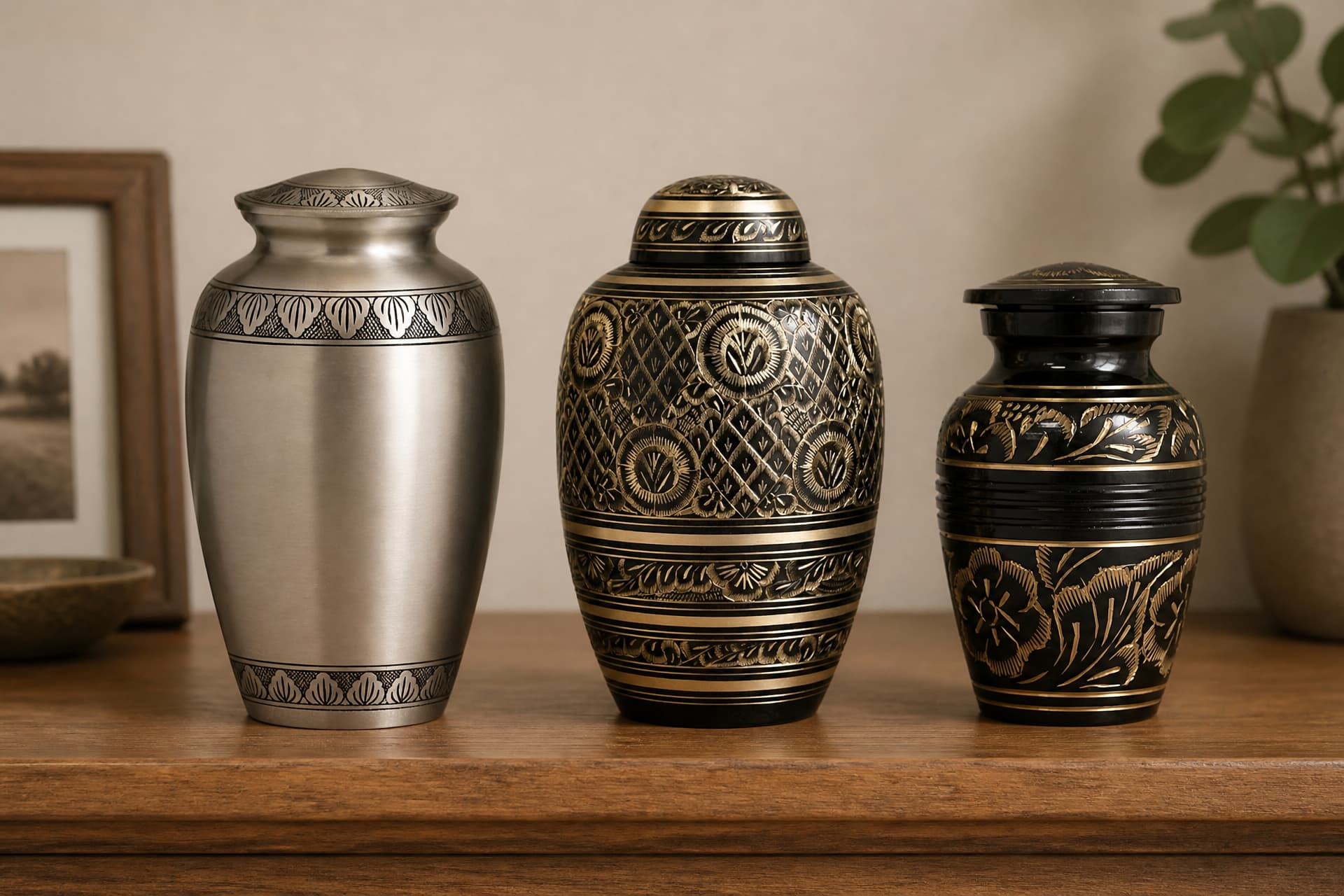
The contrast with American practice is sharper than it first appears, and it runs in the opposite direction to the one people expect. In the United States a family hands the body to a funeral director and receives a sealed cremation urn back, its contents already uniform and already closed. In Japan the family fills the vessel with their own hands. Which of those two arrangements is the unusual one is not a question this page needs to settle.
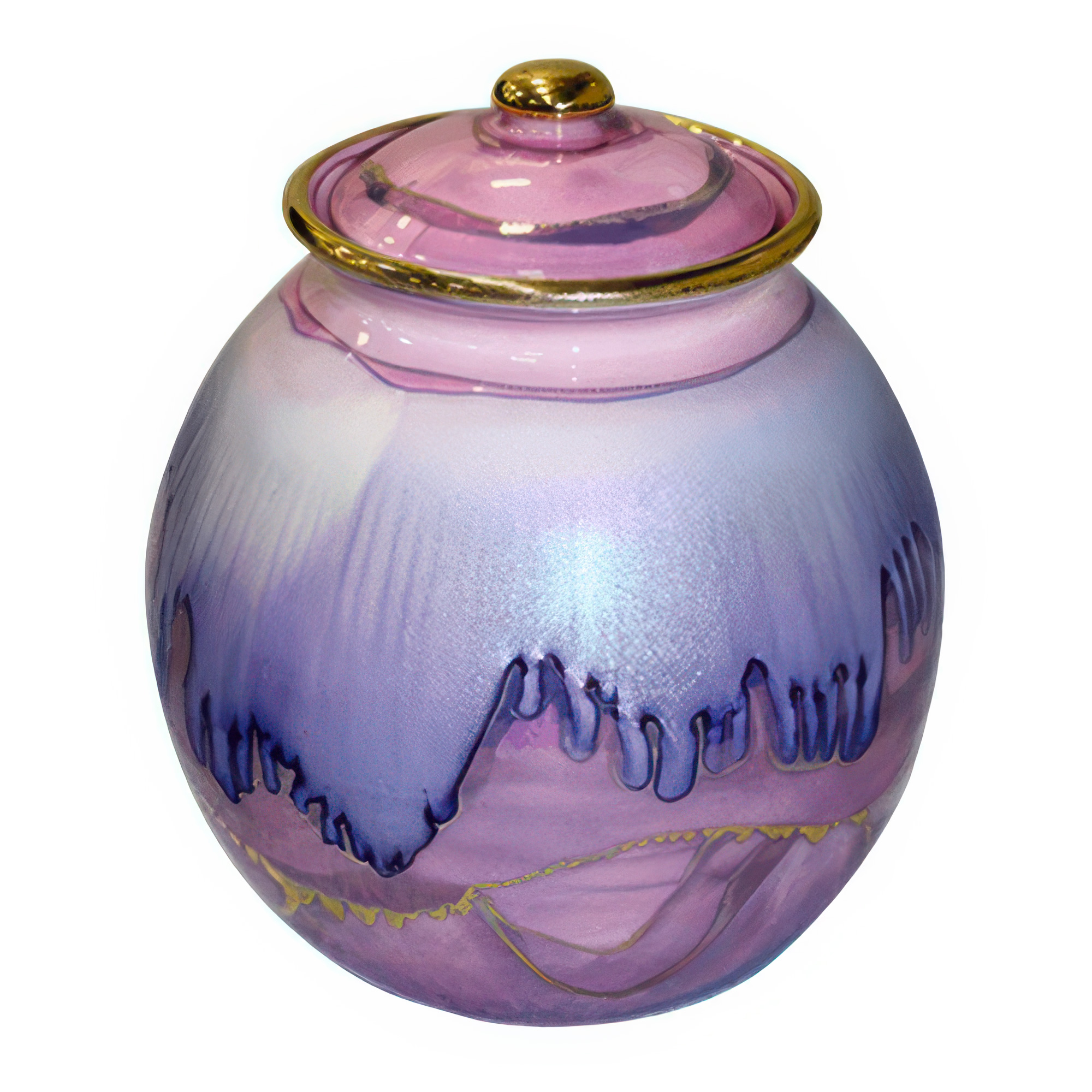
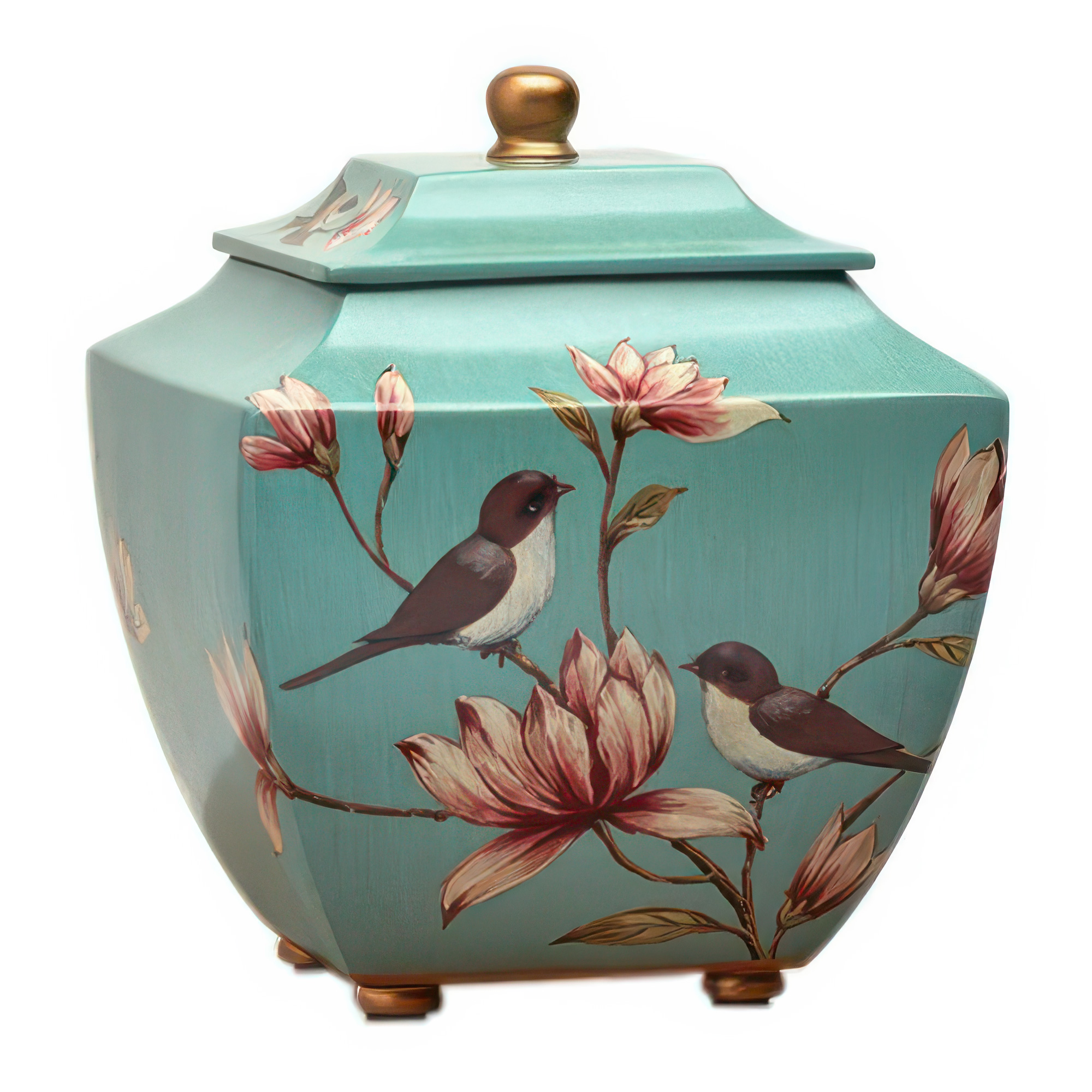
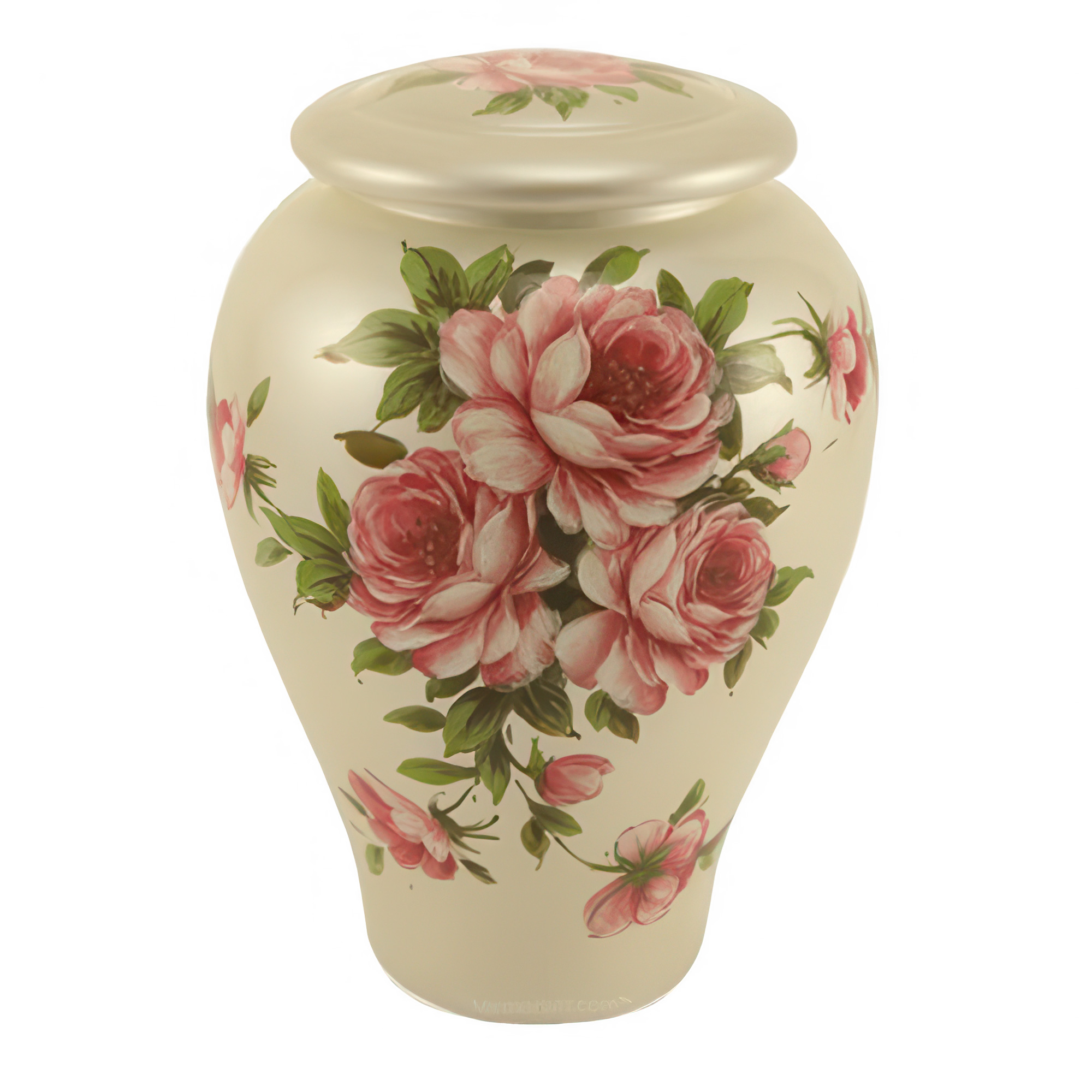
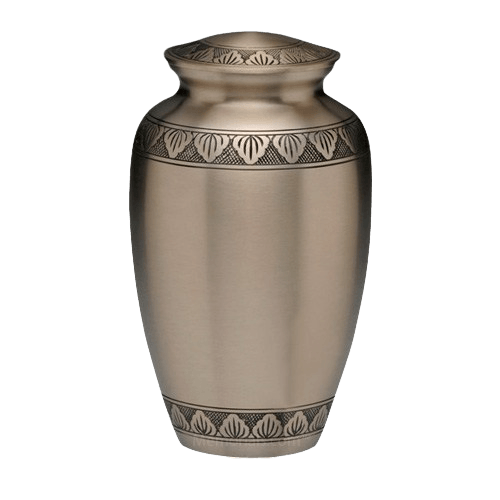
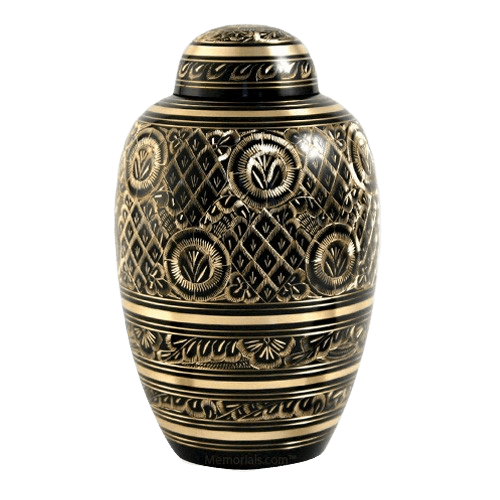
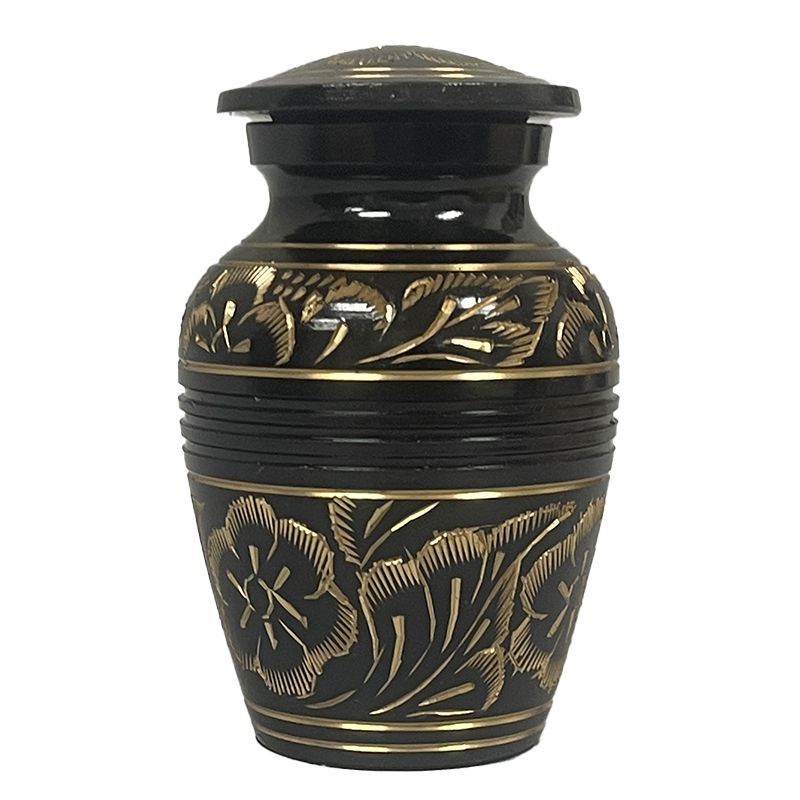
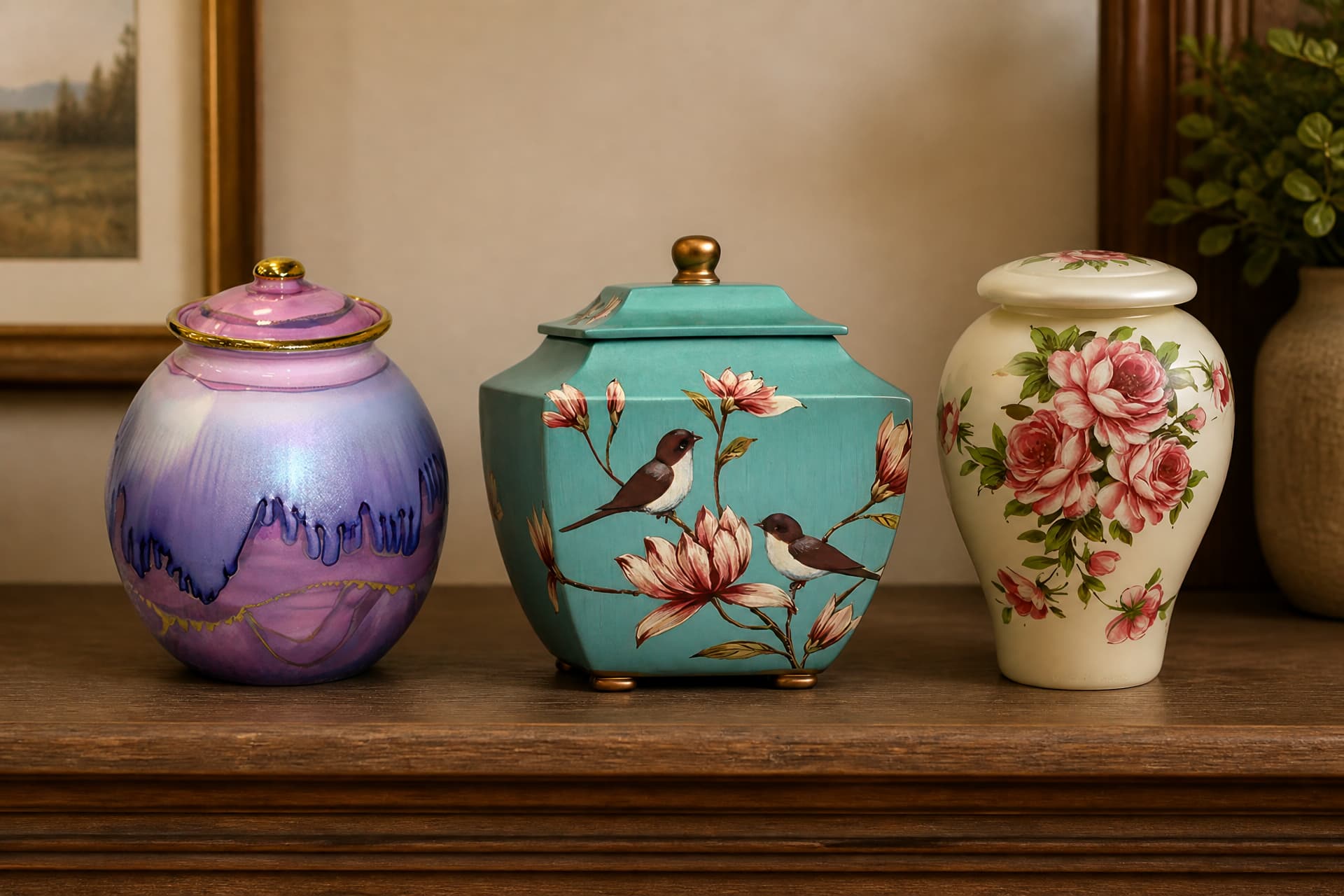
Ceramic and Keepsake Cremation Urns
The lidded jar a family fills, and the smaller vessels a division ends with
Cremation in Japan is effectively universal — more than 99 percent of deaths are followed by it, the highest rate of any country. Part of the reason is religious: cremation is the ordinary practice across much of Buddhist Asia, and buddhist funeral customs treat the body as something to be released rather than preserved. Part of it is geography, in a mountainous country with very little land to spare for graves.
But near-universal cremation does not by itself put a tray of recognizable bones in front of a family. What makes kotsuage possible is a single step that American crematories take and Japanese ones do not. What comes out of a cremation chamber anywhere in the world is not ash. It is bone — calcined, chalk-white, brittle, and still lying in something close to anatomical order. In American practice those fragments then go into a processor that reduces them to the uniform gray grit a family receives, which is the final stage of the cremation process and the reason we say ashes at all. Japanese crematories leave that step out.
So the tray is wheeled out with the skeleton still legible on it: the long bones of the legs at one end, the curve of the ribs, the vault of the skull at the other. That single omission is what the entire rite is built on. Without it there would be nothing to gather, only a container to hand over.
The Chopsticks, and Why Two People Hold One Bone
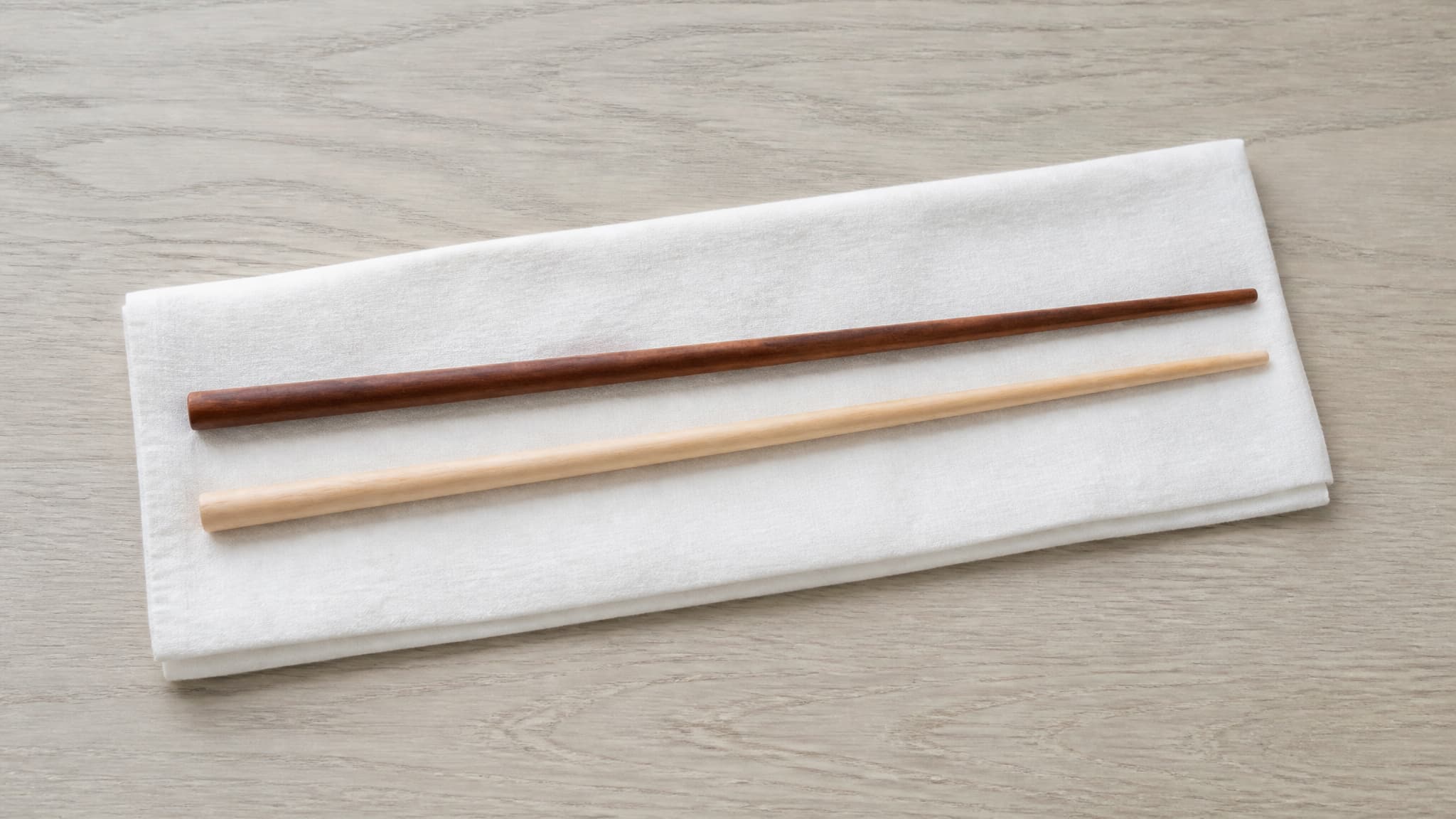
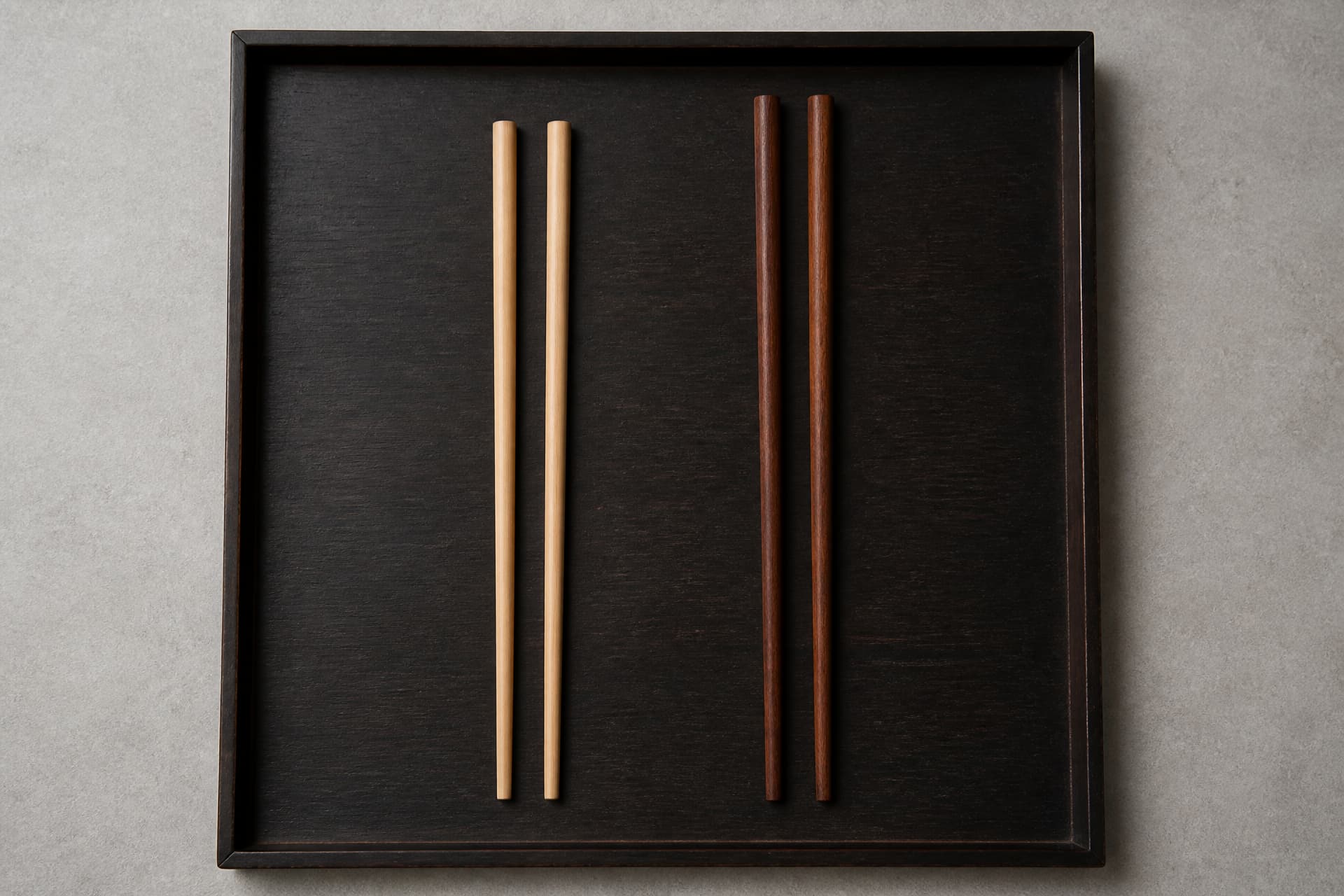
The chopsticks used for kotsuage are not eating chopsticks. They are long — long enough to reach across a tray without leaning over it — and traditionally they are mismatched: the pair is often one length of bamboo and one of willow, or two visibly different woods, or two different lengths. The mismatch is the point. An ordinary pair matches; this pair does not, because it is being used at the boundary between the living and the dead, where ordinary rules are suspended.
Two mourners approach the tray together and lift the same fragment at the same moment, one pair of chopsticks on each side of it. Sometimes the fragment is passed directly from one pair of chopsticks to another before it reaches the urn. One common explanation for the whole gesture rests on a pun that survives translation badly but is felt clearly in Japanese: hashi is the word for chopsticks and also the word for bridge, and the pair carrying a bone between them make a bridge the person crosses.
The mismatched pair is deliberate. Two different woods, sometimes two different lengths, for a gesture that belongs to neither one world nor the other.
Here is the part almost nobody joins up. Passing food directly from one pair of chopsticks to another is a hard taboo at every Japanese dinner table — not bad manners in the mild way that elbows on the table are bad manners, but a thing that stops conversation. It is a taboo because of this rite. The same gesture done over a bowl of noodles is a funeral gesture done in the wrong room. Standing chopsticks upright in a bowl of rice carries the same charge, for the same reason: it is what is done for the dead, at the pillow, and nowhere else.
Which means a visitor who has been told a hundred times never to pass food chopstick to chopstick, and never understood why, is being taught this ceremony indirectly. The etiquette rule is the ceremony's shadow.
The Order: Feet First, Head Last
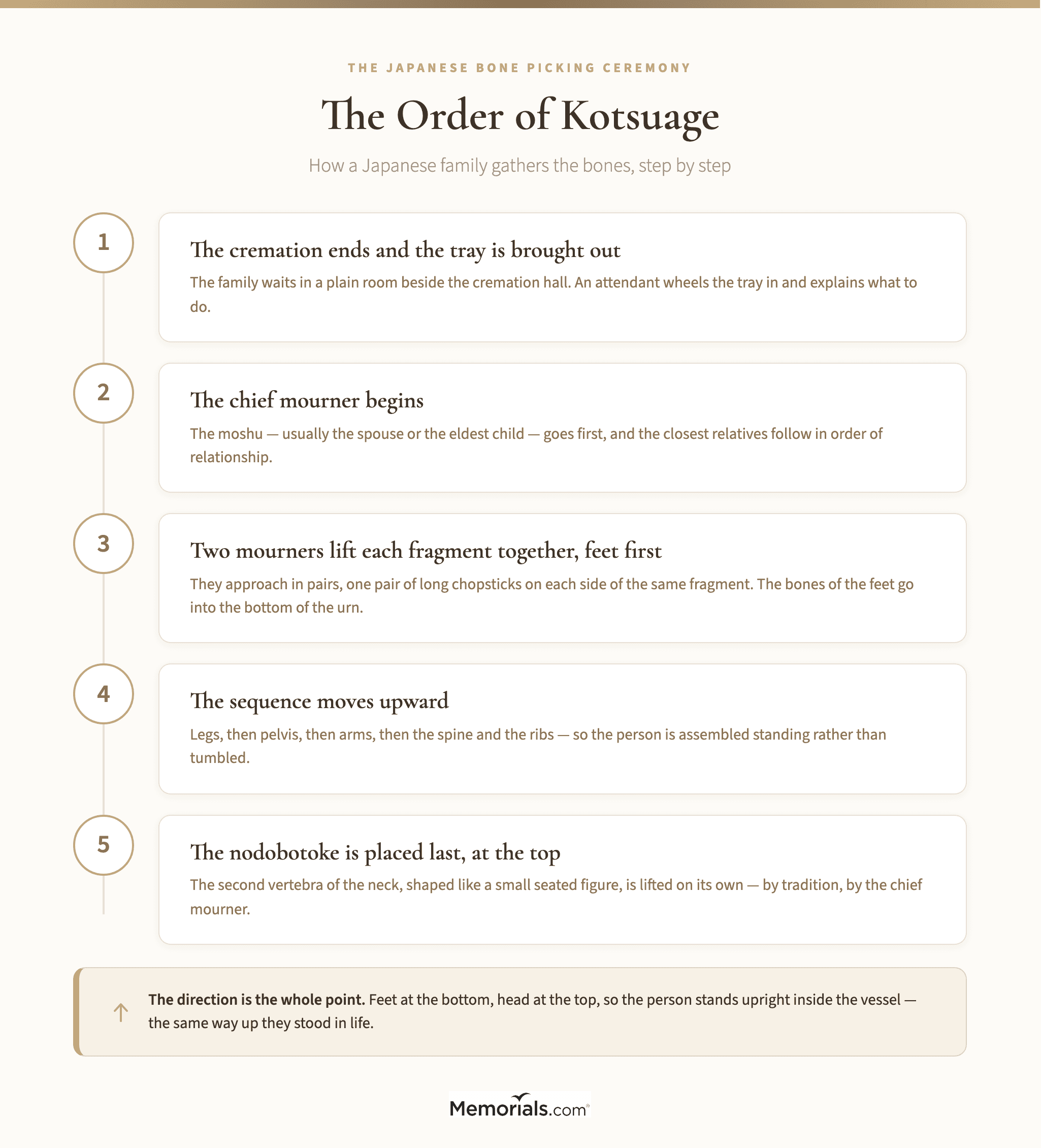
The gathering follows a fixed sequence, and the reason is simple enough that it is easy to miss how much it carries. The bones of the feet are lifted first and placed at the bottom of the urn. Then the legs, the pelvis, the arms, the spine, the ribs, and last the skull. The person is assembled inside the vessel the right way up, standing rather than tumbled, in the same posture they held in life.
The moshu begins, and the closest relatives follow in order of relationship, in pairs. Nobody is hurried and nobody is corrected. An attendant will name each part as it comes, which sounds clinical written down and is not: it is how the family knows what they are holding.
Near the end comes the nodobotoke (喉仏), the "throat Buddha." In English it is usually described as the Adam's apple, which is not quite right — the cartilage of the throat does not survive a cremation. What survives is the second vertebra of the neck, and its shape is startling: a small seated figure with a bowed head and folded arms, unmistakably a person in meditation. It is lifted last, or nearly last, usually by the chief mourner alone, and set at the top of the urn beneath a piece of the skull. Families who have been quiet through the whole ceremony often speak here, because it is the moment when the thing in the tray stops being anatomy.
The vessel itself is the kotsutsubo (骨壺) — a lidded jar, most often glazed ceramic or porcelain, plain white or softly patterned, closer in shape to a ceramic cremation urn than to anything a Western family would recognize as funerary. It goes into a brocade-covered box before it leaves the building.
Feet first, head last, so that the person stands upright inside the urn. The nodobotoke — the second neck vertebra, shaped like a seated figure — is placed at the top, and by tradition the chief mourner lifts it.
How Much Is Collected, and What Happens to the Rest
How much of the skeleton goes into the urn depends on where in Japan the funeral is held, and the split is old and consistent. In eastern Japan, broadly the Kantō region around Tokyo, families practice zenkotsu (全骨) — essentially all of the remains are collected, and the urn is correspondingly large. In western Japan, broadly Kansai, families practice bubunshūkotsu (部分収骨) — a representative portion is collected, with the nodobotoke and pieces from each part of the body, and the urn is noticeably smaller. A family that moves between the two regions can be surprised by the difference at exactly the wrong moment.
That brings up the question every Western reader has and every page on this subject steps around: what happens to the bones that are not collected. The answer is undramatic. The crematorium takes responsibility for them, and in the Kansai practice they are interred communally — a shared ossuary or memorial monument, often maintained by a temple or by the municipality, where the remains of many people are kept together. It is not disposal in any casual sense and it is not hidden from the family; it is simply the part of the arrangement that is handled institutionally rather than by hand.
A separate practice, bunkotsu (分骨), divides what is collected. A family may want part of the remains at the ancestral grave in one prefecture and part at a family temple in another, or one child living far away may keep a small share. Japanese crematories issue a certificate for a division made this way, because interment later requires paperwork proving where the remains came from. Several smaller vessels rather than one is an ordinary outcome, not an unusual request.
The family carries the kotsutsubo out of the crematorium themselves, wrapped and boxed, usually held by the chief mourner. It does not go straight to a grave. It comes home.
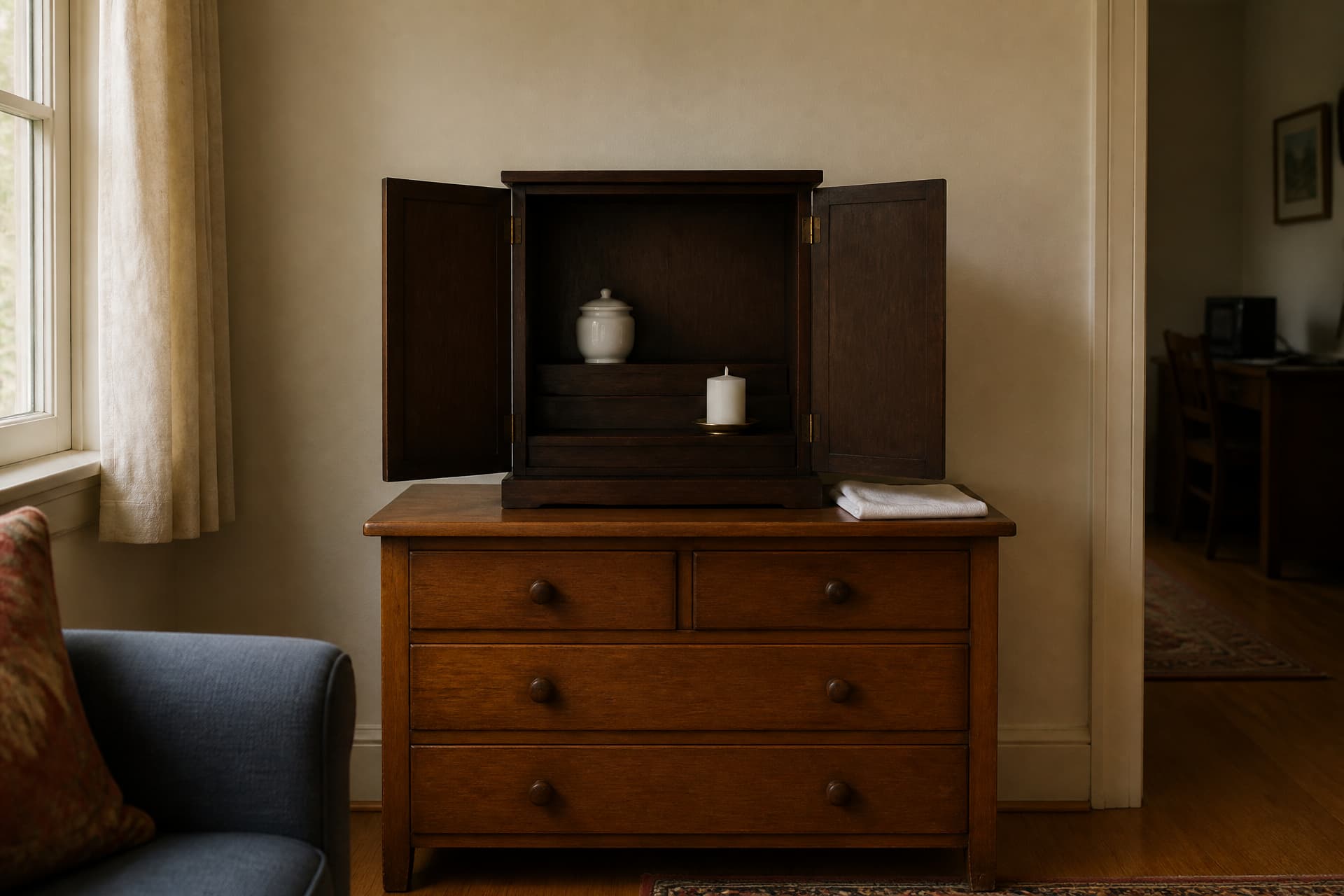
At home it is set on a temporary altar — a small stand put up for this purpose beside a butsudan if the household keeps one, with the ihai (位牌), the memorial tablet carrying the person's posthumous name, and a photograph, incense and flowers. For most families this is the arrangement they live with for the next seven weeks. Somebody lights incense in the morning. Visitors are shown to it before they are shown to a chair.
The urn usually leaves the house at the end of the 49 days after death, at the shijūkunichi memorial service, when it is interred in the family grave. Not every family keeps to that timing — a grave may not be ready, or a family may simply not be ready — and an urn that stays at home longer is nobody's failure.
For roughly seven weeks the urn lives at home, on a temporary stand beside the family altar, with incense lit in the morning.
If You Are Invited to Attend
If you are not Japanese and you have been asked to come to a cremation and stay for kotsuage, the invitation is a real one and it is not a test. Here is what actually happens to you.
You will most likely watch rather than take part. Kotsuage is generally for family and close relatives, and pairs go up in order of relationship, so unless you are part of that circle nobody expects you to approach the tray. Stand where you are put, keep your hands at your sides or loosely folded, and follow the moshu — the room takes its cue from the chief mourner, and so should you. If you are handed a pair of chopsticks, someone has decided you are family for the afternoon; go up with whoever goes up with you, lift when they lift, and let them set the pace.
You may decline. Say so quietly to whoever invited you, before the cremation rather than at the tray, and it will be arranged without comment. Waiting in the outer room is an ordinary thing to do and nobody will think less of you for it. The one genuine misstep is improvising — reaching for a fragment on your own, taking a photograph, or filling the silence with talk.
What you wear and what you bring are settled well before this point, and are covered properly in our guide to what to wear as a guest: plain black, minimal jewelry, and a condolence envelope of new-condition notes presented at the reception desk. Get those right beforehand and the ceremony itself asks nothing of you but attention.
Hands folded, eyes on the chief mourner, no improvising. For a guest, watching well is the whole of the job.
Other Cultures That Handle the Bones
Kotsuage is unusual among modern funeral rites in that a family physically handles a relative's remains, but it is not alone. In Madagascar, famadihana brings ancestors out of the family tomb every few years to be rewrapped in fresh cloth, carried, spoken to and danced with before being returned. Ossuaries and charnel houses across Europe kept the bones of the dead accessible for centuries. Secondary burial — an interment, then a later gathering of the bones into a permanent resting place — turns up independently in Greece, Korea and the Philippines.
What these have in common is not morbidity. It is the conviction that a relationship with the dead continues, and that continuing it involves doing something with one's hands.
Frequently Asked Questions
What is the bone picking ceremony at a Japanese funeral?
It is kotsuage, the rite in which the family gathers the cremated remains into the urn themselves rather than receiving a sealed container from the crematorium. It takes place in a room beside the cremation hall, minutes after the cremation ends, and the family lifts the bones with long chopsticks, two people to a fragment, working from the feet upward.
Why do two people hold the same bone with chopsticks?
Partly it is practical — the fragments are fragile and two pairs of chopsticks are steadier than one. Symbolically, the two mourners carrying a bone between them are understood to make a bridge for the person to cross, playing on the fact that the Japanese word for chopsticks sounds like the word for bridge. It is also why passing food chopstick to chopstick is taboo at an ordinary meal: the gesture belongs to this ceremony and nowhere else.
What is the nodobotoke, or "throat Buddha"?
The nodobotoke is the second vertebra of the neck, which after cremation looks remarkably like a small seated figure with a bowed head and folded hands. English sources often call it the Adam's apple, but the throat cartilage does not survive the fire. It is lifted last, usually by the chief mourner, and placed at the top of the urn.
What happens to the bones that are not collected?
In western Japan, where a representative portion is collected rather than the whole skeleton, the crematorium takes responsibility for the remainder and it is interred communally, typically in an ossuary or memorial monument maintained by a temple or the municipality. In eastern Japan the question largely does not arise, because essentially everything is collected.
Can a foreigner attend or take part in kotsuage?
Attending is common and welcome if you have been invited. Taking part is less so, because the pairs who approach the tray are usually family and close relatives in order of relationship. Watch the chief mourner, do what the room does, and if you are offered chopsticks, accept and follow the person beside you. Declining is entirely acceptable and best mentioned quietly in advance.
The Last Thing a Family Can Do
Almost everything about a modern funeral is done for the family by someone else. Somebody collects the body, somebody prepares it, somebody operates the machinery, somebody hands back a container. Kotsuage is the one step returned to the people it belongs to, and it is the last thing they will ever do for that person with their own hands.
That is why the room is calm rather than distressing, and why families who expected to dread it so often come out steadied. The tray is not a shock; it is the person, in the last form the family will see, being lifted carefully and put somewhere safe. The chopsticks are awkward, and the awkwardness is part of it — an ordinary difficulty, met together, at the end of a very long day.
If you are reading this because a date is on your calendar, that is all you really need to carry into the room. Watch the chief mourner, move when the room moves, and let the ceremony be what it is: unhurried, ordered, and far gentler than the name suggests.