🏬Supersize Online Funeral Retailer🪦1000's of Headstones⚱️Over 10,000 Cremation Urns⚰️Caskets Overnight Delivery🛒Funeral & Memorial Superstore🚚FREE Shipping on ALL Orders👨👩👧👦Helping Families for over 20 Years💰Lowest Price Guarantee🏬Supersize Online Funeral Retailer🪦1000's of Headstones⚱️Over 10,000 Cremation Urns⚰️Caskets Overnight Delivery🛒Funeral & Memorial Superstore🚚FREE Shipping on ALL Orders👨👩👧👦Helping Families for over 20 Years💰Lowest Price Guarantee
🏬Supersize Online Funeral Retailer🪦1000's of Headstones⚱️Over 10,000 Cremation Urns⚰️Caskets Overnight Delivery🛒Funeral & Memorial Superstore🚚FREE Shipping on ALL Orders👨👩👧👦Helping Families for over 20 Years💰Lowest Price Guarantee🏬Supersize Online Funeral Retailer🪦1000's of Headstones⚱️Over 10,000 Cremation Urns⚰️Caskets Overnight Delivery🛒Funeral & Memorial Superstore🚚FREE Shipping on ALL Orders👨👩👧👦Helping Families for over 20 Years💰Lowest Price Guarantee
If you have been invited to a Buddhist funeral and you are not Buddhist, two answers come before all the others. You are welcome to attend — non-Buddhists sit at these services constantly, and nobody expects you to bow, chant, or know what happens next. And plain dark clothing is safe at most temples in the United States, with one exception worth knowing about. Buddhist funeral customs ask very little of a guest: arrive quietly, follow the person in front of you, and let the family lead.
Beyond that, the service becomes far easier to sit through once you know what it is doing and why it goes on for so long afterward. This page covers the hours right after a death, what happens at the service itself, what to wear and when to bow, why cremation is nearly always the form, where the ashes go, and the memorial days a family keeps for years. It sits inside our wider , which asks the same questions of other faiths.
One caution before any of it. Buddhism spans Sri Lanka, Thailand, Cambodia, China, Korea, Japan, Vietnam, Tibet and a large American-born sangha, and no single description covers all of them. Where this page says many communities or your temple may, that is not hedging — it is the accurate answer. The family's own instruction overrides anything written here, and asking them is an ordinary question that offends nobody.
What Buddhists Believe Happens After Death
Buddhist death traditions rest on a few ideas rather than a creed, and the rites make much more sense once you have them.
The first is impermanence — anicca. Everything that comes together comes apart, and a funeral is not a contradiction of that but a demonstration of it. The second is karma: intentional action shapes what follows, both for the person who died and for everyone in the room. The third is rebirth, which makes death a transition rather than an ending.
What the schools do not agree on is the mechanism. Many Theravāda communities in Sri Lanka, Thailand, Myanmar, Cambodia and Laos teach that rebirth follows immediately or nearly so. Mahāyāna and Vajrayāna traditions across China, Korea, Japan, Vietnam, Tibet and the Himalaya more often describe an intermediate state — the bardo — lasting up to forty-nine days. That one disagreement explains most of what differs between any two Buddhist funerals you might attend.
The practical consequence is the part to hold onto. Much of what happens at the service is done for the person who died: merit generated by the living and formally dedicated to them. Chanting, offerings and gifts to the temple are all read that way, and it is why the rites carry on for weeks and years after the body is gone.
In many communities the hours immediately after a death are kept quiet and still. The body is left undisturbed for a period — some families ask for several hours, some for considerably longer — on the understanding that the mind may not have finished leaving, and that commotion around the body is unhelpful. Relatives or a monk may chant at the bedside during that time.
How long is not a fixed rule, and it varies by tradition and by circumstance. A death in a hospital or a care facility rarely allows what a death at home does, and most families work something practical out with the staff. If you are the person making calls, make two of them early: the temple, which will say what the family needs, and the funeral home, which needs to know before it moves anything.
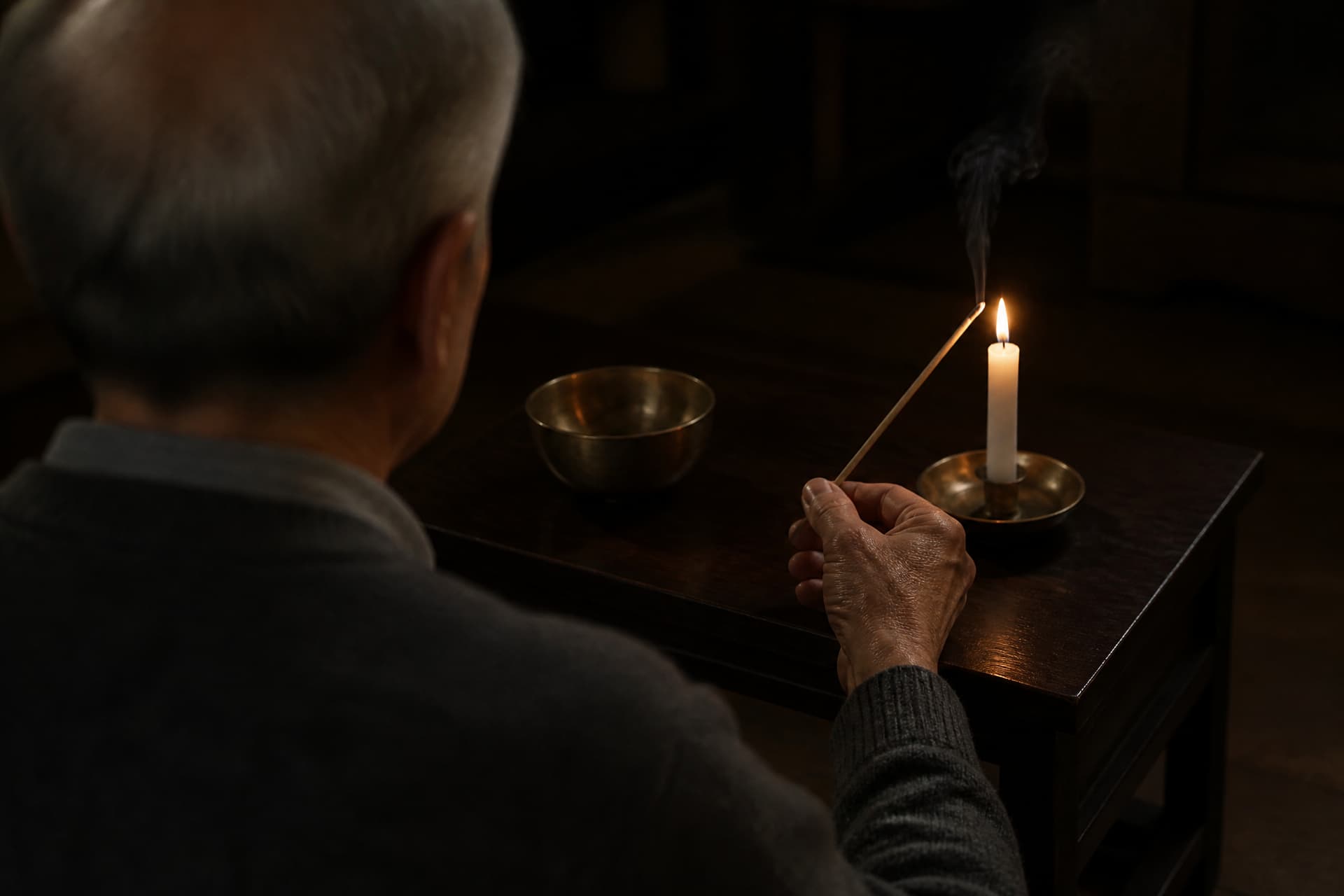
Incense is offered at nearly every stage — at the bedside, at the wake, at the service, and at the home altar for years afterward. A guest unsure of everything else can usually do this one thing correctly by watching the person ahead and copying them.
What Happens at a Buddhist Funeral Service
Most US services run in two parts: a wake or vigil one evening, and the funeral the following day. Smaller families often combine them.
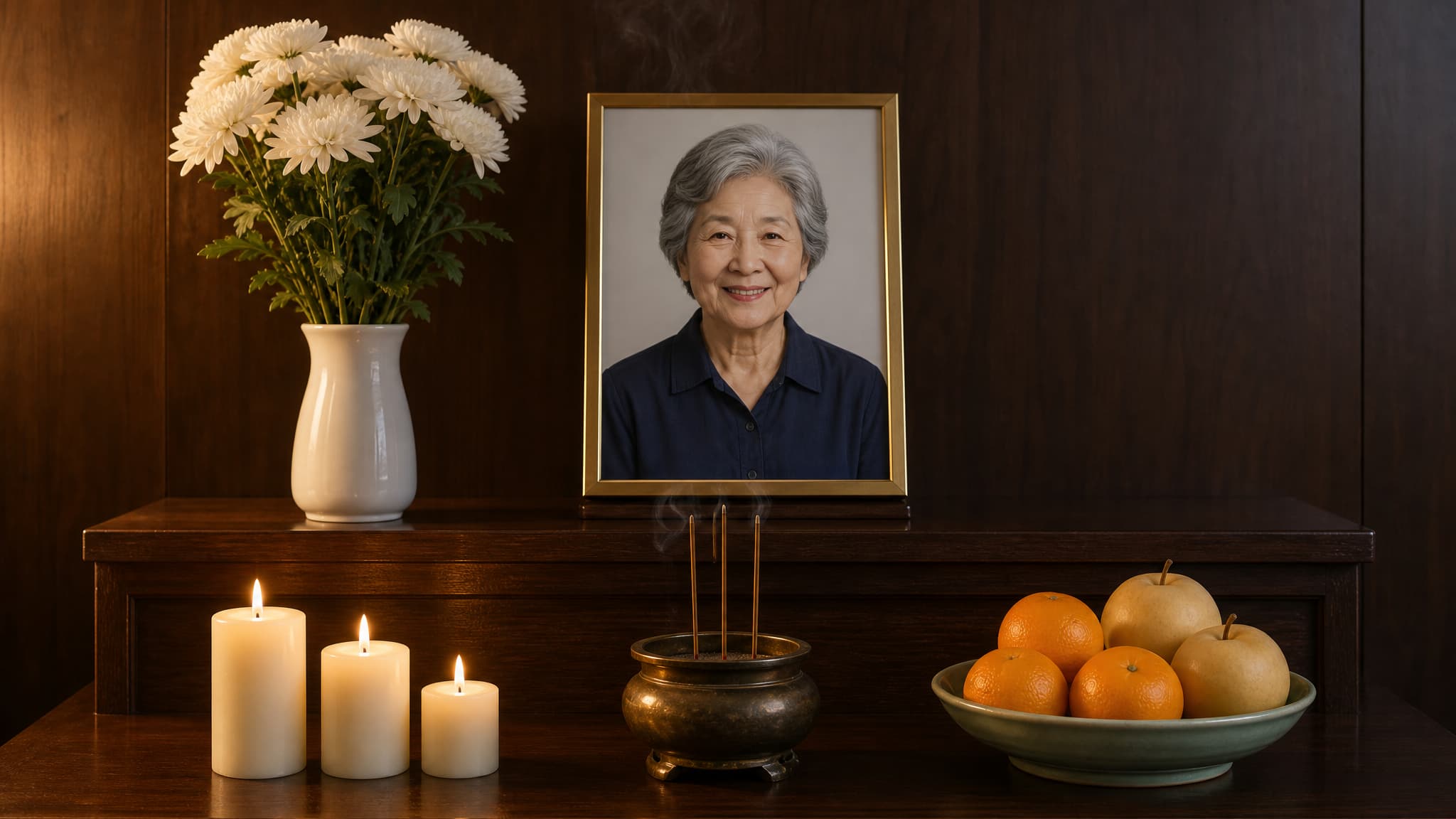
The room is arranged around an altar rather than around the body. On it sit candles, a censer for incense, white flowers — chrysanthemums in East Asian communities — a bowl of fruit or other food offerings, and a framed photograph of the person who died. An image of the Buddha usually presides over the arrangement. Where there is a viewing, the casket is generally open at the wake and closed for the service itself.
Monks may or may not attend. Where they do, they chant, and the recitation may be in Pali, Sanskrit, Chinese, Japanese or Tibetan depending on the tradition; the family and guests either chant along or simply sit. Where no monks are available — common in much of the United States — a lay leader or a family member leads instead, and nothing is diminished by that.
Then come the offerings. Guests approach the altar one at a time, bow, offer incense and step back. There is often a eulogy, and in many communities a formal dedication of merit closes the service, directing the good generated by the gathering toward the person who died. In Japan the sequence is more standardized than almost anywhere else — including a posthumous Buddhist name, or kaimyō, conferred by the priest — and the order of service is set out in japanese funeral traditions.
Attending a Buddhist Funeral: Etiquette for Guests
What to wear. Dark, plain and modest is correct at most Buddhist funerals in the United States: black, navy or gray, shoulders covered, nothing bright. The exception matters. In Cambodian, Thai, Sri Lankan and some Lao communities, white is the color of mourning, guests wear white, and the immediate family may wear white robes. Red is the one color to avoid everywhere, because across East and Southeast Asia it signifies celebration. If you cannot find out which convention applies, dark and plain is the safer guess and nobody will be offended by it.
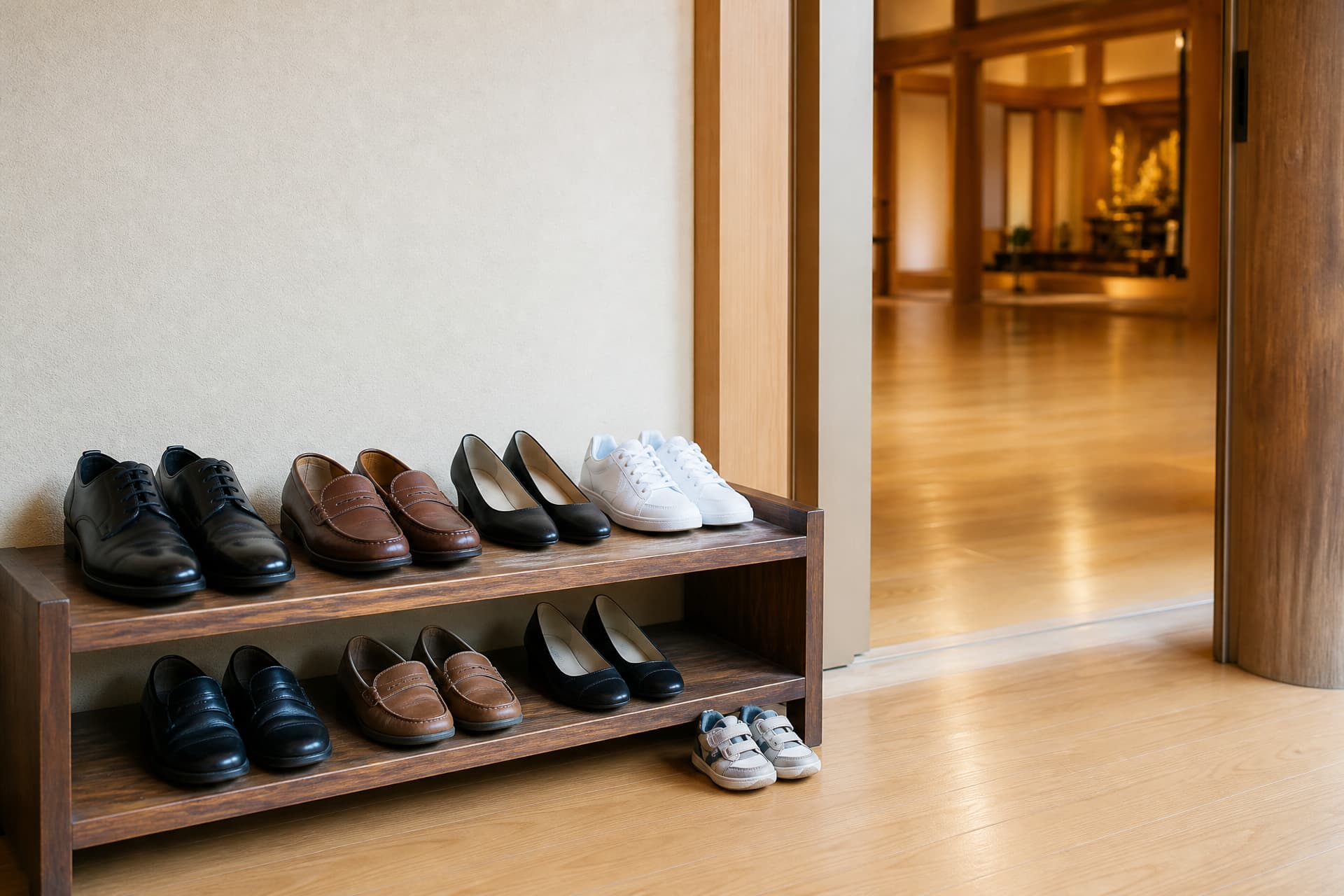
Shoes. At a temple, expect to take them off. There will be a rack or a pile of shoes at the entrance, and this is a requirement rather than a custom — it is also the thing guests most often get wrong. Wear socks you are happy to be seen in and shoes that come off without a struggle. At a funeral home the rule usually does not apply.
Bowing and standing. Follow the room. When people stand, stand. When they bow, a small bow from the waist with palms together is right, and if bowing is uncomfortable for you, standing quietly is entirely acceptable. Nobody is watching a guest for mistakes.
Incense. When your turn comes, take one stick or three, as the person ahead of you did, and light them from the flame provided. Then the part people get wrong: never blow the flame out. Wave it out with your hand, or lower the stick until it settles to a glow. Place the incense upright in the censer, bow once, and step back.
Flowers and money. White flowers are always safe. Money varies more. In Japanese practice, condolence money — kōden — is given in a special envelope, while in many Theravāda communities a donation goes to the temple rather than to the family. Both are customary, neither is required. If nobody has told you which applies, ask whoever invited you. It is an ordinary question, everyone else in your position is asking it too, and the answer beats a guess.
Shoes off at the door is a requirement rather than a courtesy, and it is the detail guests most often miss. It decides what you put on your feet that morning: socks you are happy to be seen in, and shoes that come off without a struggle. At a funeral home the rule usually does not apply.
Cremation and the Urn
A Buddhist cremation is the expected form nearly everywhere Buddhism is practiced, and the reason is historical rather than doctrinal. The Buddha's own body was cremated, and the tradition has followed for twenty-five centuries. It is a strong preference, not a commandment — burial happens where cremation is unavailable, where law or family circumstance points the other way, and in some Chinese communities where a grave carries weight of its own.
Timing varies more than the practice does. Some families cremate within days. Theravāda communities often hold the body for three days of chanting first, and Japanese families typically cremate after the funeral service rather than before it. In parts of Southeast Asia and the Himalaya the cremation still takes place on an open funeral pyre, sometimes on temple grounds; in the United States it happens at a crematory like any other.
What follows the cremation is where Buddhist practice separates most sharply from its nearest neighbor. hindu funeral traditions direct the ashes into moving water — the Ganges above all — as the act that completes the rite. Buddhist families far more often enshrine them: the ashes are kept, housed and visited. That single difference is why two traditions sharing cremation and a great deal of vocabulary end up doing entirely different things the day afterward.
In Japan the family returns to the crematory to collect the remains together at the bone picking ceremony — kotsuage, in which relatives lift fragments into the urn in pairs, working from the feet upward.
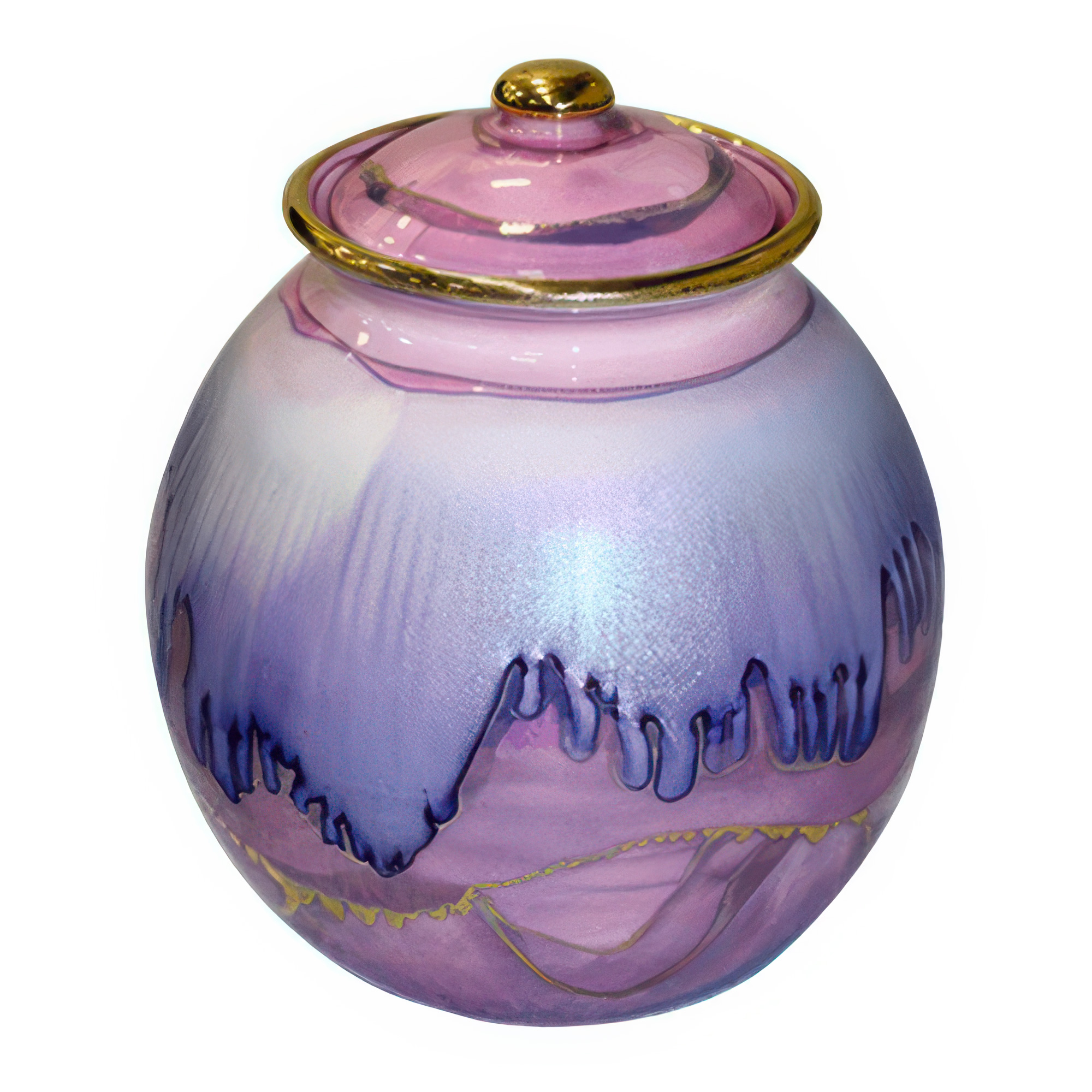
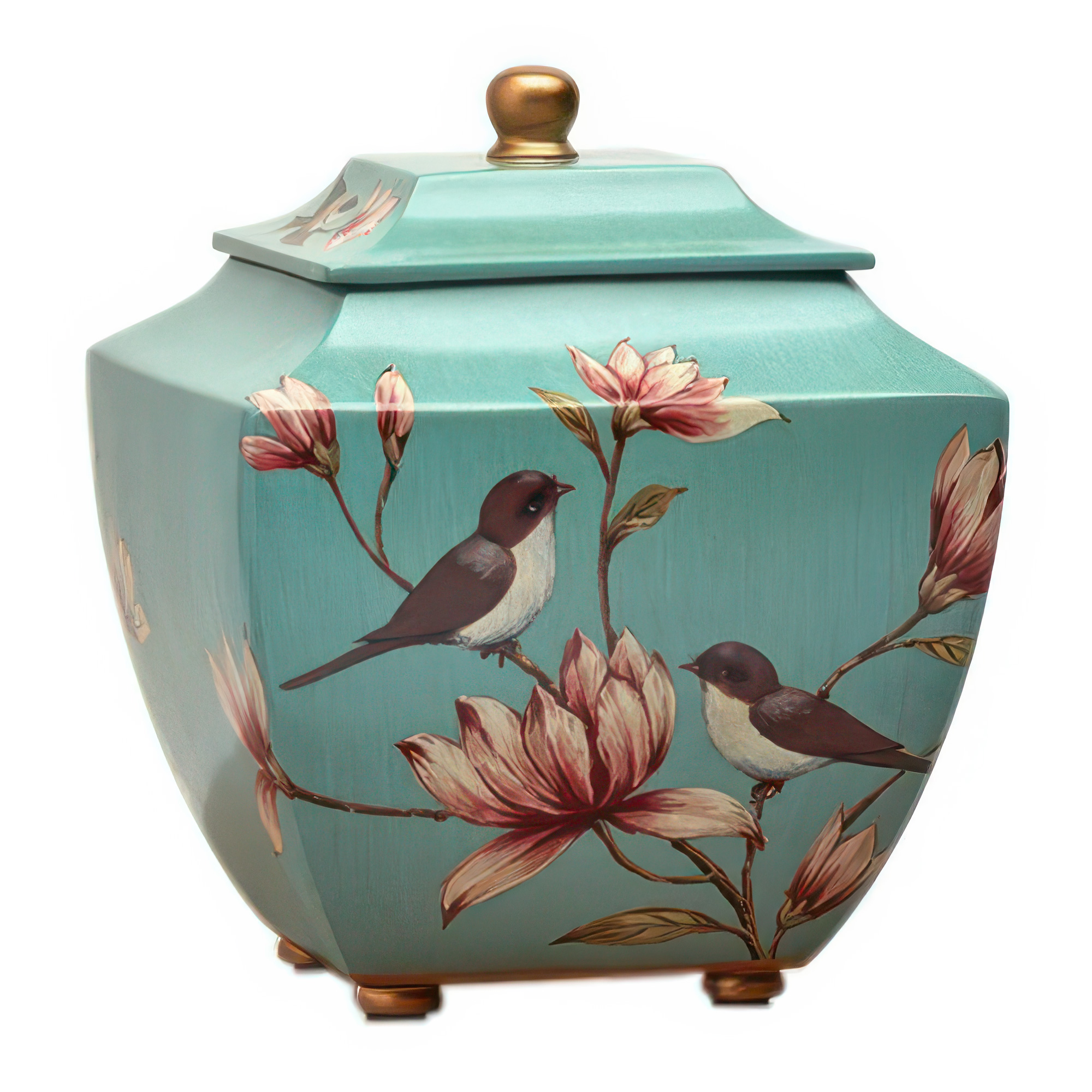
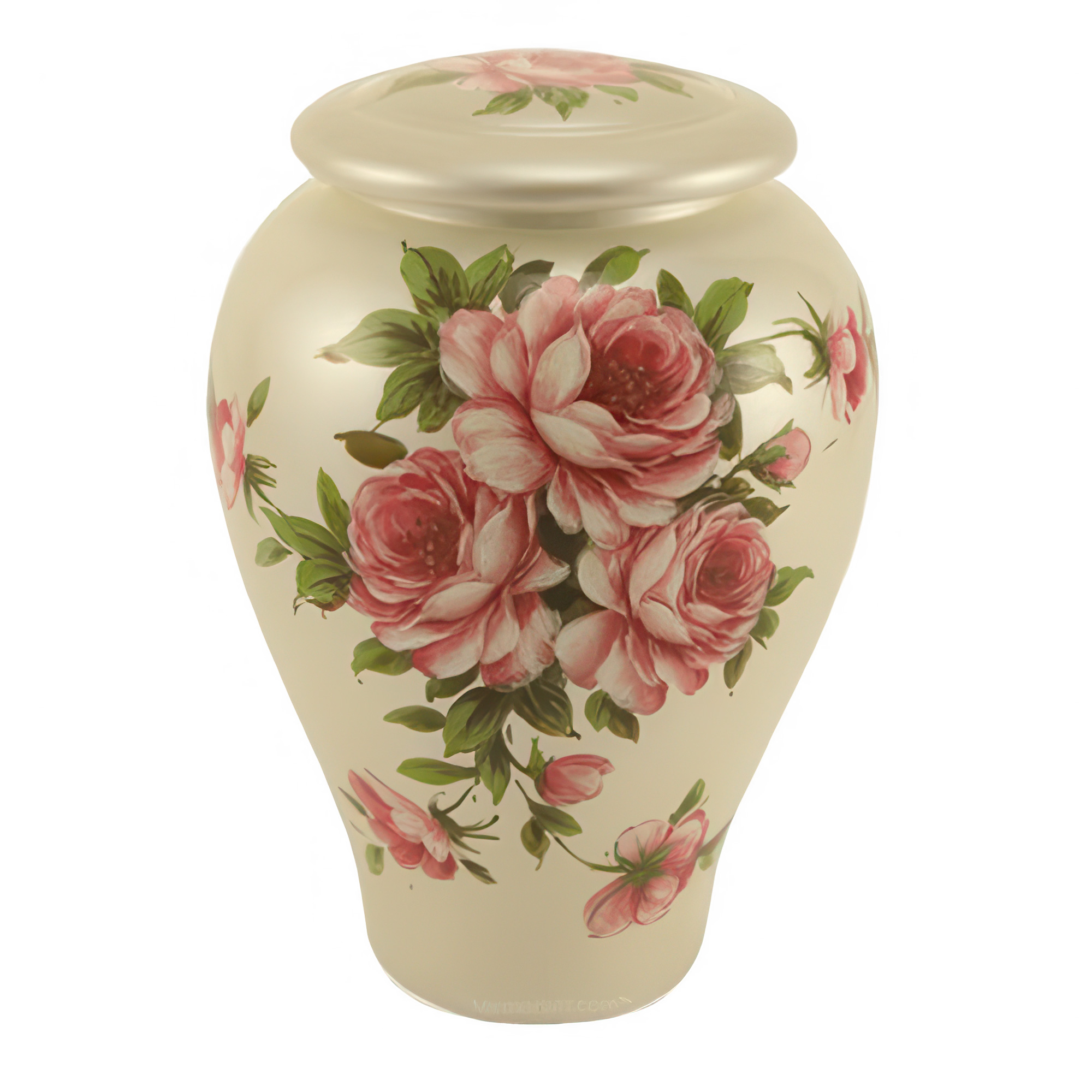
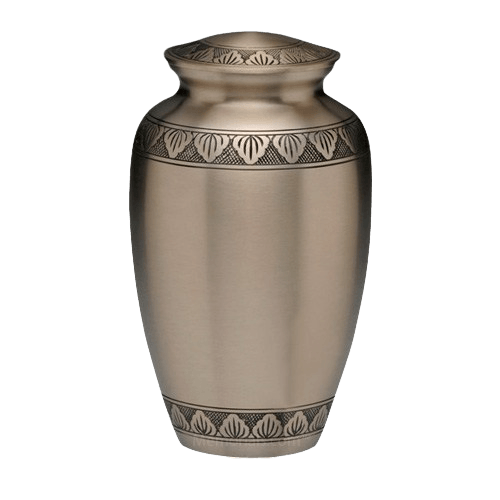
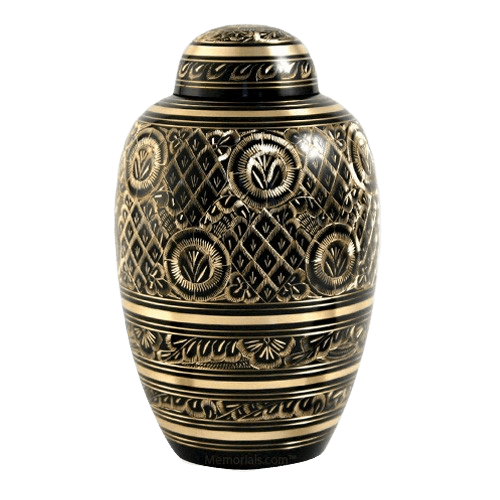
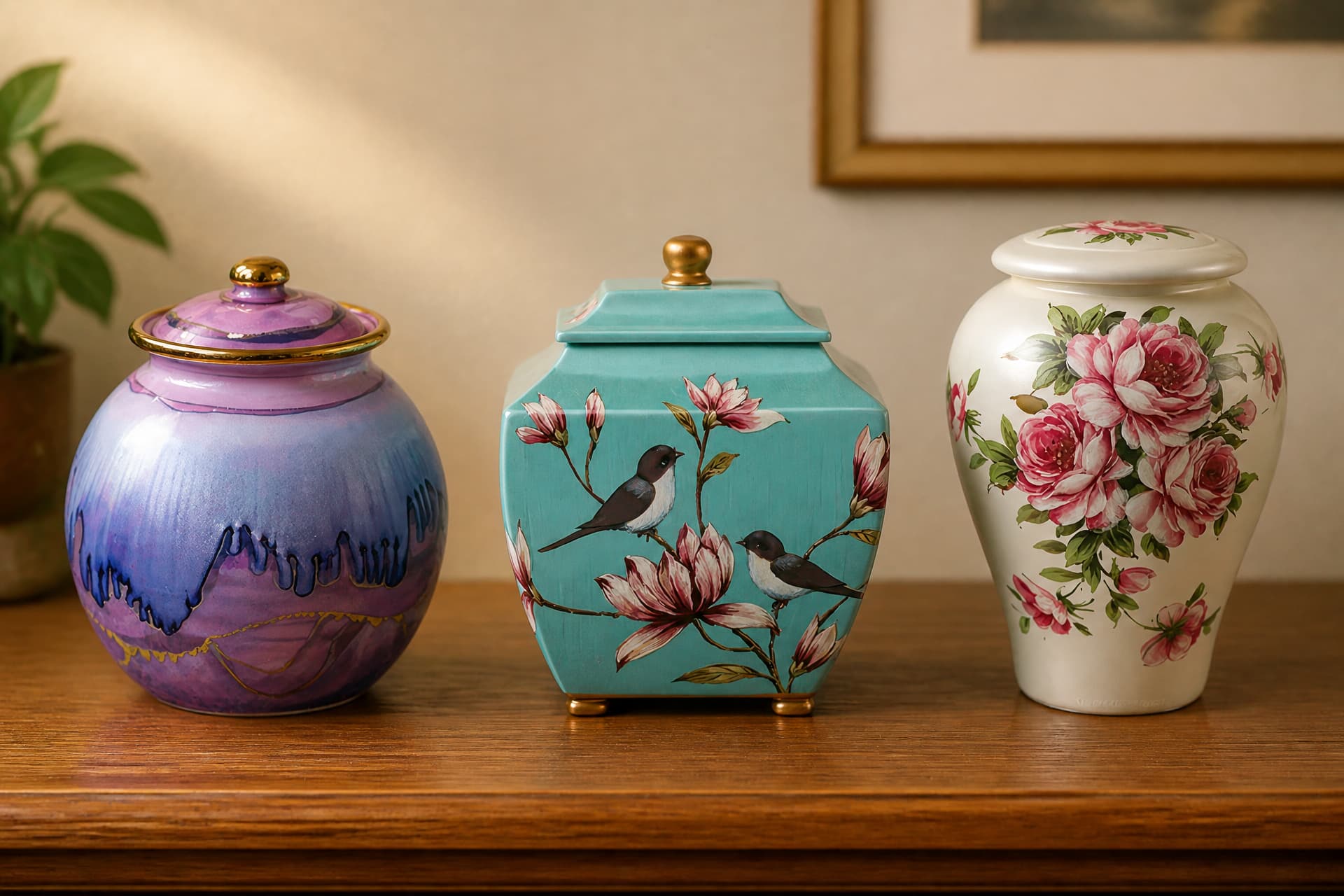
Most cremation urns sold in the United States are metal, wood or stone, which is not the East Asian form. In China, Korea and Japan the ashes are usually housed in a ceramic urn — glazed porcelain or stoneware, lidded, and made to be looked at daily rather than stored out of sight. Where a temple keeps a columbarium, its niches are often sized for that shape.
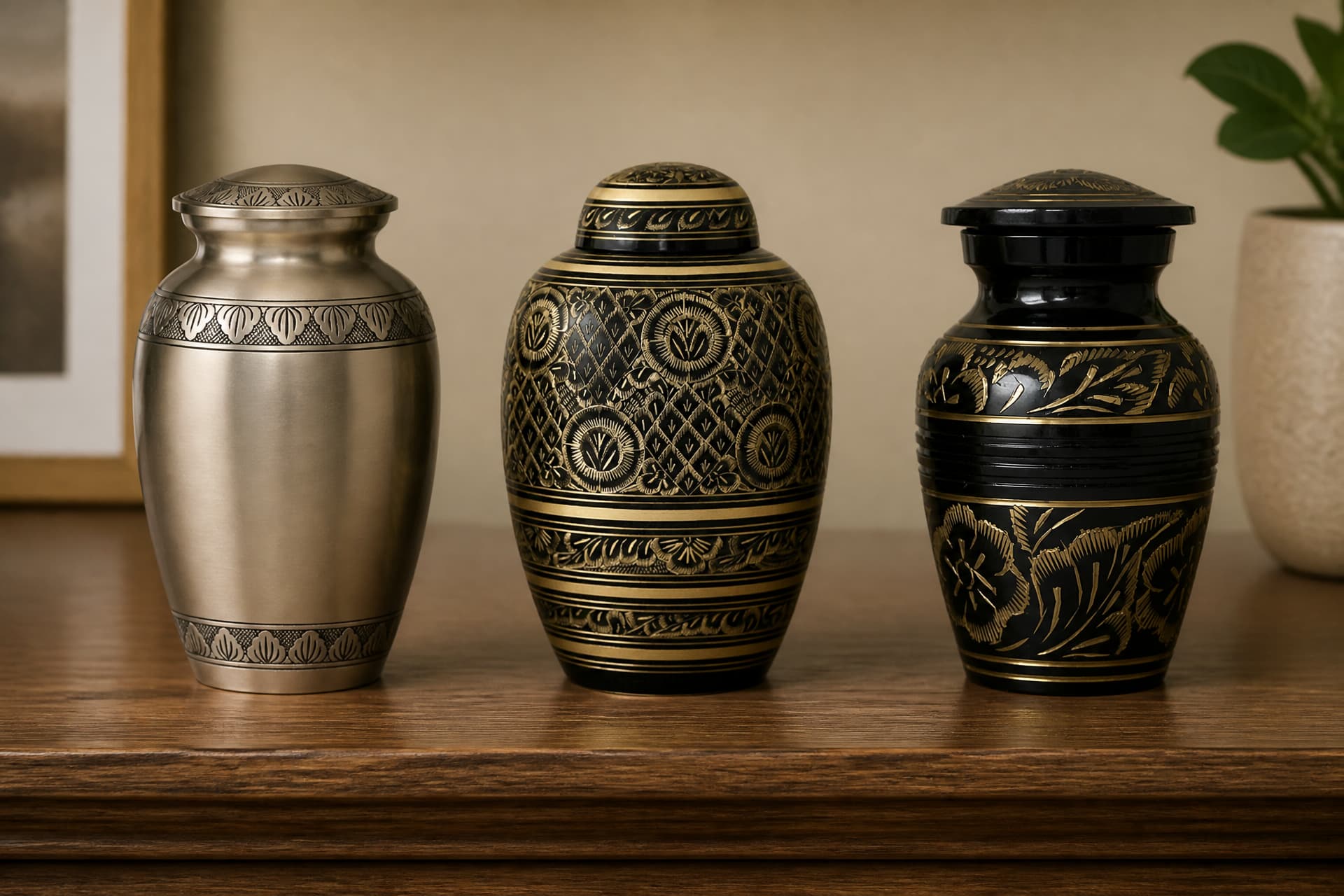
Material is the axis families actually choose along, and the range of types of cremation urns runs well past ceramic. A family splitting the difference between an American funeral home and an East Asian tradition frequently ends up choosing on look rather than on rule, which is a perfectly good way to choose.
This is the part almost no funeral home page covers, and the part a family actually has to decide. Four options are common, and many households use more than one.
The home altar. In Japanese, Chinese, Korean and Vietnamese homes the ashes commonly rest at a household shrine — a butsudan in Japanese practice — alongside the photograph, a memorial tablet (ihai), and room for daily offerings of incense, water, rice or fruit. It is a shrine you live with rather than a place you travel to, and for many families that is the entire point.
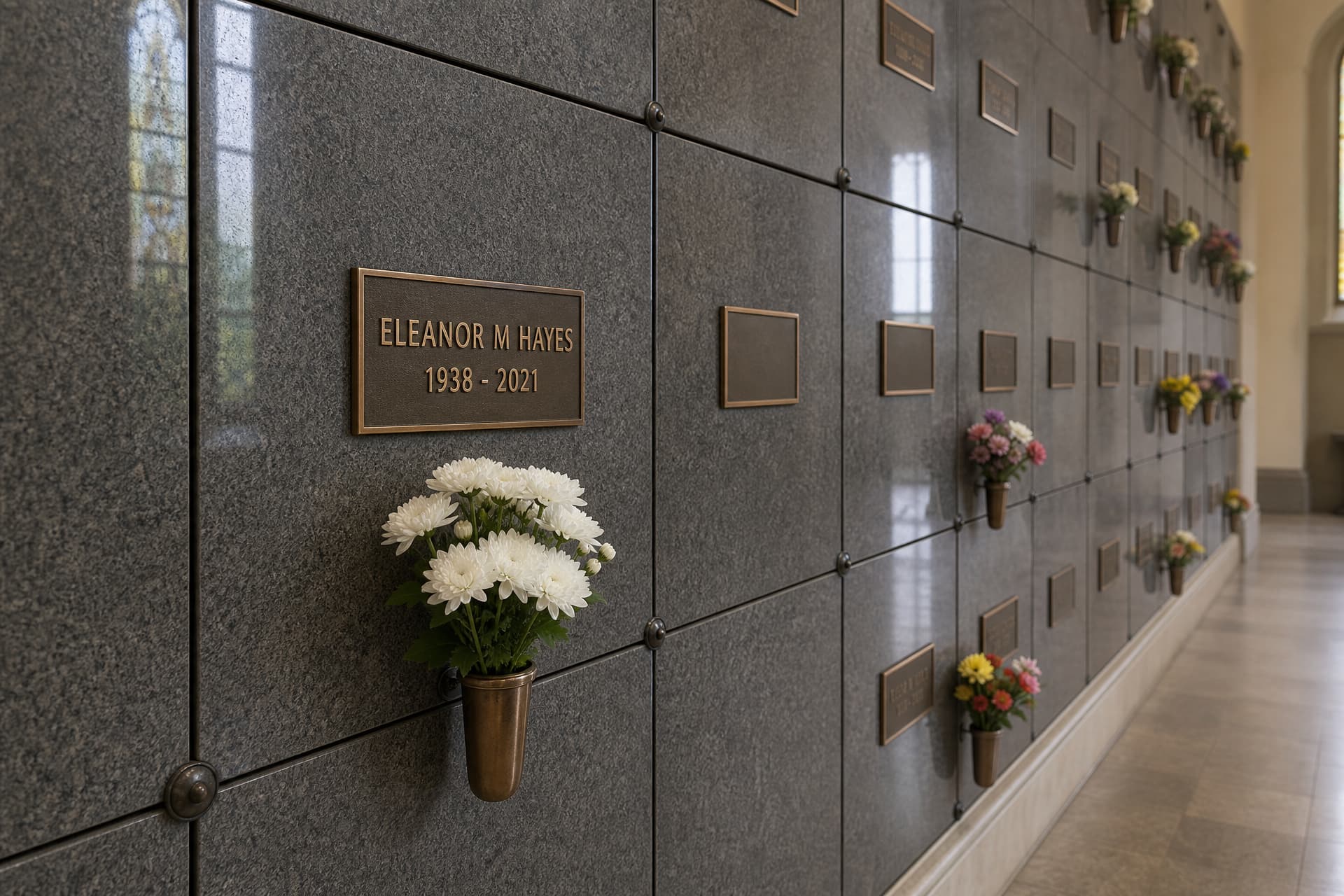
The temple columbarium. Most large US temples maintain one: a wall of niches, each holding one or two urns, in a space kept for exactly this purpose. The rules for where urns go in a cemetery are much the same whether the columbarium belongs to a temple or to a municipal cemetery. The face of each niche is a stone or bronze plate carrying the name and dates, and it is ordered separately from the urn — the plates that close columbarium niches are their own product category.
The family grave. In Japan the ashes are commonly interred in a family plot holding several generations, visited and cleaned on set days each year. In Chinese practice a grave or a niche may be chosen for reasons — geomancy among them — that are not specifically Buddhist at all.
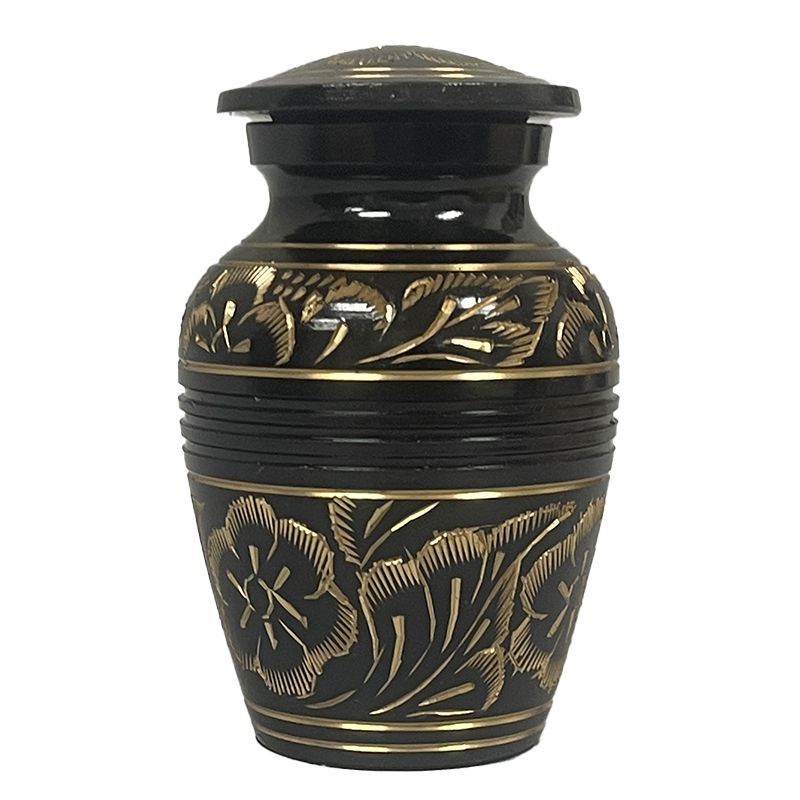
Division among relatives. Splitting the ashes is uncontroversial in most Buddhist practice, unlike in several other traditions, and families spread across continents do it as a matter of course. Keepsake urns — small vessels holding a portion each — are what most households use, one per home, with the remainder going to the temple or the grave.
Scattering happens, particularly among American-born Buddhists, but it is less common than in the general US population, precisely because so much of what comes afterward assumes there is somewhere to return to. For many families the resting place becomes the Buddhist memorial itself: the spot they visit on the marked days for the rest of their lives.
The Memorial Calendar: Seven Days, Forty-Nine Days, One Hundred Days
Buddhist mourning is not concentrated into a single day. It runs on a schedule, and a family may still be keeping it three years later.
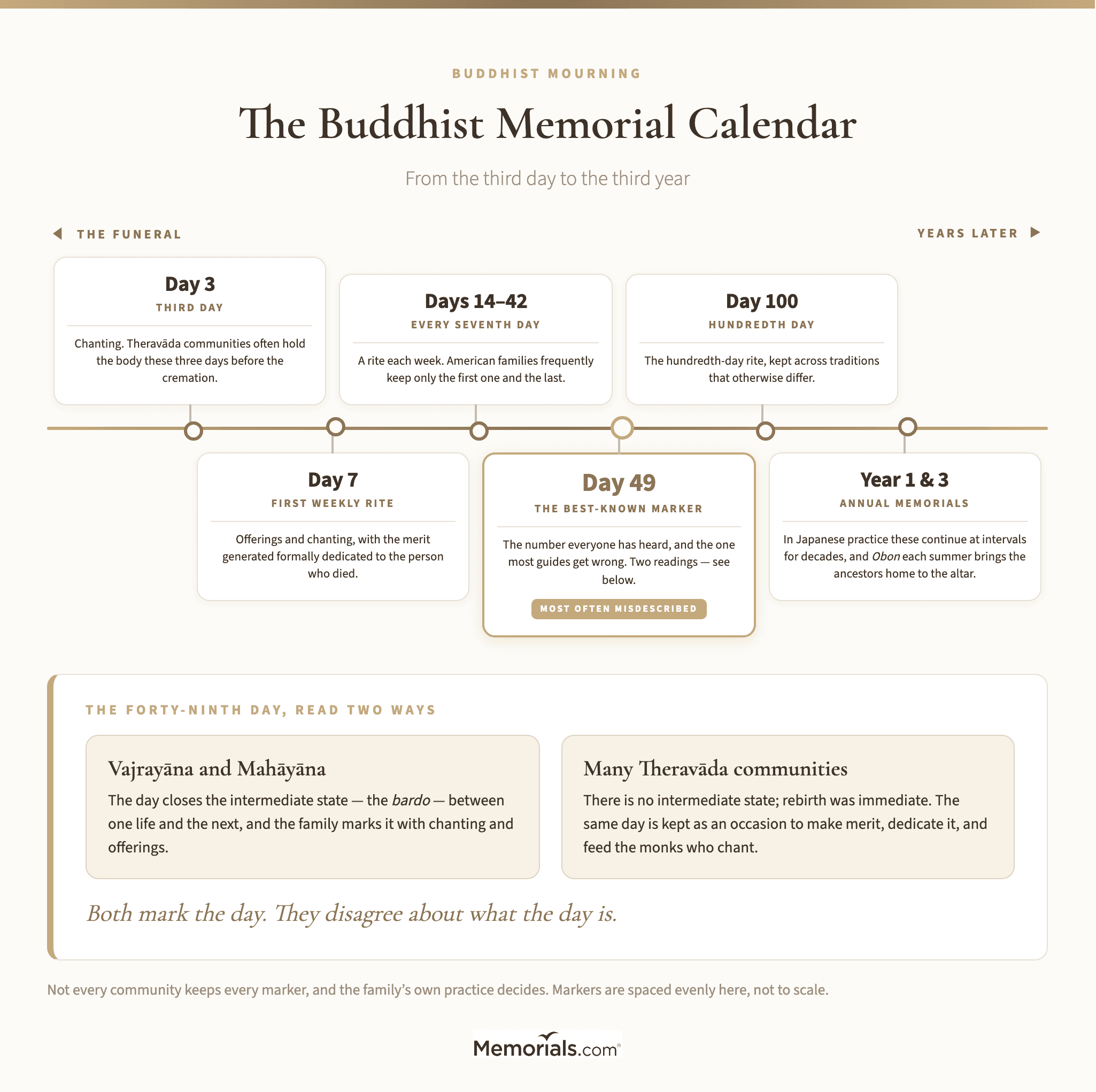
The common markers are the third day, the seventh day, then every seventh day up to the forty-ninth, the hundredth day, and the first-year and third-year memorials. Not every community keeps all of them, and American families frequently compress the weekly observances into the first one and the last. In Japanese practice the annual memorials continue at intervals for decades, and Obon each summer brings the ancestors home to the altar for a few days.
The forty-ninth day is what most guides get wrong. It is widely written that Buddhists believe rebirth occurs forty-nine days after death, stated flatly, as though every Buddhist held it. They do not. The intermediate state that the number describes belongs to the Vajrayāna and Mahāyāna framework; many Theravāda communities teach that rebirth is immediate and keep the seventh-day and hundredth-day rites for a different reason — as occasions to make merit, dedicate it, and feed the monks who chant. Both mark the days. They disagree about what the days are. What the 49 days after death actually represent, and what a family does on each of them, is worth reading before assuming the version you found applies to the family you know.
The rhythm a family keeps after the funeral, from the third day to the third year. The forty-ninth day is the best-known marker and the most often misdescribed: it closes the intermediate state in Vajrayāna and Mahāyāna practice, while many Theravāda communities keep the same days as merit-making occasions and teach that rebirth was immediate.
A temple columbarium is built to be visited, which is why the memorial calendar matters as much as it does. The marked days are the days the family comes back, and a niche or a home altar answers that need in a way a scattering cannot.
How Practice Differs Across Buddhist Traditions
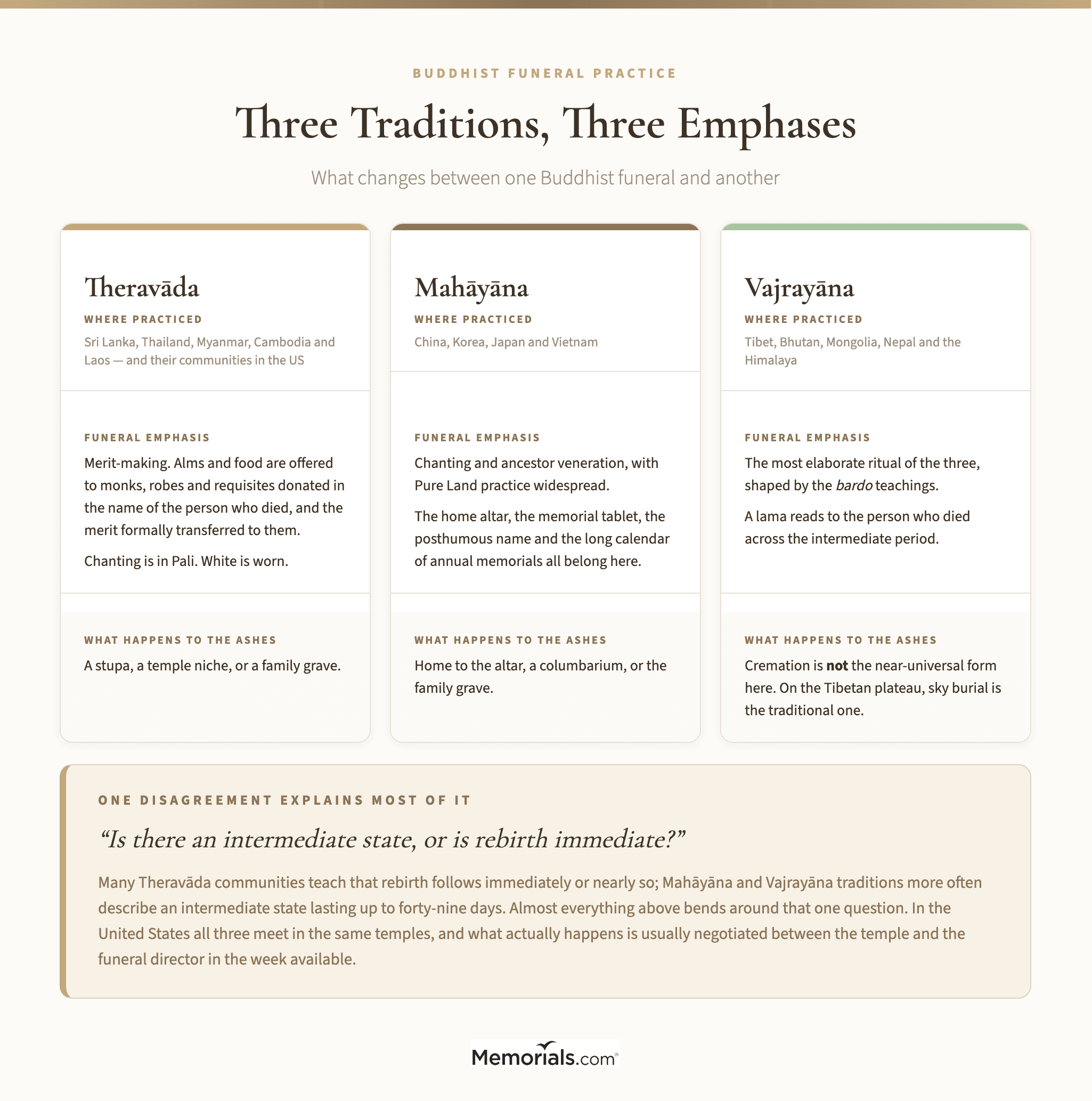
Three broad families, and knowing which one you are looking at explains most of what you will see.
Theravāda — Sri Lanka, Thailand, Myanmar, Cambodia, Laos, and their communities in the US. The emphasis falls on merit-making: alms and food offered to monks, robes and requisites donated in the name of the person who died, merit formally transferred to them. Chanting is in Pali. White is worn. The ashes generally go to a stupa, a temple niche or a family grave.
Mahāyāna — China, Korea, Japan, Vietnam. The emphasis is chanting and ancestor veneration, with Pure Land practice widespread. This is where the home altar, the memorial tablet, the posthumous name and the long calendar of annual memorials belong, and where the forty-nine-day framework is most fully worked out. The ashes come home to the altar, to a columbarium, or to the family grave.
Vajrayāna — Tibet, Bhutan, Mongolia, Nepal and the Himalaya. The ritual is the most elaborate of the three, shaped by the bardo teachings, with a lama reading to the person who died across the intermediate period. It is also where the assumption that Buddhists cremate breaks down: on the Tibetan plateau, where fuel is scarce and the ground frozen much of the year, tibetan sky burial is the traditional form, and it is Buddhist practice with reasoning of its own.
What happens in the United States is close to a fourth thing. Convert sanghas, second- and third-generation families, temples serving several nationalities at once, and funeral homes that have never run one of these services — the result is usually negotiated between the temple and the funeral director in the week available. That is not a dilution. It is what every tradition does when it moves.
The same funeral, weighted three different ways. Theravāda practice concentrates on merit-making and alms to monks, Mahāyāna on chanting, ancestor veneration and a long memorial calendar, and Vajrayāna on ritual guidance through the intermediate state — which is also the only one of the three where cremation is not the near-universal form.
Frequently Asked Questions
What do you wear to a Buddhist funeral?
Plain dark clothing — black, navy or gray, with shoulders covered — is correct at most Buddhist funerals in the United States. In Cambodian, Thai, Sri Lankan and some Lao communities the mourning color is white, and guests are expected to wear it. Avoid red anywhere, since it signifies celebration across East and Southeast Asia. If you are unsure which convention applies, ask whoever invited you, and dress dark until you hear otherwise.
Are Buddhists cremated or buried?
Cremated, in the overwhelming majority of cases. The Buddha was cremated and the tradition has followed since, but it is a preference rather than a rule, and burial is entirely acceptable where circumstance, law or family history calls for it. Some Chinese Buddhist families choose a grave, and Tibetan practice includes forms that are neither cremation nor burial.
What happens 49 days after death in Buddhism?
In Vajrayāna and Mahāyāna traditions, the forty-ninth day closes an intermediate state between one life and the next, and the family marks it with chanting and offerings. Many Theravāda communities do not teach an intermediate state at all and keep the same days as occasions to make merit for the person who died. Both observe the day. They understand it differently, so it is worth asking rather than assuming.
What happens to the ashes after a Buddhist cremation?
They are usually kept rather than scattered. Common destinations are a household altar, a niche in a temple columbarium, or a family grave, and many families divide the ashes among relatives as well. Scattering is practiced but is far less common, because the memorial observances that follow assume a place to return to.
Can a non-Buddhist attend a Buddhist funeral?
Yes. Non-Buddhist guests are welcome at Buddhist funerals and no part of the service is closed to them. You are not expected to chant, bow or offer incense, though you are welcome to do all three. Following the person ahead of you is enough, and sitting quietly is a complete way to participate.
Before You Go
If you are the guest, the whole of your job fits in a sentence: turn up in plain dark clothes, take your shoes off if the room is doing it, follow the person in front of you at the altar, and say something ordinary to the family. Nobody is grading you, and a service in a tradition you do not share asks less of you than you fear it does.
If you are the family, the decision that outlasts the service is the one about the ashes. The funeral takes an afternoon; the altar, the niche or the grave is where you will actually spend the next thirty years of anniversaries. It is worth deciding on purpose rather than by default, and worth knowing that the choice is far more open in Buddhist practice than in traditions where cremation is only tolerated — at a Jehovah's Witness funeral, for instance, cremation is neither required nor discouraged, and the family decides alone. Buddhist practice hands you the same freedom with far more precedent for what to do with it.
When you get to that decision, the shape of the vessel is the last part of it and the part people enjoy most. Ceramic is the East Asian form and the one a temple columbarium is usually built around, and there is no wrong answer beyond one the family will not want to look at every day.