🏬Supersize Online Funeral Retailer🪦1000's of Headstones⚱️Over 10,000 Cremation Urns⚰️Caskets Overnight Delivery🛒Funeral & Memorial Superstore🚚FREE Shipping on ALL Orders👨👩👧👦Helping Families for over 20 Years💰Lowest Price Guarantee🏬Supersize Online Funeral Retailer🪦1000's of Headstones⚱️Over 10,000 Cremation Urns⚰️Caskets Overnight Delivery🛒Funeral & Memorial Superstore🚚FREE Shipping on ALL Orders👨👩👧👦Helping Families for over 20 Years💰Lowest Price Guarantee
🏬Supersize Online Funeral Retailer🪦1000's of Headstones⚱️Over 10,000 Cremation Urns⚰️Caskets Overnight Delivery🛒Funeral & Memorial Superstore🚚FREE Shipping on ALL Orders👨👩👧👦Helping Families for over 20 Years💰Lowest Price Guarantee🏬Supersize Online Funeral Retailer🪦1000's of Headstones⚱️Over 10,000 Cremation Urns⚰️Caskets Overnight Delivery🛒Funeral & Memorial Superstore🚚FREE Shipping on ALL Orders👨👩👧👦Helping Families for over 20 Years💰Lowest Price Guarantee
A Tibetan sky burial is a funeral rite in which the body of a person who has died is carried to a high, open site and given to vultures. Nothing is burned and nothing is put in the ground. For much of the Tibetan Plateau this is not an extreme or a curiosity — it is the ordinary funeral, the one most families expect, and it has been for a very long time. Most people meet the phrase in a documentary, a novel or a travel piece, and come away with the picture but not the reason.
This page answers the two questions that bring almost everyone here: what the rite means, and what actually happens at one. It then answers the question those two raise — whether anything like it is possible in the United States, and what a family drawn to the idea can honestly do instead. Our wider funeral traditions guide sets the practice beside the other ways the world returns a body to the world; this page stays with the Tibetan one.
What a Sky Burial Is and What the Name Really Means
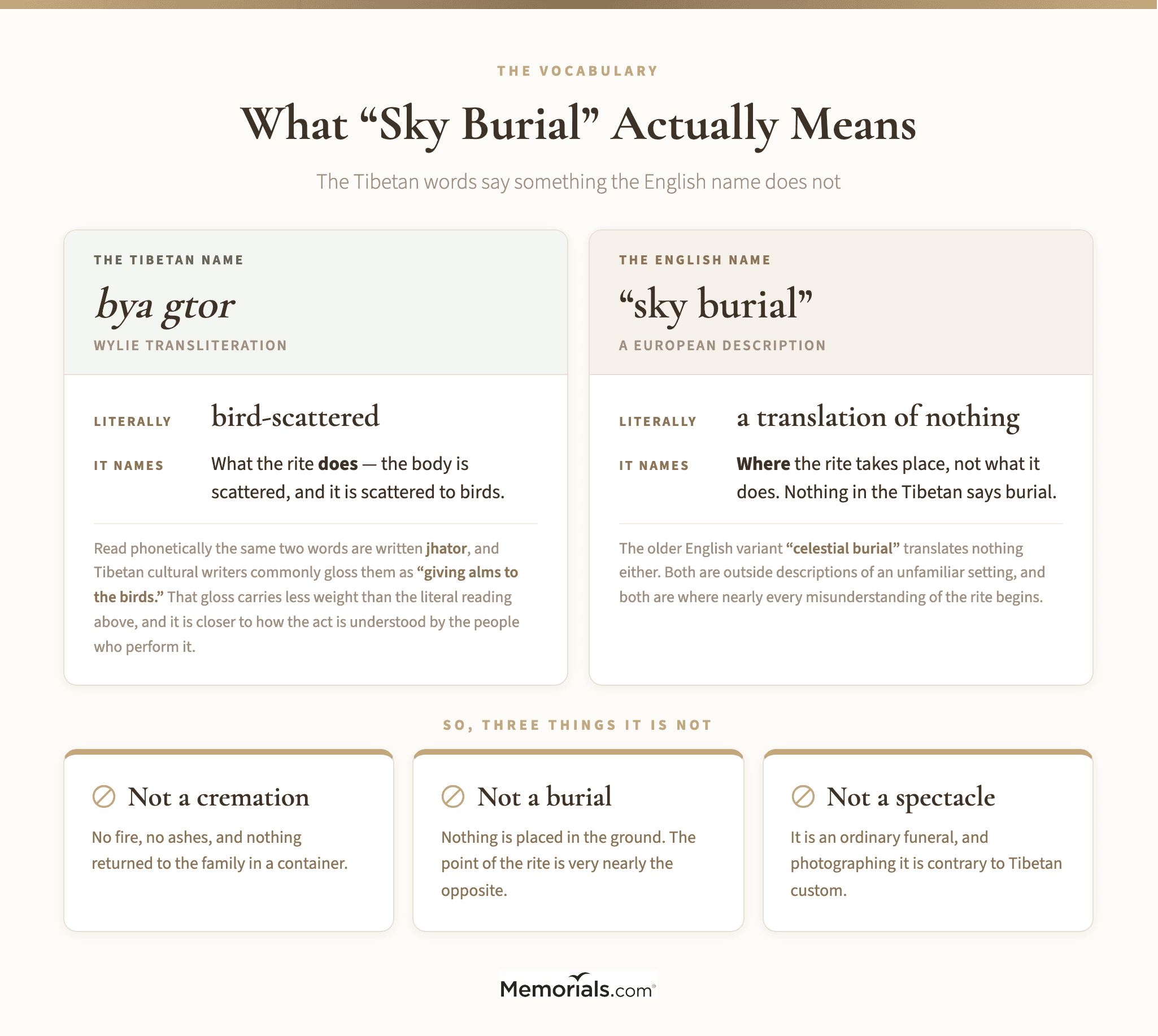
The Tibetan words for the rite are written in Tibetan script and transliterated bya gtor. They mean, literally, bird-scattered. That is the whole of it: the body is scattered, and it is scattered to birds. Tibetan cultural writers usually read the same two words phonetically as jhator and gloss them more warmly — giving alms to the birds — which is closer to how the act is understood by the people who perform it.
If you searched sky burial meaning and landed here, the short answer is in those two words, and the longer answer is that the English name gets in the way. "Sky burial" is a European description. It names where the rite happens rather than what it does, and nothing in the Tibetan says burial at all. The older English alternative, celestial burial, is a translation of nothing and reads worse.
That mismatch is the source of nearly every misunderstanding, so it is worth being blunt about what the rite is not. It is not a cremation: there is no fire, no ashes, and nothing is returned to the family in a container. It is not a burial: the body does not go into the ground, and the point of the practice is very nearly the opposite. And it is not neglect or abandonment. A sky burial is arranged, attended, prayed over and paid for, in the same way a funeral anywhere else is arranged, attended, prayed over and paid for.
The general term for what physically occurs is excarnation — the separation of flesh from bone. Tibet's version is the best known, but it is not the only one, and a reader who finds the idea shocking may be surprised how widely it turns up once the vocabulary is available.
Why the Rite Exists
There are two answers, and anyone who gives only one of them is telling half the story.
The first is doctrinal. Tibetan Buddhism belongs to the Vajrayana tradition, and its teaching on death begins with impermanence: nothing that is assembled stays assembled. Once consciousness has left, the body is understood as a vessel that has been set down — no longer the person, and no longer of use to them. What can still be done with it is give it away. Feeding the birds is a final act of generosity on behalf of someone who can no longer perform one, and generosity is not a minor virtue in this tradition but a central one. That reading is why the rite is spoken of with warmth rather than resignation. The wider context sits in our guide to Buddhist funeral customs, which covers the practices this one grew inside.
The second answer is geographic, and it is given as often as the first. Much of the Tibetan Plateau lies above the treeline. Wood for a pyre has to be carried in, and for most families it has always been too scarce and too expensive to burn a body with. The ground is rock, or frozen for a large part of the year, or both, which makes digging a grave a serious undertaking rather than a routine one. A rite that requires neither timber nor a dug grave is a rite that a high, cold, treeless country can actually perform.
Neither explanation is sufficient alone. Plenty of places are treeless without arriving at this practice, and plenty of Buddhists cremate. What produced the sky burial was the two together: a landscape that made the usual options hard, and a body of teaching that made the alternative meaningful rather than merely practical.
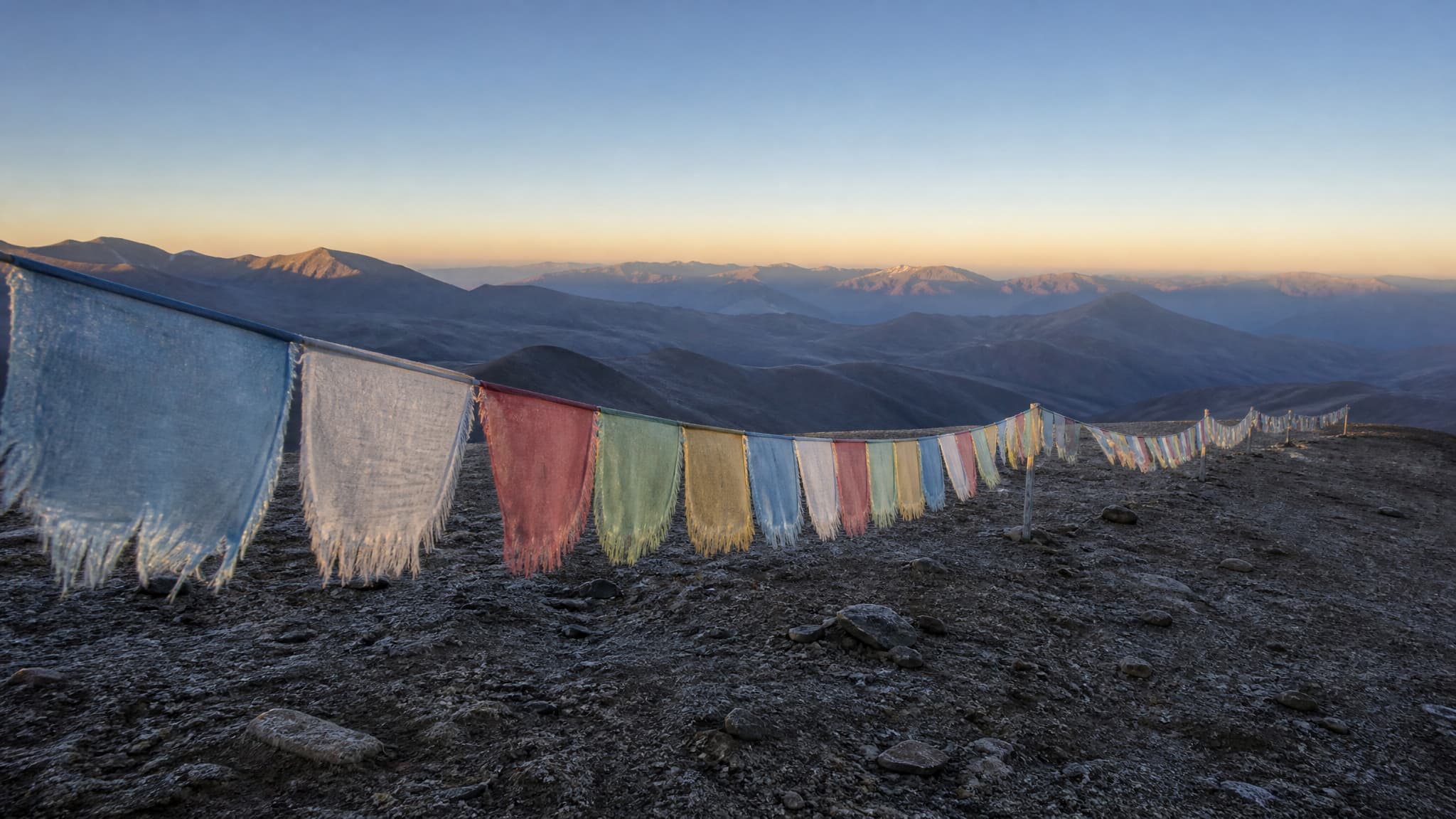
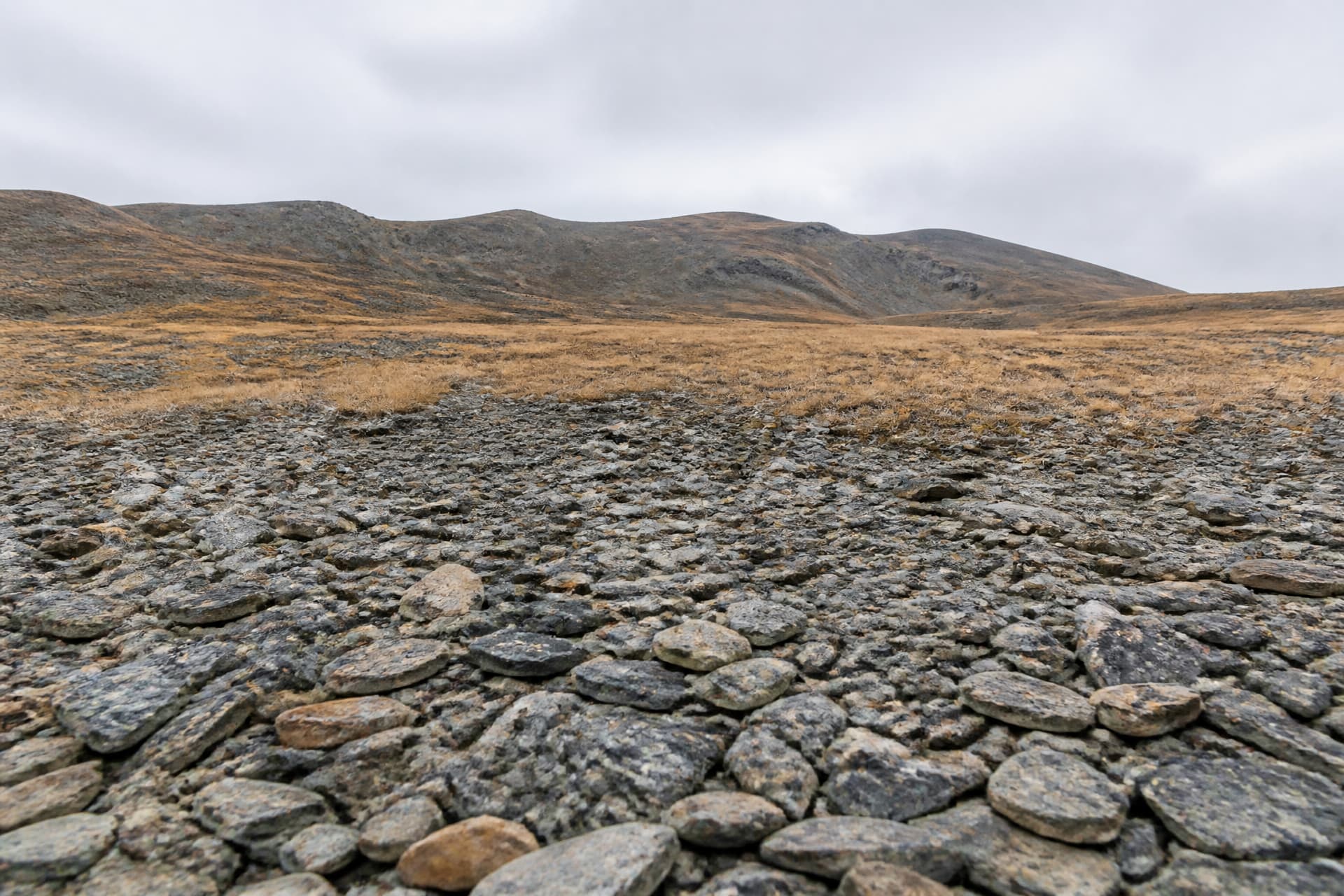
Above the treeline there is no wood to build a pyre with and often no ground soft enough to dig. The landscape narrowed the options long before doctrine gave the remaining one its meaning.
The Tibetan words mean bird-scattered. "Sky burial" is an English description of the setting, not a translation — which is why the rite is so often mistaken for a cremation or a burial when it is neither.
What Actually Happens
This is the part most pages either skip or wrap in euphemism, and it is the part readers came for. Here it is plainly, once.
Accounts from Tibetan cultural publishers describe the days before the rite consistently. The body is washed and wrapped in white cloth and kept at home, usually for something between three and five days, while monks or a lama read scripture in the room. Mourning is not silent and not private; neighbors come. The cloth itself is doing the same work a burial shroud does in other traditions — a plain covering, no ornament, nothing that has to be paid for.
The site is a charnel ground, a place set aside for the purpose and often associated with a monastery. The body is carried there, usually before dawn. Accounts describe smoke being burned at the site to draw the birds, which have learned over generations what the smoke means.
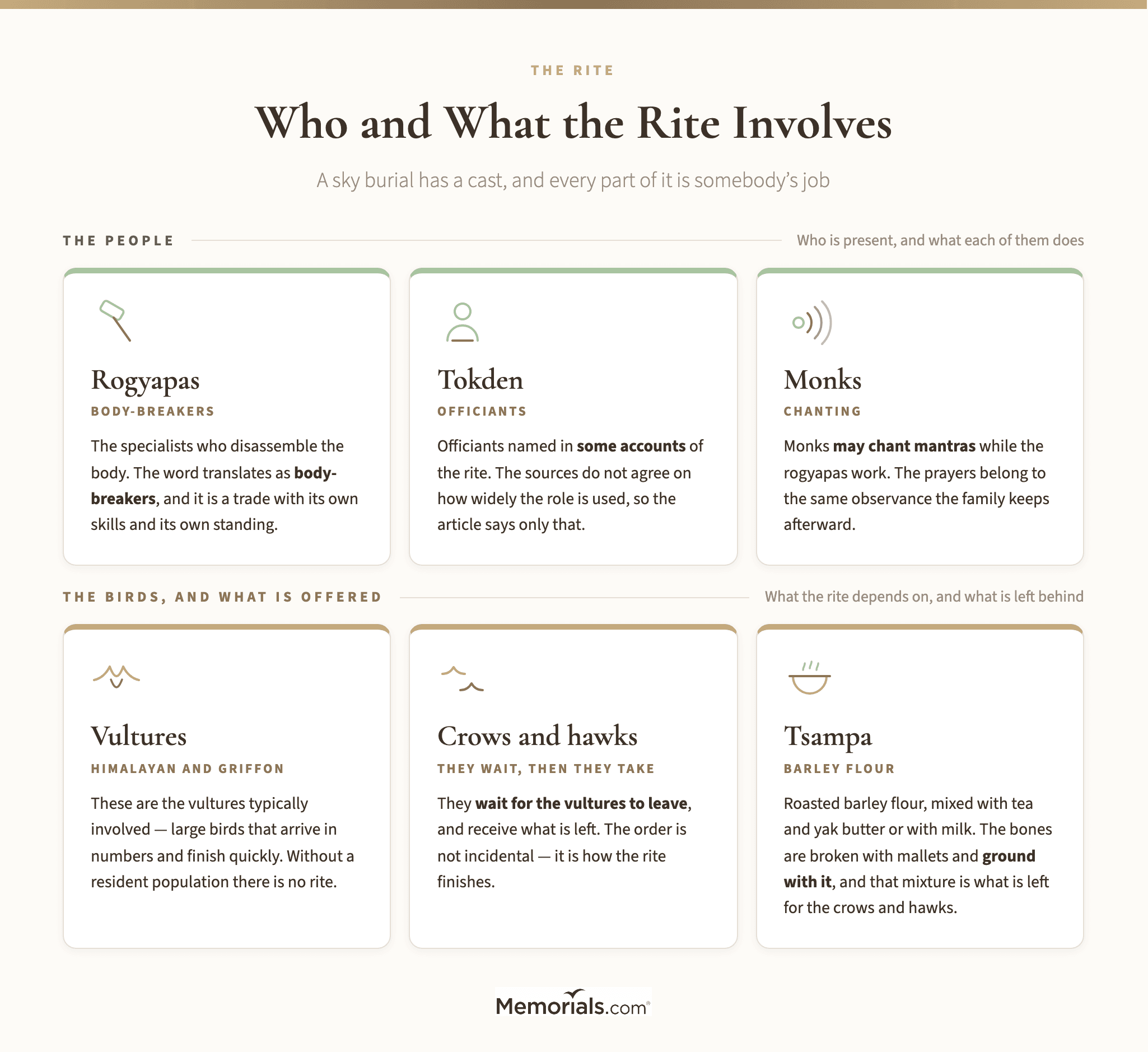
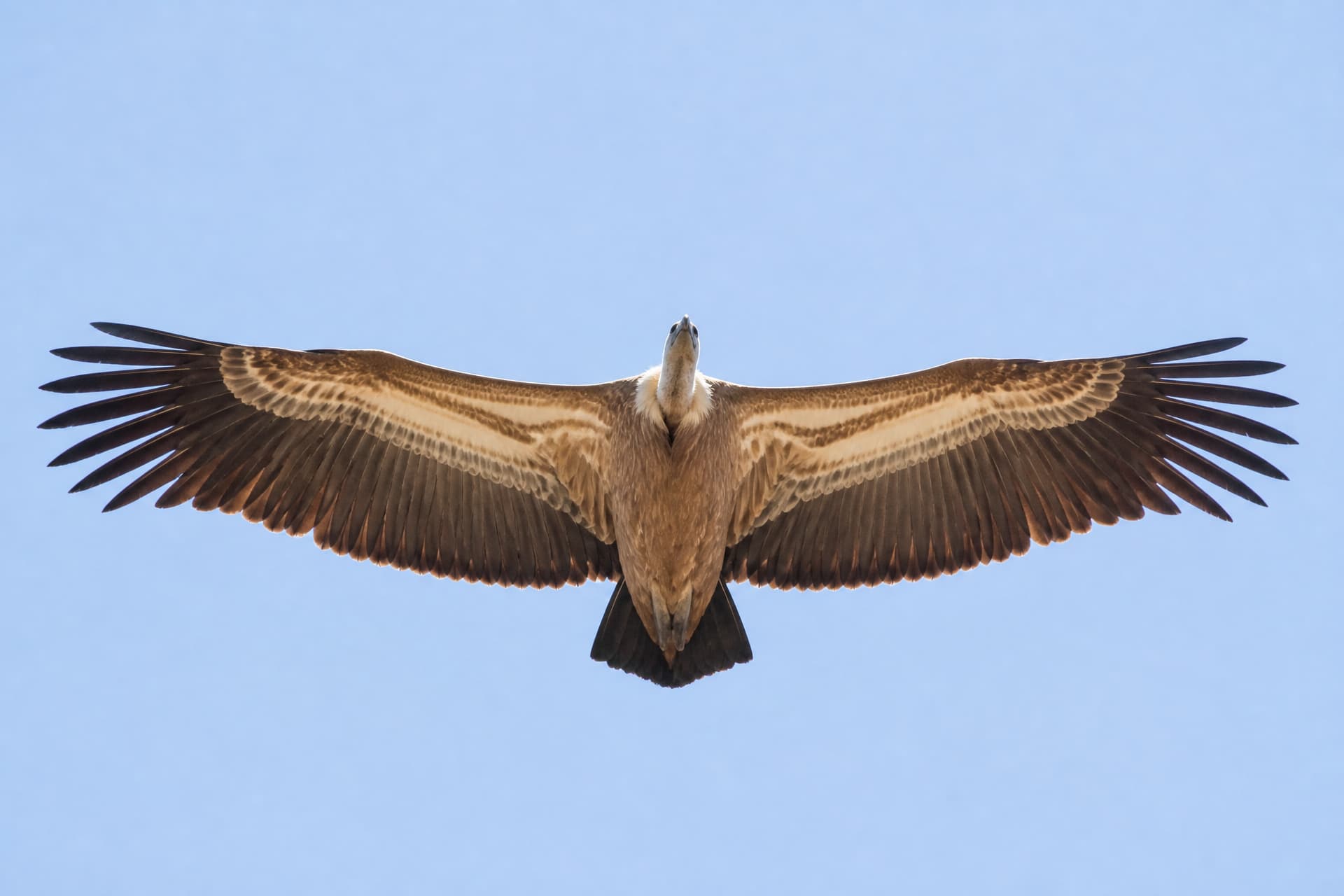
The work is done by specialists. They are called rogyapas, which translates as body-breakers, and it is a trade with its own skills and its own standing. Some accounts also name officiants called tokden. Monks may chant mantras while the rogyapas work. The vultures involved are typically Himalayan and griffon vultures, large birds that arrive in numbers and finish quickly.
When only bones are left, the rogyapas break them up with mallets and grind them together with tsampa — barley flour, mixed with tea and yak butter, or with milk. That mixture is left for the crows and hawks that wait nearby for the vultures to leave. Nothing is kept, and nothing is brought back. A family that has held a sky burial has no ashes, no grave and no marker, and does not expect any.
Read that sequence again with the doctrine in place and it stops reading as disposal. Every step is an act of giving something away, performed carefully, by people who do it for a living, on behalf of someone who cannot.
Tsampa — roasted barley flour, worked with tea and yak butter or milk — is everyday Tibetan food. It is also what the ground bone is mixed with, so that the crows and hawks will take it.
A sky burial has a cast. The rogyapas are trained specialists, the monks attend to the prayers, and the birds arrive in a fixed order — vultures first, then the crows and hawks that take the ground bone and tsampa.
The Forty-Nine Days
The rite is one moment inside a longer observance. Tibetan Buddhism teaches that after death consciousness passes through an intermediate state, the bardo, before its next rebirth, and that this passage takes up to forty-nine days. Prayers and offerings during that stretch are understood to help the person through it, which is why the family's work does not end when the body is given away — in a real sense it has only started. What the 49 days after death involve, week by week, belongs to that page rather than this one.
Fixed mourning periods are not unusual. Catholic families may pray a nine-day novena for the dead; Jewish practice measures the first stretch in seven days. Tibetan practice counts to forty-nine.
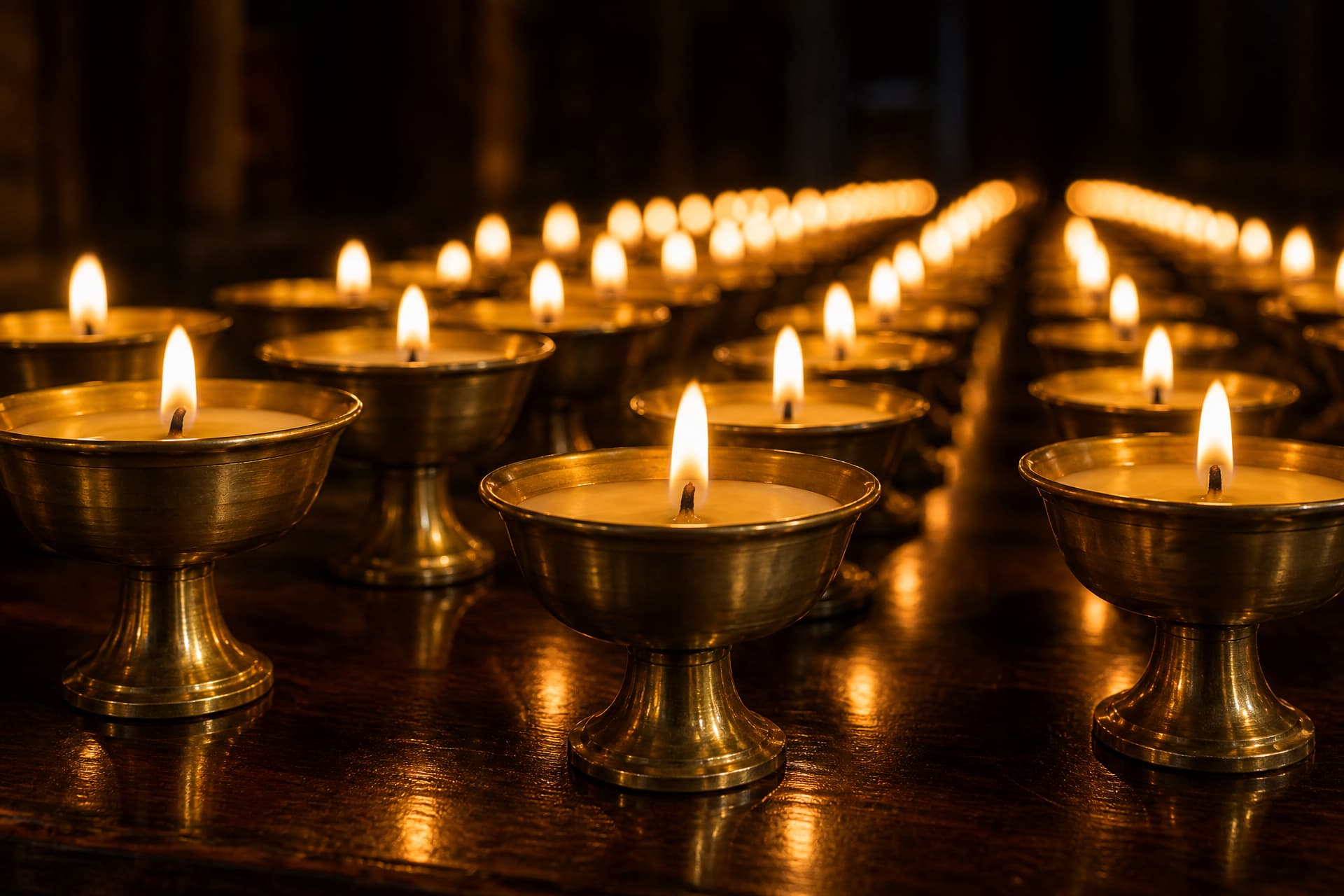
The rite takes a morning; the observance takes seven weeks. Lamps, prayers and offerings across the forty-nine days are the part of the funeral the family actually performs.
Is Sky Burial the Only Tibetan Funeral Rite?
No, and assuming otherwise is the second most common error about the subject. Tibet uses several forms of disposition, and which one a family holds depends on circumstance, region, means and the guidance of a lama.
Cremation is one of them. On a plateau where wood is scarce it has historically been the more expensive option rather than the cheaper one, which is roughly the reverse of the American arithmetic, and it is commonly described as the rite for lamas and people of high standing. It is built around a funeral pyre rather than the enclosed retort that the cremation process uses in the United States, and the difference is more than technical: an open pyre is a public event that the family stands around and watches.
There is also a Tibetan water burial, in which the body is given to a river, used in particular circumstances and in particular places. It shares the logic of the sky burial — return rather than retention — and it is a different rite with a different name, not a variant. Earth burial exists too, though accounts describe it as uncommon and, in some readings, reserved for deaths the community treats as unlucky.
The honest summary is that sky burial is commonly described as the ordinary rite for ordinary people across much of the plateau, with the others selected by circumstance. It is normal there. It is not universal there.
Is Sky Burial Practiced Anywhere Else, and Could It Happen in the US?
No, it could not happen in the United States, and it is worth saying that first rather than at the bottom.
Sky burials still take place today, across the Tibetan Plateau and into the wider Himalayan belt — parts of Qinghai and Sichuan, and Tibetan Buddhist communities in Mongolia, Bhutan and Ladakh. The practice was banned during the Cultural Revolution, later received protection, and continues to be regulated by the Chinese government, in part because of declining vulture populations. That last detail is easy to skim past and it matters: the rite depends on a wild bird population large enough to do the work, and that population is not guaranteed anywhere.
The nearest relative outside Buddhism is the Zoroastrian tradition of the dakhma, the structures English writers call towers of silence, which rest on the same reasoning — that a body should not pollute earth or fire, and that birds may take it instead. Other traditions place their dead in the open air for reasons of their own. The hanging coffins fixed to cliff faces in parts of China and the Philippines are elevated rather than exposed, and in Madagascar the famadihana brings the dead back out of the tomb years later to be rewrapped and danced with. None of these is a sky burial. All of them are a reminder that the range of ordinary human funerals is far wider than one country's law recognizes.
And that is the American obstacle. No US jurisdiction provides for exposure of a body as a means of disposition. The legally recognized methods are burial and cremation, with alkaline hydrolysis available in some states — and the rules differ state by state, so anyone planning anything unusual should check their own. But the legal answer is not the whole answer, and pages that stop there leave the reader thinking a permit would solve it. A sky burial also requires a resident vulture population that knows the site, a consecrated charnel ground, and rogyapas trained by rogyapas. None of those exists here, and none of them can be arranged.
The rite depends on a wild bird population that knows the site. Declining vulture numbers are one of the reasons the practice is regulated in China today — and one of the reasons it cannot simply be moved somewhere else.
If the Idea of Returning to Nature Speaks to You
Plenty of American readers arrive at this subject not out of curiosity but out of recognition. The idea that a body should be given back rather than sealed away lands hard, and having read this far you may be wondering what the nearest honest thing is. Sky burial is not available to you, and no arrangement makes it available. What follows is not equivalent — it is adjacent, and it is real.
A green burial is the closest option in intent. No embalming, no metal, no concrete vault, a shroud or a simple wooden container, and a body that decomposes into the ground it was placed in. Green burial grounds operate in most states and the practice is governed by the same rules as any other burial. For cremated remains, biodegradable urns are made to break down in soil or water rather than persist, which serves the same instinct at a smaller scale. Whole-body donation to a medical school or a forensic research facility is another route people choose for related reasons, and it is worth investigating early because programs have their own requirements.
For a Tibetan-American or Western Buddhist family facing an actual death, the practical path is usually cremation with the tradition's own observances kept around it: the prayers said, the forty-nine days counted, the ashes handled according to the lama's guidance rather than by default. Our guide to Buddhist views on cremation covers how families in that position approach the decision. Ask your own lama or temple before you commit to anything; the guidance you get there outranks anything written on a website, including this one.
A green burial is not a sky burial and does not pretend to be. It is the nearest available expression of the same instinct — give the body back, and mark the place lightly or not at all.
Frequently Asked Questions
Why vultures?
Because they are what the plateau has, and because they are efficient. Himalayan and griffon vultures are large birds that arrive in numbers and finish quickly, which makes the rite possible in a single morning rather than over days. In the tradition's own reading the birds are also the recipients of the gift — the act is understood as feeding them, not merely as using them.
What happens to the bones?
They are broken up with mallets and ground together with tsampa, the barley flour mixed with tea and yak butter or with milk, and the mixture is left for the crows and hawks that wait for the vultures to leave. Nothing is retained. A family comes home from a sky burial with no remains of any kind.
Who performs a sky burial?
Specialists called rogyapas, a word that translates as body-breakers. It is a trade, learned and practiced. Monks may attend and chant mantras, and some accounts name officiants called tokden, but the physical work belongs to the rogyapas.
Is sky burial still practiced today?
Yes. Tibetan sky burial continues across the plateau and in Tibetan Buddhist communities in the wider Himalayan region. It was banned during the Cultural Revolution and later received protection, and it remains regulated by the Chinese government, in part because vulture populations have declined.
Do all Tibetans have a sky burial?
No. Cremation, water burial and earth burial are all used, selected by circumstance, region, means and a lama's guidance. Sky burial is commonly described as the ordinary rite for most people in most of the region, which is a different claim from saying it is universal.
Can you watch or photograph a sky burial?
You should assume not. Photographing the rite runs against Tibetan custom and is restricted by Chinese regulation, and attendance is not a tourist activity — it is a family's funeral. Travelers are asked to stay away from charnel grounds, and the request is a reasonable one.
What the Rite Is Really Saying
Strip away the unfamiliar setting and a sky burial makes a claim most funerals make in some form: that a body is not the person, and that what is left can be turned toward something other than keeping. Tibetan practice takes that further than most and does it in the open. It asks nothing of the ground, nothing of the forest, and nothing of the family beyond the prayers of the weeks that follow. For the people who hold one it is not a strange rite. It is the last generous thing that can be done.