🏬Supersize Online Funeral Retailer🪦1000's of Headstones⚱️Over 10,000 Cremation Urns⚰️Caskets Overnight Delivery🛒Funeral & Memorial Superstore🚚FREE Shipping on ALL Orders👨👩👧👦Helping Families for over 20 Years💰Lowest Price Guarantee🏬Supersize Online Funeral Retailer🪦1000's of Headstones⚱️Over 10,000 Cremation Urns⚰️Caskets Overnight Delivery🛒Funeral & Memorial Superstore🚚FREE Shipping on ALL Orders👨👩👧👦Helping Families for over 20 Years💰Lowest Price Guarantee
🏬Supersize Online Funeral Retailer🪦1000's of Headstones⚱️Over 10,000 Cremation Urns⚰️Caskets Overnight Delivery🛒Funeral & Memorial Superstore🚚FREE Shipping on ALL Orders👨👩👧👦Helping Families for over 20 Years💰Lowest Price Guarantee🏬Supersize Online Funeral Retailer🪦1000's of Headstones⚱️Over 10,000 Cremation Urns⚰️Caskets Overnight Delivery🛒Funeral & Memorial Superstore🚚FREE Shipping on ALL Orders👨👩👧👦Helping Families for over 20 Years💰Lowest Price Guarantee
Walk into a Mexican household on the last day of October and the front room is already changing. A table gets cleared and pushed against the wall, a cloth goes over it, and by nightfall on November 1 the whole thing is burning. Ask what the dia de los muertos velas on an ofrenda are for and the answer is always the same: light. The candles are how the dead find their way back. Everything else on that table is hospitality for a guest who has already arrived — the flames are the directions.
Most pages about this holiday give the candles a paragraph and move on to the sugar skulls. This one does the opposite. It answers the four questions families actually ask — where the candles go, how many to light, what the colors are said to mean, and how long they burn — and it keeps the candles on the home altar separate from the ones carried to the cemetery, because those are two different practices on two different nights. It sits inside our funeral traditions guide among the other customs that give the dead a fixed date and a lit path home.
What the candles on an ofrenda are for
A vela is a candle. An ofrenda is an offering, and by extension the table the offering sits on — what an English speaker would call the altar. The two words belong together, because a table with nothing burning on it is not finished. In the explanation nearly every family gives, the souls travel a long way and arrive in the dark, and the candles are what they steer by. Set them out unlit and you have decorated a table. Light them and you have given directions.
The candles also carry one of the four elements, in a scheme that turns up everywhere from museum wall text to a fourth-grade classroom. Fire is the candles. Air is the papel picado, the perforated tissue paper strung above the table, which moves whenever anyone walks past it. Earth is the food. Water is the glass left out for someone who has come a long way thirsty. Families vary in how strictly they keep to it, and plenty have never heard it framed that way at all — but the candles are the part nobody leaves out.
A household altar is not a Mexican invention, and saying so takes nothing away from this one. A Japanese family keeps a butsudan, a lacquered cabinet in the front room holding a photograph, a light and a bowl of rice set down most mornings. The vocabulary is different and the theology is different. The instinct underneath is the same one: keep a place in the house where the dead are still fed and still lit.
The lighting is the moment the altar starts working. Until the first wick catches, everything on the table is preparation.
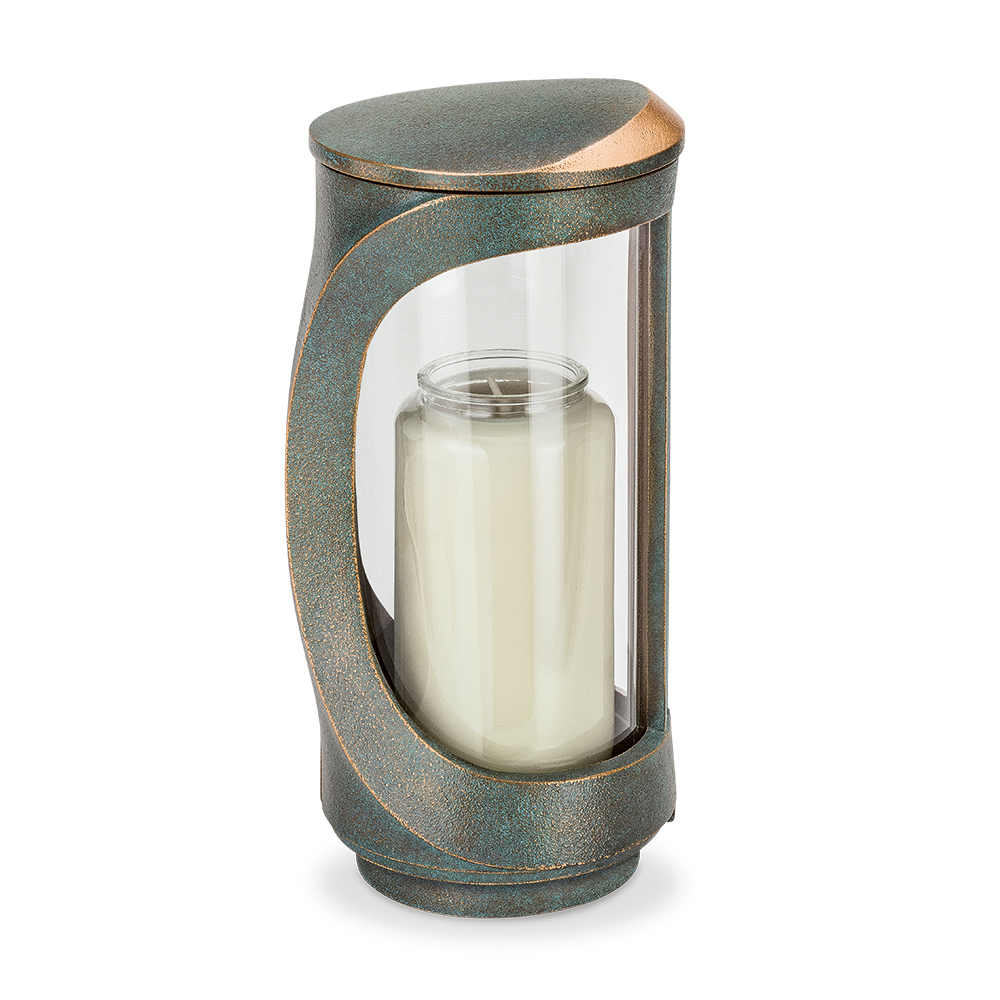
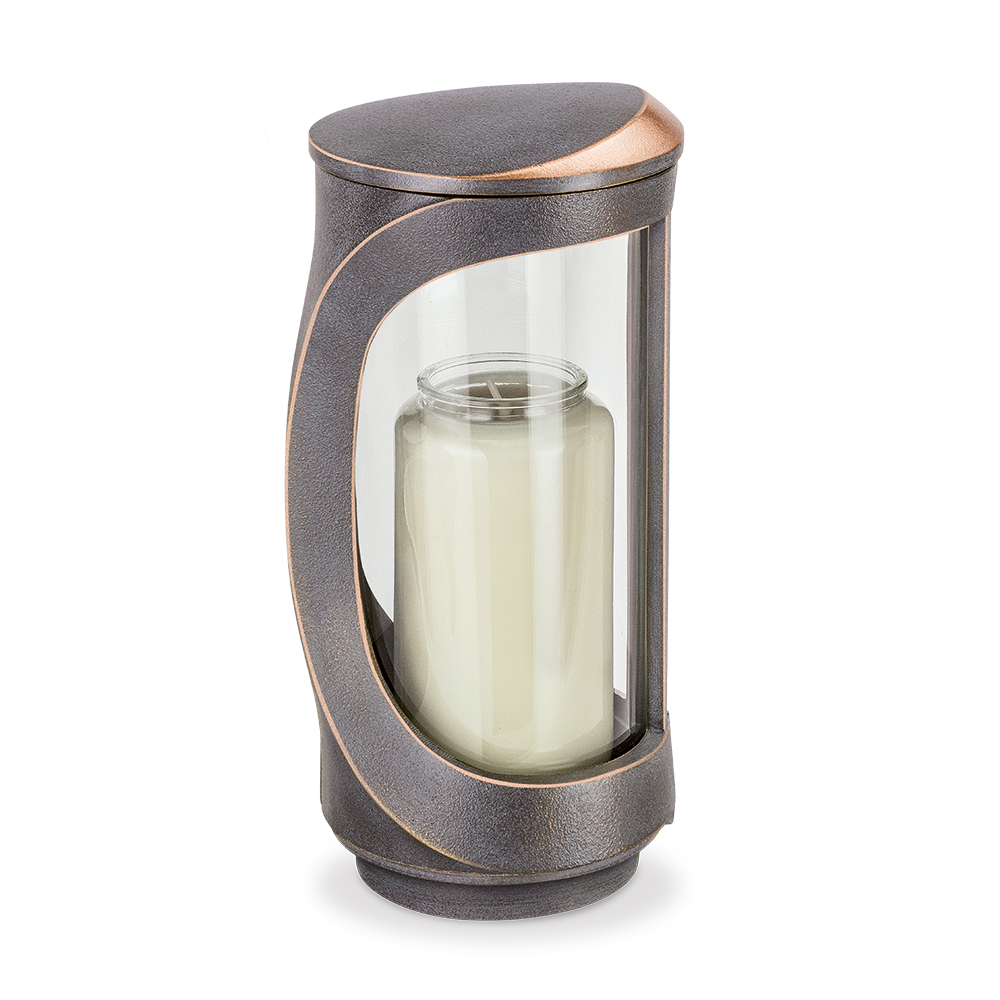
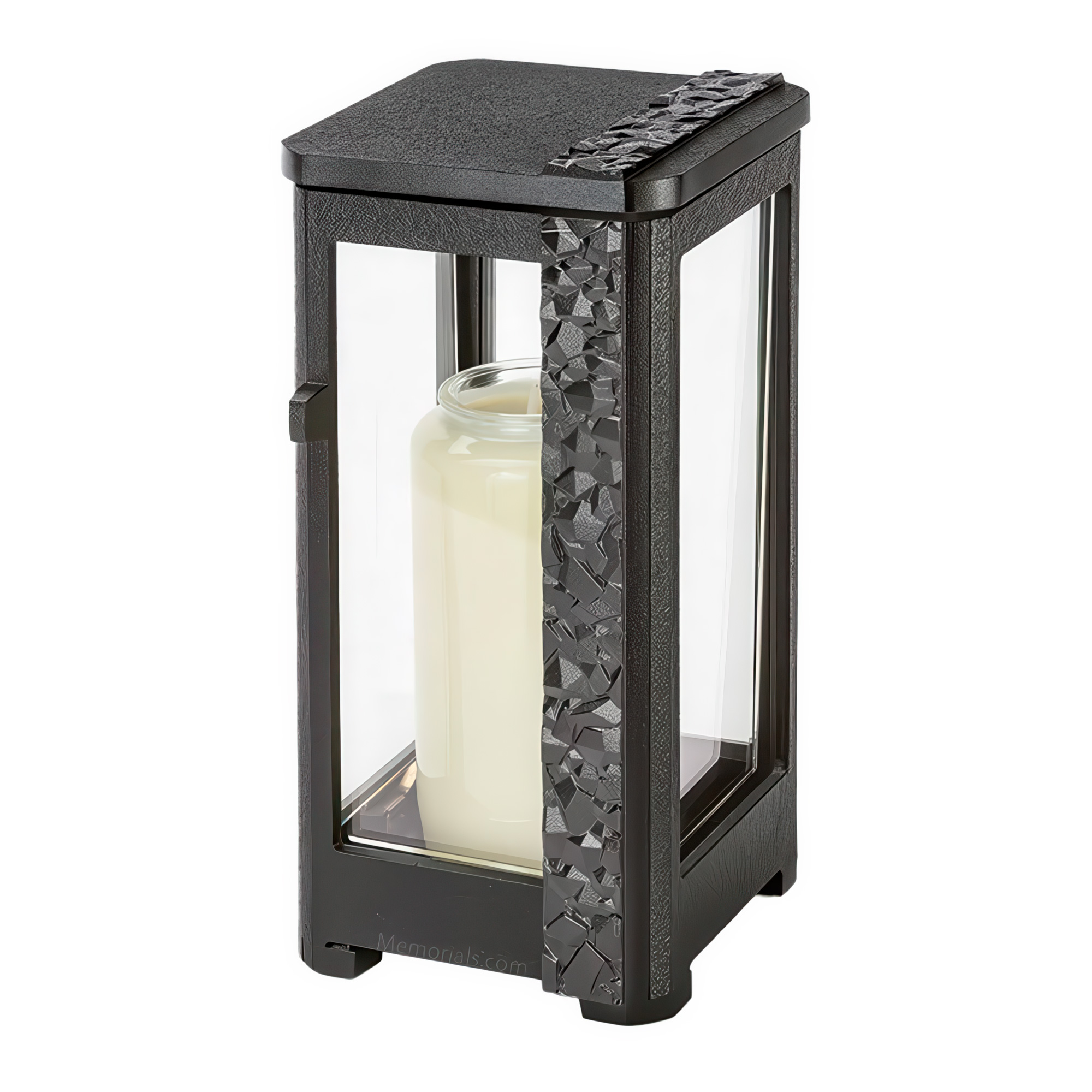
Shop Cemetery Lighting, Vases and Photo Urns
The year-round versions of what an ofrenda does for two nights
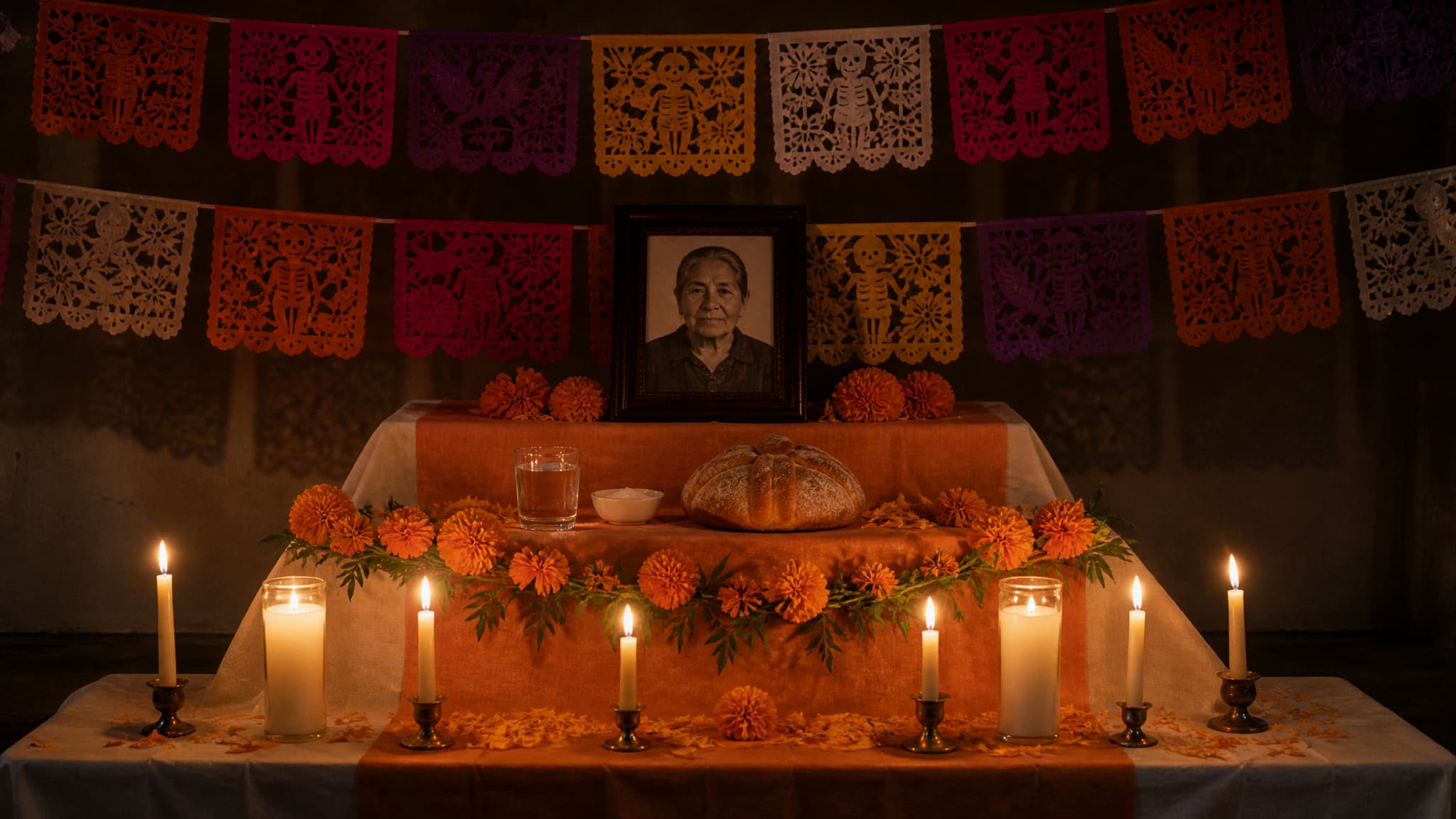
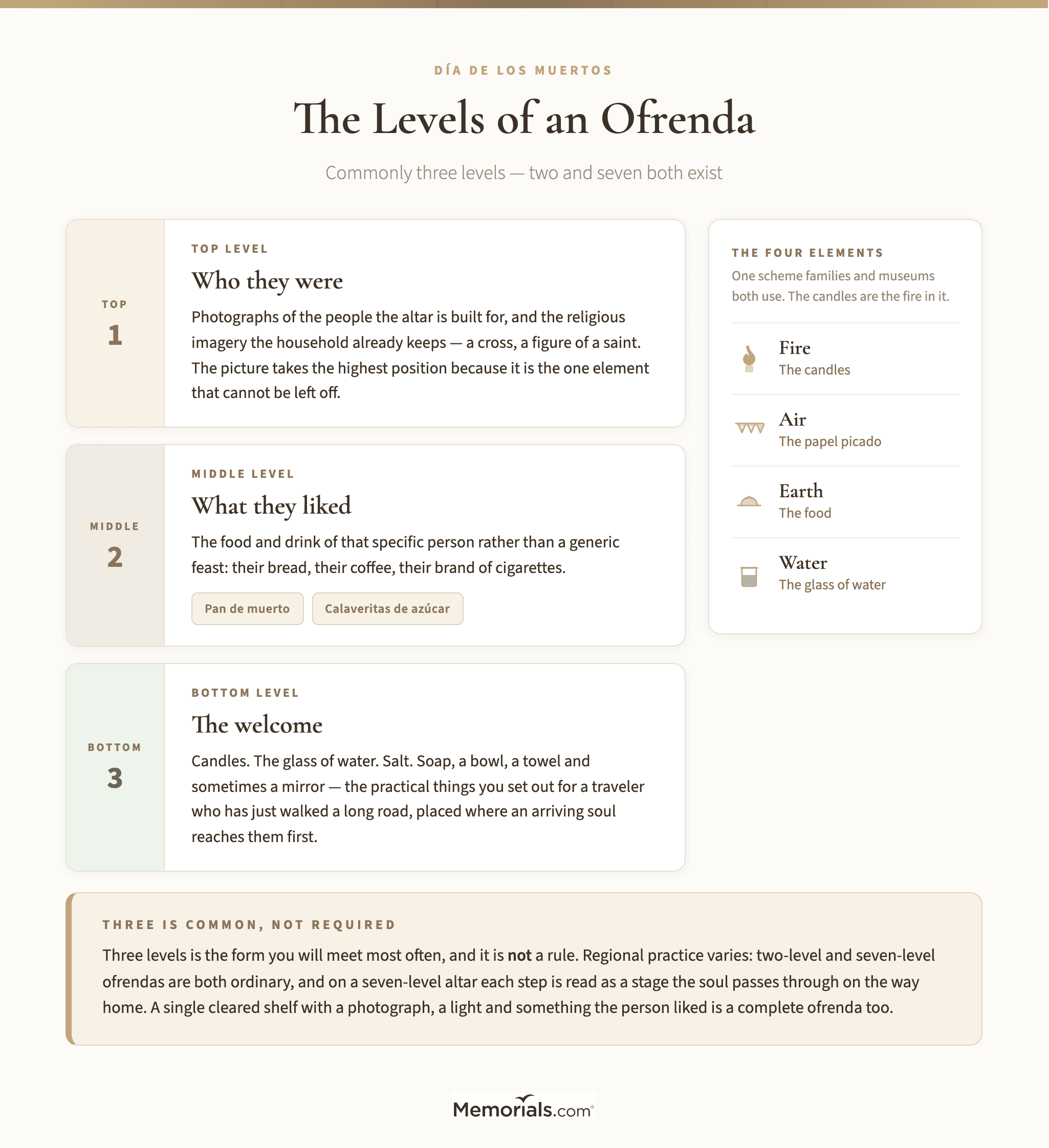
An ofrenda is usually built in levels, and the levels are not decoration. The day of the dead altar elements below are the ones that recur from Oaxaca to Los Angeles whatever else a family adds, and the candles show up on more than one of them — which is the detail most guides flatten.
In many regions the altar is built in three tiers. The top holds the photographs and the religious imagery: a cross, a figure of a saint, whatever the household already keeps. The middle carries food and drink, and specifically the food that particular person liked — not a generic feast, but their bread, their coffee, their brand of cigarettes. The bottom carries the candles, the glass of water, and small practical things for a traveler who has just walked a long road: soap, a bowl to wash in, a towel, sometimes a mirror. Three levels is common rather than canonical. Two-level ofrendas are ordinary, and seven-level ones exist, each step read as a stage the soul passes through on the way home.
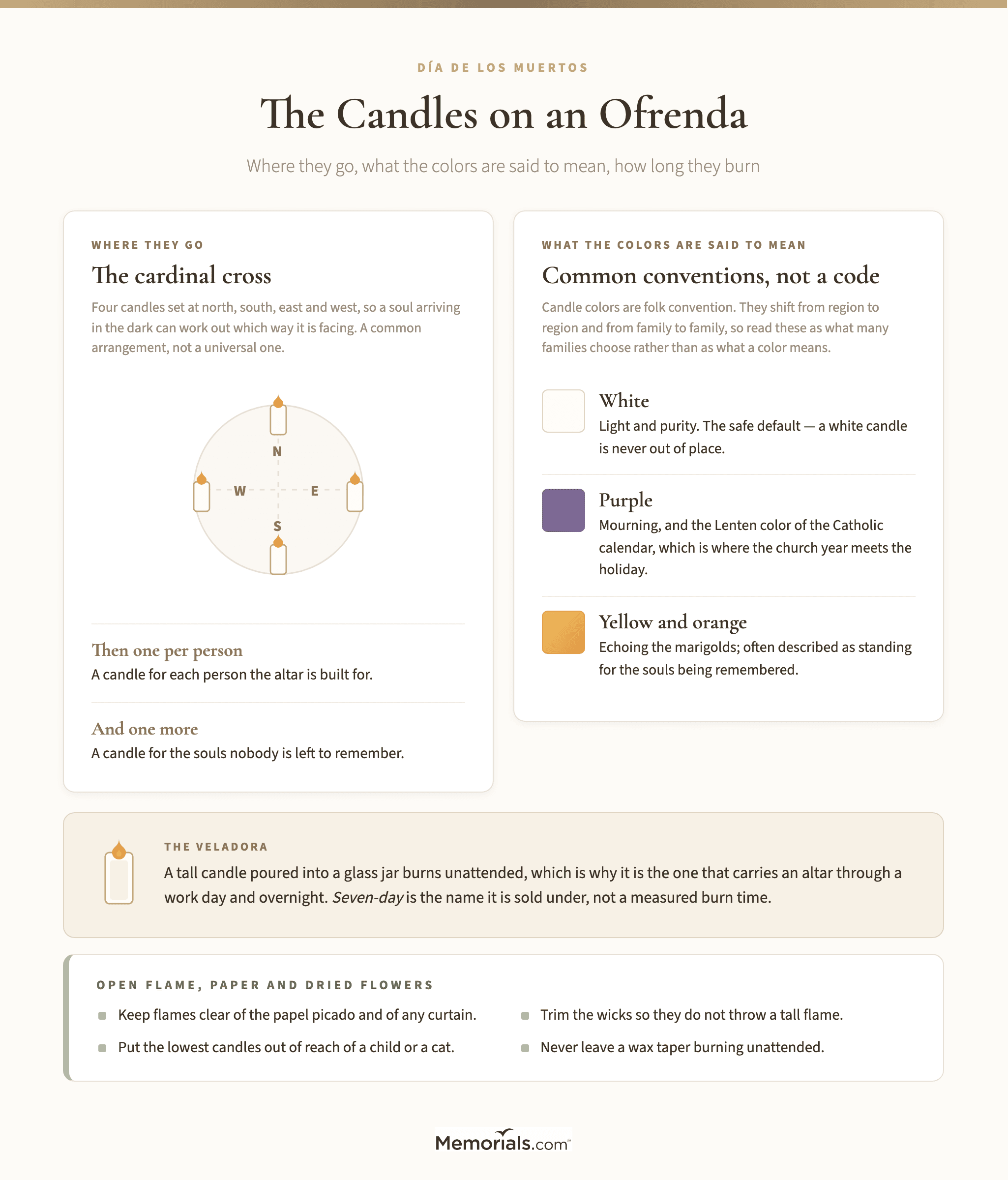
A widely kept arrangement sets four candles as a cross at the cardinal points, so a soul arriving in the dark can work out which way it is facing. That cross is the one piece of candle practice almost no English-language page mentions, and it is the piece that explains why the count is never simply "one." Beyond the four, families add candles for the people they are naming that night, and very often one more that belongs to nobody in particular — lit for the souls with no living relative left to remember them.
The tiers sort the offerings by what they are for: identity and faith at the top, the person's own tastes in the middle, and the practical welcome — light, water, soap — at the bottom where an arriving soul reaches it first. Three levels is the common form, not the required one; two and seven both exist.
How many candles, and what the colors mean
There is no correct number, and any page that gives you one has invented it. What there is instead is a set of reasons to add another candle, and the count falls out of them. One for each person the ofrenda is built for. Four for the cardinal cross, where a family keeps that custom. One for the forgotten souls. On an altar remembering a whole extended family, that arithmetic runs high; on a shelf for one grandmother, it stays small. Both are complete.
The colors are folk convention rather than rule, and they shift from region to region and from source to source. Many families choose white for light and purity, and it is the safe default if you want one — a white candle is never wrong. Purple is commonly associated with mourning and with Lent, which is where the Catholic calendar leaks into the holiday. Yellow and orange echo the marigolds and are often described as standing for the souls being remembered. Ask three families and you may get three explanations, all held sincerely. Say "many families choose" and you will be right; say "the color means" and you will be wrong somewhere.
One practical note that has nothing to do with symbolism: mix the heights. Tall glass candles at the back and low ones at the front let a whole table read as lit rather than as a row of flames, and it keeps the flames away from anything hanging above the altar.
Four candles set as a cross let an arriving soul orient itself; the rest of the count is one per person named, plus one for the souls nobody is left to remember. The color conventions beside them are widely kept and regionally variable — treat them as customs families choose, not as a code.
Veladoras — the seven-day candle
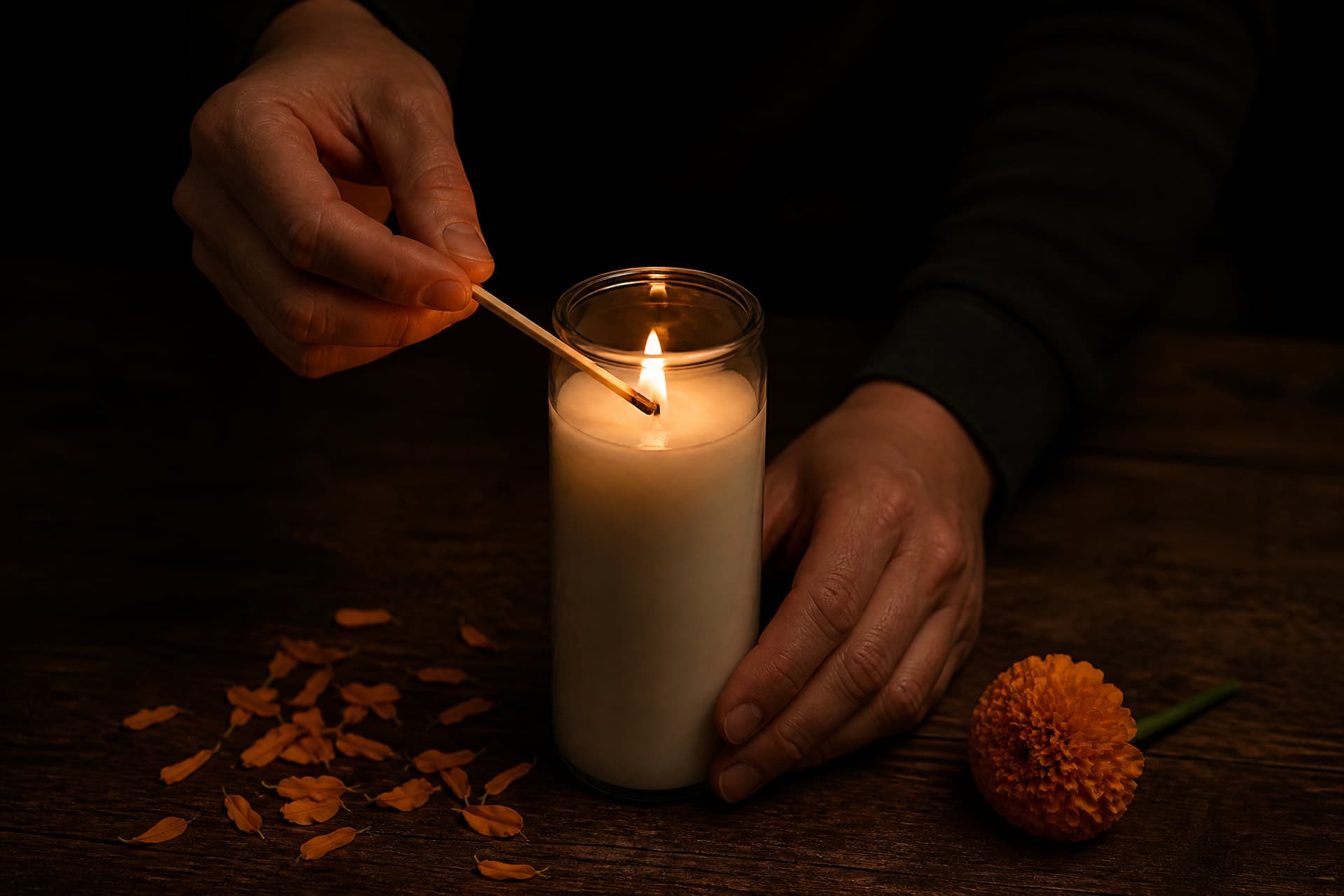
The candle an American reader is most likely to actually meet is the veladora: a tall candle poured straight into a plain glass jar, sold by the case in supermarkets across the Southwest from the middle of October. Its whole virtue is that it burns unattended. A wax taper needs somebody in the room; a veladora in glass will keep going through a work day, overnight, and through the next one, which is why the tradition survives in households where everyone leaves at seven in the morning. Several will run continuously from the evening of October 31 to the end of November 2.
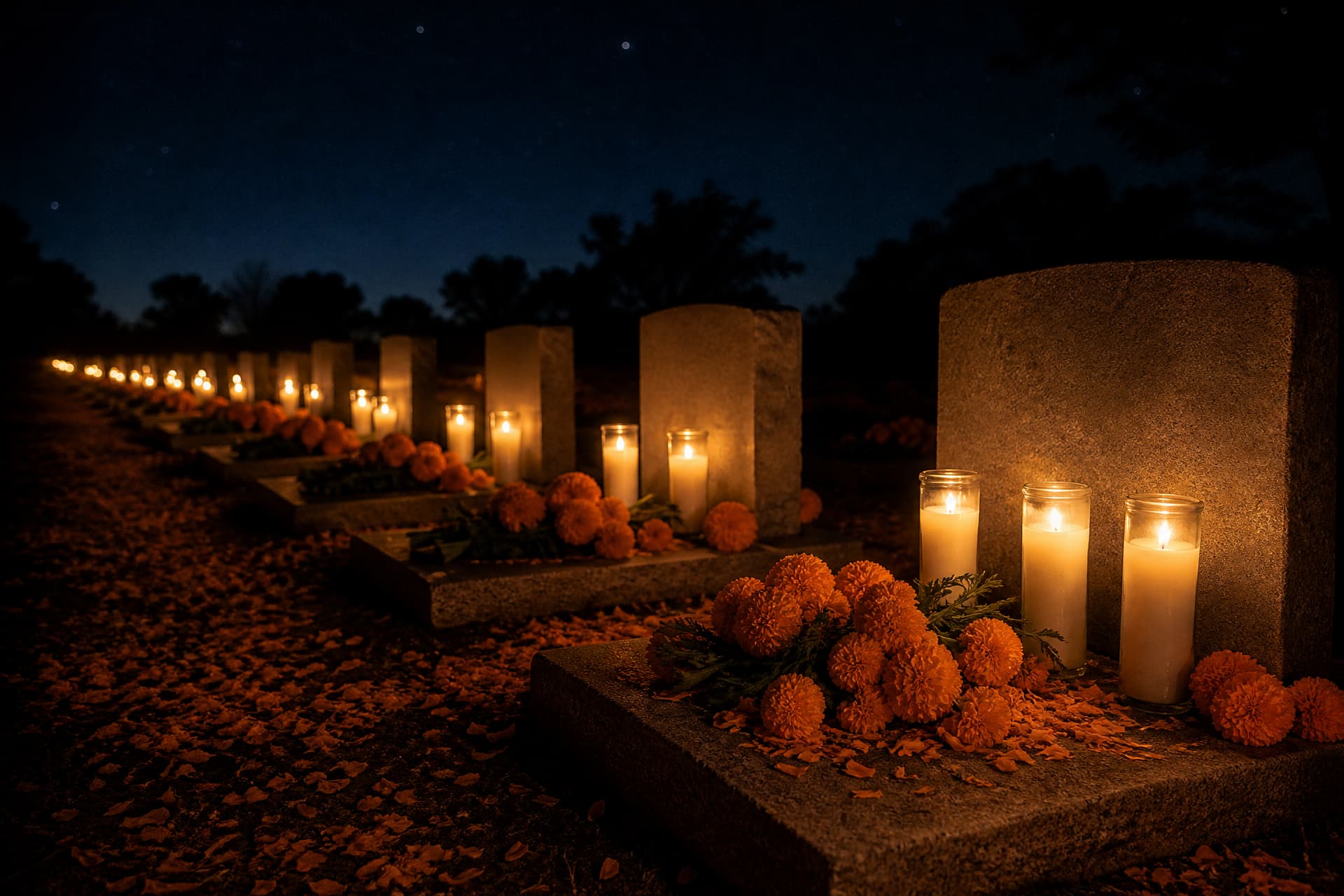
Photograph an ofrenda after dark and what you have is a study in dia de los muertos lights — flame doubled in the glass, marigold orange going warm at the edges, papel picado throwing cut shadows across the wall behind. The altar is built to be looked at in the dark, which is worth knowing before you photograph one with the ceiling light on.
The glass memorial candle is not a Mexican invention either. A Jewish family lights a yahrzeit candle on the anniversary of a death, in a glass the same shape and for the same practical reason: it burns for a full day without anyone tending it. Two traditions, no contact between them, and the same object — because a flame that has to be watched cannot mark a day, and marking a day is the job.
Outside the holiday, the same candle does quieter work all year, and families who keep one lit on a birthday or an anniversary are doing a version of the same thing. Our guide to memorial candles covers that general practice and the types available.
The safety line belongs here rather than at the bottom, because an ofrenda is the one altar in the year that combines open flame with paper, dried flowers and a tablecloth. Keep the candles clear of the papel picado and of any curtain. Trim wicks so they do not throw a tall flame. Put the lowest candles where a child or a cat cannot reach them. And do not leave a wax taper burning overnight — if you want the table lit while the house sleeps, that is exactly what the glass veladora is for.
Candles at the grave — the night at the panteón
The second half of the holiday happens at the cemetery, and it is not the same event as the one at home. The velación is the night vigil at the grave: families arrive in the afternoon, clean and dress the plot, set out flowers and food, and stay — sometimes until dawn — with candles burning along the length of the grave. In parts of Michoacán, and famously on the island of Janitzio in Lake Pátzcuaro, the whole cemetery is lit and awake for a night, and the sound is conversation and music rather than silence.
The two nights are divided by who is being remembered. November 1 belongs to children who have died, the angelitos, and November 2 to the adults. Families who keep the distinction go to the cemetery on both, and the two visits feel different: the first is gentler and often has toys and sweet food in it, the second is longer and later.
An American reader who wants to keep the vigil runs into a practical wall almost immediately. Most cemeteries in the United States lock their gates at dusk, and a good many prohibit open flame anywhere on the grounds. That is not hostility to the tradition; it is groundskeeping and liability, and the answer is to ask the office rather than to find out at the gate. Our notes on cemetery etiquette cover what to expect, and our guide to decorating a grave covers what most grounds will and will not allow you to leave behind.
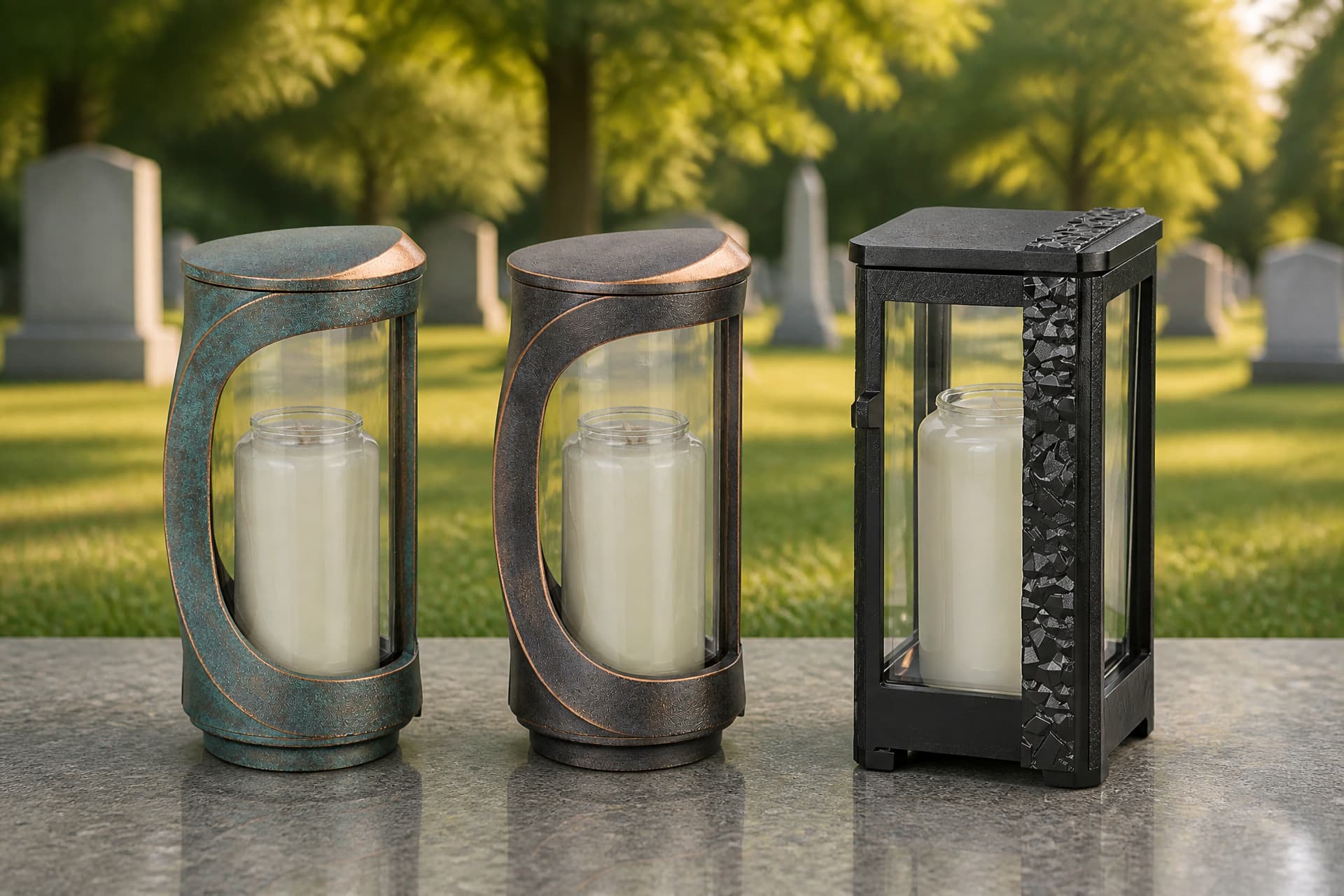
Where flame is not permitted, families improvise the way families always have. Battery lanterns and solar lights for graves come on at dusk by themselves and cost nothing to run, which turns out to suit the tradition better than it sounds: the point was never the wax, it was that the grave should not be dark.
That is also the honest bridge to anything this catalog sells, because none of it is Día de los Muertos merchandise. The velas burn for two nights. The families who want the grave lit the other three hundred and sixty-three are the ones who buy solar and eternal lights for graves — a fixture that stays at the plot year-round and does in ordinary time what the candles do on one night.
Marigolds, papel picado and everything else on the table
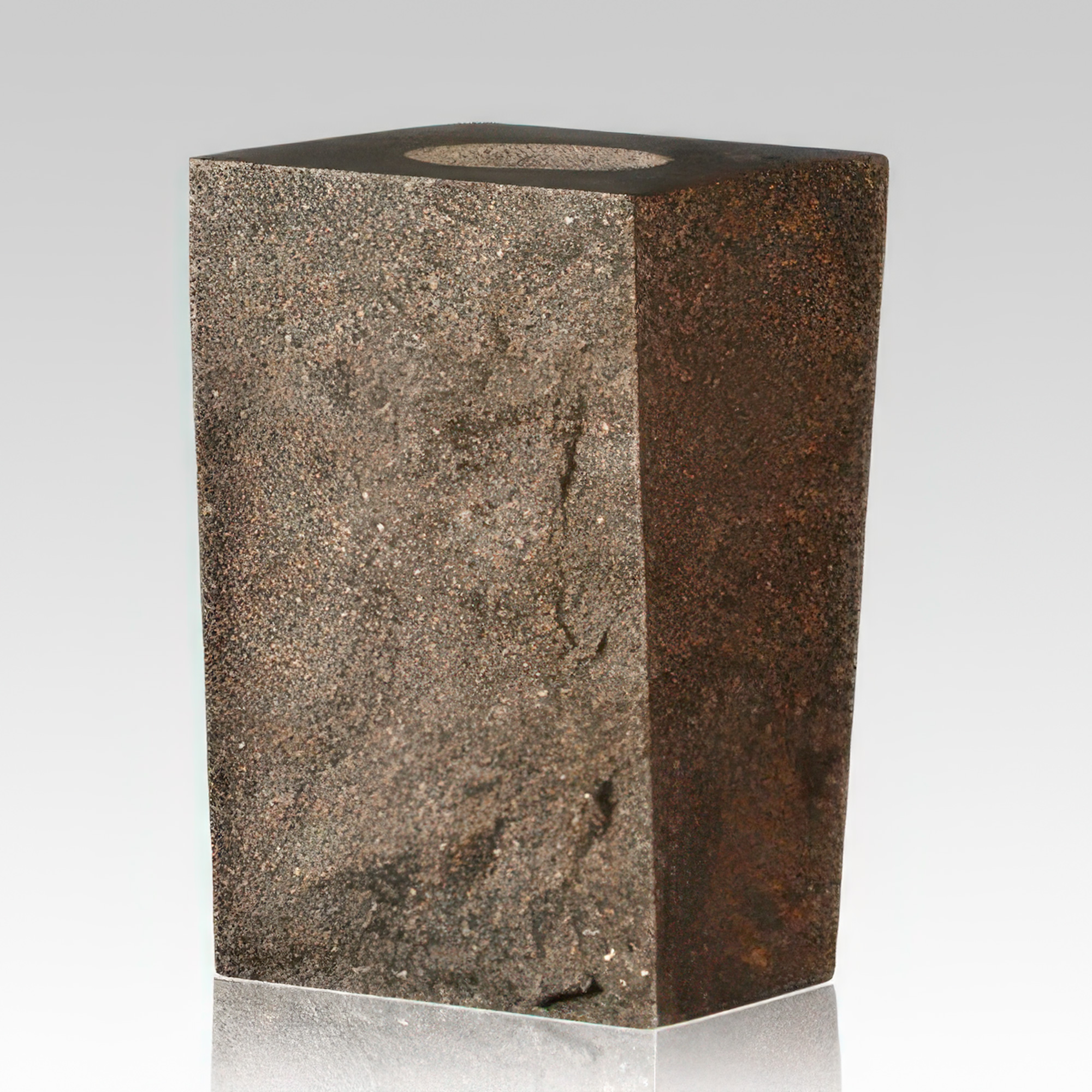
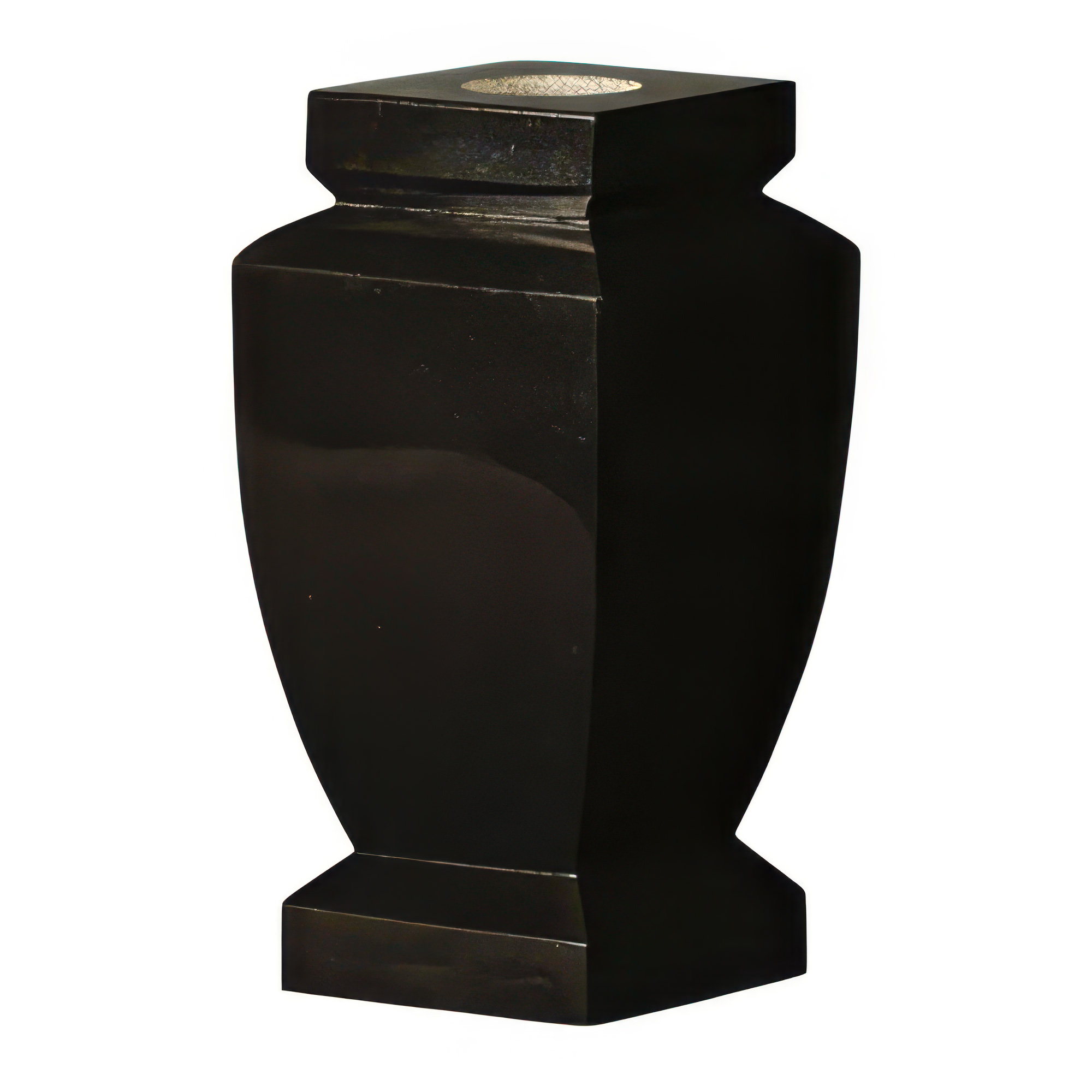
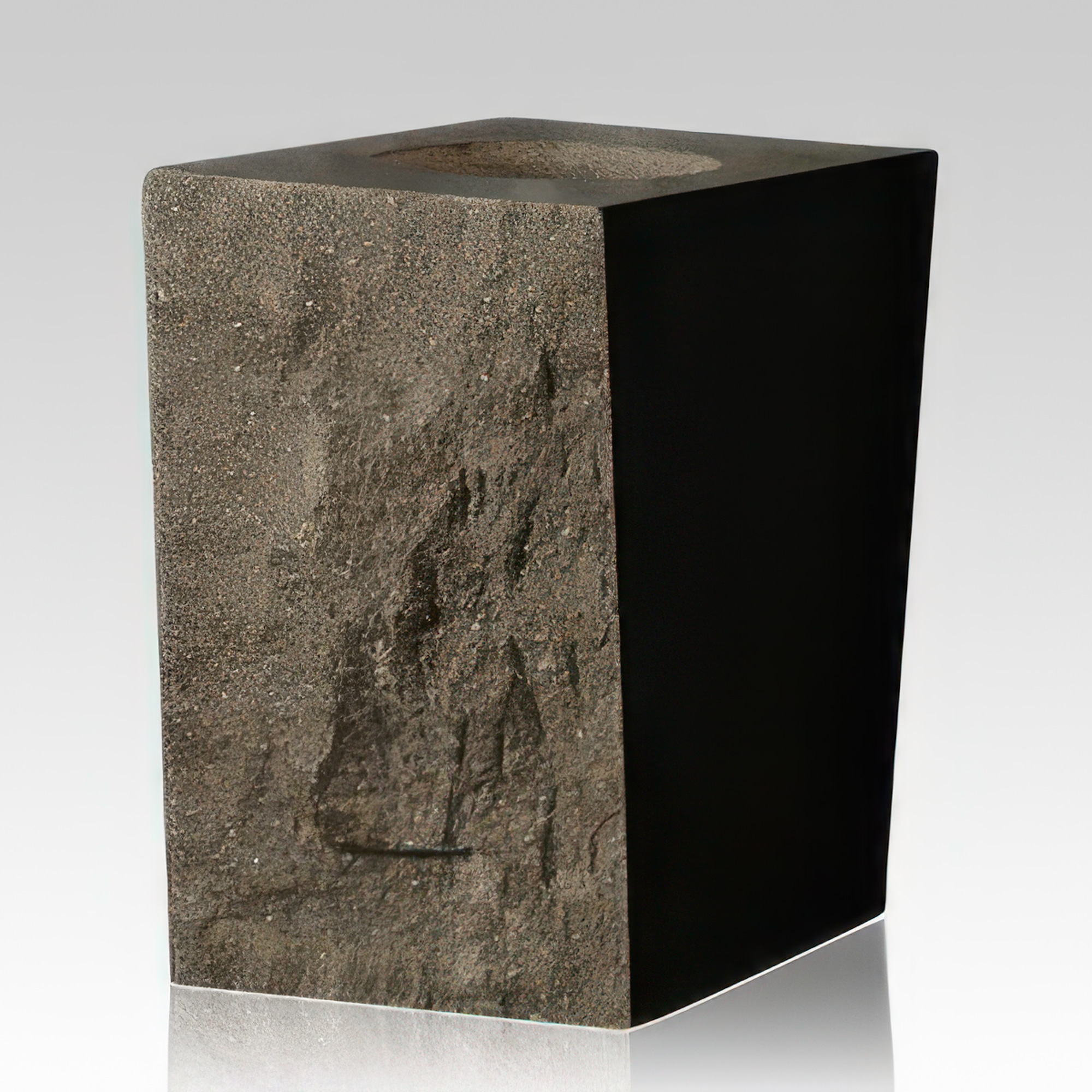
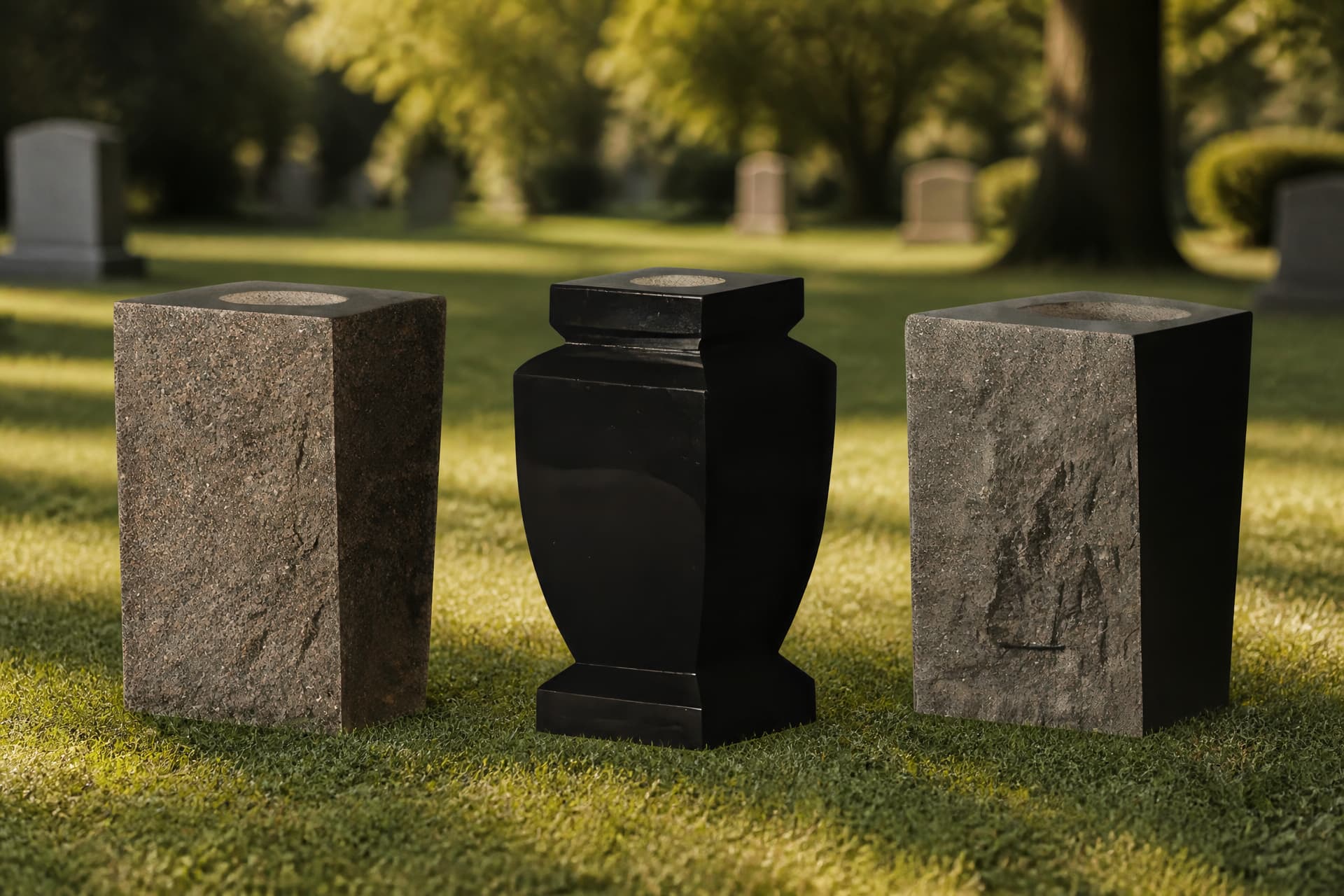
The flower is cempasúchil, the Mexican marigold, and it is on the altar for its smell rather than its color. The scent is what the souls are said to follow, which is why the petals are pulled off the head and strewn in a loose path — from the street to the door, from the door to the table, from the cemetery gate to the plot. A vase of them looks handsome; a path of loose petals is what the custom is actually asking for. Families taking flowers to the cemetery rather than the house often use the fixed grave vases already set into the plot, which hold a heavy bunch upright in wind that would flatten a jar.
The rest of the table goes quickly, and none of it is optional in the eyes of the family that puts it there. Pan de muerto, the round sweet bread with a bone shape worked across the top. Calaveritas de azúcar — sugar skulls, often with a name written across the forehead, and the name is usually a living person's, which is the joke and the point. Copal, a tree resin burned as incense, whose smoke is said to clear the way. Salt, laid out in a small cross or a dish: a Tlaquepaque artisan quoted by Smithsonian Magazine explained it plainly, that the salt is there so the soul "won't be corrupted." A glass of water for the walk. And the papel picado overhead, cut in skeletons and flowers and birds, standing for air because it moves — and, in the version many families tell, holed so the souls can pass straight through.
The dates are Catholic before they are anything else, whatever the holiday's older roots turn out to be — and those are genuinely disputed rather than settled, so treat any page that dates the tradition to a precise number of thousands of years with suspicion. November 1 is All Saints' Day and November 2 is All Souls' Day, and the ofrenda sits on that calendar. Families who want a devotional structure around the two days often keep the nine-day cycle instead of or alongside the altar; our novena prayer for the dead covers how that is counted and prayed.
Fixing a date for the dead is a thing cultures do generally, and comparing how they count is more interesting than listing customs side by side. Buddhist families mark 49 days after death as the span of a passage that happens once. The novena counts nine. Día de los Muertos does something different from both: it fixes an annual date and repeats it forever, so the relationship has no end point and does not need one.
The photograph is the one thing you cannot leave off
Every element on an ofrenda is negotiable except one. Food can be substituted, flowers can be the wrong species, the levels can collapse to a single shelf, and the altar still works. Leave off the photograph and it is a table of nice objects. The picture is what makes the ofrenda a specific person's, and it takes the highest position for that reason.
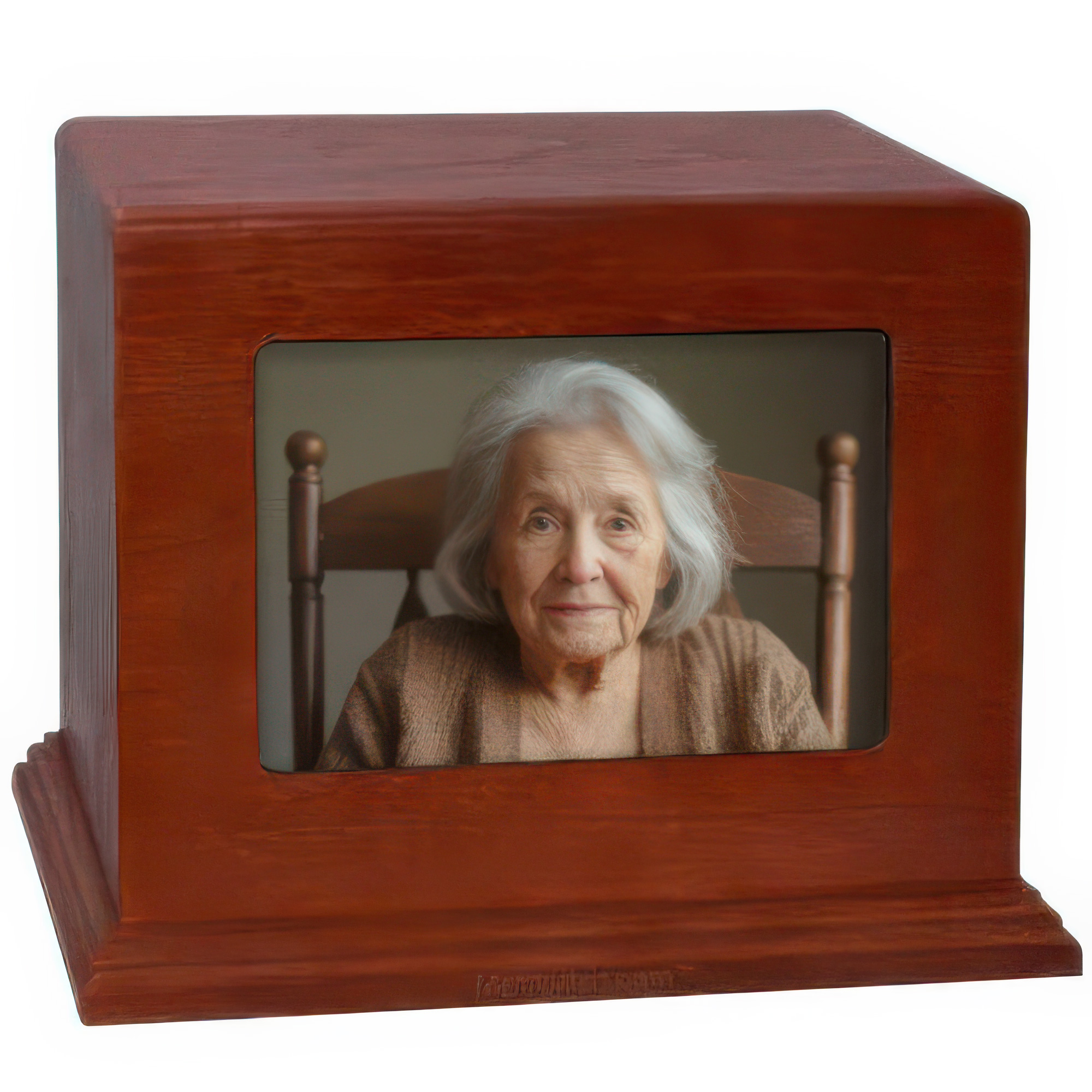
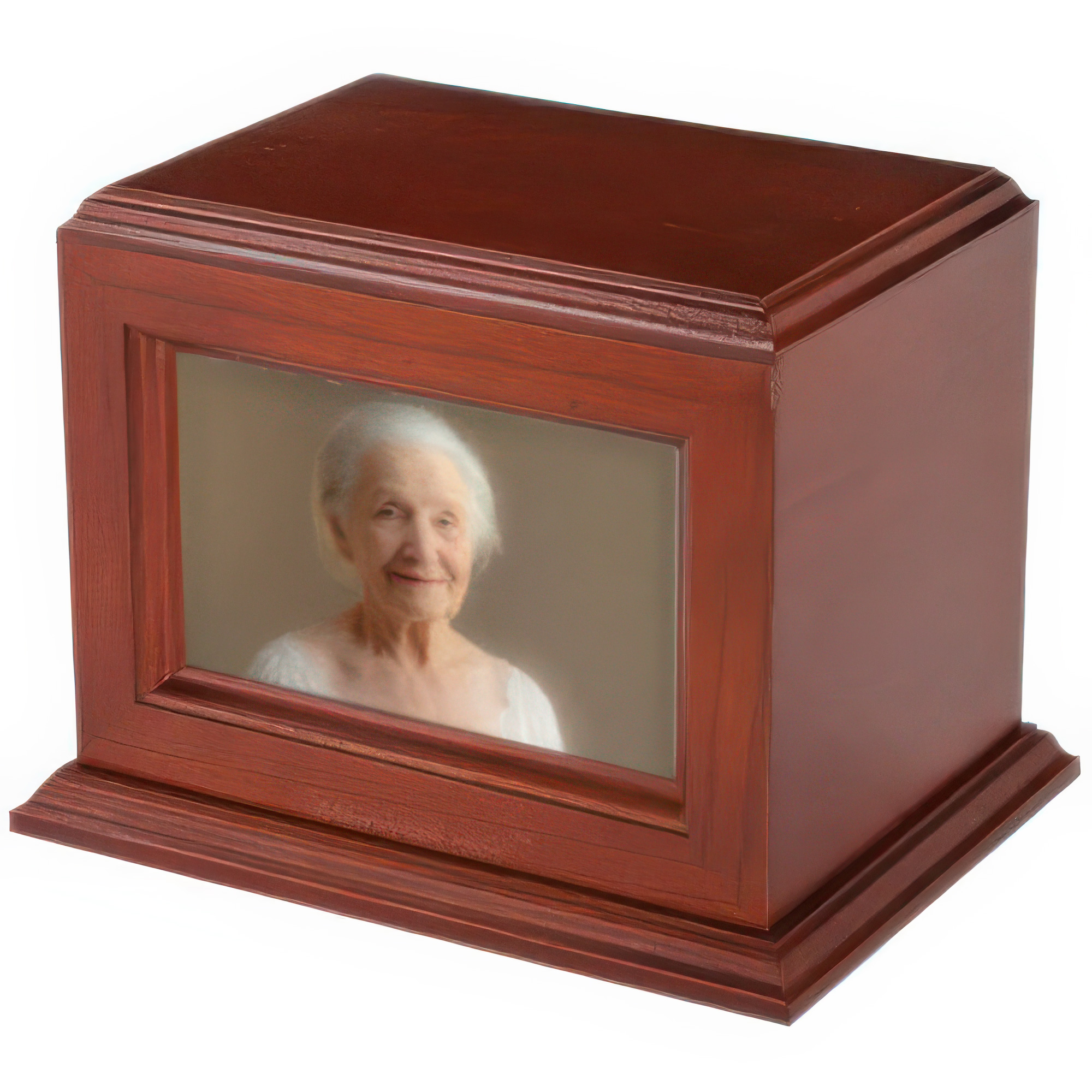
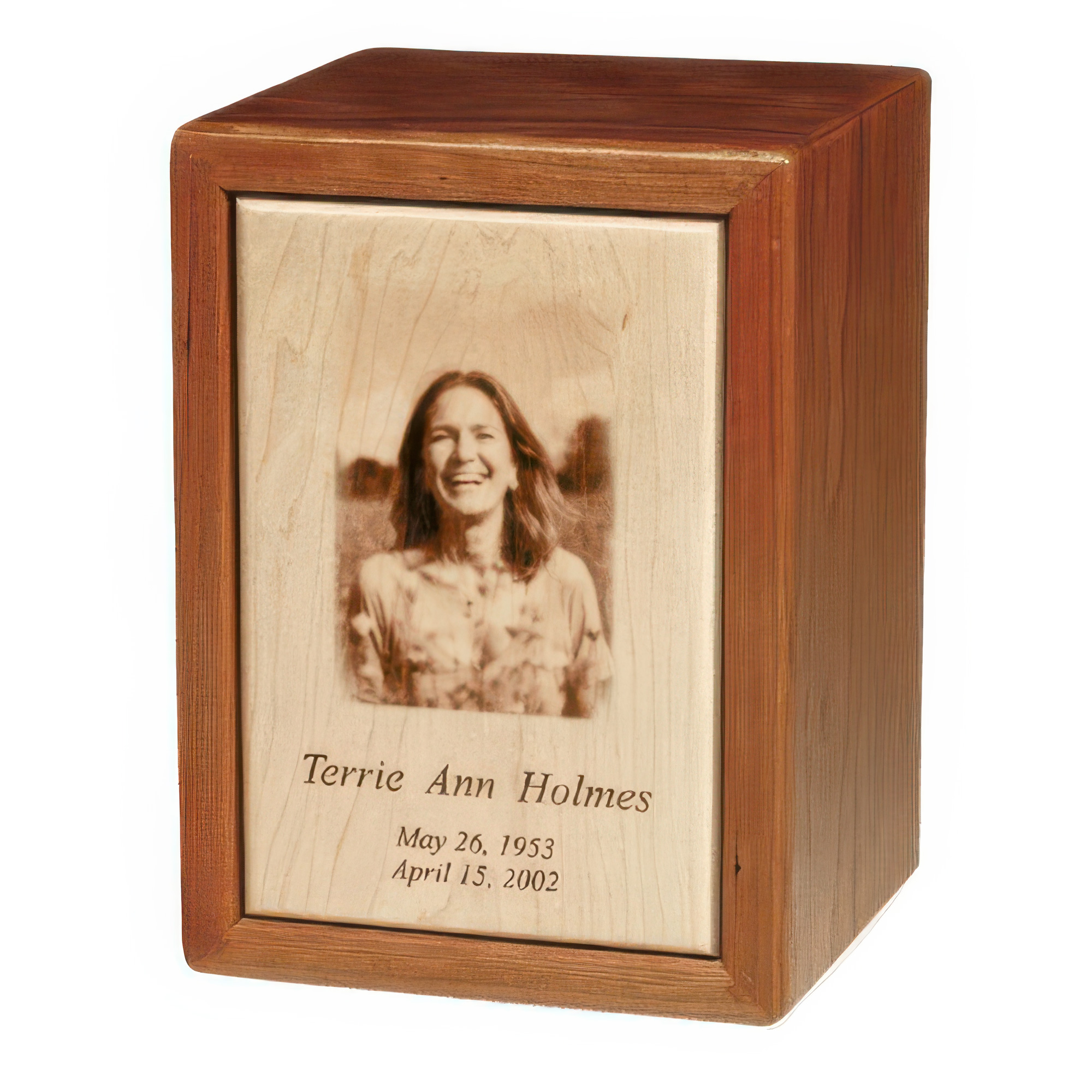
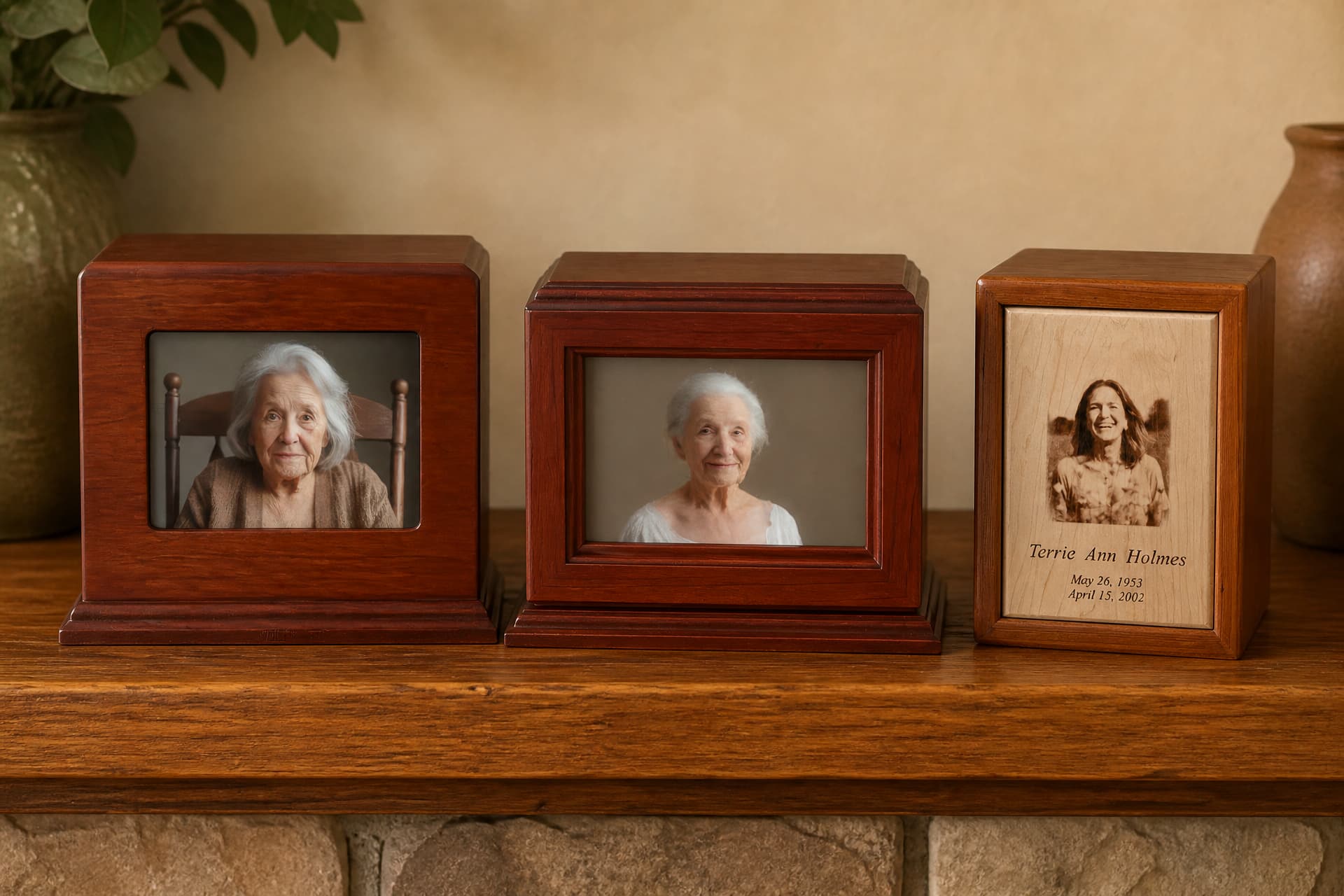
Families who kept a portion of the ashes rather than burying all of them usually find that the shelf sorts itself out — the photograph and the ashes end up in the same place, because that is where people already look. Some go a step further and choose a custom urn with picture, so the vessel carries the face and the two are one object rather than two. It is a plain practical answer to a question the altar raises every November, and it is the only thing on this page you can put on a shelf year-round.
The question sits under a great many searches and almost nobody answers it: may I build one of these if I am not Mexican? The short answer is that you may build one for your own dead, and that is the version of the practice that travels.
The distinction worth holding is between the structure and the iconography. A table, a photograph, a light, food the person liked, and a night set aside for them — that is a shape, and shapes are shared. Nobody owns the idea of feeding the dead. The specific religious objects are a different matter: a figure of a saint your family does not venerate, a Catholic cross in a house that keeps none, an image borrowed because it looked right in photographs. Those belong to somebody's practice, and the ordinary courtesy is to ask before borrowing them, exactly as you would with any other family's religious things.
Two habits will keep you out of trouble. Do not treat the catrina — the elegant skeleton figure that came from José Guadalupe Posada's engraving — as a costume; she is satire about class, not a Halloween mask. And do not call the holiday Mexican Halloween. The two fall days apart and share an origin in the Christian calendar, which is the whole of the connection. One is about being frightened of the dead and the other is about setting a place for them, and the people who keep this tradition hear the comparison constantly.
If someone has invited you to their family's ofrenda, bring something for the table. Flowers, bread, a bottle of something the person liked. The altar is built for guests, and the living count.
The vigil at the panteón is the loudest, most social part of the holiday and the part outsiders least expect. A cemetery on the night of November 2 sounds like a family reunion, because that is what it is.
Frequently Asked Questions
How many candles go on an ofrenda?
There is no fixed number. The usual reasons to add one are: a candle for each person the altar is built for, four more set as a cross at the cardinal points where a family keeps that custom, and one for the souls nobody is left to remember. A small altar for one person may carry three or four candles; a family altar carries as many as the table safely holds.
What color candles are used for Día de los Muertos?
White is the most common and the safest choice if you want one — it is read as light and purity and is never out of place. Purple is often associated with mourning, and yellow and orange with the marigolds and the souls being remembered. These are folk conventions that vary by region and by family rather than a fixed code, so a family's own habit outranks any list.
When do you light the candles, and how long do they burn?
Most families light the altar on the evening of October 31 or the morning of November 1 and keep it burning through the end of November 2. Tapers get relit as they burn down; a veladora in a glass jar will run continuously for days, which is why it is the candle of choice for a household where nobody is home during the day.
Do you have to be Mexican to build an ofrenda?
No. Building one for your own dead is a use of the form, not an appropriation of it, and Mexican and Mexican-American families are generally welcoming about exactly that. What deserves care is the religious iconography — saints, crosses, imagery belonging to a practice that is not yours. Ask before borrowing those, and do not wear the tradition as a costume.
Can you leave candles burning at a grave overnight?
In Mexico, on those two nights, that is the whole point of the vigil. In the United States it depends entirely on the cemetery: most lock their gates at dusk and many prohibit open flame on the grounds at any hour. Call the office and ask before you plan an evening there. Where flame is not allowed, battery lanterns and solar fixtures are the accepted substitute and are usually permitted year-round.
Keeping the light after November 2
The candles come down on the third. The marigolds go brown, the bread gets eaten, the table goes back under the window, and the house is a house again. That is not a failure of the tradition, it is the design of it — an ofrenda is temporary on purpose, because a welcome that never ends is not a welcome.
What stays is the photograph, and usually the shelf it sits on. Families who found the two nights useful tend to keep some small version of the light going the rest of the year: a candle on a birthday, a lamp on an anniversary, a fixture at the grave that comes on by itself at dusk. None of that requires the holiday, and none of it requires anybody's permission.
If the part you want to keep is the lit grave rather than the lit table, that is the one thing here that can be made permanent. Our cemetery lighting is built to stay out through weather and to come on every evening without anyone driving over to see to it — the ordinary-time version of the same idea, which is simply that nobody you loved should have to lie in the dark.