🏬Supersize Online Funeral Retailer🪦1000's of Headstones⚱️Over 10,000 Cremation Urns⚰️Caskets Overnight Delivery🛒Funeral & Memorial Superstore🚚FREE Shipping on ALL Orders👨👩👧👦Helping Families for over 20 Years💰Lowest Price Guarantee🏬Supersize Online Funeral Retailer🪦1000's of Headstones⚱️Over 10,000 Cremation Urns⚰️Caskets Overnight Delivery🛒Funeral & Memorial Superstore🚚FREE Shipping on ALL Orders👨👩👧👦Helping Families for over 20 Years💰Lowest Price Guarantee
🏬Supersize Online Funeral Retailer🪦1000's of Headstones⚱️Over 10,000 Cremation Urns⚰️Caskets Overnight Delivery🛒Funeral & Memorial Superstore🚚FREE Shipping on ALL Orders👨👩👧👦Helping Families for over 20 Years💰Lowest Price Guarantee🏬Supersize Online Funeral Retailer🪦1000's of Headstones⚱️Over 10,000 Cremation Urns⚰️Caskets Overnight Delivery🛒Funeral & Memorial Superstore🚚FREE Shipping on ALL Orders👨👩👧👦Helping Families for over 20 Years💰Lowest Price Guarantee
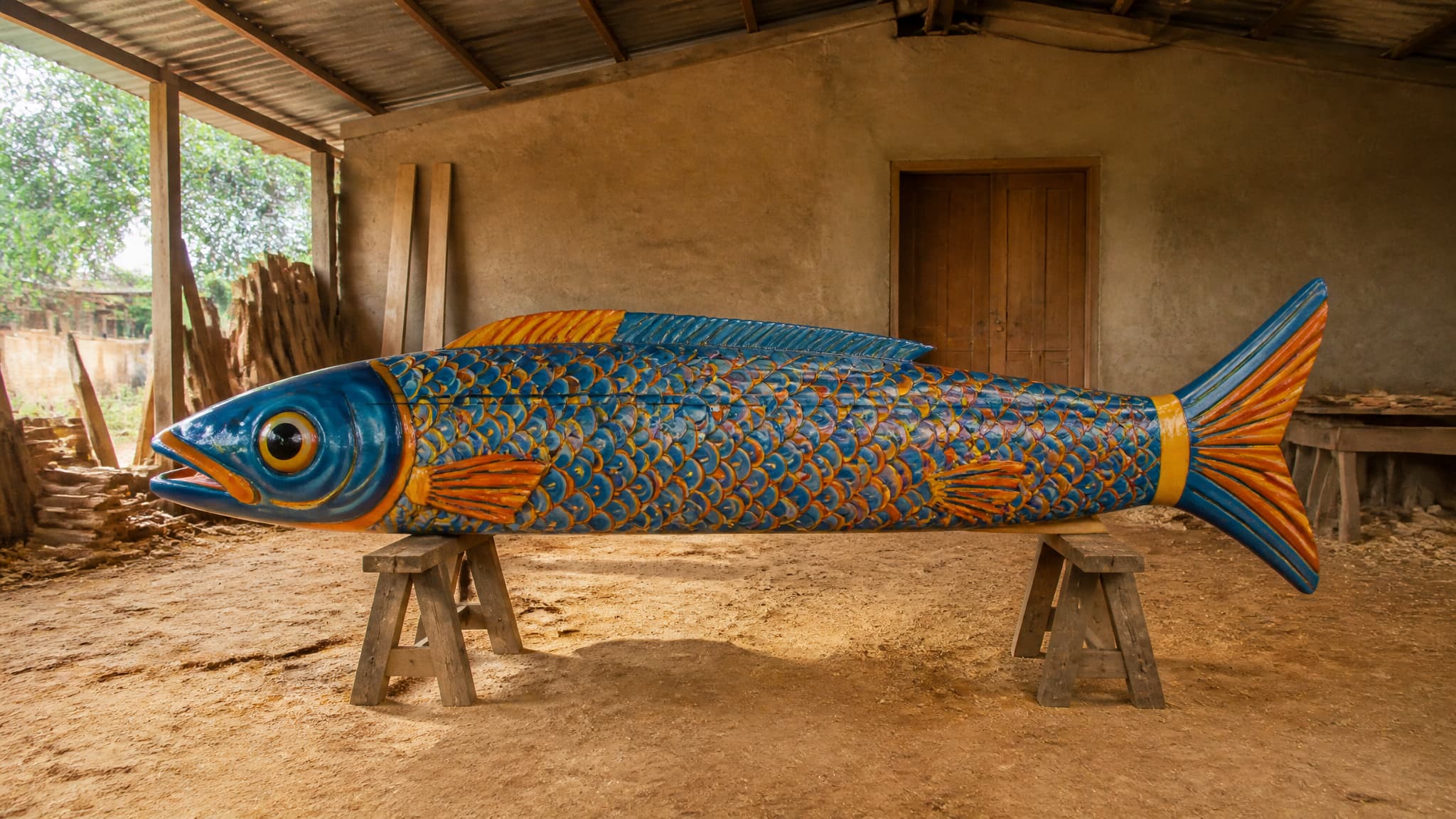
A fisherman is buried inside a painted fish. A cocoa farmer goes to his grave in a cocoa pod, a seamstress in a sewing machine, a woman who raised six children in a hen with her chicks gathered under her. These are fantasy coffins, and the first thing worth saying about them is that they are not sculpture. They are commissioned by grieving families, carried through the streets of Accra on the shoulders of men who knew the person, lowered into a grave, and covered over. The carving that took two weeks and cost the family real money is never seen again.
The tradition belongs to the Ga people of coastal Ghana, and it is younger than most people assume — roughly seventy-five years old, not ancient. This page covers what the shapes mean, who carves them, how long one takes and what it costs, and the question American readers usually arrive with, which is whether you could ever be buried in one here. It is one of the more startling entries in our , and one of the most consistently misdescribed.
What Fantasy Coffins Are, and Why They Are Coffins Rather Than Caskets
The Ga term is abebuu adekai, usually translated as "receptacles of proverbs" or, more loosely, "proverb coffins." That translation is the whole idea in two words. The shape is not decoration applied to a box. The shape is a statement about the person, made in the same way a proverb makes one — compressed, public, and legible to everyone standing at the graveside.
They come from Greater Accra, the region around Ghana's capital, and above all from the coastal towns of Teshie, Nungua and La, where the workshops that built the tradition still stand.
The English name is a translation of convenience, and not a very good one. Photo essays and museum labels call them Ghanaian coffins, figurative coffins, or simply Ghana coffins, and most people who arrive at the subject do so after seeing one photograph and typing "fantasy coffins Ghana" into a search box. The Ga mostly just call them coffins. The word "fantasy" is ours, and it carries an implication the tradition does not — that these objects are whimsical, or optional, or a little bit of a joke.
The casket vs coffin distinction is a real one rather than a synonym problem, and these fall firmly on the coffin side of it: a coffin is shaped, where the American standard is a rectangular box. That difference is the whole tradition in miniature. A rectangular box says nothing at all about who is inside it. A coffin carved as a canoe, an eagle or a bottle of beer says almost everything.
One correction worth making early, because nearly every article gets it wrong by omission: this is not how everyone in the country is buried. Most coffins in Ghana are ordinary. A commissioned figure is a mark of standing, of a family's love, and of a family's willingness to spend — which is a decision with weight to it, not a stylistic preference.
Where the Tradition Came From
The lineage everyone agrees on runs through the palanquin. Ga chiefs are carried at festivals in figurative palanquins — a carried chair built in the shape of an animal, a fruit, a symbol of the office — and those had been made in the region since the early twentieth century. A figurative coffin, on that reading, is the last palanquin a person rides.
Seth Kane Kwei, a carpenter from Teshie who lived from 1922 to 1992, is the name most associated with the form, which took hold around 1950. Paa Joe, born in 1947 and now the best-known living carver of these coffins, worked as his assistant before setting up on his own. A third name complicates the neat story: Ataa Oko, a carver from La, may have been making figurative coffins as early as 1945. The record is thin enough that "may have" is the honest way to put it, and the date is disputed rather than settled.
By around 1960 the coffins had stopped being a novelty and become an established part of funeral culture in Greater Accra. From Teshie and Nungua the practice spread inland, to Awutu Bawyiase, Pobiman and workshops scattered around the capital. A Ghana coffin has never been a mass-produced object at any point in that history; each one is drawn, argued over and built for one funeral.
Set against the history of coffins generally — millennia of chests, boxes, shrouds and stone — a painted fish from 1950s Accra is a startlingly recent invention, and one of very few genuinely new ideas anyone has had about what to bury a person in.
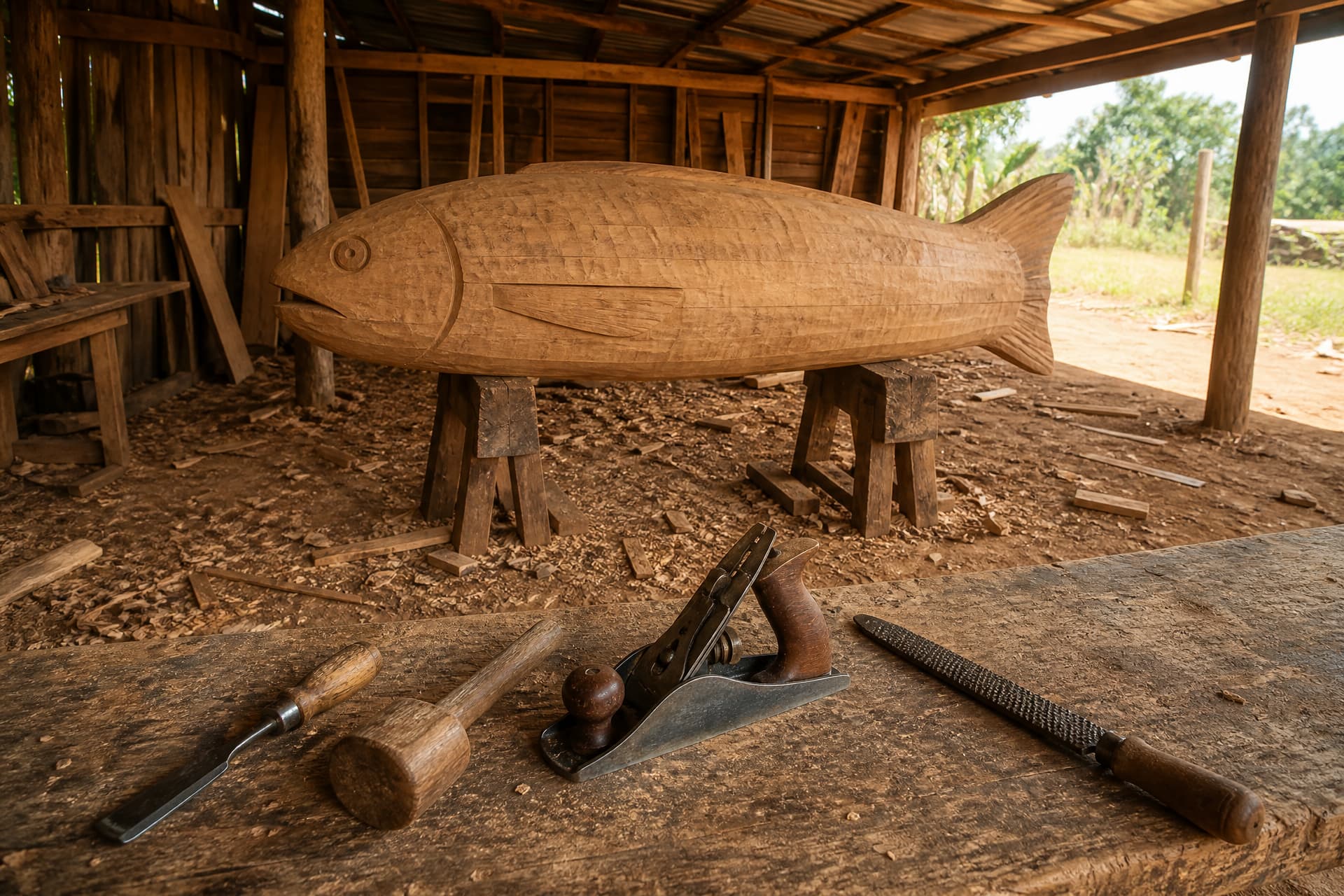
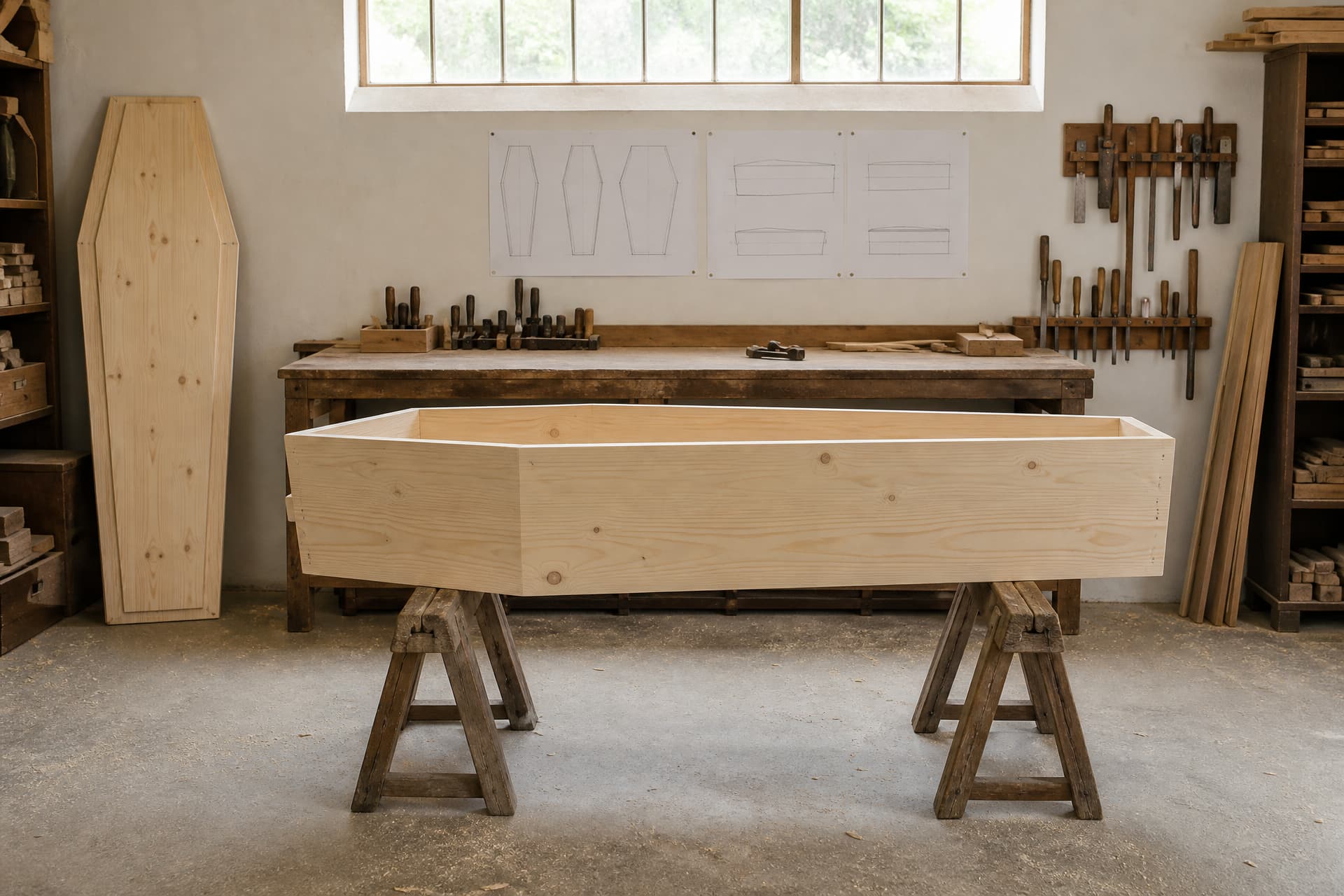
An unpainted form in the middle of a build. The shape is cut, joined and filled before any color goes on, and most of the labor happens at this stage.
How a Life Becomes a Shape
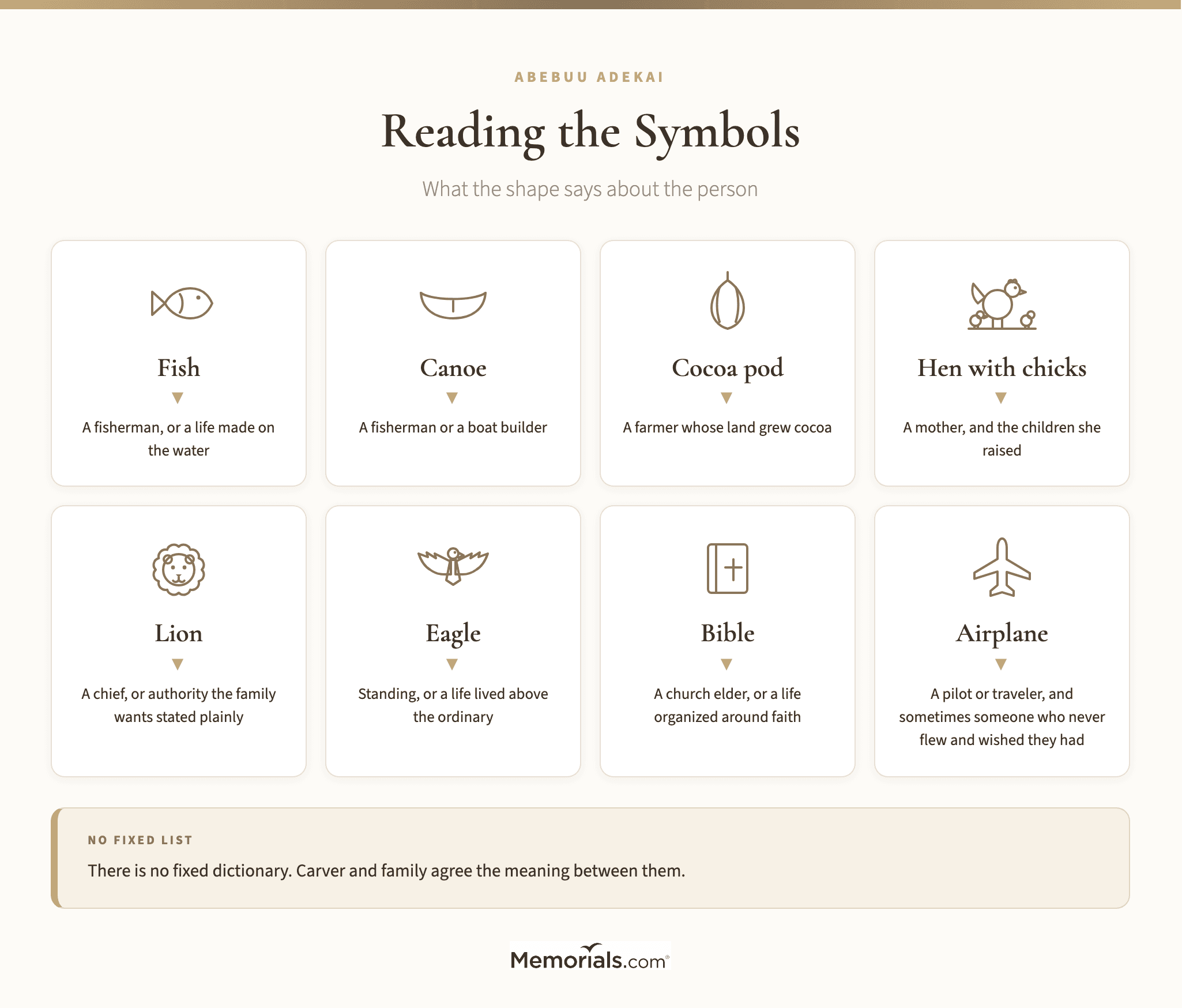
The reading is usually straightforward, and that is the point — a proverb nobody understands is not a proverb. A fish or a canoe for a fisherman. A cocoa pod for a farmer whose land grew cocoa. A hen with chicks for a mother. A lion or an eagle for a chief, or for someone whose authority the family wants stated plainly. A Bible for a church elder. An airplane for a pilot, a traveler, or sometimes for someone who never flew and wished they had.
That last category matters more than the lists suggest. A shape can record what someone did for a living, but it can also record what they longed for, what their clan claims as its symbol, or the single thing the family most wants said about them out loud. There is no dictionary. Carver and family agree the meaning between them, usually across several conversations, and the meaning is settled locally rather than looked up.
Nor is every shape solemn. Beer bottles, cell phones, Mercedes sedans and sneakers have all been carved, and a shape that reads as comic to an outsider often reads to the family as exact. A man who spent forty years driving a taxi is not being mocked by a taxi.
The common shapes and the reading behind each. Meanings are agreed between the carver and the family rather than fixed by any list, so treat these as the usual sense rather than a code.
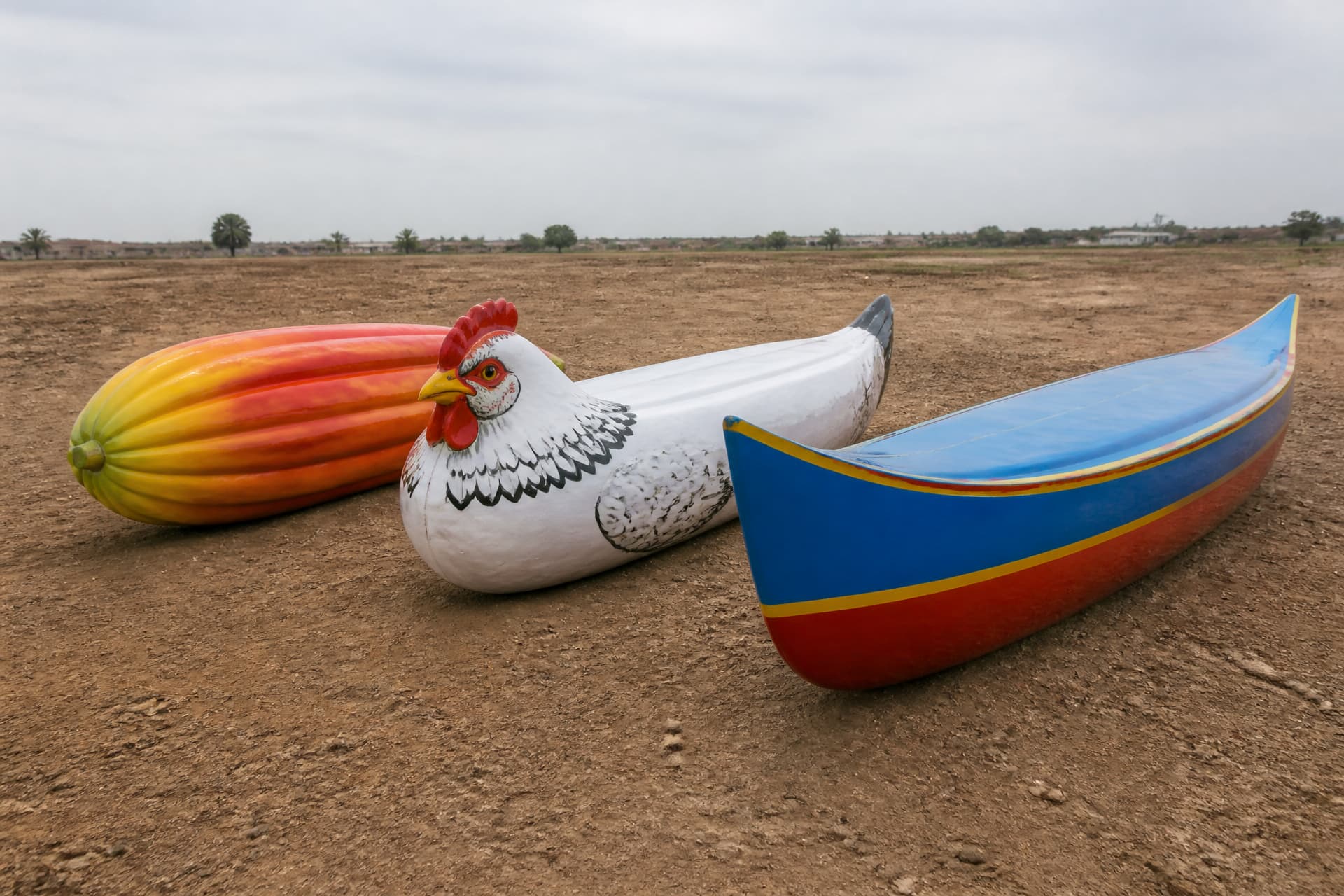
Three finished commissions waiting for collection. Each was drawn from a conversation about one person, which is why no two workshops produce the same catalog.
How a Fantasy Coffin Is Made
The usual material is wawa, a light local softwood that carves easily and keeps the finished piece light enough for six or eight men to carry shoulder-high. Costlier commissions are built in mahogany, which is heavier, more expensive, and holds fine detail better.
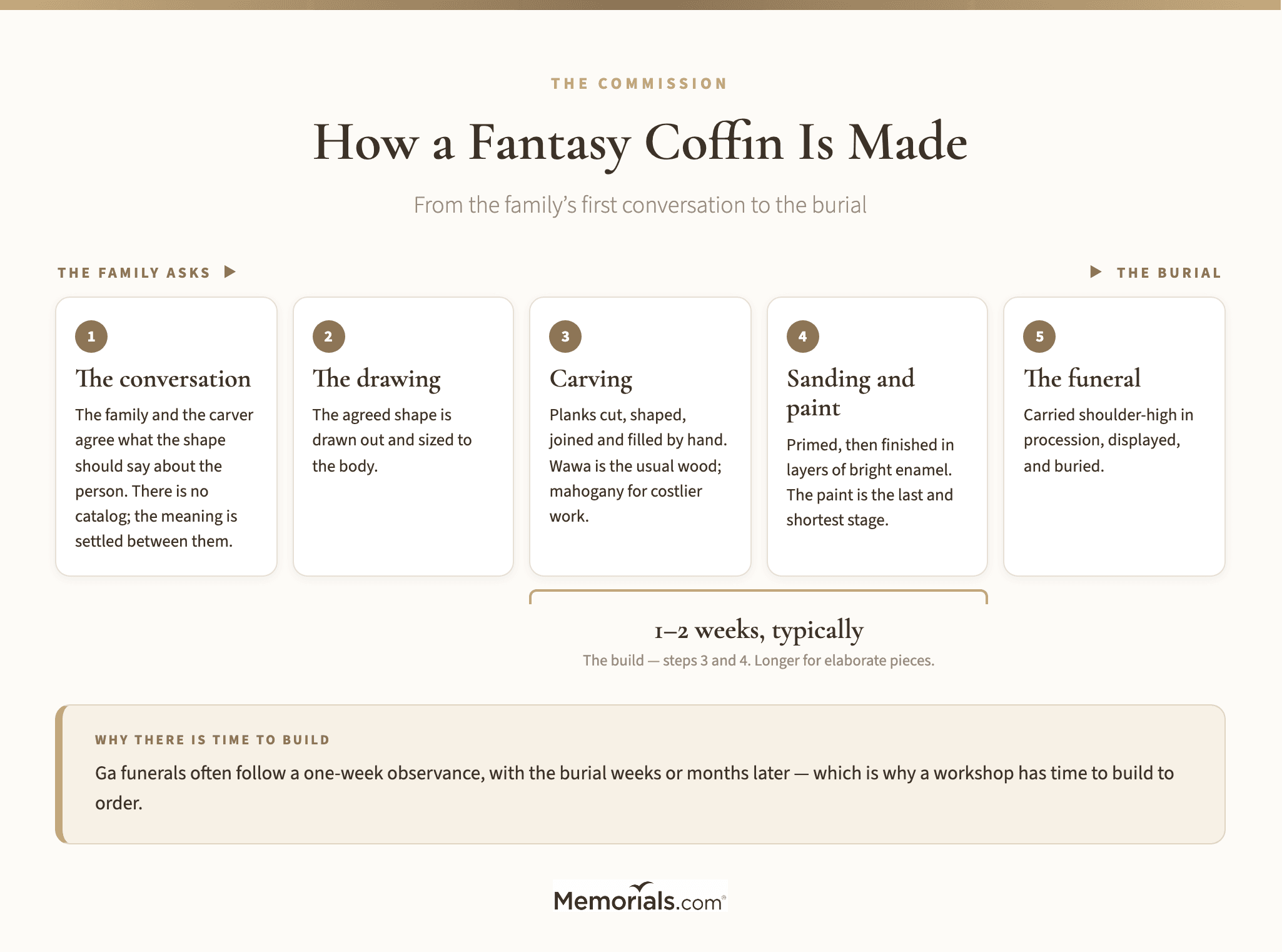
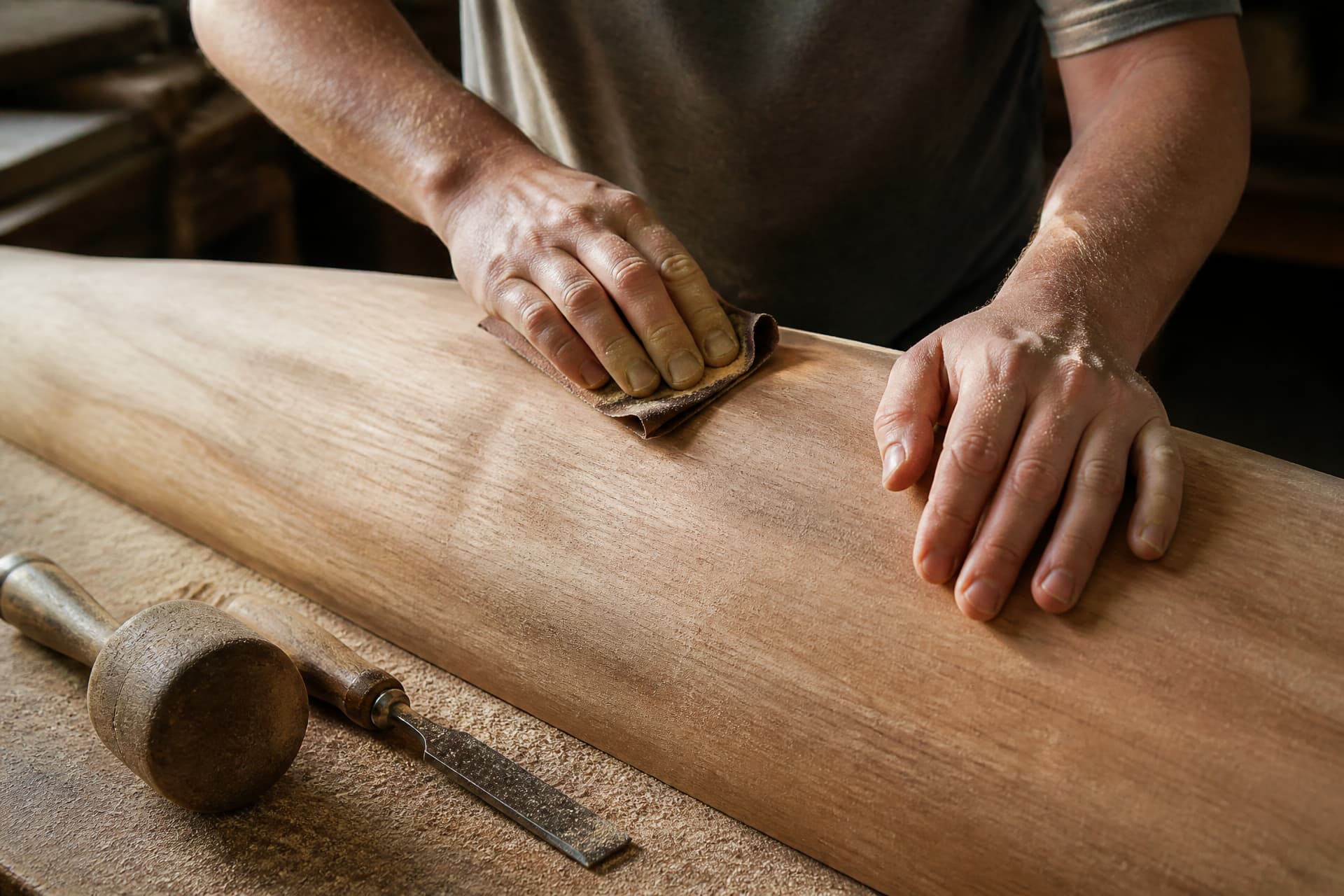
The work is done by hand. Planks are cut and shaped, joined into the rough form, filled and sanded smooth, primed, and then painted in layers of bright enamel — the color is the last stage and the shortest one, which surprises people who assume the paint is the craft. A typical commission takes somewhere between one and two weeks, though an elaborate piece takes longer and a workshop under pressure has been known to work through the nights before a funeral.
There is time for this because of how Ga funerals are scheduled. A one-week observance is commonly held soon after a death, with the burial itself following weeks or even months later once relatives have traveled and the family has raised what the funeral will cost. A carver working to that calendar is not building overnight.
A dozen or so workshops are usually said to operate around greater Accra, though nobody keeps a register and the number moves. The best known are the Kane Kwei Carpentry Workshop in Teshie and Hello Design Coffin Works, run by Daniel "Hello" Mensah; Eric Adjetey Anang, Kudjoe Affutu and Eric Kpakpo are among the carvers whose work is documented outside Ghana.
A commission runs from conversation to burial in five stages. The build is shown as a one-to-two-week span rather than a fixed schedule, because reported times vary with the size and detail of the piece.
Sanding the shaped shell before priming. Almost all of the shaping is done with hand tools, and the smoothness of this stage is what the enamel finish depends on.
What a Fantasy Coffin Costs
Prices for fantasy coffins in Ghana are not published anywhere, and every figure in circulation comes from a journalist asking a carver rather than from a price list. Published numbers disagree with each other by an order of magnitude, so the honest answer is a range with the reason for the range attached.
At the local end, a modest commission has been reported at a few hundred dollars. That is not a small sum in Ghana, and families have been known to spend past what they can comfortably afford, which is part of a long-running national conversation about how much funerals cost.
An export commission — carved to order and shipped abroad — is usually quoted at around three thousand dollars before freight, and freighting a crate the size of a coffin is its own expense. Elaborate international and gallery pieces have been quoted as high as ten to fifteen thousand dollars.
What moves a price: the wood, the size, how much fine carving and how many separate parts the shape needs, whether the finish is a simple enamel or something more detailed, and above all whether the piece is leaving the country. Anyone quoting you one flat number for this tradition is guessing.
Sacred Object, Museum Piece, or Both
Ghana fantasy coffins are held in museum collections on three continents. The Musée National d'Art Moderne at the Centre Pompidou in Paris holds them, as do the Los Angeles County Museum of Art, the Honolulu Museum of Art, Kunstmuseum Bern, the Sainsbury Centre for Visual Arts in England and the Collection de l'Art Brut in Lausanne. Paa Joe's work in particular has traveled widely, and several carvers have built international reputations that their grandfathers' generation could not have imagined.
There is a real tension in that, and it is worth naming rather than smoothing over. An object designed to be buried within two weeks of being finished is, in a museum, doing the opposite of its job. A coffin in a vitrine is a coffin that has never held anyone.
The two markets have coexisted for decades and both are legitimate — collectors' commissions have kept workshops solvent and carried the form's reputation abroad, which is a large part of why the tradition is still alive and still being taught. But keep the two objects separate in your head. One is a coffin. The other is a sculpture in the shape of one, and its meaning is different because the funeral is missing.
Other Traditions Where the Coffin Carries the Story
The Ga are not alone in refusing to treat the container as neutral, though the direction each tradition takes is different.
Elsewhere the coffin is placed rather than shaped. The hanging coffins fastened high on cliff faces in parts of southern China and the Philippines make their statement through position — putting the dead above the living, closer to the sky and out of reach — rather than through form.
A Viking funeral makes the vessel the whole point in a third way. A ship, whether burned, buried, or laid out in standing stones, says that the dead are traveling and that they are traveling as the people they were.
The newest version of the idea is neither shape nor placement but material. Mushroom coffins grown from mycelium are built to break down quickly and feed what grows above them, which is its own kind of statement about what a person's last object should do.
The Funeral as Celebration
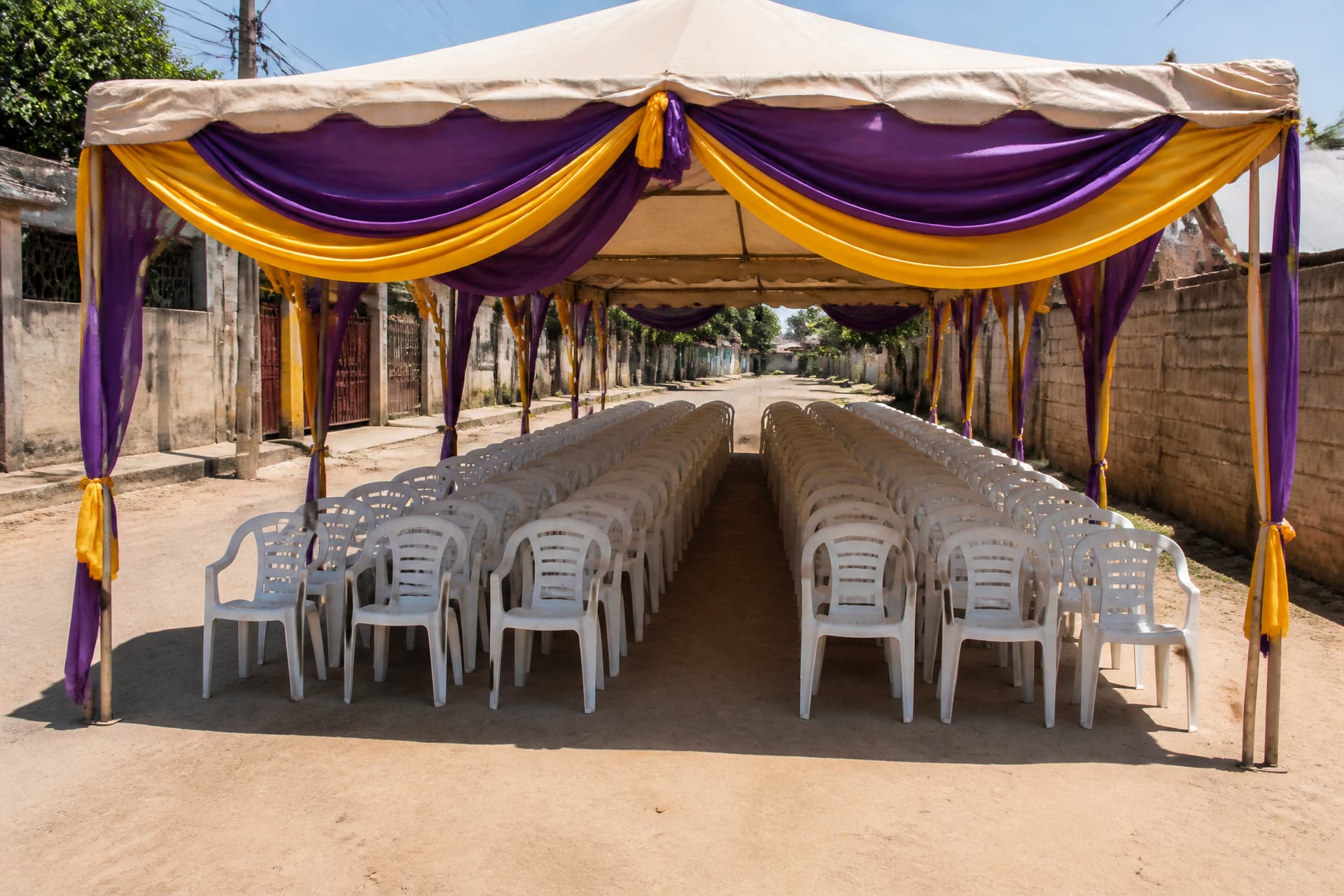
A Ga funeral is a public event on a scale most American readers have no reference for. Announcements go up on posters. Hundreds of people attend, in coordinated cloth. There is music, food, dancing, a professional master of ceremonies, and a procession in which the coffin is carried high and turned so that everyone can see it. The coffin is meant to be looked at. Building something extraordinary and then hiding it would defeat the purpose.
The closest American parallel is the New Orleans second line funeral, where a brass band leads mourners from the church and the crowd that joins along the route turns grief into something the whole street participates in. The instinct is identical: a death is a public fact, and a community marks it in public.
Irish wake traditions belong to the same family of practice — days of visitors, food, storytelling and laughter held in the same room as the body. None of these traditions treat sorrow and celebration as opposites, which is the assumption a quiet American funeral is usually built on.
Underneath all of it sits a view of the dead that Western funerals mostly leave unstated: the dead are not gone, they are relatives in a different position. Madagascar's famadihana makes that assumption more literally than most, with families returning to their ancestors at intervals rather than visiting them once and leaving. A coffin built to carry a person's identity forward makes very little sense without something like that belief behind it.
The setting before the crowd arrives. Ga funerals are held outdoors at scale, and the coffin is displayed rather than concealed, which is part of why the carving matters.
Can You Have a Fantasy Coffin in the United States?
Probably, with far more friction than you expect, and the obstacles are almost never the ones people assume. Legality is rarely the problem. Logistics and timing usually are.
Start with the cemetery, before you commission anything. Cemeteries set their own rules, and those rules are contractual rather than statutory in most cases. What they will care about is dimensions — the grave is dug to a standard size, and a shaped coffin is often wider, taller or longer than a rectangular one — and whether the cemetery requires a concrete grave liner, which is sized for a standard box and will not accommodate a hen with chicks. Ask them directly and get the answer before money changes hands. It is an ordinary question and the office will have heard stranger ones.
If cremation is the plan, ask the crematory instead. Chambers have size limits, and operators have rules about finishes and materials that go into them. A large, heavily enameled shape may simply not be accepted, and that is a conversation to have first rather than last.
Then there is time, which is the real barrier. American funerals typically happen within days to a couple of weeks. A commission in Ghana takes one to two weeks to build, plus international freight for a crate the size of a coffin, plus customs. That arithmetic does not work for a death that happened on Tuesday. It works reasonably well for someone planning their own funeral in advance, which is the only realistic path to an imported piece — and it is worth knowing that this is a pre-planning decision, not a decision anyone makes in a funeral home the day after.
The domestic route is simpler. Independent woodworkers and small coffin builders in the United States will take a shaped or painted commission, and a plain coffin can be painted, carved or decorated by a family who wants to do the work themselves. If it is the underlying instinct that appeals rather than the object, there are alternatives to traditional funerals closer to home that get at the same thing without a shipping container.
On the question of whether it is yours to do: this is a Ga tradition, made by Ga carvers, and there is a clean line through it. Commissioning a piece from a workshop in Teshie or Nungua is participating in a trade the tradition has always had — export work is part of how those workshops have stayed open and how the form became known at all. Copying the idea somewhere else, without the makers, is a different act, because it takes the shape and leaves the people who invented it. If the idea moves you, commission it from the people whose tradition it is, or do the underlying thing in your own idiom: make the container say something true about the person inside it.
The domestic version of the same instinct. A local woodworker taking a shaped or painted commission avoids the freight, the customs delay and the appropriation question at once.
Frequently Asked Questions
What does abebuu adekai mean?
It is the Ga term for these coffins, usually translated as "receptacles of proverbs" or "proverb coffins." The translation explains the tradition better than the English name does: the shape functions as a compressed public statement about the person, in the way a proverb makes a point in a few words.
How much does a fantasy coffin cost?
Sources disagree by an order of magnitude, so treat any single figure with suspicion. Local commissions have been reported starting in the low hundreds of dollars; export commissions are commonly quoted at around three thousand dollars before shipping; elaborate international pieces have been quoted as high as ten to fifteen thousand. No price list exists, and cost moves with wood, size, detail and whether the piece leaves the country.
How long does it take to make one, and what wood is used?
Roughly one to two weeks for a typical commission, longer for something complex. Most are carved from wawa, a light local softwood that keeps the finished piece carryable; mahogany is used for costlier work because it is heavier, more expensive and holds detail better.
Who makes fantasy coffins in Ghana?
Seth Kane Kwei, who died in 1992, is the carpenter most associated with the form. Paa Joe, his former assistant, is the best-known living maker. Daniel "Hello" Mensah, Eric Adjetey Anang, Kudjoe Affutu and Eric Kpakpo are among the other carvers whose work is documented, and roughly a dozen workshops are usually said to operate around greater Accra, concentrated in Teshie and Nungua.
Can you be buried in a fantasy coffin in the United States?
Usually yes, but the cemetery decides, not the state. Ask about grave dimensions and whether a concrete liner is required, since a shaped coffin often will not fit one sized for a rectangular box. For cremation, ask the crematory about chamber size and finishes. The harder problem is time: a commission plus international freight takes far longer than the few days most American funerals allow, which makes an imported piece a pre-planning decision rather than an at-need one.
What the Tradition Actually Asks
Strip away the paint and the photographs and the tradition is making a simple demand, one that has nothing to do with Ghana: that the container should say something true. A hen with chicks is not a design choice. It is a family deciding, in public and at expense, that the most important fact about a woman was that she raised her children, and then paying a carver to make that fact visible to everyone who came.
Most American funerals do not ask that question at all. The container is selected from a small range in a difficult hour, and it says nothing except that a funeral is happening. That is not a criticism of anyone making that choice under pressure — it is an observation that the choice is usually made by default rather than decided.
You do not need a carved fish to do what the Ga do. You need to have thought, before the day comes, about what one true thing you would want said. Whether the answer is a shape, an inscription, the music, or the room the wake is held in matters much less than having answered it. That is the part of this tradition that travels.