🏬Supersize Online Funeral Retailer🪦1000's of Headstones⚱️Over 10,000 Cremation Urns⚰️Caskets Overnight Delivery🛒Funeral & Memorial Superstore🚚FREE Shipping on ALL Orders👨👩👧👦Helping Families for over 20 Years💰Lowest Price Guarantee🏬Supersize Online Funeral Retailer🪦1000's of Headstones⚱️Over 10,000 Cremation Urns⚰️Caskets Overnight Delivery🛒Funeral & Memorial Superstore🚚FREE Shipping on ALL Orders👨👩👧👦Helping Families for over 20 Years💰Lowest Price Guarantee
🏬Supersize Online Funeral Retailer🪦1000's of Headstones⚱️Over 10,000 Cremation Urns⚰️Caskets Overnight Delivery🛒Funeral & Memorial Superstore🚚FREE Shipping on ALL Orders👨👩👧👦Helping Families for over 20 Years💰Lowest Price Guarantee🏬Supersize Online Funeral Retailer🪦1000's of Headstones⚱️Over 10,000 Cremation Urns⚰️Caskets Overnight Delivery🛒Funeral & Memorial Superstore🚚FREE Shipping on ALL Orders👨👩👧👦Helping Families for over 20 Years💰Lowest Price Guarantee
Most people looking for condolences for loss of mother are holding a pen over a blank card and have been for a while. So here is the short version before anything else: I am so sorry about your mom. She raised someone wonderful. You can send that exactly as written. It is warm, it is specific enough to mean something, and it does not ask the person receiving it to do anything.
The rest of this page is fifty more, sorted by who you are writing to and how well you knew her, because that is the thing that actually changes the wording. There is also a short section on what not to write, and one on what to do after the card, which is the part nobody covers.
If you want the mechanics of the card itself — structure, sign-off, what goes on the envelope — our guide to what to write in a sympathy card covers that, and the is the starting point for every other relationship.
This is the most-searched version of the question by a wide margin, and it is the right instinct. A card with one true sentence in it lands better than a card with a paragraph of arranged phrases.
I am so sorry about your mom.
Thinking of you and your family today.
Your mother was a lovely woman and I will miss her.
There are no words. I am just so sorry.
Sending you love. I am here whenever you want company.
I keep thinking about her. What a mom.
She was so proud of you. She told me often.
I am sorry. I loved her too.
Holding you close this week.
With deepest sympathy for the loss of your mother.
People type short sympathy for loss of mother and condolence messages loss of mother into a search bar interchangeably, and they want the same object: something that fits on the left-hand page of a card and does not sound like it came off a shelf. Any of the ten above will do that.
If the death was expected after a long illness, I am so glad she is not in pain, and so sorry she is gone is one of the few lines that acknowledges both halves honestly.
The short message is not the lazy option — a single true sentence usually reads better than an arranged paragraph.
People come looking for words of comfort for loss of mother expecting a phrase they have not thought of yet. What actually helps is narrower than that, and it is already visible in the line at the top of this page: She raised someone wonderful.
Say something about her. The most comforting sentence in a condolence message is almost always the one that is about the mother rather than about the grief. A person who has just lost her is being handed a great deal of sympathy and very little new information about who she was to other people, and that second thing is the part they keep.
Thoughtful means specific, not elaborate. People search thoughtful words loss of mother and then reach for length. The thoughtful part is the detail: She sent a card on my birthday every year without fail does more than a paragraph of arranged sympathy.
Write to the person, not the occasion. Searches for comforting words death of mother come disproportionately from colleagues, neighbors and in-laws — people who have to write something and are afraid of getting it wrong. For them the safest message is short, warm, and about her, and it does not need to pretend to a closeness that was not there.
Keep the comfort out of the future tense.It will get easier is a forecast, and a forecast is not a comfort in the first week. I am here either way says the same thing without asking them to believe it yet.
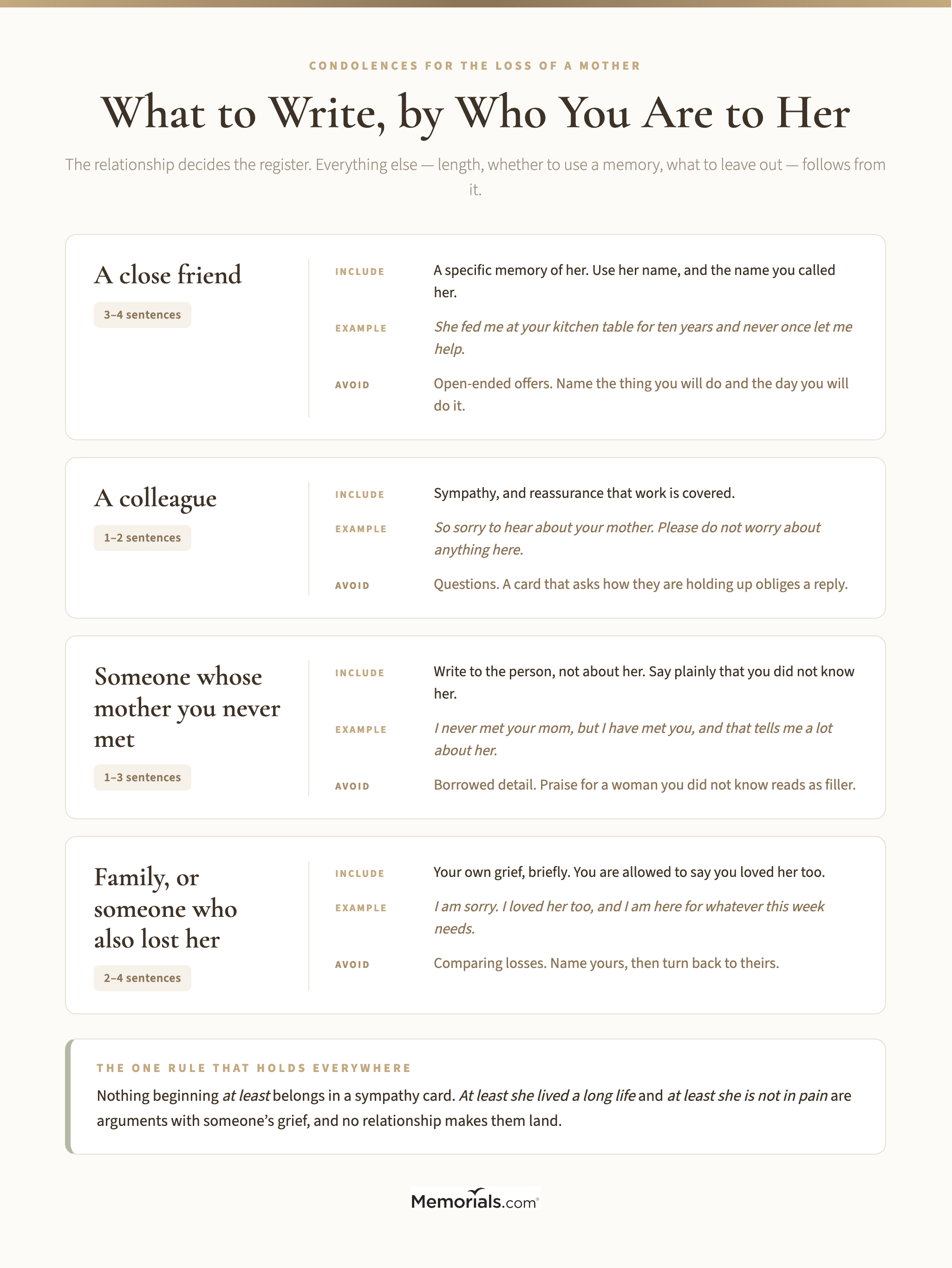
If You Are Writing to a Close Friend
You have latitude here that a colleague does not. Use her name. Use a memory. Say the thing you would say out loud.
I loved your mom. I loved how she answered the phone. I am so sorry.
She fed me at your kitchen table for ten years and never once let me help.
I keep expecting to see her at the door with a bag of groceries.
You are her, in every way that matters. She did that.
I am not going to ask if you are okay. I am bringing food over on Thursday.
She was the first adult who ever treated me like a person. I will not forget her.
Whatever this week needs, I am in. Errands, calls, sitting in silence.
I am so sorry. I loved her, and I am not going anywhere.
The strongest sympathy message for loss of mother from a close friend is almost always a memory rather than a sentiment, because a memory proves she was known. She taught me to drive in the grocery store parking lot does more work than a paragraph about strength and grace.
If You Are Writing to a Colleague
Warmer than a work email, cooler than the section above, and short. A colleague reading this at their desk on their first day back does not want to be undone by a card from the team.
So sorry to hear about your mother. Thinking of you.
Please do not worry about anything here. It is all covered.
I was sorry to hear your news. Take whatever time you need.
With sympathy from all of us on the team.
I lost my own mom two years ago. If you ever want to talk, I am around.
Sorry for your loss, and sorry I did not know her.
Two rules for the professional register. Do not ask questions — a card that asks how are you holding up? obliges a reply. And do not mention work in the same breath as the death; if cover needs arranging, that is a separate message.
Most people writing a card are in this position, and it is the case that produces the most anxious searching. You are not required to have known her. You are writing to the person, not about the mother.
I never met your mom, but I have met you, and that tells me a lot about her.
I am sorry. I wish I had known her.
I do not have the words for this, but I did not want to say nothing.
I am thinking of you, and of everything you have been carrying.
I am sorry for your loss. Please pass my sympathy to your family.
That third one is worth keeping. I did not want to say nothing is honest, and it is the reason most people are searching at all.
The register changes with the relationship, and it is the only thing that reliably does — length, whether to use a memory, and what to leave out all follow from who is writing.
Religious and Spiritual Messages
Match the family's tradition, not your own. If you are unsure what the family believes, the secular options above are the safer choice — a mismatched blessing reads as carelessness at exactly the wrong moment.
Christian
May she rest in the peace of Christ, and may God comfort you.
Praying for you and your family this week.
She is home. That does not make it easier, but it is true.
May the God of all comfort be near to you.
Jewish
May her memory be a blessing.
May you be comforted among the mourners of Zion and Jerusalem.
Wishing you a long life.
Muslim
Inna lillahi wa inna ilayhi raji'un. May Allah grant her Jannah.
May Allah give your family patience and ease.
Non-religious but spiritual
She is in every good thing you do.
Nothing that loved is ever really gone.
May her memory stay close and grow gentler.
May her memory be a blessing is the single most-used line in this whole category, and for good reason — it is warm, it centers her rather than the loss, and it carries no theology anyone has to agree with.
One practical note on names. If you knew her, use the name you used for her — Mrs. Alvarez, Dot, Grandma Ruth. If you did not, your mother is warmer in writing than your mom and never sounds presumptuous. And if the family used a different word than you would expect, follow theirs.
Where the family's tradition is unknown, a secular line is kinder than a mismatched blessing.
Sympathy Quotes for Loss of Mother
A quotation does a different job from a message. Sympathy quotes for loss of mother are usually wanted for the second line of a card, a memorial program, or a post — somewhere the words have to stand on their own rather than sound like you.
Safe to print, and safe to carve:
To live in hearts we leave behind is not to die. — Thomas Campbell, 1825
Her children arise up, and call her blessed. — Proverbs 31:28, King James Version
Say not in grief that she is no more, but live in thankfulness that she was. — traditional
Perhaps they are not stars, but rather openings in heaven where the love of our lost ones pours through. — traditional
Death leaves a heartache no one can heal; love leaves a memory no one can steal. — anonymous, and long carved on headstones
Modern, attributed, and fine for a card:Grief is the price we pay for love — Queen Elizabeth II, 2001. Short, secular, and it says the thing most people are trying to say.
Two cautions, because mother loss quotes travel a long way from their sources. The first is attribution: a line circulating on fifty sites with no author named is frequently modern rather than traditional, and the author has simply been lost in the copying. The second follows from it — memorial quotes for mom that will be engraved rather than printed are worth checking before they are cut, because a headstone is the most expensive place to find out a line is still in copyright. Our guide to what an epitaph is covers how an inscription is structured, and headstone inscriptions for mom has wording chosen for a stone rather than a card.
Card, Text, or Said Out Loud
The medium changes the length, not the sentiment.
A card can hold three or four sentences and will be reread months later — this is where a memory belongs. A text should be one or two lines and should not require an answer; no need to reply, just thinking of you is a complete message. In person, say less than you think. I am so sorry with eye contact beats anything longer.
For the digital version, what to say to someone who lost a loved one over text is mostly a question of timing and follow-up rather than wording — send it when you think of them, and send another one later.
Choosing between them is a judgment about the relationship rather than about the death, and it is the part people get wrong most often — a close friend sent an email reads as filed, a supplier sent a handwritten card reads as odd. How to offer condolences sets out which channel suits which relationship, and the sequence that follows the first message.
What Not to Write
Every one of these is well-meant and every one of them lands badly.
She is in a better place. It asks the reader to agree that somewhere is better than here with them.
At least she lived a long life. Any sentence starting at least is arguing with someone's grief.
I know exactly how you feel. You do not, and it turns the card toward you.
Everything happens for a reason. There is no reason, and offering one is worse than offering nothing.
Let me know if you need anything. Well intended, but it hands a task to the person least able to do it. Name a specific thing instead: I am bringing dinner over Tuesday unless you tell me not to.
Anything about the estate, the house, or the will. Not in the card.
The pattern is that comforting words loss of mother searches turn up a lot of phrases designed to close the subject. The good ones open it instead — they say I am here and I am not in a hurry.
After the Card
This is where most advice stops and where most of the help actually is.
The card arrives in the first week, when the house is full of casseroles and relatives. The hard part comes six weeks later when it empties, the phone stops, and everyone else's life resumes. Put the date in your calendar now, while you are thinking about it. Send a second message at a month, and again at the first birthday and the first Mother's Day — those two are the days people brace for privately and nobody mentions.
The second message does not need new material. Thinking of you today. Still miss her is enough, and it will mean more in November than anything you wrote in September.
If you want to send something alongside the card, bereavement gifts that do not need tending are the safest choice — a grieving household does not need another thing to water. Our guide to sympathy gifts for the loss of a parent walks through what suits.
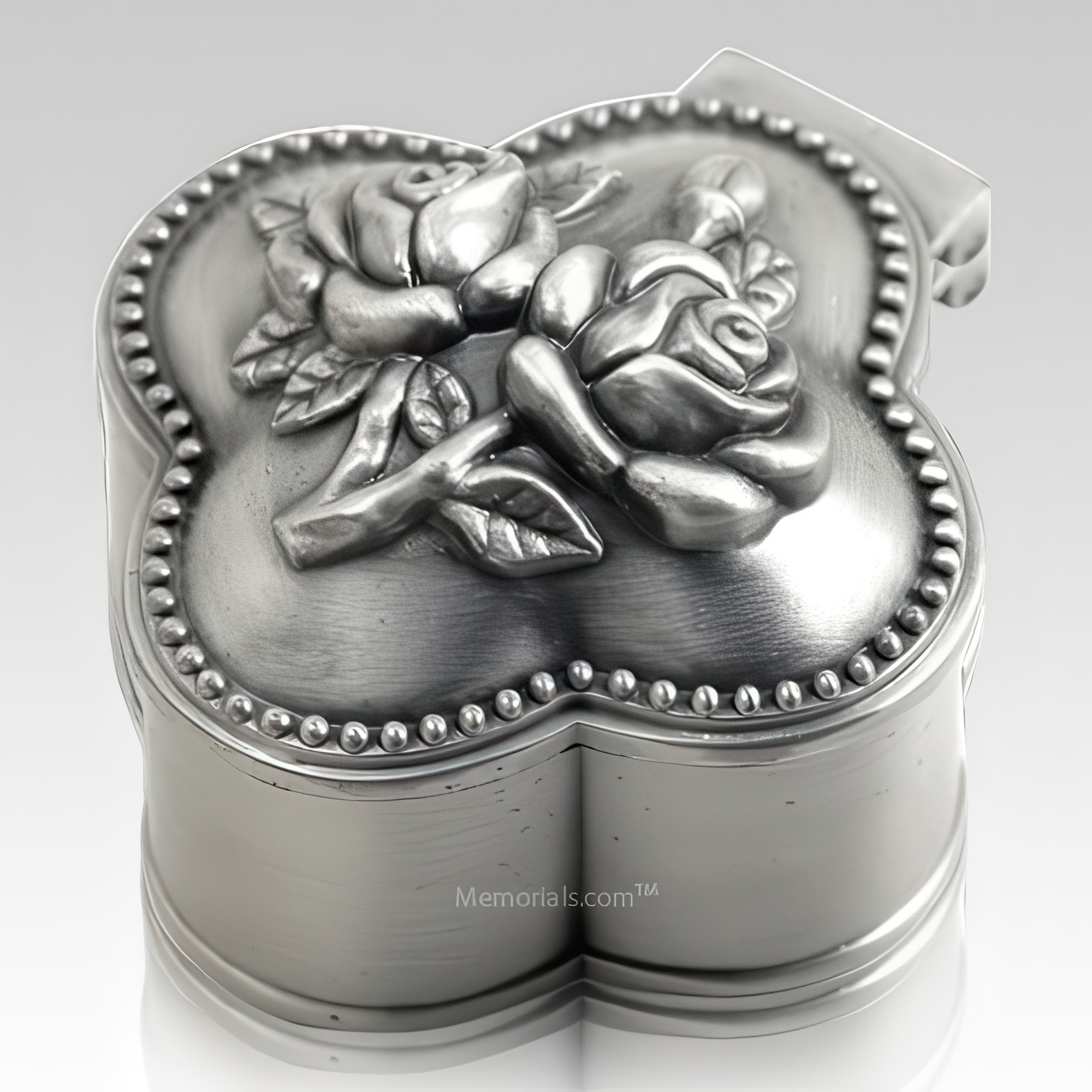
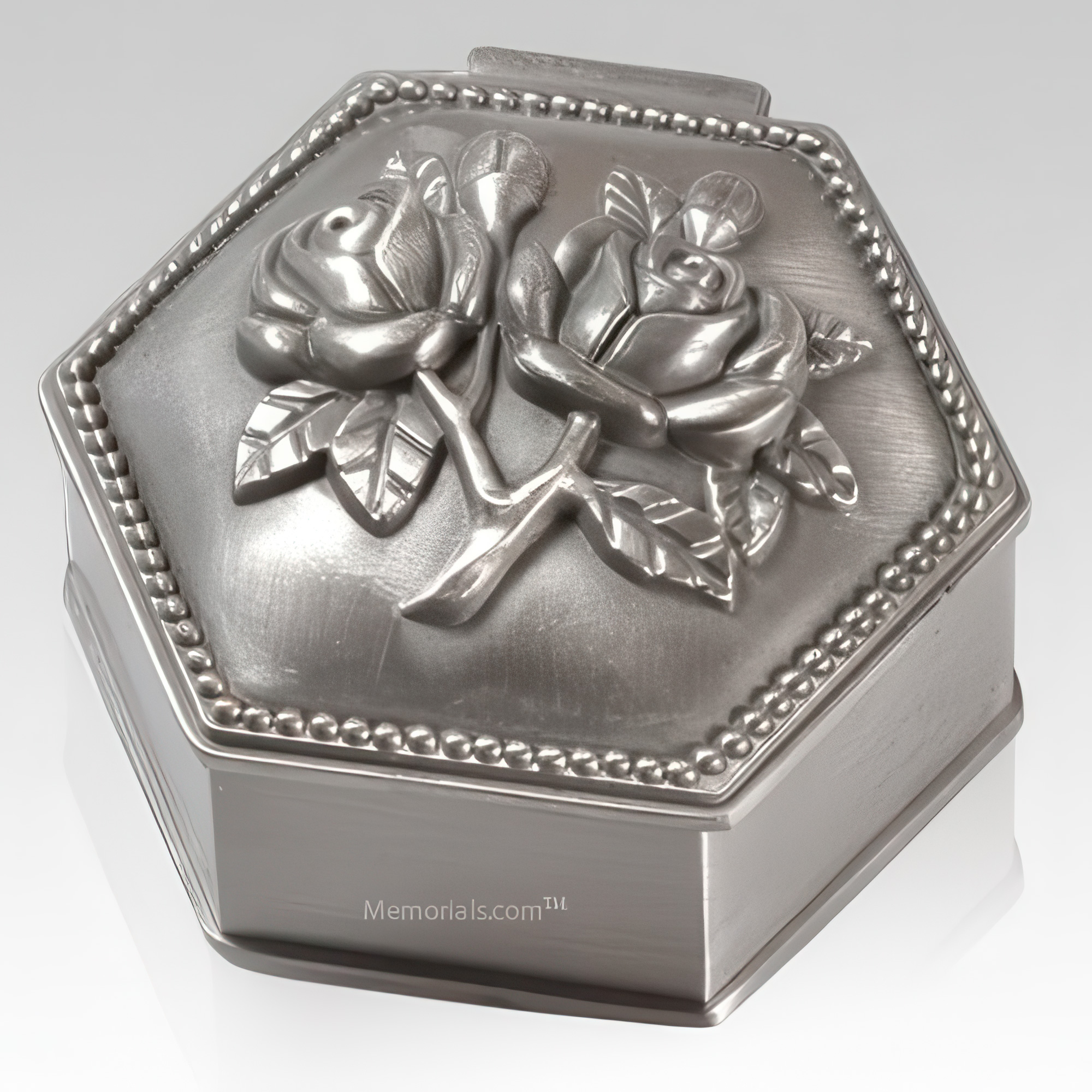
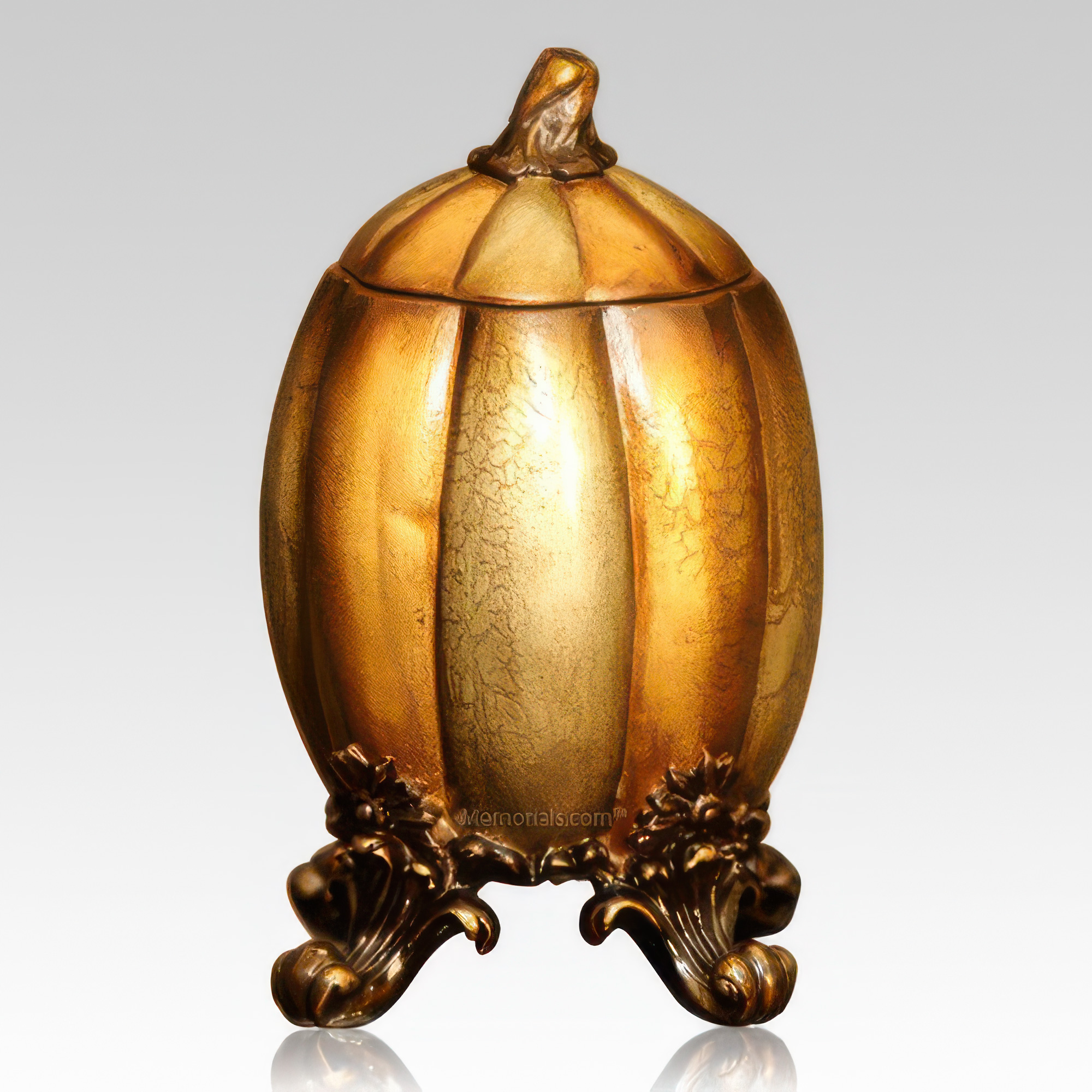
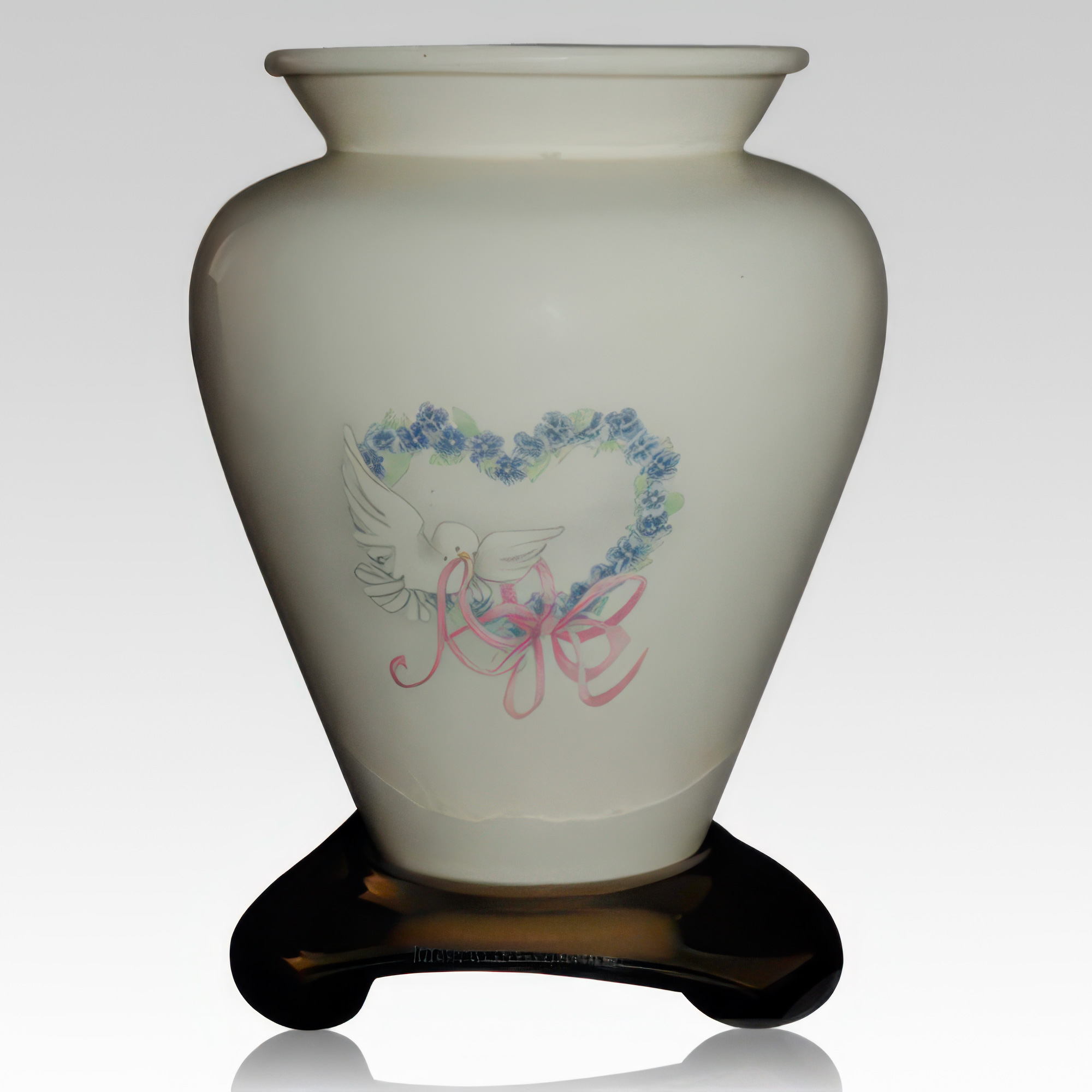
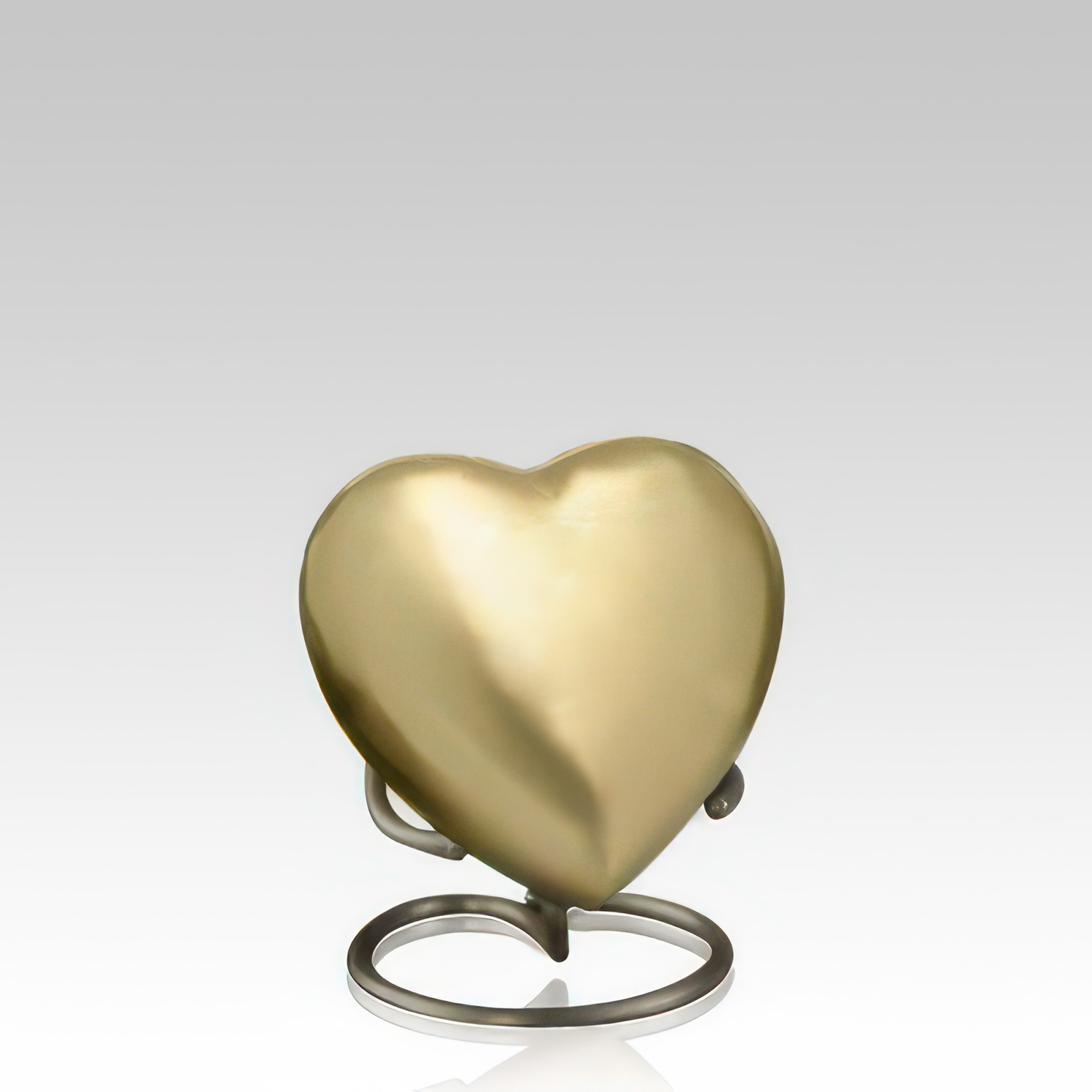
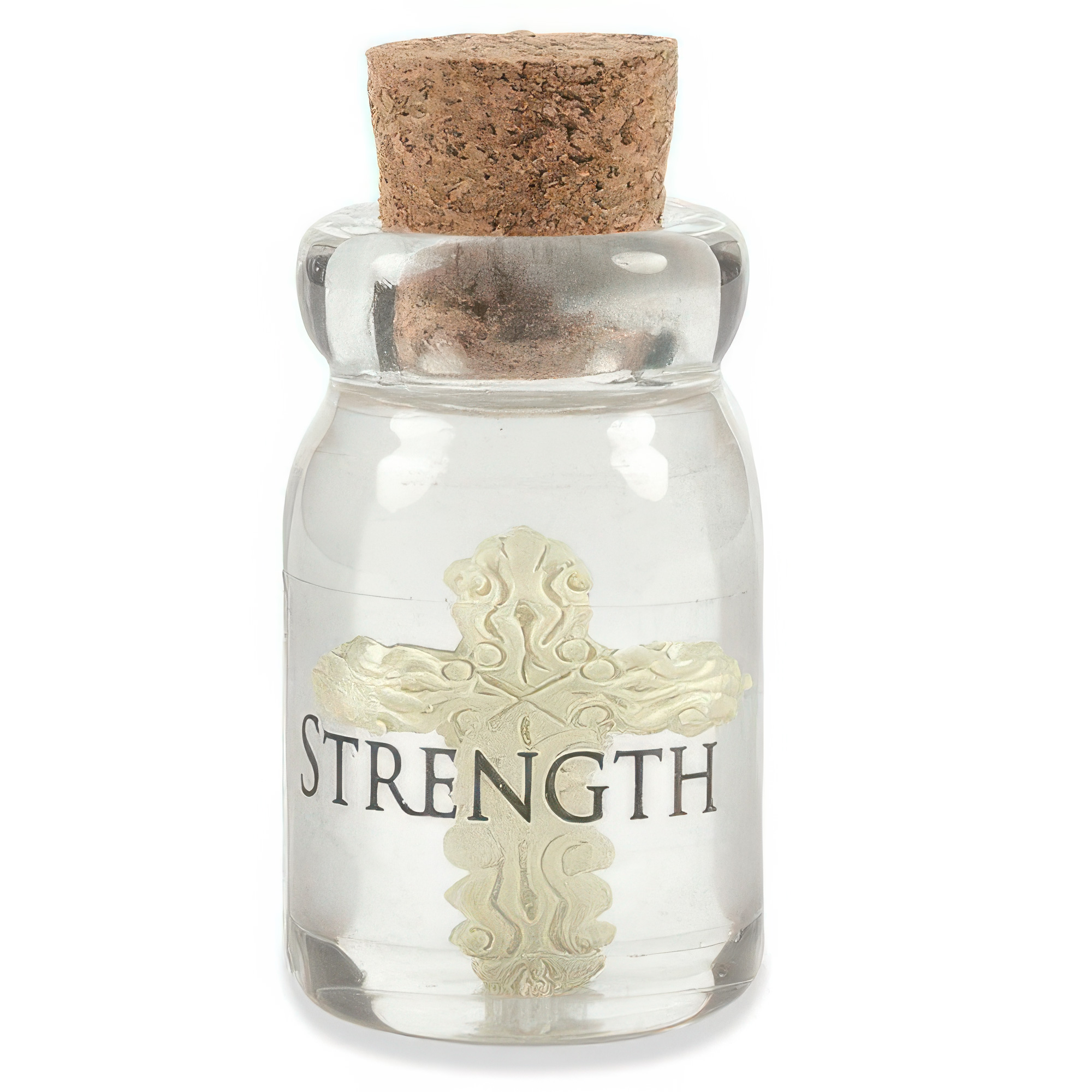
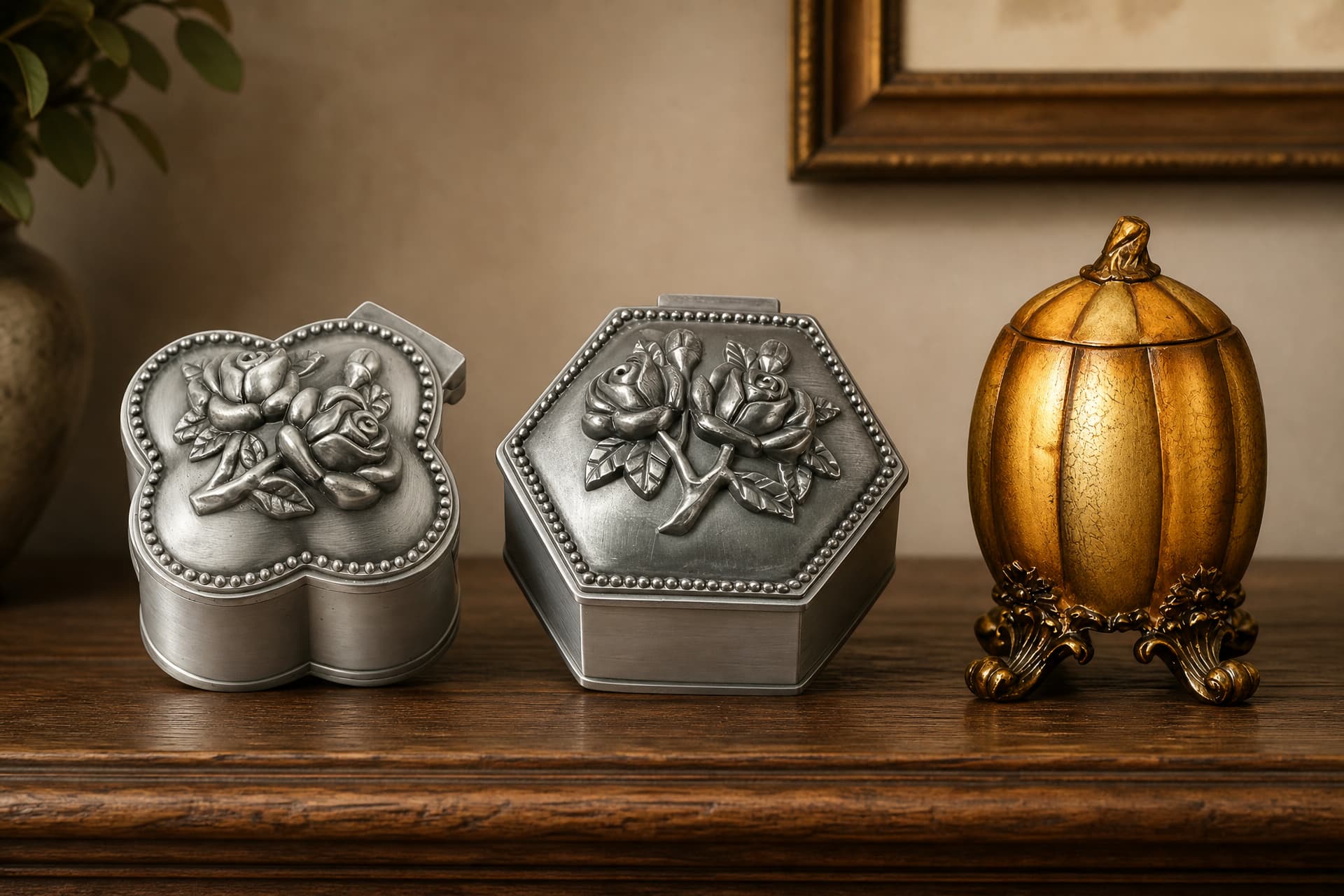
A keepsake like these is a good first gift because it asks nothing of the person receiving it. The order of service, the hospital bracelet, the last card she sent — those things need somewhere to go, and for the first few months a drawer is where they end up.
For something meant to be kept rather than consumed, memorial gifts for loss hold a photograph, a name, or a date.
Later still — and this is months away, not weeks — some families choose an engraved keepsake or a line for a marker. Our page on headstone inscriptions for a mom exists for that stage, and it is worth knowing it is there before anyone asks you for a suggestion.
Frequently Asked Questions
What do you say when someone's mother dies? Say that you are sorry, and say one specific thing about her or about them. I am so sorry about your mom. She was so proud of you. Two sentences is a complete message.
Is it too late to send a card? No. Cards arriving at six weeks or six months are often the ones people remember, because everyone else has moved on. Open with I have been thinking about you since your mom died rather than apologizing for the delay.
What should I write if I did not know their mother? Write to the person, not about her. I never met your mom, but I have met you, and that tells me a lot about her is honest and complete.
Should I mention how she died? Only if the family has. Never name a cause of death in a card, and never ask. If they raise it, follow where they take it and no further.
Do I sign it from just me or from the whole household? Either is fine. If your family knew her as a family, sign it that way — it tells the reader how widely she was known, which is its own kind of comfort.
What is the best short message?I am so sorry about your mom. It is the most-used line in this category because it is the one nobody regrets sending.
In Closing
There is no wording that makes this better, and looking for one is why the pen has been hovering. The card does not have to fix anything. It only has to say I know what happened, I am thinking of you, and I am not going anywhere — and almost any honest sentence will carry that.
Pick one from the top of this page, write it in your own handwriting, and send it today rather than perfecting it.