🏬Supersize Online Funeral Retailer🪦1000's of Headstones⚱️Over 10,000 Cremation Urns⚰️Caskets Overnight Delivery🛒Funeral & Memorial Superstore🚚FREE Shipping on ALL Orders👨👩👧👦Helping Families for over 20 Years💰Lowest Price Guarantee🏬Supersize Online Funeral Retailer🪦1000's of Headstones⚱️Over 10,000 Cremation Urns⚰️Caskets Overnight Delivery🛒Funeral & Memorial Superstore🚚FREE Shipping on ALL Orders👨👩👧👦Helping Families for over 20 Years💰Lowest Price Guarantee
🏬Supersize Online Funeral Retailer🪦1000's of Headstones⚱️Over 10,000 Cremation Urns⚰️Caskets Overnight Delivery🛒Funeral & Memorial Superstore🚚FREE Shipping on ALL Orders👨👩👧👦Helping Families for over 20 Years💰Lowest Price Guarantee🏬Supersize Online Funeral Retailer🪦1000's of Headstones⚱️Over 10,000 Cremation Urns⚰️Caskets Overnight Delivery🛒Funeral & Memorial Superstore🚚FREE Shipping on ALL Orders👨👩👧👦Helping Families for over 20 Years💰Lowest Price Guarantee
Most advice on how to offer condolences is about wording, and wording is the part people worry about most and get wrong least. The act has three parts, and almost everyone does one of them and stops: reach out, show up, follow up.
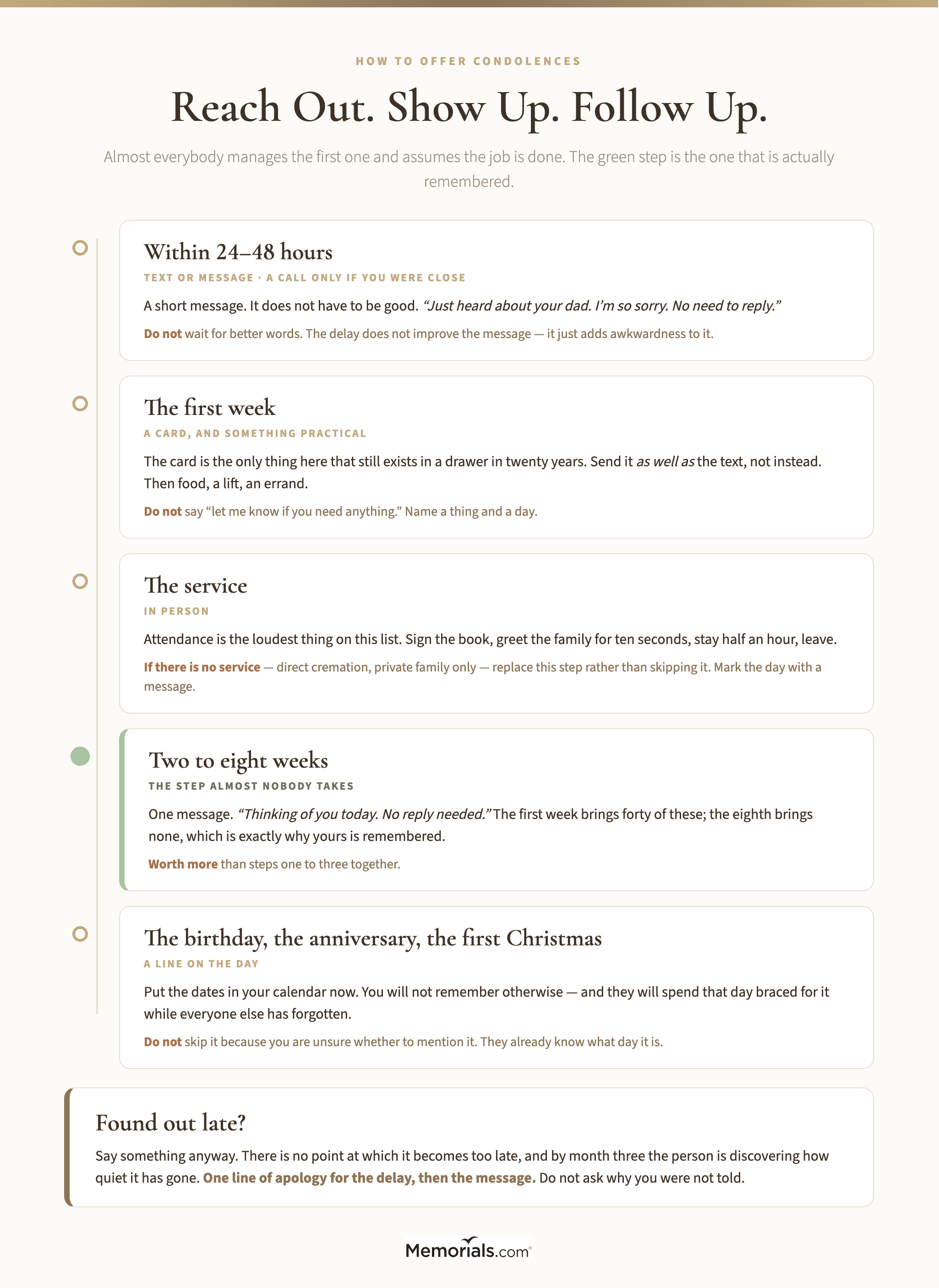
Reaching out is the text or card in the first days. Showing up is the wake, the service, or the doorstep. Following up is the message six weeks later, when everyone else has gone quiet. The third one is the rarest and it is worth more than the other two together.
Proper condolence etiquette is mostly sequencing. Get the order right and the wording hardly matters.
1. Within 24–48 hours — a short message. Text, message, or a call if you were close. It does not have to be good.
2. Within the first week — a card, if you send one, and something practical. Food, a lift, an errand.
3. The service — attend if you reasonably can. Attendance is the loudest thing on this list.
4. Two to eight weeks — the follow-up. One message. This is the one that lands.
5. The first anniversary, the birthday, the first Christmas — a line on the day.
You do not have to do all five. But doing step 1 and stopping is the most common pattern, and it is the one that leaves people feeling forgotten in March.
The text is for now; the card is for later. Send both — they do different jobs.
Things That Arrive After the Flowers
For the stage almost nobody reaches — weeks out, when it counts
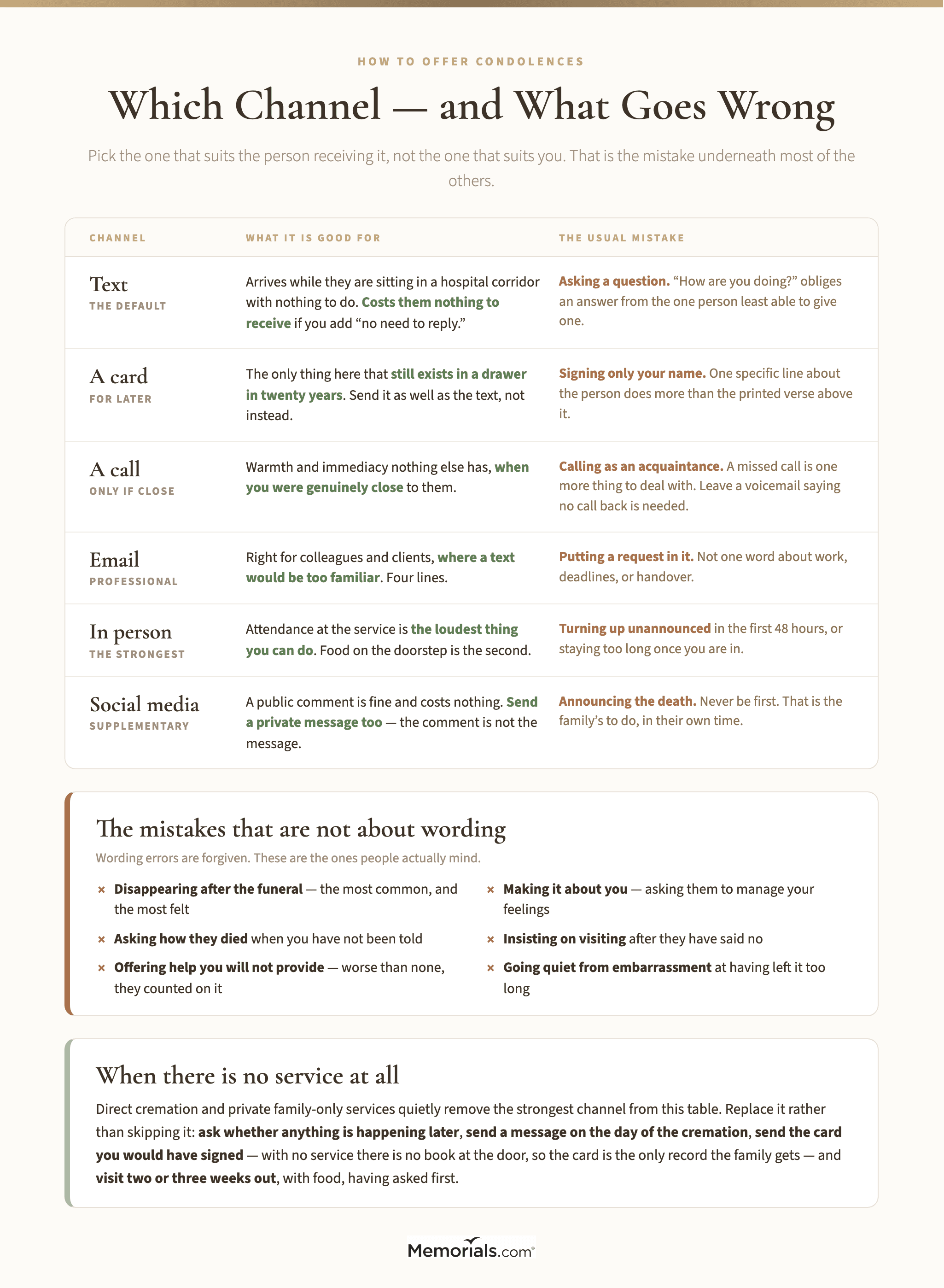
The main thing people get wrong when offering condolences is picking a channel that suits them rather than the person receiving it.
Text or message. The right default for almost everyone. It arrives while they are sitting in a hospital corridor with nothing to do, it costs them nothing to receive, and it does not need answering if you say so. If you want to know how to offer condolences via text specifically, sending condolences by text covers the timing and the three rules.
A card. Slower, warmer, and kept. A card is the only one of these that still exists in a drawer twenty years later. Send one as well as a text, not instead — the text is for now and the card is for later. Sympathy card messages covers the four-part shape.
A phone call. Only if you were genuinely close, and only if you are prepared for them not to answer. A missed call from an acquaintance is one more thing to deal with; a voicemail saying no need to call back is fine.
Email. For colleagues, clients and professional relationships, where a text would be too familiar. Keep it four lines and do not put a request in it. Grief at work covers what happens when they return.
In person. The strongest and the one to hold lightly. Turning up unannounced in the first days is not always welcome; turning up with food and not coming in almost always is.
Social media. A public comment is fine and is not a substitute for a private message. Do not be the first to announce a death publicly, ever — that is the family's to do.
What to Say When Someone Dies
Knowing what to say when someone dies matters less than people think. Three rules cover nearly all of it:
Name the person.Your dad beats your loss, and if you knew him, one specific detail beats a paragraph of sympathy.
Do not ask a question.How are you doing? obliges an answer from the one person least able to give one. If you want to open a door, say no need to reply and mean it.
Offer a specific thing or offer nothing.Let me know if you need anything moves the work onto them. I am dropping food off Tuesday does not.
That is the whole of how to express condolences in a first message, and it is the whole of how to express sympathy in general: name it, say you are sorry, offer one concrete thing. If you want the phrase itself examined — whether sorry for your loss is worn out and what to use instead — that page covers it, and what condolences actually means covers where the formal language came from. In Spanish, do not translate literally — condolences in Spanish has the phrases that work.
Step one is the one everybody does. Step four is the one almost nobody does, and it is worth more than the rest.
At the Wake, Viewing or Service
The physical part, which is where people are most anxious and least informed.
Sign the book. It is how the family knows who came. They read it afterward, often more than once.
Greet the immediate family briefly. Ten seconds. I'm so sorry. Your mother was very good to me. Then move on — there is a line behind you and the family is standing for hours.
You do not have to approach the casket. If there is an open casket and you would rather not, nobody is counting. If you do, a moment of standing quietly is the whole of it.
Stay a reasonable time and then leave. Thirty to sixty minutes at a wake is normal. Leaving is not rude; lingering can be.
If you cry, that is fine. People worry about crying more than the family does. What is not fine is requiring the bereaved to comfort you, so if it becomes that, step outside.
Dress conservatively and follow the family's lead on anything unusual — a celebration-of-life may ask for color. Our funeral etiquette guide covers the fuller picture, and what to say at a funeral service covers the in-person words.
Sign the book, greet the family for ten seconds, and do not feel obliged to approach the casket.
Sending Something
Not required, and it should never replace the message.
Flowers, unless the notice said otherwise. If it said in lieu of flowers, that is a request with a reason behind it — in lieu of flowers covers what to send instead and how much to give.
Food, which is the most useful thing on this list and the least sent after the first week. The fridge is full on day three and empty on day twenty.
A keepsake, later rather than immediately. Its whole value is that it arrives after the flowers have gone and stays. Among in loving memory gifts, the pieces that suit this are small — the memory gifts that get kept are the ones that fit on a desk rather than demand a shelf.
Direct cremation and private family-only services are increasingly common, and they quietly remove step three from the list above. The person who would have shown up now has nowhere to show up to, and the usual result is that they do nothing at all.
Replace the missing step rather than skipping it.
Ask whether there is anything at all. Many families hold something later — a scattering, a memorial lunch, a gathering at the house in the spring. If there is, go.
Mark the day of the cremation. You will often be told the date even when you are not invited to anything. A message that morning — thinking of you all today — does exactly what attending would have done.
Send the card you would have signed. The book at the door is how a family learns who came; with no service there is no book, so the card is the only record they get.
Visit later, on purpose. Two or three weeks out, with food, having asked first. That is the closest replacement for standing in a room with them.
None of this needs an invitation. A private service means the family did not want an audience for the ceremony; it does not mean they did not want to hear from you.
When You Find Out Late
Weeks or months after. This is the most common awkward case and almost nothing is written about it.
Say something anyway. The instinct is that the moment has passed and raising it now would be intrusive. It has not, and it is not. By month three the person is discovering how quiet it has become, and a message then is worth several in week one.
Do not over-apologize for the delay. One line, then the message.
I only heard yesterday about your father. I'm so sorry — and I'm sorry to be so late.
This is months late and I've been sitting on it because I didn't know what to say. I'm thinking about you.
I've just learned about your mom. I know it's been a while. I'd love to hear about her sometime.
Do not ask why you were not told. There is no good answer and the question puts them in the wrong.
When You Did Not Like the Person Who Died
Common, unwritten, and genuinely difficult.
You are not required to praise them. You are offering condolences to the living, and everything you say can be about the person in front of you rather than the one who died.
I'm so sorry. This is going to be complicated for you and I'm here for the complicated part.
I'm thinking about you. However you're feeling about it is allowed.
I know it wasn't simple. I'm sorry all the same.
That last group is also what to say when the relationship was difficult for the mourner — an estranged parent, an abusive spouse. Grief after a hard relationship is heavier, not lighter, and being told the death is a mercy is the worst thing they can hear.
The Follow-Up Nobody Sends
Step four, and the reason this page exists.
The first week brings a flood — flowers, callers, casseroles, forty messages. The eighth week brings silence. Almost nobody reaches out then, which is exactly why the person who does is remembered.
Thinking of you today. No reply needed.
It's been a couple of months and I'm still thinking about your dad.
I know what Thursday is. I'm around if you want company, and equally if you don't.
Put the date in your calendar now — the anniversary, the birthday, the first Christmas. You will not remember otherwise, and they will spend that day braced for it while everyone else has forgotten. The first week after a loss covers the other end of the same timeline.
If they wrote back to you, or thanked you for something you sent, funeral thank you messages covers that side of it.
Put the date in now. They will spend it braced; everyone else will have forgotten.
The Mistakes That Are Not About Words
Wording mistakes are forgivable. These are the ones people actually mind.
Disappearing after the funeral. The single most common, and the most felt.
Making it about you.I can't stop thinking about it, I've been so upset — said to the bereaved, this asks them to manage your feelings.
Asking how they died, if you have not been told. If they want you to know, they will say.
Announcing it publicly before the family has. Never.
Insisting on visiting when they have said no, or turning up in the first 48 hours unannounced.
Offering help you will not provide. An unkept offer is worse than none, because they counted on it.
Going quiet because you are embarrassed you left it too long. The delay is not the problem; the silence is.
Pick the channel that suits the person receiving it, not the one that suits you.
Frequently Asked Questions
How do you offer condolences properly? Reach out within a day or two with a short message, show up if you can, and follow up several weeks later. The wording matters far less than the sequence.
How soon should I offer condolences? Within 24 to 48 hours for a message. A card can follow in the first week. Late is always better than never, and there is no point at which it becomes too late.
Is a text acceptable? Yes — it is the right default for most relationships. Add no need to reply and it costs them nothing.
What should I say when someone dies? Name the person, do not ask a question, and offer one specific thing. I'm so sorry about your dad. I'm dropping food off Tuesday. No need to reply.
Do I have to go to the funeral? No, but attendance is noticed more than anything you send. If you cannot go, say so and send something in its place.
What if I only just found out, months later? Say something anyway. One line of apology for the delay, then the message. Late messages often land harder because the crowd has gone.
What if I did not get on with the person who died? Say nothing about them. Everything you offer can be about the person in front of you: this is going to be complicated for you, and I'm here for the complicated part.
In Closing
If you take one thing from this page, take step four. Reaching out in the first week puts you in a crowd of forty. Reaching out in the eighth puts you alone, at the moment it is most needed.
Set the reminder before you close this tab. That is the whole of the advice.