🏬Supersize Online Funeral Retailer🪦1000's of Headstones⚱️Over 10,000 Cremation Urns⚰️Caskets Overnight Delivery🛒Funeral & Memorial Superstore🚚FREE Shipping on ALL Orders👨👩👧👦Helping Families for over 20 Years💰Lowest Price Guarantee🏬Supersize Online Funeral Retailer🪦1000's of Headstones⚱️Over 10,000 Cremation Urns⚰️Caskets Overnight Delivery🛒Funeral & Memorial Superstore🚚FREE Shipping on ALL Orders👨👩👧👦Helping Families for over 20 Years💰Lowest Price Guarantee
🏬Supersize Online Funeral Retailer🪦1000's of Headstones⚱️Over 10,000 Cremation Urns⚰️Caskets Overnight Delivery🛒Funeral & Memorial Superstore🚚FREE Shipping on ALL Orders👨👩👧👦Helping Families for over 20 Years💰Lowest Price Guarantee🏬Supersize Online Funeral Retailer🪦1000's of Headstones⚱️Over 10,000 Cremation Urns⚰️Caskets Overnight Delivery🛒Funeral & Memorial Superstore🚚FREE Shipping on ALL Orders👨👩👧👦Helping Families for over 20 Years💰Lowest Price Guarantee
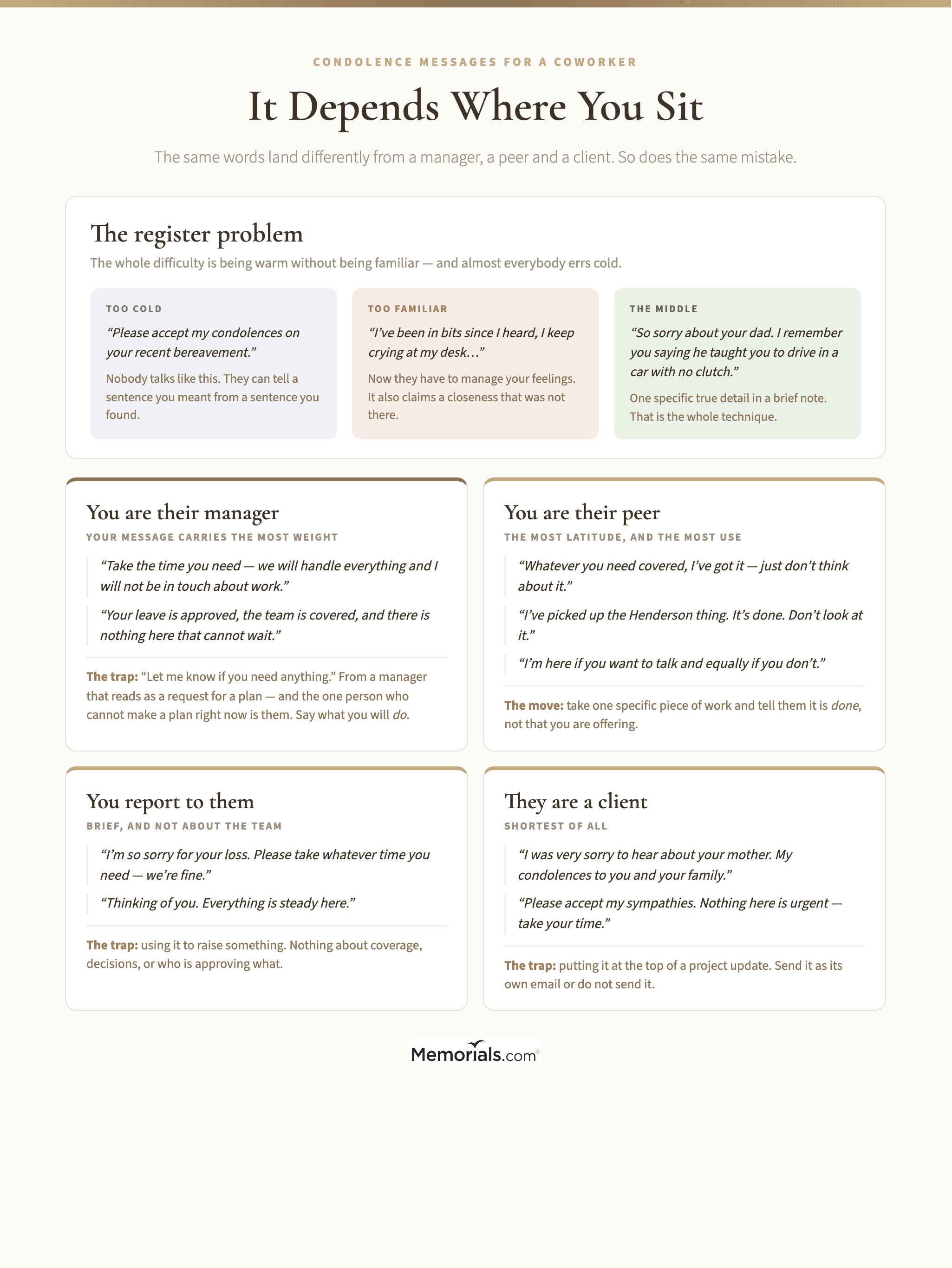
A condolence message for coworker is harder than it looks, and not because the words are difficult. It is because you have to be warm without being familiar — and almost everybody errs cold, sends four stiff lines that sound like HR, and then feels worse about it than if they had sent nothing.
The fix is one specific sentence in an otherwise brief note. Any sympathy message for a coworker can carry it. I'm so sorry about your mother. Please don't give this place a second thought — everything is covered. That is warm, professional, and asks nothing.
This page covers what to write, how your position changes it, the group card, and what to say when they come back — which is the part nobody prepares for. The sympathy and condolence guide is the wider starting point.
This is the whole difficulty, so it is worth naming plainly.
A sorry for your loss message to a coworker fails in one of two directions, and knowing which is most of the fix.
Too cold reads as obligation: Please accept my condolences on your recent bereavement. Nobody talks like that, and a grieving person can tell the difference between a sentence you meant and a sentence you found.
Too familiar reads as an overstep: a long message about your own grief, or an assumption of closeness that was not there.
The middle is one specific detail in a brief note. Anything true and small will do it:
I'm so sorry about your dad. I remember you saying he taught you to drive in a car with no clutch.
So sorry to hear about your mother. You spoke about her often and always warmly.
I'm sorry. I know how much the last few months took out of you.
If you know nothing personal at all, be specific about them instead of him or her: I know this is going to be a hard few months. Everything here is handled.
Your Position Changes the Message
The same words land differently depending on where you sit. This is the part most advice skips.
If you are their manager
Your message carries more weight than a peer's and it must contain no work at all. Not a deadline, not a handover, not a "when you get a chance."
I'm so sorry about your father. Take the time you need — we will handle everything and I will not be in touch about work.
Please don't think about this place. I'll make sure nobody contacts you.
I'm very sorry for your loss. Your leave is approved, the team is covered, and there is nothing here that cannot wait.
Say what you will do, not what they should ask for. Let me know if you need anything from a manager reads as a request for a plan, and the one person who cannot make a plan right now is them.
If you are their peer
You have the most latitude and can be the warmest.
I'm so sorry. Whatever you need covered, I've got it — just don't think about it.
I'm here if you want to talk and equally if you don't.
I've picked up the Henderson thing. It's done. Don't look at it.
Taking a specific piece of work off them, and telling them it is done rather than offering to, is the most useful thing a colleague can do.
If you report to them
Keep it brief and do not make it about the team.
I'm so sorry for your loss. Please take whatever time you need — we're fine.
Thinking of you. Everything is steady here.
If they are a client or a contact
Condolences for a colleague you work with rather than beside should be shortest of all, and never in the same message as anything transactional.
I was very sorry to hear about your mother. My condolences to you and your family.
Please accept my sympathies. Nothing here is urgent — take your time.
Send it as its own email. Not a paragraph at the top of a project update.
A manager's "let me know if you need anything" reads as a request for a plan. Say what you will do instead.
Card, Email, or Slack
The channel is usually decided for you by how you already talk to this person. Do not upgrade or downgrade it.
Slack or Teams — send it as a direct message, never in a channel. A public post makes them the subject of a thread they have to read. If your team wants to say something publicly, one message from the manager saying the person is out and asking people to hold off is better than thirty individual ones.
Email — right for anyone you do not message casually. Four lines, a subject line that says what it is, and nothing else in it. If you are unsure how to head it, condolence email subject lines covers that specifically.
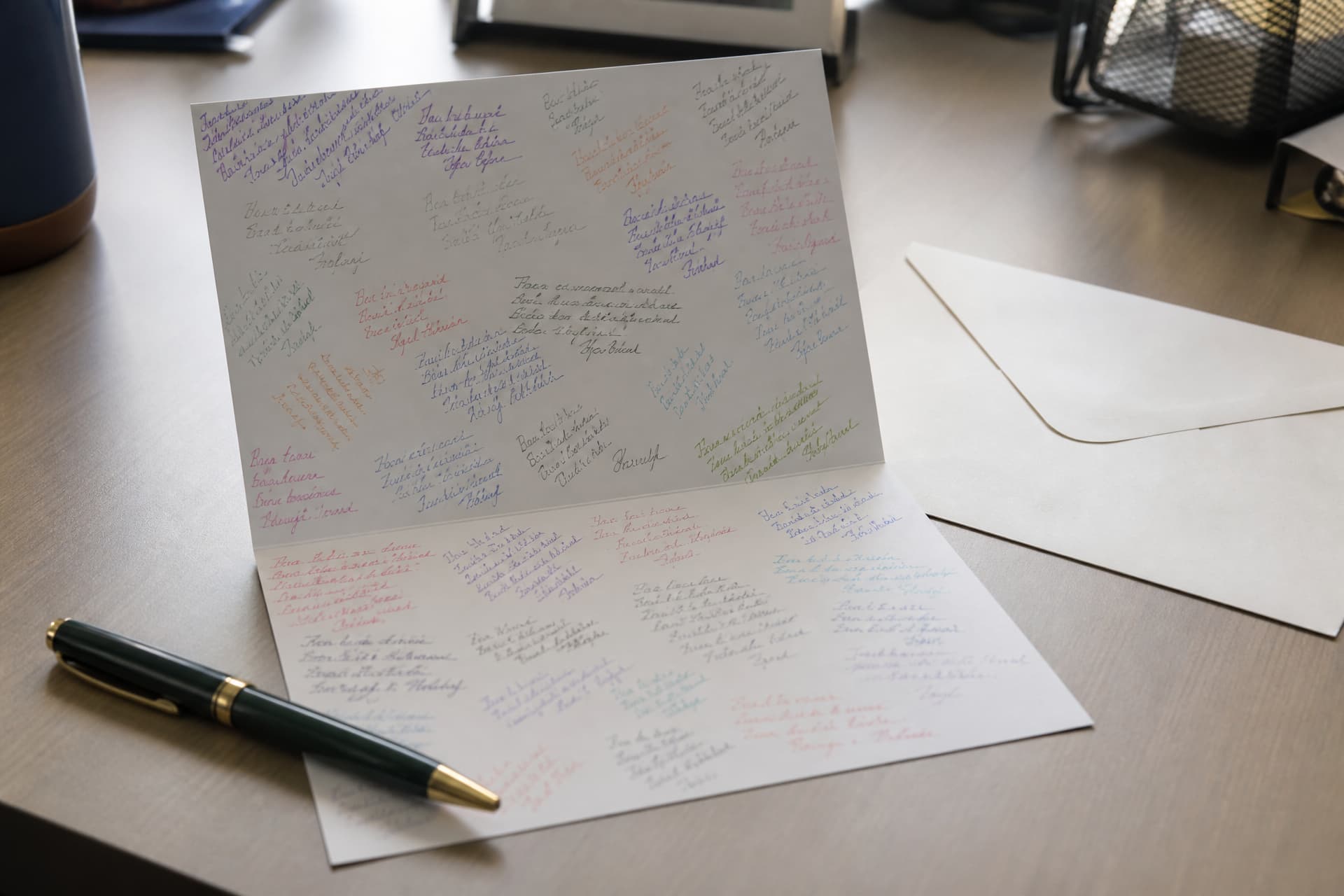
A card — the only one that gets kept. Worth doing in addition, not instead, and a sympathy card message for a coworker can be shorter than you think. Sympathy card messages has the four-part structure.
Text — only if you already text this person. If you do, it is the best channel there is. Sending condolences by text covers the timing.
If the family's first language is Spanish, do not translate a line yourself — condolences in Spanish has phrasings that work and the ones to avoid.
What to Write in a Group Card
Almost every office does this and almost every group card ends up as thirty variations of sorry for your loss, which reads as a form.
If you are organizing it, do two things. Write a line at the top saying who it is from — from all of us in Finance — and ask people to write something specific rather than something appropriate. One sentence in the request changes the whole card: If you have a memory of her mom, or just something you want to say, that's better than "condolences."
If you are signing it, do not write the same thing as the person above you. Read what is there and add something else.
Thinking of you, Sarah. — Tom
I'm so sorry. Your desk plant is being watered, in case you were worrying. — Priya
No words. Take all the time you need. — James
So sorry, Sarah. Looking forward to having you back whenever that is. — Dan
That second one is the model. Small, concrete, and it tells her something she did not know she wanted to know.
Ask people to write something specific, not something appropriate. It changes the whole card.
What to Say to a Coworker Who Lost a Parent
Knowing what to say to a coworker who lost a parent is the most common version of this by a wide margin, and it has one trap.
Most colleagues are your age or thereabouts, which means a parent's death is both expected and enormous — and people keep saying well, he was 84 as though the arithmetic helps. It does not. A long life is a reason to celebrate at the service, not a reason to grieve less.
I'm so sorry about your dad. However long you had him, it isn't enough.
I'm sorry. Losing a parent is a big one, whatever age it happens.
So sorry about your mother. I hope you get to hear some good stories this week.
Someone has to, and doing it badly is how a private loss becomes office gossip within an hour.
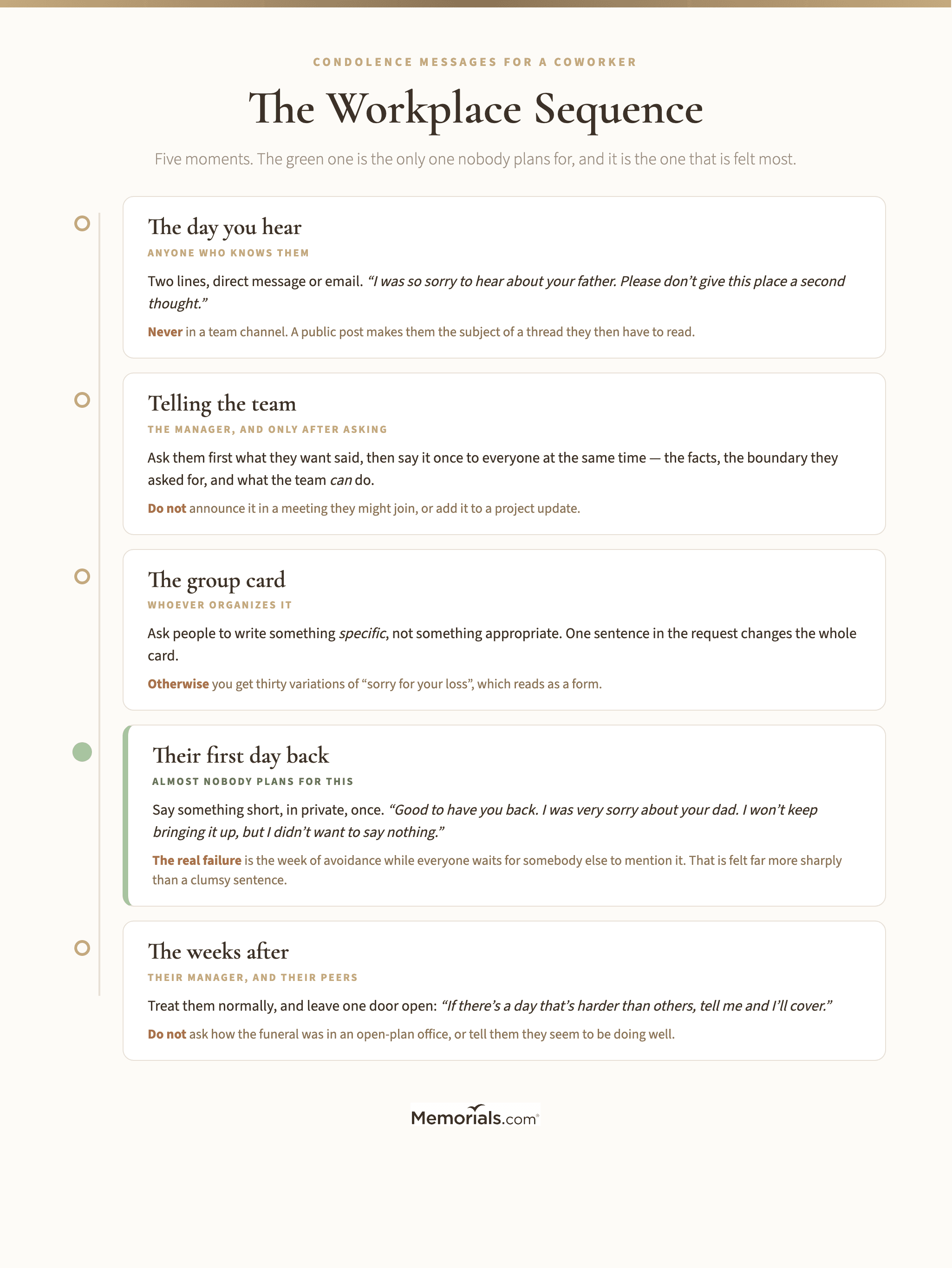
Ask them first what they want said. One message: Is it all right if I let the team know, and how much would you like me to say? Some people want the detail out so nobody has to ask; some want only that they are away. Both are reasonable and it is not your call.
Then say it once, briefly, to everyone at the same time. A single message beats the news traveling in fragments.
Ana's father died on Sunday. She'll be out for the next two weeks. She's asked that we not send anything to the house for now — I'll let you know when there's a card going round. Please don't message her about work.
Three things that message does: it gives the facts so nobody speculates, it sets the boundary the person asked for, and it tells the team what they can do, which is what most of them want to know.
Do not announce it in a meeting where they might join, put it in a channel before they have replied to you, or add "keep them in your thoughts" to a status update about a project. If a colleague sending a condolence message to a coworker is a private act, then announcing it is a careful one.
Nobody writes about this and it is the part people get most wrong.
They will walk into the office at some point and the room will go quiet, and then everybody will avoid them for a week because nobody wants to be the one who brings it up. That avoidance is felt far more sharply than any clumsy sentence.
The week of everyone avoiding them is felt far more sharply than any clumsy sentence.
Say something on the first day. Short, in private, and once.
Good to have you back. I was very sorry about your dad. I won't keep bringing it up, but I didn't want to say nothing.
Welcome back. No expectations from me today.
I'm glad you're here. Say the word if you need to step out at any point.
Then treat them normally, which is what most people want, and leave one door open: If there's a day that's harder than others, just tell me and I'll cover.
Two things not to do: do not ask how the funeral was in an open-plan office, and do not tell them they seem to be doing well. Our guide to grief at work covers the longer arc, including what a manager should adjust and for how long.
A workplace gift has a narrower target than a personal one: it should be modest enough not to embarrass, useful or lasting, and clearly from a group rather than from one person who is now the colleague who sent an unusually large present.
What works. A group contribution to the charity named in the notice. A delivered meal service, which is the most useful thing anyone sends. A plant for their desk. A single good keepsake from the team rather than several small ones from individuals.
What does not. Anything that needs displaying at home, anything with a strong religious message unless you know, and flowers sent to the office rather than the house — where they sit on an empty desk in front of everybody.
Anything about work. Not one line, not "no rush on this."
"Let me know if you need anything." From a manager especially. Name what you will do.
"At least..." anything.
A public post in a team channel. Direct message, always.
"I know exactly how you feel." You might. Say I lost my mom two years ago and I remember this part instead, which offers company rather than equivalence.
Nothing at all, because you did not know them well. Two lines from a distant colleague is never unwelcome. Silence is.
The return-to-work moment is the one nobody plans for, and the one that is felt most.
Frequently Asked Questions
What to write in a sympathy card for a coworker? Two or three lines: that you are sorry, one specific thing, and that work is covered. So sorry about your father. Everything here is handled — please don't give it a thought.
Should I mention work at all? Only to say it is taken care of. Never a deadline, a handover or a question.
Is a Slack message enough? Yes, as a direct message, if that is how you normally talk. Never post it in a channel.
What if I barely know them? Send two lines anyway. A short message from a distant colleague is never unwelcome; being the only person who said nothing is noticed.
What should the team send? One thing from the group rather than several from individuals — a charity contribution, a meal delivery, a plant, or a single keepsake.
What do I say when they come back? Something short and private on the first day, once, then treat them normally. Good to have you back. I was very sorry about your dad — I won't keep bringing it up, but I didn't want to say nothing.
In Closing
Send something the day you hear, keep work entirely out of it, and put one specific true detail in the middle.
Then say something on their first day back. That is the one people remember, and it is the one almost everybody skips.