🏬Supersize Online Funeral Retailer🪦1000's of Headstones⚱️Over 10,000 Cremation Urns⚰️Caskets Overnight Delivery🛒Funeral & Memorial Superstore🚚FREE Shipping on ALL Orders👨👩👧👦Helping Families for over 20 Years💰Lowest Price Guarantee🏬Supersize Online Funeral Retailer🪦1000's of Headstones⚱️Over 10,000 Cremation Urns⚰️Caskets Overnight Delivery🛒Funeral & Memorial Superstore🚚FREE Shipping on ALL Orders👨👩👧👦Helping Families for over 20 Years💰Lowest Price Guarantee
🏬Supersize Online Funeral Retailer🪦1000's of Headstones⚱️Over 10,000 Cremation Urns⚰️Caskets Overnight Delivery🛒Funeral & Memorial Superstore🚚FREE Shipping on ALL Orders👨👩👧👦Helping Families for over 20 Years💰Lowest Price Guarantee🏬Supersize Online Funeral Retailer🪦1000's of Headstones⚱️Over 10,000 Cremation Urns⚰️Caskets Overnight Delivery🛒Funeral & Memorial Superstore🚚FREE Shipping on ALL Orders👨👩👧👦Helping Families for over 20 Years💰Lowest Price Guarantee
Offering condolences is one of the few social obligations most people meet with genuine dread. Somebody has died, you have to say something, and every sentence you draft sounds either hollow or intrusive.
The good news is that the standard is much lower than you think, and it is not about eloquence. Say their name, say you are sorry, offer one concrete thing, and come back in six weeks. That is the whole convention. Everything on this page and everything in the twenty-seven guides below is a variation on one of those four.
The Four Moves
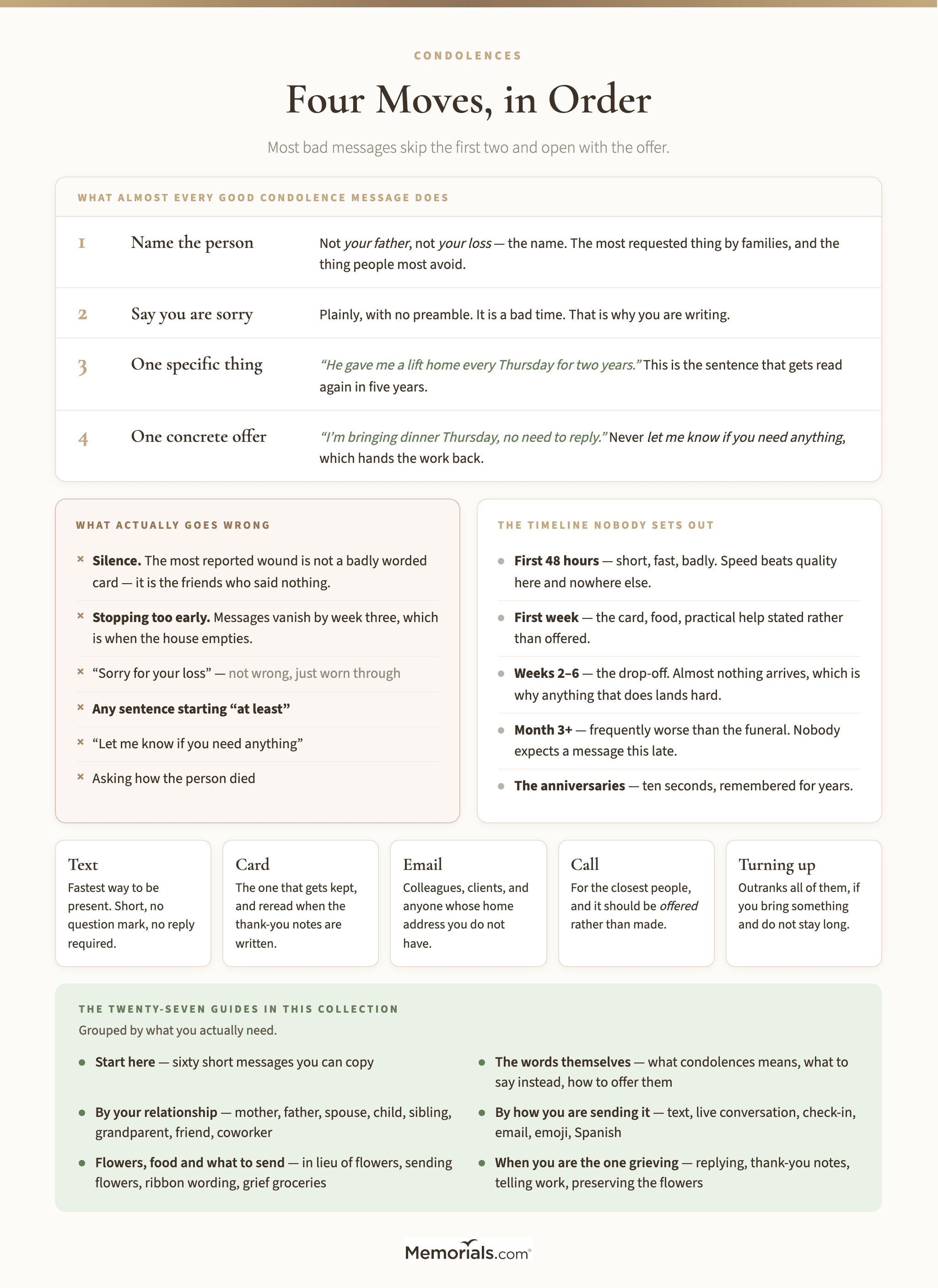
Almost every good condolence message does these in order, and most bad ones skip straight to the third.
Name the person who died.I'm so sorry about David. Not your father, not your loss — the name, if you knew it. This is the single most requested thing by bereaved families and the thing people most avoid, out of a fear of causing pain that runs exactly backward. Avoiding the name does not protect anyone; it removes the person from the conversation.
Say you are sorry, plainly. No preamble, no I don't know if you remember me, no I hope this isn't a bad time. It is a bad time. That is why you are writing.
Say one specific thing. A memory of them, or something true about the person you are writing to. Specific beats reverent every time, and this is the sentence that gets read again in five years.
He gave me a lift home every Thursday for two years.
You looked after her for a long time and I saw it.
Offer one concrete thing, or nothing at all.I'm bringing dinner Thursday, no need to reply. Never let me know if you need anything, which sounds generous and hands the work back to the person with the least capacity to do it.
Then send it. A message that took ninety seconds and arrived today beats a perfect one that never gets written, and the second is far more common than the first.
The standard is lower than you think. Name, apology, one specific thing, one concrete offer.
The most reported wound in bereavement is not a badly worded card — it is the friends who said nothing. People go quiet because they cannot find the right words, and the family reads that silence as indifference. There is no right word. There is only the message that arrives.
The second is stopping too early. Condolence messages cluster in the first week and vanish by the third, which is precisely when the house empties, the visitors go home, and the person is left with it. A message in week six is worth five in week one.
The third is the phrase everybody reaches for.Sorry for your loss is not offensive, it is simply worn through, and the replacements for it are the most-used page in this collection.
And the fourth is the word "at least".At least she had a long life. At least he didn't suffer. At least you have other children. Every version is a small argument that the grief is disproportionate. There is no at least.
Choosing How to Send It
The medium matters less than the timing, but it does change the register.
A text is right for anyone you would normally text, and it is the fastest way to be present. Short, no question mark, no reply required.
A card is the one that gets kept, and often reread when the thank-you notes are written. Worth two extra minutes and a real signature.
An email suits colleagues, clients and professional contacts — anyone whose home address you do not have.
A phone call is for the people closest to you, and it should be offered rather than made. Someone mid-crisis may not be able to speak.
And turning up outranks all of them, if you are close enough and you bring something. How to offer condolences sets out the full sequence — reach out, show up, follow up — and which of the three people actually skip.
Four moves, in order. Most bad messages skip the first two and open with the offer.
When You Are the One Receiving Them
Half of this collection is written for the other side of the exchange, because the person who has been bereaved has their own set of problems and almost nobody writes about them.
You owe nobody a reply. Not on any timetable. A heart reaction is a complete acknowledgement, and one message can answer forty people at once.
The thank-you notes are a separate job, done later, and smaller than you fear. Cards, flowers, donations and the people who did something practical — not everyone who texted.
You will have to tell your employer something, usually in the worst state you have been in for years, and the wording for that is a solved problem.
And the messages will stop before you want them to. That is not personal; it is what happens. Knowing it in advance helps.
Half this collection is written for the other side — the person with forty messages they cannot face.
What to Send
The gesture matters more than the object, and the timing matters more than either.
Food, first and repeatedly. It is the most useful thing anyone does and the thing that stops soonest.
Flowers, if the family has not asked otherwise. Read the notice before ordering — in lieu of flowers means what it says.
Something practical, which is almost always better than something beautiful: a supermarket delivery, a lift, two hours answering the door.
And something lasting, later. Not in the first week, when the house is full, but in the flat month afterward when nothing else arrives. Among memorial gift ideas the small engraved pieces are the ones families keep, and a card that turns up in month five is remembered for years.
What a Condolence Message Is Actually For
Worth being clear about, because it changes what you write.
It is not consolation. Nothing you send will reduce the grief, and a message written to try will read as though it is asking the reader to feel better on your schedule. Let go of that job — it is not available to you.
It is evidence. A condolence message is a record that the person who died existed, mattered outside their own household, and was noticed by somebody who did not have to say anything. Families describe reading the cards months later precisely for that.
It is also a small piece of infrastructure. It tells the bereaved who is still there, which is the information they most need and least have. Every message is one name on a list they will draw on later.
Which is why the specific detail matters so much.He was a lovely man is a sentiment. He gave me a lift home every Thursday for two years is proof — and proof is what gets kept.
And why the follow-up counts double. The first message says I heard. The one in week six says I am still here, and only one of those is a commitment.
The Vocabulary, Briefly
The formal language around death confuses people, and using it wrongly is a common worry that stops messages being sent at all.
Condolences are what you offer to the bereaved. My condolences is formal but never wrong, and it suits a colleague, a client or a card better than a text.
Sympathy is the feeling; condolence is the expression of it. A sympathy card carries a condolence message, which is why both words appear on the same shelf in a store.
In lieu of flowers means the family would prefer a donation. It is a request, not a suggestion.
Repast, wake, viewing, visitation are all events around the funeral, and they differ by tradition and region rather than by rule. If you are unsure which you have been invited to, ask the funeral home rather than the family.
Celebration of life usually signals a less formal service and sometimes an explicit request for color rather than black.
And "passed away" versus "died" is a matter of the family's own register. Use whichever they used when they told you, which is the safest rule in this entire subject.
The Condolences Hub Library
This guide is part of the Memorials.com sympathy condolence collection — twenty-seven pages in all. Every page below answers one specific version of the question, and each goes considerably deeper than this overview.
Start Here
If you need a line right now and nothing else.
Short Condolence Messages: 60+ Lines You Can Send — Sixty messages sorted by relationship and length, written to be copied. The page to open if you are staring at a blank card and somebody is waiting.
The Words Themselves
What the language means, what has worn out, and what the act actually involves.
The same four moves, written for the specific loss in front of you.
Condolences for Loss of Mother: 50+ Messages — The largest of these by some distance, with messages for a friend, a colleague and someone you barely know, plus Mother's Day and the first year.
Loss of a Sister: What to Write — For the sister who was holding the family's contact list and the calendar, for the relationship that was never simple, and for writing the message yourself when she was yours.
Condolence Messages for Loss of a Grandparent — Two people are grieving, and the messages go to the wrong one. Plus the long-life remark, which is this relationship's version of at least.
How to Write a Condolence Email — Subject lines that do not hide the news, four sentences for the body, and how to sign off without your job title underneath.
Written for the person receiving all of the above.
How to Respond to Condolences — Forty messages and none of them owed an answer. Short replies that close an exchange, and permission to answer none of them.
How to Preserve Flowers from a Funeral — Air drying, pressing, silica and resin, and the two or three days at the start when the decision has to be made.
Condolences are not a single event, and knowing the shape of the weeks ahead is most of knowing what to do.
The first 48 hours. A short message, sent fast and badly. This is the only moment where speed genuinely beats quality, and the only one most people manage.
The first week. The card, if you send one. Food. Practical help offered as a statement rather than a question. The house is full, the phone does not stop, and the family are running an event.
The funeral itself. Attend if you reasonably can — attendance is louder than anything you will write. If you cannot, say so before rather than apologize after.
Weeks two to six. The drop-off, and the whole reason this collection exists. Visitors go home, the flowers die, everyone returns to work, and the person is finally alone with it. Almost nothing arrives in this window, which is what makes anything that does arrive land so hard.
Month three and beyond. Grief is frequently worse here than at the funeral, because the shock has worn off and the permanence has not. Nobody expects a message this late, which is precisely the point.
The anniversaries. The birthday, the date, the first Christmas. A single line on the day — thinking of you and of David — takes ten seconds and is remembered for years.
And the second year, which the bereaved consistently describe as harder than the first, and by which point essentially everybody has stopped.
Where People Get Stuck
Five specific sticking points come up more than anything else, and each has a page here.
"I didn't know the person who died." Then write about the person you do know. I never met your mother, but I know what she was to you is a complete message and nobody expects more.
"I've left it too long." You have not. Say I've only just heard or say nothing about the delay at all, and send it. Nobody has been counting; they have been receiving nothing.
"We're not close enough." The bereaved consistently report being moved by messages from the edges of their life, and hurt by the silence of people who assumed it was not their place. Three lines from an acquaintance is never unwelcome.
"I don't know what they believe." Then do not guess. Thinking of you works in every tradition. Save the theology for families you know hold it.
"I said the wrong thing." Almost nothing is unrecoverable. That came out badly, I'm sorry and carrying on beats disappearing, which is the actual damage.
If You Only Have Two Minutes
Send this, changing the name:
I'm so sorry about David. I keep thinking about the way he used to answer the phone. I'm around all week — I'll drop something round Thursday, no need to reply.
That is the four moves in three sentences. It is not eloquent and it does not need to be. It arrives, it says his name, it proves you remember him, and it takes one thing off their list.
Then put a note in your calendar for six weeks' time, because that is the message that will still be remembered a year from now.
The message in week six is worth five in week one, and almost nobody sends it.
Frequently Asked Questions
What is the best thing to say when someone dies? Their name, that you are sorry, one specific thing about them, and one concrete offer. I'm so sorry about David. He gave me a lift home every Thursday for two years. I'm bringing dinner on Thursday.
Is a text message an acceptable condolence? Yes, and often better than a card, because it arrives today. Send a card as well if you want to; they do different jobs.
How long do I have to send a condolence message? There is no deadline, and late is genuinely welcome. Weeks two to six are the quietest stretch and the best time to arrive.
What should I never say? Anything beginning with at least. Also everything happens for a reason, let me know if you need anything, and asking how the person died.
Do I have to send flowers? No, and check the notice first — if it says in lieu of flowers, send the donation instead. Food is usually more useful than either.
I missed the funeral. Is it too late? No. Say you have only just heard, and send something now. The weeks after the funeral are emptier than the days before it.
What do I do if they never reply? Nothing. Grieving people often cannot open messages for weeks. Say once that no reply is needed, and keep going at the same pace.
In Short
Say the name. Say you are sorry. Say one true specific thing. Offer one concrete thing with a day on it.
Then send it today rather than perfecting it, and send another one in six weeks — which is the part of a condolence message that almost nobody manages and the part that is actually remembered.