🏬Supersize Online Funeral Retailer🪦1000's of Headstones⚱️Over 10,000 Cremation Urns⚰️Caskets Overnight Delivery🛒Funeral & Memorial Superstore🚚FREE Shipping on ALL Orders👨👩👧👦Helping Families for over 20 Years💰Lowest Price Guarantee🏬Supersize Online Funeral Retailer🪦1000's of Headstones⚱️Over 10,000 Cremation Urns⚰️Caskets Overnight Delivery🛒Funeral & Memorial Superstore🚚FREE Shipping on ALL Orders👨👩👧👦Helping Families for over 20 Years💰Lowest Price Guarantee
🏬Supersize Online Funeral Retailer🪦1000's of Headstones⚱️Over 10,000 Cremation Urns⚰️Caskets Overnight Delivery🛒Funeral & Memorial Superstore🚚FREE Shipping on ALL Orders👨👩👧👦Helping Families for over 20 Years💰Lowest Price Guarantee🏬Supersize Online Funeral Retailer🪦1000's of Headstones⚱️Over 10,000 Cremation Urns⚰️Caskets Overnight Delivery🛒Funeral & Memorial Superstore🚚FREE Shipping on ALL Orders👨👩👧👦Helping Families for over 20 Years💰Lowest Price Guarantee
Writing a condolence message for loss of a brother means writing to the person everyone else in the room forgets to ask about.
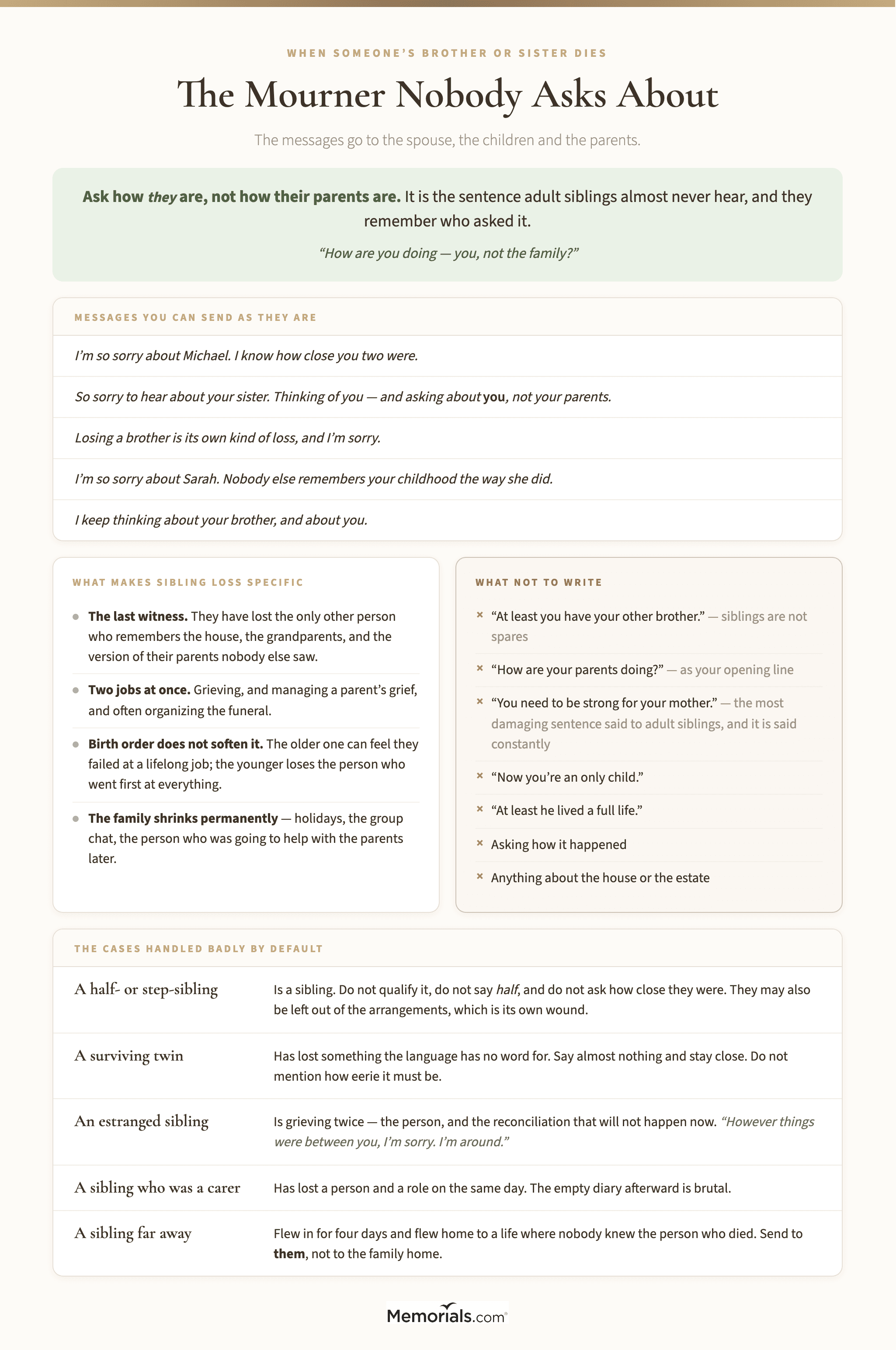
The messages go to the widow, the children, the parents. His brother or sister gets asked how their mother is holding up — often at the funeral, often repeatedly — and almost nobody asks how they are. Ask them. That, plus the name, is most of what this page says. The sympathy and condolence guide is the wider starting point.
Messages You Can Send As They Are
Copy one, change the name, send it.
I'm so sorry about Michael. I know how close you two were.
So sorry to hear about your brother. Thinking of you — and asking about you, not your parents.
I was so sorry to hear your brother died. Sending love to you and your family.
Thinking of you today. Losing a brother is its own kind of loss and I'm sorry.
I'm so sorry about Michael. Nobody else remembers your childhood the way he did.
So sorry, friend. Here whenever, for as long as it takes.
I keep thinking about your brother, and about you.
Words of sympathy for loss of brother work best when they are short and specific. One memory, one offer, and his name in it. That holds however you phrase it — condolence messages for loss of brother, words of condolence for loss of brother and condolences for loss of a brother all want the same three things.
This is the whole difference between writing to a brother and writing to anybody else.
Do not open with the parents.How's your mom coping? is the sentence he will hear forty times in a week, and every one of them relocates the grief to somebody else.
Ask the direct question.How are you doing — you, not the family? It is startling in a good way, and people remember who asked it.
Acknowledge the second job. A surviving brother is frequently grieving and managing a parent's grief, organizing a funeral, and holding a family together. You're carrying two things at once and nobody's said so.
And say the relationship out loud.That's your brother. Adults are quietly expected to be less devastated by a sibling than by a spouse or a child, and they are not.
The Thing Nobody Says About Losing a Brother
Worth knowing, because putting it in a card is the thing that lands hardest.
They have lost the only other person who remembers. A brother is a last living witness to a childhood — the house, the grandparents, the in-jokes, the version of their parents nobody else saw. The words that land hardest are the ones that name exactly that.
Birth order does not soften it. An older brother was the person who went first at everything; a younger one leaves somebody feeling they failed at a lifelong job.
Estrangement makes it worse, not easier. A difficult or distant relationship between brothers produces a complicated grief that gets almost no sympathy.
And the family shrinks permanently. Holidays, group chats, the person who was going to help with the parents later. Losing a brother reorganizes a family the way few other deaths do.
Ask how he is, not how his parents are. It is the sentence a grieving brother almost never hears.
What to Write in a Sympathy Card for Loss of a Brother
The card is kept and reread, so it is worth two extra minutes. Knowing what to say in a sympathy card for loss of a brother comes down to four moves.
Open with his name.Dear Ben, I was so sorry to hear about Michael.
Say one specific thing. A memory of him if you have one, or something true about the two of them. He talked about you constantly.You two were a double act at every party I ever saw you at.
Acknowledge them directly. One clause that puts the brother left behind at the center: I know what he was to you.
Offer one concrete thing, or nothing. I'll call on Sunday, no need to answer.
Most people searching for loss of brother condolences are looking for exactly those four moves in that order, and nothing more.
Then sign it properly — first name and surname, or a note of how they know you. Forty cards arrive at once and the family write their thank-you notes from them. Funeral thank-you messages covers that side.
Use these sparingly, and only in a card that also contains a sentence of your own. Sympathy words for loss of brother do not need to be original — they need to be specific, and a borrowed line is neither.
May his memory be a blessing.
Grief is the price of a childhood shared.
He was your first friend and your longest one.
A brother is the only person who was there for all of it.
Two people knew that whole story. Now one of you carries it.
Rest in peace, Michael. Thank you for looking after my friend all those years.
Praying for you and for your family.
If it was a sister who died, that has a page of its own now. Loss of a sister covers what is specific to it — the sister who was holding the family's contact list and the calendar, the relationship that was never simple, and writing the announcement yourself when she was yours.
A quote alone is a greeting card. A quote lands when it sits underneath something you wrote yourself, not instead of it.
Match the family's beliefs, not yours. If you do not know, thinking of you offends nobody.
Half-Brothers, Step-Brothers, Twins and the Estranged
The awkward cases, each of which gets handled badly by default.
A half-brother or step-brother is a brother. Do not qualify it, do not say half, and do not ask how close they were. They may also be excluded from the funeral arrangements, which is its own wound — are step siblings considered immediate family is a question people genuinely have to look up.
A surviving twin has lost something the language has no word for. Say almost nothing and stay close. Do not mention how eerie it must be.
An estranged brother is grieving twice — the person and the reconciliation that will not happen now. Keep it neutral: However things were between you, I'm sorry. I'm around.
A brother who was a carer has lost a person and a role on the same day, and the empty diary afterward is brutal.
And a brother with a difficult history may feel relief, guilt about the relief, and grief in rotation. Do not assume, do not congratulate, do not commiserate. Just be present.
What Not to Write
"At least you have your other brother." Brothers are not spares.
"How are your parents doing?" — as your opening line. Ask later, and ask about them first.
"At least he lived a full life." No at least, in any form.
"You need to be strong for your mother." The single most damaging sentence said to a grieving brother, and it is said constantly.
"Now you're an only child." Never.
"Everything happens for a reason."
Asking how it happened. If they want to tell you, they will.
Anything about inheritance, the house, or the estate. Not now, not from you.
Often you are not writing to one person but to a family that has lost somebody in the middle of it, and his brother is inside that group.
Name them separately in a group card.Thinking of all of you — Ben, and your mom and dad. Being named is the entire point.
Send two things if you can. One to the household and one to his brother directly, even a text. They are frequently the only adult in the family who receives nothing addressed to them.
Do not rank the grief in the card. Writing that this must be hardest of all for your mother tells a brother where he comes in the queue.
The others in that group need different words entirely. If she was a mother, her children are the ones reading about condolences for loss of mother; if he left a wife, what she is being written about is condolences for loss of husband. One death produces four or five separate bereavements, and a single card addressed to the household reaches none of them properly.
Remember the brothers and sisters who live elsewhere. The one who flew in for four days and flew home again goes back to a life where nobody knew the person who died, and that is a particular kind of alone.
And remember them at the anniversary, which is when the family closes ranks around the parents and his brother is back at work.
At Work, and Afterward
Sibling bereavement is routinely under-recognized by employers, which makes a colleague's message matter more than usual.
Say it plainly and take a task off them.So sorry about your brother. I've moved Thursday and told the client.Condolence messages for a coworker covers the register, and grief at work covers the return.
Expect the leave to be short and the grief not to be. Many policies grant fewer days for a sibling than for a parent, which tells people something they should not be told.
A reaction is not a message. A heart under the announcement in the team channel is what most colleagues manage, and the person it is about can see exactly who did only that. The condolence emoji that read as care are a short list, and not one of them replaces a sentence with the name in it. If you are sending it properly and by email, the condolence email subject line decides whether it opens as a condolence or gets filed as work — start a new thread, because a RE: undoes it.
Then keep going. A brother is the mourner whose messages stop first, because everyone assumes the spouse and the parents need it more. Checking in on someone who is grieving is the long version, and how long grief lasts is honest about the shape of the first two years.
They have lost the only other person who remembers the house, the grandparents, and the version of their parents nobody else saw.
If You Are the One Who Lost Him
A short section for the person this page is about, because a good many of them end up reading it.
You are allowed to be the most affected person in the room. There is no rule that a spouse or a parent outranks you, whatever the seating plan at the funeral says.
Say what you want and say it once.I'd rather people asked how I am before they ask about Mom. People will do it; they simply have not thought.
Ask for a job at the funeral if you want one, and refuse one if you do not. Brothers and sisters are often handed the logistics by default because they are assumed to be the least devastated.
You are now the only person holding a shared childhood, and the details thin out faster than anyone expects.
Write down what you remember, in the first weeks, before it goes. You are now the only person holding a shared childhood, and the details thin out faster than anyone expects.
And let people help late. The offers arrive in week one, when you are numb, and stop before week six, when you are not. Answering one of them in month three is entirely allowed.
What to Send
Small and personal beats large and formal here, because a brother is rarely the person receiving the flowers.
Send it to them, not to the family home. Deliveries go to the widow or the parents. A brother living three hundred miles away gets nothing at all.
Something with a shared childhood in it. A framed photograph of the two of them, a copy of a picture they have never seen. This is the gift brothers and sisters name most often.
Something small and quiet later. Among keepsake gifts the small pieces suit a brother better than anything grand, and angel pins are commonly worn by the whole family at the service.
And when the stone is discussed, a brother is often left out of a conversation between a spouse and children. Headstone inscriptions for a sibling covers the wording, and asking whether they want a say is a kindness.
What do you say to someone who lost a brother? Say his name, say one specific thing, and ask how they are rather than how their parents are. So sorry about Michael. I know how close you were. How are you doing — you, not the family?
What do you write in a card for the loss of a brother? His name, one memory, one clause acknowledging what he was to them, and one concrete offer. Then sign it so they know which of you it is.
Is losing a brother different from losing a parent? Yes, and it gets a fraction of the room. They have lost the only other person who remembers their childhood, they are often managing a parent's grief at the same time, and they get asked about everyone else first.
What should I never say?At least you have your other brother.You need to be strong for your mother.Now you're an only child. And anything beginning with at least.
What about a half-brother or step-brother? A brother. Do not qualify it and do not ask how close they were.
How long should I keep checking in? Longer than for anyone else in the family, because his brother's messages stop first.
In Closing
Say the name, say the specific thing, and then ask the question nobody else has asked them all week: how are you.
Then ask it again in a month, when the messages have stopped and the person who remembers their childhood is still gone.