🏬Supersize Online Funeral Retailer🪦1000's of Headstones⚱️Over 10,000 Cremation Urns⚰️Caskets Overnight Delivery🛒Funeral & Memorial Superstore🚚FREE Shipping on ALL Orders👨👩👧👦Helping Families for over 20 Years💰Lowest Price Guarantee🏬Supersize Online Funeral Retailer🪦1000's of Headstones⚱️Over 10,000 Cremation Urns⚰️Caskets Overnight Delivery🛒Funeral & Memorial Superstore🚚FREE Shipping on ALL Orders👨👩👧👦Helping Families for over 20 Years💰Lowest Price Guarantee
🏬Supersize Online Funeral Retailer🪦1000's of Headstones⚱️Over 10,000 Cremation Urns⚰️Caskets Overnight Delivery🛒Funeral & Memorial Superstore🚚FREE Shipping on ALL Orders👨👩👧👦Helping Families for over 20 Years💰Lowest Price Guarantee🏬Supersize Online Funeral Retailer🪦1000's of Headstones⚱️Over 10,000 Cremation Urns⚰️Caskets Overnight Delivery🛒Funeral & Memorial Superstore🚚FREE Shipping on ALL Orders👨👩👧👦Helping Families for over 20 Years💰Lowest Price Guarantee
If you are working out how to check up on someone after a death text has already been sent and answered, you have arrived at the part nobody writes about. Sending the first message is easy — almost everyone manages it, and there is plenty of advice on what it should say.
This page is about the ninth one. The funeral has happened, there is no news, nothing has changed except that everyone else has stopped asking — and that is where the actual work is.
The short version: short, regular, no questions, no expectations, and keep going for longer than feels natural. Everything below is detail. For the first message rather than the ninth, sending condolences by text covers that, and the sympathy and condolence guide is the wider starting point.
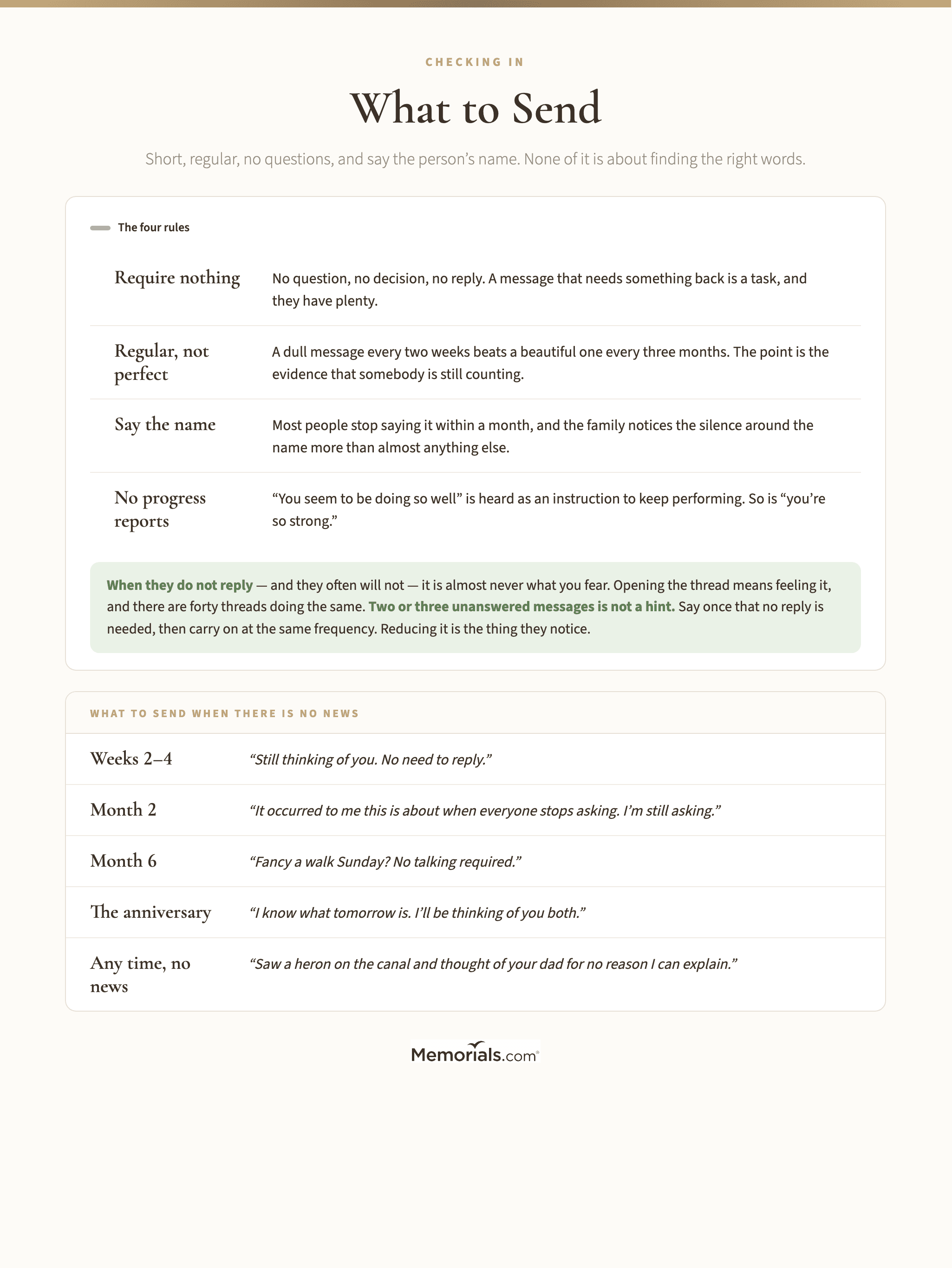
Knowing how to check in on someone grieving comes down to four things, and none of them is about finding the right words.
Knowing how to check in with someone who is grieving starts with what the message does not do.
Make it require nothing. No question, no decision, no reply. Thinking of you today. No need to answer this. A message that needs something back is a task, and they have plenty.
Be regular rather than perfect. A dull message every two weeks beats a beautiful one every three months. The point is not the content; it is the evidence that somebody is still counting.
Say the person's name.Thinking about you and about Michael. Most people stop saying the name within a month, and the family notices the silence around it more than almost anything else.
Do not report on their progress.You seem to be doing so well is heard as an instruction to keep performing. So is you're so strong.
Short, regular, and requiring nothing back. The point is not the wording; it is that somebody is still counting.
People search this a dozen ways — how to check on someone who is grieving, how to check in on a friend who is grieving, how to check on someone who lost a loved one — and the answer is the same in every case. What changes is the timing.
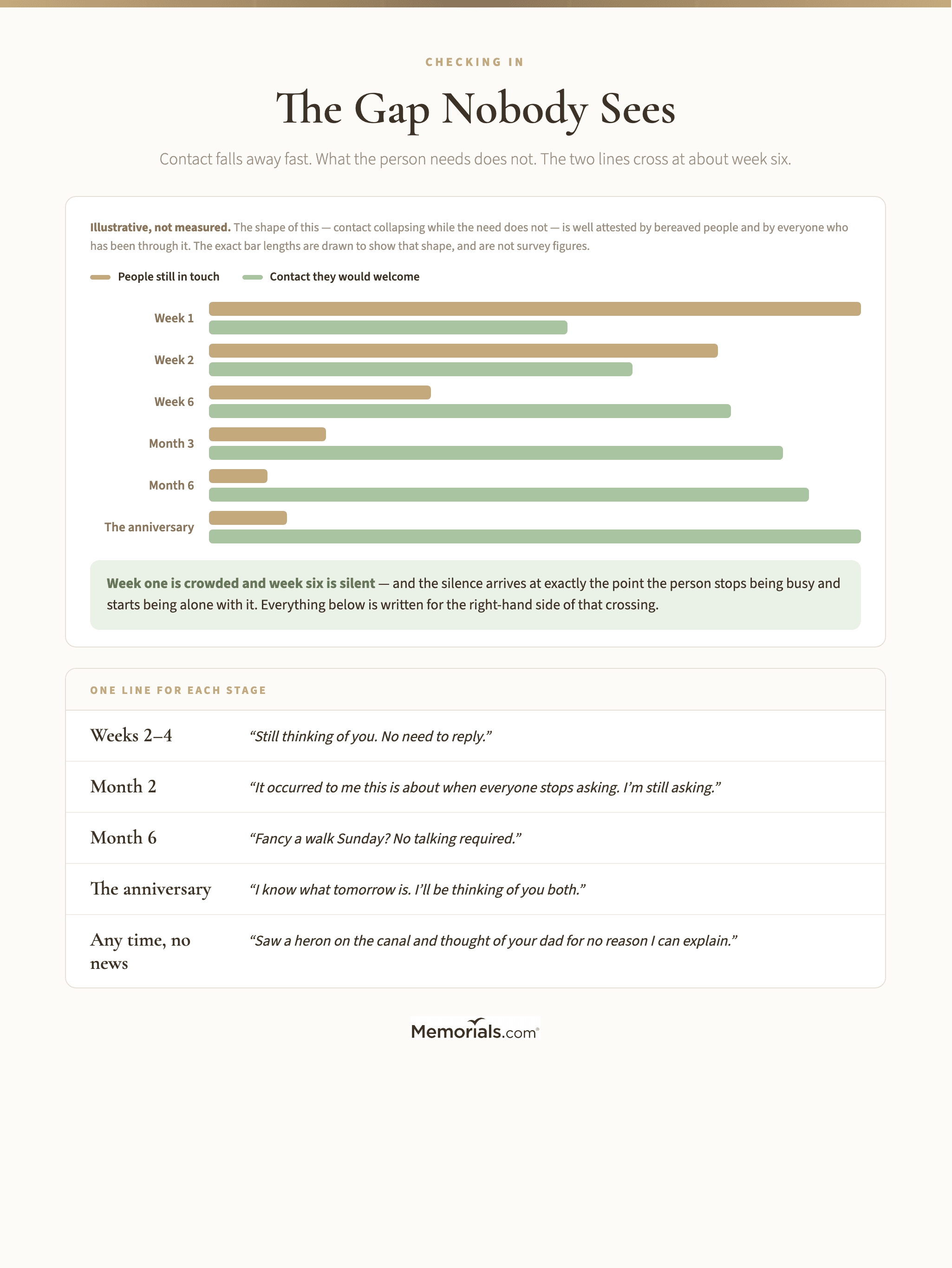
Week two to four — while people are still around, but thinning.
Still thinking of you. No need to reply.
How's this week? Genuinely fine to say "awful".
I'm around Thursday if you want company or a lift anywhere.
Month two — the drop-off. Almost everyone has gone quiet by now.
It occurred to me this is about when everyone stops asking. I'm still asking.
Thinking about you and about Anne today.
No agenda, just checking in. Reply whenever, or don't.
Month six — the quietest stretch, and the one that matters most.
Six months. I imagine that's a strange number to see written down. Thinking of you.
Still here. Still thinking about him.
Fancy a walk Sunday? No talking required.
The first anniversary, birthdays, and holidays — braced-for days.
I know what tomorrow is. I'll be thinking of you both.
First Christmas is a hard one. I'm on the end of the phone the whole time.
Happy birthday to Michael, wherever that lands for you today.
Checking in on someone who is grieving does not get less welcome as time passes. It gets rarer, which is not the same thing. How long grief lasts covers the real shape of the first two years.
The two lines cross at about week six, and that gap is the whole subject of this page. The shape is well attested; the exact bar lengths are illustrative rather than survey figures.
What to Say When There Is No News
The hardest part of how to check in on someone who is grieving over months is that nothing changes, and a message that implies something should have feels like a test.
So do not ask how they are doing. Ask nothing, or ask about something concrete and small.
Thinking of you. Nothing to report here either.
Saw a heron on the canal and thought of your dad for no reason I can explain.
No news, no questions. Just here.
I made that soup you liked. There is some in the freezer with your name on it.
The heron message is the model. A specific, pointless, true observation that mentions the person who died and asks for nothing is close to the perfect check-in. It says you are still in my head without demanding a status update.
When They Do Not Reply
They often will not, and the meaning is almost never what you fear.
Grieving people are frequently unable to answer messages for weeks — not because they do not want to, but because opening the thread means feeling it, and there are forty other threads doing the same thing. Silence is the least reliable signal you will get.
Keep sending anyway. Two or three unanswered messages is not a hint. Say so explicitly, once:
I'm going to keep sending these whether you answer or not, so please don't feel you have to.
Change nothing about the frequency because they went quiet. Reducing it is the thing they will notice.
Switch channel once, if it has been a very long time. A card in the post reaches someone who cannot face a phone.
And if they ask you to stop, stop — and say you will still be there when they want you. Some people genuinely cannot take contact for a while, and respecting that is also checking in.
And when one of them finally answers at length, the check-in has become a live conversation, which is a different skill from this one. How to comfort someone through text covers what to send while somebody is actually crying at the other end of it.
When It Is a Carer, Not a Mourner
More than a third of people looking for this are asking about somebody whose person is still alive — a husband in a hospice, a mother with dementia, a child in treatment. That is a different job and almost nothing is written about it.
Carers are checked on less than the bereaved, get no ritual, and are frequently told how well they are coping by people who see them for ten minutes a week.
No update needed. Just thinking of you both.
How's your week been? Not his. Yours.
I'm bringing dinner Tuesday. Leave the door on the latch and don't get up.
Do you want company at the hospital, or company away from it?
Ask about the carer, not the patient. Everyone else asks after the patient, which quietly tells the carer they are the support act in their own life.
Our guide to coping with a dying loved one covers what that period does to people, and anticipatory grief is real grief — do not tell them afterward that at least they had time to prepare.
The worry that stops most people from working out how to check on someone grieving at all, and it is largely unfounded — but here is how to be sure.
Give an exit in the message itself.No need to reply, say no freely, whenever suits. An invitation with a built-in refusal is far easier to accept than an open question.
Offer specifics, not availability.I'm around if you need anything asks them to plan. I'm free Sunday morning, I'll bring lunch, say the word does not.
Do not stack messages. One unanswered message, then wait for your normal interval. Three in two days reads as anxiety they now have to manage.
Never make them reassure you.I hope I'm not bothering you obliges a response whose only purpose is to comfort you.
Watch the anniversary of your own last message. If it has drifted to two months without you noticing, that is the drift this page exists to prevent.
If You Are One of Several People Checking In
Occasionally a grieving person has three or four friends all doing this well, which is wonderful and creates a problem nobody anticipates: they now have four conversations to maintain, all asking gently how they are.
Two things fix it.
Coordinate quietly. A short group message between the friends — I'm doing Tuesdays, who wants the weekends? — spreads the contact and stops the person receiving five messages on the anniversary and none in March.
Divide by kind, not just by day. One person does food, one does practical jobs, one does the walks, one does the messages. Everybody offering the same thing means most of it goes unused while the actual gap stays open.
And if you are the only one, say so plainly to the family at some point: I know I'm only one person, but I'm not going anywhere. People assume somebody else is doing it. Frequently nobody is.
What Not to Send
"How are you?" — unanswerable, and it obliges an answer from the person least able to give one.
"Let me know if you need anything." — hands the work back.
"You seem to be doing so well." — heard as an instruction.
"Are you feeling better?" — grief is not an illness with a recovery curve.
"Everything happens for a reason."
Advice of any kind, unless asked. Especially about counseling, exercise, or dating.
A long message about your own grief. Send that to a different friend.
"Fancy a walk Sunday? No talking required." An invitation with an exit built in is easier to accept.
Beyond Messages
Checking in is not only a text, and after the first month the non-message versions land harder.
Turn up with something. Food remains the most useful thing anyone does, and the second week onward is when the fridge is empty and nobody is bringing anything. Grief groceries covers what to actually buy.
Book something low-stakes. A walk, a film, a drive. Things with a natural end are easier to say yes to than an open evening.
Do a job. The car needs its inspection. The gutter is blocked. These are the tasks that pile up quietly and feel unfaceable alone.
Say the thing only you can say. An old friend holds history nobody else has, and spending it — a shared memory, the nickname, the story from before — is worth more at month five than any of the practical help. What to say to a friend who lost a loved one covers the jobs that fall specifically to a friend.
Send a physical object occasionally. Not often, and never as a substitute for the message. A card that arrives in month five, when nothing else does, is remembered. Among bereavement gifts the pieces that suit this stage are small — the memorial gifts for loss range is where to look, and something with the person's name on it says what a text cannot.
If they have gone back to work, grief at work covers what that is like from the inside and what colleagues get wrong.
The practical bit, because good intentions do not survive a busy November.
Four dates and about ninety seconds of work. It is the difference between meaning to and doing it.
Put four dates in your calendar now. Month three, month six, the birthday, and the anniversary. Add the first Christmas. That is five reminders and about ninety seconds of work, and it is the difference between meaning to and doing it.
Set a recurring nudge — every three weeks for the first year. You will delete most of them and send some, which is exactly right.
Write the person's name in the reminder.Text Sam about Michael rather than text Sam, so you remember to say the name.
Expect it to get easier and stay important. By month eight the messages are short and ordinary, and that ordinariness is the point: it means their life has someone in it who is not treating them as a crisis.
The messages that work ask for nothing and say the person's name. Both are rarer than they sound.
Frequently Asked Questions
How often should I check in on someone who is grieving? Roughly every two to three weeks for the first year. Regular and dull beats occasional and eloquent.
What do I say when there is nothing new to say? Say something specific and pointless that mentions the person who died. Saw a heron on the canal and thought of your dad. It asks for nothing and proves they are still in your head.
They never reply. Should I stop? No. Grieving people often cannot answer messages for weeks, and silence is the least reliable signal you will get. Say once that no reply is needed, then carry on at the same frequency.
Is it too late to start checking in? No. Month six is emptier than week one, so a message starting now lands harder than one sent at the funeral would have.
How do I check on someone who lost a loved one if I do not know them well? Shorter and less often, but do it. Two lines every month or so from a distant friend is never unwelcome; being one of the many who said nothing is noticed.
What if the person is dying rather than dead? Ask about the carer, not the patient. Everyone else asks after the patient, which tells the carer they are the support act in their own life.
In Closing
Put five reminders in your calendar before you close this page — month three, month six, the birthday, the anniversary, and the first Christmas.
Then send dull, short, regular messages that ask for nothing and use the person's name. That is the entire method, and almost nobody does it.