🏬Supersize Online Funeral Retailer🪦1000's of Headstones⚱️Over 10,000 Cremation Urns⚰️Caskets Overnight Delivery🛒Funeral & Memorial Superstore🚚FREE Shipping on ALL Orders👨👩👧👦Helping Families for over 20 Years💰Lowest Price Guarantee🏬Supersize Online Funeral Retailer🪦1000's of Headstones⚱️Over 10,000 Cremation Urns⚰️Caskets Overnight Delivery🛒Funeral & Memorial Superstore🚚FREE Shipping on ALL Orders👨👩👧👦Helping Families for over 20 Years💰Lowest Price Guarantee
🏬Supersize Online Funeral Retailer🪦1000's of Headstones⚱️Over 10,000 Cremation Urns⚰️Caskets Overnight Delivery🛒Funeral & Memorial Superstore🚚FREE Shipping on ALL Orders👨👩👧👦Helping Families for over 20 Years💰Lowest Price Guarantee🏬Supersize Online Funeral Retailer🪦1000's of Headstones⚱️Over 10,000 Cremation Urns⚰️Caskets Overnight Delivery🛒Funeral & Memorial Superstore🚚FREE Shipping on ALL Orders👨👩👧👦Helping Families for over 20 Years💰Lowest Price Guarantee
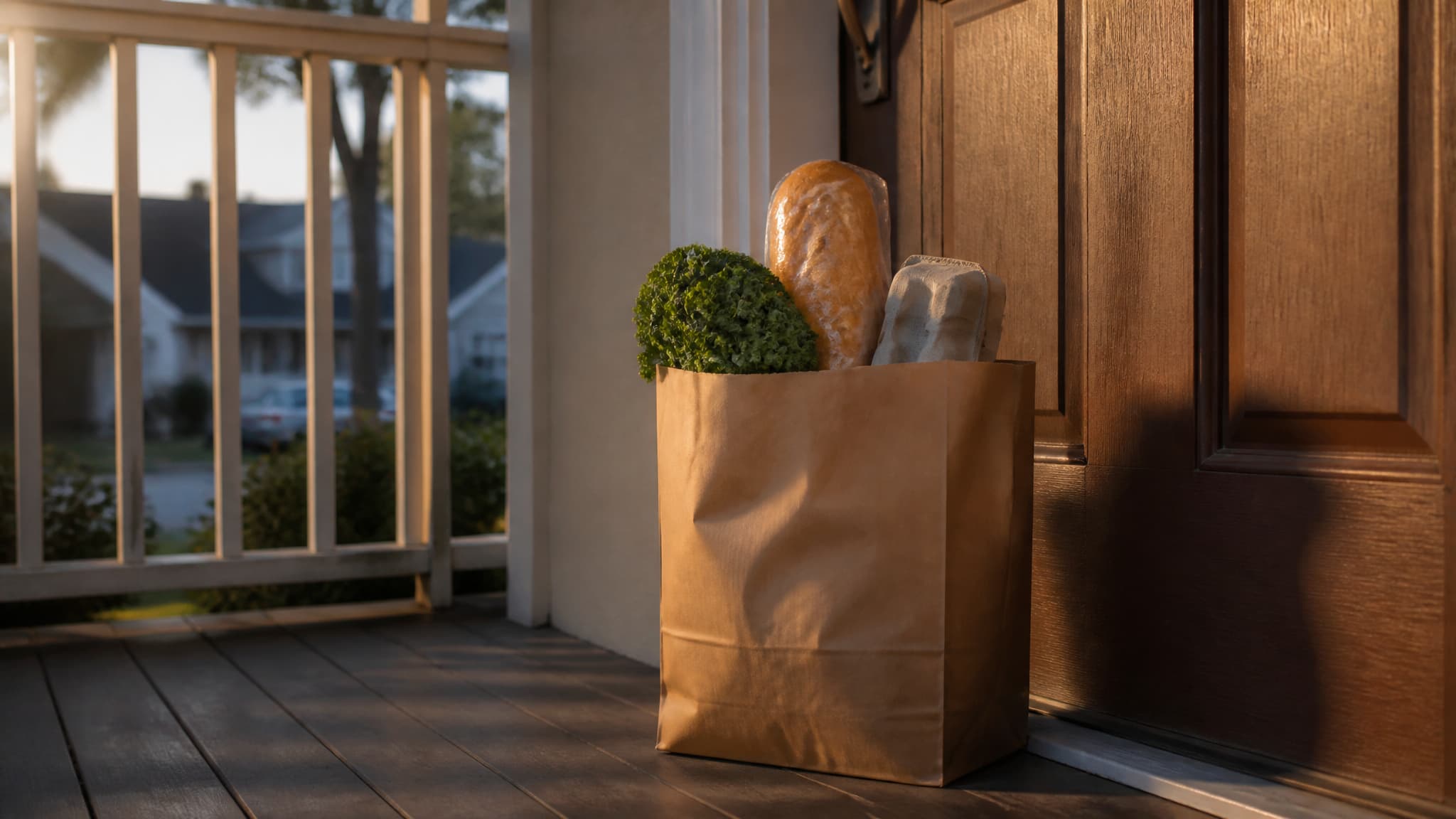
Grief groceries are the bags somebody leaves on the step when there is nothing useful to say. They are, reliably, the most appreciated thing anyone does in the first month, and almost nobody gets the contents right.
The problem is that most people bring a casserole. Casseroles are lovely and the fridge is already full of them by day three, while the house has run out of milk, bread, toilet paper and coffee, and nobody in it has eaten a vegetable in four days. The sympathy and condolence guide covers the words; this page is about the bags.
The short version: buy the boring things, cook what reheats, label everything, and leave it on the step.
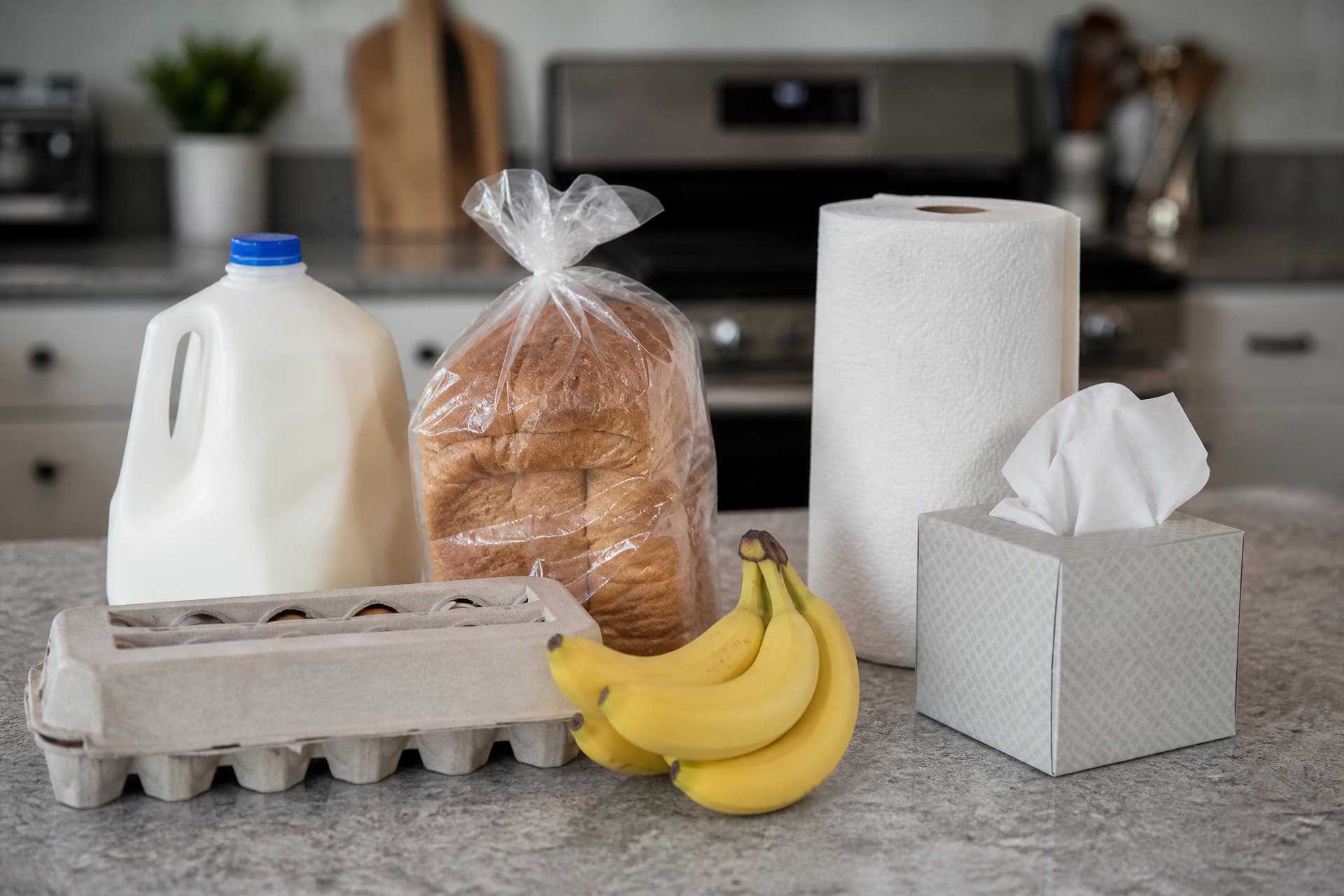
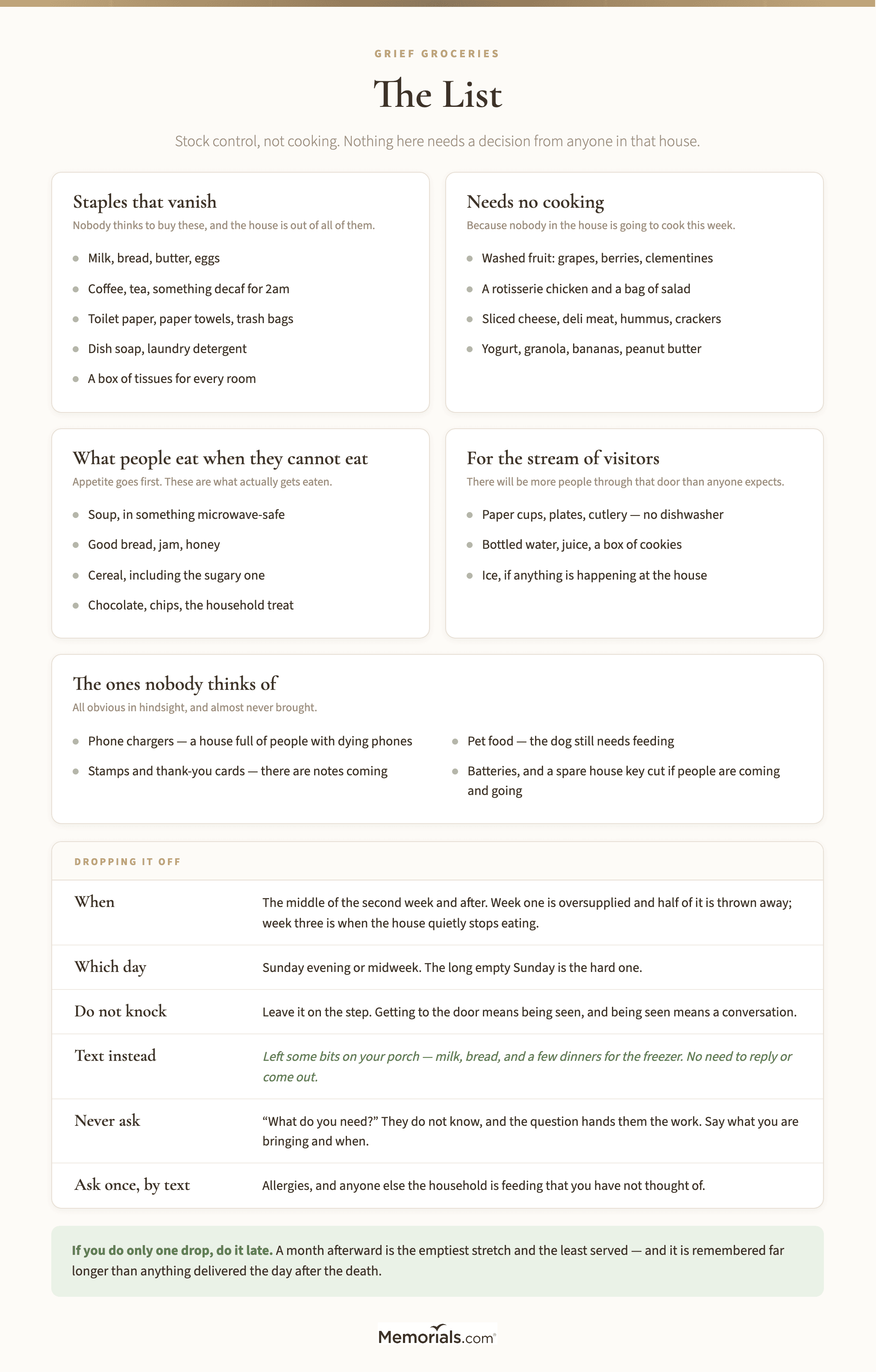
The Grief Groceries List
This is the grief groceries list, and its virtue is that none of it needs a decision from anyone.
Coffee, tea, and something decaffeinated for two in the morning
Toilet paper, kitchen roll, trash bags, dish soap
Laundry detergent, and a box of tissues for every room
Food that requires no cooking
Fruit that is already washed: grapes, berries, clementines
A rotisserie chicken and a bag of salad
Sliced cheese, deli meat, hummus, crackers
Yogurt, granola, bananas, peanut butter
The things people actually eat when they cannot eat
Soup, in a container that goes straight in the microwave
Toast things — good bread, jam, honey
Cereal, including the sugary one somebody's teenager will live on
Chocolate, chips, and whatever the household treat is
For the visitors, because there will be many
Paper cups, plates, and cutlery, so nobody has to run a dishwasher
Bottled water, juice, a box of cookies
Ice, if a funeral is happening at the house
And the two nobody thinks of
Phone chargers and stamps. The house is full of people with dying phones, and there are thank-you notes coming.
Pet food. The dog still needs feeding and nobody has thought about it.
Buying groceries for a grieving family is not a culinary act. It is stock control, and you are restocking a house where the person who did the shopping has either died or stopped functioning.
Stock control, not cooking. This is a house where whoever did the shopping has stopped.
Sympathy Keepsakes and Memory Boxes
For when the food has stopped and the cards need somewhere to live
Deciding what food for a grieving family actually helps comes down to one question: can somebody eat this at eleven at night, alone, without making a decision?
Good meals for a grieving family are not the ones that photograph well. The best meals to bring to a grieving family are single-portion, labeled, and freezable. One enormous lasagna is a kind thought and a logistical problem — it must be eaten in two days by a house with no appetite. Six portions of the same lasagna, frozen flat, feed that house for a month.
What works
Soups and stews — chili, minestrone, chicken and rice
Pasta bakes portioned into small foil trays
Shepherd's pie, cottage pie, anything under mashed potato
Curries and dals, which freeze better than almost anything
A tray of roast vegetables, because nobody else will bring any
Funeral homes and caterers call these bereavement meals, which makes them sound like an occasion. They are not. They are Tuesday.
What does not
Anything that needs assembling, dressing, or timing
Salads that go slimy by Thursday
Anything in a dish you want back
More casserole, unless you have checked
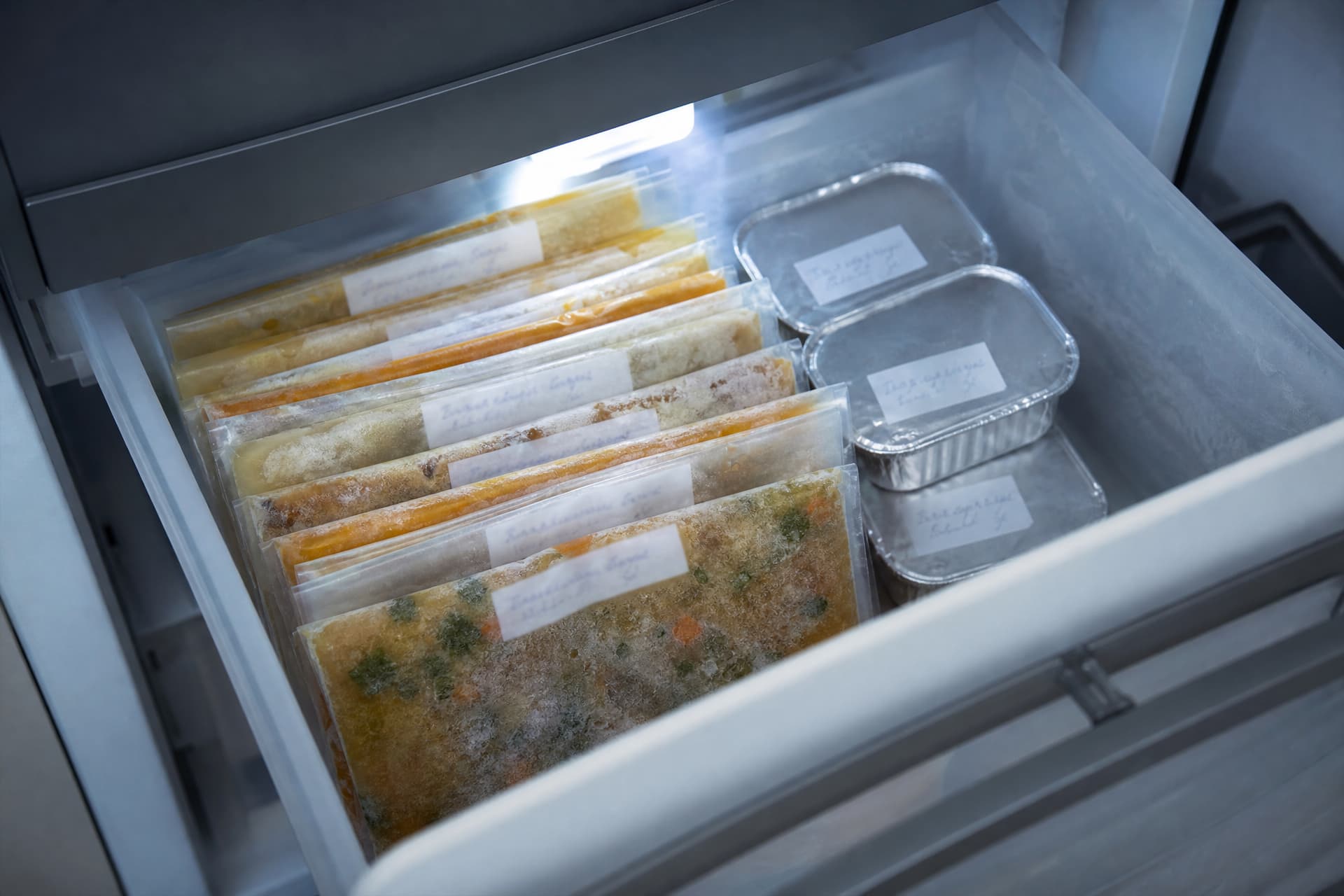
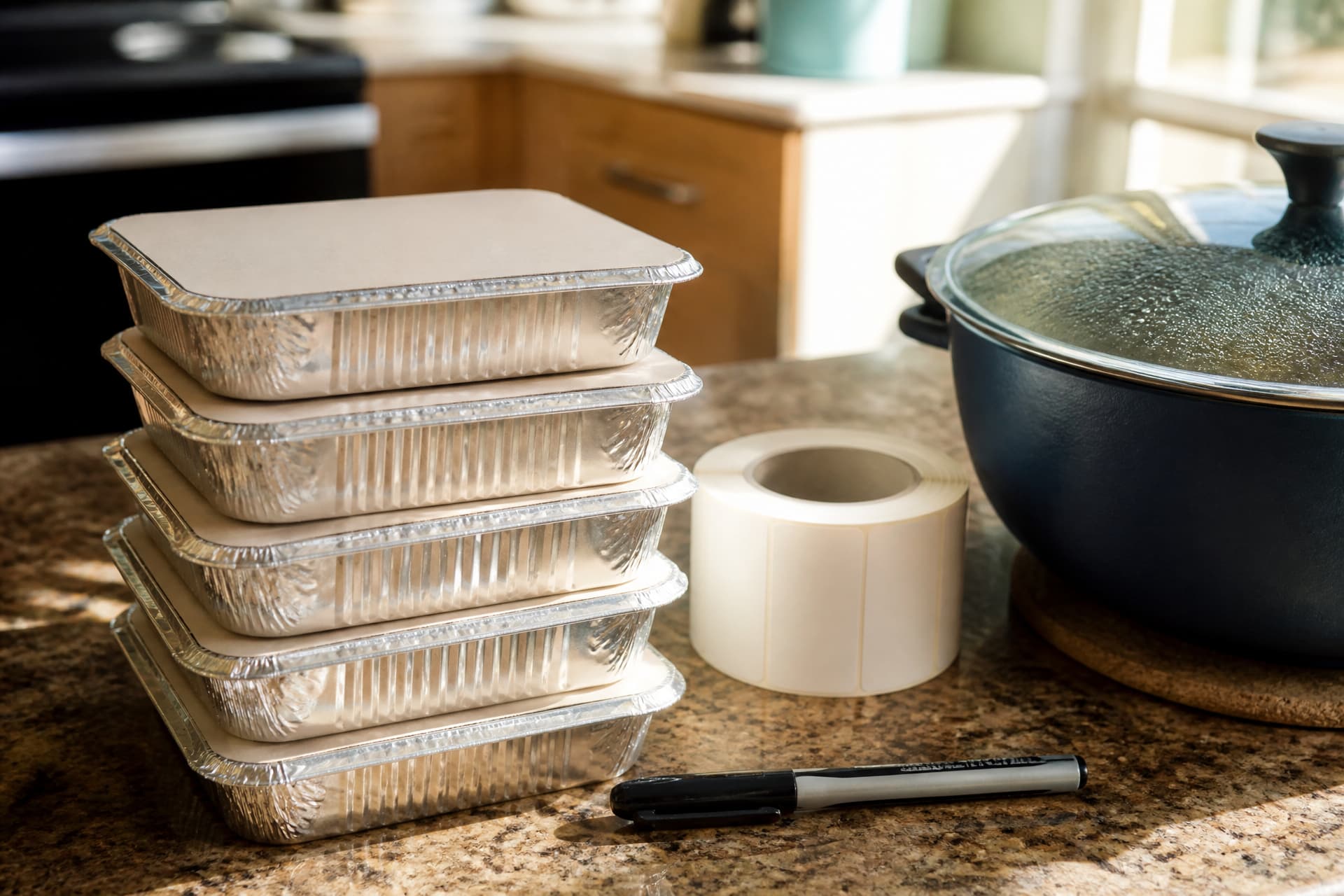
Freezer meals for grieving families need three things on the label: what it is, how to heat it, and the date. Chicken and rice soup. Microwave 4 min from frozen. Made 12 March. Meals arrive at a house where nobody can currently read a recipe, and an unlabeled foil tray becomes a mystery nobody has the energy to solve.
Use disposable containers, every time. A returnable dish is a small debt, and grieving people keep a mental list of them. Foil trays, takeout containers, and zip bags cost almost nothing and ask for nothing back.
Freeze it flat. A bag of stew frozen flat stacks, thaws in an hour, and fits in a freezer that already has four casseroles in it.
Single portions, labeled with the reheating time, in containers nobody has to return.
When to Take Food, and How to Drop It Off
The question of when should you take food to a grieving family has a clear answer, and it is not the one most people follow.
Week one is crowded. Week three is empty. The first few days bring more food than the fridge holds and half of it is thrown away. By the middle of the second week the casseroles have stopped, the visitors have gone home, and that is when a grieving household stops eating properly. If you can only do one drop, do it late.
Go on a Sunday evening or a Wednesday. Weekday evenings and the long empty Sunday are the hard ones.
Do not ring the doorbell. Leave the bags on the step, then text: Left some bits on your porch — milk, bread, and a few dinners for the freezer. No need to reply or come out. Getting to the door means being seen, and being seen means a conversation.
Never ask what they need. They do not know, and asking transfers the work. Say what you are bringing and when: I'm dropping groceries Thursday around six.
Ask one thing only, and ask it once: allergies, and anyone the household is feeding that you have not thought of. Text it, do not call.
And keep going past the first month. The first week after a loss is covered in food and no one is hungry. Month two is when a text saying dinner is on your step means the most, and checking in on someone who is grieving is the wider version of the same habit.
Take a photograph of this into the store. None of it needs a decision from anyone in that house.
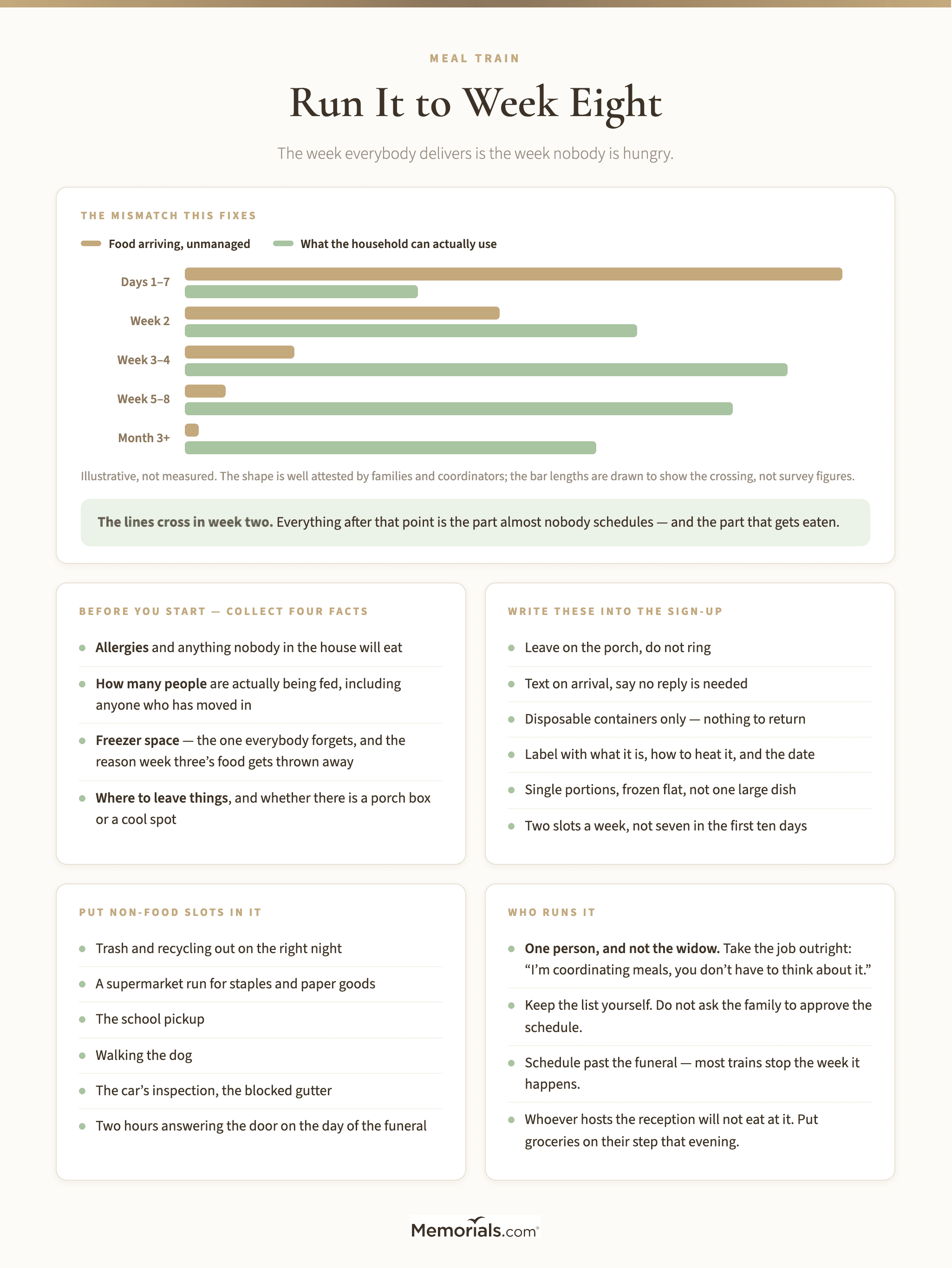
How to Run a Meal Train
When several people want to help, a meal train for death stops them all arriving on the same Tuesday with lasagna.
One person organizes it, and it is not the widow. Take the job. Say I'm coordinating meals, you don't have to think about it.
Spread it out, thinly. Two deliveries a week for six weeks beats fourteen in the first ten days. Meal train ideas for a grieving family that actually work are almost always about the calendar, not the cooking.
Collect four facts before you start: allergies, how many people, whether there is freezer space, and where to leave things. Freezer space is the one everybody forgets, and a full freezer is why the third week of food gets thrown away.
Write drop-off rules into the sign-up. Leave on the porch, text on arrival, disposable containers only, label with reheating instructions. Say it once in writing and nobody has to be corrected.
Put non-food slots in it. Trash out on Tuesdays, a grocery run, the school pickup, walking the dog, taking the car for its inspection. These get taken quickly, and they help more than a seventh casserole.
And schedule past the funeral. Most meal trains end the week it happens, which is the week they are least needed. Run yours to week eight.
What to Take Besides Food
Plenty of people search for what to take to a grieving family besides food, usually because the fridge is visibly full.
Practical supplies win. Stamps, envelopes, pens, and a pack of thank-you cards — there are notes coming and nobody has stationery. Trash bags. Batteries. A phone charger.
Take a job instead of a thing. Mow the lawn, do a grocery run, take the recycling out, sit in the house so somebody can sleep, answer the door for two hours on the day of the funeral.
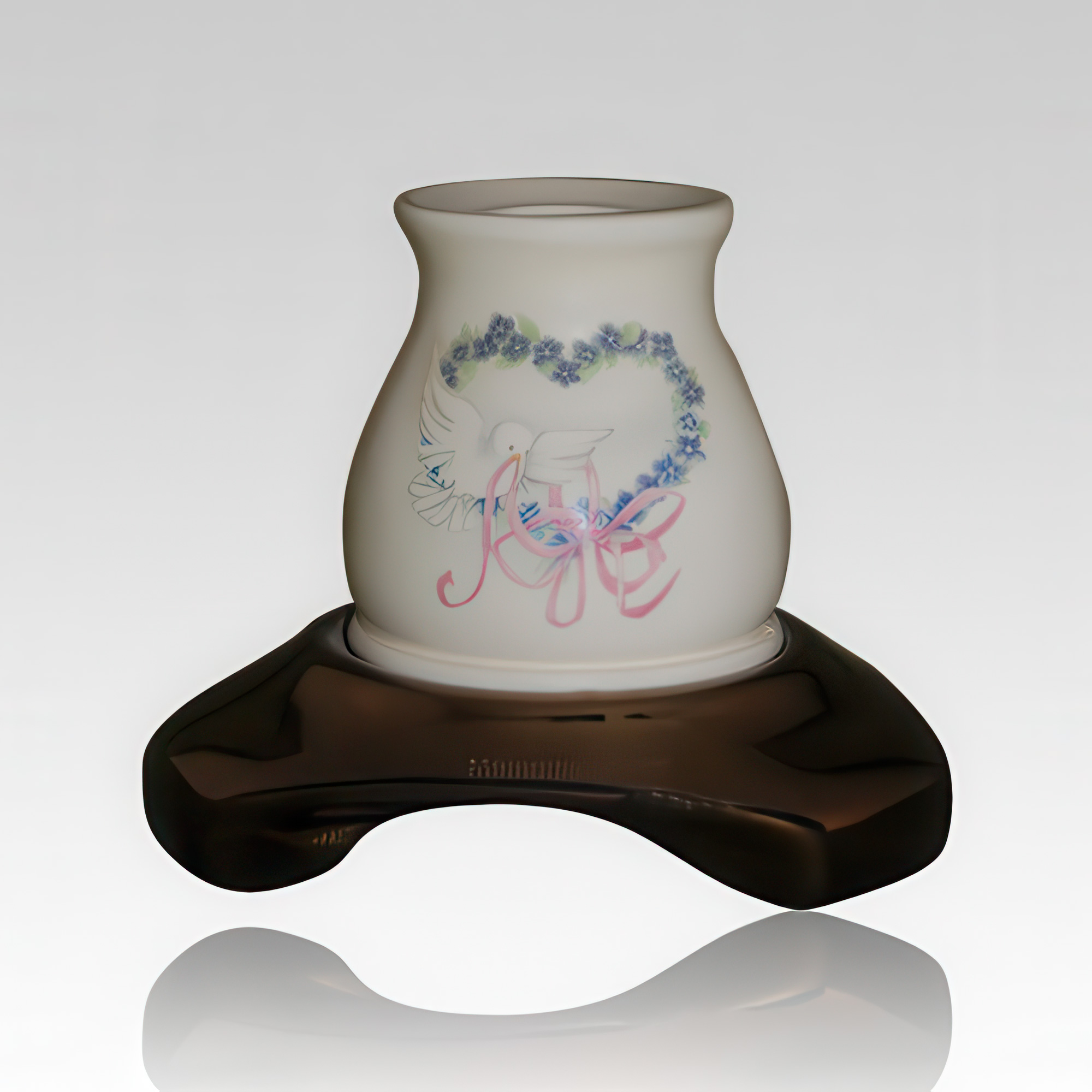
Something for the days after.Sympathy gifts by budget sets out what is appropriate at what price, and sympathy gift etiquette covers the timing and the card. If you want something that outlasts the food, keepsake boxes give the cards, orders of service and photographs somewhere to live instead of a kitchen drawer, and the smaller keepsake gifts suit a friend rather than immediate family.
If you are far away, groceries still work. A delivery slot booked in their name, a grocery gift card, or a meal-kit subscription for a month all land as food to send to a grieving family without asking them to receive anybody at the door.
Half the people reading this are not going to cook anything, and that is fine — bought food dropped off reliably beats homemade food that never happens.
Buy the components, not the meal. A rotisserie chicken, a bag of rice, a tub of coleslaw and a loaf of good bread is dinner twice and needs no instructions.
Frozen from the store is a real answer. Decent frozen soup, dumplings, or a lasagna in a foil tray goes in the freezer exactly like a homemade one. Nobody is checking.
Order it to their door. A delivery slot booked in their name, a grocery gift card, or a takeout gift card for a place they actually like. A gift card beats a gift basket, because they choose the night.
Buy the boring shop. If you do only one thing, do this one: the staples list at the top of this page, in a bag, on the step. It is the least impressive gesture available and the one families remember.
What Not to Bring
Another casserole, unchecked. Ask the coordinator, or bring breakfast instead.
Anything in a dish you want back.
Flowers, to the house, in week one. There will already be more than there are vases. In lieu of flowers covers what the family may have asked for instead.
A cheese board or a grazing platter. Beautiful, needs eating today, and nobody is hosting.
Diet food, or anything improving. This is not the month.
Alcohol, unless you know the household well.
Yourself, unannounced. The bags are the gift. Your company is a separate offer, made separately.
If It Is a Colleague, Not a Neighbor
Food travels badly to an office and it is the wrong gesture from a workplace anyway.
Send groceries to the house, not the desk. A delivery slot or a grocery card from the team is worth more than a basket of things nobody chose.
Then remember the return.Grief at work is about what happens after the food stops, which is where most workplaces lose the thread.
Disposable containers and a marker. A returnable dish is a small debt, and grieving people keep a list of them.
Feeding the Funeral Is a Different Job
Do not confuse the two. Stocking a house is what this page is about; feeding forty people after a service is catering, and it runs on different rules — quantities, hot-holding, who pays, and what the venue allows. Our funeral food guide covers the reception, the repast, and the menu.
The one overlap worth naming: whoever hosts the reception will not eat at it. Somebody should put a plate aside for them, and take a bag of groceries to their house that evening, because they will get home at nine to an empty fridge and a hundred folded chairs.
The two lines cross in week two, and everything past that point is what actually gets eaten. The shape is well attested; the bar lengths are illustrative rather than survey figures.
Frequently Asked Questions
What should I put in a bag of grief groceries? Staples before food: milk, bread, butter, eggs, coffee, toilet paper, trash bags, tissues. Then things that need no cooking — fruit, a rotisserie chicken, yogurt, good bread. Then paper cups and plates for the visitors.
When is the best time to take food to a grieving family? The middle of the second week and onward. The first few days are oversupplied and half of it is wasted; week three is when the household quietly stops eating.
How much food should I bring? Single portions rather than one large dish, four to six of them, frozen flat and labeled. It keeps, it stacks, and it does not commit anybody to eating the same thing twice a day.
Should I knock? No. Leave it on the step and text to say it is there, with an explicit line that no reply is needed.
What if the freezer is already full? Ask the meal train coordinator, or switch to staples and paper goods, which never run out of room. A grocery delivery slot booked in their name is the safest gift of all.
What can I bring instead of food? Stamps, thank-you cards, trash bags, batteries, a phone charger — or a job: the lawn, the recycling, the school run, two hours answering the door on the day of the funeral.
Is it too late to bring food a month later? No. Month two is the emptiest stretch and the least served. A drop-off then is remembered far longer than one made the day after the death.
In Closing
Buy the boring things. Cook something that reheats, put it in a container you never want to see again, and write on the lid what it is and how long it takes.
Then leave it on the step, send one text, and do it again in three weeks when everybody else has stopped.