🏬Supersize Online Funeral Retailer🪦1000's of Headstones⚱️Over 10,000 Cremation Urns⚰️Caskets Overnight Delivery🛒Funeral & Memorial Superstore🚚FREE Shipping on ALL Orders👨👩👧👦Helping Families for over 20 Years💰Lowest Price Guarantee🏬Supersize Online Funeral Retailer🪦1000's of Headstones⚱️Over 10,000 Cremation Urns⚰️Caskets Overnight Delivery🛒Funeral & Memorial Superstore🚚FREE Shipping on ALL Orders👨👩👧👦Helping Families for over 20 Years💰Lowest Price Guarantee
🏬Supersize Online Funeral Retailer🪦1000's of Headstones⚱️Over 10,000 Cremation Urns⚰️Caskets Overnight Delivery🛒Funeral & Memorial Superstore🚚FREE Shipping on ALL Orders👨👩👧👦Helping Families for over 20 Years💰Lowest Price Guarantee🏬Supersize Online Funeral Retailer🪦1000's of Headstones⚱️Over 10,000 Cremation Urns⚰️Caskets Overnight Delivery🛒Funeral & Memorial Superstore🚚FREE Shipping on ALL Orders👨👩👧👦Helping Families for over 20 Years💰Lowest Price Guarantee
Most advice about how to comfort someone through text stops at the first message. This page starts after it.
You sent your condolences. They answered. Now it is 11:40 at night, the three dots have appeared and vanished four times, and whatever comes next is going to be hard to read. That is a live conversation with someone who is falling apart right now, and it is a different job from writing a nice note — you cannot see their face, you cannot pause, and every gap you leave gets filled with something.
The short version: stay, slow down, say almost nothing, and do not try to fix it. Everything below is the detail. If you have not sent that first message yet, sending condolences by text covers it, and the sympathy and condolence guide is the wider starting point.
Knowing what to say to comfort someone over text comes down to four things, and none of them is finding the perfect sentence.
Answer fast, then slow down. Reply quickly enough that they know you are there — then stop racing. A person crying at their kitchen table does not want a conversation partner working at speed. Short messages, spaced out, are the texture of somebody sitting with them.
Do not fill the silence. The single most common mistake is answering a gap in the thread with more words. If they go quiet for four minutes, they are crying, or they are choosing what to admit. Let it sit. I'm here is a complete message.
Never move them along. No at least, no he's at peace now, no time helps. Each of those asks a person in the worst hour of their life to feel better on your schedule.
Do not make them look after you.I'm so sorry, I don't know what to say, I feel awful, I hope I'm not making it worse hands them a second person to comfort. Say one honest version once — I don't have the right words, but I'm not going anywhere — and then stop.
Answer fast, then slow down. Short messages with gaps between them are what sitting beside someone looks like over a phone.
This is the moment people search for — how to comfort someone who is crying over text — and it has a specific answer.
When someone tells you they are crying — or the messages break into fragments, all lowercase, no punctuation — stop giving information. No advice, no logistics, no offers, no questions with question marks. What they need is proof that somebody is still on the other end while it happens.
Send short things. One line at a time.
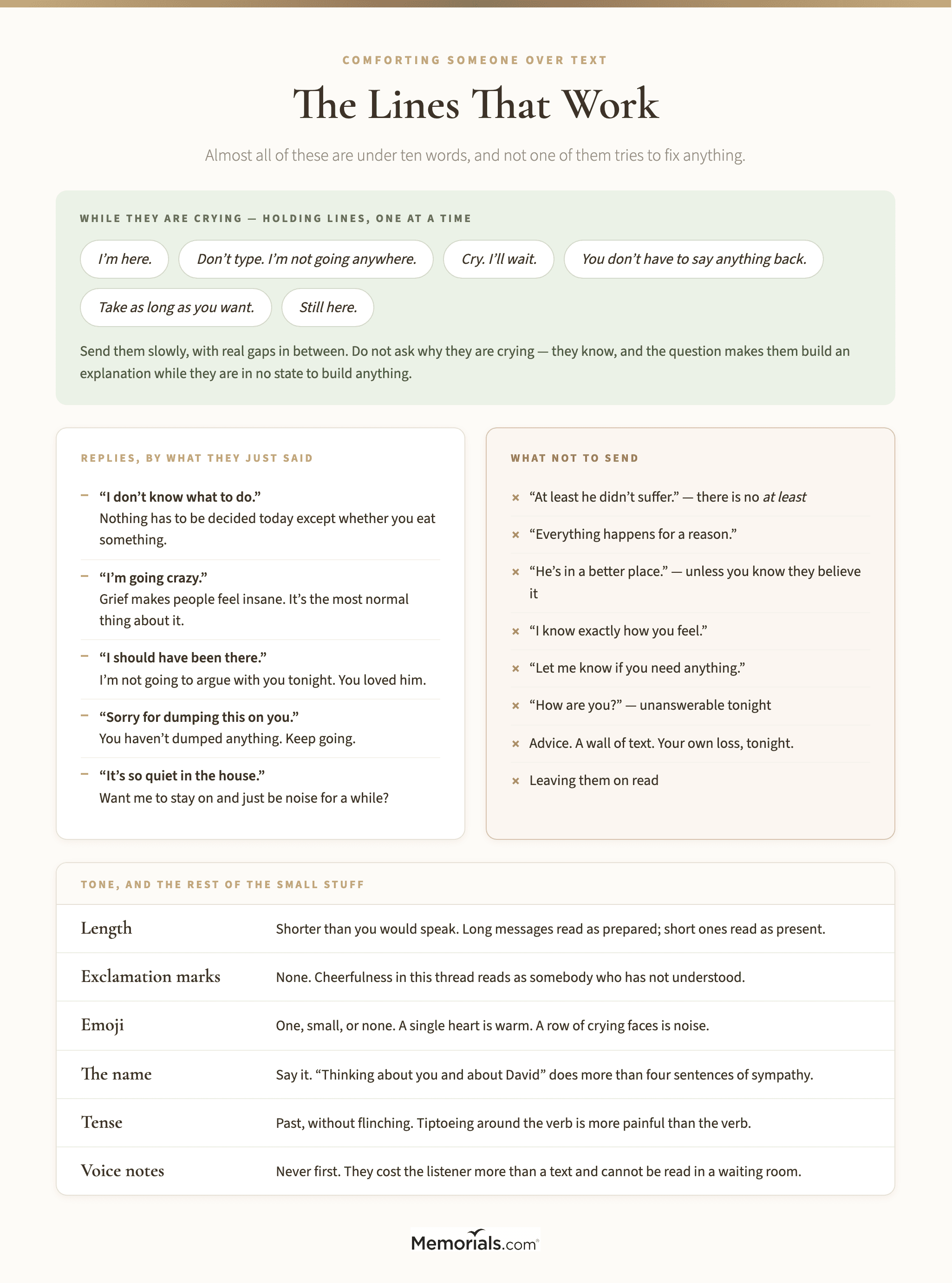
I'm here.
Don't type. I'm not going anywhere.
Cry. I'll wait.
You don't have to say anything back.
Take as long as you want. I'm not doing anything else tonight.
Then actually wait. Two minutes of nothing from you is not an awkward silence; it is the message. If it stretches long enough to worry you, one line — still here — is plenty.
Name what is happening without diagnosing it.That sounds like it hit you all at once lands. It's the shock, that's normal does not, because it turns them into a case.
And do not ask them why they are crying. They know. The question makes them build an explanation while they are in no state to build anything. Physical symptoms of grief covers why the body does this without warning, months in.
When to Stop Typing and Call
Texting is the right medium for most of this, and the wrong one for about ten minutes of it. Learning how to comfort people over text includes knowing when to leave.
Offer a call — never just make one. A ringing phone is a demand, and someone mid-cry may not be able to speak. Ask in a way that is easy to refuse:
Do you want me to call, or is text better right now?
I can call in two minutes if you'd rather not type. Totally fine either way.
Want me to call and you don't have to talk? I'll just be on the line.
That last one is the useful one. An open line with no obligation to speak is closer to company than a conversation is, and people accept it far more often than a normal call.
Go to the phone when any of these show up: they say they are alone and frightened; the messages stop making sense; they mention not wanting to be here; they are making a decision tonight that cannot wait; or you have been going back and forth for an hour and it is getting worse rather than steadier.
And go in person when you can. Nothing sent from a phone beats a person on the doorstep with food. If they are within reach, say I'm coming over, I'll bring dinner, you don't have to talk to me — and then go. The first week after a loss is when this matters most and when it is offered least.
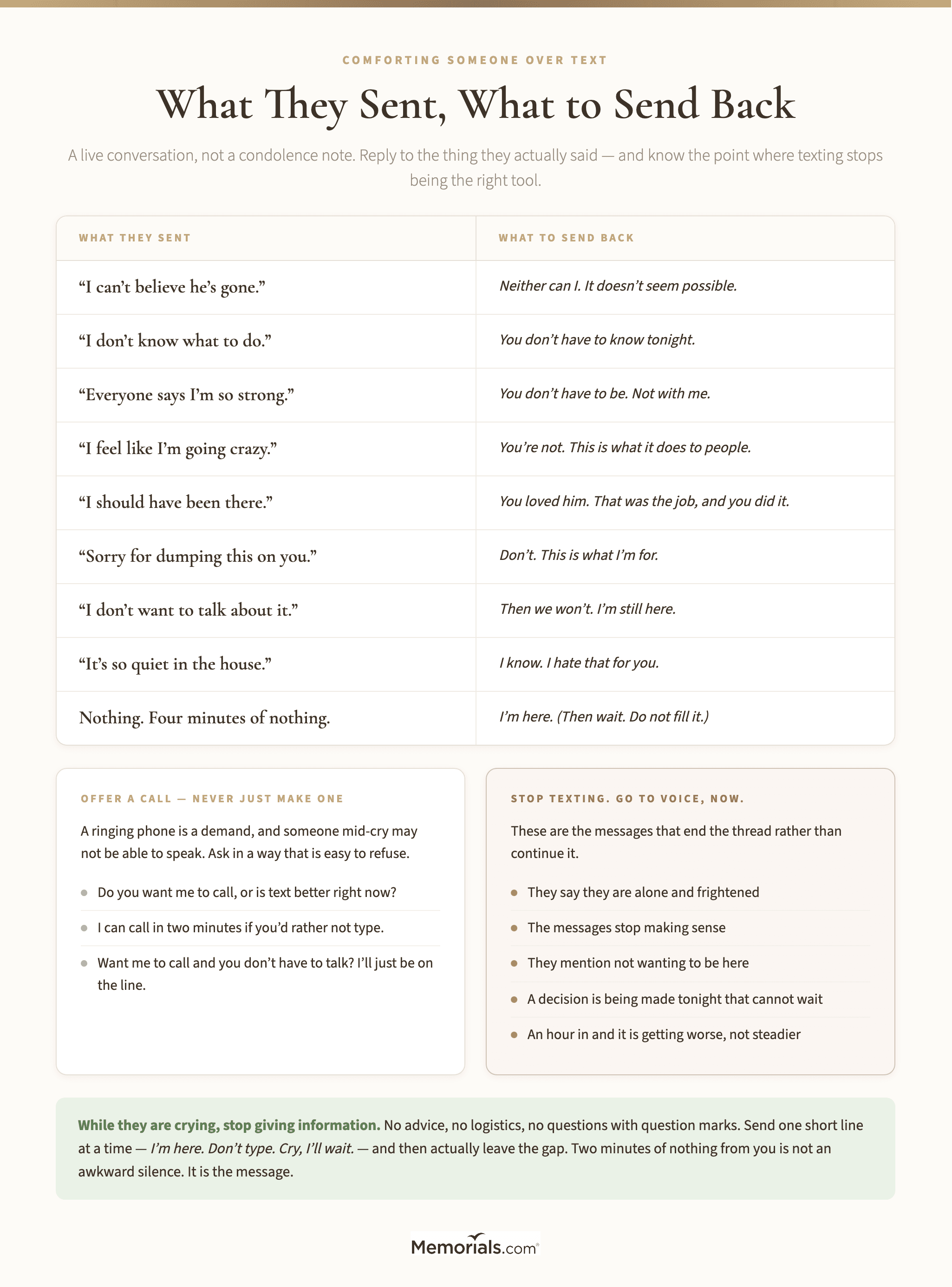
The left column is what they sent; the middle is what to send back. The right-hand path is the one that ends the texting.
What to Text Someone Who Lost a Loved One, by What They Just Said
Comforting text messages are easier to write as replies than as openers. People look for this in some odd shapes — what to text to someone who lost a loved one, how to console someone over text death — and the answer is the same every time: reply to the thing they actually said. Here is what to send when they say it.
"I can't believe he's gone."
Neither can I. It doesn't seem possible.
I keep expecting to see him too.
"I don't know what to do."
You don't have to know tonight.
Nothing has to be decided today except whether you eat something.
"Everyone keeps telling me how strong I am."
You don't have to be. Not with me.
You're allowed to be a complete mess about this.
"I feel like I'm going crazy."
You're not. This is what it does to people.
Grief makes people feel insane. It's the most normal thing about it.
"I should have been there."
I know you think that. I don't think it's true, and I'm not going to argue with you tonight.
You loved him. That was the job, and you did it.
"Sorry for dumping all this on you."
Don't. This is what I'm for.
You haven't dumped anything. Keep going.
"I don't want to talk about it."
Then we won't. I'm still here.
Fine by me. Want to talk about literally anything else?
"It's so quiet in the house."
I know. I hate that for you.
Do you want me to stay on and just be noise for a while?
Tone, Punctuation, and the Rest of the Small Stuff
How do you comfort someone over text when tone does not travel? Mostly by being plainer than feels natural.
Write shorter sentences than you speak. Long messages read as prepared. Short ones read as present.
Drop the exclamation marks. Cheerfulness in this thread is jarring, and Thinking of you!! reads as somebody who has not understood.
Emoji: one, small, or none. A single heart after a short message is warm and widely understood. A row of crying faces is noise. Which emoji to use in a condolence message covers the ones that work and the ones that read as flippant.
Say the name of the person who died.Thinking about you and about David does more than four sentences of sympathy. Most people avoid the name, and the family feels the avoidance.
Use the past tense without flinching.He was so funny is not a betrayal. Tiptoeing around the verb is more painful than the verb.
Never send a voice note first. They cost the listener more than a text and cannot be read in a waiting room. Send one only if they send one.
Do not screenshot or forward the conversation to a group chat, however concerned everyone is. If you need to raise the alarm, raise it about them, not with their words.
Plainer than feels natural. Short sentences read as present; long ones read as prepared.
When They Say Something That Frightens You
Occasionally a message stops being sadness. Take it seriously and take it out of the thread.
Say it plainly.That scared me a bit. Are you safe right now? is not too direct. Vagueness here helps nobody.
Do not promise to keep it secret.I'm not going to keep this to myself, because I want you around is an honest answer and usually a relief.
Move to voice.I'm calling you now is the one time you skip the offer.
Have a number ready. In the US, 988 reaches the Suicide and Crisis Lifeline, by call or text, at any hour.
And know the ordinary version too. Numbness, sleeplessness, and not being able to picture next week are usual in early grief. Normal grief versus grief depression draws the line, and how long grief lasts covers the real shape of the first two years for anybody expecting it to be over by spring.
Comforting a Widow or Widower Over Text
What to text someone who lost their husband or wife is its own problem, because the messages arrive in a house that is now empty, and they arrive for a much shorter time than the grief lasts.
Do not ask how the kids are doing. Or the parents, or the business. Ask about them. Everyone else asks about everyone else.
Do not disappear at week three. The calls stop almost exactly then, and the widowed describe that drop-off more bitterly than the funeral itself.
Send at ordinary hours, on ordinary days. Sunday afternoon and Tuesday at nine at night are the hard ones, not the anniversaries everybody remembers.
Be specific about the person.I've been thinking about the way Marion used to answer the phone. A concrete memory is worth any amount of sympathy.
And keep it up.Checking in on someone who is grieving is the long version of this page — the ninth message rather than the first, and the one almost nobody sends. If they have gone back to work already, grief at work explains what that is like from the inside.
How to Console Someone Over Text When You Barely Know Them
A colleague. Your sister's friend. Someone you have not seen since school. The instinct is to say nothing because you are not close enough, and that instinct is wrong — the bereaved consistently report being moved by messages from people at the edges, and hurt by the silence of people who were not sure it was their place.
Say who you are and why you are writing.This is Dan from the Tuesday class. I heard about your dad and I'm so sorry.
Keep it to three lines. Distance is fine; length is what makes it strange.
Make no claim on the friendship. Do not ask for details or a reply, and do not say let me know if you ever want to talk.
Say one true specific thing if you have one.He always saved me a seat is worth more from a near-stranger than a paragraph of formal sympathy, precisely because they will not hear it anywhere else.
Then leave it. One message, no follow-up unless they answer.
After the Conversation Ends
The thread goes quiet around one in the morning and you are left holding it, which is the part nobody warns you about.
Send one thing the next morning.No reply needed — just wanted to say last night didn't scare me off. Talking today or not, I'm around. This is the highest-value message in the whole exchange, and it takes nine seconds.
The morning after is the message almost nobody sends, and the one that decides whether they text you again.
Write down what they told you. The name of the brother, the date of the funeral, the thing they are dreading on Thursday. Referring to it in two weeks proves you were actually listening.
Put a reminder in your calendar for two weeks out, then a month, then the anniversary. Intentions do not survive a busy month; a calendar entry does.
Send something physical eventually. Not instead of the messages and not the next day, but a card or a small object that arrives in the flat month when nothing else does is remembered for years. Among funeral gifts the pieces that suit this are small and quiet, and the memory gifts range is where to look for something with the person's name on it.
And look after yourself a little. Absorbing somebody's worst night costs something. Tell a friend of your own — not the details, just that it happened.
And if you are close enough, send food rather than ask about it.Grief groceries — milk, bread, coffee, the things that quietly run out in a house where nobody is shopping — are the one delivery that needs no thank-you note and no decision from the person receiving it.
Replies are easier to write than openers. Almost all of these are under ten words, and none of them tries to fix anything.
Frequently Asked Questions
What do I say when someone is crying over text? Stop giving information and send short holding lines — I'm here, don't type, I'll wait — then leave real gaps between them. Do not ask why they are crying and do not offer advice while it is happening.
Is it cold to comfort someone by text instead of calling? No. Text is often kinder, because it can be read when they are able and answered when they can. Offer a call rather than making one, and say the call can be silent if they would rather not talk.
How do I comfort someone over text if I'm not close to them? Say who you are, say you are sorry, say one true specific thing about the person who died, and ask for nothing. Three lines from an edge-of-the-circle acquaintance are welcome; silence is what gets noticed.
What if I say the wrong thing? Almost nothing is unrecoverable except at least, everything happens for a reason, and disappearing. If you get it wrong, say that came out badly, I'm sorry and carry on. Staying beats phrasing.
Should I keep texting if they never reply? Yes. Grieving people often cannot open a thread for weeks because opening it means feeling it. Say once that no reply is needed, then keep going at the same pace.
How long should I keep this up? Far longer than feels necessary. Contact drops off sharply at about week three, which is roughly when it starts to matter.
In Closing
You will not find the sentence that helps, because it does not exist. What exists is a person who answers at midnight, sends four words instead of forty, does not flinch at the crying, and is still there in March.
Send I'm here, then wait. That is nearly the whole method.