🏬Supersize Online Funeral Retailer🪦1000's of Headstones⚱️Over 10,000 Cremation Urns⚰️Caskets Overnight Delivery🛒Funeral & Memorial Superstore🚚FREE Shipping on ALL Orders👨👩👧👦Helping Families for over 20 Years💰Lowest Price Guarantee🏬Supersize Online Funeral Retailer🪦1000's of Headstones⚱️Over 10,000 Cremation Urns⚰️Caskets Overnight Delivery🛒Funeral & Memorial Superstore🚚FREE Shipping on ALL Orders👨👩👧👦Helping Families for over 20 Years💰Lowest Price Guarantee
🏬Supersize Online Funeral Retailer🪦1000's of Headstones⚱️Over 10,000 Cremation Urns⚰️Caskets Overnight Delivery🛒Funeral & Memorial Superstore🚚FREE Shipping on ALL Orders👨👩👧👦Helping Families for over 20 Years💰Lowest Price Guarantee🏬Supersize Online Funeral Retailer🪦1000's of Headstones⚱️Over 10,000 Cremation Urns⚰️Caskets Overnight Delivery🛒Funeral & Memorial Superstore🚚FREE Shipping on ALL Orders👨👩👧👦Helping Families for over 20 Years💰Lowest Price Guarantee
Everything else written about what to say to a friend who lost a loved one is sorted by who died. This page is sorted by the fact that you are the friend, because that changes what is available to you.
You are not managing the funeral. You are not hosting anybody. Nobody is watching how you behave. That means you can say the honest thing rather than the correct thing, you can do the undignified jobs precisely because you are not family — and, most importantly, you are the one who can still be there in month six, when the relatives have gone back to their own households.
Start with a message today. Then read the last two sections, which are the ones that actually matter. The sympathy and condolence guide is the wider starting point.
Send One of These Now
Complete as they are. Do not wait for better words; the delay does not produce them.
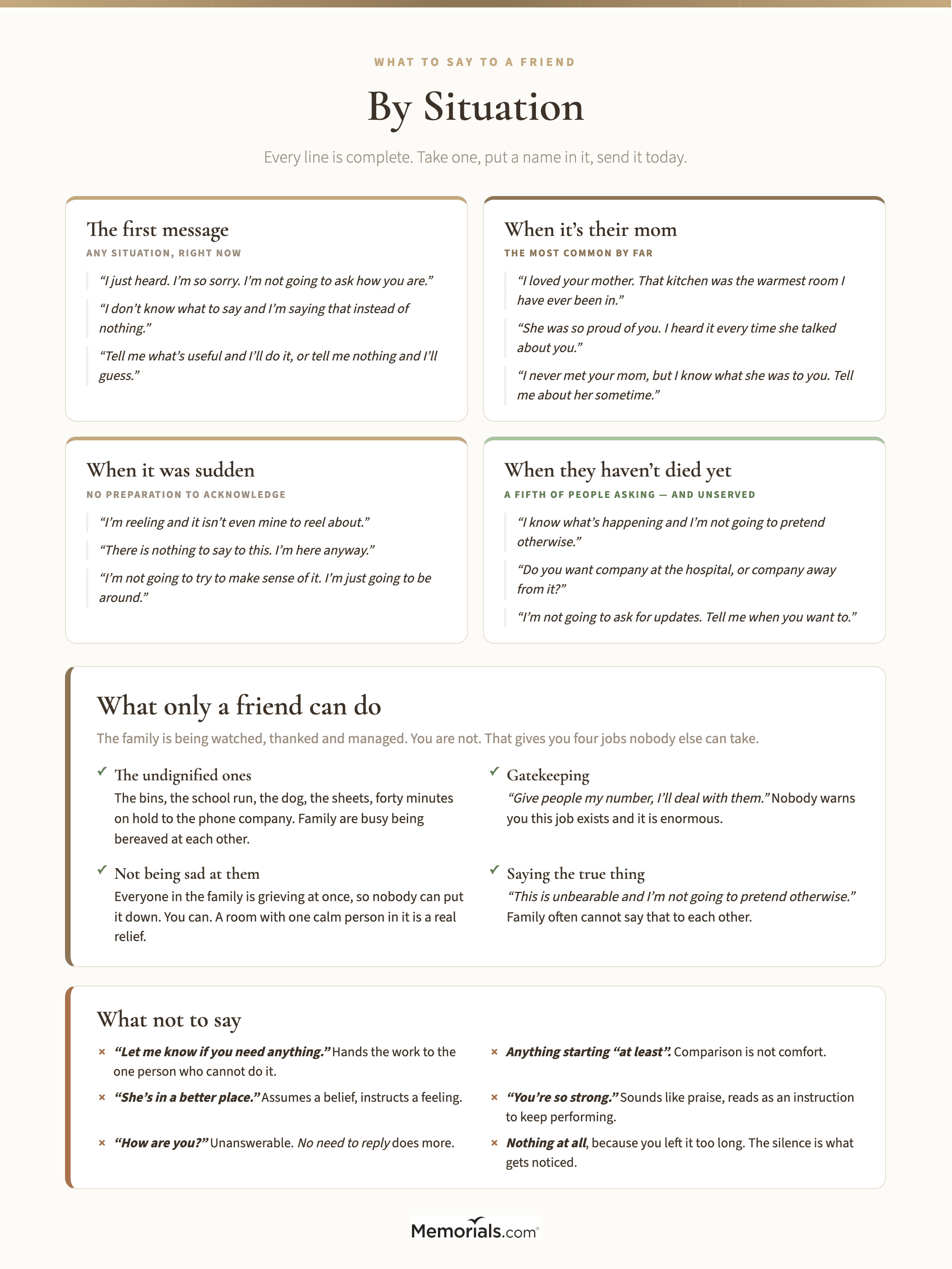
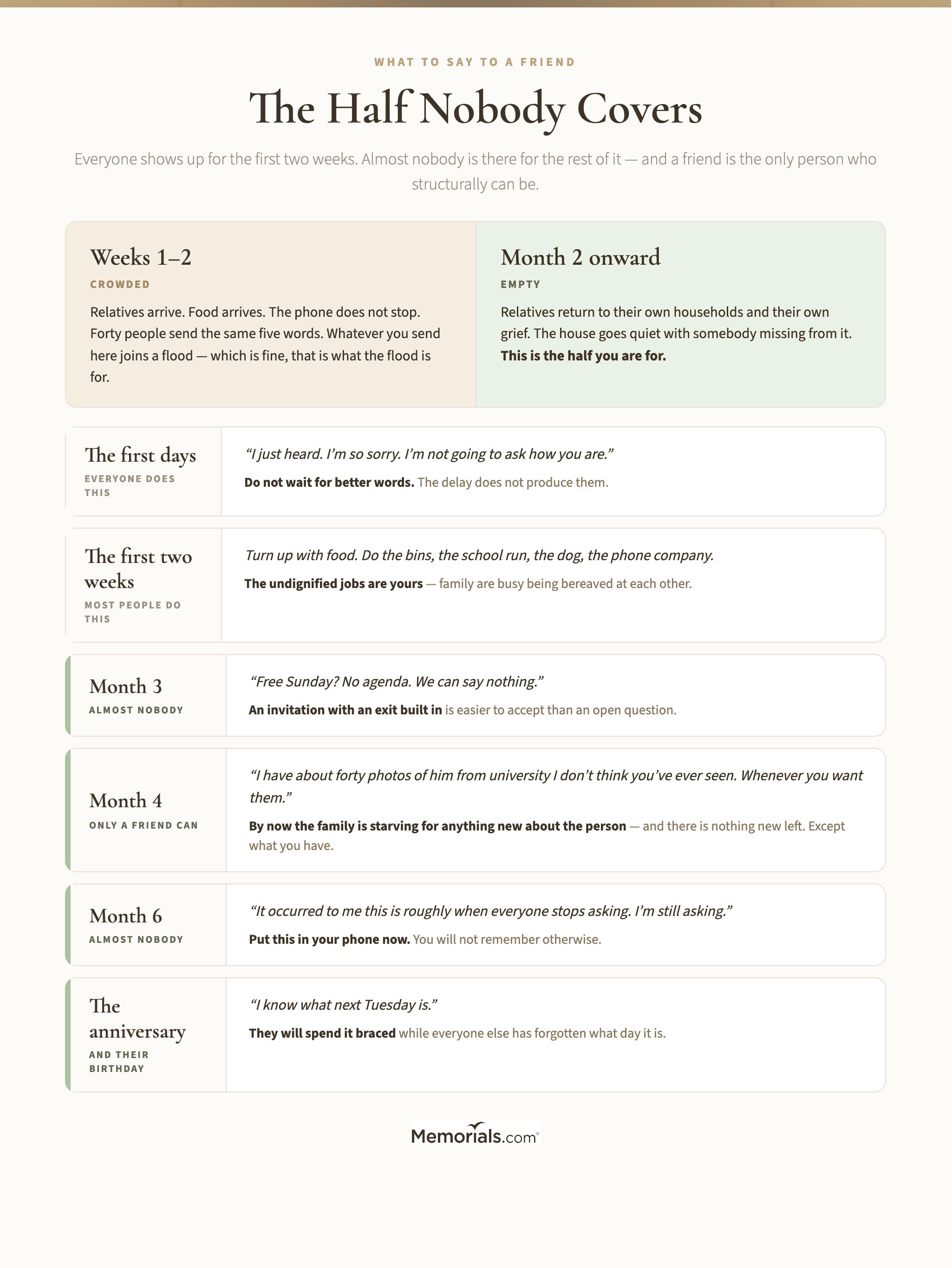
I just heard. I'm so sorry. I'm not going to ask how you are.
No words. I love you. I'll call tomorrow.
I'm so sorry. I'm coming Thursday with food — you don't have to talk to me.
I don't know what to say and I'm saying that instead of nothing.
Thinking about you constantly. No need to reply to any of this.
I'm so sorry. Tell me what's useful and I'll do it, or tell me nothing and I'll guess.
That last one is worth keeping. Good condolences for friend relationships give them an out — the option of not deciding anything. A sympathy message for friend circumstances is not a test they have to pass.
Any one of them can open into a longer exchange, which is a different thing again. How to comfort someone through text covers what to send while they are upset in real time, and the point at which you should stop typing and call.
You have latitude the family does not. You can say the honest thing rather than the correct one.
By a wide margin the most common version of this, and it deserves its own words.
A friends mom passed away message should say something about her if you can. Most people default to the friend and skip the mother entirely, which is understandable and is exactly the wrong instinct — the mother is who has gone.
Your mom was so kind to me when we were seventeen and I never forgot it.
I loved your mother. That kitchen was the warmest room I have ever been in.
I keep thinking about her laugh. I'm so sorry.
She was so proud of you. I heard it every time she talked about you.
If you never met her, say that honestly and ask:
I never met your mom, but I know what she was to you. Tell me about her sometime.
I'm so sorry. I'd like to hear about her when you feel like talking.
A sudden death of a friend message has a different job from one after a long illness. There is no preparation to acknowledge, no "at least it was peaceful," and often no funeral date yet.
I'm reeling and it isn't even mine to reel about. I'm so sorry.
There is nothing to say to this. I'm here anyway.
I heard an hour ago and I have not been able to think about anything else.
I'm not going to try to make sense of it. I'm just going to be around.
Do not ask what happened. If they want you to know, they will tell you, probably several times, in the order it makes sense to them rather than to you. Our guide to how to offer condolences covers the whole sequence.
When They Haven't Died Yet
A fifth of the people searching this are asking about a friend whose person is dying — a mother in a hospice, a husband on a ward — and almost nothing is written for them.
This is a harder message to write, because the instinct is to say something hopeful and hope is exactly the thing that has become complicated.
I know what's happening and I'm not going to pretend otherwise. I'm here.
However long this takes, I'm not going anywhere.
Do you want company at the hospital, or company away from it? Either is fine.
I'm not going to ask for updates. Tell me when you want to.
The most useful thing to know: anticipatory grief is real grief, and people in it are often told they should not be sad yet. They should. Our guide to coping with a dying loved one covers what that period does to people.
And afterward, do not say at least you had time to prepare. Nobody ever has.
The bottom panel is the point of the page. What you can do is worth more than what you say.
When the Person Who Died Was Also Your Friend
A case the relationship pages do not cover: sometimes you are not consoling someone about a stranger. You knew them too. You are grieving and supporting at the same time, and the two jobs pull against each other.
A loss of friend message in that situation can say both things at once, and should.
I lost a friend and you lost your brother. I'm grieving with you, not at you.
I keep forgetting and then remembering. I imagine that's a hundred times worse for you.
I loved him too. Tell me if that's a help or a burden and I'll act accordingly.
I'm sad and I'm still useful. Give me a job.
Two things worth knowing here.
Your grief is real and it is not the priority in that room. Both are true at once. Grieve properly somewhere else — with other mutual friends, ideally — so that when you are with the family you have something left to give.
You may be the keeper of things nobody else has. Photographs from before they were married. Stories from a version of the person their family never met. Do not offer these in week one, when everything is overwhelming. Offer them in month four, when the family is starving for anything new about the person and there is nothing new left.
"I have about forty photos of him from university that I don't think you've ever seen. Whenever you want them." That is one of the best messages in this entire article, and it can only be sent by a friend.
By month four the family is starving for anything new about the person, and there is nothing new left. Except what you have.
What Only a Friend Can Do
The family is being watched, thanked, and managed. You are not. That gives you four jobs nobody else can take.
The undignified ones. The bins. The school run. The dog. Changing the sheets. Canceling the dentist. Calling the phone company and sitting on hold for forty minutes. Family members are busy being bereaved at each other; you can just do these.
Gatekeeping. Offer to be the person who fields everyone else — give people my number, I'll deal with them — so they are not answering the same six questions thirty times. Nobody warns you this job exists and it is enormously useful.
Being the one who is not sad at them. Everyone in the family is grieving simultaneously, which means nobody can put their own grief down. You can. Sitting in a room with someone who is not also crying is a real relief.
Saying the true thing.This is unbearable and I'm not going to pretend otherwise. Family often cannot say that to each other. You can.
If you want a script for offering: name a specific thing, name a day, and do not ask a question. I'm doing your shopping Thursday. Text me the list or I'll guess badly. Our page on grief groceries covers the food side of it properly.
The part that matters most, and the reason to read this page rather than a list of lines.
The first two weeks are crowded. Family arrive, food arrives, the phone does not stop. Then everyone goes home, and the person is left in a house where somebody used to be. Relatives return to their own lives with their own grief to manage. Friends are the only people structurally available at month six — and almost none of them are there.
Still thinking about you. No reply needed.
It occurred to me this is roughly when everyone stops asking. I'm still asking.
Free Sunday? No agenda. We can say nothing.
I know what next Tuesday is.
Put three dates in your phone now, before you close this page: month three, month six, and the anniversary. Also their person's birthday if you know it. You will not remember otherwise, and they will spend those days braced while everyone else has moved on. How long grief lasts covers the real shape of it, and the first week after a loss covers the other end.
Keeping it up across a year is a small practice of its own, and mostly a matter of changing nothing when they go quiet. How to check up on someone after a death text is about the ninth message rather than the first.
What to Write in a Card
What to write in sympathy card to a friend is the same four moves as any card, with more room to be personal:
Say you are sorry, plainly.
Name the person who died, by name.
Say one specific thing — a memory of them, or what you know they were to your friend.
Offer something concrete with a day on it.
Sam,
I'm so sorry about Barbara. I keep thinking about that Christmas she made us all sing and nobody was allowed to be embarrassed about it.
I'm coming over Sunday. I'll bring lunch and I'll do your dishes, and you can talk or not talk.
"Let me know if you need anything." The single most common and the least useful. It hands the work to the one person who cannot do it.
Anything starting "at least." At least she didn't suffer. At least you had time. At least it was quick.
"She's in a better place." Assumes a belief and instructs a feeling.
"I know exactly how you feel." You might be close. I lost my mom three years ago and I remember this part offers company instead of equivalence, and lands well.
"How are you?" Not wrong, but unanswerable. No need to reply does more.
"You're so strong." It sounds like praise and reads as an instruction to keep performing.
Nothing at all, because you left it too long and now feel awkward. The silence is what gets noticed, not the delay.
Month six is when the relatives have gone home. Friends are the only people still structurally available.
Gifts for a Grieving Friend
The friend-specific rule: it should not ask anything of them. No assembly, no thank-you note implied, no decision about where to put it.
Good gifts for grieving friend situations follow one friend-specific rule.
What works. Food that needs no cooking. A cleaner for two weeks. A cinema ticket for three months' time. Something small that holds a little of the person — and, if you knew them, a photograph they have not seen.
What does not. Anything that needs displaying, anything requiring a response, and — unless you know them very well — anything with a religious message.
Put month three, month six and the anniversary in your phone now. That is the whole job.
Frequently Asked Questions
What do you say to a friend who lost a loved one? Say you are sorry, name the person who died, and offer one specific thing on a named day. I'm so sorry about Barbara. I'm coming Sunday with lunch.
What do I write if their mom died? Say something about her, not only about your friend. I loved your mother — that kitchen was the warmest room I've ever been in. Use her first name.
What if I never met the person who died? Say so and ask. I never met your mom, but I know what she was to you. Tell me about her sometime.
What if I don't know what to say? Say that. I don't know what to say and I'm saying that instead of nothing is a genuinely good message.
What if they're still dying? Say you know, and do not offer hope you do not have. I know what's happening and I'm not going to pretend otherwise. I'm here.
Is it too late if I never said anything? No. Month six is emptier than week one, so a late message often lands harder. Do not over-apologize — one line, then the message.
In Closing
Send something today, name the person who died, and offer a specific thing on a specific day.
Then put month six in your phone. The relatives will have gone home by then, and you will be one of very few people still in a position to turn up. That is the part only you can do.