🏬Supersize Online Funeral Retailer🪦1000's of Headstones⚱️Over 10,000 Cremation Urns⚰️Caskets Overnight Delivery🛒Funeral & Memorial Superstore🚚FREE Shipping on ALL Orders👨👩👧👦Helping Families for over 20 Years💰Lowest Price Guarantee🏬Supersize Online Funeral Retailer🪦1000's of Headstones⚱️Over 10,000 Cremation Urns⚰️Caskets Overnight Delivery🛒Funeral & Memorial Superstore🚚FREE Shipping on ALL Orders👨👩👧👦Helping Families for over 20 Years💰Lowest Price Guarantee
🏬Supersize Online Funeral Retailer🪦1000's of Headstones⚱️Over 10,000 Cremation Urns⚰️Caskets Overnight Delivery🛒Funeral & Memorial Superstore🚚FREE Shipping on ALL Orders👨👩👧👦Helping Families for over 20 Years💰Lowest Price Guarantee🏬Supersize Online Funeral Retailer🪦1000's of Headstones⚱️Over 10,000 Cremation Urns⚰️Caskets Overnight Delivery🛒Funeral & Memorial Superstore🚚FREE Shipping on ALL Orders👨👩👧👦Helping Families for over 20 Years💰Lowest Price Guarantee
Good condolences text messages are short, specific, and ask nothing of the person reading them. Just heard about your dad. I am so sorry. No need to reply. That is a complete message, and sending it in the first hours is worth more than a longer one composed over three days.
Text is now the most common way people say this, and it has stopped being the lesser option. A card still matters and still gets kept, but the text is what arrives while the person is sitting in a hospital corridor with nothing to do, and that timing is most of its value.
This page covers what to send, what to avoid, and the follow-up almost nobody sends. For the words in their fuller form, short condolence messages has sixty of them, and the sympathy and condolences guide is the wider starting point.
The single most useful thing on this page. Sending condolences by text the day you hear beats a better message next week, every time.
The reason is that the first week brings a flood and the fifth week brings silence. Your imperfect text arriving on day one joins the flood — which is fine, that is what the flood is for — but the delay you are considering does not produce a better message. It produces a message that arrives after you have started to feel awkward about the delay, and awkwardness leaks into the wording.
Write one of these and send it:
I just heard about your mom. I am so sorry. No need to reply to this.
I am so sorry. Thinking of you today.
No words. Just love.
I heard. I am so sorry. I will check in Sunday.
So sorry to hear about your dad. Here whenever you want company.
The first-hours message does not have to be good. It has to arrive.
A sympathy text message that works follows three rules, and length is not one of them.
Do not ask a question.How are you doing? obliges an answer from the one person least able to give one. If you want to open a door, say no need to reply and mean it.
Name the person.Your dad is warmer than your loss, and if you knew him, one detail is worth a paragraph — he always answered the phone on the first ring.
Offer a specific thing or offer nothing.Let me know if you need anything moves the work onto them. I am dropping food off Tuesday, leave the porch light on does not.
A text for condolences that follows those three is finished. Length is not the variable; those three are.
When You Were Close to the Person Who Died
Most advice assumes you are writing to the bereaved from outside the loss. Sometimes you are inside it — the person who died was your friend too, or your colleague, or your brother's wife.
Say so. It is not a competition and naming your own grief briefly makes the message truer, not more self-centered.
I loved him too. I am so sorry. Thinking of you all.
I keep expecting to see her. I cannot imagine what this week is for you.
He was my friend for thirty years and I am so sorry you have lost your dad.
Then turn back to them. One sentence about you, the rest about them — that ratio is what keeps it from becoming your message rather than theirs.
What to Send When You Barely Know Them
A colleague, a neighbor, a friend of a friend. The instinct is to say nothing because you are not close enough. Send something anyway — the volume of messages is itself a comfort, and nobody counts how well the sender knew them.
So sorry to hear your news. Thinking of you.
I do not know you well but I wanted to say I am sorry.
Sorry for your loss. Nothing needed from you here.
Very sorry, Sam. Take whatever time you need.
Keep it to one line and do not mention work, deadlines, or cover in the same message. If those need handling, that is a separate text tomorrow.
One vocabulary note while you are here: almost nobody types the word condolences into an actual text, and it reads stiff when they do. It belongs on a card, in an email, or in a sign-off — the condolences meaning is formal by origin — and over text so sorry does the same job without the starch.
When You Hear Second-Hand
Somebody tells you, or you see a post. You do not have to pretend you heard directly.
I heard from Priya about your mother. I am so sorry.
I saw your post. Thinking of you and your family.
Please pass on my condolences to your mom as well.
That last form matters more than it looks. Asking someone to pass on a message is a real option when reaching out yourself would be an intrusion, and it is the honest way to handle a death text message that reaches you through a chain of people rather than from the family.
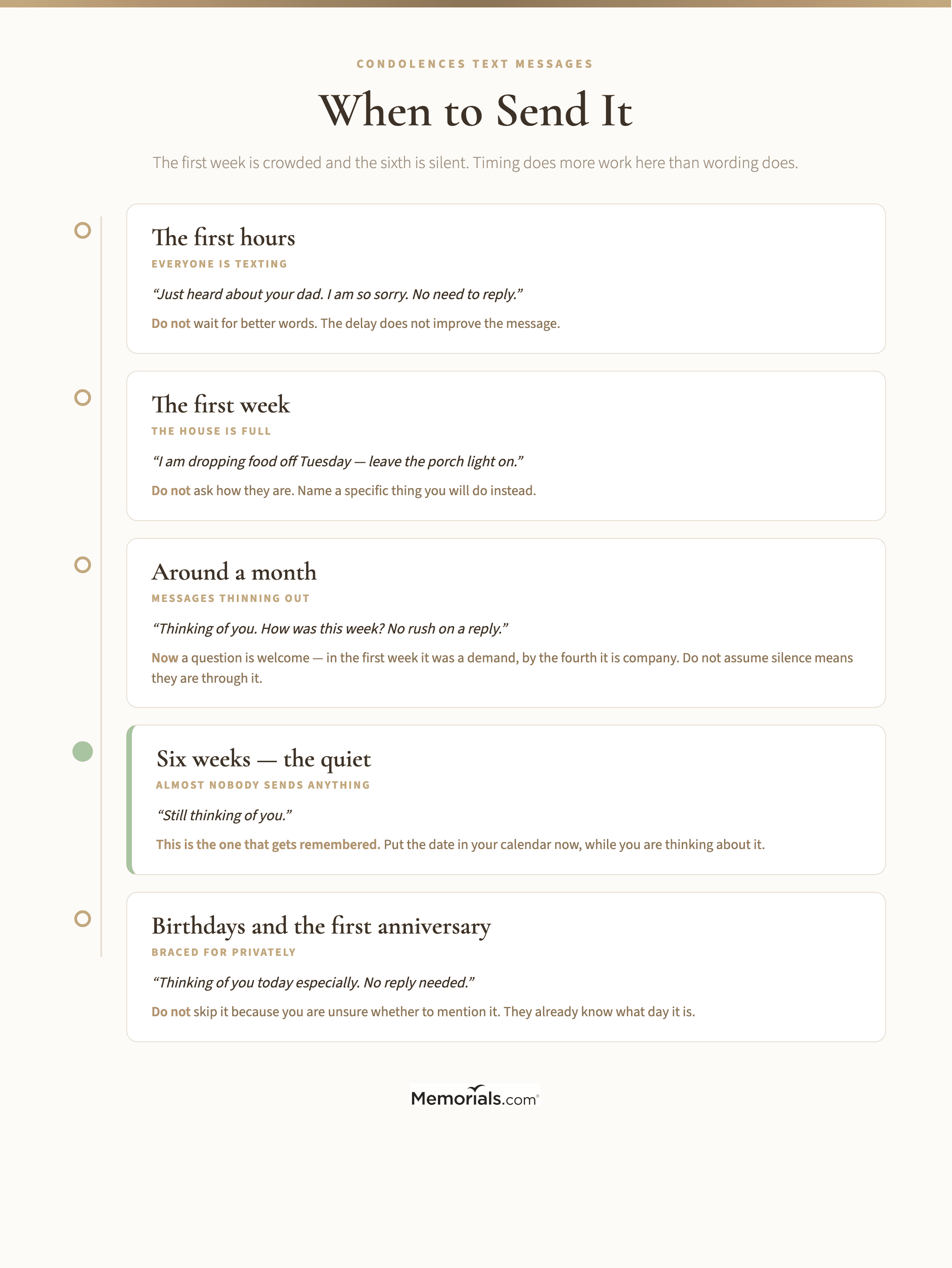
The messages people remember are rarely the first ones. The first week is crowded and the sixth is silent — that is where a two-line text does the most work.
What Not to Text
Every one of these is well-meant.
She is in a better place. Asks the reader to agree somewhere is better than here with them.
At least it was quick / at least she had a long life. Any sentence starting at least argues with someone's grief.
I know exactly how you feel. You do not, and it turns the message toward you.
Everything happens for a reason. There is no reason.
Let me know if you need anything. Well meant, and it hands a task to the wrong person.
A long paragraph. On a phone, in that week, a wall of text is one more thing to get through.
One more, which is specific to the medium: do not send a voice note unless you know they like them. A voice note has to be listened to, often with other people in the room, and it cannot be read at three in the morning.
A digital condolence has questions a card never had.
Emoji. One is fine at the end of a warm message — a heart from someone who uses hearts reads as normal. A message made only of emoji does not. If you would not use it out loud, do not lead with it.
Reacting to a post. A reaction is not a message. It costs nothing and it reads as nothing. Send the text as well.
Group chats. If the news breaks in a group, send your message to the person privately rather than into the thread. A grieving person reading fourteen sympathy messages scroll past in a work chat is a specific kind of awful.
Spelling. People search condolance text and half a dozen other misspellings, and it does not matter — nobody grieving has ever noticed a typo in a kind message. Do not let getting it right stop you sending it.
Read receipts and typing indicators. If your phone shows them, expect nothing from either. A person who read your message at 2am and did not answer is not ignoring you; they are lying awake. Turn off your own expectations rather than your notifications.
The Follow-Up Nobody Sends
This is the part worth taking away.
The first week is loud. Cards arrive, the house fills, the phone does not stop. Then it stops, and by the fifth or sixth week the person is alone with it for the first time — usually just as everyone around them has concluded they are doing fine.
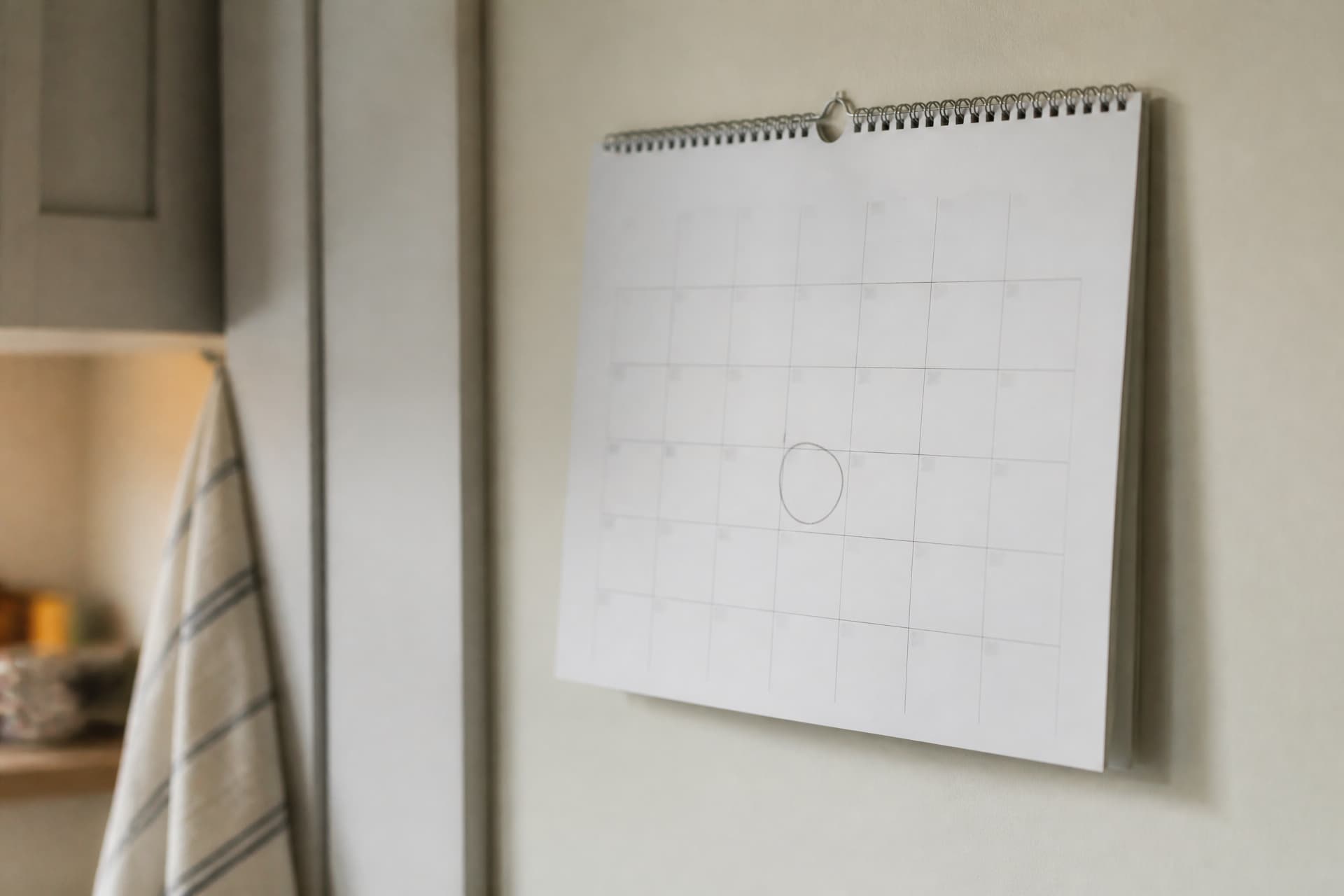
Put a date in your calendar now, six weeks out. Then send:
Still thinking of you.
Thinking of you today. No reply needed.
How is this week? Genuinely asking, no rush.
Six weeks out, while you are still thinking about it. By the time the date arrives, everyone else has stopped.
Eight words. Almost nobody sends it, which is exactly why it is remembered. Do the same on the first birthday and the first anniversary, and on the first Mother's or Father's Day if that applies — those are the days people brace for privately.
Worth a section, because the volume can be its own problem.
You do not owe anyone a reply. Not one of the people who texted you expects an individual response, and the ones who would be offended by silence in this particular week were never worth the effort anyway.
When you do want to answer some of them, how to respond to a death text has the short replies that close an exchange politely. Four words is a complete answer, and none of these people is waiting for more.
If the count is overwhelming, a single message to everyone is completely acceptable — Thank you all for the messages. I have read every one and I cannot answer them individually right now. Send it once, to whoever needs it, and let it stand.
And if a message lands badly — the better place, the at least, the person who made it about themselves — you are allowed to simply not respond to that one. It almost always came from someone who meant well and reached for a phrase instead of a thought.
Text, Card, or Both
Both, if you can. They do different jobs: the text arrives in time to matter, and the card arrives to be kept. A text on the day and a card in week two is the most useful pairing there is.
Is it rude to send condolences by text? No. It is now the normal first response, and speed is the point. A card can follow.
What if they do not reply? That is the expected outcome and it is not about you. Say no need to reply in the message so they know it is not owed.
How to share condolence message wording with a group card or a family thread? Send yours privately. If a group is collecting messages, keep yours to one line and sign it — the reader is going through dozens.
Should I text or call? Text first. A call demands they perform being okay for the length of the conversation. Offer the call in the text: happy to talk if you want, no pressure at all.
Is it too late to send one? No, and late is often better. Open with I have been thinking about you rather than apologizing for the delay.
What do I send if I only found out weeks later? Say so plainly. I only just heard about your mother and I am so sorry. Nobody is keeping a register.
Do I text the bereaved person or their partner? Whoever you actually know. If you know both, one message to the person who lost the family member and a separate one to their partner — the partner is doing an enormous amount of quiet work and is almost never asked about it.
Is it alright to send a photo of the person who died? Usually yes, and often it is the best thing you can send — but ask first, in a separate message. A photograph arriving unannounced can land very hard depending on the day.
In Closing
The message that helps is rarely the well-crafted one. It is the one that arrives on the day, says something true, and asks for nothing back — and then the second one, six weeks later, when the house has gone quiet.
Send the first one now. Put the second in your calendar before you close this page.