🏬Supersize Online Funeral Retailer🪦1000's of Headstones⚱️Over 10,000 Cremation Urns⚰️Caskets Overnight Delivery🛒Funeral & Memorial Superstore🚚FREE Shipping on ALL Orders👨👩👧👦Helping Families for over 20 Years💰Lowest Price Guarantee🏬Supersize Online Funeral Retailer🪦1000's of Headstones⚱️Over 10,000 Cremation Urns⚰️Caskets Overnight Delivery🛒Funeral & Memorial Superstore🚚FREE Shipping on ALL Orders👨👩👧👦Helping Families for over 20 Years💰Lowest Price Guarantee
🏬Supersize Online Funeral Retailer🪦1000's of Headstones⚱️Over 10,000 Cremation Urns⚰️Caskets Overnight Delivery🛒Funeral & Memorial Superstore🚚FREE Shipping on ALL Orders👨👩👧👦Helping Families for over 20 Years💰Lowest Price Guarantee🏬Supersize Online Funeral Retailer🪦1000's of Headstones⚱️Over 10,000 Cremation Urns⚰️Caskets Overnight Delivery🛒Funeral & Memorial Superstore🚚FREE Shipping on ALL Orders👨👩👧👦Helping Families for over 20 Years💰Lowest Price Guarantee
A short condolence message is usually the right one. Here are ten you can send exactly as written, before any of the explanation: I am so sorry for your loss. Thinking of you. There are no words. Sending love. I am so sorry — she was wonderful. Holding you close today. No need to reply, just thinking of you. I am here whenever you want company. So sorry. I am thinking of your whole family. With deepest sympathy.
Any of those is complete. A card containing one true sentence lands better than a card containing a paragraph of arranged phrases, and the reason people search for a short version is not laziness — it is the accurate instinct that more words are not more comfort.
What follows is sixty-odd lines grouped by where they are going, because a flower card holds eight words and a sympathy card holds forty. The sympathy and condolences guide is the wider starting point, and if you want the word itself explained, covers where it comes from and when it fits.
For a flower card, a signature line on a group card, or a text you do not want to overthink.
I am so sorry.
Thinking of you.
With deepest sympathy.
So sorry for your loss.
With love and sympathy.
Sending love to you all.
No words. So sorry.
Here for you, always.
With sympathy and love.
Holding you in my thoughts.
These are the condolences messages short enough to fit anywhere, and none of them requires the reader to do anything. That last part matters more than the wording.
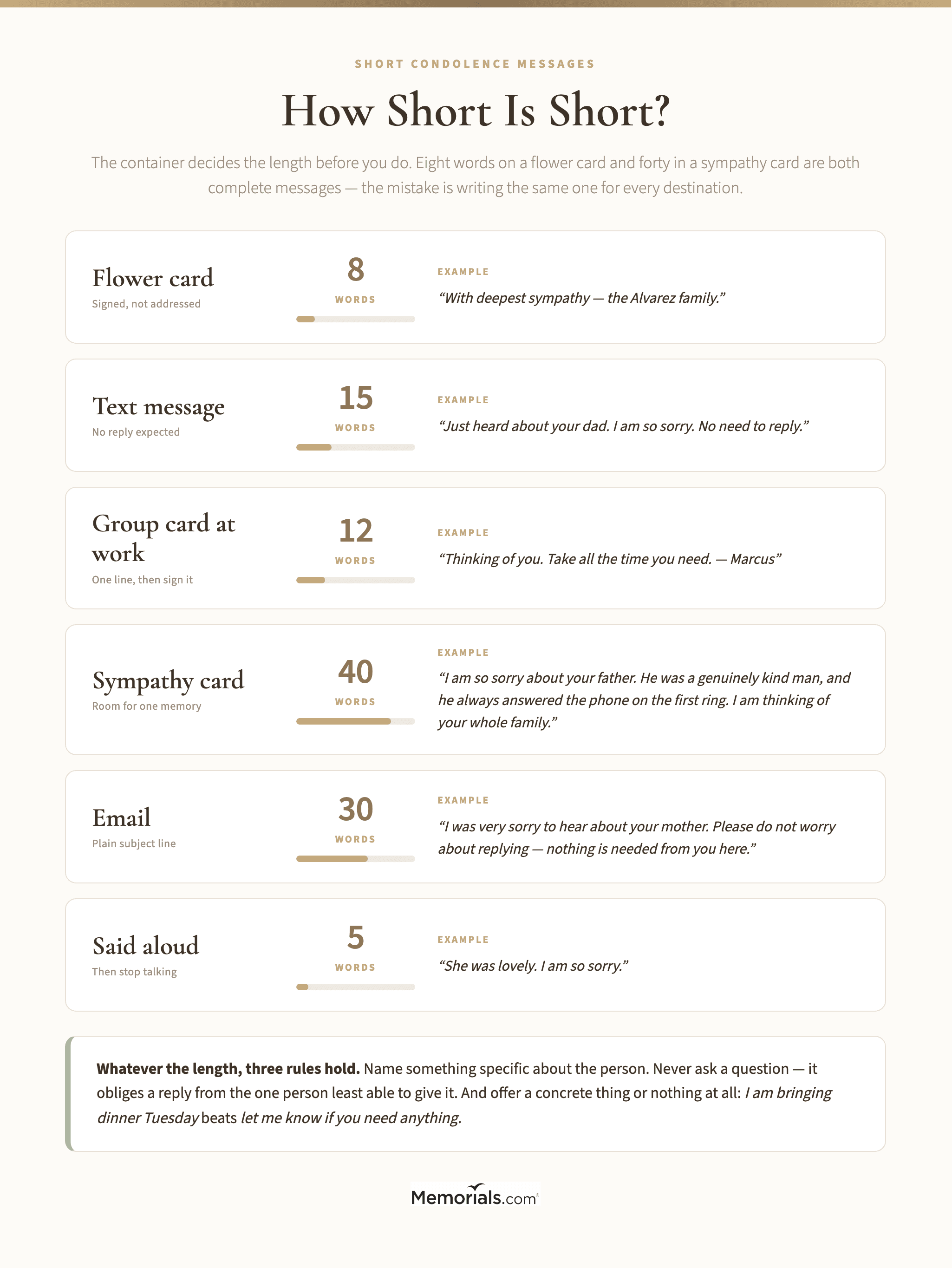
A flower card holds about eight words. A sympathy card holds about forty. The container decides the length before you do.
One caution about the very shortest lines. They work in a stack of cards and they work on a text, but they read as thin when they arrive on their own, days after everyone else's. If yours is the only card that week, spend one more sentence.
A card has more room, and this is where one specific sentence earns its place. Sympathy card messages that name the person, or name one thing about them, are the ones that get kept. People search sympathy cards messages and sympathy card messages for loss interchangeably, and they are after the same object: a line that sounds like a person wrote it.
I am so sorry about your father. He was a genuinely kind man.
There is no good way to say this, so I will just say I am sorry.
She was so proud of you. I hope you know that.
I keep thinking about the two of you together. I am so sorry.
With deepest sympathy for the loss of your mother.
I am sorry. I loved him too.
Your family is in my thoughts this week and will be for a long while.
He made everyone feel welcome. I will not forget that.
I wish I had the right words. I do not, but I am here.
Some people want simple condolences message wording with no flourish at all — nothing that sounds like a greeting card wrote it. These are simple sympathy card messages in the most literal sense.
I am sorry he died.
This is awful and I am sorry.
I do not know what to say.
I am so sorry. That is all I have.
Thinking of you every day this week.
I am sorry. Please do not reply to this.
You are on my mind.
I am sorry for your loss and I mean it.
The fourth and sixth are worth keeping. That is all I have and please do not reply both do something a longer message cannot: they admit the limit and take the pressure off.
For a Flower Card or Wreath Ribbon
This is the tightest space of all — usually one line on a small card the florist fills in over the phone. A short sympathy message for flowers has to survive being read aloud by a stranger.
With deepest sympathy.
In loving memory of a wonderful man.
Forever in our hearts.
With love from all of us at [company].
Thinking of you — the Alvarez family.
With sympathy and admiration for a life well lived.
Rest well.
Always remembered.
A sympathy note for flowers is signed, not addressed — the card sits among many, so the family needs to know who it is from more than they need a message. If you are choosing what to send as well as what to write, messages for funeral flowers covers the etiquette, and many families now request a donation in lieu of flowers instead.
A note on the condolence message for flowers you send to a workplace rather than a home: keep it to the company name and one line. Anything warmer belongs in a separate card.
The container decides the length. Eight words on a flower card and forty in a sympathy card are both complete messages — the mistake is writing the same one for every destination.
For a Text Message
A text should be shorter than a card and should never require a reply. Sending one the day you hear is worth more than a perfect one sent next week.
Just heard about your dad. I am so sorry. No need to reply.
Thinking of you today.
I am so sorry. I am around all week if you want company.
No words, just love.
I heard. I am so sorry. I will check in on Sunday.
Thinking of you and not expecting a reply.
The last one is the whole technique in a sentence. Condolence text messages goes into timing and follow-up, which by text matter more than the words.
A message sent the day you hear beats a better one sent next week — and it should never ask the reader to reply.
Email is the awkward one. It is the wrong register for close friends and the right one for a colleague, a client, or somebody whose address is the only one you have.
I was very sorry to hear about your mother. Please do not worry about replying.
I heard your news and wanted to say I am sorry. Nothing is needed from you here.
With sympathy from all of us. Take whatever time you need.
Keep the subject line plain — the person's name, or simply Thinking of you. Anything cleverer looks wrong in an inbox.
For a Group Card at Work
Sign it, keep it warm, and do not write a paragraph on a card twenty people are sharing.
So sorry for your loss — Priya
Thinking of you. Take all the time you need. — Marcus
Very sorry to hear your news. — the whole team
Sorry, Dan. Here if you need anything at all. — Chris
When Short Is the Wrong Call
Three cases where the instinct to keep it brief works against you.
When you are the closest person. A best friend, a sibling, the person who will be doing the practical work — they need more than a line, and a short message from you reads as distance rather than restraint.
When you knew the person who died and the family did not know you did. Say how. He was my manager for six years and he was the reason I stayed tells them something they may never hear otherwise, and it cannot be done in five words.
When the card is doing double duty. If your message also has to explain that you cannot attend, that is two jobs. Do both properly rather than compressing them into one apologetic sentence.
Brief Words for Speaking Aloud
At the door, in a receiving line, at the graveside. Brief sympathy words are harder than written ones because you have to say them to a face.
I am so sorry.
I am glad I knew him.
She was lovely. I am so sorry.
I do not know what to say, but I am here.
Thank you for letting me come.
Say one of these and then stop. A brief sympathy message spoken plainly, with eye contact, does more than a longer one delivered nervously — and nobody has ever been criticized for saying too little at a funeral.
What Makes a Short Message Work
Three things, and they are the same three every time.
Name something. A detail proves you knew them. He always answered the phone on the first ring is worth more than a paragraph about strength and grace.
Do not ask a question.How are you holding up? obliges a reply from the person least able to give one.
Offer something specific or offer nothing.Let me know if you need anything transfers the work to them. I am bringing dinner Tuesday unless you tell me not to does not.
There is a fourth, which is about when rather than what. The first week brings a flood of cards and the sixth week brings nothing, and the sixth week is harder. A short message then — Still thinking of you — costs you eight words and arrives when the house is quiet. Almost nobody does it, which is exactly why it is remembered.
And one thing to avoid entirely: any sentence beginning at least. There is no version of that construction which does not argue with someone's grief. Our page on what to say instead of sorry for your loss has the fuller list.
If you are sending something alongside the words, in loving memory gifts that need no tending are the safest choice — a grieving household does not want another thing to look after. Sympathy gift etiquette covers what suits and what does not.
Frequently Asked Questions
How short is too short? Three words is fine on a flower card. In a sympathy card, one sentence reads as considered and half a sentence reads as unfinished — So sorry alone is the only one that lands badly, because it looks like you ran out of room.
Should I sign a sympathy card with my full name? If there is any chance the family will not place you, yes — first and last name, and how you knew the person. Dan Reilly, from the running club saves them working it out.
Can I send the same message to several people in one family? Yes, and nobody will compare. If you can name the person differently for each — your mom, your wife — do, because it reads as written rather than copied.
Is a text message an acceptable sympathy note? Yes. A sympathy note sent by text on the day is better than a card that arrives in ten days, and most people now send both.
What if I did not know the person who died? Say so. I never met your father, but I have met you is honest, and honesty is the whole job.
Is it too late to send one? No, and a late card is often the better one. Open with I have been thinking about you rather than apologizing for the delay — an apology makes the message about you.
Should I mention how the person died? Only if the family has, and never in the first line. A short message has no room for it anyway, which is one more argument for keeping it short.
Do I write "sympathy" or "condolences"? Either. Condolences is slightly more formal and is tied to a death specifically; sympathy is warmer and broader. Neither is wrong on a card.
In Closing
The pressure to find the perfect sentence is what keeps the card blank on the table for three days. There is no perfect sentence. There is only a short, true one, sent today rather than polished for a week.
Pick a line from the top of this page, write it in your own hand, and put it in the post.